




Abstract
In this article we are interested in how the coordinating role of top civil servants is related to the argument that country-level differences in the adoption of New Public Management significantly alter the Public Service Bargains of top civil servants and consequently their capacity to accomplish interdepartmental coordination. A managerial PSB limits top civil servants’ role in interdepartmental coordination, as their focus will be on achieving goals set for their specific departments, rather than for the central government as a collective. We test our argument with empirical insights from a comparative analysis of five countries: Belgium, Canada, Denmark, the Netherlands and the United Kingdom. We find that our argument is only partly valid and discuss the theoretical and empirical implications of the analysis.
Alongside the introduction of New Public Management, the relationships between ministers and their top civil servants in state administration have evolved. At the same time, societal issues are getting more complex and demand a holistic, cross-sector approach. The concept of a managerial Public Service Bargain is used to analyze changes in top civil servants’ role and the impact of reforms on the capacity of top civil servants to accomplish interdepartmental coordination. Practitioners can learn more about the close link between challenges for interdepartmental coordination and changes in the role and functioning of top civil servants.
Keywords
Introduction
An issue in recent literature on public management reforms is the change in emphasis away from specialization associated with ‘New Public Management’ (NPM) towards a more holistic approach (Bogdanor, 2005; Christensen and Laegreid, 2007). The post-NPM literature argues that in order to address complex policy issues more effectively, government organizations need to modify or even reverse previous trends of disaggregation and agencification, and enhance the coordinating capacity of the state. In this article we are interested in explaining the coordinating role of top civil servants through these broader issues of public management reform. Based on the literature on NPM and post-NPM reforms, Public Service Bargains (PSBs) and coordination, we elaborate an explanatory argument on the relations between these phenomena. We argue that differences per country in the adoption of NPM significantly alter the PSBs of top civil servants and thus their capacity to accomplish interdepartmental coordination. We hypothesize that a managerial PSB limits top civil servants’ role in interdepartmental coordination, since their focus will be on achieving goals set for their specific departments, rather than for the central government as a collective. We explore the utility and possible implications of the argument by testing it with empirical insights gained from a comparative research project on PSBs of top civil servants in Belgium, Canada, Denmark, the Netherlands and the United Kingdom.
We first elaborate the basic thrust of our argument and show how it relates to the literature on NPM, PSBs and coordination. We also discuss other factors and causal mechanisms that may be related to our argument. Next, we test our argument with empirical insights from a comparative analysis of five countries. We then discuss our findings and the insights gained from the analysis, and suggest a conclusion.
New Public Management, Public Service Bargains and the role of top civil servants in interdepartmental coordination
New Public Management in state administration
Although the term is older, the most influential early formulation of the concept ‘New Public Management’ (NPM) was coined in a seminal article by Hood, as ‘a shorthand name for the set of broadly similar administrative doctrines which dominated the bureaucratic reform agenda in many countries from the late 1970s’ (Hood, 1991: 3–4). Hood provided a list of seven ‘doctrinal components’ of NPM, and suggested that NPM was ‘a marriage of two different streams of ideas.’ (Hood, 1991: 5). One stream related to the new institutional economics, emphasizing free choice and market mechanisms. Another stream related to the tradition of scientific management, emphasizing management by objectives and results and organizational autonomy to let the managers manage. A lot of the NPM literature of the past two decades can be related to these two streams and how they may interact (H.F. Hansen, 2011). In this article, we focus on the managerial stream of the NPM movement, and thus essentially on the first four points of Hood’s list: hands-on professional management; explicit measures of performance; output controls, and disaggregation of units in the public sector. Based on these components a managerial-NPM ideal-type (in the Weberian sense) of public sector organizing can be constructed (see also Verhoest et al., 2010: 6–9):
Structural disaggregation, creating single-purpose and client-oriented organizations; Managerial autonomy and result control, emphasizing both to let the managers manage and to make the managers manage; Split between policy and operations, dividing tasks into policy preparation close to the political level and policy operation closer to the citizens.
Consequently we ask to what extent such a managerial-NPM ideal-type has been implemented in the state administration in the countries we analyze. If we find a high degree of implementation of all three doctrinal elements in the state administration of a country, we classify the impact of the managerial-NPM ideal-type as very strong. On the contrary, if we find a low degree of implementation of all three elements, we classify the impact as very weak.
Evolving Public Service Bargains for the top civil servants
A state administration’s movement towards a managerial-NPM ideal-type as outlined above implies changes in the role of its top civil servants. One way to perceive these changes is to use the concept of ‘public service bargains’ (PSBs): ‘explicit or implicit agreements between public servants and those they serve’ (Hood and Lodge, 2006: 6). This concept provides a tool with which to examine the role of top civil servants and to analyze how their role in the management of the civil service has been challenged as a result of administrative reforms (Hondeghem, 2011). In bargained outcomes, expressed in convention or formal law or a mixture of both, politicians gain some degree of loyalty and competency from civil servants, and those civil servants in turn gain a place in the government structure, responsibility and rewards (Hood and Lodge, 2006).
While PSBs differ across countries, Hood (2000) believes a general shift is occurring towards a managerial bargain, built around the notions of service targets, performance agreements and ex post control. A managerial-PSB ideal-type is based on the introduction of individual performance agreements, outlining the core functions of the top civil servants in their department. Further, it includes (see also Hondeghem, 2011: 161):
Rewards in terms of bonuses and career options (or, when performance is insufficient, sanctions such as dismissal); Managerial competencies rather than technical skills, as top civil servants are assessed on their ability to deliver service objectives, rather than provide policy advice; Autonomy to make decisions concerning the management of the department, in exchange for increased responsibility, including the blame for mistakes.
Again, we use this construction to ask to what extent such a managerial bargain ideal-type has been implemented in the state administration in the countries we analyze.
Core functions and problems of interdepartmental coordination
Increased awareness of the complexity of policy challenges in a number of domains (Carter, 2001; Inglehart, 1990) has enhanced the call for government programs to work together. This concern is visible in Hall et al.’s (1976: 459) definition of coordination as ‘the extent to which organizations attempt that their activities take into account those of other organizations’. Coordination may be enhanced through vertical command and control mechanisms or horizontal mechanisms such as mutual adaptation and network structures. Furthermore, Bouckaert et al. (2010: 55) distinguish between:
Structural coordination instruments, that realize coordination of tasks by creating new or changing existing structures and institutional forms within government; Managerial coordination instruments, that refer to broad systems such as strategic management, financial management, or cultural and knowledge management.
Top civil servants hold a pivotal position in enhancing interdepartmental coordination, as their role can be important to ‘replace the collective civil service cultural glue that has been weakened by the strong individualizing tendencies of other management changes’ (OECD, 2001: 5). We use the above construction, distinguishing structural and managerial coordination mechanisms, to assess to what extent top civil servants are engaged in coordination efforts in our country case studies.
Other factors related to interdepartmental coordination
In an empirical study of coordination in seven countries (Bouckaert et al., 2010), mixed patterns of coordination were found. The individual starting positions of the countries play a substantial role, with NPM countries engaging in an action–reaction pattern of specialization and coordination, while non-NPM countries follow a more linear pattern. Traditional political-administrative structures are shown to impact on these trajectories. Not only do the coordination mechanisms being used show a path-dependent nature, this also holds true for shifts in the role and functioning of the top civil service. Moreover, while public management reforms alter PSBs, existing bargains might also have subtle effects on management reforms, for example by influencing the ‘ownership’ of the reforms (Pollitt and Bouckaert, 2011). We thus need to keep in mind variations in organizational traditions and history of reforms when assessing the strength of our argument that links a managerial PSB with diminished capacity for interdepartmental coordination. Factors may include the size of the country (number of inhabitants), a federal versus unitary state, the type of government–parliament relations (majority, minority, etc.), the number of departments, and the basic function of the departments in the national governance structure (e.g. small policy-formulating versus large production-oriented units; 1 variety among departments in having a specialized unitary task structure versus a complex multi-task structure).
To conclude, we acknowledge the importance of differences in the institutional, historical context of the countries. However, the primary focus will be on the managerial PSB being introduced as part of NPM reforms.
The causal model
In our theoretical discussion, we used literature on (post-)NPM, coordination and PSBs to develop our argument step by step. Managerial-NPM, as a model for organizing public sector activities, has been defined in various ways (Hood, 1991; Verhoest et al., 2010). Different names, such as disaggregation or agencification, have come across, but typically three elements are included (Pollitt and Talbot, 2004): (1) a hierarchical relation based on management by objectives and results and often formalized in performance contracts; (2) a focus on the performance of the unit as measured by results related to its core tasks; and (3) a high degree of autonomy delegated to the top manager of the unit to organize the process. In our argument we link this creation of ‘manageable units’ (Hood, 1991) to changes in the PSBs of top civil servants. NPM implies a shift towards a managerial bargain, which entails that when one succeeds in achieving good results for the core tasks of a unit, more autonomy as well as rewards in terms of bonuses and career options will be gained. Such incentives will contribute to a focus on achieving goals set for the specific unit, overlooking the possibility and efficiency of cooperation. This in turn can lead to problems of coordination between units. Our argument is close to the post-NPM criticism that calls for a more holistic approach. While societal issues are getting more complex, the focus of performance agreements on specific units makes it more difficult to approach challenges by the government as a whole. In this article, we study the role of the highest ranking civil servants in the state administrations, that is the civil servants who head the departments, since they have the potential to reach out and build bridges between departments. For these actors, a managerial bargain implies a focus on the performance of their specific department, rather than the government as a whole. Therefore we expect that the more a country has implemented this model in depth, the more interdepartmental coordination problems it faces.
A schematic version of our argument can be seen in Figure 1, which integrates theories on NPM and PSBs with the post-NPM critique concerning coordination problems. The figure outlines the hypothesized causal relationships between managerial NPM reforms, the introduction of managerial bargains and problems of horizontal coordination.
Schematic version of the argument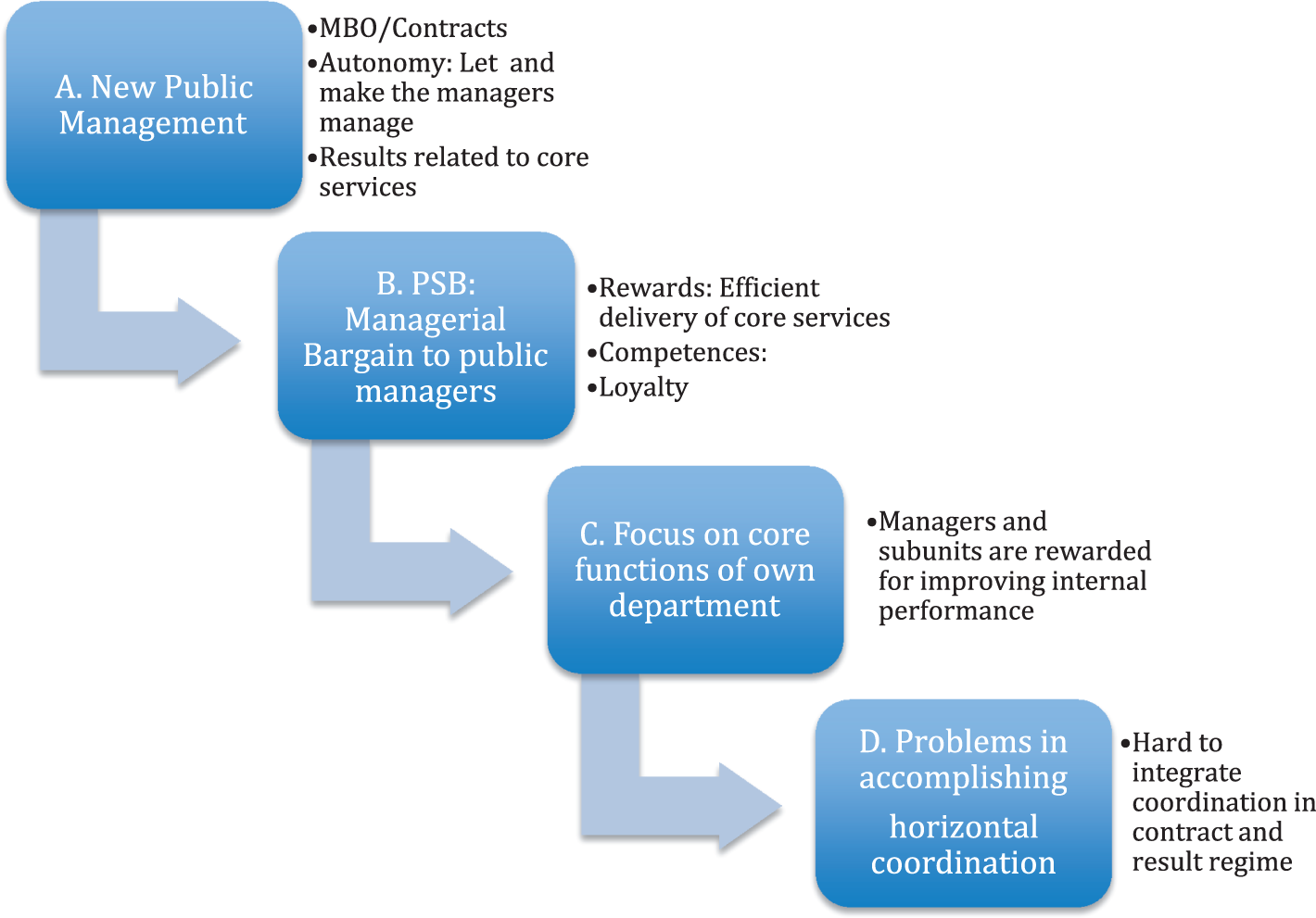
Comparative analysis of five countries
In this section, we test our model with empirical insights from the state administration in five countries: Belgium, Canada, Denmark, the Netherlands and the United Kingdom. The choice of these five cases was primarily based on two criteria. First, the theoretical framework of PSBs emphasizes a distinction between systemic and pragmatic bargains. In a systemic bargain (Belgian and Dutch cases), the public service’s role is part of a fundamental constitutional settlement. In a pragmatic bargain (Canadian, Danish and UK cases), public servants’ rights and duties are more or less a convenient agency arrangement between politicians and bureaucrats (Hondeghem, 2011; Hood, 2000). Second, variation in the scope of implementation of managerial-NPM was enhanced by including countries from the Anglo-Saxon (Canada and UK), the Nordic (Denmark) and the central-European (Belgium, Netherlands) context (see also Christensen and Lægreid, 2011; Pollitt and Bouckaert, 2011). 2 The cases show differences in the core factors of our causal argument: managerial-NPM and managerial bargain. We therefore expect them to differ also in the involvement of top civil servants in coordination and the extent of coordination problems resulting from this. Next, we briefly explain our data and methods and then provide the empirical analysis, structured by means of three research questions.
Data and methods
Our analysis is based on data generated by the MANDATE project, an international comparative research project on the evolution of PSBs. Scholars from five countries have participated in this project 3 and generated data from desk research, interviews with and survey responses from top civil servants who head the departments in the state administrations. 4 The subjects of the surveys and the interviews are largely overlapping, where the surveys provided the more standardized response. As we targeted the highest ranking civil servants only, our population in each country is very small: one civil servant for each department. With the exception of the UK, where it proved impossible to address the top civil servants directly, participation rates within our population were reasonably high. 5 Equally important for our analysis are secondary data and readings of the academic administrative literature on the five countries, as well as consultation of country experts in each country – practitioners as well as academics. While the interviews provide us with valuable insights on the subjective views the top civil servants have of their role in interdepartmental coordination, it is essentially the combination of data sources that helps us to draw a picture of NPM reforms, PSBs, coordination problems and the causal relationships between these.
Comparative empirical analysis
Our comparative empirical analysis focuses on three questions:
How strong is the impact of managerial-NPM on the state administration of each country? To what extent can the PSB of top civil servants be characterized as a managerial bargain? How extensive are interdepartmental coordination problems, and in what way are top civil servants involved in coordination?
This analysis provides us with material to test our causal argument that involvement of top civil servants in interdepartmental coordination is (partially) explained by changing PSBs which, in turn result from managerial-NPM reforms.
Impact of New Public Management on state administration
The wave of NPM has affected most Western countries. However, the strength of the managerial-NPM ideal-type differs from country to country.
NPM in general and managerial-NPM in particular have had a strong impact on state administration in the UK. The split between policy and operations has been pronounced. Departments have been downsized and a transfer of functions has taken place from departments to agencies. Performance contracts and increased emphasis on managerial competences, in contrast to the former Whitehall generalist model, characterize the governance system established in recent decades. Contracts have become individual, and performance and pay are related. The managing role has become very important, which made Permanent Secretaries more responsible for outputs and thereby ‘guardians’ of their departments (Van Dorpe and Horton, 2011). Structural disaggregation has been a strong trend and is closely related to the split between policy and operations. In the late 1980s a large-scale ‘Next Step’ reform was launched introducing Executive Agencies – ‘semi-detached’ central government bodies – operating within a framework of accountability to ministers. Executive Agencies continue today to be the principal service delivery agents for central government alongside executive Non-departmental Public Bodies (Oliver et al., 2011). In conclusion, the UK is the country in our study closest to the managerial-NPM ideal-type.
In recent decades NPM-like traits have been a part of the Canadian public service and these have intensified over the years. In terms of the split between policy and operations, the main trend has been an increasing centralization of decision-making power in the Prime Minister’s office (PMO) and in the Privy Council Office (PCO) which ‘has become the de facto department of the Prime Minister (PM)’ (Bourgault, 2011: 258). Departments provide policy advice in their fields and implement decisions made by the PMO and PCO. It is on the dimension of managerial autonomy and result control that the influence of the NPM-wave has been most pronounced. Salaries have been raised, bonuses increased, and poor performance could lead to termination of an assignment. The answerability of Deputy Ministers (the Canadian term for the departmental top civil servant) is high, with accountability within the departments being strengthened by the 2006 Federal Accountability Act. While the Deputy Ministers have become entrepreneurs, and enjoy greater autonomy and responsibility, ‘they have not become free agents; they remain accountable to the centre’ (Bourgault, 2011: 255; De Visscher et al., 2010: 31). Structural disaggregation is rarely if ever discussed in the Canadian public management reform literature and does not seem to have had a significant impact. In conclusion, managerial-NPM has had varying impact on our three dimensions, but on balance has had a strong impact.
In Belgium, the process of federalization in the second half of the 1990s and the Copernicus reform introduced in 2000 were the major events of public management reform. A split between politically appointed policy units close to the ministers (the ministerial cabinets) and the civil service headed by the Secretaries-General, implies that the Belgian Secretaries-General tend to be less involved in policy preparation than the top civil servants in the other countries in our analysis. Belgium has to some extent moved from a traditional ex ante control system to a system with performance contracts. But generally speaking, the lack of evaluation criteria and performance-related pay prevent true managerial independence (De Visscher et al., 2011). Furthermore, the strong politicization of the administration results in limited autonomy for the Secretaries-General as well as the agency managers. Structural disaggregation is closely related to the process of federalization that accelerated from the 1970s and was only weakly influenced by the NPM movement. Hence, generally speaking NPM in Belgium was weak and has never significantly influenced the Belgian federal state.
Extensive managerial- and marketization-NPM reforms, have been introduced in the Netherlands in recent decades. Disaggregation and agencification have been strong trends. In terms of the split between policy and operations, a number of operations have been removed from departments to agencies (Brandsen and Kim, 2010). Furthermore, performance agreements are prominent in Dutch state administration. However, the soft nature of these agreements and the informal manner of evaluation by the minister give Secretaries-General great flexibility. This, in combination with the large amount of responsibility that Secretaries-General have, gives them great autonomy. The structural disaggregation dimension is very pronounced in the state administration, but can only partly be related to managerial-NPM. There has been a strong trend in recent decades towards creating specialized arm’s-length agencies. In conclusion, managerial-NPM has had a strong impact in the Netherlands.
The split between policy and operations was introduced in the Danish state administration in the 1960s before the NPM wave. A basic division of labor in which the departments provide policy advice, while their agencies provide services, was implemented in many ministries. It was never universally adopted, but had a strong impact (Hansen and Andersen, 2011). Managerial autonomy and result control, introduced in the 1980s, has impacted on the vertical relations between departments and agencies. While a formal contract regime has been established including individual performance contracts for agency managers, the extent to which it works in practice varies substantially between ministries and policy areas. Disaggregation into small-specialized units was never a strong trend in Danish state administration (M.B. Hansen, 2011). Some state agencies fit into that managerial-NPM trend, in contrast to others, and in recent years the main trend has been to create larger units in order to gain economies of scale and reduce administrative costs (Hansen and Andersen, 2011). To conclude, the impact of the managerial-NPM wave on Denmark has been medium.
The Public Service Bargain of the top civil servants
Following Hood and Lodge’s account of shifts in PSBs in the UK and Germany, the concept has recently been tested in Belgian, Canadian, Danish, Dutch, New Zealand and UK state administration (Bourgault, 2011; De Visscher et al., 2011; Hansen and Salomonsen, 2011; Lodge and Gill, 2011; Steen and van der Meer, 2011; Van Dorpe and Horton, 2011). This research provided a moderate picture. A managerial bargain inspired by the NPM movement has entered the role of the top civil servants. However, older parts of the PSB still persist, resulting in hybrid bargains. These hybrids deviate strongly in their content and therefore also in the extent to which we can identify elements of the managerial bargain ideal-type.
The developments in the British civil service show clear signs of an evolving managerial bargain. Permanent tenure is not guaranteed anymore. Top civil servants are employed on individual contracts, with a substantial number being recruited from outside the public sector. The renewal of contracts depends upon performance, although there are few dismissals. The pay system was radically changed: automatic annual pay increases were abolished, top salaries are individually negotiable, and performance-related pay gained importance (Van Dorpe and Horton, 2011). The former advisory role of Permanent Secretaries has decreased as it is taken over by political advisors, and their role as manager has become more important. This is mirrored in the management of competencies, where managerial skills receive increased attention alongside more job-specific competencies (Van Dorpe and Horton, 2011). Responsibility for outputs has increased, and although the minister is still ultimately responsible, senior civil servants can be called in front of committees of the House of Commons and get individually blamed for mistakes. The relationship between the Permanent Secretary and the Minister can be described as less harmonious than before, and more one of principal–agent. Despite this modified relationship, Permanent Secretaries still act – in a lesser form – as ‘interlocutors and collaborators’ of their ministers, leading to a semi-managerial bargain; albeit with a comparatively strong managerial feel (Van Dorpe and Horton, 2011).
In Canada, in the 1970s performance appraisals for Deputy Ministers were already in use. In the 1980s and 1990s, the managerial approach intensified. Performance evaluation became more detailed and personalized. Performance bonuses could entail a substantial part of compensation, albeit that recent budget cutbacks reduced the volume of bonuses. In contrast, recruitment, mobility and career paths seem to have changed little (Bourgault, 2011). However, by the end of the twentieth century, the top civil servants were true strategic managers. Their professional identity and the perspective on required competencies evolved alongside, showing a decline in sector specialists and lawyers, and an increase in top civil servants holding management training and experience (Bourgault, 2011). The presence of ministerial responsibility was complemented by pressure to introduce personal accountability for the Deputy Ministers, e.g. through the introduction of the 2003 Management Accountability Framework and the 2006 Federal Accountability Act. As a result, the relationship between the Minister and the Deputy Minister is still cooperative, while it is also more managerial than before (De Visscher et al., 2010). In the interviews and survey, the Deputy Ministers indicate that they have gained more autonomy, but also that this comes with more accountability and reporting (see also Bourgault, 2011). The hierarchical element remains, and the autonomy of the Deputy Ministers is not fully exploited by them (De Visscher et al., 2010), which makes the new bargain not exclusively managerial.
The Copernicus reform aimed to induce new managerialism into the Belgian state administration. In practice, several reforms were reviewed in the implementation phase (Brans and Steen, 2006; De Visscher et al., 2011). This resulted in a hybrid position for top civil servants. Performance agreements were introduced. The Secretaries-General are appointed on a temporary statutory basis, the renewal of their mandate being dependent on their evaluation. At the same time, traditional traits such as security of tenure or guaranteed career were not abandoned completely. The evaluation system is perceived as ‘not thus far [having] reached maturity’ (De Visscher et al., 2010: 176) as no performance-related pay was introduced and so far almost all senior civil servants have been assessed positively. The culture of the Belgian state administration was transformed to include more appreciation for management skills. However, top civil servants are still regarded as technical experts, holding a mainly policy implementing role. This is closely linked with reforms not having succeeded in abolishing the ministerial cabinets and involving top civil servants more closely in policy-making. On paper, greater autonomy and responsibilities were granted to top civil servants. In practice, the administration is still highly politicized and the top civil servants feel limited in their managerial freedom, due to an ex ante control system which is still in force and various rules limiting initiative. This led to a hybrid bargain, where many elements of the hierarchic type have persisted and which only to a limited extent includes characteristics of a managerial bargain (De Visscher et al., 2011).
In the Dutch state administration, performance agreements are widespread and (limited) pay bonuses were introduced for the top civil servants. The performance agreements lack a clear managerial spirit because of their soft nature and lack of harsh consequences in case of disappointing results. As a result, characteristics of a traditional reward system – such as elements of permanence, career progression and generous pay – persist alongside the new managerial traits (Steen and van der Meer, 2011). The responsibilities that Secretaries-General have are quite demanding since they are in charge of leading all ministerial tasks and responsibilities. With this, the Secretaries-General have great flexibility in how they implement policy. However, the primacy of politics, hierarchy and continuity remain highly valued as in the old bargain. This is illustrated in our data by the top civil servants combining an increased managerial focus on service delivery with respect for bureaucratic principles such as continuity and hierarchy. Also, this results in mixed assessments as to the autonomy of top civil servants. Autonomy is limited through efforts to enhance political control, and because of increased functional mobility having eroded the power base of top civil servants. At the same time, the managerial focus is supportive of a more proactive role of top civil servants (Steen and van der Meer, 2011). As a result, the Dutch bargain is a hybrid one, rather than exclusively managerial.
While efficiency, effectiveness and economy have become key values of the Danish government, the hierarchical logic of ministerial rule remains very influential. Values such as loyalty and responsibility towards the minister are strongly institutionalized (Hansen and Salomonsen, 2011). In the interviews, a clear duality in the role of the Department Chiefs is emphasized: ‘on the one hand the role as advisor for the minister has top priority and increasing importance… on the other hand managing the department and its agencies’. Despite the introduction of performance contracts, for the Department Chiefs there is a lack of clear ex-post criteria for evaluating performance and little consequence in payment. The division of labor between the policy-oriented departments and the implementation-oriented agencies implies that with regard to responsibilities, the heads of department see an executive bargain as more appropriate for top civil servants of agencies, while their own responsibility is to move quickly on new agendas and to perform their role as intimate advisors to the minister (Hansen and Salomonsen, 2011). These elements combined lead to quite an informal bargain between the Minister and the Department Chiefs, in which the managerial impact of an NPM bargain is softened and the advisory aspect remains most prominent.
Interdepartmental coordination (problems) and involvement of top civil servants
This section elaborates on the importance of coordination (problems) in each country, and top civil servants’ involvement in interdepartmental coordination.
Departmentalism has always been a feature of the British civil service. However, the agencification policy, which was designed to create structures fit for purpose, further balkanized and fragmented the service (Van Dorpe and Horton, 2011). Before 1979, the Cabinet in the UK had an important role in horizontal coordination and it met weekly to exchange information. One of the significant trends likely to weaken informal coordination mechanisms has been a change from the classical Whitehall model of an ‘Oxbridge’ generalist top civil servant towards a much more heterogeneous profile of British top civil servants (Greer and Jarman, 2011). An unintended consequence of this attempt to enhance managerial and technical competence may well be a less well-functioning informal coordination. At the end of the twentieth century, coordination was still with the Prime Minister and the Cabinet. In terms of centralized decision-making capacity, the UK and Canada are no doubt the most centralized of our five countries. However, the Modernizing Government White Paper of 1999 was committed to ‘tackling horizontal government in a better way’ (Bouckaert et al., 2010: 114–115). Joined-up government structures were introduced to enforce collaboration of organizations in cases of overlapping competencies. The following years saw that trend towards reform continue. Efforts by the Labour Government to improve coordination and integration across departments were attempted through the use of Public Service Agreements (PSAs), which were linked to the government’s strategic priorities and held targets shared by more than one department (Halligan, 2011). Under the Coalition Government, these PSAs have been greatly reduced and each department has been given strict directions to reduce expenditure and manpower. The Cabinet Office remains the powerhouse and continues to work through the Committee of Permanent Secretaries, a permanent committee which meets regularly and which also works through subcommittees.
The hypothesized impeding impact on interdepartmental coordination of the strong managerial bargain for Canada’s Deputy Ministers seems to have been offset by other factors. The increasing financial problems in Canada led to a search for more (horizontal) coordination and greater policy coherence (Peters, 1998). With the role of the Clerk as head of the civil service, a corporate management culture has risen, which prioritizes government’s interest above the interests of the (sub)departments, and can be seen as an ‘intensive practice of coordination’ (Bourgault, 2007, 2011). Deputy Ministers hold weekly coordination meetings, meet periodically in committees and working groups, have retreats and group learning sessions and share peer assessments (Bourgault, 2011). By enhancing a corporate management culture, Canada may have found a way to create a ‘public service executive community’ (Bourgault, 2003: 19). This is furthermore strengthened by an increasingly centralized formal structure in which executive power is concentrated in the Prime Minister’s Office and the Privy Council Office.
While the managerial bargain of the Copernicus reform has had limited impact on coordination problems, perhaps due to lacking implementation in practice, the transfer of tasks and competencies in the process of federalization in Belgium caused serious coordination problems. The result is a lack of coherence in and across the departments and policies. The main involvement of Belgian Secretaries-General in horizontal coordination is through the structure of the College of Secretaries-General. In its prior function the College was an advisory body of government; however, it has broadened its representative and coordination function towards a ‘common management body for the federal administration’ (Bouckaert et al., 2010: 193–194). The College gives the Secretaries-General the chance to consult on each other’s policies (Bouckaert et al., 2010). However, the position of the ‘ministerial cabinets’ and the ‘inter-cabinet’ meetings restricts the role of the Secretaries-General to that of policy implementers, and only to a limited extent could they take a coordinating role. A small majority of chairs identify first with their department, and only in second place with the government as a whole. The strong affiliation with their own department is illustrated by a Secretary-General stating: ‘I do not think I would be as credible if I was interchangeable with any other department’s chairman’ (see also De Visscher et al., 2011).
The Netherlands has always been a country of deep political, societal and religious cleavages. The departmental fragmentation intensifies existing political fragmentation (Steen, 2009). While the need for coordination of policies is recognized and recent reforms induced structural changes in the outline of government departments, the Secretaries-General tend to rely on networking and bottom-up collaborative initiatives. The Secretaries-General work bilaterally or in sub-groups on specific projects cutting across policy fields. They also meet in plenary in the Council of Secretaries-General. A Secretary-General who was interviewed states: ‘meeting my colleagues from other departments enables us to switch perspectives more quickly and, as such, to tackle new challenges together’. In order to enhance mobility across departments, the Senior Public Service dictates that no Secretary-General can stay in the same position for more than seven years. The survey and interviews show that, as a result, the Secretaries-General identify with their own department as well as with the whole of government. As mentioned above, performance agreements are a dominant element in the Dutch administration, but the informal manner of evaluation and the broadness of responsibilities give plenty of opportunity to interact with other departments.
The weak managerial bargain of the Department Chiefs in Denmark is not a significant impediment to their involvement in interdepartmental coordination. As in the Netherlands, however, the principle of ministerial rule does provide a formal structure supporting ‘silos’, thus inhibiting interdepartmental coordination, although the formal executive power of the Danish Prime Minister is stronger than in the Dutch case. Furthermore, although coordination with other ministries is a recognized task of the Department Chiefs, advising the minister and managing their department and agencies comes prior to this. Three trends, combining structural and management coordination instruments, seem to have been important in enhancing interdepartmental coordination in recent decades: (a) a strengthening of the coordinating capacity of the ministry of finance; (b) the gradual change of the career system of top civil servants from an intra- to an interdepartmental career system; (c) the establishment of regular meetings and seminars between the Department Chiefs.
Discussion
Comparative analysis – findings
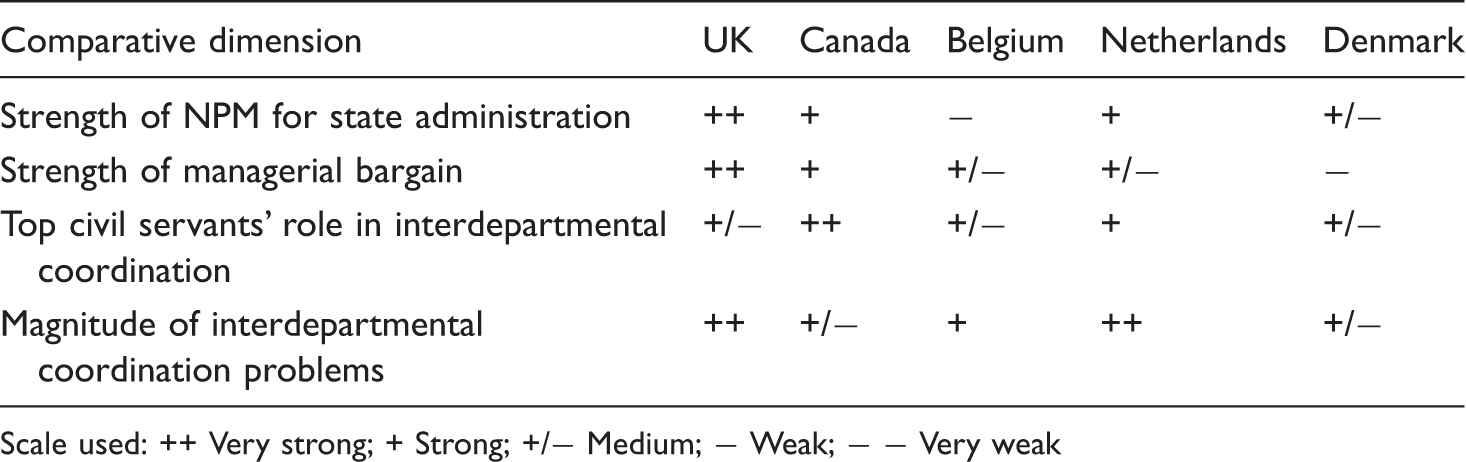
Scale used: ++ Very strong; + Strong; +/− Medium; − Weak; − − Very weak
As Table 1 and the discussion of the cases show, our hypothesized scenario seems to hold only for the UK. Managerial-NPM reforms strengthened disaggregation of the government system and since the end of the 1990s joined-up government initiatives have been implemented in order to re-enhance coordination. Most of these coordination reforms have strengthened the role of the Prime Minister, the Cabinet Office and the Treasury (Bouckaert et al., 2010), rather than relying on the Permanent Secretaries who hold a primarily managerial role, in contrast to their former advisory role. We see similar, but less pronounced, features in the Canadian case. The PSB of Deputy Ministers has a strong managerial focus, but apparently a strong corporate culture has developed, supported by networking and regular contacts among the top civil servants, as well as the formal centralization as in the UK. As a result, horizontal coordination problems seem less pronounced in the Canadian case.
Next to this stands the picture of the Danish and Dutch top civil service. We typify Denmark as a medium-level adopter of managerial-NPM. The Netherlands has been more ambitious in its adoption of managerial-NPM. Both countries experienced initiatives towards decentralization, devolution and specialization in state administration. However, even more than these reforms, it is the built-in fragmentation linked with the more traditional characteristics of the political-administrative system, such as ministerial rule, that advances a need for coordination and integration. At the same time, the top civil servants’ bargains show ‘soft’ managerial traits, leaving room for maneuver – especially pronounced in the Danish case. Perhaps due to the weaker coordinating mechanisms of the structural features in the Dutch system (e.g. weaker coordinating power of the prime minister, even more fragmented party system), coordination initiatives, even at the level of the top civil servants, seem to have gone further in the Dutch case.
Finally, the hypothesis also gets mixed support from the Belgian case. Despite the country being a modest managerial-NPM reformer, the introduction of performance contracts is an important change in the PSB. However, historical features of the political-administrative system –such as the power of the ‘ministerial cabinets’, strong politicization of the administration, limited autonomy of top civil servants as an effect of this, and rooted values such as equality and legality – resulted in a bargain which, compared to the other country case studies, shows limited characteristics of managerialism. Coordination problems are persistent. A major factor in this, however, is the history of state forms and its impact on the bureaucratic structures of the country.
What lessons can we learn from these mixed findings? First, our analysis indicates that initial conditions, for instance types of politico-administrative regime (Pollitt and Bouckaert 2011), may be more important to coordination problems than recent trends in public management reform. The Dutch state administration has severe coordination problems, but these seem to be more related to basic features of the system such as political fragmentation, the principle of ministerial rule and weak concentration of executive power by the PM, and less related to the substantial influence of managerial-NPM.
Second, one useful way to interpret our argument, which is derived from the post-NPM literature, is as a sometimes-true mechanism (Elster, 1989; Hedström and Swedberg, 1998) whose importance is dependent on the context and other processes at work. That means that the hypothesized causal mechanisms in our argument may well be at work but are counter-balanced, denounced or overruled by other causal processes in the context. For instance the most radical adopters of managerial-NPM – the UK and Canada – have taken measures to counteract the coordination problems caused by the model. Both countries have strengthened formal centralization, and while Canada seems to have successfully adopted a corporate management model, the UK has adopted attempts at joined-up government. This strengthening of the center may be part of a more general trend as suggested in a recent comparative study (Dahlstrom et al., 2011). Yet, the modest success of efforts towards coordination is also pointed at, for example, by Lodge and Gill (2011) who take the New Zealand model as an example.
Another way of coping with the coordination problems of the managerial-NPM model is by only implementing it selectively and partly symbolically. The Danish and Belgian case may be perceived as such an example. In Denmark the departmental top civil servants do not have performance contracts in the usual sense of the word, while their agencies do. Yet, even for the agencies there is huge variation in the character and importance of performance contracts. In Belgium, the performance contracts are partly symbolic due to lack of clear performance criteria.
Conclusion
This article represents an attempt to grasp the challenges of interdepartmental coordination faced by top civil servants. We hypothesized that the more the state administration is influenced by managerial-NPM and the functioning of top civil servants is characterized as managerial PSB, the more limited the role of the top civil servant is in interdepartmental coordination, and the more the state administration faces severe problems of interdepartmental coordination. In general, our findings from Belgium, Canada, Denmark, the Netherlands and the United Kingdom provided mixed support for this theoretical argument.
One implication of our analysis seems to be that post-NPM arguments stating that managerial-NPM has caused severe coordination problems in western democracies may be overstated. Perhaps due to the strong bias towards an Anglo-American empirical context in scientific publications on Public Management Reform, the impact of NPM, and thus its explanatory power, has been overstated. When explaining variations in interdepartmental coordination one therefore cannot focus solely on recent challenges provided by NPM or post-NPM reforms. We have suggested an interpretation based on the notion of social mechanisms whose importance depends on the context as a useful way of moving forward and enhancing further comparative research.
Another implication is that further comparative research is needed if we want to understand the mechanisms enhancing and inhibiting interdepartmental coordination in state administration. Further research could be directed at deepening our analysis of the involvement of top civil servants in coordination by extending our focus to the levels immediately below the highest ranking top civil servants in the departments and to the agencies’ heads. Also, our research could be extended to involve more country case studies. While the first research strategy helps deepen understanding of our causal model and the role of PSBs, the latter can provide new perceptions of the way the context impacts – counterbalances, denounces or overrules – upon the causal mechanisms of our argument.
Finally, although our article is based on a large, international research project, it relies heavily on our interpretation of a complex dataset. Future comparative research should be directed both at further deepening this interpretative method, as well as supplementing this approach with the use of standardized quantitative data. Related to this, it should be recognized that our findings are primarily based on ‘talk and decision’ data (Pollitt and Bouckaert, 2011: 11–15) while our knowledge of ‘practice and results’ is rather ‘impressionistic’. Future comparative research should face the challenge of incorporating more extensive data on the practice and results of public management reform.