




Abstract
Unsupervised police decisions taken under stress inherently involve the exercise of discretion and remain questionable when considering the legitimacy of police behavior. Law enforcement agencies seek ways to control discretion to avoid the undesirable consequences of police discretion and maintain organizational legitimacy. Drawing on expectancy and value-based approaches, this study examines the role of extrinsic motivation, intrinsic value orientation and selective enforcement attitudes on the responsiveness of Turkish patrol officers. The findings of the study suggest that reward expectancy which represents the extrinsic motivational perspective, did not have a statistically significant relationship to responsiveness. Public service motivation representing the intrinsic motives of respondents, on the other hand, indicated a strong, positive, and statistically significant relationship with responsiveness. Officer attitudes toward selective enforcement negatively influenced officer responsiveness.
Points for practitioners
Unlike research that emphasizes the role of contingent incentives on controlling discretion, this study empirically reported that intrinsic rewards have an even stronger effect on officer behavior. The leader’s role is essential in making followers work towards the interests of the public and the well-being of society. Ill-designed extrinsic reward systems may crowd out intrinsic motives of employees and cause a decrease in work-related outcomes. This is especially true in hierarchical organizations where reward policies are more likely to be perceived as unfair.
Introduction
Police officers make decisions in a variety of situations at the street level which has a direct impact on citizens’ liberty and their quality of life. These decisions are discretionary in nature since it is almost impossible to set specific rules in advance regarding who will be stopped or arrested by a police officer. Specifying these rules would make them unmanageable, conflicting, and inconsistent. Unspecified rules ultimately give discretionary power to lower-level employees in an organization.
Lipsky (1980) highlighted the importance of lower-level employee roles in the implementation of any policy. Empirical research has mostly supported his argument that there are ‘street-level bureaucrats’ who are not only practitioners but also policymakers. What makes them part of policymaking is their ability to choose among a variety of actions when they are in contact with citizens. In this context, firefighters, social workers, and police officers are regarded as street-level bureaucrats among others who work the streets, serve citizens, and enforce laws.
Law enforcement organizations seek ways of controlling discretion to avoid its undesired consequences and maintain organizational legitimacy, while placing a certain degree of discretion in the hands of officers to allow them to perform their duties. However, the literature on police discretion does not give a clear picture of how to control police discretion (Mastrofski, 2004). This study goes beyond prior research which aimed only at understanding how the reward expectancy of officers for extra pay and career advancement shapes their decisions to enforce the law. It investigates the role of both extrinsic motivation and intrinsic value orientation on work effort and responsiveness. More specifically, it seeks to identify the role of reward expectancy and public service motivation on the responsiveness of patrol officers in stopping vehicles and questioning people, while at the same time investigating the negative influence of selective enforcement on responsiveness.
The context of the study is the Turkish National Police (TNP) which is a hierarchically structured and highly centralized organization. It serves the urban population of the country and executes its day-to-day operations by local police departments in each of the 81 provinces within the country. All police officers in the TNP are recruited, trained, and appointed through a central mechanism. All members of the TNP are subject to rotation after serving in a province for a certain period.
This study reviews the police discretion literature in the next section, and then provides the theoretical background and hypotheses of the research. In terms of methodology, the study examines the effect of extrinsic motivation and intrinsic value orientation and selective enforcement on the responsiveness of Turkish patrol officers using a sample of 613 uniformed patrol officers in seven provinces of Turkey. The study uses structural equation modeling (SEM) to examine causal relationships among the concepts of the study that were measured using a self-rated 5-point Likert scale. A five-step model validation process was employed for the validation of measurement models using confirmatory factor analysis (CFA) and for validation of the covariance structural model. Findings of the study are discussed and future research is suggested.
Police discretion and factors affecting discretion
Police discretion research has been conducted to explain how variations in police behavior are affected by a range of factors. A large body of discretion literature is summarized under the following headings: situational factors, environmental factors, individual and attitudinal factors, and organizational factors.
Situational factors
Situational factors have been found to be more important factors in officer decisions than other variables. The importance of situational factors arises from their consistency across many previous studies conducted in a variety of settings. Since legal factors affect discretion, it is not surprising that officers make more arrests when crimes are serious (Black, 1971; Smith, 1987), when weapons are used, when suspects are intoxicated, and so on, compared to situations involving extra-legal factors (Worden, 1989).
Disrespectful behavior exhibited by offenders increases the likelihood of an officer making an arrest and using force toward those suspects (Worden, 1989; Worden and Shepard, 1996). Studies examining gender differences in police discretion usually suggest that men are more likely to be arrested or stopped by police (Visher, 1983) while others have detected no gender difference in police decisions (Smith and Visher, 1981). Previous research examining the effects of race on stop and searches and arrest decisions has found that blacks are more likely to be stopped and/or arrested (Black, 1971). More arrests are made when there is no relationship between the offender and victim (Black, 1971; Worden and Pollitz, 1984).
Environmental factors
Police discretion research suggests that even when situational characteristics are very similar, policing practices differ depending on the community characteristics. Police officers develop behavior models that are acceptable in the community where policing is practiced. Klinger (1997) argued that police response to a specific neighborhood is largely influenced by officer perceptions of what appropriate behavior is in that community. In circumstances where the police believe that a community does not deserve services, the community gets a lower level of services from the police. In this context, white and affluent communities are more likely to be served by the police.
The crime rate in a community also determines the policing strategy to be implemented in that community. Empirical investigations have indicated that police are more inclined to behave harshly in communities with higher crime rates (Fyfe, 1981). Alpert et al. (2005) have argued that officer perceptions about neighborhood characteristics reveal controversial issues in policing practices. They specifically suggest that ‘the perception of high crime rates in certain communities leads to greater police deployment, which yields higher arrest rates, which, in turn, [is] interpreted as evidence of a higher crime rate’ (2005: 411).
Individual and attitudinal factors
Individual factors are investigated in two categories. First, the individual characteristics of officers have been seen as correlates of police decisions. Many studies have examined the relationship between officer characteristics, such as gender, age, race, educational level, social class, and experience, and police behavior. Those studies have produced mixed results concerning the influence of individual characteristics on officer decision-making.
Scholars examining the impact of officer gender on variations in police behavior have suggested that police behavior on the street is influenced by officer gender (Homant and Kennedy, 1985) while others report a weak or no relationship between the two (Terrill and Mastrofski, 2002). A few studies have found that officer behaviors are linked to the race of the officer (Dunham et al., 2005) while a large body of literature has not detected any impact of officer race on officer behavior (Terrill and Mastrofski, 2002). Scholars have reported that years of experience reduces the likelihood of an arrest (Muir, 1977) and have found a negative relationship between years of experience and the level of force used (Terrill and Mastrofski, 2002). Fyfe (1981) reported that officers with higher levels of education tend to use less force than others, while others have argued that there is a weak relationship between education and officer behavior (Worden, 1990). Overall, studies on the individual characteristics of officers hae not produced consistent findings and do not reveal a strong impact on behavior.
Along with officers’ characteristics, officer decisions are thought to be correlated with officers’ values, beliefs, and attitudes. According to Goldstein (1977), officers’ responses in certain situations are derived from their perceptions about what policing means. Similarly, Mastrofski et al. (1995) have reported that officers engage in policing activities based on their beliefs as to what is best for the community. A developmental process forms officers’ attitudes toward their role, community, and citizens which leads them to build up an interpretive framework for understanding situations as they arise. They use their own attitudes and policing style to make decisions about who is suspicious, who is to be arrested, and whose actions need to be investigated.
Organizational factors
Research on the organizational characteristics of police agencies has indicated that the decisions of police officers are related to departmental characteristics. Officers’ decisions are affected by organizational values, demands, and constraints. Wilson (1968) suggested that the attitudes and behaviors of officers on the role of police are shaped by organizational characteristics and goals (Groeneveld, 2005; Mastrofski et al., 1987). Research examining the effects of organizational influence on individual officers’ behavior has found that organizational complexity and large bureaucratic structures negatively affect the probability of making an arrest. Maguire (1994) investigated the impact of organizational context and structure on arrest rates in child abuse cases. He concluded that larger police departments make fewer arrests than smaller departments. Mastrofski et al. (1994) reported that officers in smaller agencies made more arrests than their counterparts in larger agencies. They attributed these results to lower organizational control in larger departments. The study revealed that formal policies and rules are strictly enforced in smaller departments, while the informal characteristics of larger organizations dominate officer behaviors, resulting in wider exercise of discretion. Clearly, an organization can influence its members’ choices on the street by regulating them via organizational policies, rules, and reward/sanction structures.
Previous work has mainly investigated organizational factors that are likely to account for variations in police behavior within the organizational theory framework. In this regard, a few empirical studies have analyzed the validity of the rational, constrained rational and loosely coupled models (Eitle, 2005; Mastrofski et al., 1987). The majority of them concluded that the degree to which an organization can direct the behaviors of line officers depends on the size and structure of the organization.
Theoretical framework and hypotheses
Several studies have found that situational factors have the strongest impact on daily police decisions (Smith and Visher, 1981; Worden, 1989). However, organizations have no influence on the situational factors of police discretion, although they have control over extra-legal factors (Mastrofski, 2004). Controlling police discretion can be investigated in at least two broad categories. First, organizations may choose to shape officer decisions on the street by using external rewards to motivate them to behave in the way the organization wants. Widely used organizational rewards include promotion opportunities, overtime payment, and official recognition for greater arrest, stop/search, and citation productivity. The use of monetary and promotional rewards, however, is far from being flawless, and the success of reward instrumentality in shaping police behavior is questioned (Mastrofski, 2004).
The second approach emphasizes that it is imperative to manage discretion using a value-based approach. Organizations can promote values and beliefs in their members that have concurrence with organizational and individual values so that employees perform their job in the desired way.
The key aspect of this approach is that individual and organizational values and goals must be consistent to achieve compliance with organizational policies and ultimately exert control on police discretion.
In this study, the incentive and sanction structures of organizations were conceptualized as reward expectancy and considered in the first category of controlling discretion. The reward expectancy model recognizes that workers follow their own self-interest, and thus their aims would maximize their utility in the workplace. It emphasizes that employees are instrumentally motivated and mainly interested in the outcomes offered by organizations (Tyler et al., 2007). The basic premise of the model is that an employee’s motivation is a function of their effort to increase performance (expectancy), their belief that high performance will lead to rewards (instrumentality), and their perception of the value of those rewards (valence). Several studies have reported that officer arrest rates, drug enforcement and problem solving activities can be explained by expectancy theory (DeJong et al., 2001; Johnson, 2009a; Mastrofski et al., 1994).
The intrinsic motives of employees are examined within the value-based approach since it essentially refers to the values of officers. Many researchers have argued that intrinsic rewards also have a role in motivating employees (Deci et al., 1999). Intrinsic value orientation examines whether the job is meaningful to employees, whether employees feel personally responsible for the results of their work, and whether they know the outcomes of their activities (Deci and Ryan, 2000; Ryan and Deci, 2008). Public service motivation has been considered a particular type of intrinsic value orientation (Crewson, 1997). Public service motivation refers to an individual’s willingness to work for the interests of people and the welfare of society (Perry and Hondeghem, 2008). First, individuals with higher public service motivation were inclined to choose jobs in public organizations. Second, a positive relationship exists between employees’ public service motivation level and their job performance. Finally, employees with a high level of public service motivation are less likely to be motivated by extrinsic rewards (Perry and Wise, 1990). Public service motivation can predict performance and other job-related outcomes, such as organizational commitment and job satisfaction (Crewson, 1997).
In the early years of motivation research, extrinsic and intrinsic motivators were thought to be independent and their powers additive (Cameron and Pierce, 2002). However, more recent studies have revealed that their combination may not increase motivational force. Instead, some scholars have argued that extrinsic rewards actually undermine intrinsic motivation. In the literature, some evidence has been found of a crowding-out effect of monetary rewards over intrinsic rewards, especially in certain settings and conditions (Cameron et al., 2001; Oh and Lewis, 2009; Ryan and Deci, 2000).
Officer attitudes also can be investigated with a value-based approach since employees bring their ideas, attitudes, and values into an organization. Officer attitudes toward citizens, toward policing styles, and towards the enforcement of law may differ substantially from one another (Paoline, 2004). Even though attitudes toward discretionary enforcement differ depending on the policing orientation of patrolmen, it is widely accepted that all officers engage in discretionary selective enforcement behavior.
This study follows those studies that have separated the conceptualization of motivation and effort. Brown and Peterson (1994: 71) suggested that ‘effort represents the force, energy or activity by which work is accomplished whereas motivation represents the psychological state or predisposition of individuals with respect to choices involving the direction, intensity and persistence of behavior’. Effort is a fundamental component that needs to be regarded as a linking factor for motivation and performance (Blau, 1993; Brown and Peterson, 1994).
Mastrofski et al. (1987) indicated that officer decisions in larger agencies are greatly affected by peer culture and the policing environment. On the other hand, smaller departments were more successful in shaping officer behaviors. The rational model became more valid in smaller agencies, indicated by higher compliance with organizational rules. The loosely coupled model was found to be more valid in larger departments, allowing officers wider discretionary decision-making opportunities (Eitle, 2005; Mastrofski et al., 1987). The particular predispositions of individuals will have an essential role in determining work outcomes. Public service motivation and personal inclination will lead to higher levels of responsiveness on the street. The open systems model points out that individual parts of an organization are loosely coupled, and organizational structure and policies are less likely to be connected to officer decisions and behaviors. Even when an organization aims to increase the responsiveness of officers on the street by attempting to control the exercise of discretion, organizational and personal goals may still be loosely coupled.
The first hypothesis of this study was formulated based on the rational model, a reward-and-sanction schema of organization, which is a formal regulation set by the agency administration and is likely to govern worker behaviors. In the model, police officers are expected to increase their responsiveness to be able to maximize their utility by a means of rewards offered by the organization. H1: The reward expectancy of officers positively affects their responsiveness to street contingencies. H2: The reward expectancy of police officers positively affects their work effort in enforcing the law. H3: Public service motivation positively affects police officers’ responsiveness to contingencies on the street. H4: Public service motivation positively affects police officers’ work effort in terms of enforcing the law. H5: Police officers’ work effort positively affects their responsiveness to daily situations. H6: Attitude toward selective enforcement negatively affects the responsiveness of patrol officers. Conceptual framework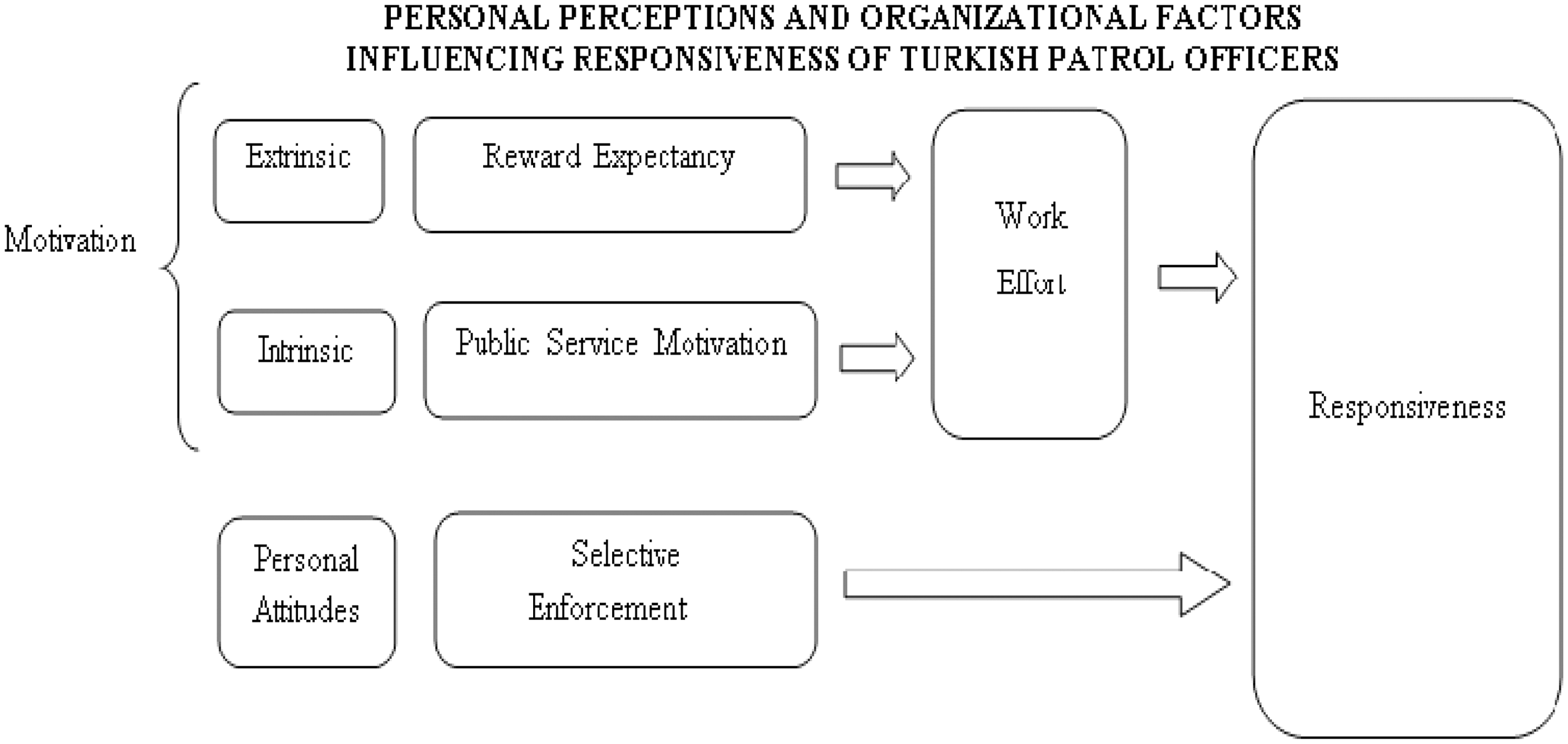
Methodology
The study uses responsiveness as an endogenous variable and reward expectancy, public service motivation, and selective enforcement as exogenous variables.
The use of responsiveness is a new approach in terms of conceptualization and as a measurement method. It covers more of the behaviors of the police such as stopping, searching, questioning, and initiating legal processes when compared to other studies which use arrest decisions as a measure of discretion. To measure the concept, the study uses six scenarios. In each scenario a situation that involves a minor violation is described. Based on a review of the literature, all elements of a police officer’s decisions to stop, search, and question are included in the scenarios.
Employees’ effort level was measured in several different ways in a limited number of studies. The most frequently used methods were self-reported assessments, co-worker ratings, and supervisor evaluations of how hard an employee works. The questionnaire includes a single item to measure work effort: How much effort do you think that you exert in your work when you consider your capacity? The response scale for this question ranges from 0 percent to 100 percent.
This study uses a reward expectancy concept that was derived from the expectancy theory of motivation. A 15-item questionnaire was designed to measure reward expectancy. The scale contained questions about how likely officers were to achieve assigned tasks (expectancy), to what extent they believed performance would lead to rewards (instrumentality), and how much they valued organizational rewards (valence).
Perry (1996) developed a scale to measure public service motivation that consists of six dimensions and 40 items. The shorter version of the questionnaire, which contains 24 items in four dimensions (self-sacrifice, attraction to policy-making, compassion, and civic duty), was found to be an appropriate operationalization of the construct and the ‘gold standard’ of measurement. Only the self-sacrifice and civic duty dimensions were included in the survey instrument to measure public service motivation. A self-rated 5-point Likert scale is used in the study.
This study uses a selective enforcement scale derived from Wortley’s (2003) attitudes-toward-police discretion. Based on Wilson’s (1968) propositions, Wortley (2003) constructed a scale consisting of two subsets of items (Service-Legalistic and watchman) to measure officer attitudes toward discretion. Selective enforcement items from both scales were adapted for use in the study, regardless of whether they belonged in the service-legalistic or watchman scale.
In order to precisely determine the influence of exogenous variables on responsiveness (Eitle, 2005; Mastrofski et al., 1987), officer perceptions of intensity and three demographic characteristics of police officers (age, education, and gender) were controlled.
A sample from sworn and uniformed patrol officers, working in the 81 police departments of the TNP in each province, was chosen for the study. Being subunits of local police departments, patrol squads are subunits under the auspices of local police departments and are primarily responsible for patrolling and maintaining safety in their district. The study used a stratified random sampling method to obtain the representative patrol officers in Turkey. The rotation procedures of the TNP make samples drawn from any department more homogeneous. The largest police department in terms of personnel, in each of the seven geographical regions in Turkey, was chosen as the sample domain (Istanbul, Ankara, Izmir, Diyarbakir, Adana, Samsun, and Erzurum).
After the study had received the approval of the Institutional Review Board (IRB), target participants were invited and encouraged to take part in the study on a voluntary basis. The study employed Dillman’s (2000) ‘tailored design method’ to increase response rates. To achieve higher participation, the study primarily used an electronic survey method. However, considering that potential respondents, patrol officers, are usually away from a computer and internet access, the researcher distributed printed questionnaires when necessary. Consequently, researchers distributed a total of 863 electronic or paper questionnaires to patrol officers in seven provinces in seven geographic regions of the country. Six hundred and thirteen of the distributed questionnaires were returned, giving a response rate of 71 percent.
The study uses structural equation modeling (SEM), a statistical tool used to investigate causal relationships among two endogenous and three exogenous variables. SEM is used to model a causal relationship that is represented by multiple equations and at the same time allows inclusion of unobserved variables where measurement errors are taken into account. This method is especially useful for the validation of theoretically grounded models (Byrne, 2001; Hoyle, 1995). The model validation process was conducted in five steps, both for validation of measurement models and validation of the covariance structural model.
The first stage, specification, required the researcher to determine which latent and observed variables would be included in the model. There was also a need to specify relations among exogenous and endogenous variables. The next step (identification) included acquiring values for the set of parameters to be estimated in a specified model. It basically refers to whether a unique solution for all parameters in an equation exists. There are three types of model: under-identified (no solution), just-identified (only one solution) and over-identified models (optimum solution). Over-identified models are preferable since they provide a degree of freedom to test the model fit (Schumacker and Lomax, 2004). The model estimation stage refers to a statistical estimation of the free parameters of the sample data. Amos software uses maximum likelihood as the default estimation method. The maximum likelihood method chooses values for the parameters of a model that indicate the most likely distribution of data. The model assessment step is also critical since the primary purpose of developing and testing a model is to find one that fits the data well enough to explain actual relationships in observed data (Byrne, 2001; Hoyle, 1995; Schumacker and Lomax, 2004).
Based on Schermelleh-Engel et al. (2003), the fit indices reported in this study are chi-square (χ2), likelihood ratio (χ2/df), p-value, Root Mean Squared Error of Approximation (RMSEA), Standardized Root Mean Square Residual (SRMR), Tucker Lewis Index (TLI), Comparative Fit Index (CFI), Probability (p-close), and Hoelter's Critical N (CN). For model modification purposes, .40 was set as a threshold for the value of parameter estimates to retain in the model. Second, whether the estimates of free parameters were statistically significant at the .05 level was examined to decide whether to eliminate them from the model. Nonsignificant parameters were excluded from the model to obtain a simpler model that reflects the covariance structure. However, some parameters were allowed to remain in the model even when their estimated values were not significant (Schumacker and Lomax, 2004). The five-step model validation process was applied to both the measurement and structural equation models of the study. Once the measurement models were validated, the latent variables were put into the model and evaluated by using goodness-of-fit indices similar to the way in which the measurement model was validated.
Findings
Educational level, age, gender of participants, and department size and perceived intensity of the department were used as control variables. In terms of educational level, officers with a two-year college degree (42.6 percent) or a bachelor’s degree (45.4 percent) constituted 88 percent of survey participants. More than half of the survey participants (54.6 percent) were under 30 years of age. Only 3.3 percent of participants were female officers in this study, while the percentage of male officers was 96.7 percent. The majority of respondents (73.4 percent) believed that their department had a high-level workload when compared to other departments in the country and other work units in the same department. Of the 613 respondents, 261 Istanbul police officers, or 42.6 percent, participated in the survey. Ankara was in second place in terms of the number of participants (103). It was followed by Izmir (89), Adana (77), Diyarbakir (43), Erzurum (25), and Samsun (15).
A correlation matrix among constructs was created to explore relationships between latent variables. Table A1 (see Appendix) indicates that correlations between variables are moderate or low. Correlation analyses also revealed that reward expectancy is negatively correlated with all other constructs in the study. The highest correlation is found between public service motivation and responsiveness while the lowest correlation is between selective enforcement and public service motivation
Confirmatory factor analysis (CFA) was conducted to assess the validation of the measurement models. CFA was used to find out to what extent the proposed measurement models are consistent with covariance between factors (Schumacker and Lomax, 2004). The five-step validation process (model specification, model identification, model estimation, model-fit assessment, model modification) was applied to each construct of the study.
Four subscales of the survey instrument in this study were evaluated based on Cronbach’s alpha reliability coefficient. It is important to note that reliability analyses were conducted after the factors for items that seemed not to belong were excluded from the measurement models. Responsiveness was measured by six items and an SPSS scale reliability procedure produced a coefficient of .80. The Cronbach’s alpha score calculated for reward expectancy was .87. The reliability coefficient of public service motivation (PSM) was .84. For the last subscale of the instrument, selective enforcement, the Cronbach’s alpha value was .62, which is relatively low compared to other scales in the instrument.
All study variables were put into a structural model to detect hypothesized relationships among the variables. The theoretically informed conceptual model was taken as the basis to design the model. Analysis revealed that parameter estimates can be obtained from the variance/covariance structure of the data set.
Goodness of Fit statistics for generic and revised structural equation models
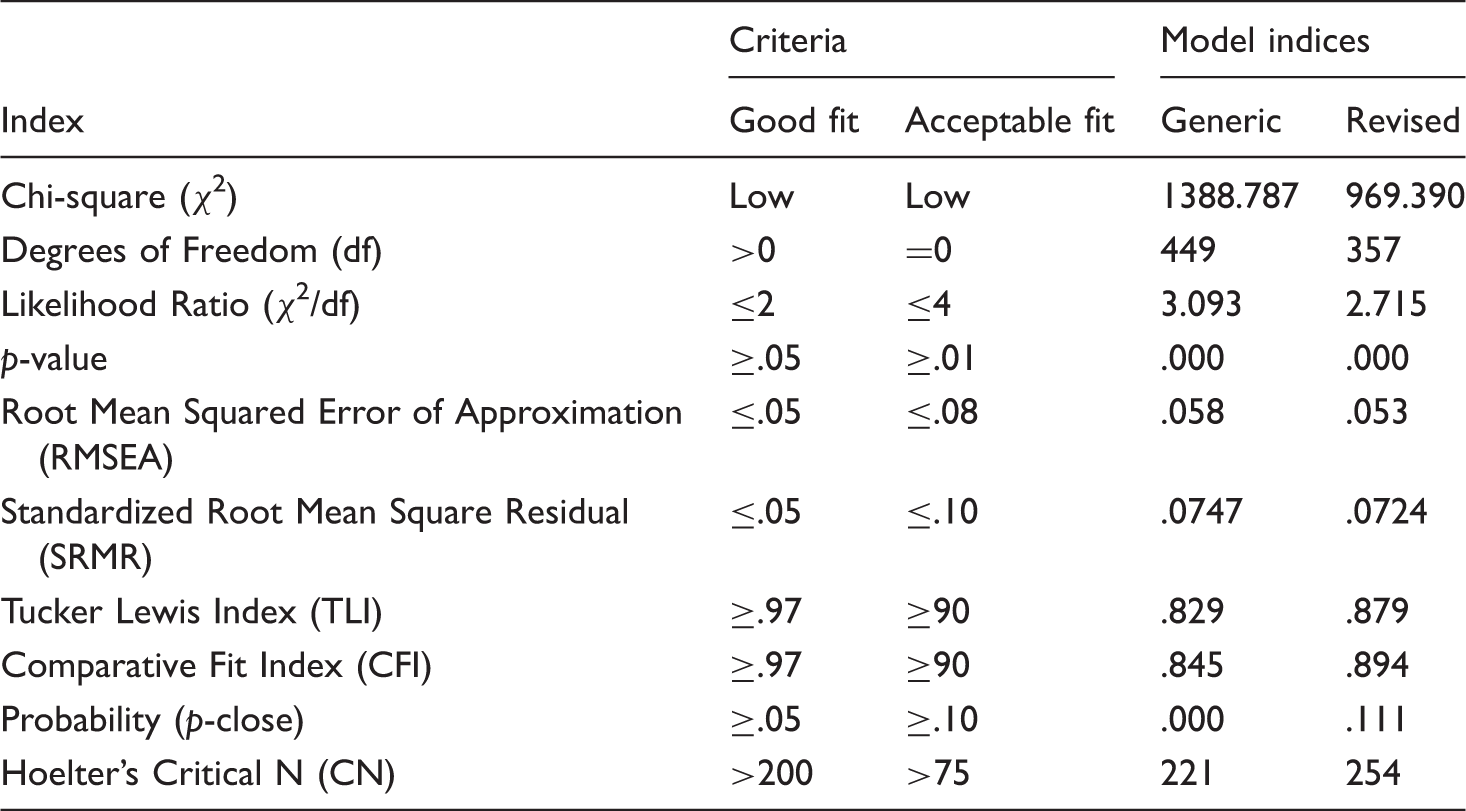
The nonsignificant control variables, education, department, and gender were removed from the model. However, the reward expectancy construct, which indicated nonsignificant relationships with responsiveness and work effort, was retained because of its substantial role in the model. The final structural equation model that indicates relations among constructs of the study is illustrated in Figure 2. Endogenous variables of the study explained 37 percent of the variation in responsiveness.
Structural equation model for factors affecting responsiveness
Parameter estimates for the revised structural equation model
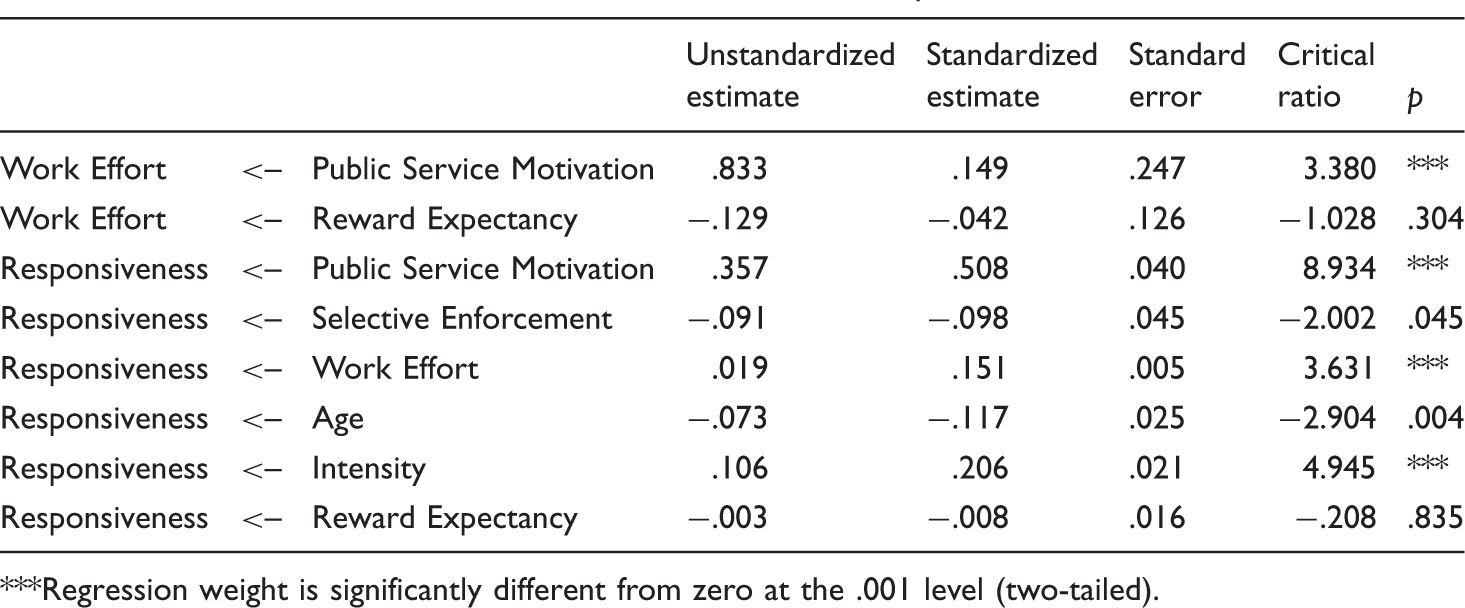
Regression weight is significantly different from zero at the .001 level (two-tailed).
The revised model indicated a considerably better model fit compared to the generic model. A lower chi-square value (969.390) was obtained after revision of the model (1388.787). Similarly, the likelihood ratio (χ2/df) was reduced to 2.715 from 3.093. Even though the RMSEA and SRMR were at acceptable levels in the generic model, their values were improved in the revised model. TLI and CFI indicated values very close to desired levels, although they did not exactly meet the criteria. P-close and Hoelter’s CN indices suggested a good model fit. The only fit statistic that did not meet its criterion was probability (p-value), indicating a significant value (.000). Because of its sensitivity to sample size, this finding needs to be interpreted with caution. The probability value is more likely to be significant in models with a large sample size.
The hypotheses regarding the impact of reward expectancy on work effort and responsiveness were not supported. No empirical evidence was found to support the claim that reward expectancy positively influences the work effort or responsiveness of officers. The relationships between these variables also indicated very weak regression weights (−.04, −.01). Furthermore, the directions of associations were negative, which was not expected. Public service motivation had the greatest impact on both the work effort and responsiveness among the other variables with a regression weight of .51. Results indicate that work effort mediates the relationship between public service motivation and responsiveness. However, the relationship between reward expectancy and responsiveness was not mediated by work effort. The selective enforcement and responsiveness relationship was in a negative direction as proposed and statistically significant at the .05 level. Department, education, and gender were not significant at the .05 level, while intensity and age were found to be related to responsiveness.
Discussion
The study findings indicate that no effect of reward expectancy on responsiveness can be attributed to any two factors in light of the empirical research in this field. First, the results are consistent with the research on performance-based pay systems, which found no effect of monetary rewards on either work effort or performance. The failure of the system to motivate managers was explained by a perception of unfair organizational procedures (Gaertner and Gaertner, 1985). Therefore, it is not surprising that the findings of the study indicate no influence of extrinsic rewards on responsiveness, implying that employees of the TNP do not believe that rewards are distributed based on fair procedures. This condition breaks the perceived link between responsiveness and outcome (reward).
Second, results of this study were also consistent with the finding that extrinsic rewards are instrumental when they are structured to reward officers for their easily measurable behaviors (DeJong et al., 2001; Johnson, 2009a, 2010). Since this study focused on one of the intangible aspects of policing (responsiveness), the expectancy perspective failed to explain variations in behavior, which is consistent with Johnson’s (2009b) findings.
Third, this study also supported the findings of one of the more robust studies on police discretion (Mastrofski et al., 1994) in indicating a negative relationship between reward instrumentality and responsiveness.
Fourth, results of this study indicated that officers do not value organizational rewards. Interestingly, more than 60 percent of participants stated that they do not value the rewards offered by their organization. This response pattern of officers gives insight into why officers working for the TNP are not motivated by extrinsic rewards. As explicitly stated in theory, it cannot be expected that employees who do not believe that the rewards are valuable would be likely to increase their effort and perform better.
This study’s findings indicated that public service motivation also has an impact on work effort and responsiveness. In other words, patrol officers with higher public service motivation are more likely to work harder and respond better than those whose public service motives are lower. This finding is also consistent with empirical studies conducted in the field. Public service motivation was reported to be positively related to organizational commitment (Crewson, 1997), organizational citizenship behavior (Kim, 2006), job satisfaction (Liu et al., 2008) and job performance (Ritz, 2009). As responsiveness is considered a work-related outcome, it is not surprising that public service motivation increases the responsiveness of participants.
The study also found that officers in the TNP are not inclined to be motivated by extrinsic rewards offered by their organization. Even though this study did not aim to test the theory’s assumption that suggests that public employees are not motivated by contingency rewards, it gives insight into this proposition by reporting higher PSM and no relationship between reward expectancy and responsiveness.
Another finding of the study relates to the role of work effort in motivation studies. The only relationship mediated by work effort was the one between PSM and responsiveness. As a result, this study partially supports the mediating role of work effort in motivation/work outcomes models.
The fifth hypothesis of the study, that selective enforcement negatively influences responsiveness, was supported. This finding suggests that officers who believe that the police should enforce the law selectively are less responsive in situations that require police response. The scarcity of research on the role of officer attitudes about their behavior makes it difficult to compare the findings of this study with similar research. One of these rare studies found that 63 percent of officers believe that some situations require selective enforcement of the law (Paoline, 2004). Another study that examined police discretionary decision-making in traffic enforcement revealed that police leniency is very common in law enforcement. In traffic violations such as speeding, red-light running, and not wearing seat belts, officers preferred giving verbal warnings in 56 percent of cases, indicating a high level of selective enforcement (Schafer and Mastrofski, 2005). These studies indicated that the findings of this study are not unexpected.
This study revealed that officer age and perception of intensity have a significant impact on responsiveness. In the literature, the number of years in service, rather than officer age, was examined in terms of its effects on officers’ productivity. In the TNP context, years in service and age can be regarded as a covariate to a certain degree. When we consider that age increases with years of service, the findings of the study are consistent with the results of research reporting that the productivity of officers decreases as years of service increase (Mastrofski et al., 1994). However, this conclusion might be misleading, since these two variables are not necessarily equivalent in all circumstances.
The intensity perceptions of officers were found to be related to responsiveness. As intensity increases, the responsiveness of officers also increases. This finding is unexpected and inconsistent with the arguments of prior studies. It was expected that as intensity in the department increases, officers are less likely to find time to respond to minor crimes. This outcome might result from this variable’s dependency on officer perceptions. More verifiable measures of intensity in a department might be used in future studies to detect its effect on responsiveness.
Conclusion
The results of this study indicated that officers who work for the TNP are mostly public service-oriented employees. At this point, it is plausible to recommend that the TNP formulate and implement policies that ensure the recruitment of public service-oriented cadets. Although this is a necessary policy, research suggests that it is not sufficient to achieve the desired work outcomes unless employees perceive that they contribute to serving the public interest by carrying out a given duty in the organization. The leadership of an organization can take a critical role in making followers work for the public interest and the well-being of society.
The empirical investigation of the study revealed that the TNP’s current organizational reward policies and practices are not effective instruments in motivating its members to be more responsive. Possible causes of this might be the perception of officers that rewards are not distributed according to fair procedures or that higher responsiveness does not necessarily lead to obtaining organizational rewards. The TNP might choose one of following courses of action: discarding the reward system completely or revising/improving the system. The idea behind the elimination of the current reward structure would be the crowding-out effect of contingent rewards on intrinsic value orientation. Since TNP members are motivated by PSM, eliminating the external reward system might have a positive impact on the intrinsic goals and values of TNP officers by providing them with more autonomy and giving them the opportunity to work for the public interest without external restriction. Moreover, discarding the system may provide some savings to the agency through budget cuts on some types of reward such as salary incentives. The TNP can also revise the existing organizational reward system. In this case, it is critical to determine intelligible and visible rules that apply equally to all members of the TNP. If the TNP can persuade its members that their responsiveness on the street will lead to organizational rewards that are distributed based on fair criteria, extrinsic rewards can also be used as instruments to motivate officers to be responsive.
This study contributes to the literature by taking a motivational and attitudinal theoretical framework in the investigation of police discretion. First, this study contributes to the discretion literature by developing the concept of responsiveness in the conceptualization of officer behavior. When it is considered that the measurement of police discretion greatly depends on the arrest decisions of officers, this more comprehensive conceptualization of discretion becomes an essential contribution in this field. It also makes contributions to the field by using a robust analytical method and providing empirical evidence on discretion. In addition, this study was conducted in a setting that differs from the usual police discretion research locations.
There are some limitations of this study. The first is related to a general lack of survey research and its dependence on the self-reported ratings of respondents. There is always the possibility that participants in the study may have reported what is generally supposed to be true instead of what they really believe. Respondents are likely to over-report their responsiveness and work effort, while selective enforcement might be under-reported because of its lower desirability. Another possible issue is construct validity, which is a concern when study variables are latent, in other words, not observable directly and not easy to measure. It is always questionable whether all items are included that are necessary to cover every aspect of discretion.
Future research should, first, include organizational justice in the models that aim to study external sources of officer motivation to work out why reward expectancy does not increase police responsiveness. Second, earlier studies have argued that in some cases rewards offered by organizations are basically not enough to motivate employees to increase their effort and work outcomes. Future studies also need to focus on whether the inadequacy of monetary rewards is a factor that negatively influences extrinsic motivation. Finally, more comparative research on the roles of extrinsic motivation and intrinsic goals and values in police discretion is needed. Since responsiveness, conceptualized for the purpose of characterizing officer discretion, was used for the first time in this study, further research questions arise that require the examination of different organizational and cultural settings.