



Abstract
For regulators, independence is associated with good governance, reform and best practice. It has become one of the most claimed characteristics of the regulatory state. But what does it really mean to be an independent agency? This article explores this question with stakeholders of five privacy (and information) commissions to map the understanding of those actually involved in the everyday processes of regulation. It is argued that the beliefs and expectations of stakeholders shape not only relationships but ultimately the legitimacy of regulatory practices. Six separate themes of understanding are identified. The themes represent areas of particular concern for each stakeholder group. Together they suggest a shared understanding of independence that encompasses both behavioural qualities as well as structural arrangements. A framework is proposed that provides a means for incorporating the different accounts of independence and recognizing the active role of agencies in determining independence.
Points for practitioners
Agency independence relates to behavioural qualities as well as structural arrangements. Behavioural qualities of independence encompass championing public interest, engendering trust and demonstrating impartiality. Procedures and routines based on clear principles of procedural fairness and transparency are likely to enhance agency independence.
Keywords
Introduction
For regulators, the very idea of independence has become associated with good governance, reform and best practice. International organizations recommend it, agencies seek it, governments support it and citizens expect it. Independence is one of the most claimed characteristics of the regulatory state. Despite this new orthodoxy (Christensen and Lægreid, 2011) what we mean when we describe an agency as independent is far from clear. Indeed, it is in danger of becoming what Pollitt and Hupe (2011) call a ‘magic concept’. One that seductively ‘helps set agendas’ and ‘excites discussion’ but is not ‘precise or even stable’ (Pollitt and Hupe, 2011: 645). The goal of this article is to offer an anchor point in the debate by directing attention to the practical understanding of independence as expressed by those with a stake in the everyday practices of regulation.
This article maps beliefs and expectations about agency independence to build a practical understanding of what stakeholders mean when they describe an agency as independent. It focuses on meaning rather than assessment of actual (or perceived) agency independence. This is important in at least three ways. First, agency independence is capable of being understood in a variety of different ways including (but not limited to) formal organizational design, freedom from interference, autonomous practice and self-sufficiency (Carpenter, 2001a; Verhoest et al., 2004; Christensen and Laegreid, 2006). The perspective taken by stakeholders in any particular field cannot be assumed. Second, the beliefs and expectations that stakeholders associate with agency independence shape relationships that are central to the work of the agency and regulatory outcomes. They do this by directing attention and resources (Scott, 2008). Third, and at a deeper level, stakeholders are sources of legitimacy for regulatory agencies. Stakeholders include beneficiaries of regulation and regulated organizations as well as political principals and their policy advisors. If the expectations of these groups are not met, in the longer term broader social support for the agency and the regulatory process may be withdrawn (Scott and Lane, 2000; Yesilkagit, 2004; King and Whetten, 2008; Yesilkagit and Van Thiel, 2011). The mapping of the meaning of agency independence at the field level provides insight into the content of these institutional processes by providing a comprehensive, albeit subjective, description of what it means to be independent.
Independent regulatory agencies are a particular kind of public body used to deliver regulation. They are defined as structurally separate public organizations, which operate at arm's length from government to deliver regulatory programmes (Thatcher and Stone Sweet, 2002; Christensen and Laegreid, 2006; Verhoest et al., 2012). Formal independence is defined in terms of institutional arrangements that describe the agency's reporting relationships, resourcing, staffing and accountability. It is initiated by legislation and administrative separation from elected officials (Thatcher and Stone Sweet, 2002; Verschuere et al., 2006; Gilardi and Maggetti, 2011). While there is a growing agreement that these actions are not sufficient to deliver independence in practice (Maggetti, 2007; Flinders, 2008; Yesilkagit and Van Thiel, 2008; Groenleer, 2009; Maggetti, 2012), the interdisciplinary nature of the work in this area has led to different accounts of which features are important. These differences seem to stem, at least in part, from a differing understanding of the meaning of independence.
For instance, a common account in political and legal studies is that independence is about the structural separation of power and authority interests (Majone, 1997; Thatcher and Stone Sweet, 2002; Jordana and Levi-Faur, 2004; Gilardi, 2008). Independence follows as the condition of being insulated from political interests and operates at a structural level (Majone, 2005; Groenleer, 2009; Barkow, 2010). Another account from the public administration literature conceptualizes agency independence in terms of autonomy. Autonomy is the extent to which an agency can decide for itself about matters it considers important (Verhoest et al., 2004; Christensen and Laegreid, 2006; Roness, 2009; Verschuere, 2009). This may be operationalized as managerial, policy, financial, human resource and legal autonomy (Verhoest et al., 2004; Christensen and Laegreid, 2006; Verhoest et al., 2010). Yet another account comes from social theory and psychology. This perspective suggests that to be considered independent an agency would need to have some level of control over key aspects of its survival such as resources (Dworkin, 1988; Ryan and Deci, 2000; Chirkov et al., 2003). Each account draws to attention different elements and functions of agency independence.
A common theme in these accounts is that external actors are critical to the development of independence. This is a top-down, authoritative explanation which focuses attention on the way the environment can direct action through coercive processes. However, independence can also be understood in terms of actions that agencies may take themselves. Studies such as those by Oliver (1991), Yesilkagit (2004), Suddaby et al. (2007; Suddaby and Viale, 2011) and Greenwood et al (2011) suggest that while institutions undoubtedly provide boundaries, how agencies interpret these external pressures and manage their own processes will also contribute. The top down pressures should not be considered an ‘institutional iron cage from which there is no escape’ (Heugens and Lander, 2009: 76). The challenge for understanding agency independence is not the different perspectives or the different starting points for analysis. It is rather building an understanding that is sufficiently comprehensive to be meaningful. Fundamentally, independence is about how the institutional environment and the agency interact. How independence is expressed will depend to a large extent on how the rules are interpreted by the key stakeholders in the regulatory process (Black, 2002).
This article maps the understanding of agency independence with stakeholders of five independent privacy (and information) commissions in Australia and New Zealand. It seeks to understand the dimensions of independence from the point of view of those embedded in the field of privacy protection. It starts from the premise that actors in a field contribute to the normative and meaning systems that establish boundaries for legitimate action (Fligstein, 2001; Scott, 2008; Thornton et al., 2012). The setting of privacy governance provides a particularly rich site for exploration. The regulatory rationale relates to protection of human rights and promotion of social justice. The independence of the privacy commissions is fundamental to the credibility and legitimacy of the governance regime. A key aspect of the regulatory task is the balancing of social interests using the tools of advocacy, policy advice, complaint resolution, compliance monitoring and enforcement. This unusual combination of regulatory responsibilities means that commissions are required to interact with multiple stakeholders for multiple purposes in order to achieve their goals providing ample opportunity for interpretation and reinterpretation of the meaning of independence.
This study focuses on how independence is understood by those who share an interest in the governance of privacy in an effort to identify the dimensions that are meaningful at the field level. The field level is where players interact, regulatory independence is expressed and governance actually takes place (Scott and Meyer, 1991; Scott, 2008). It will be argued that stakeholders in this particular field understand agency independence as involving both structural arrangements and agency level attributes. The following section provides a brief description of the role, functions and organizational design of the privacy (and information) commissions in Australia and New Zealand that constitute the focal agencies for the case study. A brief note on methodology is provided in the next section followed by a discussion of the dimensions of independence that emerged from interviews with stakeholders. The article concludes with a discussion of the structural mechanisms and behavioural qualities that appear to underpin agency independence and the implications this understanding may have for both practice and future analysis.
Case study: the field of privacy protection in Australia and New Zealand
The setting for this exploration is the regulatory domain of data privacy protection in Australia and New Zealand which includes multiple privacy (and information) regulatory agencies. 1 Five independent commissions operate within this domain: the Office of the Australian Information Commissioner, the Office of the New Zealand Privacy Commissioner, the Information and Privacy Commission New South Wales Office, the Office of the Victorian Privacy Commissioner and the Office of the Information Commissioner Queensland (for ease these are referred to collectively as ‘the commissions’). Each commission has relatively high levels of statutory independence including protections from political direction, statutory appointment of the commissioner and substantial regulatory authority. The two national commissions regulate both public and private sector organizations. The three state commissions are focused on public sector activities but regulatory coverage does extend to contractors and in the case of New South Wales, health care providers.
The challenges for privacy governance are immense. The privacy problem is variously framed in terms of consumer protection, world data trade, market efficiency, crime prevention, national security and even property rights. Claims for privacy protection must be balanced with social and economic issues related to community safety, information flows and efficient business practices as well as other rights such as freedom of expression (Bennett and Raab, 2006; Solove, 2008; Busch, 2012). It is clear that the boundaries of privacy protection as a social issue are moving. As the context created by technology changes, so does the privacy problem, creating considerable tension and ambiguity for regulators.
Australia and New Zealand have both established principles based regulatory arrangements for privacy protection. The principles based approach means that instead of focusing on prescribing specific actions, the commissions have considerable discretion to draw conclusions about the outcomes regulatees achieve (Black et al., 2007). In common with many privacy and data protection regulators around the world, the commissions also have statutory advisory and information roles (Bennett and Raab, 2006; Newman, 2012). For instance, each commission has a mandated policy advisory role alongside its more conventional regulatory responsibilities of resolving complaints, and enforcing compliance. The advisory role extends beyond simply providing information about regulatory requirements to encompass advocacy for, and championing of, privacy rights. This includes the assessment of impact and provision of advice on major projects, proposed legislation and government policy. This requires a constant engagement with government bodies on matters other than those of current regulatory concern.
The commissions are embedded within a tradition of human rights claims that prioritizes conciliation and mediation between regulated organizations and individual citizens. This mandates a certain style of regulation that is dependent on direct negotiation with affected parties. Commissions are required to investigate complaints against government bodies as well as private organizations. The successful resolution of complaints and the perceived fairness of the process is critical to the achievement of social justice objectives.
The evolving nature of the ‘privacy problem’, the principles and complaints based regulatory regime and the multiple roles given to the commissioners require the agency to actively engage with a broad range of interests to do its work. This contributes to the complexity of the field in which independence is expressed. Understanding the beliefs and expectations at both agency and field levels in these circumstances is vital to understanding the regulatory process. In the end, it is the coherence of these views that will determine the credibility and legitimacy of the regulatory regime (Suchman, 1995).
Data collection and analysis
Three key categories of stakeholders were identified. 2 These included commissioners (as both field level actors and representatives of the agencies), senior policy officials and non-government stakeholders such as executives in regulated businesses and privacy advocates. Each stakeholder was chosen on the basis of their experience and high level of interaction in the field of privacy governance in Australia and New Zealand.
A total of 17 individual semi-structured interviews (six commissioners or deputy commissioners, four policy officials and seven non-government stakeholders) were held. Each interviewee was asked to describe their understanding of independence and their views on what independence promised to deliver in the context of the operation of the commissions. Interviewees were specifically asked to comment on their normative understanding of independence separately from their views on whether or not they believed any of the commissions had actually displayed independence. This differs from a number of other studies of agency independence which have interviewed managers about the degree of autonomy they perceive themselves to have (Lægreid et al., 2006, 2008). While these perceptions may also be important, the focus here is on the meaning of agency independence.
Interviews were recorded and transcribed. This data was analysed to identify key themes related to agency independence. Themes were induced from the data. However, naming and subsequent groupings of the themes was influenced by a theoretical understanding of the field (Ryan and Bernard, 2003). This was an iterative process chosen to complement the exploratory nature of the research questions and the need to distil and manage the diverse textual material (Boyatzis, 1998; Bryman, 2008; Rapley, 2011). In addition to considering responses to specific questions about the meaning of independence, entire interview transcripts were reviewed for similarities and differences in the way that agency independence was described.
The QSR NVivo software program was used to analyse the proportion of text strings from each stakeholder coded to each theme This count has been used as an indication of the relative emphasis given to each component of independence. To increase confidence in this interpretation, the predominance of themes in each interview transcript was also identified using a narrative style analysis and cross-checked with the frequency counts. There was a high level of agreement between the two approaches in terms of the relative emphasis given to each theme. Notwithstanding this confirmation, caution still needs to be exercised in drawing conclusions from this data set. A low frequency of comments on a particular theme should not be taken to mean that it is less important to stakeholders. Rather it should be taken as indicative of the degree of emphasis given in responses to open-ended questions about the meaning of independence. If the interviewees had been asked to rate or rank these themes, then an order of importance may be revealed. This may be a useful extension for further work.
Understandings of independence
This section presents an analysis of agency independence as it is understood by the three groups of stakeholders: the privacy commissioners (and deputies), related policy officials and non-government stakeholders. It was clear from the interviews that stakeholders use the term ‘independence’ in qualitatively different ways. In all, six separate themes of understanding were identified as important. The themes reveal a wide-ranging understanding of the independence of the privacy commissions. The themes are used to build two overall dimensions of independence; structural mechanisms which reflect independence as something that is produced outside the agency and behavioural qualities that relate to actions that the agency may take itself. This latter dimension extends the understanding of independence beyond that ordinarily associated with regulatory agencies and underscores the need to consider both ‘top-down’ and ‘bottom-up’ processes. The balance of this section identifies and describes the themes of understanding underpinning structural and behavioural independence. The particular understanding of each of the three stakeholder groups is also presented, highlighting the priority and emphasis given to particular themes of independence.
Themes
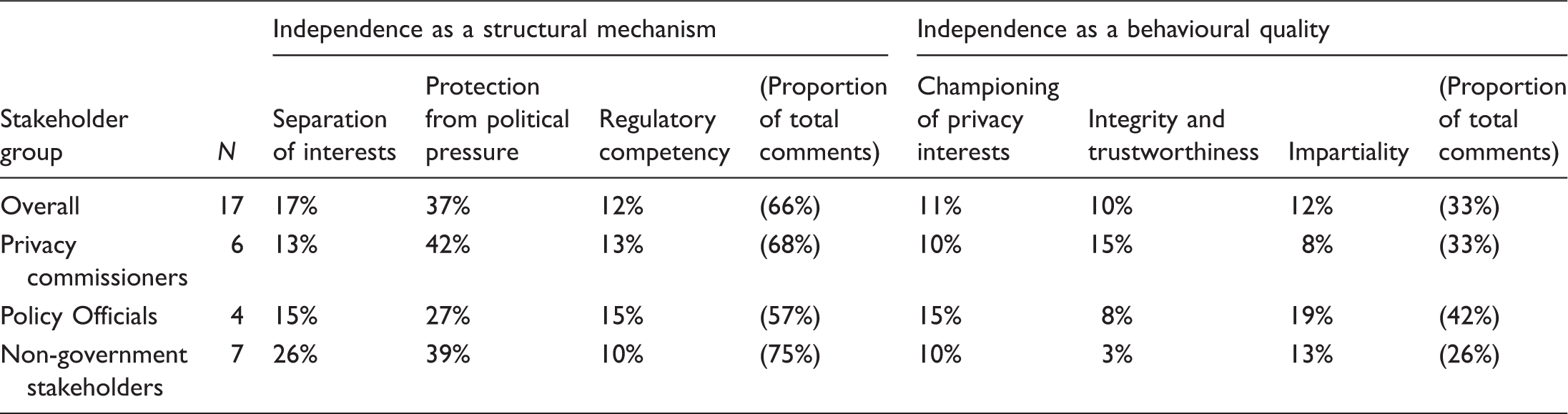
Proportion of comments coded for each theme of independence identified by stakeholders of the privacy (and information) commissions in Australia and New Zealand

Protection from political pressure
The most frequently referenced understanding of independence related to freedom from political pressure. That is, the ability to act and make decisions free from the restraints of current government policy or party-political considerations. As one stakeholder said ‘The promise of independence … is to be free from the influence of the government of the day. To be autonomous. Free from political issues’ (non-government stakeholder PN12). Independence is expected to insulate the commission from political changes and pressure from interest groups.
Separation of conflicted interests
Aligned with protection from political pressures was an understanding of independence as the absence of conflict of interest. Independence separates the powers between the commission and the executive government. A key aspect of agency work is the regulation of personal information held by government, the relationship between a privacy commissioner and other public officials is of utmost importance. The importance of independence as a means of removing any actual or perceived conflict of interest was keenly expressed by commissioners. The conflict of interest problem is expressed in terms of the relationship between different parts of the bureaucracy.
Regulatory competency: a capacity for dispute resolution
A third aspect of independence related to regulatory competency. Stakeholders emphasized the need for the commissions to be able to undertake all key regulatory tasks in order to be understood as independent. In particular this includes the competency to resolve disputes. This understanding relates to the capacity to resolve complaints and undertake compliance monitoring and enforcement action from within the commission. It is independence in the sense that the commission does not need to rely on another body to pursue regulatory action.
Independence is privacy championing
Education around privacy is a key role for each commission and features prominently in day to day activities. It extends beyond simply providing information about regulatory requirements to encompass advocacy for, and championing of, privacy rights. This includes the assessment of impact and provision of advice on major projects, proposed legislation and government policy. Stakeholders associated ‘championing’ with independence. It relates to the freedom to speak out and give priority to this one issue.
This theme suggests a level of personal commitment to privacy protection and identification may be necessary to be considered independent. One stakeholder expressed it this way: ‘I think the privacy commissioner was intended to be a proactive regulator. They did think they could shape this space for society, community confidence and be a guardian. I think that was the intention’ (non-government stakeholder PN09).
Integrity and trustworthiness
Stakeholders associated independence with protecting citizens and enabling them to be safely heard. As one stakeholder succinctly put it: ‘There has to be no possibility of retribution from government. Independence provides anonymity and protection from politicians and bureaucrats’ (policy official PD07). This suggests an understanding of independence as trustworthiness. Another statement referenced trust directly: ‘The promise of independence is public trust. Our culture would not trust an agency that was in the pocket of government. People need to be able to be confident to speak with us and know they will not damage their relationship with government’ (privacy commissioner PA14). Here a strong and deliberate connection has been made between independence and the trust of individual citizens. This suggests that an independent commission is one that takes responsibility. Independence in this sense may be observed in the way that the commission conducts itself in dealings with individual complainants and regulatees.
Independence means impartiality
Closely related to the notion of trusting relationships is the expectation that the commissions will behave in a fair and even-handed manner. Independence is understood as meaning that not only will commissions be depoliticized but they will also be impartial. Impartiality relates to the conduct of decision making not simply the material interests of the agency. The notion of impartiality is also closely related to concepts of justice. If for any reason a commission may be perceived to favour one party over another for any reason unrelated to the merits of the case, then justice will not be seen to be done. This goes to the general conduct and public statements of the commissioners as well as the resolution of complaints. It extends to more than simply political bias. Independence in this sense seems to relate to a standard of behaviour and commitment to a just and fair process. Impartiality is not simply related to the separation of powers but also to a commitment to values of fairness and justice.
Stakeholders
These six themes reflect the patterns of understanding among stakeholders. There was a high level of agreement about these themes of understanding and all stakeholders identified both structural mechanisms and behavioural qualities in their descriptions of independence. However, the findings suggest that internal and external stakeholders may differ in terms of the relative value they ascribe to structural and behavioural dimensions of independence and the themes they use to express this understanding.
The proportion of comments from interviewees related to the various themes of understanding of commission independence
Privacy commissioners and deputies
Four current privacy commissioners and two deputy privacy commissioners (described here simply as ‘commissioners’) were interviewed as part of this study. As a group, they most frequently made comments related to the theme of protection from political pressures or directions. This component of independence featured strongly in the views of all but one commissioner. The most frequently referenced behavioural quality for this group related to integrity and reassurance. Commissioners related independence to the behaviour of the agency in its dealings with complainants and regulated bodies. This suggests an understanding of independence that emphasizes structural separation of interests, protection from intervention by politicians and trustworthy behaviour on the part of the agency itself.
Policy officials
The interviewed policy officials, chosen because of their direct roles in the design and establishment of the privacy (and information) commissions, reported a broad view of agency independence and recorded the highest proportion of comments related to behavioural qualities of any group. In contrast to the commissioners and non-government stakeholders, 42 percent of comments from the policy officials referenced behavioural qualities of independence. In particular, advocating for the protection of privacy rights and the impartial investigation and resolution of complaints were emphasized.
According to policy officials, part of the original intent of establishing an independent privacy commissioner was to create a ‘privacy guardian’ able and willing to criticize both government and private sector actions, lead public debate on privacy and advocate on behalf of citizens. Indeed these were the ideas invoked by the New South Wales attorney general when introducing privacy legislation into the parliament. The role was described as akin to a ‘privacy champion’, ‘public advocate’ and ‘frank and fearless upholder of the law’ (NSW Attorney General, 2010).
Comments from this group emphasized fair and impartial decision-making as fundamental to the understanding of independence. One policy official indicated that there was a clear intention in the legislation that the privacy commissioner ‘exercise a degree of independent judgement’ to ‘resolve the relationship’ the individual has with regulated organizations (policy official PD07).
Non-government stakeholders
Members of the non-government stakeholder group were chosen to represent the views of both regulated businesses and the beneficiaries of privacy regulation. While it is a diverse group its inclusion provides an opportunity to access views of those stakeholders external to the formal government structures associated with privacy regulation.
The non-government stakeholders focused more strongly on a structural understanding of independence than any other group. Of the comments coded from this group 74 percent related to independence as protection from political pressures, separation of interests and regulatory competency. In discussions, this group expressed a strong and coherent understanding of agency independence, but also strongly believed that these structural mechanisms were effectively missing from current arrangements. Both advocates and stakeholders from regulated organizations pointed towards the potential for government control of the privacy commissions via restriction of funding and a revolving door between the agencies and government for key staff. According to this group a great deal more should be done to convincingly separate the interests of government from the privacy commissions and those whose privacy interests need to be protected. Referring to the collection and use of vast amounts of personally identifiable information by government, one stakeholder described the current structures as ‘one of the greatest cases of conflict between the objectives of those who want regulation and the public service’ (non-government stakeholder PN06). Presumably, agency interests also need to be separated from those of private sector regulatees but this did not figure highly in the responses from this group.
While the non-government stakeholders spoke most extensively about the structural mechanisms that underpin (or should underpin) commission independence, behavioural qualities were also important. The most frequently mentioned behaviour was impartiality: that is a demonstration of fair and even handed conduct. Of the coded comments 13 percent related to this component of independence. This proportion of comments related to impartiality is higher than that recorded for the commissioners. In this sense the group is expressing an understanding of independence as including commitment to a just and fair process. Impartiality is not simply related to the separation of powers and interests but also to a commitment to values of fairness and justice.
The priority placed on a structural mechanism of independence (particularly those relating to the separation of interests) by the non-government stakeholders raises the possibility of mismatched expectations between key actors in the field. It also suggests that a clear demonstration of the separation from direct and indirect control of government interests more than any other single factor will be a prerequisite for this group of stakeholders to endorse the independence of privacy (and information) commissions as credible and legitimate.
Independences, logic and stakeholders
Overall the findings reveal that independence is understood in at least two qualitatively different ways. First, stakeholders understand independence as a set of institutional arrangements that remove conflicts of interest, separate agencies from direct political control and provide a means of streamlining complaint resolution. Independence in this sense operates at a structural level and is a kind of institutional mechanism to separate power and interest. This reflects the dominant focus in the literature and the conventional view that independence is something provided to agencies when they are established.
Second, stakeholders also understand independence as a quality underpinning behaviour. This second dimension relates to the way each commission conducts itself in its work. So, rather than seeing independence as only about structural separation, this dimension focuses on the way each commission chooses to pursue its objectives and exercise its independence. It suggests that there must be a commitment on the part of the agency to values such as fairness, impartiality and openness before it will be considered independent.
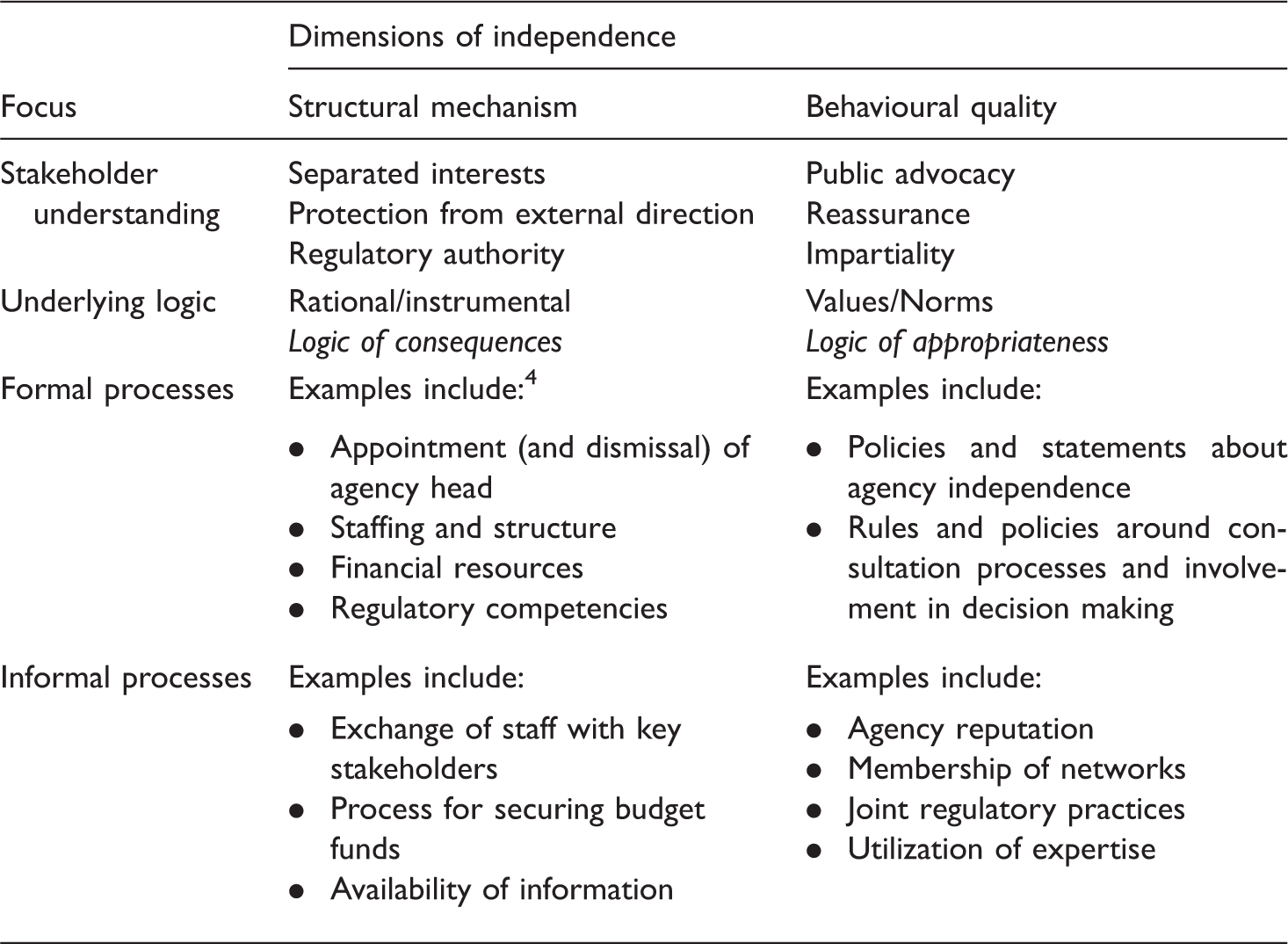
Dimensions of independence: a framework for understanding
Other studies have also identified the potential importance of agency behaviour in the understanding of independence (Carpenter, 2001b; Verhoest et al., 2004; Yesilkagit, 2004; Christensen and Laegreid, 2006; Groenleer, 2009; Roness, 2009; Verschuere, 2009). In particular, Carpenter (2001b) and Yesilkagit (2004) both offer models of bureaucratic autonomy that identify organizational capacity and culture and Groenleer (2009) includes organizational identity and leadership as factors in autonomy development. More recently, Maggetti (2012) has proposed a two dimensional framework for the analysis of independence that includes the development of unique agency ‘preferences’. Each of these models emphasize the importance of agency level behaviours and attributes in the development of independence. The findings here show the importance of the behavioural dimension also extends to the construct itself. Organizational identity, culture and other enduring qualities may be considered as expressions of independence not simply contributing variables. The particular behavioural qualities identified by stakeholders reflect the characteristics of the field and the roles of the privacy commissions. For instance, active promotion and advocacy of privacy protection is identified as a component of agency independence. While this is important in this field and can be understood in relation to the agencies' social justice role, it may not be expressed by stakeholders concerned with say, the regulation of electricity pricing. Similarly, qualities such as impartiality may be linked to field practices relating to the resolution of individual complaints. The issue is, however, not simply how the views of stakeholders impact the salience of these particular qualities (which may nevertheless be of considerable significance) but rather how they shape the understanding of independence itself. What constitutes agency independence in one field may be different from another.
What constitutes independence can also be described in terms of underlying logics. Structural independence can be understood as a rational means of optimizing the institutional arrangements to address a problem defined in terms of interests and power. The behavioural dimension of independence, however, is connected with broader social goals such as protection of rights, public trust and social justice. The expectations that independence makes an important contribution to the commissions' capacity to ‘champion’ privacy interests, engender public trust and maintain impartiality may be more about symbolic performance and the intrinsic value placed on independence. These characteristics operate according to a logic of appropriateness rather than a logic of consequences (March and Olsen, 2006). These two logics are not incompatible but do evoke different means for the realization of independence.
For instance, the structural dimension relies on means originating in the agency's environment such as delegations, appointment processes and resourcing. These factors involve actors outside the organization 3 and to a large extent are outside the agency's control. In contrast, the behavioural dimension depends on factors largely expressed at the organizational level that involve internal actors and local practices. While these two levels of operation reference factors that may be within the agency's control and some that are not, this distinction should not be confused with the more familiar notions of formal and informal independence. Formal independence relates to the statutory provisions that constitute agencies (Gilardi, 2008; Gilardi and Maggetti, 2011). While these rules originate in the broader institutional context, so do many informal pressures related to independence (Maggetti, 2007, 2012). As can be seen from Table 3, it is possible to identify examples of formal and informal aspects of structural independence and formal and informal aspects of behavioural independence.
The findings also indicate a variation in beliefs and expectations between stakeholder groups. Depending on the level of variation this has the potential to introduce confusion to normative pressures. Seo and Creed (2002) also suggest that an accumulation of contradictions may even provide a potential source for actors to challenge the legitimacy of otherwise taken-for-granted arrangements. The present study has identified the presence of variation between the groups but is limited in its ability to draw conclusions about the size and consequences of the disparities.
Conclusion
Part of the ‘magic’ of independence may be that it has come to be associated with a wide range of practices. In this particular field, stakeholders have emphasized that independence includes structural mechanisms and behavioural qualities. This characterizes independence as something that is co-produced by rules and resources (the structural mechanisms) and organizational responses (the behavioural qualities). Viewed from the perspectives of stakeholders, structural mechanisms such as providing protection from political direction and separating interests are important but still not sufficient when considering independence.
The use of stakeholder views and opinions to build a normative understanding of independence has practical and analytical implications. At an applied level it has the potential to reveal which aspects of practice are likely to be valued by participants and influential as sources of legitimacy. It identifies the importance of understanding independence at both the field and agency levels, and suggests from a practitioner viewpoint that taking care to embed principles of procedural fairness, transparency and professional conduct into the regulatory process may directly enhance the identity of the agency as independent. At an analytical level, these findings build on previous conceptualizations of agency independence and extend them by showing how agency context, and in particular stakeholders, may shape not only the development of independence but the understanding of the construct itself. From both perspectives, the study demonstrates the potential of considering independence in a way that is not inherently tied to factors outside the agency's control.
This article has presented an understanding of agency independence from the perspective of stakeholders in the field of privacy governance. It has identified dimensions and themes that are meaningful to them. The resulting framework provides a means of incorporating and organizing different accounts of independence. While the content of the themes is grounded in the particular context of this case study, the overall findings and approach may have wider applicability as a basis for comparative studies. A logical next step is to explore how these normative expectations are given expression in different fields and the consequences this may have for understanding what it means to be an independent agency.
Footnotes
Acknowledgements
I would like to thank Martino Maggetti, Christopher Walker, Koen Verhoest, Michael Johnson and the two anonymous reviewers for their encouragement and valuable comments on earlier versions of this article.
Funding
This research received no specific grant from any funding agency in the public, commercial, or not-for-profit sectors.