




Abstract
Given the complex decision-making that goes into policy choices for regulatory regimes, it would seem intuitive that such regimes might develop under distinct national styles. By revisiting several historical models of regulatory development, including Bernstein's classic life-cycle model, and then by analyzing six case studies from the US and UK, for example, we explore the possibility that regulatory regimes vary more prominently along the temporal dimension rather than along spatial ones. We conclude that regulatory regimes have similar developmental patterns, although the time spent at each stage in the process can vary significantly according to unique domestic factors.
Points for practitioners
Existing theories of regulation would suggest that regulatory activity should either follow identical development trajectories in different countries or it should be entirely idiosyncratic in every jurisdiction in which it is used. Clearly neither is true, as some regulatory regimes display similar qualities and development patterns, while others appear to be unique. A comparison of regulatory activities in the US and UK reveals that regulatory regimes in these countries develop through similar stages along similar pathways, but that the rate of development and the transition through the stages can occur at different speeds. This development is mainly stimulated by periodic crises that force changes in regulation.
Introduction
Variations in state–market interactions can range from the minimal state activity involved in the protection of property rights identified and favored by classical political economists (Dobb, 1973) to more sophisticated state leadership – as in the creation of rules for the sale and exchange of goods and services or their attributes (Salamon, 2002). Regulatory regimes are a temporal manifestation of this relationship and specify the limits and boundaries of more or less long-term state–market interactions (Senn, 2011). 1
Given the number of possible variations in regulatory configurations (Berg et al., 2000; Wu, 2008) it is well known that regulatory regimes vary substantially spatially – across different jurisdictions and policy sectors – and at any given point in time, regulatory activity in different locations can appear to be quite dissimilar (Bollhoff, 2002; Brewster and Goldsmith, 2007; Jasanoff, 1990; Lodge, 2011). That is, different countries adopt similar or different types of regulation, or select various configurations of elements in their regulatory arrangements, and this can result in distinct national or sectoral differences in regulatory style, process and content (Freeman, 1985; Kagan, 1991, 2001; Knill, 1998).
However, while regulatory activity can vary from one jurisdiction or sector to another, it is also possible that regime development contains a temporal element as well. That is, that a general pattern of evolution exists for all regulatory regimes, irrespective of location or policy area. In other words, although regulatory regimes may often appear to vary across space, the real variance may actually be occurring across time with differences attributed to different jurisdictions and sectors being more a manifestation of the different temporal stages in which different jurisdictions or governments find themselves. That is, much variance in regulation across space can be regarded as a reflection of key factors that affect the temporal development of a particular regulatory regime, rather than as resulting from the idiosyncrasies of a specific jurisdiction. 2
Until recently only a very few studies dealt in a sophisticated and empirically robust manner with the years immediately following the establishment of a regulatory regime – see for example the excellent recent study of the origins and early evolution of the US Food and Drug Administration (FDA) in Carpenter (2010). This comes in spite of the widespread finding in the literature that understanding the early phases of regulatory regime evolution and development is crucial in understanding their later functioning (Howlett, 2011).
While some early work on regulatory regime formation (Bernstein, 1955) provided a model of the temporal development of regulatory regimes, it was not precise enough about the various stages of regulatory regime genealogy to allow observers to be able to highlight and isolate temporal differences from spatial ones. In what follows below it is argued that by clarifying the stages of the creation of a regulatory regime – especially those early stages which set the foundation for the later characteristics of the mature regime – it is possible to provide a more precise and testable model of regime development which allows the question of temporal versus spatial variations to be assessed.
After deriving this model, six cases of regulation in a variety of policy areas in two countries are explored in order to illustrate the temporal dimension of regulatory development. We conclude that although regulatory regimes may proceed through similar stages of development, and in a similar order, the length of time spent at each stage can vary substantially due to exogenous forces in the form of public crises or emergencies which are necessary to motivate the progression to the next stage of development. Thus both spatial and temporal factors are found to affect regime development, rather than the exclusively spatial ones most existing literature relies upon to explain this phenomenon.
The temporal dimension in the evolution of a regulatory regime: the idea of a generic regulatory life-cycle
Bernstein's (1955) canonical book on independent regulatory commissions is widely known for its treatment of ‘capture’, in which a regulatory regime is controlled by the firms or industry that it is meant to regulate. However, it is often not recognized that ‘capture’ was a characteristic Bernstein associated with a particular late stage of a regulatory agency life-cycle, one in which original public interest motivations in creating a commission had been overtaken by routinized interactions between regulators and regulatees. Over many years, Bernstein argued, mutual work relationships and exchanges of personnel led to blurring of the public/private interest divide and could result in an agency transforming itself slowly until it came to represent more the interests of regulated firms and actors rather than the public interest per se.
Hence, in his work Bernstein proposed the first temporal model of regulatory regime development, one based on an analogy to a human life-cycle in which regulation is seen to pass through stages of gestation, youth, maturity and old age. Although Bernstein did not develop this insight systematically, the idea that there is a generic pattern of regulatory evolution – independent of nationality, sector or historical period – has proved to be alluring, and other students of regulation, de-regulation and, more recently, re-regulation have used similar concepts to analyze temporal patterns in the evolution of regulatory institutions and processes (Eisner, 1994). However, for a number of reasons the use of only a four-stage model of a regulatory life-cycle has proven problematic and has kept the idea out of the regulatory studies mainstream.
In Bernstein's (1955: 74–95) human life analogy, regulation begins with a period of ‘gestation’, in which a problem is recognized by stakeholders and public authorities, but no action is taken beyond the initial organization of advocacy efforts. In the next ‘youth’ stage, an autonomous regulatory agency or an independent regulatory commission is granted rule-making powers by the relevant public authorities. In this stage, the newly-created regulatory body will actively seek to define its role in the developing regime. Subsequently, the regime will enter a stage of ‘maturity’, in which ideological positions are frozen, roles are implicitly or explicitly defined, and functionality of the regime is more mechanical and less controversial. And finally, the regime will fall into a stage of ‘old age’, in which it is often captured by the industry being regulated before being reformed or replaced.
Many questions exist about what drives regulatory development through these stages, and only these stages, and in this particular order. For example, Bernstein's ‘youth’ stage – and especially the creation of an autonomous regulatory agency –has been studied extensively, particularly by critics of regulation who raise fundamental questions about its value to society (Posner, 1974; Stigler, 1971); likewise, the ‘old age’ stage, and particularly regulatory capture, has been explored by numerous authors who argue capture may occur earlier in the process or may be built into it from the start (Carpenter, 2004; Kahn, 1970; Stigler, 1975; Sunstein, 1991). In general these various works suggest that the stages of development have not been adequately analyzed either individually or as a whole, and a generally accepted temporal model of regulatory regime evolution has yet to be put forward.
For greater explanatory value, such a model would need to focus more on the time elements involved in regulatory development, such as how long a regime would be required to spend at each stage, and the factors that control the transitions between stages.
In developing such a model, it should be noted that Bernstein's is not the only model of regulatory regime development which incorporates a temporal dimension. In analyzing environmental regulation, for example, Otway and Ravetz (1984) proposed a three-stage model of development in which, first, regulation passes through a ‘scientific’ phase when a problem is acknowledged and scientific data are collected, but no further action is taken. Then, the regime enters a second, ‘technical’ phase in which the substantive elements of regulatory activity are developed, including the numerical limits associated with various hazards. And, lastly, in the ‘administrative’ phase, the regime is implemented by applying codes enforceable by punishments and rewards. According to Otway and Ravetz this last stage is iterated and improved through experience.
This model offers some more depth to Bernstein's model by clarifying the early stages of regime construction by defining stages according to the regulatory activity required by that particular period of regime evolution. However, the Otway and Ravetz model does not account for the agency of actors within the regulatory regime and instead suggests a more or less linear pattern for regime development based on its attaining the functional prerequisites for effective ‘command and control’. This would imply that all regulatory regimes develop in the same way or at the same rate, which can easily be shown not to be accurate in all cases.
In his study on risk regulation, Leiss (2001) proposed a less functional agency-oriented model based on the changing nature of the regulatory responses from public authorities that occur at each stage. This has the effect of dividing Otway and Ravetz's ‘technical’ phase into two sub-stages: an ‘early’ stage in which authorities attempt to downplay the scope of the hazard under examination; and a ‘middle’ stage in which the hazard is properly acknowledged but a struggle ensues for control of the political debate surrounding regulation. Leiss's model represents an improvement over both the Bernstein and the Otway and Ravetz formulations in that it acknowledges the different roles played by public authorities and private actors in determining the course of development of a regime. Furthermore, Leiss also gives a timeline for the duration of each stage: he asserts that the ‘early’ stage can last for ten to fifteen years while the ‘middle’ stage can pass by slightly faster at five to ten years. In contrast, Leiss's ‘mature’ stage can last for several decades.
Combining Bernstein-type labels with the additional stages identified by Leiss and Otway and Ravetz generate a model of a regulatory life-cycle which includes an additional stage missing in Bernstein's early formulation. That is, the work by Leiss and Otway and Ravetz can be regarded as filling in a missing gap between Bernstein's ‘gestation’ and ‘youth’ stages of development: to continue the human life-cycle metaphor, by adding a stage of ‘childhood’ missing in Bernstein's original formulation of a generic model. The model is also enhanced the provision by Leiss and Otway and Ravetz of additional detail on the regulatory issues and activities involved in Bernstein's idea of a ‘youth’ stage of development – in particular, their association of activities at this stage with the development of standards.
Using a similar model, Howlett and Migone (2012), based on work such as that by Borraz (2007a, 2007b), also investigated the early ‘childhood’ stage of development in nascent contemporary bio- and nano-technology regulatory regimes and identified an additional stage in this early period in which, at first, regulators attempted to fit a new problem into an existing framework of rules and laws, engaging in ‘adaptive experimentation’, often while also exhorting regulatees to modify their own behavior through voluntary limits. They labeled this the ‘infant’ stage of development and argued that only if this early effort failed to address a recognized problem would it be followed by the process of ‘standard-seeking’ identified by Leiss and Otway and Ravetz (see also Majone, 2010). In addition, Howlett and Migone postulated a ‘death’ or termination stage that would account for de-regulation and other forms of policy termination (Daugbjerg, 1997; deLeon et al., 1978; Derthick and Quirk, 1985; Lewis, 2002).
Combined seven-stage model of the regulatory regime life-cycle
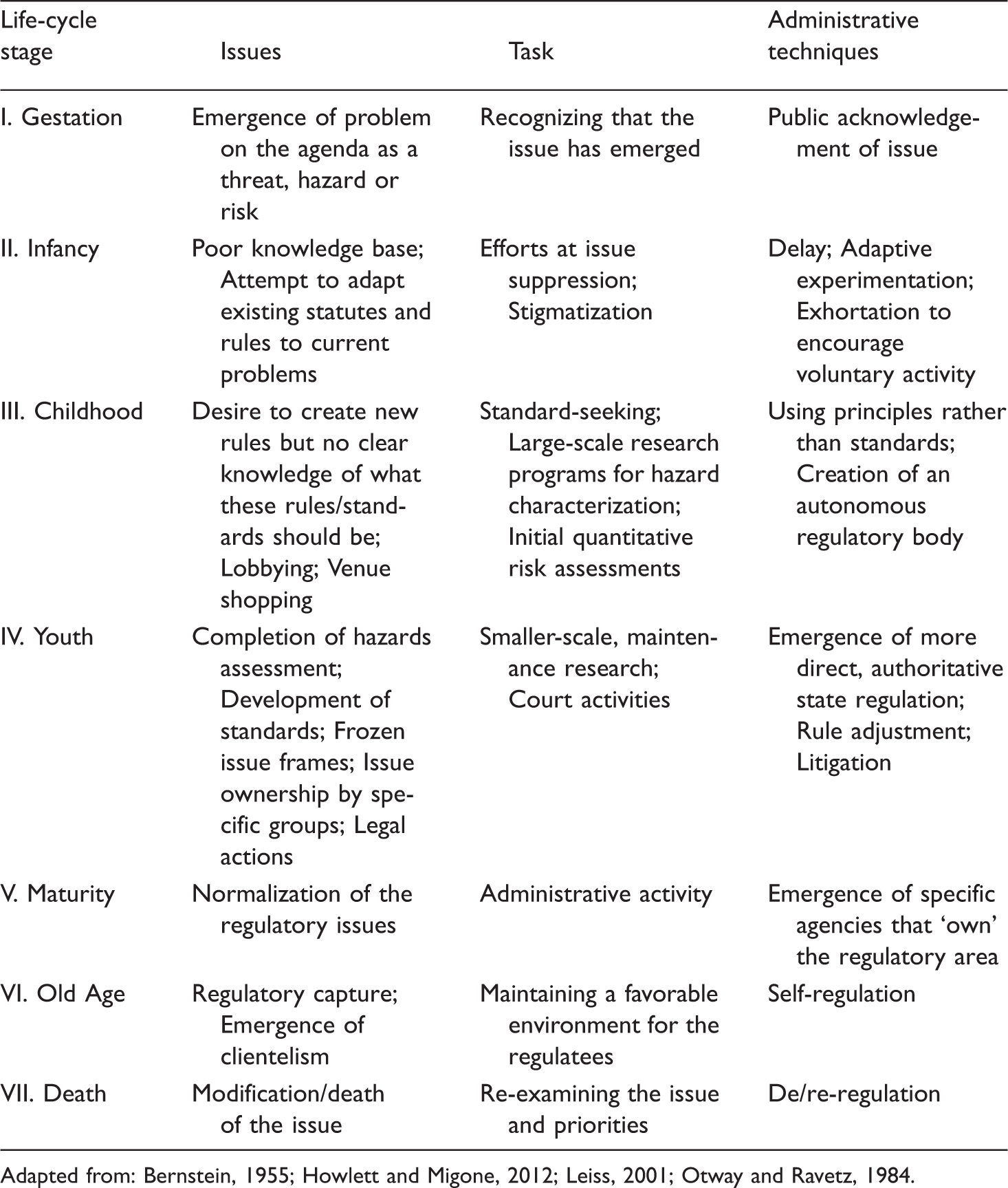
Adapted from: Bernstein, 1955; Howlett and Migone, 2012; Leiss, 2001; Otway and Ravetz, 1984.
It is acknowledged that the pattern of regulatory evolution put forward by this combined model is not an automatic process of progression through the stages once an initial trajectory has been established; but, rather, that stages may take varying amounts of time to complete and the process of development may stop at any point in a regime's evolution and even reverse itself – as happens with de-regulation, for example. While political actors within regulatory regimes may have considerable agency in decision making, as noted above, it is likely that exogenous forces ultimately control the timing and sequencing of regulatory regimes – in other words, that time is more of an independent than a ‘dependent’ variable. This is because, as Leiss (2001) has argued, public authorities are initially reluctant to impose regulation. In many sectors, especially in areas of risk regulation, it is therefore plausible that for a regulatory regime to emerge, a hazard must not only be identified as a policy problem but must also have tangibly manifested itself in the form of a public crisis or emergency, in order to force the hand of decision makers (Howlett, 2012). This conforms to theories that argue that public crises are instrumental in turning unappealing policy options into active policy agendas (Birkland, 2006; Henstra, 2011). Seen from this perspective, regulatory regimes will pass through the same stages in the same order, but the duration of the various stages will be controlled by exogenous factors such as high-profile public crises.
Testing the genealogical model of regulatory regime development: six case studies
In order to test the application of the model against real-world experiences, six historical cases of regime development were analyzed using sources found in the existing secondary literature. The cases chosen cover a range of diverse topics, jurisdictions, time periods and processes in order to maximize the possible variations and permutations which any general model must cover.
The cases selected for the study cover automobile safety, prescription drugs, genetically-modified organisms (GMOs), food safety, occupational health and safety and regulations banning dangerous dogs. These involve different industrial and technological sectors, as well as two different countries (US and UK) over various time periods, as well as issues with different levels of public prominence. This allows us to control for variations in political culture, social mores and national idiosyncrasies among other significant attributes of regulatory contexts highlighted in the existing literature on the subject. Four of the cases involve regimes that have completed their journey to maturity (automobile safety, prescription drugs, food safety and occupational health and safety); and two of the cases have not (GMOs and dangerous dogs), which helps to control for censoring issues in examining temporal cases.
Case 1: Automobile safety in the United States
Before 1950, automobile safety in the US was considered to be the responsibility of the driver. However, during the 1950s some legal precedents were set in which manufacturers were deemed responsible for damages in car accidents (Leonardi, 2010: 257). This formed the gestation stage of the current auto safety regulatory regime. The hazard of deaths and injuries attributable to automobile design had been identified, but US governments had not yet begun to investigate possible strategies for legislative or regulatory action in an attempt to solve the problem.
From 1960 to 1965, US auto safety regulation entered a period in which the problem of unsafe vehicle designs had been acknowledged but regulation had not yet been implemented or even strategized. During this time, governments were reluctant to impose binding rules and exhortation to voluntary self-regulation was the primary strategy for addressing the problem. Optional safety packages were available to the consumer, but they were unpopular (Claybrook and Bollier, 1985: 92–95).
Furthermore, government attempts at regulation in this time period were mainly focused on adapting existing jurisdictions and rules, without thought being given to the creation of new standards or a new regulatory agency to enforce them. For example, although it managed to pass in 1962, Congressman Kenneth Roberts’ bill to regulate the chemical consistency of brake fluid met with considerable opposition because at that time motor vehicle regulation was considered to be within the domain of the states (Lee, 1998: 397). This period thus is characteristic of the ‘infant’ stage of development identified above.
In 1965, Senator Abraham Ribicoff initiated the ‘Federal Role in Traffic Safety’ congressional hearings, which brought to light a great deal of data on the dangers of driving in America – including the fact that car crashes were by then the primary non-natural cause of death in the United States and that the number of fatal crashes was rising (Chirinko and Harper, 1993: 270; Claybrook and Bollier, 1985: 95; Leonardi, 2010). Ribicoff's congressional hearings and Ralph Nader's 1965 book, Unsafe At Any Speed, precipitated the creation of the National Highway Traffic Safety Administration (NHTSA) in 1966; and by 1968 federal automobile safety standards were being enacted (Claybrook and Bollier, 1985: 96; Peltzman, 1975: 678). From 1965 to 1968, then, auto safety proceeded into the childhood stage, in which the development and promulgation of standards and then the creation of an autonomous regulatory agency occurred.
After 1968, the automobile industry settled into a period of experimental regulation, such as the 1974 ruling that all new cars must have ignition-interlocked seatbelt mechanisms, or dashboard airbags, or both – a regulation that was soon to be repealed due to public disfavor and industry pressure (Graham, 1984: 143). Experimental regulation is a typical feature of the youth stage of regulatory development, one which this regime had advanced by the early 1970s. Thereafter, as courts clarified roles and responsibilities of the different regime actors, the system entered into its current ‘mature’ stage.
Case 2: US prescription drugs
This same pattern fitting the seven stage model set out above can be observed in a much earlier case in the US, that of regulation pertaining to prescription drugs. In the 1890s, for example, there was a growing concern in the US that chemical additives to food products might have negative health effects. Temin (1985: 434) argues that although the Pure Food and Drug Act of 1906 was enacted to enforce truth in product labeling and advertising, there is reason to believe that the passage of the Act was precipitated by evidence that some food additives were poisonous. Although it mainly pertained to food items, the law – as the name implies – was applicable to medicine as well and it set the stage for later regulation of medication (Schwartz and Goldberg, 2005: 138). From the 1890s until 1906, therefore, the regulation of medication was in its gestation stage of development, in which time there was growing acknowledgement by experts in the field that consumables might have adverse health effects; but no effective government action was taken.
The 1906 Pure Food and Drug Act enforced labeling on medication but did not regulate its distribution. During this time, there was no regulatory body charged with oversight of the industry and pharmaceutical manufacturers were only required to label the ingredients on their products, not to test products for toxicity (Schwartz and Goldberg, 2005: 139). This would have been the infant stage of regulatory development for pharmaceuticals, in which some reluctant action was taken but did not impose onerous requirements on manufacturers.
In 1937, however, Masengill's Elixir Sulfanilamide, which turned out to be highly toxic, killed over 100 people who purchased the product and used it as directed. Because there was no stronger regulation in place, the US federal government was only able to sue Masengill under the 1906 Act for mislabeling its product (Carpenter, 2010; Temin, 1979). This is a typical outcome of the infant stage of regulation, in which existing rules must be adapted to new circumstances. Although it had been created in 1930, the US FDA was not given the power to regulate the manufacture and distribution of medication until the Food, Drug and Cosmetic Act of 1938 was enacted (Schwartz and Goldberg, 2005: 138). After 1938, the FDA became highly active in regulating these activities (Schwartz and Goldberg, 2005: 139; Temin, 1979: 97). This represents the childhood stage in the regulatory regime's development.
As with the 1965 crisis in automobile safety, it was the 1937 Elixir Sulfanilamide incident that created the sense of a major public emergency, in this case in the regulation of medicines. The 1938 Act that empowered the FDA had actually been proposed in 1933, but languished at the committee level for five years before the Elixir Sulfanilamide debacle prompted its enactment (Carpenter, 2010; Temin, 1985: 435).
By the end of the 1940s, several court cases had secured the FDA's power over pharmaceutical manufacture and distribution (Carpenter, 2010; Temin, 1979: 100). During this time, the regulatory regime was engaged in judicial action that helped to solidify the roles of industry and of the regulatory body – as would be expected, as the regime emerged from the youth stage of development to a mature one.
Case 3: GMOs in the US
The model also holds in a more recent case, that of the regulation of genetically modified organisms (GMOs) in the United States from the time when techniques in this area were first developed in the 1960s. Although some discussion on the possible health hazards of GMOs took place in the 1970s, no regulatory action was taken during this time (Marden, 2003: 737; McHughen and Smyth, 2008). This marked the beginning of a gestation period as the US federal government began to take notice of the development of GMO technology but did not decide on a strategy or a even a need for regulation.
After 1980, the National Institutes of Health released guidelines for GMO exposure to the environment, but no legally binding rules were enacted (Shapiro, 1990: 13–14). This is typical of the infancy stage of regulation: a reluctance to regulate on the part of the public authorities, leading to the emergence of voluntary rules rather than regulation enforceable with punishments and rewards.
Unlike with the two earlier cases cited above, however, GMO technology in the US has not experienced a public crisis or emergency that could stimulate the creation of a central regulatory agency. The field has therefore stalled, for the time being, in the infancy phase. Currently, the FDA, the federal Environmental Protection Agency, and the US Department of Agriculture are all empowered to make rules regarding genetically modified crops. Without a central regulatory body responsible to binding legislation, the regulatory regime must rely on existing laws and voluntary actions for regulating GMOs (Marden, 2003).
Case 4: Food safety in the UK
Prior to 1980, food safety regulation in the UK was in a period of gestation. While there was some concern over potential safety hazards, policy was directed by the Ministry of Agriculture, Fisheries and Food (MAFF) on an ad hoc basis, with no consistent guidelines or enforceable regulation (Lang et al., 2001). In some cases, private sector corporations contributed directly to the formulation of policy in their areas of activity (Millstone and van Zwanenberg, 2002). Although during this time there was growing awareness of the potential need for food safety regulation, no definite action was taken.
Between 1980 and 1995, however, several contamination scares in eggs, dairy produce and other British food products prompted MAFF to take action, but their response was indicative of a reluctance to impose binding regulation on industry and no major changes in policy direction resulted from these efforts (Millstone and van Zwanenberg, 2002: 601). This conforms to the infant stage of regulatory development, in which attempts are made to create new regulations using existing legislation.
In 1996, however, a major crisis shook the regime when the UK government acknowledged that bovine spongiform encephalopathy (BSE or, more familiarly, ‘mad cow disease’) was linked to the fatal variant Creutzfeldt-Jakob Disease in humans and that it was likely that human deaths from the disease were linked to consumption of British beef products (Gerodimos, 2004). In response, the government created the Food Standards Agency and empowered it through legislation to enforce food safety standards. This new regulatory body has behaved thereafter very much as would be expected of an agency in the childhood and then youthful stages of regulatory development. It embarked on a program of defining its role in a nascent regulatory regime, which has included an activist agenda of rule enforcement that, together with an awareness campaign and funding for new scientific research, resulted in a decrease in food-related illness in the UK (Krebs, 2004: 391).
Case 5: Occupational health and safety in the UK
In the gestation period of the occupational safety regulatory regime in the UK, which lasted until 1970, there was documented knowledge of hazards in the workplace, but no action was taken to mitigate the risk to workers. For instance, in the 1960s, 300,000 workplace accidents and 600–700 deaths were recorded each year (Beck and Woolfson, 2000: 37), but no regulation was enacted during this time.
In 1970, Parliament set up the Committee on Safety and Health at Work, also known as the Robens Committee after its chair, to investigate potential ways in which the government could address workplace safety from a regulatory perspective (Howells, 1972). The committee, which reported in 1972, did not lead to the imposition of enforceable regulatory rules – in fact, the report of the committee recommended a more flexible legislative framework with fewer rules and direct collaboration between employers and employees for individualized workplace agreements (James and Walters, 2002). The actions later taken by the government reflected this attitude, because the guidelines that were enacted subsequent to the publication of the Robens Report were not binding or enforceable (Irwin et al., 1982). As we have seen, this is exemplary of the infant stage in the lifecycle of a regulatory regime, where public authorities are hesitant to impose binding rules and instead resort to adapting existing legislation to deal with regulatory problems.
However, after 28 people were killed and 36 injured in an explosion at a chemical processing plant in Flixborough in 1974 (Sadee et al., 1977) the government moved quickly to create a regulatory body called the Health and Safety Executive. This initiated the childhood stage in the regime's development, in which an active agenda of rule creation was pursued and the roles of actors within the regime became more clearly defined (Irwin et al., 1982; James and Walters, 2002). This was followed in the 1980s by the youth stage, in which roles became solidified and regulation was incrementally expanded (Baxter, 1986) until the regime reached maturity in the 1990s.
Case 6: Dangerous dogs in the UK
This final case examines regulatory actions pertaining to dangerous breeds of dogs in the UK in the late 1980s. Dog breeds that were regarded as dangerously aggressive were banned on an ad hoc basis in the midst of a small number of high-profile incidents. Significantly, however, an autonomous regulatory body was commissioned in the UK during this time and no clear standards were set for action, with regulation remaining in the gestation phase (Lodge and Hood, 2002). The Dangerous Dogs Act was given Royal assent in 1991; however, the legislation has been criticized as being ineffective and unenforceable (Baldwin et al., 2000; Hood and Rothstein, 2001), which is consistent with regulatory activity in the infant stage of development.
The case of dangerous dogs is a good example of what can happen when a public authority attempts to force a regulatory regime to advance through or even skip stages of the regulatory life-cycle without having the necessary level of public or regulatee support for so doing. After beginning the gestation period in the 1980s, many western European countries tried to impose regulations on dog breeds, even though there was not enough statistical data or public outrage to constitute an actual crisis (Lodge, 2001). In the absence of a crisis the regulatory regime stalled.
Analysis: summary of cases and key findings
Summary of empirical examples
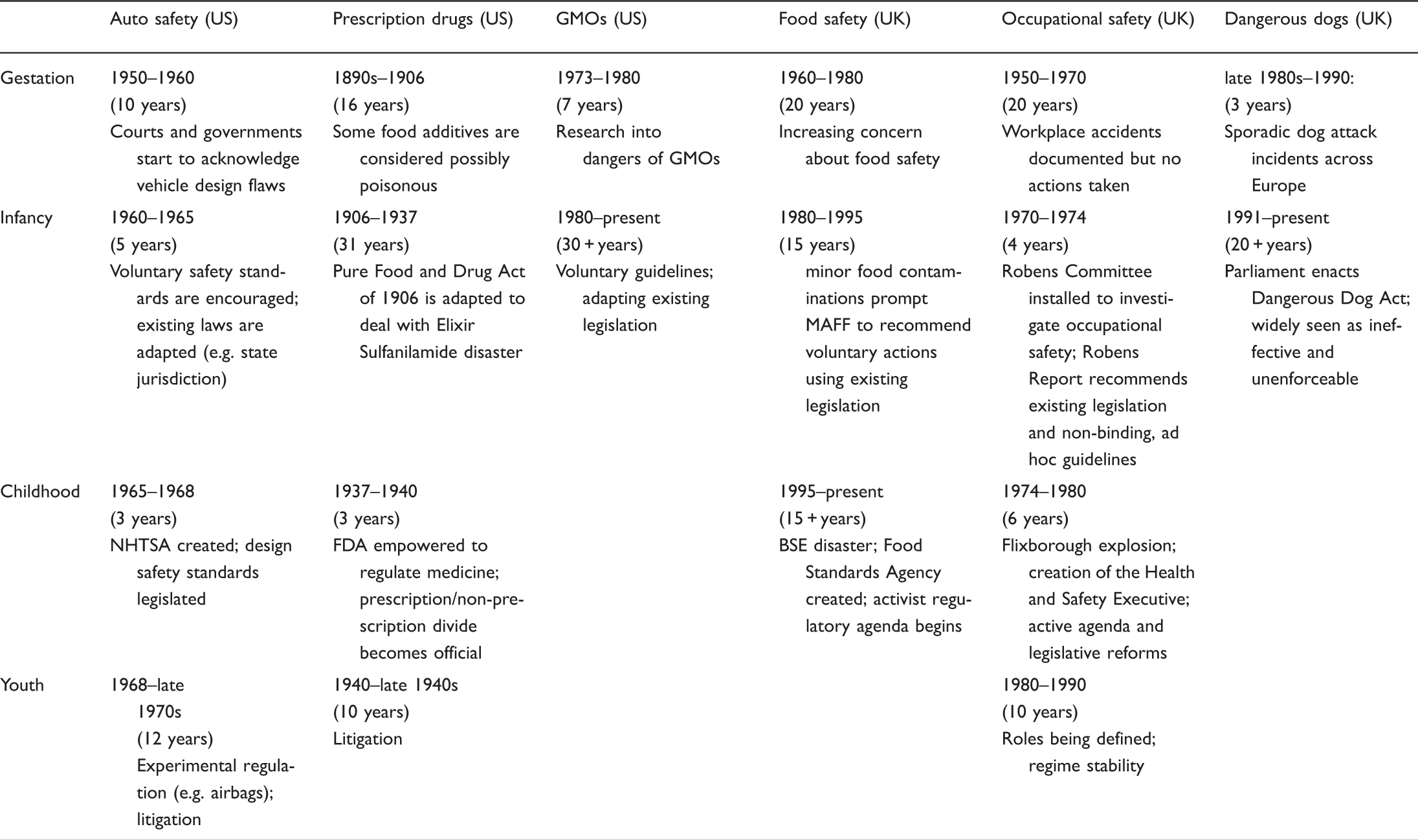
This shows, first of all, that each of the various case studies of regulation followed the same general path of regulatory development as set out in our model, despite wide diversities in national origin, sector and historical period covered. This supports the hypothesis that, as Bernstein (1955) suggested, there is a general model of regulatory regime development and that it is one based on hazard recognition and standard-setting, as Otway and Ravetz (1984) and Leiss (2001) argued. Secondly, the case studies show that not all regulation completes its journey to maturity and the length of time at which a regime can remain at a particular stage can vary substantially, as Howlett and Migone (2012) suggested.
With respect to this last point, the case studies suggest that an important factor in all the cases is the presence, or absence, of repeated crises which, when present, contribute to driving the regime to the next level or stage of development by undermining the belief or claim made by either or both public and private actors that existing standards and hazard definitions are adequate to deal with the hazard in question. Without a high-profile public crisis, either real or perceived, as the cases of GMOs and dangerous dogs show, a regulatory regime will fail to move to the next higher stage of development. This status quo is upset by the re-emergence of the same hazard or a new one, causing new and more onerous and encompassing standards and definitions of hazards to be developed.
Similarly, a key factor which keeps a regime in equilibrium at the mature stage is a set of rules institutionalized in a regulatory agency and law, the creation of which is a crucial factor for attaining regime maturation. This typically emerges in the childhood stage of development and develops its own identity and impetus through actions and court decisions in the youth stage, which solidify its mandate and powers. In the cases in which a crisis failed to propel a regime to a mature stage, no regulatory body was created and the regime did not move beyond its pre-existing stage of regulation. This is an important consideration, especially in light of the fact that both the Otway and Ravetz and Leiss models do not make mention of the institutionalization of a regulatory body as a fundamental element of the regulatory development process. Thus the utility of this revised model is that it incorporates the importance of the creation of a regulatory body as per Bernstein in addition to the necessary technical and scientific evidence gathering that dominates the early stages of regulatory activity as demonstrated by Otway and Ravetz and Leiss.
Conclusion
Producing an accurate depiction of the typical pattern of regulatory regime development is an important step in understanding the forces driving its evolution in general and in specific spatial and historical settings. While some authors have attempted to explain differences in regulation by focusing on more or less idiosyncratic national characteristics such as culture (Bernauer, 2003), others have tried to explain noticeable similarities in such regimes through recourse to transnational effects such as global pressure towards similar regulation (Kinchy et al., 2008; Murphy and Davidow, 2006). However, it is also possible that many of the purported differences between regimes may be more perceived than real, because authors have been examining regulatory regimes at different stages of development – reflecting not a spatial, but rather a temporal, source of diversity (Graham, 1993; Jordana and Levi-Faur, 2004; Keller, 1981; Majone, 1997).
The model presented in this article presumes a stepwise linear developmental process for regulatory regimes, but it acknowledges that the stages of progression may vary in duration from one regime and location to another. This variance primarily represents temporal differences rather than spatial ones, however. That is, the impetus for movement between the stages of development depends on the appearance of exogenous forces in the form of periodic crises that put pressure on authorities to respond with substantive policy action.
In other words, our case studies demonstrate that crisis is an important driver of change in regulatory regime development. This is a somewhat surprising conclusion, because it runs contrary to an otherwise particularly convincing school of thought that crisis and reform are mutually antagonistic (e.g. Boin and ’t Hart, 2003). However, a great deal of scholarship has in fact linked the advent of crisis situations with general policy change (see, for example, Cortell and Peterson, 1999; Keeler, 1993; Kingdon, 1984; Krasner, 1984). The determination of the precise role of crisis in effecting policy change is therefore likely to be an avenue of future research with rich potential.
Footnotes
Funding
This research received no specific grant from any funding agency in the public, commercial or not-for-profit sectors.