



Abstract
How should we conceptualize major institutional and policy changes that take place in the absence of crises, shocks or big bangs? This article uses the case study of tobacco policy (in 23 democracies) to highlight the concept of phased transition towards paradigm change. It recognizes the importance of fundamental policy change while going beyond the binary distinction between the world at one point in time replaced by a fundamentally new political world in the next. It uses multiple measures of policy change over time to identify the magnitude and speed of change and considers how the current literature conceptualizes such outcomes.
Points for practitioners
Major policy change need not be associated solely with crisis or a major event. Rather, it can follow a series of steps or phases during which a series of key factors change and those changes reinforce each other to produce momentum. The case of tobacco control highlights the potential for relatively coherent policy change over three decades.
Introduction
How should we conceptualize major institutional and policy changes that take place in the absence of crises, shocks or big bangs? The effect of such events on institutional and policy change is well documented in the political science and policy analysis literature. However, major studies of ‘punctuated equilibrium’ also highlight their rarity: a very small number of major changes are accompanied by a very large number of small changes (Baumgartner and Jones, 1993, 2009; Hall, 1993). Further, we can identify a trend in the literature to seek new ways to conceptualize, and account for the pervasiveness of, non-punctuated change with profound long-term results, including: ‘punctuated evolution’ (Hay, 2002: 163); ‘gradual change with transformative results’ (Streeck and Thelen, 2005: 9) and ‘gradual but profound’ change (Palier, 2005: 129).
In that context, this article highlights the concept of phased transition towards paradigm change. ‘Paradigm change’ involves a fundamental shift in the way that policymakers understand and address a policy problem. ‘Transition’ refers to the importance of fundamental policy change in a series of phases (or eras, which are often decades apart) during which different policymaking environments help produce different outcomes. The aim is not to point to a date in the calendar when one era of policy ended and another began but, instead, to divide time into a series of phases to compare along the following lines: different actors, with different preferences, may be involved; the organization responsible for policy has changed, or the existing organization’s ‘standard operating procedures’ have changed; policymakers understand, and seek to solve, the problem in a different way; a government’s knowledge of the problem, and its knowledge of the ways in which other governments have sought to address it, has changed; the relationship between interest groups and governments has changed; and the socioeconomic context provides new opportunities or constraints (Cairney et al., 2012). This arrangement allows us to examine the manner in which policy changes in different cases, identifying, for example: the linear, gradual accumulation of change over time; disjointed periods of policy change over a number of phases; or, the relatively sudden and dramatic replacement of one era by another. While the manner and extent of change will differ by case, the framework does not. Rather, it helps us focus on the most important causal factors – ‘institutions, networks, socioeconomic process, choices, and ideas’ (John, 2003: 488) – as a means to gauge and explain policy change. This approach to understanding policy change is universal, not case specific, and it represents a valuable tool to inform theories of policy and institutional change.
We use the case study of comparative tobacco policy to illuminate the value of this framework. Tobacco control is a fundamental global issue partly because of the size of the policy problem: there are 1.35 billion smokers and smoking contributes to one in ten deaths worldwide (Cairney et al., 2012: 2). It is an example of major post-war policy change that may have taken place (in many ‘developed’ countries) in the absence of a major punctuation (Cairney et al., 2012; Lopez et al., 1994; Studlar, 2002). In the mid-twentieth century, cigarette smoking was ‘normalized’; an accepted part of social behavior reinforced by governments protecting tobacco production and demand. By the early 2000s, tobacco as a product, behavior, and industry had become denormalized, with policy changes introduced that would have been inconceivable 50 years earlier. The article draws on data from 23 democracies (in Europe, North America, and the Western Pacific) over the past half century, to assess the strength (magnitude) and scope (breadth) of policy, and its change over key time dimensions (timing, tempo, sequencing, duration, trajectory), to identify key phases in tobacco policy. The methods will be to provide first a broad historical interpretation of the development of tobacco control policies in Western democracies over the past century, followed by more specific, summary tabular analyses of policy instruments across these countries, designed to measure time dimensions as well as strength, scope, and trajectory.
Conceptualizing non-punctuated change
Two of the most influential studies of institutions and public policy employ the concept of ‘punctuated equilibrium’ to explain policy change. Baumgartner and Jones (1993, 2009; Jones and Baumgartner, 2005) and Hall (1993) identify rare cases of major change when actors help secure a fundamental reframing of policy problems and their solutions and/or policy failures prompt crises and new ways of thinking. Hall (1993) compares this process to Kuhn’s (1962) ‘paradigm shift’ to describe the replacement of one scientific community by another, with profoundly different ideas. Paradigmatic policy change is associated with profound institutional change as: (a) policymakers are replaced at the next election and/or they seek advice from new experts; and (b) radically new ideas are adopted and institutionalized (Hall, 1993: 281).
A third influential account, the Advocacy Coalition Framework (Sabatier, 1993; Weible et al., 2009) may identify a greater likelihood of major change following some form of crisis but, in all three accounts, major changes take place in the context of a general picture of incremental change or institutional inertia (see Cairney, 2012: 230). Their task is to conceptualize these periods of stability and continuity punctuated by instability and change.
More recently, we can identify attempts to seek new ways to conceptualize non-punctuated change with profound long-term results. Such attempts often represent rather strong criticisms of a reliance on ‘punctuated equilibrium’ explanations (or similar big bang terms such as crisis, critical junctures and focusing events) and an alleged tendency to make binary distinctions between phases in time (Béland and Cox, 2010; Goetz and Howlett, 2011). The case is made particularly strongly by Streeck and Thelen (2005: 1): … much of the institutionalist literature relies … on a strong punctuated equilibrium model that draws an overly sharp distinction between long periods of institutional stasis periodically interrupted by some sort of exogenous shock.
Common ground between punctuated and non-punctuated accounts?
However, these ostensibly contrasting theories often present similar ideas about the magnitude and speed of policy change (Cairney, 2013). In punctuated equilibrium accounts, we can identify a range of changes from annual budget punctuations, in which ‘hyperincrementalism’ in most areas accompanies seismic change in a small number of others (Jones et al., 2009: 861; True et al., 2007: 170), to the decades it took to produce a complete shift in government policy on issues such as tobacco, pesticides and nuclear power (Baumgartner and Jones, 2009: 269; Cairney et al., 2012: 221–227). These descriptions do not differ markedly from others in the field, such as Kingdon (1984: 122–136) whose discussion of the gradual evolution of ideas ranges from ‘a while’ to ‘a few years’ to ‘twenty-five-years’.
The same can be said for debates within new institutionalism. Do modern accounts of ‘gradual but profound’ changes really contrast with Hall’s image? The latter draws on Kuhn (1962, 1970: 150) who identifies gradual paradigm change as one generation of scientists, with a new way to understand and explain the world, replaces another. Hall’s idea may be that this process happens more quickly in certain cases, since scientists do not have to retire before their generation becomes excluded from policymaking. Rather, an approach to policy may die quickly as new governments with different ideas replace old experts with new ones or if a crisis appears to force an established government to do likewise.
This is an area in which we might expect great variation. In some cases, such as Hall’s example of UK economic policy, we might expect a crisis to provoke a complete shift within a decade or so (compare with Sabatier, 1993) because economic policy, as an area that defines the nature of the state, is more highly visible, open and competitive. In other policy areas, which are more readily divided into less visible (and often less open and/or competitive) ‘subsectors’ (see Cairney, 2012: 12), we might often expect a generational shift of experts within government to take several decades, reflecting the ability of some groups with privileged insider access to continue to provide information to policymakers at the expense of their competitors. Expertise and information alone do not determine their position – their reputation and established personal networks (often based on their past value to government), combined with their resources, allow them to remain insiders longer than others whose status rises and falls simply according to (more or less pressured) policymaker perceptions regarding the value of their ideas.
This discussion informs our attempts to frame accounts of policy change. The literature suggests that major change may take place over an extended time period, from one to several decades, in the presence or absence of major game-changing events. Consequently, a sole focus on only two phases separated by a major event may have limited value. Instead, we explore the value of a focus on ‘phased transition’ in which policy changes, sometimes profoundly, during a series of phases, often in the absence of a ‘big bang’ (compare with Lindblom, 1964: 157, on major change ‘through a series of incremental steps’; see also Durant and Diehl’s 1989 commentary on Kingdon).
Modern tobacco policy in the Western world
The case study of tobacco policy allows us to examine phased transition in more detail. The article presents a narrative of major policy change (in most developed countries) based on the following indicators:
timing (when policy instruments were introduced); sequencing (the order in which policy instruments were introduced); scope (the range or coverage of overall policies); magnitude (strength) of overall policies (high, medium, and low); speed (mean year in which major policy instruments were introduced); trajectory (direction of policies, from tobacco promotion to control); and duration (the time since the first policy instrument was introduced).
There are numerous ways to identify and measure policy instruments (Bardach, 2009; Birkland, 2005: 174–177; Howlett et al., 2009; John, 2012), from legislation to regulate behavior to the provision of public expenditure or other forms of encouragement to change behavior (such as voluntary agreements or official government statements). In tobacco policy, Cairney et al. (2012: 14) identify 14 instruments in five main categories:
regulation of tobacco advertising and promotion, tobacco sales, smoking in public places, tobacco ingredients and customs control; finance, including taxation, spending on health services, economic incentives and litigation against tobacco companies; capacity-building grants to anti-tobacco organizations; education, such as mass media campaigns and health warnings on cigarette packages; and learning tools, such as funded scientific research and government reports (see Schneider and Ingram, 1990).
The article focuses on the shift from tobacco promotion to tobacco control, which began in the 1950s following the discovery of the health hazards of smoking (Doll, 1998). After a period of hesitancy, policy began to change significantly (Studlar, 2004). Smoking moved from being a normal social act to a denormalized (and often demonized) behavior. Tobacco policy in the past half-century has moved from ‘political economy’, which emphasized tobacco promotion as an economic benefit through government subsidies and research, to ‘public health/secular morality’, in which priority is normally given to these considerations (Brandt and Rozin, 1997; Studlar, 2008). This has been a relatively uniform change, albeit at variable speeds, throughout Western societies, with few exceptions.
Profound policy change has taken place over five decades (accelerating in particular from the 1980s), reflecting a mutually reinforcing process of change and interaction between ‘institutions, networks, socioeconomic process, choices, and ideas’ (John, 2003: 488). ‘Institutions’ refers to regular patterns of behavior and the rules, norms, practices and relationships that influence it (Cairney, 2012: 69). Political systems contain multiple policymaking institutions and disperse power across levels and types of government. ‘Networks’ refers to the relationships between actors responsible for policy decisions and those, such as interest groups, with which they consult and negotiate. Government departments may have particular operating procedures that favor particular sources of evidence and some groups over others. ‘Socioeconomic process’ refers to the policy conditions that policymakers take into account when identifying problems and deciding how to address them. Relevant contextual factors include a political system’s demographic profile, economy and mass attitudes and behavior. ‘Ideas’ is a broad term to describe two related processes: the way that a problem is framed or understood, and therefore how much attention it receives and how it is solved; and, the beliefs (knowledge, world views, language) that actors share. Policymakers make choices within this overall context.
Institutional change has taken two key forms: a shift of responsibility and a shift of focus. Government departments and other organizations focused on health policy have taken greater responsibility for tobacco control, replacing departments focused on finance, agriculture, trade, industry and employment. Further, the rules within these departments have shifted, from the early post-war period geared towards solving problems such as contagious diseases towards more attention to tobacco policy (but often in partnership with the tobacco industry) in the 1970s, before the modern focus on tobacco control (often despite tobacco industry opposition) from the 1980s. Consequently, the rules of decision-making have changed.
The definition of the problem now takes place through the lens of public health, and sometimes secular morality. Tobacco was once viewed primarily as a product with economic value, and tobacco growing and manufacturing was often subsidized or encouraged. Now, it is largely viewed as a public health problem, often as an epidemic to be eradicated.
The balance of power within networks has shifted. The tobacco industry was an ally of government for decades before and after the Second World War. When policy was coordinated by finance and other departments, tobacco companies were the most consulted. Now, anti-tobacco groups are more likely to be consulted and tobacco companies are often excluded.
The socioeconomic context has changed markedly. The economic benefit of tobacco production and consumption has fallen (for example, tax revenue is less important to finance departments once protective of the industry), the number of smokers has declined, and opposition to tobacco control has been replaced by a ‘permissive consensus’ in which the public is increasingly willing to accept comprehensive tobacco control. Finally, the production and dissemination of the scientific evidence linking smoking (and passive smoking) to ill health has been accepted within most governments, while the most effective policies to reduce smoking are increasingly transferred across countries.
Change in these factors has been mutually reinforcing. For example, increased acceptance of the scientific evidence has helped shift the way that governments understand the problem. The framing of tobacco as a health problem allows health departments to take the policy lead. A decrease in smoking rates reduces the barriers to tobacco control; more tobacco control means fewer smokers.
However, policy change has taken considerable time to occur. The gap between the identification of smoking (and passive smoking) related ill health, and a comprehensive policy response was, in most cases, 20–30 years. The modern tobacco control regime developed over five decades as the scientific evidence accumulated, the socioeconomic context changed and governing institutions became more receptive to tobacco control ideas.
Tobacco policy: from two phases to multiple phases
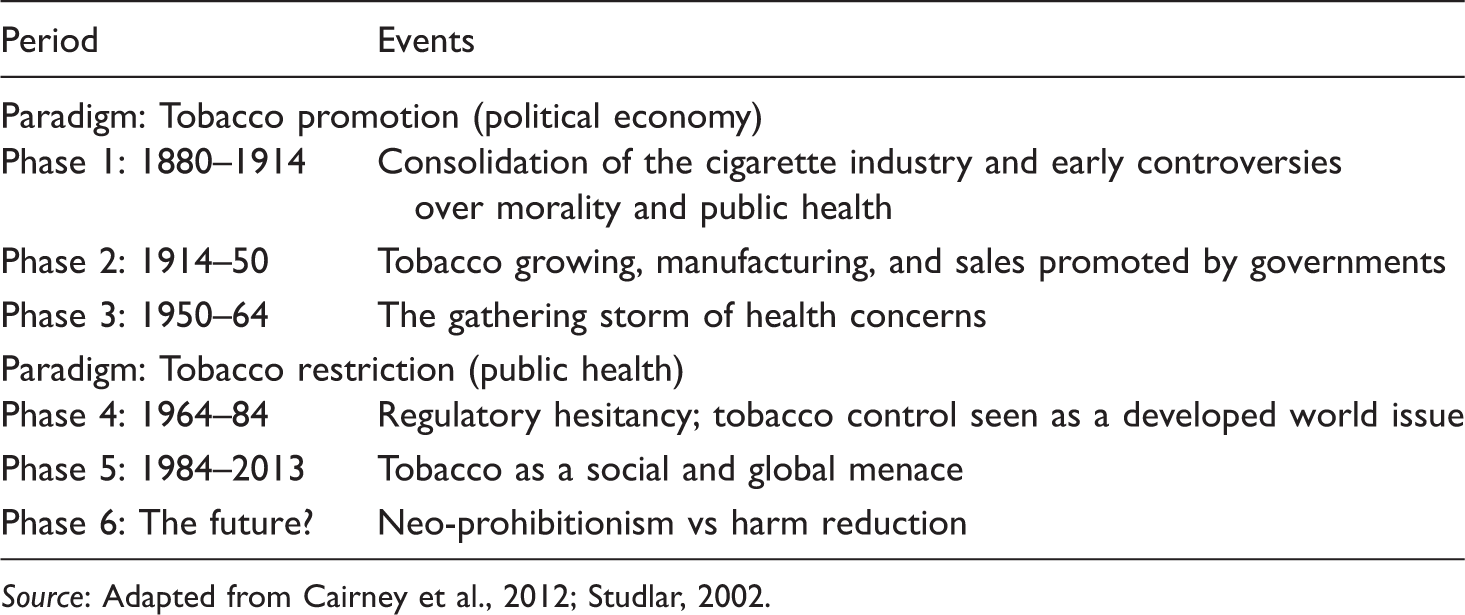
The phases of tobacco control policy, 1880–2012
Source: Adapted from Cairney et al., 2012; Studlar, 2002.
Clearly, paradigm shift did not happen overnight. It is also difficult to identify a big bang event that set policy on a profoundly new direction (although see Cairney et al., 2012: 224, on tobacco punctuations). In this context, can we identify a meaningful process of phased transition? The difference between phases 1–2 and 5 are relatively clear. In phase 1, early moral concerns, as a new way to frame tobacco, gained some traction in some countries, especially English-speaking ones, but were defeated by the First World War and a strong association between tobacco and patriotism through supplying cigarettes to the troops. Other government involvement in tobacco production was minimal, making it only a weak target for groups seeking to control the distribution and consumption of tobacco. Suspicions about the health hazards of smoking were inadequately supported by scientific evidence, and cigarette sales began to grow (Cairney et al., 2012).
In phase 2, moral concerns were less discernible as a consequence of the now well-established image of tobacco companies as patriotic and smoking as glamorous. This image was reinforced by its association with women’s equality, slim bodies (if smoking replaced ‘nibbling’) and the US film industry. Government involvement grew, largely to further an economic image of tobacco in which the leaf could be subsidized for domestic production and cigarettes could become a source of domestic taxes and overseas exports. In other words, the main policy instruments encouraged tobacco production and consumption. Consequently, the main government departments related to agriculture, trade and treasury functions and networks worked closely with tobacco companies. Knowledge of the health hazards of smoking was minimal (at least until the early post-Second World War period), and tobacco consumption peaked, with over half of the male population smoking in some countries (Cairney et al., 2012: 5).
These early phases contrast with phase 5, in which tobacco control has become comprehensive in many countries, with many policy innovations reinforcing each other to produce a coherent package. This contrast shows us the importance of phases 3 and 4, which may have seemed to represent slow progress at the time, but can now be viewed as key phases in the shift from one paradigm to another.
In phase 3, the main change relates to the available knowledge of tobacco-related harm. Studies in the US and UK prompted a decade-long period of establishing scientifically the dangers of smoking, culminating in the Royal College of Physicians Report in the UK in 1962 and the US Surgeon General’s Report in 1964 (Doll, 1998). The earlier studies had a significant effect on patterns of tobacco consumption (see Baumgartner and Jones, 2009: 91 on the US), particularly following the popular Reader’s Digest article ‘Cancer by the Carton’ (Norr, 1952). They began to reshape the socioeconomic context (e.g. fewer smokers means reduced consumption and revenue from taxation). The new knowledge provided the potential for innovative ways to frame the tobacco problem, for different government departments to become involved, and for additional groups to lobby. However, that potential did not come to fruition in this period.
In phase 4 there is the beginning of what we now take for granted: a move towards reframing the tobacco argument in terms of the health of the population (prompted by a combination of the growing evidence and the increasing rates of illness associated with smoking); a gradual strengthening of health department involvement; the development of dedicated public health and anti-tobacco groups, as well as a redirection of effort from medical groups (some of which had made alliances with tobacco companies that would seem incredible in the present day – Wolinsky and Brune, 1994); and, the development of national and international networks dedicated to the production of scientific knowledge and the sharing of ideas on tobacco control. Yet, we can also see a difference from phase 5: public health groups and health departments were relatively marginalized, and tobacco control was still in its infancy. Control was often restricted to a few limited measures and, in some cases, voluntary agreements between the government and industry, to reflect tobacco’s unusual status as potentially damaging but legal and economically valuable. There were tobacco control instruments in place in many countries, but they would be seen as inadequate through the lens of contemporary politics and policymaking (Cairney et al., 2012: 15).
The data on multiple phases: scope, duration, speed and strength
Scope, duration, strength, and speed of policy adoptions in 23 Western countries
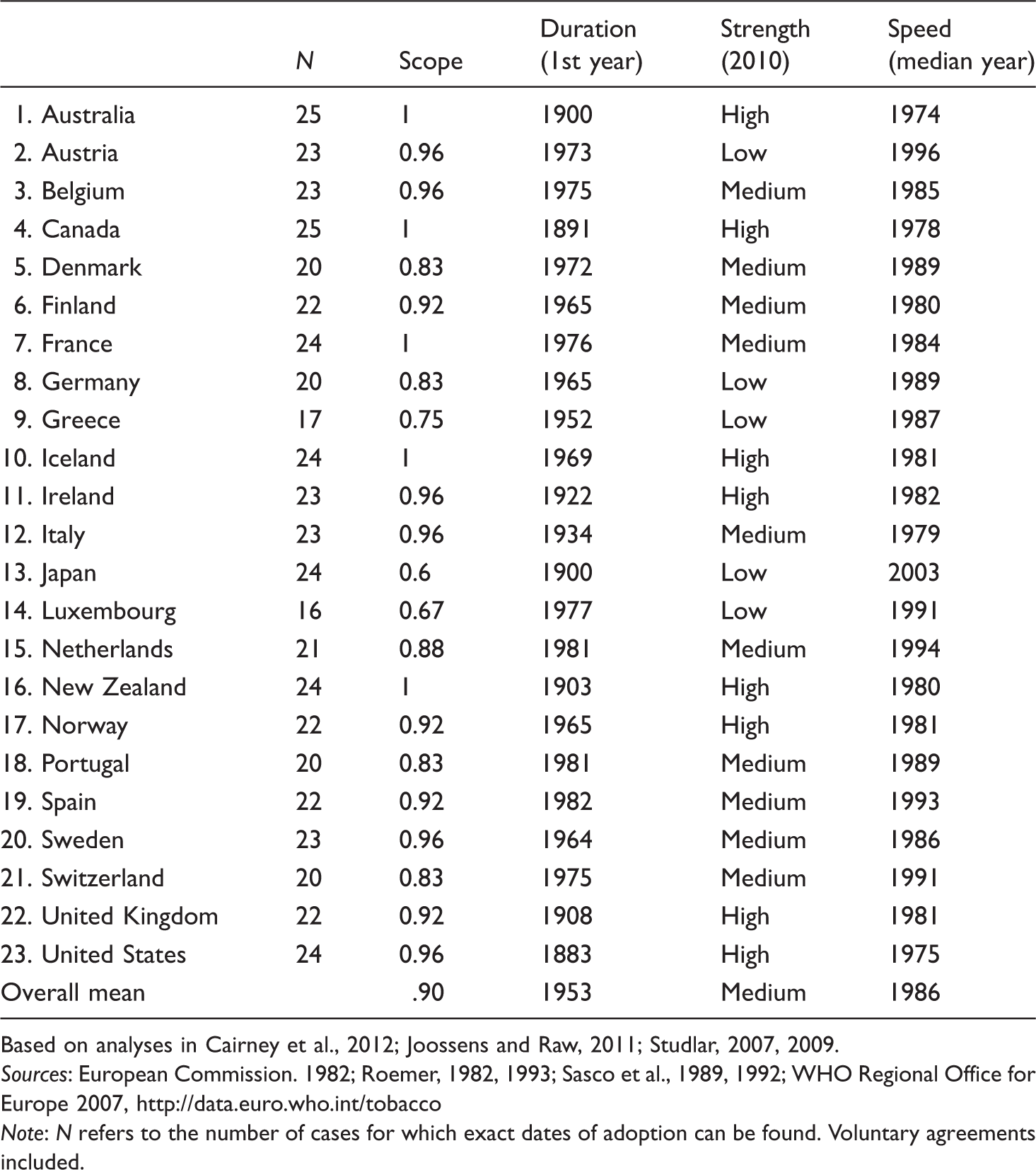
Based on analyses in Cairney et al., 2012; Joossens and Raw, 2011; Studlar, 2007, 2009.
Sources: European Commission. 1982; Roemer, 1982, 1993; Sasco et al., 1989, 1992; WHO Regional Office for Europe 2007, http://data.euro.who.int/tobacco
Note: N refers to the number of cases for which exact dates of adoption can be found. Voluntary agreements included.
Sequencing and trajectory of tobacco control policies
Sequencing of tobacco control policy instruments
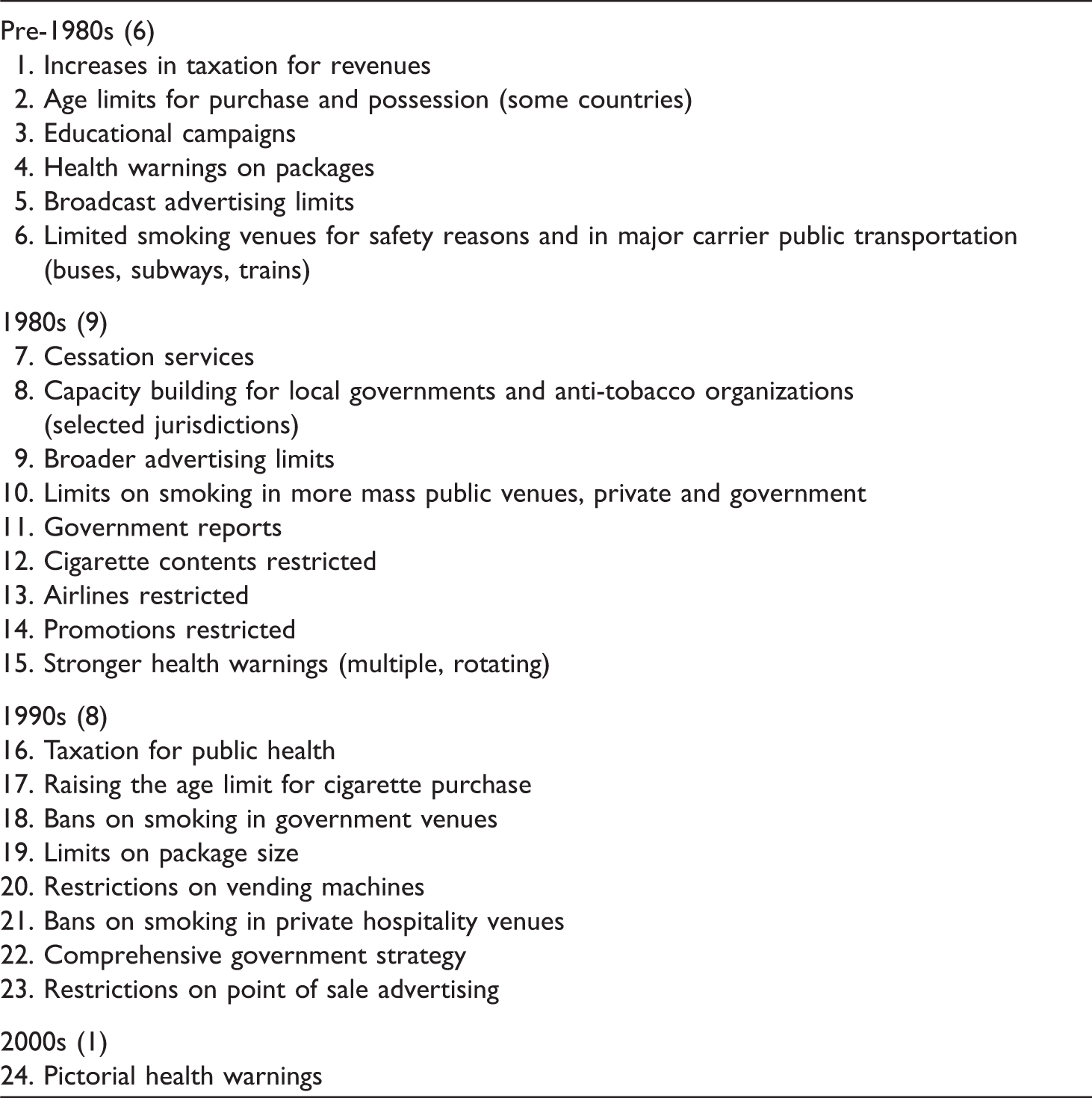
The process has developed differently according to the instrument. There were few adoptions of any instruments until the 1980s, then a protracted acceleration of adopters over the next 30 years, with more convergence (or more rapid diffusion) occurring in the 1990s and 2000s. Some instruments (mass media campaigns, telecast bans and other advertising restrictions, minimum sales age, indoor smoking restrictions in limited venues, and package health warnings) appeared before others, such as contents restrictions, cigarette distribution restrictions, and restaurant and bar smoking restrictions. Some innovations, notably minimum age restrictions, have moved slowly while others progressed more rapidly. Generalizations about the timing of some instruments are hindered by a low N because of lack of specific dates or the presence of pioneers who acted many years ahead of other countries. However, overall, the results support a pattern of progressive adoption of more instruments, with an acceleration in the 1980s, throughout most developed democracies (Cairney et al., 2012; Studlar, 2004, 2007, 2009).
There has been a slow but accelerating trajectory of restrictive measures, with sporadic outbursts of activity. There was a spurt in the 1960s and 1970s for a limited number of instruments (education, health warnings, broadcast and telecast advertising bans), then broader adoption of policies in the 1980s (including increased taxation, second-hand smoke restrictions, and capacity building), with more instruments and greater restrictiveness in calibrations in the 1990s and 2000s (graphic health warnings, banning of cigarette displays, broadened second-hand smoke restrictions).
There are policy plateaus in some countries but are few episodes of reversibility of policy. Some taxation policies in Canada and in subcentral jurisdictions in the US and Canada have been reversed, at least temporarily, because of smuggling concerns or temporary revenue needs (Studlar, 2002). The Dutch government has been accused of reversing education policies (Cheng and Sterling, 2012). Nevertheless, the general situation contrasts to the prohibitionist anti-tobacco policies of the late nineteenth and early twentieth centuries when tobacco sales bans were widely violated or reversed legally (Studlar, 2005; Tate, 1999; Tyrrell, 1999). At that time, many of the proposed ‘remedies’ did not ‘take off’. A half-century later, they not only remained but increased in numbers and restrictive calibrations. In the 15 older EU member states there has been an upward trend in the regulation of tobacco, but with considerable variation in the pace of trajectories and some leapfrogging of policies and leaders (Studlar, 2009; Studlar et al., 2011). The most common policy instruments have followed an approximate S-curve, with different policy instruments beginning at different times. This is a common process in studies of diffusion of policy across jurisdictions (Bennett, 1997; Berry and Berry, 2007).
A focus on phases allows us to reflect on the fact that policy change does not result inevitably from the production and dissemination of ideas – even when they are as important as the knowledge of tobacco-related harm that is now taken for granted. Instead, the time delay has been a resource for tobacco producers in two ways. First, there is a long incubation period for tobacco-related diseases, allowing tobacco to become established as ‘normal’. Second, tobacco companies exploited the fact that smoking became difficult to change (economically, culturally, politically), to delay institutional and policy change. The scientific knowledge took time to establish, particularly because the industry’s denial of the growing body of scientific evidence was so effective (Oreskes and Conway, 2010). In contrast, anti-smoking groups were often hampered by the abstract nature of their claims based on ‘downstream costs’ when diseases presented themselves after a considerable time lag. This may still be an issue, even in the new era of tobacco control. Many policies still contain discretionary time rules for implementation (including the three Action Plans of the Europe Against Cancer program of the EU – European Commission, 2004). There are also government policies with more long-range declaratory time goals (which are difficult to enforce), such as the periodic reports by the US Department of Health and Human Services announcing ambitious targets for the goals of Healthy Public Policy, including smoking reduction.
Conclusions
A framework which focuses on phased transitions helps us to conceptualize paradigm change in the presence or absence of a major crisis. In both cases, it is valuable to explore change over a series of phases rather than presenting a binary shift from one outcome to another. The framework helps scholars theorize the often-mutually-reinforcing interplay between key causal factors in public policy – ‘institutions, networks, socioeconomic process, choices, and ideas’ (John, 2003: 488) – as policy changes, often profoundly, over decades.
In this context, which theories or concepts help explain developments in tobacco policy? Our focus on phases allows us to integrate a series of points from the policy literature. From Kingdon (1984, 1995) we can take the idea of ‘softening’. Kingdon describes the slow progress of an idea towards acceptability within the policy community. Policy changes, but only when new solutions are ‘softened’ to make them more consistent with existing practices and attitudes. This helps explain why policy does not immediately follow a lurch of attention to a new problem (in some countries attention to tobacco arose several times in phases 3 and 4 before the issue was addressed in a comprehensive way) and why we should not consider tobacco control necessarily to be an idea ‘whose time has come’. Rather, it took considerable time and effort for the idea of tobacco control to become acceptable in most countries. Yet, softening alone does not help us explain how or why a major change took place. Kingdon’s focus on the ‘politics’ stream (the motive and opportunity for policymakers to adopt a new solution) helps show us the conditions that have to be met before major change will take place, but it has less to offer on why the policy context changed so profoundly. The lesson from tobacco control is that, if the same balance of power continued from the early post-Second World War period, the idea of tobacco control would never become soft enough! Rather, the idea of control became acceptable only when the policymaking conditions changed.
For this aspect of policy we can draw more on Baumgartner and Jones’ (1993, 2009) emphasis on venue shopping. A key factor in the production of a policy environment in which tobacco control became more acceptable is the role of venue shift – when, for example, departments of health became central to the development of tobacco policy, producing a change in the balance of power between interest groups and providing a more receptive audience for new knowledge (the science on tobacco-related harm and lessons from other countries) which reinforced the case for tobacco control. Such changes, combined with an analytical focus on the profound transformation in the nature of attention (government, media, public) to tobacco, help explain how a radically different environment developed. Attention changed from being low and positive in the early post-Second World War period, to majority-negative in the 1980s (Studlar, 2004, 2009). This is a discussion that is central to the idea of softening; only when the policy environment changed was it possible for the idea of tobacco control to begin its progress towards acceptability in policy arenas. This may be described as a policy ‘punctuation’ if the term does not refer to a specific event (or even a small number of events) or a dramatic shift in policy direction overnight (Cairney et al., 2012: 224). Rather, we identify profound change as occurring over several phases and decades.
We can draw similar conclusions from Hall’s (1993) analysis. Much intellectual effort is now being expended trying to go beyond the idea of institutional punctuated equilibrium; to identify and explain gradual paradigm changes. Such change may occur when policymakers seek advice from new experts, allowing radically new ideas to be adopted and institutionalized as one scientific community is replaced by another. In the case of tobacco, this took more time than Hall’s famous example of UK economic policy. Although the experts in favor now have profoundly different views from the interests that dominated in the post-war period, this did not happen dramatically during a crisis period. Rather, we can identify a series of phases in which institutional shifts occurred more gradually, and new networks developed over decades.
This finding does not contradict Hall’s idea (particularly since tobacco policy may not be directly comparable to higher stakes and higher attention economic policies), but it does highlight three factors worthy of further consideration during the production of future case studies. First, we find that paradigm change, associated with shifts of expertise, may happen in protracted phases rather than during a brief transition. For example, the stickiness of group–government relationships results from the ability of groups to draw on resources other than expertise. In the tobacco case, companies had built up a reputation within government (based on their initial patriotic image, followed by their economic value) and established personal networks that allowed them to remain insiders long after their claim to expertise was being undermined. Second, this legacy has an effect on the phases of change, producing an often confusing picture of policymaking during a major transition. For example, governments may simultaneously combine institutional mechanisms to promote and control tobacco. It may resemble a process labeled ‘layering’; ‘of new arrangements on top of pre-existing institutions intended to serve different purposes’ (Schickler, 2001: 16). The case of tobacco shows that such processes need not necessarily be treated as ‘disjointed’ or ‘incoherent’ (Streeck and Thelen, 2005: 23). Rather, in some cases, there is temporary inconsistency as one policy regime is replaced gradually by another. Third, we may identify a complicated mixture of policy decisions under the term ‘policy’. For example, one part of government may be holding onto its trade links with tobacco companies at the same time as another part is funding public health groups and devoting considerable resources to denormalizing smoking and perhaps even demonize the industry. The policy inconsistency has, in the tobacco case, generally proved to be temporary.
Of course, one thing that our framework does not provide is a means to predict the future. On the contrary – our focus on phases rather than binary shifts or linear progression highlights the possibility of complicated and uncertain policy trajectories. However, we can make some informed comments about the potential sixth phase of tobacco control, which has been debated for several years. There are two alternative scenarios. One would be a continuing sporadic but more uniform movement towards a ‘neo-prohibitionist’ regime (Nadelmann, 1990), with laggard countries adopting stronger policies, continued decreases in smoking, more public health measures such as plain packaging (de-commercialization) backed by stronger institutional support, the public health/morality perspective achieving greater dominance, and tobacco industry political power declining in favor of that of anti-tobacco groups. But recent disenchantment with slow progress in reducing smoking may lead towards the embrace of a more radical approach.
The search for alternatives to the traditional consumption of addictive, toxic cigarettes continues and could complicate the neo-prohibitionist scenario. Difficulties in reducing smoking prevalence, as well as the development of snus, e-cigarettes, and the ongoing search for a ‘safe’ cigarette (Felderbaum, 2011; Jacobs, 2011), have complicated the neo-prohibitionist vision. The alternative regime of harm minimization/reduction argues that a better strategy is to reduce overall smoking hazards by encouraging alternative nicotine delivery mechanisms, even if these are not completely harmless. The goal is to reduce smoking to a hard core of identifiable addicts. De-commercialization can be part of either approach, not only in the form of plain packaging but also through mandated changes in cigarette product design, price and/or profit controls, and state-regulated distribution of cigarettes (Borland, 2003; Cunningham, 1996; Malone, 2011).
Those opposed to harm reduction argue that supposedly ‘safer’ products can be used to induce consumers to smoke cigarettes, or co-dependency. While there may be potential for a tobacco harm reduction regime, it would take time to implement such a policy. In the absence of an agreed breakthrough in a safe, effective delivery product, the development of a global tobacco harm reduction regime will continue to be slow and controversial. The future of tobacco policy is complicated and uncertain, depending not only on alternative visions but also on scientific results as well as the interaction of the five factors described above.
In other words, the past half-century of tobacco policy has been one of gradual change in multiple countries, which in the longer-term perspective has resulted in cumulative, major change that would have been considered highly improbable, and in fact was not predicted, in the 1950s. Yet, it has not led to the eradication of smoking or the end of the power of the tobacco industry (much to the frustration of public health groups). Rather, the industry is still profitable and powerful, even in countries with the strongest tobacco control regimes. Continued uncertainty over the next phase of tobacco control reminds us of the continuous ability of the industry to adapt; to decelerate policy change through multiple venues, as in the bureaucracies of central governments, cabinets and legislatures (through campaign contributions), courts, and, in some countries, appeals to public opinion.
Footnotes
Acknowledgements
Earlier versions of this article were presented at the Southwestern Social Science Association, San Diego, 4–7 April 2012 and the European Consortium for Political Research, Antwerp, 10–15 April 2012.
