



Abstract
The delegation of public tasks to arm’s-length bodies remains a central feature of contemporary reform agendas within both developed and developing countries. The role and capacity of political and administrative principals (i.e. ministers and departments of state) to control the vast network of arm’s-length bodies for which they are formally responsible is therefore a critical issue within and beyond academe. In the run-up to the 2010 General Election in the United Kingdom, the ‘quango conundrum’ emerged as an important theme and all three major parties committed themselves to shift the balance of power back towards ministers and sponsor departments. This article presents the results of the first major research project to track and examine the subsequent reform process. It reveals a stark shift in internal control relationships from the pre-election ‘poor parenting’ model to a far tighter internal situation that is now the focus of complaints by arm’s-length bodies of micro-management. This shift in the balance of power and how it was achieved offers new insights into the interplay between different forms of governance and has significant theoretical and comparative relevance.
Points for practitioners
For professionals working in the field of arm’s-length governance, the article offers three key insights. First, that a well-resourced core executive is critical to directing reform given the challenges of implementing reform in a context of austerity. Second, that those implementing reform will also need to take into account the diverse consequences of centrally imposed reform likely to result in different departments with different approaches to arm’s-length governance. Third, that reforming arm’s-length governance can affect the quality of relationships, and those working in the field will need to mitigate these less tangible challenges to ensure success.
The structure of the modern state has altered dramatically in recent decades. The implicit assumptions and explicit recommendations of managerialist reform strategies led to the rapid ‘unbundling’ or ‘unravelling’ of the state across both the developed and developing world. The large-scale ‘balkanization’ of multi-purpose hierarchical public bureaucracies into larger numbers of single-purpose arm’s-length bodies (ALBs – bodies which carry out public functions with some degree of independence from government) as part of a new ‘smaller, leaner and more streamlined’ approach to the business of government not only formed a core component of the dominant public management paradigm but also posed new challenges in terms of navigating multiple relationships and steering complex networks. It is in exactly this context that Tobias Bach (2013) suggests that the literature on delegation has been dominated by two related but quite distinct analytical perspectives (for a review see James and Van Thiel, 2011). The first perspective focuses on why politicians delegate and offers a range of theoretical explanations and research-based rationalities (see, for example, Bertelli. 2006). The second perspective, by contrast, focuses on ‘actual levels of autonomy’ (Verhoest et al., 2004) or the ‘de facto independence’ (Maggetti, 2007) of arm’s-length bodies. The current state-of-the-art in this field is represented by the various outputs generated by the CRIPO/COBRA project (Verhoest et al., 2011) that combine to offer a rich account of the existence of a common gap between ‘de jure’ and ‘de facto’ levels of autonomy.
Far less, however, is known about how this gap is mediated or about the dynamic relationship between arm’s-length bodies and their sponsor or ‘parent’ departments, especially during times of political change. Moreover, although several studies have focused on how arm’s-length bodies commonly attempt to protect or increase their levels of autonomy (see, for example, Aulich, 2012), far fewer have focused on the ‘filling-in’ of the ‘hollowing-out’ by parent departments seeking to assert greater control capacities. This article is therefore concerned with how arm’s-length relationships are mediated at an everyday level, and with the processes by which departments assert greater control over arm’s-length bodies. In order to explore these issues, we draw on research undertaken in the United Kingdom, and the central question of the article is therefore ‘to what degree and how did the post-2010 Coalition government in the United Kingdom realize its stated intention to impose greater control over arm’s-length bodies?’ In order to answer this question, the article draws upon over 150 interviews with politicians, civil servants and chairs or chief executives of public bodies. Documentary analysis and observation of internal meetings, workshops and conferences in ministerial departments also delivered fresh insights and data. This research was undertaken with the support of the Cabinet Office and the Public Chairs’ Forum and then further developed and refined through a series of three practitioner focus groups. The findings were subjected to further analysis, review and reflection through engagement with select committee inquiries in both the House of Commons and the House of Lords. 1 A key finding of this research – and the core argument of this article – is that the relationship between parent departments and their arm’s-length bodies in the UK has been transformed in the wake of the election of a coalition government in May 2010.
Sponsorship
Sponsorship – eight insights from the existing research base
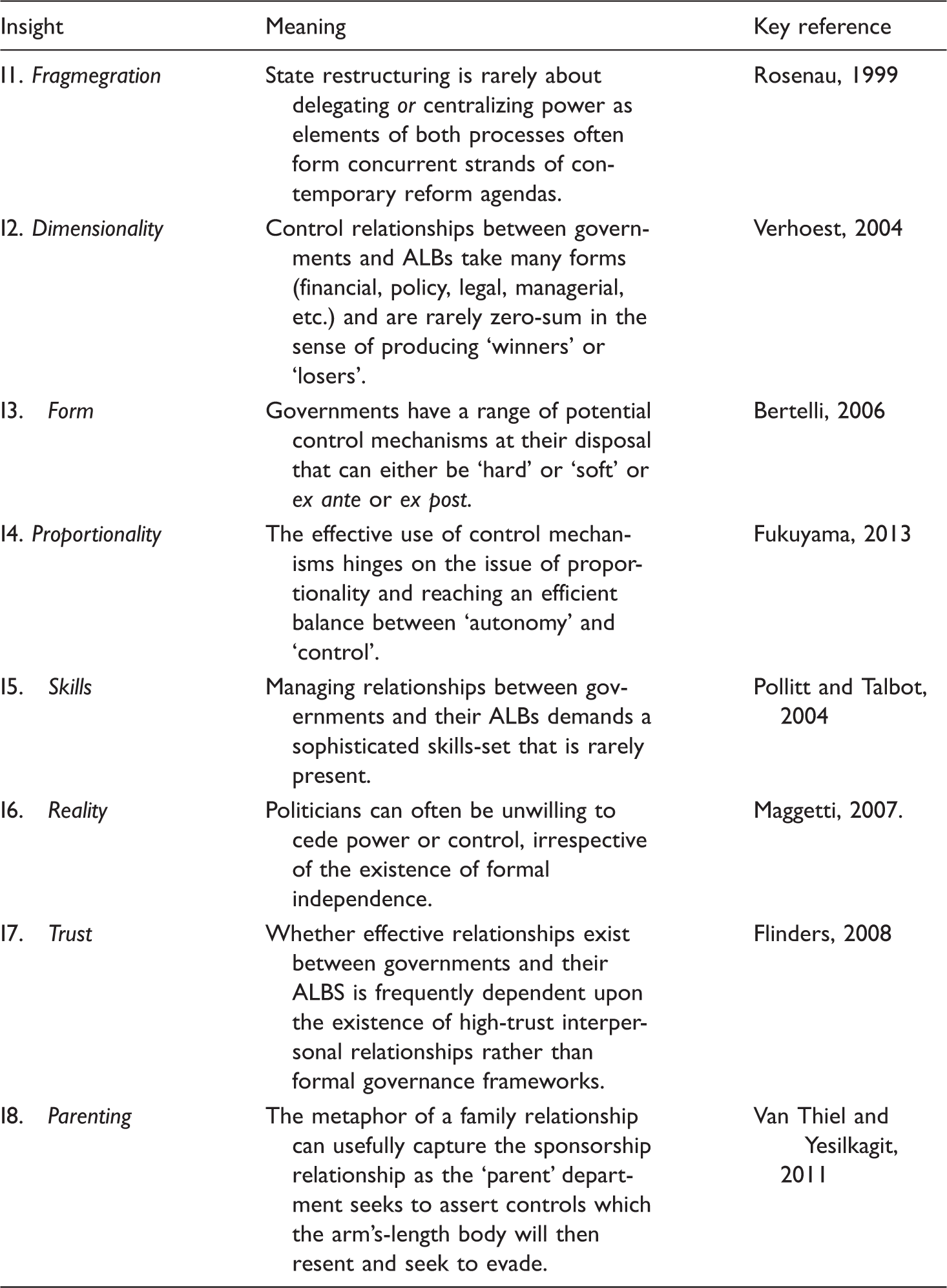
These eight themes emphasize not simply that sponsorship relationships are complex and multifaceted but – at a more basic level – scholars have arguably revealed very little about how these relationships are actually mediated. Studies have tended to operate within a distinct paradigm that revolves around deductive inquiry, foundationalist ontology, realist epistemology and an emphasis on survey-based data in an attempt to quantify large sets of complex relationships. Yet whether such quantitative methods can (on their own) capture the subtleties and dynamics of sponsorship relationships is open to debate.
Taking each ‘insight’ (very briefly) in turn it is possible to not only tease out a certain internal consistency or logic between and within them but also to create an analytical lens with the capacity to shift from the macro to the micro in a manner that resonates with Giovanni Sartori’s (1970) classic arguments about the need for political analysis to be able to move ‘up and down the ladder of generality’ (with ‘sponsorship’ as our ‘root concept’). At the highest level would therefore be James Rosenau’s analysis of global governance and his focus on the existence of ‘fragmegration’ (I1) as an over-arching concept which while being ‘admittedly a bit awkward and grating’ does at least capture a Janus-faced dynamic within modern governance in the sense that (fragmenting) managerial reforms generate a demand for new (integrative) forms of control capacity. The link with dimensionality (I2) is therefore solid but rarely acknowledged in the sense that delegation is a multi-dimensional concept that can capture the dispersal of many different forms of discretion. Koen Verhoest and his research collaborators (2004) distinguish between at least six dimensions (managerial, policy, structural, financial, legal and interventional) in order to reveal how levels of autonomy can vary significantly across these dimensions and also how an increase in one dimension may lead to a reduction in another (e.g. greater financial freedom but within a tighter policy framework). 2 This focus on dimensionality flows into Bertelli’s (2006) emphasis on forms (I3) of control tools or frameworks. Written contracts, framework documents and audit processes provide examples of common ‘hard’ forms of control whereas ‘softer’ and less tangible forms of control (inter-personal relationships, cultural bonds, a common public sector ethos) can be equally important in terms of providing an inter-organizational glue or form of social capital.
The existence of various dimensions and forms of control mechanisms can be placed within Tony Bovaird’s (2005) emphasis on the need to achieve a balanced equilibrium and an emphasis on proportionality (I4) within public governance. Such an emphasis chimes with Francis Fukuyama’s influential commentary, ‘What is Governance?’ (2013), and his focus on the relationship between ‘capacity’ (i.e. control capacity) and ‘autonomy’. For Fukuyama, an imbalance between ‘capacity’ and ‘autonomy’ is likely to be highly problematic in the sense of leading to either micro-management and agency-shadowing, on the one hand, or a situation synonymous with the ‘runaway bureaucracy thesis’ (or ‘abdication model’) in the United States or what European scholars have labelled ‘the poor parenting model’, on the other. Achieving an optimal balance between autonomy and control – Fukuyama’s ‘sweet spot’ – therefore hinges on a subtle and sophisticated understanding of proportionality that highlights the importance of skills (I5). The simple argument being made is that managing sponsorship relationships demands a sophisticated skill-set among the individuals or teams responsible for managing the relationship on a day-to-day level. While some of these skills will undoubtedly focus on strategic governance, audit processes and other more formalized elements there is, as this article’s empirical research will illustrate, a need to possess an arguably more important but less tangible set of skills that relate to political salience and risk. Although there is very little literature that focuses on the issue of sponsorship skills, the work of Pollitt and Talbot (2004) and Flinders (2008) does point to the existence of a serious ‘skills gap’, particularly in those polities where the public service ethos among senior civil servants generally views direct managerial experience as a second-class aptitude.
Controls framework reforms, April 2013

Source: Cabinet Office (April 2013) Cabinet Office Controls Guidance.
Notes:
1. Level 1 – Departmental authority and sign-off required.
2. Level 2 – Cabinet Office authority and sign-off required.
3. Exemptions will be considered but must be considered on a case-by-case basis by the Cabinet Office and HM Treasury.
Taken together, these eight themes emphasize that sponsorship relationships are complex, dialectical and multifaceted. What the research presented in this article reveals is a sudden shift in the internal control relationship between departments and their arm’s-length bodies in the UK – and, specifically, between ministerial departments and their Non-Departmental Public Bodies (NDPBs).
3
One way of understanding the nature of this shift, as well as how that shift relates to the insights outlined in Table 1, is to offer a conceptual map of autonomy and control (Figure 1). Informed by the findings of original research in the UK, this map distinguishes between strategic control (x-axis, relating to the broad policy framework) and operational control (y-axis, relating to operational or administrative elements of delegation). The nature of both forms of control can be either ‘tight’ or ‘loose’, with the former relating to the existence of explicit, dense and regularly monitored ‘hard’ control mechanisms, and the latter by the existence of implicit, weak and rarely enforced ‘soft’ control mechanisms.
Conceptual map of sponsorship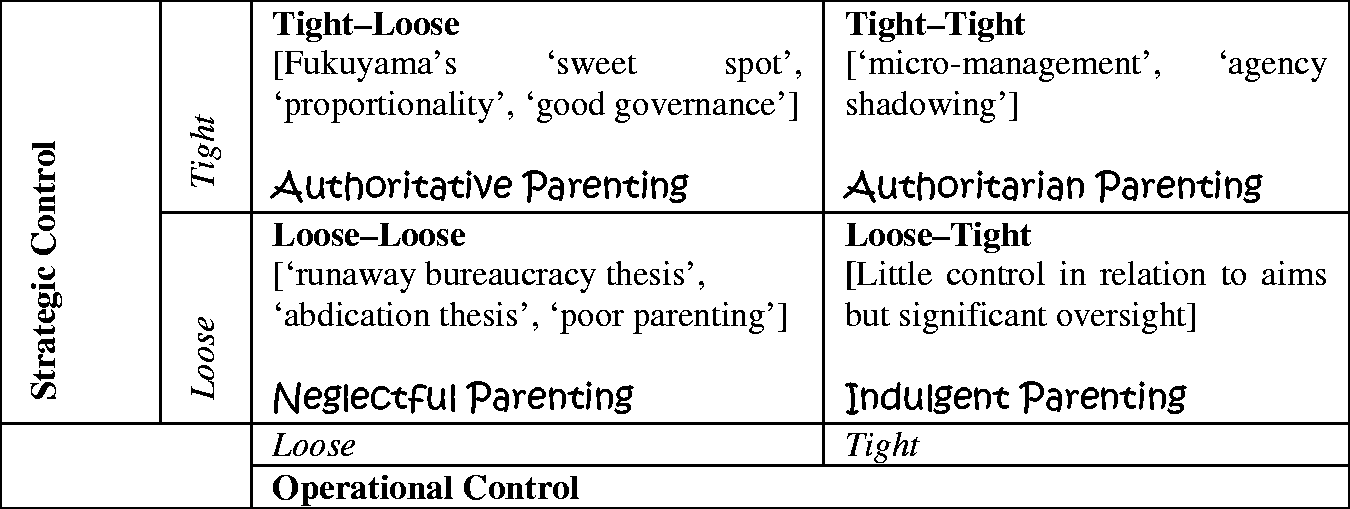
Figure 1 does not offer a complex model or a developed deductive theory but offers a useful heuristic or ‘organizing perspective’ that simplifies a complex politico-administrative relationship in order to facilitate research and understanding. What is immediately apparent from Figure 1 is the manner in which it can be transposed upon the existing research literature in a clear and direct way. The ‘loose–loose’ quadrant would therefore relate to what this article prefers to term the ‘poor parenting model’. The opposite of this situation is reflected in the ‘tight–tight’ model where few powers are delegated and even those are subject to a dense fabric of control mechanisms and approval demands that equate to ‘micro-management’ or ‘agency shadowing’ (to extract terms from the wider literature). Tight–loose would in this typology represent the acme of delegation theory in the sense that the arm’s-length body enjoyed significant operational and managerial freedom but operated within a clear and explicit policy-framework. The bottom-right ‘loose–tight’ quadrant represents something of an anomaly. No research, as far as the authors are aware, has discovered a situation in which an arm’s-length body is largely free to select its own strategic policy goals but is then subject to close operational supervision in the delivery of those goals by its sponsor department.
Moving from the existing research base to the original research outlined in this article, the great value of Figure 1 is that it offers great empirical relevance in the British case. During the run-up to the 2010 General Election a number of reports and inquiries highlighted the sponsorship of non-departmental public bodies as an issue of major concern for any future government. The reports of the Public Administration Select Committee (PASC) in the House of Commons, the Institute for Government, a number of detailed academic studies and the Cabinet Office’s own commissioned research revealed a breakdown of internal sponsorship relationships. Viewed through the insights set out in Table 1, the research served to outline a situation in which a public service reform agenda had driven an ambitious programme of delegation with little thought about the need to protect or preserve central steering capacity (I1, more fragmentation than fragmegration). Control relationships were confused and uncertain (I2) with many departments not even able to produce lists of how many NDPBs they sponsored, let alone detailed accounts of how managerial or financial control procedures were operationalized. (The annual review of NDPBs – public bodies – that had been published since 1980 was discontinued in 2009.) NDPBs were, in theory at least, subject to ex ante and ex post control mechanisms (I3) but in the vast majority of cases arm’s-length bodies were effectively allowed to self-govern with very little interference from the centre. Therefore in terms of proportionality (I4) the emphasis was very much on autonomy rather than control and the reform agenda around the time of the 2010 General Election was very much focused on achieving a more appropriate equilibrium (see, Institute for Government, 2011). Departmental officials lacked the skills (I5) to effectively manage sponsorship relationships and, if anything, the reality (I6) uncovered by parliamentarians, think tanks and researchers was of an administrative system in which politicians were too willing to cede power. Although this may have reflected the existence of high-trust interpersonal relationships (that may, in turn, have been related to the Labour government’s decade in office and therefore their role in appointing the cadre of senior appointees) the thrust of the criticism highlighted a lack of formal control structures (and a failure to operationalize those structures where they existed).
As a result, ‘quango reform’ emerged as a surprisingly visible element of the 2010 General Election campaign with all of the three main political parties including wide-ranging reform commitments within their manifestos. With the benefit of hindsight one of the most instructive interventions in the cross-party attempts to ‘get tough on quangos’ came in July 2009 with David Cameron’s speech ‘People Power: Reforming Quangos’ which balanced an emphasis on abolition with an emphasis on reform. ‘It would be far too simplistic for me to stand here and announce some kind of “Bonfire of the Quangos”’, Cameron argued. ‘People have heard that kind of talk many times before, and seen little to show for it. Instead, we need a more sophisticated approach… [P]roper public spending control means proper control of quango spending and proper control of quango spending has to start at the top.’ What the research presented in this article reveals is the manner in which that ‘more sophisticated approach’ has led to a stark shift in the relationship between departments and arm’s-length bodies that is commonly characterized by officials and ministers within Whitehall in the explicit language of a shift from ‘loose–loose to tight–tight’. 4
From loose–loose to tight–tight
As one official within the Cabinet Office put it, ‘Tight–tight is the new permanent!’ (interview, November 2012). The Coalition government has implemented a significant reform agenda that has focused more on tightening the internal control framework than on abolishing arm’s-length bodies. The aim of this section is to detail the nature and content of that changed relationship at a cross-governmental level before examining its more specific impact and interpretation in three case study departments in the next section. Even the most cursory analysis of British administrative history reveals that the sponsorship and management of arm’s-length bodies has never been a priority for ministers or their departmental officials. The twentieth century ended with the House of Commons describing New Labour’s approach to the governance of arm’s-length bodies as ‘unambitious, piecemeal and ad hoc’, and Peter Hennessy telling the House of Lords that ‘we [the UK] are deeply ingrained as a back-of-the-envelope nation, certainly in the organisation of the central state’ (HC Deb 209: para 59). In 1999, the PASC criticized sponsorship relationships for being either of a ‘command and control’ style or more commonly almost non-existent. The starkest illustration of the need to reform internal control relationships came in November 2004 with the publication of Corporate Governance of Sponsored Bodies by the National Audit Office, which offered a damning critique based around an exaggerated perception of autonomy on the part of arm’s-length bodies (with a teenager-like sense of strong independent identity) and a weak sense of partnership with their sponsoring department.
The pace of change was, however, arguably glacial and in March 2010 a Treasury report – Reforming Arm’s-Length Bodies – identified a similar set of issues. It drew attention to (among other things) a lack of clarity in relation to the respective responsibilities of departments and NDPBs, a lack of clear accountability in terms of ‘who was responsible for what’ (‘and why’), poor performance management by departments and the lack of any consistency in terms of controls frameworks. This led to the introduction of a revised internal controls framework for the management of arm’s-length bodies as part of a broader attempt to reduce administrative spending and increase public sector efficiency (cf. NAO, 2013: 13). Within days of taking office, however, the Coalition government adopted a twin-track strategy for the review and reform of arm’s-length bodies. The first element focused on the launch of a cross-government review of all arm’s-length public bodies (i.e. not just NDPBs) in order to create a simple list of the bodies that actually existed under the sponsorship of ministerial departments. Such was the confusion over such matters within Whitehall that even when the Minister for the Cabinet Office, Francis Maude, announced the findings of this review to the House of Commons (901 bodies in total) he was forced to concede that he could not ‘be certain, that that is the true extent of the landscape’ (HC Deb 516, col. 505). This led to an announcement that 192 NDPBs would be abolished, 118 merged and 171 ‘substantially’ reformed reducing the ‘headcount’ figure from 901 to 648.
Although this ‘bonfire’ (or what critics labelled ‘little more than a barbeque’) and the subsequent Public Bodies Act 2011 attracted a significant amount of media comment and academic analysis (see Skelcher et al., 2013), an arguably more significant reform path was being imposed within Whitehall that focused not on abolition but on reform in the sense of rebuilding the control capacity of sponsor departments over their NDPBs. ‘When the coalition government came to power’ Public Bodies 2012 (Cabinet Office, 2012) states, ‘they [the coalition government] introduced tough spending controls to tackle unnecessary and poorly co-ordinated public spending’. The centrepiece of this strategy was the imposition from September 2010 onwards of a new controls framework covering nine broad areas of activity (see Table 2). The initial belief that the tighter controls framework would be a temporary measure proved incorrect as the government announced in 2013 that ‘the controls have been extended permanently as they support a new more business-like way of working’ (Cabinet Office, 2013: 6). The framework involved three levels of external approval for any spending: Level 1 related to Sponsor Department approval; Level 2 to Cabinet Office approval; and Level 3 required the approval of the Treasury, Major Projects Authority and Cabinet Office.
This new framework matters for a number of reasons. First and foremost, the basic discretion afforded to NDPBs has been significantly reduced. Indeed the financial freedoms below the threshold for Level 1 (i.e. departmental clearance) are very low and in some cases all spending must be approved (marketing and publicity, property, etc.). As one NDPB chair described the new arrangements, ‘It’s a bit like micro-management by remote control. It’s ridiculous’ (Practitioner Focus Group, October 2012). Second, it is the Cabinet Office and not departments or the Treasury that is driving this agenda. The role and capacity of the Cabinet Office has increased significantly since May 2010 (see Dommett and Flinders, 2014). In the run-up to the General Election, the ‘Agencies and Public Bodies Team’ within the Cabinet Office consisted of just one full-time member of staff but within 12 months of the election had been increased to 17 full-time staff (NAO, 2013), and this team sits within a broader and new Efficiency and Reform Group consisting of over 200 staff. Third, the new controls framework is just one element of a broader set of measures that are designed to increase the capacity of departments over arm’s-length bodies. Elements of this broader reform agenda include the Coalition government’s view that executive agencies (i.e. hived-in rather than hived-out forms of delegation – but see Elston, 2013) represent the most appropriate balance between autonomy and control and also the imposition of a new set of transparency rules that are designed to impose external control pressures.
Details of how much officials are paid, every line of government spending above £25 k, every contract worth over £10 k (plus the actual contract in full) plus other measures are all monitored by a new Public Sector Transparency Board. At a broader level, the introduction of ‘Whole of Government Accounts’, a consolidated set of financial statements for around 1500 organizations across the public sector, will provide new levels of transparency, delivering comparable accounts by which to assess government organizations (see HM Treasury, 2012). In addition, as part of the ‘Clear Line of Sight (Alignment)’ project, the expenditure of NDPBs is now incorporated into the Estimates and Resource Accounts of sponsoring departments (House of Commons Library, 2010). Beyond this financial and administrative tightening of relationships a new Triennial Review procedure has been introduced which questions the governance of each public body every three years and also asks whether the functions still need to be provided at arm’s-length (Cabinet Office, 2011: 7–8). The coalition has also overseen the introduction of a Sponsorship Improvement Plan, which includes identifying examples of best practice and principles of good practice, led by a high-level Sponsorship Champion and supported by civil service training units.
The imposition of this tighter internal controls framework to dictate the relationship between sponsoring departments and arm’s-length bodies in the UK is important for at least three reasons. First, recent developments can be directly related to each of the eight ‘insights’ discussed in the previous section. The reform agenda has been one of centralization and fragmentation (i.e. I1) in the sense that measures to centralize NDPBs have sat alongside other reforms that have sought to increase the autonomy of other elements of the state (discussed below). The multi-dimensional nature of control relationships (I2, financial, legal, managerial, etc.) is captured perfectly in the new controls framework (Table 2) but it could be argued that there has been a zero-sum dynamic at play in the sense that NDPBs have lost power across a range of dimensions. This has stimulated complaints from the Chairs and chief executives of NDPBs that the relationship has swung too far (i.e. from ‘loose–loose’ to ‘tight–tight’) in a way that is pathologically imbalanced. This situation was recognized by a senior civil servant at an event at the Institute for Government on the future of arm’s-length bodies in July 2012 when he described the changed relationship between departments and NDPBs as the imposition of ‘the tourniquet model’, before going on to remark that ‘we all know what happens if a tourniquet is too tight or is kept on for too long … The arm drops off!’ This is a powerful metaphor that relates to the fact that the Coalition government’s tighter controls framework became a permanent feature of arm’s-length governance.
Research in the UK therefore reveals a stark shift in the management of sponsorship relationships by the core executive from a historical emphasis on what PASC labelled ‘benign neglect’ (2011: 24–26) through to a tightening of the relationship towards the end of the previous Labour government, to a further (significant) tightening under the Coalition government since May 2010. The distinctive twist in the findings of this research, however, questions the dominant ‘loose–loose to tight–tight’ mantra that seems surprisingly common among officials, advisers and ministers. The new controls framework arguably represents a significant tightening of operational control by the core executive – in the form of financial monitoring and approvals processes – but without an accompanying tightening of strategic oversight of policy; that is, it is characterized as ‘loose–tight’. In order to drill down still further the next section focuses on three case study departments.
It takes two
Statistics on case study departments (2012)
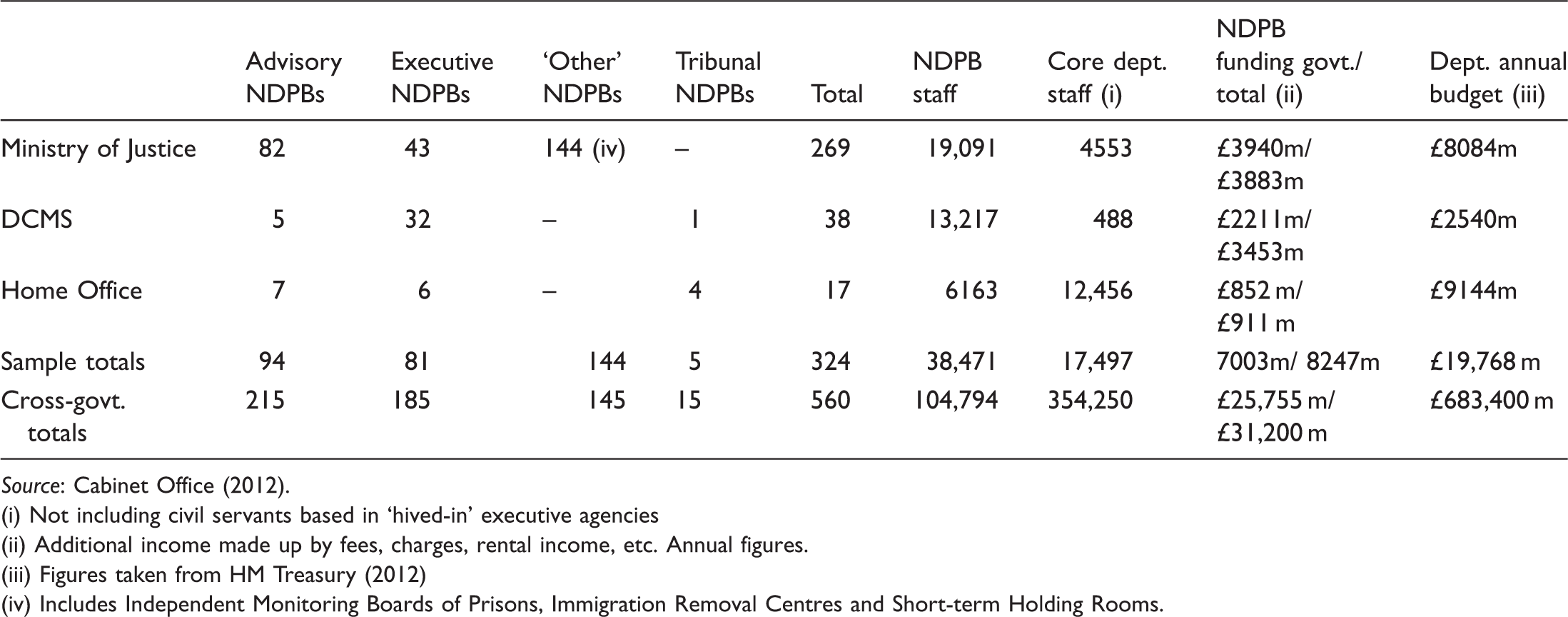
Source: Cabinet Office (2012).
(i) Not including civil servants based in ‘hived-in’ executive agencies
(ii) Additional income made up by fees, charges, rental income, etc. Annual figures.
(iii) Figures taken from HM Treasury (2012)
(iv) Includes Independent Monitoring Boards of Prisons, Immigration Removal Centres and Short-term Holding Rooms.
Ministry of Justice
The Ministry of Justice (MoJ) is responsible for the sponsorship of one of the largest NDPB portfolios in Whitehall (see Table 3). Prior to the Coalition government’s reform agenda, the MoJ followed what one official described as a ‘piecemeal approach’ (interview, September 2012) in which sponsorship was undertaken by specific policy teams. The outcome was a disjointed approach bereft of underlying strategy in which sponsorship arrangements differed significantly across the department. ‘There was nothing in place as a sponsor’, one official stated, ‘[to say] this is what you need to do. It was just “here are the key issues!”’ (interview, April 2013). This failure to take sponsorship seriously was highlighted in by the Public Accounts Committee (PAC), By its own admission, the Ministry has exercised insufficient control over its arm’s-length bodies, including the Legal Services Commission. We do not share the Ministry’s view that there is little scope to influence the behaviour of arm’s-length bodies. The Ministry needs to be clearer in its funding arrangements with these bodies about what its expectation of them is. (PAC, 2011: 5)
The ALBGD has also undertaken a broader review of the MoJ’s approach to sponsorship, with the intention of allowing NDPBs to participate more fully in the policy-making process. The review warned of ‘a perceived misunderstanding around the principle of independence and the roles and responsibilities of the different teams within the department’ (MoJ, 2013b). Independence is a particularly important issue in the MoJ, given that large numbers of its NDPBs perform quasi-judicial functions that require statutory independence from ministers. Several such bodies drew on these concerns in their evidence to the Justice Select Committee in 2012. There is confusion in the MoJ about our independent status and we are concerned that moves to apply MoJ appraisal processes to us, move our offices to the main MoJ building, stop our independent websites, restrict our ability to recruit diverse staff we require and prolonged budget uncertainty risks damaging our actual or perceived independence. (Justice Committee, 2012, ev.164)
Two important findings can be taken from this brief case study. First, despite a chequered history in terms of effective sponsorship relationships, the MoJ has emerged as the current ‘beacon department’ for best practice in Whitehall and the lead department for several cross-governmental initiatives. And yet (second) locating the department on the conceptual map of sponsorship (Figure 1) is difficult due to the existence of different interpretations of change among key actors within Whitehall. The existence of these differing narratives adds to the richness of our understanding of how sponsorship works in both theory and practice. While actors in the MoJ (officials and ministers) emphasize their attempts to implement a risk-based model of sponsorship (that is arguably at odds with the Cabinet Office’s more comprehensive model) in order to achieve a working equilibrium, the dominant message emanating from arm’s-length bodies sponsored by the department is that the ‘arm’ in the arm’s-length relationship is now simply too short (i.e. ‘tight–tight’). This may reflect both the quasi-judicial functions of many of the department’s arm’s-length bodies, the reduced discretion and increased audit demands of the post-2010 controls framework or possibly just a degree of healthy tension in what many agreed was synonymous with a parenting relationship.
Department for Culture, Media and Sport
Despite the abolition of 19 arm’s-length bodies as a result of the review of public bodies in 2010, the Department of Culture, Media and Sport (DCMS) remains a classic ‘hub-model’ department in the sense that a relatively small department sits at the centre of a network of public bodies. Around 85 percent of departmental expenditure is channelled to arm’s-length bodies, and the sponsorship of these bodies has been the topic of almost constant review and reform since the creation of the Department of National Heritage in 1992. In July 1999, the Select Committee on Culture, Media and Sport published a detailed critique of sponsorship arrangements and this led to the establishment of a new Quality, Efficiency and Standards Team (QUEST) to develop and support the sponsorship of arm’s-length bodies across the department (HC Deb 505: para. 18). The role of QUEST was very similar to the remit of the ALBGD in the MoJ, but its existence was short-lived as it struggled to build an effective relationship with arm’s-length bodies and DCMS implemented a system of ‘Fraser figures’ for each body (i.e. a senior named official responsible for managing specific relationships). The imposition of a 24 percent reduction in the department’s budget under the 2010 Comprehensive Spending Review led to a restructuring of its sponsorship arrangements. ‘It was straightforwardly – if you’re going to be 50 percent smaller, then the way you interact with your public bodies is going to have to be radically different’ (interview, November 2012). The sponsorship model therefore shifted from a comprehensive structure of Fraser figures to a risk-based model of sponsorship.
Although this mirrors developments in the MoJ, the system in DCMS is quite different with a ‘hub-model’ of sponsorship being used to oversee a hub-model of governance. The ALB Team therefore operates as a relatively small cross-departmental unit that manages all arm’s-length body relationships and operates a three-star risk assessment framework. The eight to ten bodies deemed ‘high risk’ enjoy a closer and more frequent sponsorship relationship with the department but unlike in the MoJ these risk assessments are not undertaken in partnership with the arm’s-length body (as this process was seen to be too resource intensive). This risk-based approach has left some arm’s-length bodies feeling quite neglected by the department. They don’t really have the sort of close ongoing relationship. And … they feel a bit cut adrift, really. And however much you say that’s because, actually you’re a very well run organization in which we have a lot of confidence, they still go, ‘Oh, but you’re going to come and see us regularly, aren’t you?’ (DCMS official, interview, November 2012)
‘Feeding the machine’ also emerged as an important issue for officials based within the DCMS. ‘We have a mismatch’, one official argued, ‘between a lack of resources and the stuff that is coming out of the Cabinet Office’ (interview, October 2012). This gap between resources and auditory demands is particularly problematic in those departments with a large ‘family’ of arm’s-length bodies. The introduction of triennial reviews, for example, has involved huge amounts of preparation, planning and consultation on the part of both arm’s-length bodies and sponsor departments but without any additional resources. More broadly, however, the main tension would appear to lie with the limited discretions that NDPBs now enjoy in the wake of the new controls framework. As one chair noted, ‘I can’t do anything within departmental sign-off. It’s ridiculous!’ (Roundtable discussion, 2013).
The Home Office
As Table 3 illustrates, the Home Office is not a highly delegated department. It has 16 arm’s-length bodies, most of which are very small apart from two – the National Policing Improvement Agency (1619 staff and £352 m budget) and the Serious Organised Crime Agency (3652 staff and £448 m budget) – that collectively account for 10 percent of departmental expenditure. Once again, however, the Home Office has a troubled history when it comes to managing arm’s-length bodies. In particular an internal review in 2008 found a complete lack of clarity or consistency across the department in how sponsorship was managed: ‘there were different sponsor teams across the whole Home Office’, one senior official noted, ‘and no real coordination of what we did’ (interview, April 2013). In fact, the report highlighted that just one official was responsible for coordinating sponsorship across the whole department. Not only did this lead to significant variations in terms of the style and quality of sponsorship, but interviewees also suggested that policy teams tended to operate as ‘lobbyists’ for their arm’s-length bodies rather than acting as a strategic mediator of relationships. ‘It was acknowledged that there had to be more coordination and more consistency’ (interview, April 2013), and a new central team was created to coordinate sponsorship activities within the department from 2009.
With responsibility for improving the sponsorship capacity of policy teams, disseminating good practice and acting as a point of contact for the Cabinet Office, the Home Office ‘Arm’s-length Bodies Team’ facilitated a much closer relationship with NDPBs. Quarterly meetings chaired by a Director-General, for example, were held with all executive NDPB Chairs and Chief Executives in order to ‘unpick dysfunctional relationships’ (interview, October 2012). The focus of these meetings was not, however, on operational issues but on common challenges and strategic concerns, and they were viewed as vital ‘to build up a healthy, mature dialogue between departments and bodies’ (interview, October 2012). One additional innovation was the use of an annual questionnaire-based assessment exercise in which both the department and the arm’s-length body reflected on the effectiveness of the current relationship. This pre-2010 work on improving sponsorship meant that the Home Office ‘moved from red to green in the audit of sponsorship’ (interview, October 2012). The positive relationships created by this work-stream were, however, ‘flushed down the toilet’ (interview, October 2012) according to one official by the impact of the Cabinet Office’s public bodies review process during the summer of 2010 (discussed above). The review provided the ALB Team with just three weeks to review all of their public bodies and provide the Cabinet Office with a list of abolitions and mergers. The arm’s-length bodies were not consulted in this process and this led to internal resentment, particularly when decisions were leaked to the press before they were formally announced and departmental sponsors were still unable to discuss the future of bodies with Chairs and Chief Executives.
Since 2011 the process of rebuilding effective working relationships within the Home Office has been hampered by the impact of cutbacks that have reduced strategic sponsorship competence. The ALB team has been reduced from five members of staff to just one person, and this has led to a shift of responsibility back onto policy teams. Officials within those teams suggested that the role of the central unit was now predominantly one of ‘fire-fighting’ when difficult situations occur while also ‘servicing Cabinet Office bureaucracy’ (interview, October 2012). Seen through the lens of our conceptual map (Figure 1) research portrays the Home Office as a rather curious case on the basis that far-reaching reforms to internal sponsorship relations had been instituted from 2008 onwards that had broadly established a working tight–loose relationship. The impact of the post-2010 reforms set out above has been to destabilize this situation and impose what several interviewees described as a more ‘dysfunctional’ loose–tight relationship in which tighter operational controls have been imposed without corresponding changes in relation to strategic oversight. ‘The problems were a relationship thing, they weren’t about whether we had enough control’, one senior Home Office official noted. ‘So I think sponsorship was working but the feeling of control was I think more … if it was brought in to rectify a perceived problem then I think that perception was wrong’ (interview, April 2013). The distinctive dimension of the research conducted in the Home Office was that sponsorship relations appeared to have retracted into what one official described as a very clear ‘them and us’ governance model in which inter-organizational and interpersonal levels of trust were low.
The exploration of these case studies has highlighted some important features that refine the core argument of this article and tie the findings of the research to the conceptual map outlined in Figure 1. At the broadest cross-governmental level, the available evidence suggests that sponsorship relationships have changed significantly under the post-2010 Coalition government. This shift can be characterized – as many respondents emphasized – as moving from from ‘poor parenting’ to one of ‘micro-management’ or ‘authoritarian parenting’. At the mid-range level (i.e. between specific departments and their arm’s-length bodies), however, variances are apparent in relationship management profiles. In the MoJ a ‘neglectful’ model of parenting has moved to an ‘authoritative’ relationship. At the Home Office the shift appears to be operating in the opposite direction with ‘authoritative parenting’ slipping towards ‘neglectful parenting’. Finally, in DCMS a boomerang effect is observable wherein the immediate post-2010 move towards a tighter internal sponsorship system appears to be under pressure from the impact of internal resource and capacity constraints which have, in turn, led to concerns about a shift back towards a ‘poor parenting’ model.
Managing complexity
Sponsorship – eight insights from post-2010 research in the UK
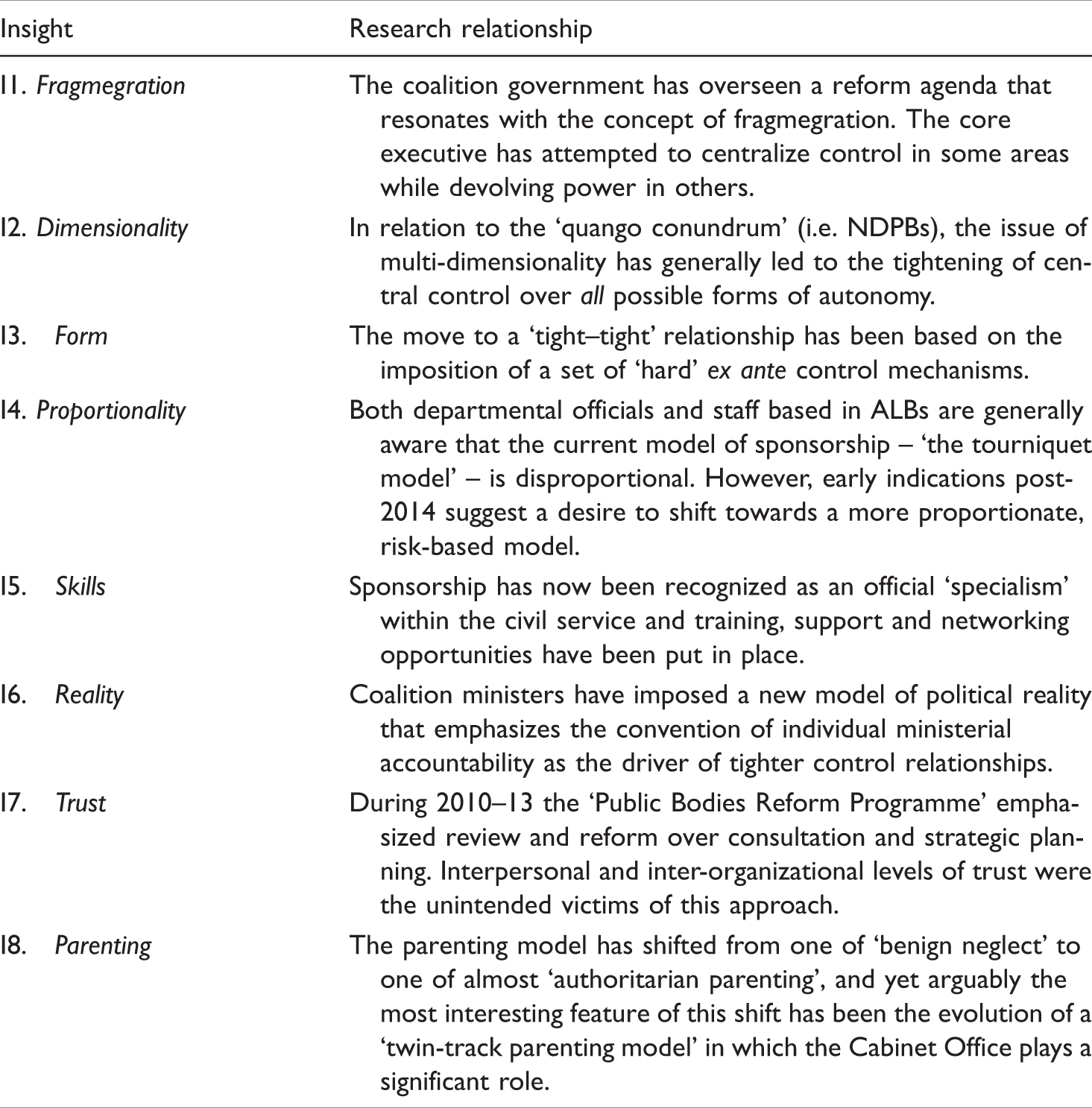
Reflecting back from empirics to theory, the theme of ‘variable geometry’ reminds us that metaphors concerning parents and children are arguably problematic when transported into the complex reality of modern governance. What is missing from the existing research base is an analysis of multiple agents and multiple principals that goes beyond vague genuflections to ‘fuzzy’ or ‘polycentric’ governance. In this British case, for example, several arm’s-length bodies have more than one sponsor department and, if anything, what the research presented in this article has revealed is the existence of a curious parallel or ‘twin-track’ approach to sponsorship (one ‘heavy’ model imposed by the Cabinet Office, a second ‘lighter’ model imposed by sponsor departments on the basis of a risk-based framework). An important element of this ‘twin-track’ model is not only that arm’s-length bodies must account to both their parent department and the Cabinet Office (i.e. not to the Cabinet Office through their parent department) but at a more basic level that the Cabinet Office now has the capacity to play a more active role in the governance of public bodies. From the mid-1990s onwards, an international literature on the ‘hollowing-out’ of the state was often critical of the weak capacity of central coordinating units – as examined in Pat Weller and Herman Bakvis’ ‘The hollow crown’ (1997) – with the British Cabinet Office frequently criticized for lacking both teeth and capacity.
From a broader comparative perspective these research findings may look less distinctive and be interpreted as little more than one element of an international ‘post-New Public Management’ trend that has problematized and responded to the fragmentation dilemma through tighter control. ‘Post-NPM’ measures therefore seek to respond to the coordination dilemma by redefining relationships, limiting discretion, increasing controls, reasserting the position of the principal and shifting back towards a hierarchy-based model of agency governance (almost pre-NPM). This trend – as the reports of the OECD and the studies of several scholars have documented – can be identified across North America, Western Europe and Australasia as countries search for new ways of ‘managing the machine’ in the context of what is often termed ‘post-crisis politics’. Whether the UK can be so easily dismissed as simply part of the ‘post-NPM’ paradigm is unclear and takes the analysis back to Lord Hennessy’s critique of the British political tradition as being ‘deeply ingrained as a back-of-the-envelope nation, certainly in the organisation of the central state’. A shift to a ‘post-NPM’ mode of governing therefore brings with it certain assumptions and expectations about explicit rationalities and strategic thinking that are strangely heretical in the British context. The question therefore becomes one of ‘meta-governance’ (i.e. ‘the governance of governance’) and the degree to which the coalition government’s approach to NDPBs forms one strand of a more integrated approach to meta-governance across the dense and congested sphere of quasi-government that think tanks, academics and parliamentary committees highlighted in the run-up to the 2010 General Election.
The issues explored in this article have taken place in an ‘age of austerity’, when governments around the world – not least the UK – are developing strategies to cope with decreases in public sector funding (see Cepiku and Savignon, 2012), and face dilemmas in how to maximize the efficiency of their arm’s-length bodies (MacCarthaigh, 2012). Austerity has placed pressure on public sectors to explore increasingly innovative forms of delegation in order to drive efficiency. However, the problem highlighted by the research presented in this article is whether ministerial departments have the capacity to effectively govern this increasingly diverse landscape. Insights from DCMS and the Home Office suggest that capacity issues, themselves brought about by austerity policies which demand cuts in public sector expenditure, affect the ability of government to maximize the efficiency of arm’s-length bodies through close parenting.
Indeed, the hook or barb in the research presented in this article is that the Coalition government has not adopted a strategic cross-governmental approach but has instead imposed significant reforms on a fairly narrow sphere or layer of governance (i.e. NDPBs). The problem is that arm’s-length bodies embrace a huge range of ‘para-statals’, ‘fringe bodies’ and other organizational forms (Establishments publics nationaux in France, Zelfstandige bestuursorgen in the Netherlands, Organismos autonomos in Spain, Crown Entities in New Zealand, Ongkarn mahachon in Thailand, etc.) and this terra incognita generally defies neat topographical mapping and demands not only the existence of large amounts of political capital but also a constitutional entrepreneur at the heart of government to drive through reform. In the UK alone the Institute for Government (2012) has identified no less than 12 species or forms of ALB – of which the ‘NDPB’ is just one – that operate under the auspices of ministerial departments. And yet the coalition government has rejected demands to reform and restructure arm’s-length bodies in toto in order to establish a simpler and more coherent institutional landscape. In a manner that arguably provided a perfect glimpse into the British political tradition the Minister for the Cabinet Office, Francis Maude, rejected demands to include all arm’s-length bodies and not just NDPBs in the government’s reform programme by explaining, ‘I’m kind of temperamentally slightly allergic to trying to create a top-down overall scheme of arrangement. It is very complex and confusing, and simplification is desirable but I think not in order to meet the demands of administrative tidiness’ (HC Deb 537, Q141). In October 2013 the Institute for Government questioned this logic and argued in favour of a more ambitious and systematic programme of reform. From both a comparative perspective and from the position of theories of meta-governance, the British case is therefore possibly distinctive due to its attempt to manage complexity in one bureaucratic sphere (i.e. NDPBs) while at exactly the same time creating an ever more complex patchwork of arm’s-length bodies that exist beyond this tighter, more explicit and more formalized controls system.