




Abstract
Campus safety and security is a salient issue and an area of increasing concern facing educational institutions in the United States. Yet little is known regarding ongoing efforts and resulting difficulties to co-produce campus safety and security. This article contributes to the literature on co-production by examining student and campus police officer perceptions of the professional–service user relationship in the context of campus safety and security. Findings suggest that demographic and contextual factors shape user and professional perceptions of their relationship in different ways, and that these perceptual differences affect efforts to co-deliver services.
Points for practitioners
This article describes the views of university police personnel and students regarding the co-production of safety and security on a research university campus in the United States. Data gleaned from the research illustrates that while police officers and students may have differing views of one another and their roles in co-production, they agree that public safety would be served by opportunities for police and students to meet one another and have personal interaction outside of formal, law enforcement-driven situations. This suggests the value of well-developed engagement strategies, as well as the potential benefit of harnessing ‘teachable moments’ during which police and the student population can learn about one another.
Introduction
Co-production is associated with the expanding role that individual and organized groups of citizens play in designing and delivering public services (Alford, 2002, 2009; Bovaird, 2007; Parks et al., 1981; Whitaker, 1980). Co-production has been lauded for its potential to better understand, prevent and address public problems; to increase the efficiency and effectiveness of public services; and to engender support from citizens and other co-producers (Meijer, 2011; Needham, 2003, 2006, 2008; Ostrom et al., 1978; Parks et al., 1981). As the collective action between public organizations and service users, co-production entails a series of steps that are dependent upon the willingness of all parties to coordinate, cooperate, and collaborate.
Bovaird (2007) provides a framework that highlights the range of user and community relationships with public servants in the co-production of public services. Although Bovaird points out that this framework can be applied to a variety of decision-making arenas, we focus on efforts to co-deliver services. As is evident in Figure 1, professional–user interaction can range from non-existent (where professionals or users are sole designers and deliverers), to comprehensive co-production where services are co-designed and co-delivered by users and professionals (Bovaird, 2007).
Bovaird's framework classifying co-production professional–user relationships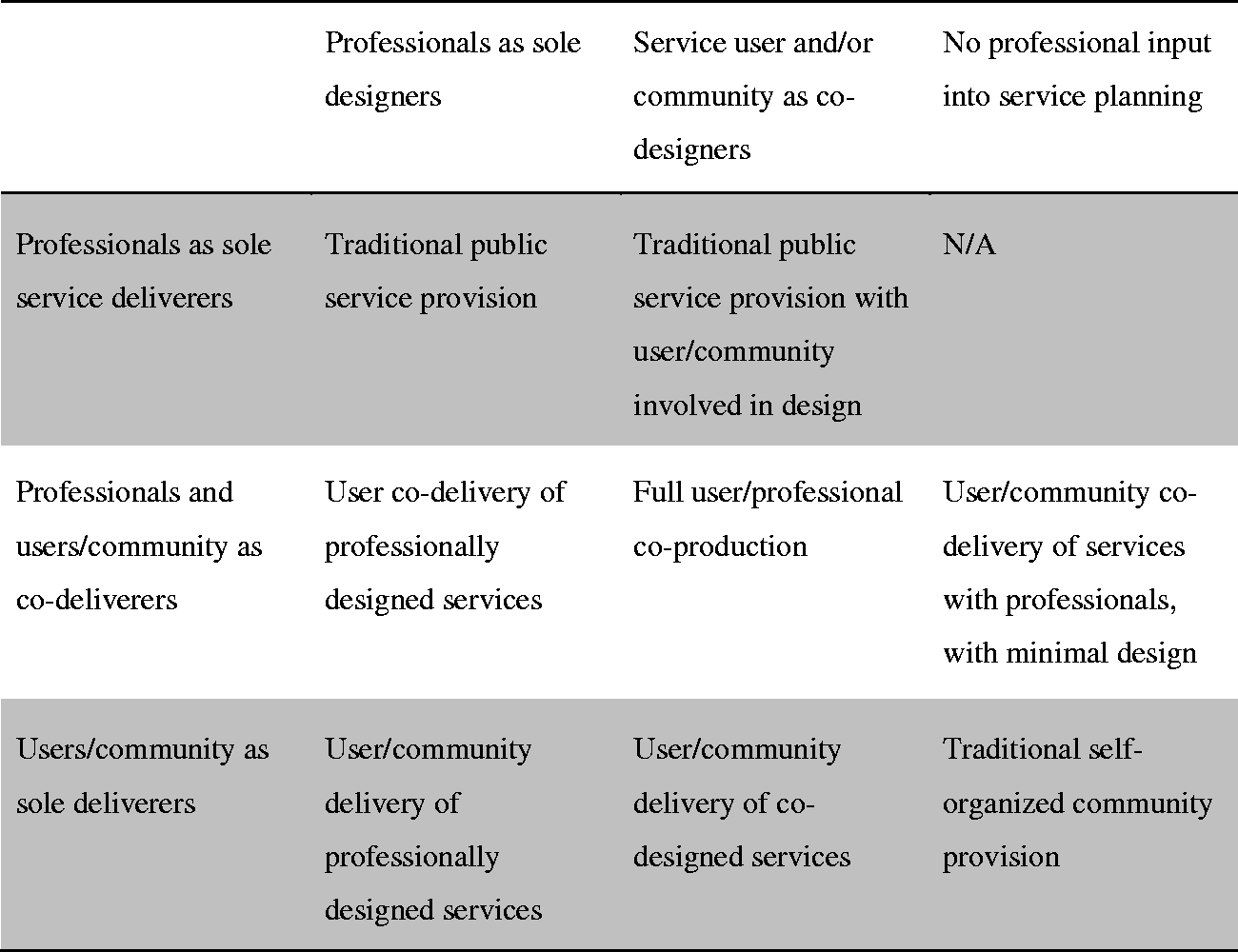
Previous research highlights a number of challenges to co-productive relationships between professionals and service users, including the conflict inherent in all group processes (Follett, 1918), as well as issues related to trust, incentives, transparency, conflicting value orientations, role ambiguity, and burnout (Birchall and Simmons, 2004; Bovaird, 2005; Mayo and Moore, 2002; Taylor, 2003). In general, the challenges that impact interactions between professionals and users engaged in co-production are highly nuanced and go beyond mere engagement and participation (Bovaird, 2007). Few researchers, however, have empirically investigated points of convergence and divergence in user and professional perceptions of ostensibly co-productive relationships, and how these perceptions affect co-productive efforts.
This study addresses this research gap using Bovaird's framework to examine how professionals and service users view their respective roles in co-production, and how these perceptions affect the efforts of professionals to establish a more collaborative relationship with service users. Specifically, we explore how undergraduate students and campus police view their relationship, and how these views affect efforts to co-produce safety and security on a college campus in the southeastern USA. We pose three research questions:
How do police officers and citizen clients perceive their role(s) as well as those of their partners in the co-production of safety and security? What obstacles or barriers, real or imagined, impact the partnership central to the co-production of safety and security in general, and on the campus of the University of Georgia (UGA) in particular? What strategies to overcome these real or perceived obstacles are offered by police and undergraduate co-producers of campus safety and security at UGA, and how can these strategies be applied to other contexts?
Answers to these questions will illuminate the challenges that face professionals and users in establishing a more co-productive relationship. Given the fact that there have been over two dozen mass shootings on university campuses in the USA since 2013, we also believe that this study provides important practical insights for the co-production of campus safety and security.
The co-production of public safety and public order
Around the globe, Alford (1998), Needham (2003), Boyle and Harris (2009) and others have described a push for governments to enact policies to foster co-production in an effort to modify the day-to-day behavior of their citizens. Co-production has often been connected to the practice of local law enforcement (Ostrom et al., 1978; Parks et al., 1981, 1999; Whitaker, 1980). In the United States, although the term ‘co-production’ is infrequently used outside of academic circles, its ethos is reflected in other widespread trends in policing.
For example, local police departments have increasingly utilized civilians to assist in the production of police services through the use of non-sworn police personnel; Cordner (2007) labels this trend ‘civilianization’. Police agencies in the United States also work with civilian volunteers to deliver services. Efforts to integrate volunteers from the community with civilian and sworn employees of local police departments to co-deliver public safety and public order are also integral to a professional philosophy embraced by most police organizations in the USA: community-oriented policing.
Community-oriented policing (COP) is an operating philosophy that reflects and supports the values of democratic society: civic engagement and public participation in public safety, order and security (Kappeler, 2012; Oliver, 2007). At its core, COP leverages community partnerships to prevent crime and solve problems. The emphasis that is placed on outreach, and active engagement with civilian volunteers, and community-based groups has impacted professional norms, stimulated tactics and strategies to increase public participation and improve community–police relations, and resulted in new collaborative arrangements. The civilianization of law enforcement, increasing civilian volunteer use, and the adoption of COP strategies and tactics noted above illustrate the widespread practice of co-production by law enforcement agencies in the USA.
The co-production of campus safety and security in the USA
It is important to note several characteristics of law enforcement, as well as college and university campuses in the USA, when considering the co-production of campus safety and security. First of all, one characteristic of law enforcement in the USA is the number of local law enforcement units, with distinct but often overlapping jurisdictions. Of the 18,000 law enforcement units in the country, two-thirds are local departments and agencies (Local Police, 2014). The Department of Justice (Woolfenden and Stevenson, 2011: 3) estimates that there are 20,000 campus police and security officers across the country. Campus police officers, like other sworn officers in the USA, thus operate in a network of law enforcement agencies. In at least two respects, however, the co-production of campus safety and security in the USA presents unique challenges that are not endemic to law enforcement units across the country.
For example, colleges and universities in the United States are often residential and, unlike in some other countries where boarding schools may be more common, freshman year marks the first time that many students have lived away from their families. At UGA, 61 percent of incoming freshmen live in dormitories on campus (University Housing Quick Facts, n.d.). Thus, college and university campuses contain concentrations of young adults living in close proximity to one another without the level of adult supervision to which most are accustomed. This is pertinent given that the opinions of police among the young are expected to be measurably more negative than among older segments of society (e.g. Bridenball and Jesilow, 2008; Reisig and Giacomazzi, 1998; Reisig and Parks, 2000). Not surprisingly, ‘because younger citizens perceive the police as attempting to restrict their independence, they tend to hold more negative attitudes toward the police when compared to their more mature neighbors’ (Reisig and Giacomazzi, 1998: 550).
What is more, while populations may shift in all cities, the residential character of campuses in the USA means that police personnel are faced with an expected turnover of as much as 25 percent of their community every year as senior students graduate, and new students start. This suggests that campus police should therefore be aware that each year they are faced with reformatting their relationship with fully a quarter of the population they serve. Tyler (2011: 257) suggests that, ‘[E]very encounter that the public have with the police … should be treated as a socializing experience that builds or undermines legitimacy.’ With this in mind, it becomes clear that the dynamic nature of the population on a university campus can frustrate education opportunities, as the majority of the student body is completely new every four or five years.
In addition, the nature of the university community dictates that everyone on campus was born and raised somewhere else – the university is no one's hometown. Therefore, campus officers face perceptions of police legitimacy that were framed outside of the campus environment. Thus, campus police inherit both good and bad police–community relations and have less control over the public perception of police in their own jurisdiction.
One other characteristic of campus life in the United States bears mentioning: fraternities and sororities. These private entities are a combination of residence hall, social club, and networking organizations. They also have the reputation, whether deserved or not, of hosting campus parties with pervasive underage drinking. According to UGA's Office of Greek Life (Claudia Shamp, personal communication, 29 July 2014), there are 6400 fraternity and sorority members at UGA, 17 sorority houses and 26 fraternity houses for a total of 43 Greek residence facilities where 958 females and 559 males reside.
Despite the importance of campus safety, little is known regarding the perceptions of university police department officers and undergraduate students vis-à-vis their respective roles in the co-production of campus safety and security.
Study site
UGA is a research institution with nearly 10,000 employees and 34,475 students, of whom 26,215 are undergraduates. The main campus measures 759 acres, and is primarily located in Athens-Clarke County, Georgia (University of Georgia, n.d.). Athens-Clarke County is the smallest of Georgia's 159 counties, consisting of 122 square miles. The population of the combined city-county jurisdiction (based on the 2010 Census) is approximately 116,714, with a median age of 25.9. In all, 61.9 percent of Athens-Clarke County residents are white, 26.5 percent are black, 10.4 percent are Hispanic, and 4.2 percent are Asian. Out of the total population, 33.5 percent live below the poverty level (Athens-Clarke County Public Information Office, n.d.).
The UGA Police Department (UGAPD) is a full-service law enforcement agency with primary jurisdiction on the university campus (University of Georgia Police Department, n.d.). The agency employs 87 sworn officers, of whom 72 are white, ten are black, three are Hispanic, and one is Asian. Seventy-eight sworn personnel are males; nine are females (University of Georgia Police Department, 2013a).
The campus police department seeks to engage with the UGA community to enhance public safety through a community-oriented policing philosophy; this stance is reflected in a number of organizational efforts and guidelines. For example, the agency website explains the department's drive to include the university community in safety production efforts, especially to provide ‘education that allows our community to make the appropriate choices regarding their safety, their property, their community, and the law’ (University of Georgia Police Department, 2013b). Such educational programs are offered regularly; an orientation video shown to all new students emphasizes the value of student input in affecting crime (University of Georgia, 2010), and in the first quarter of 2013 alone, the department's Crime Prevention Unit offered nine educational programs to the community, with a total of 355 attendees (University of Georgia Police Department, 2013a).
The department also maintains an active online and social media presence to elicit input and information, and push out vital emergency and crime-related information. The ‘UGA Alert’ system, an emergency notification program that provides students and employees with up to date information, is an aspect of a partnership between university police and the civilian-staffed UGA Office of Emergency Preparedness (University of Georgia Office of Emergency Preparedness, n.d.). An online officer complaint form solicits both recommendations and concerns, while also reinforcing the organizational importance placed on community policing (University of Georgia Police Department, n.d.).
Research design and methodology
This study utilized a qualitative approach to data collection to explore the perceptions of undergraduate students and campus police officers at the University of Georgia in reference to the co-production of campus safety and security. According to Bovaird's (2007) co-production framework presented in Figure 1, the relationship between the UGAPD and the campus community described above could be categorized as one where users co-deliver professionally designed services. This study explores whether or not this categorization resonates with the perceptions of both users and professionals, and examines how discrepancies between user and professional perceptions affect efforts to co-deliver services in practice. To this end, a non-experimental design using focus group interviewing was used to assess the perspectives of undergraduate students and line level campus police officers, on efforts being made, challenges faced, and opportunities present for students to co-deliver professionally designed campus safety and security.
Data collection
This study used focus group discussions as the primary approach to qualitative data collection. Focus group interviewing has a number of strengths as a data collection tool (Kamberelis and Dimitriadis, 2008: 397; Krueger, 1988; Stewart and Shamdasani, 1990). Previous research has highlighted the ability of focus groups to get in touch with the lived and perceived realities of participants (Jarrett, 2003). In particular, the focus group approach has been found to be an excellent tool in getting a sense of the lived professional realities of local law enforcement officers (Williams, 1998), of community residents in relation to local law enforcement efforts to address a perceived problem (Williams and Close, 2008; Williams and Stahl, 2008), as well as the perceptions of college students (Broadbear et al., 2000). There are also a number of limitations to the focus group method, including difficulty in assembling groups, lack of generalization to a larger population, and ‘group think’ and/or domination by an opinionated member (Morgan, 1988; Stewart and Shamdasani, 1990).
Enhancing the integrity of qualitative data
This study acknowledges the limits of group interviewing, and seeks to address or mitigate the three shortcomings – credibility, trustworthiness, and authenticity – that are often associated with qualitative data. Members of the research team utilized a rapport process to recruit UGA undergraduate students and sworn, non-civilian officers, of the UGA Police Department to participate in focus group discussions. This process leverages trust to create a harmonious relationship between the researcher and the informant, thereby resulting in the free flow of information (Spradley, 1979), and has been advanced and recommended, especially in the context of criminal justice organizations (Pogrebin, 2003).
Overview of participants
Members of the research team recruited UGA undergraduate students and UGA Police Department officers to participate in our data collection efforts. Strategies utilized to recruit both types of participants are described in more detail in subsequent paragraphs.
Recruitment of undergraduate students
Undergraduate students engaged in focus groups were recruited from one of three sources: an undergraduate honor society on campus, an African-American fraternity, and recruitment by individual students employed by campus housing as Resident Assistants (RAs). RAs are trained peer leaders who supervise other students who live in a residence hall or dormitory. A snowball sampling technique was used in conjunction with food incentives in exchange for their participation.
Recruitment of UGA police officers
All members of the UGA Police Department were sent a cover letter and consent document via email before participants were approached. Patrol Division personnel were contacted during shift briefings while Investigations personnel were briefed about the study in a separate meeting in their office. Other sworn members of the Department were asked to consider participating if they had not yet been previously contacted in other, more formal circumstances. Focus group participants from the Patrol Division were assigned by shift commanders to meet with researchers to have the opportunity to participate during their scheduled shift.
Summary of participants
A total of 20 students participated in the five focus group discussions for undergraduate students. A summary of these participants is found in Table 1. Fifteen line-level officers participated in the three focus group discussions. Table 2 provides a more opaque picture of these participants due to human subject regulations, and the researchers' desire to protect the confidentiality of participants as promised. Tables are available in the Online Appendix [http://ras.sagepub.com/]..
Data breakdown and analysis
All focus group discussions were audiotaped or digitally recorded and transcribed. In order to get a more intimate feel for the data, a manual approach to capturing the content and context of group discussions was used. The process that was employed to process raw data into emergent themes is described below.
All recordings were transcribed and made available to all members of the research team. Members were given instructions and the opportunity to review and reflect upon the transcriptions as a way to facilitate the reduction and sorting of data, the generation of notes and observations, and the identification of attention-getting quotes. A color-coding strategy was applied to assist with this effort. These notes, observations, and quotes led to the generation of initial codes, based on a protocol offered by Knodel (1993). Data from each focus group was divided into three categories: key words, key phrases, and illustrative quotes of critical incidents or experiences. An analysis of data categories revealed the themes and perceptions described below.
To guide the analysis of the emerging themes, we utilized assertion analysis, which couples designation analysis (describing focus group discussions by directly quoting participants) with attribution analysis (counting and coding the frequency of words, phrases, and statements) towards the identification of group themes or perceptions. A descriptive-interpretive approach was then used to compare and contrast perceptions, experiences and opinions within and across the different line-level officer and student groups. This approach was based upon the format of Krippendorf (1980), Morgan (1988), and Stewart and Shamdasani (1990).
Results
Morgan (1988), Stewart and Shamdasani (1990) and others have noted that focus group interviewing is not designed to reach a consensus. However, in this exploratory study six dominant themes or perceptions emerged: two within UGA undergraduate and UGA officer groups, respectively, and two shared across all groups. Each of these themes will be presented and discussed below.
Emergent themes
Theme 1: The university bubble effect
This perception of campus as a protected space, which is segregated from the dangers of the outside environment, seems to have a ‘bubble effect’ on UGA students. This effect, as perceived by officers, is manifested in student behaviors and actions that jeopardize their property, personal safety and security. For example, an officer observed that: It does seem like a majority of the things we respond to they could have easily prevented. Things like, ‘I left my laptop sitting on this table for 45 minutes and when I came back it was magically gone …’. Or, ‘my wallet got stolen out of my car. I left it right here on my front seat where everyone can see it.’ (Group 3, UGA PD Line Level Officers)
Theme 2: The role of university officer as parent
Another dominant theme that emerged from officer discussions was that of UGA officer as a de facto parent. Officers constructed this theme by their articulation of parental roles and behaviors during discussions. The overall theme of UGA officer as parent was assembled with the supporting subthemes of UGA officer as teacher, role model, protector, helper, problem solver, enforcer and communicator. An officer stated this thought explicitly: It's [the role of UGA Police officer] very similar to having to be a parent … Because you are campus police for the university, we kind of provide a parental figure in our role … (Group 3, UGA PD Line Level Officers)
Another officer echoed this feeling, and said:
I feel like one of the primary goals here is to make sure that they [students] feel safe … they already have enough to worry about as it is. … making the environment safe to where they can focus just on what they need to is our primary goal … (Group 1, UGA PD Line Level Officers)
Theme 3: The self-perception of undergraduate university students as young, maturing adults
Two themes exclusively emerged from the undergraduate student focus group discussions. The first of these themes was the self-perception of undergraduate students as young, maturing adults. Inherent in this perception was an understanding that as young, maturing adults, missteps, mistakes and youthful indiscretions should be expected and not harshly punished with enforcement actions. This theme was supported by various descriptions and anecdotes. For example, one student said: They [UGA police] are working with college students. They kind of have to have more patience because we [UGA undergraduate students] are transitioning into adults and so you got to have a friendly relationship, yet be stern at the same time. (Group 3, UGA Undergraduate Students) Just seeing their [police officers] faces, sometimes, it's just like a lost cause … They [UGA police officers] have a lot of work to do. It's probably long nights for them sometimes. (Group 1, UGA Undergraduate Students)
Theme 4: Prevailing negative perceptions of the police based on indirect and direct enforcement encounters
The second theme that emerged from the undergraduate student focus group discussions is the negative perceptions that many students have of UGA police officers. This, of course, reflects a theme pervasive in society as a whole regarding the relationship between youth and police (see Bridenball and Jesilow, 2008; Reisig and Giacomazzi, 1998; Reisig and Parks, 2000). Certain personal anecdotes seemed to serve as the prism that focus group members used to perceive officers. I got pulled over – it was kind of justified – but on a Friday night downtown I was just making a U-turn to get a drink at Starbucks. It wasn't the wisest place to make a U-turn, but it wasn't illegal. But they [UGA police] were like super accusatory like, ‘Have you been drinking?’ And it was like 9 o’clock. And I actually don't drink. I was like, ‘I’m underage.’ And he was just like very, very accusatory… (Group 5, UGA Undergraduate Students) My brother's roommate – he is 21 – was walking back from downtown, got stopped by a cop, accused of breaking into several houses, and forcibly arrested. … I feel like that's where the resentment- stories like that get passed around – where the resentment just initiates, and it will kind of spread more locally within a small friend group or in close relationship to the fallen victim to the system … (Group 2, UGA Undergraduate Students) I said, ‘strained’, ‘uncomfortable’, and ‘uncooperative’. I said, ‘strained’ because I don't think that students view the police as their allies. So I think that puts a strain on how much they're willing to cooperate. Which is why I put ‘uncooperative’ because I think that often student[s] are, like don't want to rat someone out, or they don't want to kind of help out the police because they don't think the police would do anything to help them out … I said ‘uncomfortable’ just because of those reasons. I know I’ve never really felt any level of comfort when seeing a police officer, even when I follow the rules and don't do anything wrong. (Group 1, UGA Undergraduate Students)
Theme 5: Perceptions of us versus them mentalities
The first of two shared themes that emerged from focus group discussions of undergraduate students and line level police officers was the perception of an ‘us versus them’ scenario between undergraduate students and UGA police officers. This theme was supported by the subthemes of lack of engagement with the other (students and police), student peer pressure, anti-snitching (tattle telling or ratting out) sentiments of students, and fear of targeted enforcement actions. The picture that emerges from these connecting subthemes is of a ‘limited’ at best – and from the perspectives of some student participants, a ‘hostile’ or adversarial at worst – relationship that creates distance, separation, and detachment of students from police officers. The following quotes from student focus groups support this theme and its undergirding subthemes: Students have this kind of, like, camaraderie amongst each other, but it's very, like, outsider or insider … and so it fosters this community that it's, like, us against the cops. (Group 4, UGA Undergraduate Students) Nobody wants to be a tattletale … I think there's a stigma associated with it… (Group 2, UGA Undergraduate Students) [E]ven if I knew I was doing the right thing and wasn't afraid of myself getting in trouble, just making that contact and speaking to a police officer in the first place when … maybe one of the officers isn't very friendly or maybe I'm just nervous about talking to them in the first place. (Group 1, UGA Undergraduate Students) We are them! We are Athens. We all live and buy groceries and get gas and do everything here together but just for 8 hours every day, we are wearing this [referring to their police uniform]… (Group 1, Line Level Officers) 95 percent [of the time] when you are walking through a building or hall there are students who are walking down the same hall … but the moment they see you they tense up and freeze. They walk with their head down and try not to make eye contact with you. I just feel like they think that we are there for the wrong purposes. This is sad because we are there to serve them … I definitely think that across the board it is that ‘they are out to get us’ and that is clearly not why we are here. (Group 1, Line Level Officers)
Theme 6: Need for more personal, positive, and informal interactions between university undergraduates and university police officers
The second of two shared themes that emerged from focus group discussions of undergraduate students and line level police officers was a shared perception of a need for more personal, positive, and informal interactions between UGA undergraduate students and UGA police officers. This theme was supported and reinforced by the following subthemes: the power of the uniform as a visible and virtual barrier that separates these co-producing entities, the professional and functional, yet impersonal, relationship that exists between officers and students, and the need for more ‘informal interactions’, ‘positive encounters’, and ‘casual conversations’ to address the ‘preconceived notions’ that officers and students have of each other. A student summarized it this way: The uniform serves as a barrier between students and … officers because, students see the uniform and go, ‘Oh no. I have to be on my best behavior. They're going to accuse me of doing something wrong, or they're gonna think I’m doing something wrong’, when I don't think that's truly the case. (Group 4, UGA Undergraduate Students) … Definitely being proactive instead of being reactive. I think that is a way to break down the barrier. You get out and talk to people, to get to know our community. (Group 3, Line Level Officers) I put ‘rare’, I guess ‘rare’ and ‘undeveloped’ kind of go along the same lines with what we’ve already said, but just about there not being a ton of interaction. And then ‘professional’ was the last one … I guess when you talk to them, it's not just like a, ‘Hey, how are your classes going?’ kind of conversation … It's like – it's businesslike … (Group 2, UGA Undergraduate Students) I was thinking of maybe events where the student organizations and the police work together. Where it could be like a cookout or some type of benefit program where they work together and they come up with ideas to help each other. (Group 1, Line Level Officers) We only get one initial encounter [with students] … and oftentimes that one is usually negative … we need more positive and informal [non enforcement action] interactions, especially between freshmen and [line level] officers. (Group 2, Line Level Officers)
Interpretation, discussion, and implications of results
Co-productive approaches to service design and delivery are based on the assumption of a viable relationship between the professional and the user, where all participants recognize a role for themselves as co-producers of public services (Bovaird, 2007). Yet, the emergent themes from our study suggest that the relationship between UGAPD officers and students can be characterized as a nascent or embryonic version of Bovaird's (2007) conceptualization of user as co-deliverer of professionally designed services; campus police in the study are trained, and take action consistent with the conceptualization of professionally designed and co-delivered services. However, our findings suggest that students have yet to fully understand their potential role, or embrace the idea of co-delivery. Thus while officer perceptions seem to reflect Bovaird's (2007) conceptualization of professionally designed and co-delivered services, student perceptions align more closely with Bovaird's conceptualization of traditional public service delivery.
Our findings suggest a number of factors that shape user and professional perceptions of their potential role in co-production, which in turn affect efforts to establish a co-productive relationship between students and campus officers. As undergraduate students begin their college studies, they are eager to be perceived as adults and to experience the freedom that they associate with the American college experience. Even though they are encouraged by police professionals to be co-deliverers of campus safety and security, these undergraduate students are not necessarily aware of the responsibilities that come with the rights of their newfound freedom, and seem hesitant to participate as co-deliverers. As a result, students are subject to the ‘bubble effect’ described by UGA police officers, leaving the professionals as the sole designers and, in many instances, the sole deliverers of campus safety and security. Officers sworn to protect and serve the campus student population thus assume a parental role encompassing not only enforcement but also education and the facilitation of information to support students in navigating their transition to adulthood.
The findings from our study also suggest that, as students search to assert their independence as young adults, they tend to be most sensitive to the enforcement role of officers. This perceived power asymmetry affects the professional–user relationship. Indirect and direct enforcement encounters that students have with UGA police reinforce this asymmetry and result in a predominantly negative view of police officers by students. Thus, just as the dynamic between child and parent can be volatile as youth matures, the relationship between undergraduate students and UGA police seems to be characterized by a heightened state of tension. This tension seems to skew student perceptions of efforts made by professionals to foster a co-productive relationship and delays the development of student users as co-deliverers of campus safety and security. The key to successful co-production on college campuses therefore seems to be the management of this tension: effective management by police administrators may expedite the maturation of the professional–user relationship and ultimately produce the anticipated benefits of the full co-production model where professionals and service users are co-deliverers and co-designers of campus safety and security.
Figure 2 depicts the interaction of themes one through four described above. Currently, these factors create a context that hinders co-delivery of campus safety and security, but with conscious management, they could be leveraged to create an environment conducive to co-production. Currently, students perceive, and officers are aware that students perceive, an ‘us-versus-them’ culture (Theme 5). Theme 6, also shared by officers and students, suggests that more personal, positive and informal interactions between UGA undergraduates and police officers would foster a culture of mutual trust and shared responsibility.
Interaction of themes identified from focus group discussions. Themes 1–4 interact to produce a culture of ‘us-vs-them’ (Theme 5). Data suggests that personal, positive, informal interactions (Theme 6) could alter this dynamic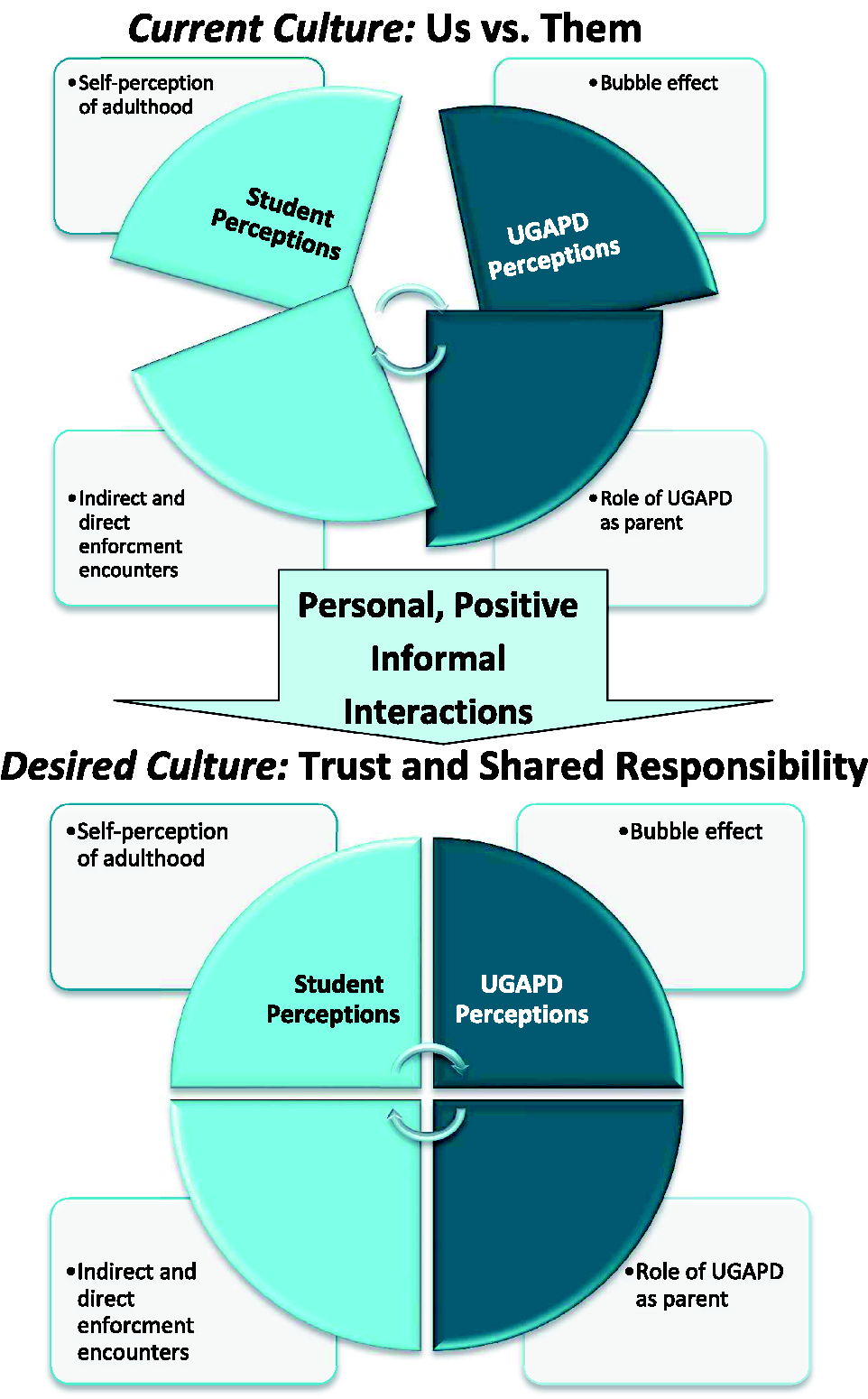
While the current lack of discourse, meaningful interactions, and deliberative negotiations between police professionals and student users inhibit students’ willingness to engage as co-deliverers, both students and officers report a willingness to engage in such personal, positive and informal interactions. The researchers are interested to see what further insights will emerge from future research. Our preliminary findings suggest that developing structured opportunities for students and campus police to engage in dialogue and negotiations, and to build positive relationships in informal settings, may expedite the advancement of users as co-deliverers of professionally designed services and possibly, over time, facilitate the full co-production of campus safety. As noted by Parker and Heapy, ‘[E]ngaging people in co-production … needs to happen at the point of delivery and through conversation and dialogue rather than chance alone’ (2006: 15). One such interaction could be the co-designing or co-planning of campus safety and security efforts by the professionals and users.
The findings from this phase of our project illuminate a very visible linkage with the concept of civic competence, the capacity of citizens to accomplish political (Cassel and Lo, 1997; Dahl, 1992) or public tasks that impact their lives (Meijer, 2005). Dahl (1992) and others have highlighted problems related to civic competence as regards to knowledge, attitudes, and behavior.
Our analysis of transcripts from group discussions brings focused attention to the lack of knowledge (i.e. the benign ignorance that students have about their potential role in fostering a more safe and secure campus environment emblematic of the bubble effect). Likewise, our findings bring to light a suspicious, and at times clearly distrustful, attitude that students have towards UGA police and the feelings that police officers have in return. Finally, our findings reveal that current perceptions decrease the potential for users as co-deliverers of professionally designed services, much less as participants in enhanced co-production efforts. This suggests that all three of the civic competence issues identified by Dahl (1992) are present in this context.
The connections of our findings to the concept of civic competence issue a clarion call for more research. New lines of inquiry can examine the effects of user and professional demographic characteristics on the range of relationships identified by Bovaird (2007). For example, in the context of efforts to co-produce campus safety and security, are students from certain regions of the state or country more civically competent? Are students from more urban, rural, or suburban areas more civically competent? Does race or ethnicity, gender, or socioeconomic background have an effect? Are students from certain majors more inclined towards civic competence?
Other lines of inquiry could address some of the administrative implications of this study: What strategies or tactics are more effective in getting users to evolve from non-deliverers to co-deliverers and from co-deliverers to co-planners? Are some strategies and tactics more effective with some age groups or populations than with others? Answers to these questions can further enhance our understanding of endogenous challenges that impact professional–user interactions along the co-production continuum, and provide further insight into the challenges specific to the co-production of campus safety and security. Such future research could also help distinguish the relative efficacy of possible solutions to the problem of fostering civic competence, including deliberation to foster empathetic understanding (Dahl, 1992; Lupia, 2002), the impact of technology and new media (Lupia and Baird, 2003; Meijer, 2014) and the utility of increased transparency (Meijer, 2005).
Beyond highlighting potentially fruitful avenues for future research, this study has made a number of contributions to the literature on co-production. By examining points of convergence and divergence in user and professional perceptions of a seemingly co-productive relationship, this study highlights the need to consider the perspectives and behaviors of all actors when describing and studying co-production. This is especially true given that disparities in user and professional perceptions of their relationship appear to affect the efficacy of co-productive efforts. This study also expanded potential applications of Bovaird's (2007) conceptual framework, since it was used here to analyze user and professional perceptions of their service delivery relationship, rather than categorize the relationship overall from the perspective of the researcher. Finally, this study examines co-productive efforts in a relatively under-studied context: campus safety and security.
Conclusion
The UGA Police Department, like other public entities around the globe, has evolved from being reactive or simply reacting to calls for service, to being more proactive as officers independently act upon the knowledge, technical skills, and abilities that they have (Moore et al., 1988). Like other public agencies, the UGAPD now also faces the challenge of being more co-active, or partnering with individuals and groups to solve problems and deliver services. The findings from our study reveal that a full co-delivery relationship between professionals and users has not been achieved between students and campus officers at UGA, and specifically highlights the challenges of shifting from professional to co-delivery of services (Bovaird, 2007). Even though challenges are visible, opportunities exist to lessen the strain on the student–officer relationship and foster a more active role for students as co-deliverers of campus safety and security.
To address the focal challenge that emerged from this study – a challenge that may also affect relationships and interactions between professionals and users in other settings – administrators and public servants at the line level must recognize and appreciate the knowledge and skill sets that users bring to the relationship; value the need for constant recalibration; be aware of the power asymmetries, and how such asymmetry may impact the perceptions and resulting realities of professional–user relationships; and be vigilant in their efforts to recruit, nurture, and develop a diverse cadre of users as co-deliverers of services. Positive, informal, and non-threatening encounters may be a prerequisite to overcoming the distance, lack of personal relationships, and oft resulting negative perceptions between professionals and users. These prescriptions offer important implications for efforts to enhance and sustain a co-productive relationship between UGA police professionals and student users, as well as other professionals and users in other settings. Attending to these details by fostering dialogue and interaction and encouraging negotiations between professionals and users may bring the theoretical benefits of co-production as a ‘therapeutic tool’ and a mediating structure more into contemporary practice (Needham, 2008; Parker and Heapy, 2006).
Footnotes
Acknowledgements
The researchers would like to thank the University of Georgia Police Department, and Police Chief Jimmy Williamson.