



Abstract
Comparative literature on institutional reforms in multi-level systems proceeds from a global trend towards the decentralization of state functions. However, there is only scarce knowledge about the impact that decentralization has had, in particular, upon the sub-central governments involved. How does it affect regional and local governments? Do these reforms also have unintended outcomes on the sub-central level and how can this be explained? This article aims to develop a conceptual framework to assess the impacts of decentralization on the sub-central level from a comparative and policy-oriented perspective. This framework is intended to outline the major patterns and models of decentralization and the theoretical assumptions regarding de-/re-centralization impacts, as well as pertinent cross-country approaches meant to evaluate and compare institutional reforms. It will also serve as an analytical guideline and a structural basis for all the country-related articles in this Special Issue.
Points for practitioners
Decentralization reforms are approved as having a key role to play in the attainment of ‘good governance’. Yet, there is also the enticement on the part of state governments to offload an ever-increasing amount of responsibilities to, and overtask, local levels of government, which can lead to increasing performance disparities within local sub-state jurisdictions. Against this background, the article provides a conceptual framework to assess reform impacts from a comparative perspective. The analytical framework can be used by practitioners to support their decisions about new decentralization strategies or necessary adjustments regarding ongoing reform measures.
Keywords
The issue
Recently, Western Europe has been subject to a wave of sub-central reforms. Comparative literature on institutional reforms in multi-level systems proceeds from a global trend towards the decentralization of state functions (Denters and Rose, 2005; Ongaro et al., 2010; Pollitt and Bouckaert, 2004; Stoker, 1991): Political Decentralization is in fashion. … It is hard to think of any other constitutional feature – except perhaps democracy itself – that could win praise from both Bill Clinton and George W. Bush, Newt Gingrich and Jerry Brown, François Mitterrand and Jacques Chirac, Ernesto Zedillo and Vicente Fox, Mikhail Gorbachev and Boris Yeltsin. (Treisman, 2007: 1–2.)
We will proceed in four steps: first, the article will elaborate some basic hypotheses on decentralization effects, drawing on pertinent institutional theories. In the second step, the major patterns and models of decentralization put forward in the relevant literature will be discussed. Third, we outline the analytical dimensions for a comparative assessment of decentralization effects, drawing on evaluation literature and research. Last, we will identify the factors that can theoretically be assumed to influence the causal relationship between decentralization and performance, particularly policy properties, country-specific governance structures/local government systems (as the ‘starting conditions’ of reforms; see Pollitt and Bouckaert, 2011) and external context factors (e.g. fiscal stress).
For better or for worse? Basic hypotheses on decentralization effects
On the one hand, a wave of enthusiasm has tended to accompany the international discussion of decentralization. In the context of development politics, as well as in developed countries, decentralization is approved as having a key role to play in the attainment of ‘good governance’. It promises to bring the state closer to the citizen, to enhance efficiency and effectiveness in the provision of public services, and also to promote accountability and participation (for an overview, see Treisman, 2007: 1–14). Reformers assume that the reallocation of tasks from upper to lower levels of government makes a real difference in the provision of public services.
On the other hand, the implementation of delegated state tasks can also fuel competing priorities and create erosions in the original local self-government task portfolios. This leaves little (fiscal) room for manoeuvre while local governments’ autonomy and discretion tend to be seriously threatened (cf. Holtkamp, 2010). There is also the enticement on the part of state governments to offload an ever-increasing amount of responsibilities to and overtask the local levels of government. Another striking feature of decentralization policies – disguised under the cover of subsidiarity – is to transfer unpleasant and veritably expensive public functions to local authorities. In other words, the state government shifts responsibilities and implementation problems associated with these transferred functions to the local levels of government (blame-shifting). Such circumstances lead to legitimate criticisms that decentralization processes produce increasing performance disparities within local sub-state jurisdictions since the effects unfold to reinforce the already-existing differences among the relevant decentralized bodies and actors. A widespread view is that this generates some adverse impacts that threaten the standards of equality in living conditions (Gleichwertigkeit/égalité) and the uniformity of public administration (cf. Ebinger, 2010). Against this background, some countries have embarked on new strategies of re-centralization.
Advantages and disadvantages of decentralizationa

Note: For the theoretical deduction and further explanations underlying the six performance dimensions used in Table 1, see later. For the theoretical sources and inherent meanings underlying the six performance dimensions used in Table 1, see later.
Source: Adapted from Grohs et al. (2012).
Due to these divergent and, in part, strikingly contradictory assessments, the relevant studies come to the conclusion that it is not so much the fact of task reallocation as such that explains performance differences, but rather the actual implementation of the reforms (cf. De Vries, 2000: 200; Treisman, 2007: 21–26), in conjunction with the specific political situation (cf. De Vries, 2000: 200–201; Ostrom and Bish, 1977) and the characteristics of the devolved or centralized policy/task (see later).
Models of decentralization
In the pertinent literature, various typologies to distinguish models of decentralization have been suggested. We draw on a distinction of four major types of decentralization/de-concentration, which can also emerge in different variants and ‘sub-types’ (see also Benz, 2002: 209; Kuhlmann et al., 2011; Wollmann, 2006):
Political decentralization is the complete transfer of state functions to local administrative bodies. In this process, a democratically elected local representative body is given full responsibility over planning, financing and the administration of the new task. Administrative decentralization involves a more moderate method of restructuring intergovernmental relationships. In this case, elected local councils do not receive autonomous decision-making competencies over the transferred functions. Although the local authorities can decide on the organization and processes of execution, they function as ‘agents of the state’ with respect to these policies. They continue to be subject to the strict supervision and control of the state. Vertical de-concentration involves the transfer of (central) government functions to locally operating state agencies or field offices, which are located at the sub-national/local administrative level but continue to be part of the organizational structure of the state/central government. Horizontal de-concentration means that specific tasks previously assigned to local government bodies become separated from the responsibility portfolio of those bodies, consolidated at the same level as independent administrative functions (quasi-autonomous non-governmental organizations (‘Quangos’)) and placed directly under the authority of the (central) government (Skelcher, 1998).
Our approach is not meant, however, to presume a deterministic relationship between the type of decentralization, institutional changes and performance. In all three models of decentralization, the nature of the policy under consideration is expected to matter. From the perspective of the public and stakeholders, policies differ in political saliency and, hence, face varying demands regarding input–output standards of legitimacy (Scharpf, 1999; see further later). As a result of this, the decentralization of service delivery functions that immediately affect local citizens might have a more straightforward positive impact on the institutional performance than, for instance, the devolution of technical or environmental functions, which cover a broader territorial scope and are likely to produce numerous ‘supra-local’ impacts.
Evaluating the effects of institutional reforms: analytical dimensions and problems of measurement
From a public policy perspective, decentralization can be conceived as a deliberate intervention into the functional setting and the ‘institutional logistics’ of multi-level systems. This particular type of public policy, which has also been referred to as ‘polity policy’ (see Wollmann, 2003: 4), causes specific steering problems. 1 Consequently, the evaluation of ‘polity policy’ is – in contrast to that of (‘normal’) sectoral policies – characterized by an even more complex analytical architecture (Kuhlmann and Wollmann, 2011; Pollitt and Bouckaert, 2003: 12–14). First, changes within the politico-administrative system must be analyzed (institutional evaluation). Then, the consequences of these institutional changes on the effectiveness and performance of public administration have to be considered (performance evaluation). In a third step, the more remote impacts outside the politico-administrative system (outcome evaluation) have to be examined. With each of these three steps of reform evaluation the number of intervening factors and therefore the problems of causality tend to increase. Hence, it becomes more and more difficult to precisely attribute observable changes to specific reform measures (e.g. decreasing outlays, increasing employment, etc.) and it is often impossible to clearly isolate the effects of a single reform process. In addition to this, reform goals are often not clearly defined and individual objectives are contradictory (Boyne et al., 2003: 13–15; Kuhlmann and Wollmann, 2011; Pollitt and Bouckaert, 2004: 103–133). Moreover, depending on perspective and affiliation to various stakeholder groupings, the evaluation and quantification of performance can vary (Boyne et al., 2003: 14; Connolly et al., 1980; Enticott, 2004).
Measurement of local government performance consecutive to national decentralization reforms
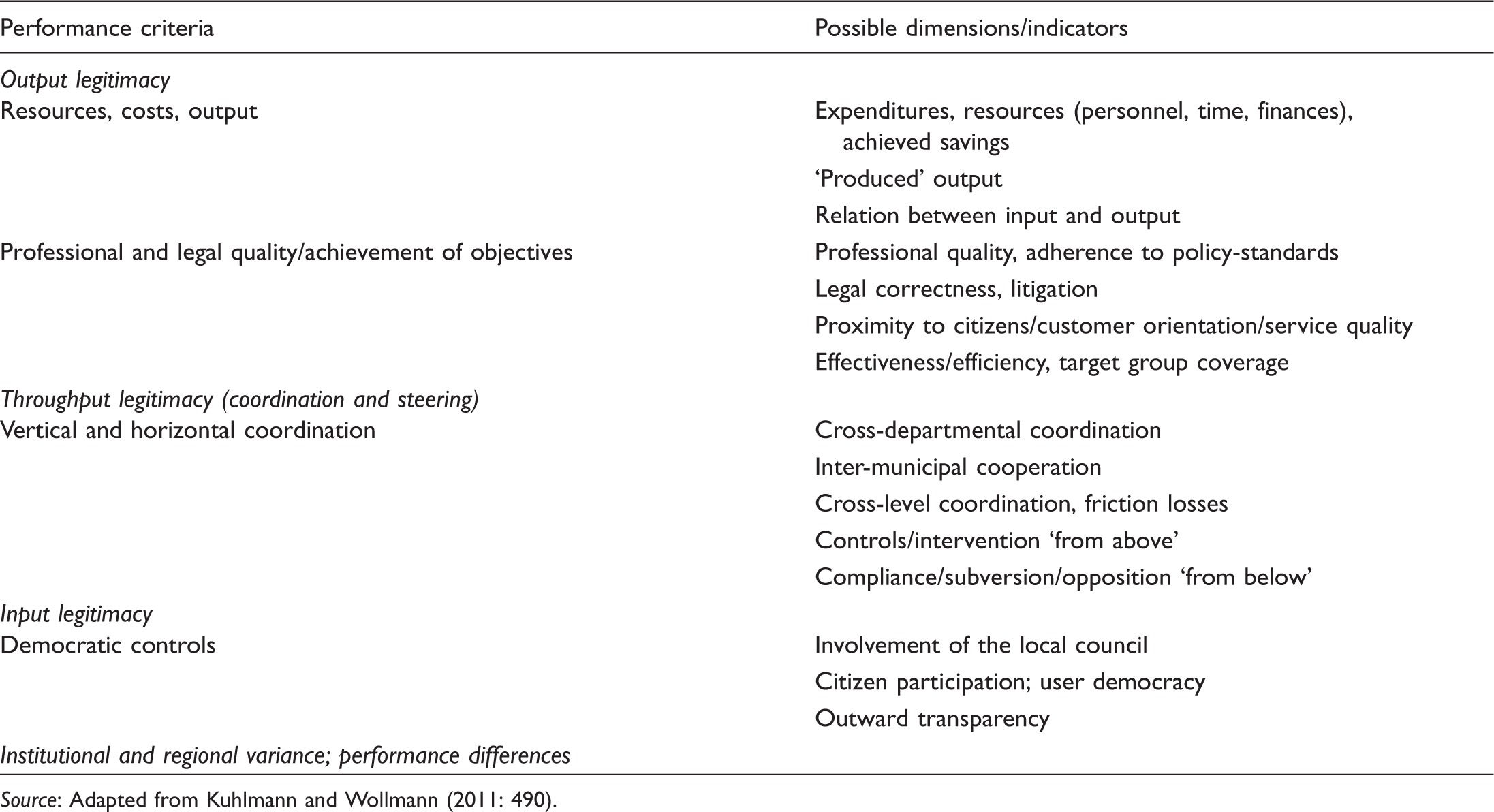
Source: Adapted from Kuhlmann and Wollmann (2011: 490).
Explaining the effects of and analyzing the conditions for decentralization
A major task of comparative reform assessment is to filter out the specific favoring conditions for decentralization, its impacts and also its stabilization over time for different political-institutional settings/countries and different policies. We differentiate here between country-specific factors (administrative traditions and local government systems), policy-specific factors (characteristics of the devolved tasks), actor-specific factors and external pressures (e.g. fiscal stress). Of course, all of these variables show interactions and represent configurations of determining factors to be taken into account when it comes to explaining reform impacts. Yet, for analytical reasons, in a first step, we have to separate them in order to specify how each of these factors will (in theory) influence the outcome of decentralization reforms. In a second step, the relationships between specific sets of variables can be examined, which is one task of the country analyses presented in this Special Issue.
Administrative traditions and local government systems
Historically ingrained institutional structures and administrative traditions inherited from the past have been highlighted as being influential factors of reform successes or failures. They can be assumed to produce distinctive effects of decentralization reforms in politically and historically different contexts. While external pressures may generate congruent (international) reform discourses, the actual implementation measures and the rate and modality of institutional change in the different countries is, by and large, a product of country-specific political, institutional and cultural parameters. This argument can be conceptually derived from the New Historical Institutionalism, stressing the importance of past institutional choices and path dependencies, which are assumed to predetermine further institutional development (see Immergut, 1992; Krasner, 1984; Steinmo et al., 1992). From this theoretical viewpoint, the institution-building process is influenced by the already-existing institutional arrangements, which are seen as relatively persistent features of the historical landscape and one of the central factors pushing historical development along a set of ‘paths’. In assuming that subsequent policy choices are largely conditioned by ‘policy legacies’ and the cognitive schemes of political actors that have been inherited from and ingrained in the past, Historical Institutionalists emphasize the limited scope and ‘corridor’ of reforms, suggesting a more incremental rather than large-scale institutional change. Against this background, institutional development is likely to produce a multitude of distinctive models that are shaped by past institutional choices and existing patterns of political and administrative cultures.
The five countries under scrutiny in this Special Issue (France, Germany, the UK/England, Belgium/Flanders and Switzerland) represent distinct models of local government systems, which are theoretically assumed to have an impact on the reform processes and outcomes. These models can be seen as ‘typical’ cases of decentralized institution-building and reform in Western Europe. Therefore, the country analyses presented here will examine the influence of a given administrative and local government system on the decentralization reforms. We distinguish three analytical dimensions (see also Hesse and Sharpe, 1991; Kuhlmann, 2009a; Kuhlmann and Wollmann, 2013):
Functional profile, that is, the scope and salience of the functional responsibilities that are assumed by local territorial bodies from the vertical distribution/fusion of functions between local and central government (separate versus fused systems; dual versus monistic function model) and financial autonomy. Local government systems can be differentiated as to whether state authorities and local self-governments execute their responsibilities separately and largely independently from one another, or whether the levels interact strongly, leading to a mix of state and local responsibilities (Bennett, 1989). The first administrative type has been termed the ‘separationist model’, which is traditionally characteristic of the British (and Swedish) administrative tradition (cf. Bulpitt, 1983). In contrast, typical of the continental European countries are ‘fused systems’. These are characterized by state and local self-government tasks not being carried out separately, but instead being integrated administratively (‘mixed’). France can be considered a prototype of the ‘state-centred integrationist model’ (until decentralization in the early 1980s) since the state authorities, through their local offices, were strongly involved in the conduct of local government tasks. In contrast, the ‘local administration-centred integrationist model’ can be found in the German and Austrian local government tradition. A viable typology of local government functions can also be based on the scope and content of functional responsibilities and on the extent of autonomy (local discretion) that the local authorities have in carrying out the tasks. For example, the financial autonomy of Swedish and Swiss local governments is particularly high because they are funded largely (64% and 59%, respectively) from their own (income) tax revenue and, at the same time, have significant influence on local tax rates. For post-Thatcher England, in contrast, the opposite is true (with 13% of their overall local revenues stemming from their own taxes). With a proportion of 45% of their own taxes in the overall local government revenues, the French local authorities have a higher local fiscal autonomy than their German (40%) or Italian (37%) counterparts (OECD, 2011). In some cases, the actual strength and autonomy of local governments deviate considerably from their formal legal/constitutional status. Hence, in many countries, local self-government now possesses a constitutionally codified status (Germany, Sweden, France, Italy); however, in part, the actual scope of responsibilities is limited (France, Italy). Conversely, it was true for the UK until the Thatcher era that local government did not have a constitutional status (which is still the case), but enjoyed very extensive autonomy and a broad responsibility profile (which has since become largely eroded). On the legal level, a general competence principle applies to continental Europe and Scandinavia, according to which the municipal councils are responsible (at least formally) for all matters relating to the local community. This stands in contrast to the British ultra vires principle by which local governments only carry out those responsibilities that have been explicitly assigned to them by parliamentary legislation, which can be revoked at any time. The ultra vires principle was, however, attenuated by the local government legislation of 2000 and aligned more closely with the general competence clause typical of the continental European local government tradition. Territorial profile, that is, the territorial structure and related territorial viability of local government (Northern European versus Southern European model). The criterion of the territorial structure of the municipal level is closely connected to the functional profile, which can plausibly be seen as constituting an important institutional condition for the viability and operational capacity of local government. In line with Norton (1994), Baldersheim et al. (1996), John (2001: 25–30) and Wollmann (2008), one can, on the one hand, identify the so-called ‘Southern European type’, characterized by a small-scale local government structure with a multitude of small municipalities and by the absence of territorial reforms. On the other hand, the so-called ‘Northern European type’ has been distinguished as being marked by territorially (and demographically) large-scale municipalities resulting from extensive territorial reforms. Examples of the ‘Southern European type’ can be found, in particular, in countries with a continental European Napoleonic tradition (France, Spain, Italy), whereas the UK exemplifies the ‘Northern European model’, which also includes the Scandinavian countries. The countries shaped by a continental European federal tradition can, in contrast, be largely assigned to the ‘Southern European type’ (Switzerland, Austria and in Germany, the Länder of Rhineland-Palatinate, Baden-Wuerttemberg, Bavaria, Schleswig-Holstein and most of the East-German Länder (by contrast, the Länder of North Rhine-Westphalia and Hesse fall under the ‘Northern European type’)). Political profile, that is, the structure of local democracy (representative versus direct democratic), the relationship between council and local executive authorities (monistic versus dual), and the electoral procedure of the head of administration (direct versus indirect). In order to specify the political profile of local government, the democratic decision-making rights of citizens at the local level, the (internal) institutional arrangement of local government decision-making, and its politico-administrative leadership structure should be highlighted. This holds true particularly for the relationship between the local executive and local council. With regard to the first criterion, local government systems with a pre-dominance of representative democracy-based institutions (traditionally, the UK, Sweden since 1974, Germany until 1990 and France) can be distinguished from local government systems that possess strong direct democracy-based elements, such as binding local referendums (Switzerland, German Länder since 1990, Hungary, Italy, Sweden until 1974, Austria, Finland and the Czech Republic). Under the latter criterion, monistic and dual systems may be discerned (Kuhlmann and Wollmann, 2013). In monistic systems, all decision-making powers, including the ‘executive’ direction and control of local administration, lie with the elected local council or, more specifically, with sector-wise responsible council committees. For this reason, in comparative terms, one speaks of government by committee systems (the UK, Sweden and Denmark). In such systems, ‘strong mayors’ are generally unknown, and they have come to be criticized for a lack of political and executive leadership and for the sectoral fragmentation of administration. In dual systems, by contrast, responsibilities are divided between the executive leader/mayor and the legislative/council, with the local executive branch being equipped with its own decision-making powers (France, Germany, Italy, Hungary, Spain, Portugal, Greece and Poland) (cf. Heinelt and Hlepas, 2006: 33). This ‘strong mayor’ form of local democracy (Mouritzen and Svara, 2002) is made even stronger in some countries through the direct election of the mayor (Germany, Italy and Hungary) (cf. Wollmann, 2009). Furthermore, a major source of the political power of local governments can be observed in the access of local political actors to higher levels of the political-administrative system. This access (Goldsmith and Page, 2010; Page and Goldsmith, 1987) can result from the accumulation of mandates (cumul des mandats), patronage-based relationships and the logic of political careers emblematic of Southern European local government systems (France, Italy, Greece and Spain). However, such access may lead to a blending of levels or even to a ‘colonization’ of the state by local actors (as in the case of France). Figure 1 summarizes the main criteria for a comparison of local government systems. Comparing local government systems.

Our assumption is that the (functional, territorial, political) properties of a particular local government system will influence decentralization processes and effects. For example, a country’s/region’s level of central–local interweavement and the characteristics of a ‘fused system’ might impede the speed of ongoing decentralization. After all, the more parties and interests involved in decision-making, the slower the actual decision-taking, at least in theory. Likewise, the local government’s experience in discharging a broad scope of functional responsibilities is likely to affect the centre’s choice of dominant type or constellation of decentralization, as well as its impact. Transferring a new function to the local level might also depend upon the territorial viability of the municipality to take up full responsibility, democratically vis-a-vis the citizen, as well as administratively over an enlarged bureaucracy. Furthermore, in strong mayor systems with powerful local leaders, it might be easier to effectively manage an extended local task portfolio than in collective systems. To sum up, we believe that the inherited local government system and tradition sets the overall frame for decentralization, albeit that other factors are at play as well.
Characteristics of the devolved policies
We assume that the characteristics of a policy must be taken into account as they significantly influence the reform impacts (Knoepfel, 2009; Knoepfel et al., 2011; Ongaro et al., 2010). We hypothesize that the actual effects of decentralization are closely linked to the nature of the transferred tasks. Wherever horizontal coordination becomes a significant aspect accompanying the discharge of those tasks, and economies of scale feature as less important, decentralization could be expected not only to provide an outlet for blame-shifting, but also to lead to real performance improvements. Against this background, the selection of policy areas was inspired by two considerations. On the one hand, we selected functional areas that are actually affected by decentralizing strategies in the respective countries with a view to studying their effects. To this effect, we included some (though not all) of the priority areas of decentralization, such as labor market policies in France and Italy, local planning policies in England and Flanders, and social services in Germany. The different policy areas do not have the same significance for de-/re-centralization in all countries scrutinized, however. In addition, we adapted the policy selection to the national/regional reform agenda in order to cover those areas that were subject to major reform strategies in the respective countries (e.g. security policy in Switzerland).
On the other hand, the policies covered by this Special Issue are meant to include the provision of personal as well as impersonal goods. More precisely, we are interested in variances between the following three types of tasks, the properties of which can be assumed to shape the causal relation between decentralization and local government functioning/performance:
services rendered to individuals (social services); regulatory tasks (security policy); and spatial planning-related functions (urban planning).
Several assumptions can be put forward when it comes to the influence of policy characteristics on decentralization processes and effects. For example, the scale of the problems at stake might urge the tackling of them on a sub-central level if local people and institutions understand them better, as often in the case of the environmental and socio-economic issues of a specific area. Local government, representing the so-called ‘everyday face of the public sector’, might then be better placed to tackle these problems than the centre. If required, it might facilitate citizen participation to this end, particularly among less-favored groups and populations, or create networks and other forms of cooperation with public and/or private partners. Conversely, a policy’s highly specialized nature might block decentralization in case of a (perceived) lack of skilled personnel at the sub-central level and, if still implemented, increase the latter’s workload while decreasing their motivation. Against this backdrop, the contributions gathered in this Special Issue will analyze the relationship between the devolved policy and the decentralization impact.
External pressures and actor constellations
External pressures (particularly fiscal stress) and actor constellations are major explanatory factors that the research presented here draws on. Following the hypotheses put forward by neo-institutional economics, institutional development is primarily shaped by exogenous influences, making for similar policy reactions in historically and politically different countries. In assuming that institutional reforms are processes of seeking an economic optimum, the economically oriented institutionalism stresses the (rationally based) efficiency of an institution as being the decisive criterion for designing politico-administrative institutions (for this line of argument, see Richter and Furubotn, 1997; Schröter, 2001). The external pressure hypothesis is further underpinned by the research on European Union (EU) integration, policy diffusion and policy transfer (see Héritier et al., 2001), which states that national reform activities are, to a large extent, triggered and fuelled by external pressures and supranational driving forces. Hence, with regard to decentralization reforms, we should expect central government to extend various (post-) New Public Management (NPM) developments in its internal organization to its relation with regional and local government. One of them is the evolution from a primarily process-oriented towards a more result-oriented approach when steering and controlling its sub-central counterpart. Today, this trend is mostly affecting countries of the so-called Franco group as local government in the Northern/Middle European and especially the Anglo countries have been confronted with ‘a payment for results’ regime for years. Currently, the latter are exploring new tools and instruments, such as framing, facilitation and storytelling, that allow the center to meta-govern the public and/or private actors and networks sub-centrally. This development gives the sub-central level not only more autonomy, but also more responsibility, and is likely to be a forerunner to similar evolutions in other countries as well. Exogenous context factors can also be expected to account for variance in decentralization effects because different regional socio-economic and fiscal circumstances, for example, financial pressures or crises, might prompt local actors to exercise the devolved tasks with less resources and, probably, as a consequence, at the expense of service quality.
On the other hand, to the external pressure hypothesis, the objection can be raised that institutional choices are not only prompted by external pressures, but also strongly depend on ‘endogenous’ forces, in particular, on country- or even city-specific actor constellations and power-seeking strategies (see Crozier and Friedberg, 1979). Here, we can draw on the actor-oriented approach of the new institutionalism (Mayntz and Scharpf, 1995; Ostrom et al., 1994; Scharpf, 2000), arguing that institution-building has to be interpreted as a result of institutional choices made by political actors within specific institutional settings. According to this line of thought, institutional development is not determined by an abstract economic optimum, but shaped by the strategic decisions of political actors seeking to maximize the attainment of a set of goals given by a specific preference function. Irrespective of similar external pressures, in different political contexts, we should thus expect clearly distinctive trajectories and effects of decentralization depending on the specific constellations of actors and political interests.
Conclusion and outlook
This Special Issue will provide empirical insights and theoretical explanations regarding the effects of functional restructuring in various European countries. It thus seeks answers to the crucial question of whether decentralization serves ‘for the better or for the worse’. In general, we assume that the institutional changes that accompany decentralization reforms exert a significant influence on task fulfilment and the performance of service delivery. However, the euphoric expectations credited to decentralization strategies must be questioned and tested against empirical evidence, to which the analyses in this Special Issue will contribute. They are intended to reveal whether and under which circumstances decentralization reforms entail positive/intended or negative/unintended effects, additional costs and burdens, or improvements and increasing capacities.
The conceptual framework put forward in this article is meant to serve as an analytical guideline for the subsequent country-related contributions and to point out major explanatory factors for the comparative assessment of decentralization reforms. The following contributions will analyze the reform movements with regard to particular policy fields representing typical cases of the institutional changes in the respective countries and thus reveal crucial characteristics of the reforms in general. They are structured along the following dimensions/questions:
Conditions for decentralization/explanation of effects – a) Administrative traditions and local government systems: what is the influence of a given institutional setting/tradition on decentralization reforms/impacts? To what extent do the national/local politico-administrative ‘starting conditions’ explain reform outcomes? b) Characteristics of the devolved policies: what is the explanatory power of the policy characteristics? Is decentralization more ‘successful’ in specific policy sectors, but less in others, and why? c) External pressures and actor constellations: to what extent and how do external pressures and specific constellations of actors/stakeholders influence decentralization reforms/impacts? Models of decentralization and reform implementation – Which approach of reform do the national/regional reformers pursue (‘political decentralization’/‘administrative decentralization’/‘de-concentration’, which would lead to re-centralization, etc.)? Do the reforms involve significant structural reorganizations (‘big bang’) or just incremental changes? How are the reforms being implemented? Through consensus-building or top-down direction? Reform impacts and outcomes – what are the impacts of the territorial and functional reorganizations? Did performance improvements occur? Which reform solutions have proven most effective? Which lead to more and which to less performance change and in which performance dimensions (e.g. effectiveness, efficiency, coordination, etc.)? Is decentralization creating more policy diversity? Do some of the reforms finally result in re-centralization, and why?
As such, this Special Issue is intended to make a contribution to filling a gap in recent academic literature concerning sub-central reforms and the systematic assessment of their impacts in the intergovernmental setting.
Footnotes
Funding
This research received no specific grant from any funding agency in the public, commercial or not-for-profit sectors.
Note
 ). Her recent international publications include ‘Towards a city-regional policy in Flanders from the bottom-up’ (Urban Research and Practice, 2012) and (with B. De Peuter and V. Pattyn) ‘Territorial reform of local government evaluation criteria underpinning decisions and debate in Flanders’ (Local Government Studies, 2011).