



Abstract
This article analyses the decentralization of the French welfare state focusing on the transfer of the Revenu minimum d’insertion (RMI) welfare benefit to the departments in 2003 and 2004. We map and explain the effects of the reform on the system and performance of the subnational provision of welfare tasks. To evaluate the impact of decentralization on the RMI-related action of the departments, we carry out a qualitative document analysis and use data from two case studies. The RMI decentralization offers an exemplary insight into the incremental implementation of French decentralization. We find many unintended effects in terms of the performance and outcome of the subnational welfare provision. This is traced back to the combining of institutional and policy reforms and the inadequate translation of high political expectations into an inadequate action programme both resulting in excessive demands on the local actors.
Points for practitioners
The decentralization of public tasks is associated with high expectations in terms of the effects on the performance of public services and public governance on the subnational levels. For an in-depth measure the range of administrative performance and political systems effects should be taken into account. We propose a five-dimensional scheme allowing for the determination of decentralization effects on the resource input to and the operative output of subnational public services, on the horizontal coordination between subnational task holders and the affected non-public stakeholders, on the vertical intergovernmental coordination, and on the democratic accountability of subnational authorities.
Introduction
France represents a distinctive case of the trans-level restructuring of public tasks through decentralization. Compared to other European countries (e.g. the United Kingdom), French decentralization never featured a pragmatic strategy of devolvement ‘on demand’ (McEwen and Parry, 2005: 41). Instead, from its inception in the early 1980s, it stood out because of the fact that policy-makers attempted to ‘square the circle’. The Republican idea of the central state as the unique guarantor of ‘equal opportunities’ to all citizens was meant to be combined with the strategy of granting subnational authorities 1 more power and competencies in order to generate efficiency gains and bring public administration closer to the citizens (Cole, 2005: 85–86). In the following we critically examine the French decentralization reform which has so far been implemented in two waves or ‘acts’ (‘Acte I’, 1982–86; ‘Acte II’, 2003–04). In this, we turn our attention to the welfare state with its social benefit (aide sociale) and social service (action sociale) functions as this represented the emphasis of the reform from the outset (Borgetto, 2010a: 7).
A particularly important process within the scope of the more recent ‘Acte II’ was the transfer of competencies for the minimum income scheme Revenu minimum d’insertion (RMI) from the state to the departments in December 2003. Strictly speaking, the RMI is welfare aid for 25- to 65-year-old people able to work. The ‘departmentalization’ of this aid represents an exemplary case of the overall decentralization of the French welfare state. This reform used to be conceptualized as a ‘big bang’ by the changing central governments since the beginning of the 1980s. It was designed as a double approach to coupling institutional change (decentralization) with policy change. As a result, the decentralization as an institutional reform policy was accompanied by many unintended effects. The institutional complexity increased and the resolution of conflicts between the actors on the central and subnational levels of government became more difficult, more time consuming and less transparent. Asked by the former French President, Nicolas Sarkozy, to deliver a report on decentralization, the former Prime minister and local politician, Édouard Balladur pointed to the double (unintended) impact of this institutional policy. First, with the complete transfer of tasks to the subnational authorities (‘political decentralization’), the anticipated structural effects could not be achieved. Second, a number of politically envisaged policy objectives were missed, which, again, produced negative and unintended consequences: … the organization of the subnational units became even more complex over time. The latest steps towards the decentralization … of policies were not accompanied by efforts towards a rationalization of the structures, competencies, and financing of tasks discharged by the territorial authorities. As a result, public action loses its effectiveness, the tax payer has to face higher costs and the voters are confronted with a lack of transparency. (Comité pour la réforme des collectivités locales, 2009: 9; authors’ own translation)
In accordance with the aims of this special issue and taking this assessment as a starting point, we ask the following questions: How did the decentralization of the RMI impact upon the public provision of the according welfare benefits and social services at the level of the departments? And what explains the intended and particularly the unintended effects of this institutional reform in terms of the functioning and performance of public services within the scope of the French welfare state? We argue that the ‘big bang’ mode of reform, i.e. the combination of structural/institutional and policy reform goals, has led to an overburdening of the departments resulting in an (at least partial) failure of overall reform objectives.
The article proceeds in six steps: Using neo-institutionalist and public management approaches, we first develop a concept to investigate the effects of the reform. Here, we concentrate on three dimensions of assessment: the resources of the French departments (input, output), their executive performance, and the democratic quality (system effects) (second section). Second, we introduce the RMI, explain the distribution of related tasks between the central state and the departments prior to the decentralization reform of 2003, and refer to the critique of the former co-governance constellation (third section). Subsequently, we present the changes resulting from the decentralization law of December 2003 and scrutinize the effects of the reform drawing on our framework of impact assessment (fourth section). Referring to the ‘government at a distance’ theory (Epstein, 2005), we then discuss to what extent and how the RMI reform failed in its institutional and policy objectives. We show that the RMI, unlike other public tasks, was not fully compatible with the idea of arm’s-length steering preferred by French central governments since 2004 (fifth section). Finally, we summarize our argument and reflect on the current ‘Acte III’ (2013–14) as the most recent attempt towards administrative modernization in France (sixth section).
Mapping the effects of decentralization: a conceptual framework
As a policy of institutional reform, decentralization represents a specific variant of public policies. First, it is similar to ‘normal’, i.e. sector, policies to the extent that it matches the ‘usual’ policy process. It comprises the definition of policy goals, the selection of specific instruments to reach these goals, measures to implement policy and the evaluation of effects (Jann, 2001: 329). In terms of its content, institutional policy refers to conscious decisions for the change of the structural basis of public policy-making. It thus represents an attempt of policy-makers to alter the institutional order (polity) within which they make decisions (March and Olson, 1989: 69–70). Second, institutional policy is specific to the extent that it is characterized by a ‘weak coupling’ of reform rhetoric (talk), action programmes (decision) and actual change (action) (Brunsson, 1989). In most cases, many actors with different interests are involved and a high level of coordination is needed. Weak coupling can be functional and represent a rational strategy in organizational reform processes (March and Olsen, 1989: 99). Yet, therefore, the questions of the implementation of such reforms and of their effects arise all the more urgently.
Comparative public administration and local government studies provide conceptual references for an assessment of decentralization reforms. In these fields of organizational research the adoption of a functionalist perspective on institutional reforms is common. Researchers usually concentrate on three interconnected dimensions of effects: first, changes within the politico-administrative system including the effects of these institutional changes on the actors’ behaviour (institution assessment), second, the performance of institutions (performance assessment), and third, the outcomes of public sector reforms in the affected fields of intervention (outcome assessment) (Pollitt and Bouckaert, 2004: 103–142). In order to examine the effects of decentralization on the action of subnational governments (here: departements) in France we combine both of the aforementioned analytical perspectives and concentrate on two areas and five dimensions of effects (see Table 1):
Changes on the ‘operative level’ of administration (performance effects) Changes in the politico-administrative decision-making system (system effects). Measuring effects of decentralization on subnational public services Source: Author’s own diagram.
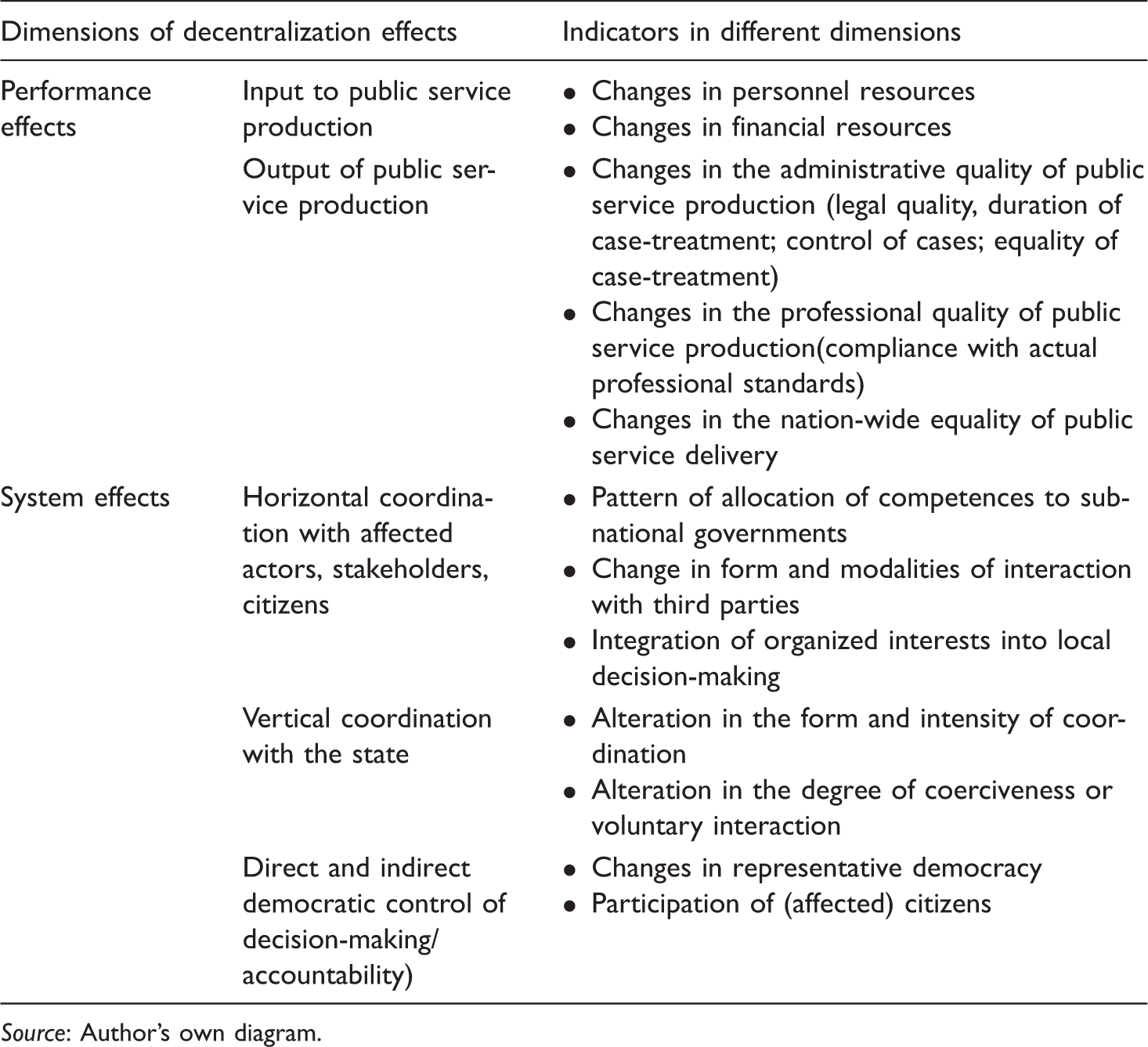
In terms of ‘performance effects’ we focus on the extent to which decentralization has affected the function-specific performance of local bureaucracies to provide public tasks such as the RMI. We distinguish between two dimensions: first, the input dimension of public action; performance effects here become apparent in the change of the resource (financing, personnel) expenditure of public administrations for the task involved, and second, the output dimension; performance effects here become apparent in the adherence to fixed quality standards both in administrative-technical (legality, appropriate processing periods, uniform administrative control, equal treatment of the customer/citizen) and functional-professional regard (achievement of existing professional standards). Moreover, output-related performance effects manifest themselves in the supra-local equality of services (March and Olsen, 1989: 143–158).
In terms of ‘system effects’ we analyse the impact of decentralization on the legitimacy of public decision-making and accountability of administrative actors. Here, we concentrate first on the coordination dimension, i.e. changes in the system and modes of interest intermediation between the (new) subnational service stakeholders and the (public and non-public) third parties affected and changes in national–subnational intergovernmental relations (March and Olsen, 1989: 119–129). Second, we examine the effects of decentralization on the democratic accountability of the subnational service stakeholders. Here, we focus on changes in the participation of the (affected) citizens in the politico-administrative decision-making process on the subnational (department) level (March and Olsen, 1989: 118).
Before we apply the concept, we now introduce the RMI as a welfare function and object of decentralization.
The RMI as a welfare function and object of decentralization
With the complete transfer of the RMI onto the departments – more precisely to the Conseils généraux (literally: general councils) and their presidents – at the end of 2003, the French legislator terminated a long period of ‘co-governance’ (co-gestion) dating back to the establishment of the RMI in 1988 (Cyntermann and Dindar, 2008). From 1988 to 2004, the division of functions between the state and the general council regarding RMI-related issues was as follows:
The prefect as the state-appointed representative in the territory and the president of the general council as the elected local executive shared the function of annual planning and regulation of services to the RMI recipients within the department. This collaboration resulted in the so-called ‘inclusive social service programme’ (plan départemental d’insertion – PDI) concluded by a joint state-departmental committee (commission départmentale d’insertion – CDI). The prefect was responsible for the financing of the RMI, i.e. both its welfare aid and social service functions (Sénat français, 2007: 17). Yet, the general council had to contribute each year with a proportion of at least 17 percent of the previous year’s RMI total budget in the department. Moreover, the prefect fulfilled the administrative tasks related to the execution of the welfare aid component of the RMI. He, inter alia, examined and authorized or refused the individual requests for social help (Steck, 2010). The general council for its part had to arrange for the implementation of the social service component of the RMI (action sociale) and for the realization of its ‘activating’ character.
Given the emergent debate on poverty, the critique of the French social system as being incapable of managing this new phenomenon (Cynterman and Dindar, 2008: 23–25) and the sharp rise in long-term unemployment during the 1980s (INSEE, 2014), the RMI was politically very salient from its outset. Notwithstanding the foreseeable high costs for and the incalculable financing risk, the socialist government decided not to transfer this task of national solidarity to the departments. Instead, it enacted cooperation between central government and the general councils. The traditional republican imperative of égalité (equality) simply conflicted with a complete decentralization of the task (Cyntermann and Dindar, 2008: 31–32). However, to achieve labour market ‘activation’ of the unemployed, the prefects heavily depended on the general councils’ support. These had established themselves as powerful players in the field of subnational welfare policy since the beginning of the 1980s, built up their own social services departments and created territorial networks with different providers of social services (Thoenig, 2005: 699).
The concern about the equal treatment of all citizens and the policy-related necessity for intense coordination between the state and the subnational actors can be regarded as a major reason for the evolution of a ‘co-governance’ regime (Thierry, 2008: 243) which was criticized right from the outset (Cyntermann and Dindar, 2008: 31; Sénat français, 2003: 12, 17). The most important critiques concerned the highly complex, non-transparent and bureaucratic architecture of the system (for details see Lafore, 2010: 77; Thierry, 2008: 245), the coerced ‘partnership’ and the lack of clarity about distribution of RMI-related competencies between the state and the general councils (Cyntermann and Dindar, 2008: 40; Thierry, 2008: 244), the barely manageably increase in costs caused by ‘co-gestion’ (Thierry, 2008: 244), and the neglect of the actual RMI purpose, i.e. the activation and integration of support for unemployed people (Sautory, 2008). Indeed, activation and inclusion were central elements of the RMI. Yet, their realization was challenged from the very beginning as their main instrument, the individual social inclusion contract (CI), had been little used during the whole period between 1988 and 2003. Not only did the quota of concluded contracts remain low during that time, it fluctuated at around 50 percent of the total of RMI recipients (Sénat français, 2003: 20). The actually concluded contracts, too, included a ‘potpourri’ of quite undifferentiated measures (Cyntermann and Dindar, 2008: 21–22).
Given these deficits of the RMI (Thierry, 2008), but also given the continuous critique of the departments claiming RMI decentralization (Sautory, 2008: 227), the conservative government of Jean-Pierre Raffarin, which came into office in May 2002, implemented this project. After having asked the representatives of the subnational authorities (‘Assises des libertés locales’ 2002 to 2003), it decentralized and reformed the RMI with the relevant law of December 2003 (JORF n° 293 du 19 décembre 2003: 21670).
How did decentralization impact upon the subnational authorities?
From January 2004, the general councils became fully responsible for the implementation of the RMI. The decentralization law of December 2003 determined that the general council should hold responsibility for the planning and resolution of the departments’ PDI, whereas its president and leader of the departmental administration should be competent in all decisions and operative tasks related to the welfare aid component of the RMI. He should equally be competent in the policy of social inclusion of the individual RMI recipient within the scope and service offering of the PDI (JORF n° 293 du 19 décembre 2003: 21670). Through these provisions a long-standing premise of the departments and their main interest organization, the Assemblée des départements de France (ADF), was finally realized (Cyntermann and Dindar, 2008: 31; Mauroy, 2000). Yet, at the same time, the old question of costs and (equal) performance of public service fulfilment in terms of the RMI re-emerged. In fact, the rates of unemployed and long-term unemployed varied greatly between the departments, which gave rise to the fear of unequal treatment of the unemployed within the national territory and unequal implementation of this public welfare service (Sénat français, 2003: 11–12). Actually, the legislator abolished the 17 percent rule, thus heightening the financing autonomy of the general councils. Yet, he established a new type of integration contract (Contrat d’insertion-Revenu minimum d’activité [CI-RMA] and in 2005: Contrat d’avenir [CA]), created the new position of integration officer (Référent d’insertion), held to the strong coordination of the general councils with the other subnational public and non-public actors and made the inclusion of the ‘RMIst’ into the labour market the top priority of the policy.
In view of this dual institutional and policy reform, the departments faced the double challenge of institutional adjustment and instrumental learning. In the next section, we use the schema developed in the second section in order to examine the performance and system effects of RMI decentralization and their importance for the realization of the institutional reform objectives before, subsequently, we test the initial hypothesis of poor reform effects due to systematic overburdening of the departments. In doing so, we draw on official statistics and evaluation reports from the Cour des Comptes (CdC), the Inspection générale des affaires sociales (IGAS), the Direction de la recherche, des études, de l’évaluation et des statistiques (DREES) together with the Assemblée des départments de France (ADF) and the French Senate published during the period of investigation between 2004 and 2009. We utilize reports of these selected bodies as they represent the most prominent bodies for the assessment of public (social) policies and as they are separately connected to the different most important public actors and stakeholders of interest in terms of the RMI (Senate: local/departmental governments; DREES/ADF: more scientific, yet general council-friendly; IGAS: central government; CdC: neutral, interested in core task of public finance). In addition, we also use data from two selected case departments (Seine-Maritime and Gironde). Here, we investigated the effects of the RMI decentralization as part of our own research carried out between 2007 and 2009. As we can only refer to two case studies, these data cannot be taken as representative. So we use the material only in order to further illustrate the findings from the document study. Methodologically we conduct a qualitative analysis of the content of the reports selected.
Performance effects
Input: outlays, staff
The central government had a broad scope of interpretation in terms of actual personnel transfers. Rather than mentioning the precise number of staff to be transferred, the decentralization law of December 2003 stipulated that the general councils were each to receive the same number of staff as there had been employees charged with RMI tasks in the local field offices of the state administration (Direction départementale d’action sociale et de santé, DDASS) until 2003. The prefect was to determine the number of relevant staff and report it to the ministry of social affairs who decided on the transfer (IGAS, 2007a: 5, 13). This complicated method led to numerous conflicts between the levels of government and had a delaying effect in terms of personnel devolvement. So only 387 of the total 627 posts were transferred by 2007 (IGAS, 2007a: 39). Moreover, in some departments full compensation was achieved by then, whereas in others, not even half of the staff was transferred (IGAS, 2007a: 38–39). In addition, the relation between transferred personnel and the number of corresponding RMI recipients fluctuated strongly between departments. While 4300 RMI recipients corresponded to one transferred position in the Bouches-du-Rhône department in 2005, it was only 878 in Gers in the same year (IGAS, 2006). Not surprisingly therefore, in 72 percent of all departments it became necessary to recruit additional personnel as early as 2005 (Avenel, 2005: 3). And the trend of new hiring continued until the integration of the RMI into the RSA in 2009 (Arnold and Lelièvre, 2012: 7).
The fiscal compensation also proved to be inadequate. The total revenues of the departments increased between 2003 and 2008 from an average of €617 to €999 per year and inhabitant (France métropole) following the decentralization laws of Acte II (DGCL, 2013). This had to do, inter alia, with an increase in state allocations. As for the RMI in particular, the states’ compensatory allocations paid from the mineral oil tax (Taxe intérieure sur les produits pétroliers – TIPP) amounted to €4.7 billion in 2004 and to around €5.2 billion in 2010 (France métropole) (Observatoire, 2012: 63). From 2006 onwards, the central government granted additional state compensations totalling €0.2 billion and established a special ‘mobilization fund for social integration’ (Fonds de mobilisation départementale pour l’insertion, FMDI). Yet, these apparently impressive efforts cannot detract from the fact that the financial compensation hardly sufficed to achieve the above-mentioned reform objectives. Actually, the government acted in accordance with the motto ‘Faire mieux avec moins’ when deciding the fiscal compensation for the RMI transfer. In the ‘General Finance Act’ of 2004 the legislator stipulated that the compensation of the additional financial burdens was to come from a new tax source and not, for example, from an earmarked allocation (Art. 59 Loi de finances pour 2004). Anyhow, this ruling was only seemingly autonomy friendly as the TIPP lacked any relation to the development of unemployment and could thus not adequately compensate for the risk of unstable economic activity (Cour des Comptes, 2009). In the light of a positive economic outlook many general councils were convinced that they would be able to tackle the RMI more efficiently than prior to the decentralization. So they agreed to this ruling in 2003 (Interview 4 department Gironde, June 2008) – yet with foreseeable consequences: the TIPP did not progress as quickly as the rise in expenses for the RMI since 2005. The result was a funding gap of €1.9 billion by 2010, with only 74 percent of the RMI expenditure of the departments being covered by the states’ compensation (DGCL, 2013: 15, 33). Summing up, the decentralization of the RMI did not just impact the spending capacities of the departments but ultimately led to a curtailing of the departments’ fiscal discretion overall (Le Lidec, 2010). In addition, from 2003 onwards the departments were faced with an enormous increase in the expenditure for social welfare which resulted from a continued transfer of tasks (Le Lidec, 2010: 34; expenditure grew from €8 billion to more than €28 billion between 1996 and 2010; Clément, 2012: 3).
Output: service and professional quality, legal correctness, costumer orientation
The decrease in input capacities of the departments notwithstanding, hardly any negative effects initially showed up on the output side (service quality). On the contrary, our assessment suggests that the general councils were quick to learn in the face of increasing financial pressures, although the ‘poorer’ departments, in particular, adapted their social service boards to the new policy objective of rapid labour market integration of the RMI recipients only with delays. This finding was confirmed by different studies (Helfter, 2010: 88–89; Le Lidec, 2010: 37–38).
With regard to ‘legal correctness’, which is expressed inter alia by the quantitative development of appeals against administrative acts, we found that the number of appeals rose from 2004 onwards (IGAS, 2007b: 8). Yet, this did not mean a decrease in service quality but can be attributed to the fact that many departments followed a more restrictive policy of fraud control (IGAS, 2007b: 10–11). Actually, the general inspection of social affairs did not observe a change in the legal quality of the RMI implementation (IGAS, 2006: 11–12). Moreover, the majority of the departments had already contracted out numerous functions to the family benefits office CAF by 2004 (Avenel, 2005: 5). This was not only smart as the CAF had performed the case processing until the transfer of the task in 2003, but it was also obvious, given that the CAF remained legally responsible for the payment of benefits after 2004 (Le Bihan et al., 2006: 7; IGAS, 2006: 8). But also in those areas where the general councils used their new powers – for example, in fraud control (Avenel, 2005: 5) – only few transitional difficulties appeared.
In terms of professional quality, the adjustment was less smooth. One major change was the mandatory establishment of an individual case management in every department. In many cases, the relevant institutional changes went beyond the legally required introduction of an integration officer (référent d’insertion) as contact person for the RMI recipients. Some departments, e.g. in Seine-Maritime, experimented with the classification of RMI recipients into groups according to their specific needs. The aim was to standardize and improve individual support (Le Bihan et al., 2006: 5). Furthermore, most general councils pursued the objective of increasing the quota of integration contracts. On the one hand, this was intended to promote the ‘disciplining’ of beneficiaries, and on the other hand the quality of support for a rapid reintegration into the labour market was to be improved (IGAS, 2006). Eventually, measures were taken to reform the social services. In this respect, there were two ‘camps’, roughly speaking (Helfter, 2010): Some departments continued to put strong emphasis on the idea of social care; frequently they were concerned about the high costs of change in their welfare services (e.g. Seine-Maritime). Other departments pursued the goal of incorporating the new paradigm of ‘activation’ into their social integration policies. They installed individual case management procedures and redirected their social services towards the goal of rapid, sanction-related labour market reintegration of RMI recipients (Le Bihan et al., 2006: 8–11; e.g. Gironde). Due to the manifold professional, institutional and procedural adjustments, the heterogeneity and variance between the departments increased considerably after 2003. Consequently, the principle of equal treatment of the citizens deeply rooted in the French political and administrative culture was called into question, at least in this field of social intervention (CdC, 2009: 67).
System effects
Horizontal coordination
The first two indicators in this respect refer to the interaction between the general councils and other public and private actors relevant for the implementation of the RMI. They indicate whether the decentralization contributed – as expected – to the improvement of the subnational coordination between the involved actors and a reduction of institutional interweaving. For many departments, the decentralization of the RMI represented a ‘window of opportunity’ in terms of a reorganization of their relationships with local third parties. Actually, resorting to the administrative contract instrument (contrat administratif) they sought to formalize relations in particular with local governments (Le Bihan et al., 2006: 5–7). This increase in ‘contractualization’ can be related to at least two aspects of the decentralization. First, in 2003 the legislator had not reduced the multitude of institutional actors (general council, CCAS, CAF, accredited charities) who were allowed to accept RMI applications. This meant a high need for coordination. Second, within the scope of the right to local self-government enacted in articles 34 and 72 of the French Constitution, all local and regional authorities may perform every public matter within their jurisdiction (clause de compétence générale), which means that all subnational authorities may in principle act in favour of the social integration of their citizens. This principle remained untouched during the decentralization, notwithstanding the fact that the law of December 2003 explicitly declared the general councils to be the ‘directors’ (chef de file) of any subnational inclusion policy. By resorting to the administrative contract and revising existing contractual partnerships, the general councils wanted to enforce their directors’ role, impose their own policy priorities, and establish a legally unequivocal distribution of tasks and burdens between the legal partners (IGAS, 2006: 15). However, the anticipated transparency and accountability effects were low. Intensified contractualization merely represents a ‘second best’ solution to the problem of inter-level competence overlaps. The departments are still not able to formally invoke a right of ‘control primacy’ in particular vis-à-vis the municipalities (Borgetto, 2004). These adhered to their traditional facultative social benefits programmes even after the ‘Acte II’ (Mission parlementaire, 2009). The resulting situation of ‘competitive intervention’ negatively impacted on the transparency of local social services (IGAS, 2008: 24). In fact, the transition to horizontal contract-based management of local welfare services led to an increase rather than a reduction in coordination.
Vertical coordination
Equally, intergovernmental relations did not become easier as a consequence of decentralization. Not surprisingly, the intensity of cooperation between the territorial state authorities and the departments changed considerably after 2004.The majority of the general councils reduced their cooperation with the states’ field authorities (DDASS) to a minimum (IGAS, 2007b: 32). Notwithstanding, decentralization did not contribute to an unbundling of institutional interweaving between levels. Rather, given the new statutory requirement of the rapid labour market integration of RMI recipients, the former mandatory policy coordination with the DDASS was replaced by voluntary interaction between the departments’ social boards and other de-concentrated single-purpose authorities of central government (IGAS, 2007b: 32–33).
Democratic accountability, legitimacy
Finally, an effect of the ‘Acte II’ was the formal strengthening of representative democracy on the various levels of territorial government. In the case of the RMI, the elected general councils were given the power to decide autonomously on the planning, budgeting and instrumentation of the departmental RMI policy including the supplementary social services (Art. L263-3 Code of Social Law [CASF], version 01/2004-06/2009). However, for several reasons this empowerment could be judged to be merely window dressing.
First, central government continued to intensely regulate subnational social policy-making after 2003. This concerned the content of the RMI (activating labour market reintegration), the procedures of policy implementation (e.g. coordination with the states’ labour administration) and the structuring of local social administrations (deployment of an integration officer). The regulative strait-jacketing equally affected other social tasks which had been decentralized since 2001 with the overall result of negative effects on the proximity to citizens and the accountability of local authorities: ‘… the responsibilities transferred to the general councils are at best marginally accompanied by an improved administrative autonomy; these transfer of functions are well suited to push the general councils into a schema in which they become mere ‘agencies’ or operators on behalf of an all-prescribing central state’ (Le Lidec, 2010: 35: own translation).
Second, the RMI policy and budgetary planning remained – as prior to decentralization – a process strongly dominated by the departments’ executive.
Third, in terms of the involvement of stakeholders and citizens, the effects were also rather sobering. The participation of RMI recipients was not an issue for the majority of the departments after 2003 (IGAS, 2007b: 21). Only in exceptional cases did the general council aim to develop appropriate dialogue procedures (Interview 1 department Seine-Maritime, Mai 2008). The fact that nowadays in 85 percent of all departments RMI recipients participate in local policy planning within the framework of the so-called ‘interdisciplinary working groups’ is not a learning effect on the departmental authorities but instead relates to the legal stipulation to make the RMI recipients participate. This was enacted with the establishment of the RSA in 2009 (Arnold and Lelièvre, 2012: 6). The strengthening of the general councils’ discretion and democratic accountability as anticipated effect of the decentralization was thus negligible overall.
What explains the unintended effects of the decentralization?
Taking a neo-institutionalist viewpoint, ‘positive’ effects might be expected from a decentralized allocation of public tasks, e.g. on the effectiveness of public action or the accountability of actors (Pollitt and Bouckaert, 2004: 105–106). The new institutional theory assumes that the organization of public tasks makes a difference in terms of the results (output) as well as the performance (outcome) of political and administrative action (institutions matter; March and Olson, 1989: 96). This idea of a rationalization of the states’ action through decentralization has been supported by organizational sociologists and political scientists particularly interested in the reform of the French State. They argue that France is currently implementing a new form of governance in different fields of public policy-making which can be described as ‘government at a distance’ (Epstein, 2005; Hassenteufel, 2011: 6, 14–28). Both Epstein and Hassenteufel, show convincingly that the central state has regained steering capacities over recent years largely caused by this restructuring, which paradoxically not only includes the decentralization of public functions but also the (re-)strengthening of the state (‘[re-]centralization’; Hassenteufel, 2011: 19). More specifically, ‘government at a distance’ includes the functional strengthening of the subnational authorities (but also their obligation to act and invest, and their responsibility) through the assignment of certain tasks and duties to them, and it also implies a strengthening of the central states’ powers, particularly through the erection of locally operating state agencies and field offices (Epstein, 2005: 11; Hassenteufel, 2011: 16). All in all, ‘government at a distance’ is assumed to limit and even reduce public spending because subnational governments are expected to compete for centrally limited funds. Moreover, it promises decreasing necessities for intergovernmental coordination of certain policies, such as urban planning and health.
However, according to our empirical results on the RMI these theoretical expectations regarding the overall impacts of ‘Acte II’ (Epstein, 2005: 12) can only partially be confirmed. In particular, the presumed costs reductions and the streamlining of intergovernmental coordination have not occurred so far (Béhar and Estèbe, 2012; Thierry, 2008: 247–248). What are the reasons for this (partial) failure? We argue that the combination and temporal coincidence (‘double impact’; see Le Lidec, 2011: 159) of structural/institutional and policy reforms have overburdened the departments. Hence, the would-be ‘big bang’ territorial reform of France resulted in a rather incremental ‘muddling through’ and limited performance gains. In the following, we develop this argument taking two dimensions of assessment into account: efficiency and cost saving on the one hand and coordination on the other.
Why did the efficiency goal fail?
The costs of welfare aid and social integration services clearly increased after RMI decentralization. In particular, the expenditure on staff leapt up and devoured the state compensation for personnel granted to the general councils. One major reason for this fiscal imbalance can be found in the legislation of December 2003. The relevant law stipulated new methods of individual case management (Référent d’insertion) and created a new contractual instrument of public employment policy (Contrat d’insertion-Revenu minimum d’activité). These rulings implied additional costs for the general councils, not foreseeable beforehand (Sautory, 2008: 227). Against this background, many general councils needed to recruit a new labour force so as to keep the quality of existing services, but also to fulfil new ones (Sénat français, 2011: 157). In the two cases examined here, staff in the field of the RMI increased by 24 (Gironde) or even 90 (Seine-Maritime) full-time employees from 2004 to 2006. Moreover, the instrument of the CI-RMA equally provoked new expenditures (Sénat français, 2007: 19; Rihal and Long, 2007). These new costs were on top of the already existing costs which, in turn, were (and are) made up of a number of formally fixed benefits very much depending on the economic development and (un-)employment and thus being difficult to calculate in general.
Why did the coordination goal fail?
One central problem was that the state did not secure its own position on the ground, e.g. by the creation of a ‘neutral’ steering agency. Instead, since 2004, central government retreated completely from its social inclusion activities at the level of the departments (Sautory, 2008). Furthermore, from the 1990s, the general councils were functionally downgraded and restricted to ‘huge social welfare offices’ of the state without adequate compensation from above. They did not possess any political authority to give directives on social inclusion policies, social investment and social services (Borgetto, 2004; Cole, 2005; Le Lidec, 2010) and fully depended on the cooperative will of their institutional ‘partners’ (municipalities, state actors, associations). Yet, coordination often did not function because the number of actors and the need for cooperation were conspicuously high within the multi-faceted field of social inclusion. Furthermore, policy and financing duties were differently distributed amongst the different actors (including central government; Borgetto, 2010b: 15–16). Lastly, the multitude of actors involved continued to be autonomous without any ‘shadow of hierarchy’, especially in the field of social inclusion (Mission parlementaire, 2009: 11–13). Thus the contractual arrangements proved not to be a functional equivalent to the former hierarchic mode of steering (Borgetto, 2010b: 16). Indeed, former experiences of an increase in inter-local, departmental or regional competition and a decrease in coordination, made, for example, in the field of town planning (see Biarez, 1990: 624), recurred in the field of RMI. An interview partner in the welfare office in Gironde summed up this situation in a nutshell: ‘The DDASS didn’t even involve its own facilities in the implementation of the RMI. That was good for the coordination between those involved here prior to decentralization. Now I sometimes get the impression that it is difficult to maintain an overview. Sometimes, a neutral arbitrator is missing’ (Interview 3 department Gironde, June 2008).
In addition, the departments soon had to recognize that they were not able to fulfil their new competencies without any cooperation with the central state or its field offices (Hardy, 2010). Therefore, they rapidly re-entered into cooperation with central state field offices. This initially voluntary cooperation has since been formalized. According to the changed article 263-1 CASF, collaboration is especially strong with the local branch offices (missions locales) of the national employment agency ANPE (Agence nationale pour l’emploi) (Arnold and Lelièvre, 2012; IGAS, 2006: 16). So, decentralization did not contribute to the unbundling of vertical relations. Rather, one system of interweaving was substituted for another.
Conclusion
Our initial hypothesis, according to which the ‘big bang’ mode of reform led to an overburdening of the departments which blocked the realization of (positive) goals of the state reform, is confirmed by the empirical analysis of the RMI decentralization. The extensive regulation of RMI-related subnational policy-making after 2003 and the poor design of the decentralization reform (Acte II) in institutional terms worked in opposite directions. As a result, the implementation of RMI-related tasks was impaired and the general objectives of decentralization were not achieved in this field. Moreover, there was a considerable need for further institutional and policy reform after 2003. This was particularly evident in the complete revision and integration of the RMI into a new social benefit, called Revenu de solidarité active (RSA), in 2009.
Following the decentralization of the RMI, the general councils made enormous efforts to adapt their social administrations with the result that, notwithstanding the new burdens put on them, the quality of service delivery was generally not impacted. However, those departments suffering from budgetary problems and/or high levels of unemployment had a tough time in fulfilling the newly acquired competences. This contributed to an increase in disparities between the departments in terms of social services and the investment in the ‘action sociale’ and still furthered the need for a re-investment of the state in this field of public action so as to counteract the risk of unequal public services for the French citizens which the Balladur Commission had put forward in 2009.
Overall, the performance and system effects of the ‘Acte II’ fell short of the expectations formulated prior to the reform. As for the departments in particular, there was neither a clarification of subnational tasks nor a strengthening of local autonomy.
In view of these disappointments the French state has taken a number of steps towards even more radical territorial reforms since 2008 (see Cole, 2014). Beginning with the Balladur Commission which had suggested the dissolution of departments in mainly urbanized regions and their replacement by metropolitan regions, going on to the territorial reform law of December 2010 which enacted, inter alia, the fusion of departments and regions and the creation of metropolitan poles, and ending with ‘Acte III’ of the decentralization initiated by the current French government in January 2014 which stipulates a new reduction of regions, their functional upgrading and a coordinated debate on the departments’ future, each of these steps sought to reduce, in particular, the departments’ functional and political powers. Yet, considering the resistance of the departments and their association, the ADF, against these radical proposals, the dismantling of the institutional stickiness of the French territorial system through the dissolution of this level of government as another ‘big bang’ has remained improbable. Thus, it comes as no surprise that President François Hollande explicitly proclaimed the preservation of the departments as a territorial level within the scope of the ‘Acte III’ (Le Monde, 2014). Instead, the actual draft law only favours financial incentives for those territorial authorities – especially the departments – willing to fuse with other collectivities. Whether this renewed, softer and more competitive attempt to trigger a conclusive reordering of the French subnational system can be asserted politically or whether the ‘Acte III’ will prove to be yet another incremental ‘muddling through’ with negative effects remains to be seen.