




Abstract
Working in the public sector implies the need to make decisions in the face of dilemmas. As consistent decision-making is highly desirable for organizational performance, the question arises: what do public service professionals base their decisions on? This study aims to increase our understanding of whether public service motivation and professional role identity are useful concepts by which to predict what decisions public service professionals will make in complex situations. Using survey data, this research investigates the impact of these two concepts on the decision-making of veterinary inspectors working at the Dutch Food and Consumer Product Safety Authority. The results support the hypothesis that decision-making is influenced by the way in which veterinary inspectors interpret their professional role. Public service motivation, in contrast, seems to have neither a direct nor a moderating effect on decision-making in the context of dilemma situations.
Points for practitioners
Two important conclusions of this study are of interest for managers working with professionals. Our findings should urge them to consider the different views that employees have about their job when teams are formed or when specific combinations of tasks are assigned. For example, attention should be paid to the question of which mixture of professional role identities is most suitable to accomplish organizational objectives. Second, the construct of public service motivation can be used by human resource managers to assess whether public professionals are motivated to provide public services. However, the results also indicate that the operationalization of public service motivation needs to be adapted to the professional context of public service providers.
Keywords
Introduction 1
Working in the specific context of public governance entails a regular need to take decisions in the face of dilemmas (De Graaf et al., 2014). Public organizations are challenged to balance ‘traditional’ governmental values, such as integrity, neutrality and legality, with ‘business-like’ values, such as efficiency, responsiveness and effectiveness. The problem seems to be that there is no overriding ‘good’ or ‘common’ scale ranking the importance of these values (Van der Wal et al., 2011); a condition that in moral philosophy is called value pluralism (Wagenaar, 1999). Also, public servants have to deal with a great number of stakeholders, each having their own requests for public services. Borrowing Hardy’s (1981: vii) words, ‘most administrative practice … is a compromise between conflicting values and forces within society’, which often leads to deviant behaviour because pressures overwhelm individuals (Van der Wal et al., 2011).
As equality before the law is a core value in the public sector (Rainey, 2003), variation in the decision-making of public service professionals, provided the context is similar, must be prevented. A deeper insight into what drives the decision-making of individuals in dilemma situations is necessary because it can help to anticipate and adjust unwanted decision-making.
Professional role identity (PRI), that is, the perception individuals bring to their professional role, and public service motivation (PSM), or ‘an individual’s orientation to delivering services to people with a purpose to do good for others and society’ (Perry and Hondeghem, 2008: vii), seem promising concepts by which to identify predictable links between what drives employees and outcome variables. The aim of this study is to increase our knowledge of what role these two concepts together play in the decision-making of public service professionals facing dilemma situations.
To reach this aim, this study uses insights from identity theory. A central argument of this theory is that individuals ‘engage in activities that correspond in meaning to the meaning of their identity’ (Burke and Stets, 2009: 188). Regarding the concept of PRI, this implies that individuals act in ways that are consistent with the perceptions they bring to their professional role. Individuals scoring high on PSM are expected to perform well because they perceive their work as meaningful (Perry and Wise, 1990; Wright and Grant, 2010). A limitation, however, is that our knowledge about the impact of PSM on actual behaviour is limited (Andersen and Serritzlew, 2012) and we cannot be sure how individuals act in the context of dilemma situations (Schott et al., 2014). How will a public service-motivated individual decide if safeguarding safety implies trading off against transparency? By using insights from identity theory, we will provide a line of reasoning that is clearer about the consequences of PSM in the context of dilemmas than traditional approaches.
This study has several contributions. First, we contribute to the literature on professionals by investigating how they view their professional role and how this relates to decision-making. Second, we research the effect of PSM within a specific context: in dilemma situations. Insights from identity theory are used to present a line of reasoning that is useful to study the consequences of both PSM and PRI in this specific context. Finally, this study contributes to the recent debate (Giauque et al., 2011; Liu et al., 2008) on the universal applicability of the PSM scale by testing it within the case of Dutch veterinary inspectors.
Theoretical framework
This section summarizes research on professionals (at an occupational and individual level) and PSM as these two concepts seem useful to learn more about the question of why individuals make certain decisions in the context of dilemma situations.
Professionals’ behaviour has been studied in the field of sociology for a long time (sociology of professionalism), but it is also central to the public administration literature. Some public administration scholars focus on individuals, measure their identification with the profession und investigate how this relates to other concepts (e.g. DeHart-Davis et al., 2006; Perry, 1997). Others view individuals as belonging to different occupations with varying levels of professionalism. For example, Andersen and Pedersen (2012: 48) point out that ‘the level of specialized theoretical knowledge combined with the existence of firm intro-occupational norms’ affects the behaviour and performance of all individuals belonging to a certain occupation. Recently, we see research on professionals focusing on transformations. Emery et al. (2014), for example, investigated changes in the professional profile of Swiss federal administrative elites through indicators such as academic and social capital and career path. Buffat (2014) showed that organizational hybridization affects professionals’ professional identities: they also become hybrid. Noordegraaf (2013) argued that increasingly dependent and fragmented professional fields might be required to look for new forms of control and new understandings of what public professionalism means.
Research approaching professionals at an individual level shows that the behaviour of professionals is influenced by more than one set of overarching professional norms. For example, Selden et al. (1999: 172) noted that ‘popular stereotypes and scholarly depictions do not provide a clear understanding of how public administrators perceive their roles and responsibilities or how they use their considerable discretionary power’. Using Q-methodology, De Graaf (2011) identified different types of top public administrators depending on the way they weigh their loyalties to their different masters and pointed out that these typologies ‘indicate how administrators behave and make decisions’ (De Graaf, 2011: 285). This is in line with research by Tickle (1999), who found that teachers’ perceptions of their professional identity influence their judgements and behaviour, and with the work of Goldstein (1977), who found that officers’ responses in certain situations are influenced by their perceptions of what policing means’.
We suggest identity theory as a theory that can explain why individuals with the same occupational background may take different decisions in practice. It explains differences in decision-making by making use of the self and the context as explanatory variables. According to Stryker and Burke (2000), the self can be seen as a multidimensional construct consisting of a collection of role identities, each being based on the occupation of a particular role in social intercourse. Role identities are ‘self-conceptions, self-referent cognitions, or self-definitions that people apply to themselves as a consequence of the structural role positions they occupy’ (Hogg et al., 1995: 256). By taking on a role identity, individuals accept certain self-meanings and expectations accompanying the role, and then behave to preserve and represent these expectations and meanings (Stets and Burke, 2000). By researching how individuals give meaning to their professional role, we learn more about how the professional interprets his or her professional role and which decision-making may be expected in dilemma situations. This leads to the first hypothesis: H1: Decision-making in dilemma situations is influenced by PRI, that is, the way individuals interpret their professional role.
Since Perry and Wise (1990: 368) provided the first definition of PSM – ‘a predisposition to respond to motives grounded primarily or uniquely in public organizations’ – several different definitions of PSM have been published (see, e.g., Brewer and Selden, 1998; Rainey and Steinbauer, 1999). Central to all definitions is that PSM is associated with serving the community and/or providing ‘meaningful public service’. Put differently, PSM can be described as a personal commitment towards the public interest (Schott et al., 2014). Similarly, Vandenabeele (2008: 15) describes PSM as ‘the motivation (of civil servants) to contribute to the public interest in a disinterested way’, implying that the public interest is an integral aspect of PSM.
A large body of research exists treating PSM as a predictor of positive outcome variables (e.g. Leisink and Steijn, 2009; Wright and Pandey, 2008; Vandenabeele, 2009) on the basis of the assumption that public service-motivated individuals perform well since they are working to provide services that they perceive as meaningful (Perry and Wise, 1990; Wright and Grant, 2010). Another line of research focuses on the antecedents of PSM (e.g. Giauque et al., 2013; Schott and Pronk, 2014). Recently, scholars have questioned the conceptualisation and applicability of PSM in diverse contexts. Liu et al. (2008), for example, found evidence that the generalizability of PSM observed in the Angelo-Saxon culture and context is limited when it comes to China. Giauque et al. (2011) found similar results and called for a conceptualization of PSM taking into account the institutional characteristics of the individuals under study.
Despite this large body of PSM research, however, we do not know how individuals actually put their PSM into practice if they are confronted with complex real-life situations that force them to make trade-offs (Schott et al., 2014). Schott et al. (2014) argue that this is related to the central aspect of PSM, namely, the ‘public interest’, being a very elusive concept and suggest that it is necessary to supplement PSM with other theories that provide clearer insight into the meaning of the public interest for an individual. Following up on this, we combine the concept of PSM with the concept of PRI. As mentioned earlier, the public interest and PSM are highly interrelated concepts. We expect that a high level of PSM will drive individuals to decisions that are consistent with their interpretation of what it means to serve the public interest in their professional role. Individuals who score low on PSM, in contrast, will more easily adhere to a pragmatic solution that might involve trading off their personal interpretation of the public interest. The leads us to the second hypothesis: H2: PSM moderates the relationship between PRI and decision-making.
Methodology
Sample and procedure
In the summer of 2013, a Web-based questionnaire was distributed to all veterinary inspectors working at the Veterinary and Import of the Dutch Food and Consumer Safety Authority (NVWA) division. This group of professionals is considered an ideal subject for research into the role of PSM and PRI in the context of dilemma situations because they work in a demanding setting, involving face-to-face interactions with different types of inspectees who have strong economic interests. Their primary task is to enforce European law, national law and rules set by the organization directed at safeguarding public health, animal health and animal welfare. However, in their (prior) work as practicing veterinarians, they are also used to considering the economic aspects of farming. As these different aspects of their work are not always compatible, they are frequently confronted with dilemma situations. All veterinary inspectors belong to the profession of veterinarians. In total, 403 employees were addressed, 258 of whom returned useful questionnaires (67%), which yielded a total response rate of 64% (N = 258).
Following common practice (Pandey and Stazyk, 2008), the following three socio-demographic characteristics were included as control variables: position, age and gender. We also controlled for tenure, additional employment contract (yes or no), type of employment contract (practitioners or ‘regular’ veterinary inspector) and team (living animal, abattoirs or import) because these control variables provide specific characteristics of the case. Finally, proactive personality 2 was included because in the sociological literature, this concept is commonly associated with the successful adoption of organizational values (Ashford and Black, 1996).
Of the respondents, 63% were male and 37% were female. More than 50% of the respondents held the position of veterinary inspector without managerial responsibilities. The largest age group was between 55 and 65 years old (36%), and had worked at the NVWA for between five and 10 years (40%). Only 10% of the sample were younger than 35 years old. A total of 65% had an employment contract as a ‘regular’ veterinary inspector, 33% worked as practitioners on call and 32% of the sample were also employed as veterinarians in private practice.
Statistical technique
In order to test the hypotheses, logistic regression analyses were performed. A logit model is necessary because the independent variable – decision-making – is categorical, which means that the general assumption of linearity in linear regression models between the independent and dependent variables is violated. By expressing the linear regression equation in logarithmic terms, logistic regression analysis avoids the problems associated with violating the assumption of linearity. The relationship between the independent and the outcome variables is expressed as an odds ratio (OR), which is the estimated increase in the logit of the outcomes variable associated with a one-unit increase in the predictor variable.
Measures
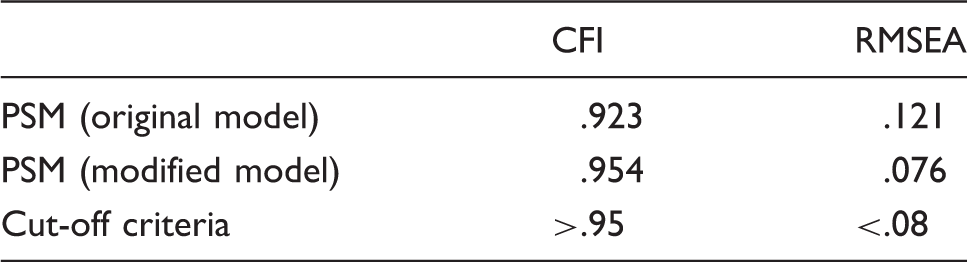
In the online appendix (Table OA1), a complete list of all items used in this study can be found. All items were measured on a five-point Likert scale (ranging from ‘agree’ to ‘disagree’). In order to deal with construct validity, two-factor analytic methods are performed. Principal component analysis (PCA) is used to assess the construct validity of the instrument measuring PRI because it is newly developed, and confirmatory factor analysis (CFA) is used to assess the construct validity of the highly theory-driven PSM instrument.
Summary fit indices, confirmatory factor analysis.
Results of principal component analysis.
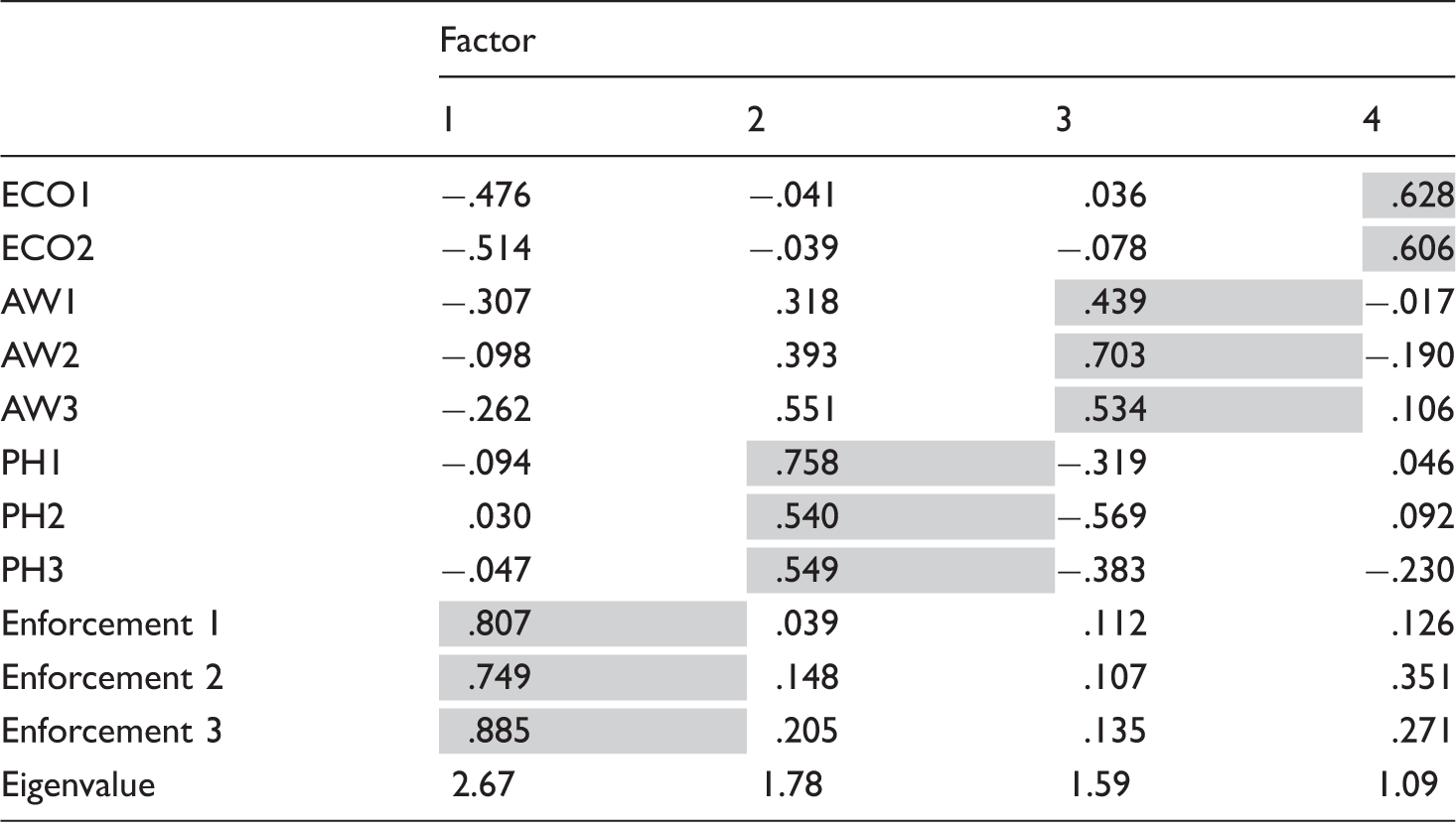
Note: Rotation: Varimax.

Findings
Descriptive statistics of the variables under study
Descriptive statistics of concepts under study.

Note: Please see the section on measures for the reason why I retained this concept in spite of its low Cronbach’s α.
Testing hypotheses
H1 – Decision-making in dilemma situations is influenced by PRI, that is, the way individuals interpret their professional role – was tested using a two-step procedure. First, the effect of each dimension of PRI on decision-making was tested separately. Second, controls were included in the logit models.
Results of binary regression analysis (Dilemma 1).
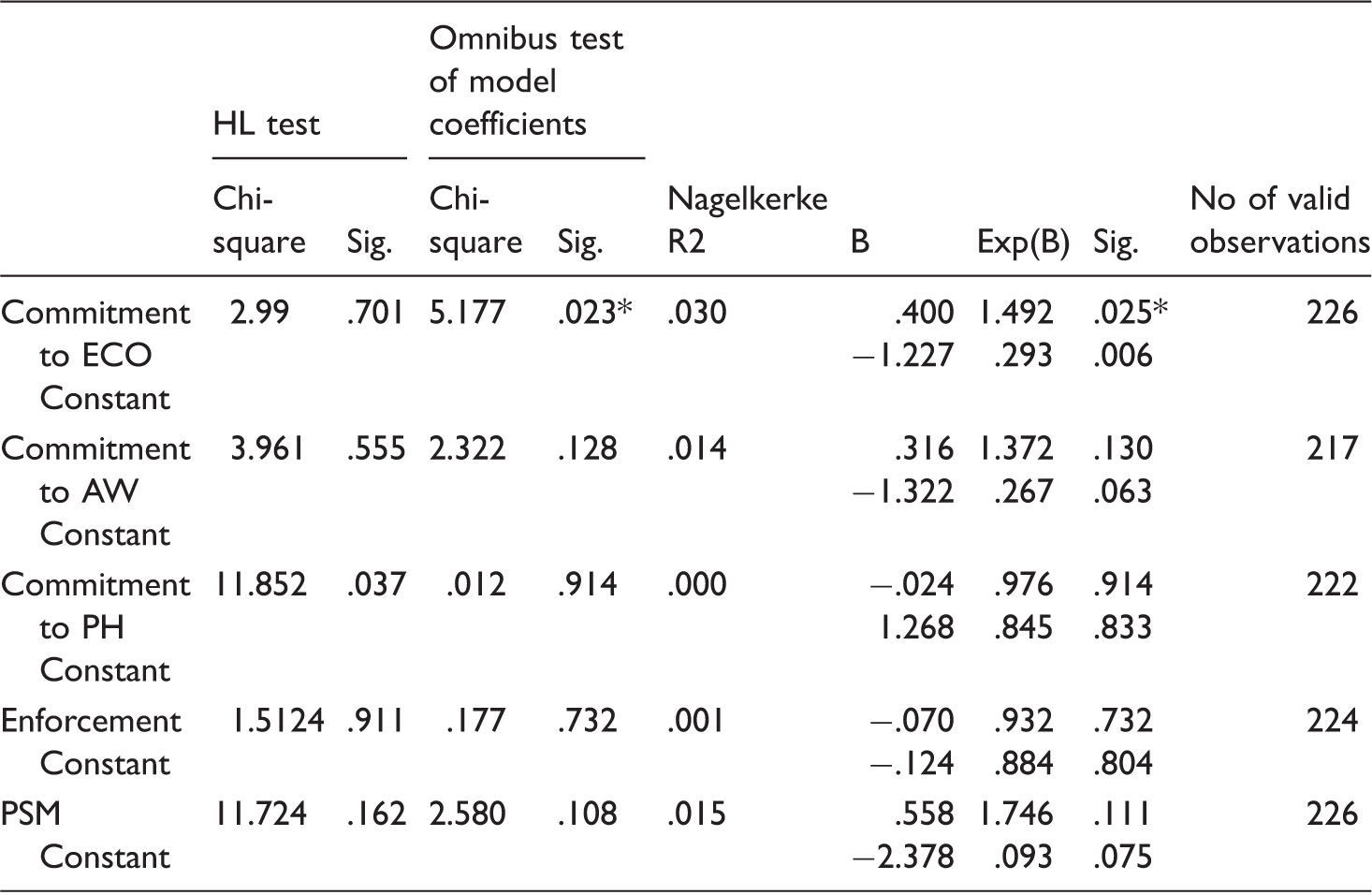
Notes: 0 = I disqualify the cattle (reference category). 1 = I defer the decision until I talk to my supervisor. *Significant at <0.05 (two-tailed).
The logit models showed that the dimensions ‘commitment to animal welfare’, ‘commitment to public health’ and ‘strict rule enforcement’ had no significant effect on decision-making. A one-unit change in the independent variable ‘commitment to economic interest’, however, increased the likelihood that the respondent decided to defer the decision and talk to the supervisor first. This means that if veterinary inspectors saw considering the economic interest as an important aspect of their work, the probability increased that they deferred their decision until they had talked to their supervisor.
In a next step, we included the control variables in the analysis in order to control for alternative explanations of decision-making. The results of this second model showed that the effect of ‘commitment to economic interest’ remained significant (Exp(B) = 1.635; p = .017 < .05). The control variables that had a significant effect on decision-making in Dilemma 1 were gender. Women were three times more likely than men (Exp(B) = 3.009) to defer their decision and contact the supervisor first than disqualifying the cattle.
Multinomial logistic regression analysis (Dilemma 2).

Notes: 0 = I order the cow to be shot and slaughtered and try to pre-date the fracture so that I can act if necessary. 1 = I order the cow to be shot and slaughtered and defer my decision until I receive the additional vaccination information I required. 2 = I order the cow to be shot and slaughtered and try to pre-date the fracture AND make my decision on the basis of the additionally inquired vaccination information. 3 = I order the cow to be shot and disqualify it (reference category). *Significant at <0.05 (two-tailed).
The logit model shows that the dimension ‘commitment to public health’ had a significant effect on decision-making. If individuals viewed safeguarding public health as an important aspect of their work, the probability decreased that they slaughtered the cow and tried to pre-date the exact date of the fracture rather than ‘slaughtering and disqualifying the animal’. The same was true for the response category ‘I order the cow to be shot and slaughtered and defer my decision until I receive the additional vaccination information I required’. Thus, if respondents scored higher on ‘commitment to public health’, they were more likely to slaughter and disqualify the animal right away.
Including controls to the analysis showed that the finding is not confounded by third variables. Controls with a significant effect were ‘type of employment contract’ and ‘team’. Compared to practitioners, ‘regular’ veterinary inspectors were eight times more likely to choose the response category ‘I order to shoot and slaughter the cow and try to assess the fracture’s date so I can maintain order if necessary AND make my decision on the basis of the additionally inquired vaccination information’ compared to ‘I order to slaughter and disqualify the cow’ than practitioners’ (Exp(B) = 8.068). Individuals of the team ‘slaughtering houses’ were 30 times more likely (Exp(B) = 30.428) to slaughter the cow and to try to pre-date the exact date of the fracture than members of the team ‘import’.
Overall, the results provide some support for H1. They show that the way in which individuals interpret their professional role has a significant effect on decision-making even after controlling for a large number of variables. In the two dilemmas researched in this study, the effects of ‘commitment to economic interest’ and ‘commitment to public health’ were significant. However, the results also indicate that the influence of these variables is limited. The effect sizes, expressed in odds ratios, show that their impact is much smaller if being compared to the effects of some of the controls: they rank between 1.4 and 1.9 while odd ratios of some controls are much higher. This is also reflected in the small Nagelkerke R Square of the logit models.
H2 – PSM moderates the relationship between professional role perception and decision-making – was tested by including PSM as a moderator in the logit models discussed earlier. The results can be found in the online appendix. Table AO1 lists the results of the moderator analyses applied to the relationship between the PRI dimensions and decision-making that were found to be significant in the previous analyses for Dilemma 1. Table AO2 does the same for Dilemma 2.
Interestingly, the results failed to provide any support for H2. PSM did not moderate the relationship between PRI and decision-making in the two dilemma situations included in this study. This was true for both the dimensions of PRI that had a significant effect on decision-making in previous analyses and the dimensions that did not have significant effects.
Finally, we also investigated whether PSM had a direct effect on decision-making in dilemma situations. The results of testing this effect can be found in Tables 4 and 5. In none of the dilemmas investigated in this study did PSM have a significant effect on decision-making.
Discussion
PSM among veterinary inspectors and their professional role identity
The results of this study indicate that veterinary inspectors differ in the way they perceive their professional role: some oppose ‘strict rule enforcement’ as an important aspect of their work; others think about it in a neutral way. This finding shows some interesting parallels with research by De Graaf (2005), who was able to identify four discourses of farm animal veterinarians’ conceptualizations of animals and their owners. Empirical evidence for the existence of different professional role identities is highly interesting because it challenges the fundamental assumption in the sociology of professionalism that professionals with the same occupational background share one single professional identity and act accordingly (e.g. Andersen and Pedersen, 2012).
Applying the measurement of PSM, all four dimensions of PSM could be reproduced and the reliability scores of all dimensions were acceptable, implying that the concept of PSM is a valid one in the context of Dutch veterinary inspectors. However, there are some restrictions related to this conclusion that have to be pointed out. As mentioned earlier, on the basis of a pilot study and the results of the CFA, three items out of three different dimensions had to be excluded from further analysis. This can be interpreted as an indication of the necessity to ensure that the formulation of the items is suitable for the professional context. Veterinary inspectors are very down to earth and pragmatic, which might explain why they find it difficult to identify with items that contain woolly phrases such as ‘the common good (PSM_ATPS4)’ and ‘civic duty (PSM_SS4)’. We have therefore, come to a similar conclusion as Giauque et al. (2011) and Liu et al. (2008): PSM is not a universal concept, but the professional context, in particular, should also be considered when PSM is studied. Depending on which values, norms and language are common within professional institutions, conceptualizations of PSM could vary. This finding indicates that the case of veterinary inspectors is interesting to learn more about the universal applicability of the PSM scale within specific professional settings.
PRI and decision-making
We also investigated whether the different views that professionals have about their role are reflected in the decisions that they make by testing H1. The results provided some support for the hypothesis that decision-making in dilemma situations is influenced by PRI. The dimension ‘commitment to economic interest’ influenced the decision ‘I defer the decision until I have talked to my supervisor’ in Dilemma 1. Individuals who scored high on this PRI dimension were more likely to defer their decision than to choose a response category implying immediate and negative consequences for the inspectee. This means that even though veterinarian inspectors seem to vary with regard to the decisions they make, no statistically relevant number of respondents crossed the line and said that they had acted against organizational objectives, values and regulations: they did not show deviant workplace decision-making. Rather, they deferred their decision to a supervisor. At this point, strong conclusions are premature. However, it can be argued that they possibly deferred the decisions to find other ways to act for the benefit of the individuals that they were inspecting.
In Dilemma 2, the dimension ‘commitment to public health’ had a significant effect on decision-making. Individuals who thought that fostering public health was an important aspect of their professional role were less likely to do additional medical research or to wait for additional information about the vaccination history of the animal than to disqualify the animal from the production process immediately. We carefully argue that the results give rise to the assumption that individuals who focus on public health in their work are very strict in avoiding any potential threat to public health.
The dimensions ‘strict rule enforcement’ and ‘commitment to animal welfare’ were not found to have a significant impact on decision-making in any of the two dilemma situations investigated here. How can these non-findings be explained? We return to this question when discussing the limitations of this study.
Attention should also be paid to the low statistical power of the models testing H1, implying that a significant amount of variation remains unexplained. Thus, next to PRI, there must be other important factors that have not been included in the conceptual model that can better predict why individuals make certain decisions in dilemma situations. An explanation for the low percentage of variance explained is provided by the principle of identity salience from identity theory. The central argument of this principle is that depending on the relative levels of an individual’s commitment to the different role identities they hold, the role identities are positioned differently within the identity hierarchy. From the basic assumption that salient identities are likely to be activated frequently across different situations (Burke and Stets, 2009), we might argue that a different role identity than the PRI of veterinary inspectors is positioned highest in the identity hierarchy, and hence more frequently played out in dilemma situations.
PSM and decision-making
The results provided no evidence for H2, claiming that PSM moderates the relationship between the way individuals interpret their professional role and the decisions they make in dilemma situations. The results also showed that PSM did not have a direct effect on decision-making in the context of dilemmas either. This provided support for the critique by Schott et al. (2014) that it is not enough to know the strength of PSM if we want to predict how an individual will behave in the context of dilemma situations.
A possible explanation for why the expected interaction effect of PSM could not be found in the data might be the low statistical power mentioned earlier. Given that the sample size on which the results of this study were based was limited, it is difficult to find significant effects. In addition, we did not ask explicitly how respondents interpreted their task of serving the public interest from the point of view of a veterinary inspector. It might be argued that veterinary inspectors interpret this task differently – not as safeguarding the values of animal welfare, public health, economic interest and strict enforcement – and that no interaction effect of PSM could therefore be found.
Limitations
Some limitations of the current study should be pointed out. Due to the cross-sectional character of the data, there might be problems related to causal inference, such as reversed causality and/or confounding variables. Some scholars are also sceptical about measuring both the independent and the dependent variable on the basis of just one source (e.g. Favero and Bullock, 2015) since findings might be distorted by common method bias (CMB). Other scholars claim that the risk of CMB is overestimated (Lance et al., 2010). Nevertheless, we put the dependent and independent variables in distant parts of the questionnaire in order to reduce the risk of respondents cognitively combining the independent and dependent variable, which might trigger a CMB-biased pattern of responses.
The fact that the results are based on self-reported data provides another limitation to this study. The scores for self-reported decision-making might be biased by socially desirable answers, and hence deviate from actual behaviour. Future research would benefit from relying on more objective data sources, such as registered decisions that have actually been made by public service professionals, rather than asking individuals how they would decide in a hypothetical dilemma situation.
Another limitation is the low Cronbach’s α of the variable PRI and the small sample size, implying low statistical power (DeVellis, 2003). This might explain some of the non-findings of this study: why the professional role dimensions ‘commitment to animal welfare’ and ‘strict rule enforcement’ had no effect on decision-making and why no moderator effect of PSM was found. However, as the entire research population (all veterinary inspectors in the Netherlands) only contains 403 individuals, a large-N study was impossible. Also, we think that we were justified in using the variable PRI because: (1) the PCA we performed supports the idea that the items of the scale can be clustered in four different dimensions; and (2) Cronbach’s α reliability coefficient depends on the number of items that measure a concept (Dooley, 2001) and the separate dimensions were addressed by only two or three items.
Conclusions
Several conclusions can be drawn based on the results of this study. Including the concept of PRI into the study of decision-making in the context of dilemma situations is useful to learn more about what drives public service professionals’ decision-making. Next, the results provide insights into the effect of PSM in this context. They suggest that PSM has no explanatory value for decision-making in situations in which values are conflicting. This finding supports the argument made earlier by Schott et al. (2014) that – especially in the context of dilemma situations – PSM alone is not sufficient to explain how individuals will act. The results of this study also indicate that the measurement instrument of PSM might not be universally applicable to individuals belonging to specific professions. Several items had to be excluded from the statistical analysis because of the results of a pilot study and the CFA. Finally, and against expectations, PSM did moderate the relationship between PRI and decision-making. Next to the concluding remarks, the results of this study also indicate that the relationship between PSM, PRI and decision-making has not yet been fully analysed. We hope that future research will tackle the aforementioned limitations of this study by, for example, developing the instrument measuring professional role identities further. This will enable scholars to make stronger claims regarding the relatedness of the key concepts of this study.
Footnotes
Funding
This work was supported by the Netherlands Organisation for Scientific Research (NWO) grant number 452-10-001.
Notes
References
Supplementary Material
Please find the following supplemental material available below.
For Open Access articles published under a Creative Commons License, all supplemental material carries the same license as the article it is associated with.
For non-Open Access articles published, all supplemental material carries a non-exclusive license, and permission requests for re-use of supplemental material or any part of supplemental material shall be sent directly to the copyright owner as specified in the copyright notice associated with the article.
