



Abstract
One of the most difficult and under-examined issues in the ethics research of developing countries is whether the establishment of codes of ethics in public service organizations leads to employees’ organizational commitment. This study investigates the link between codes of ethics and organizational commitment, as well as its three dimensions of affective, normative and continuance commitment, in Ghanaian public service organizations. Correlational, regression and descriptive statistics were used to study 228 participants conveniently sampled from selected public service organizations within the Greater Accra Region of Ghana. Empirical evidence showed that codes of ethics significantly and positively predicted employees’ organizational commitment, as well as the three dimensions of the affective, normative and continuance commitment of employees.
Points for practitioners
Codes are intended to educate the general public, and employees in particular, about the mission of an organization, to foster a good ethical climate, and to provide guidance for resolving ethical problems in an organization. To ensure employee commitment to the organization, the codes should be effectively implemented, well communicated and strictly enforced with impartiality; otherwise, the codes will appear merely as ‘cosmetic dressing’ to the organization.
Introduction
In contemporary times, unethical practices including bribery and corruption, embezzlement of funds, conflicts of interest, sexual harassment, misuse of confidential information (Benavides et al., 2012; Trevino and Nelson, 2013), and other illegal conduct are widespread in organizations. This trend has led to growing public concern over the inappropriate conduct of leaders and public officials, resulting in the resurgence of interest in ethical issues (Pajo and McGhee, 2003). These unethical behaviours have harmful effects on individuals as well as organizations. For instance, approximately US$2.9 trillion of global annual revenue is lost due to various forms of unethical behaviour (Association of Certified Fraud Examiners, 2010). Organizations have therefore sought to reduce these unethical practices by instituting ethics or integrity programmes (Beeri et al., 2013; Kolthoff et al., 2013), and these include the development of codes of ethics (Beeri et al., 2013; Kolthoff et al., 2013; Wolf, 2008). A code of ethics reflects an organization’s standards and establishes realistic modes of behaviour that apply to everyone in the organization. It therefore governs the actions and conduct of employees through the promotion of ethical practices, leading to reputational benefits such as projecting the image of the organization (Ali and Al-Kazemi, 2007; Matten, 2003; Mohamed et al., 2010; Saks et al., 1996; Valentine et al., 2011), guiding the ethical behaviour of employees (Fritz et al., 2013; Glor, 2001) and contributing to the success of the organization (Valentine and Barnett, 2007).
Closely related to codes of ethics is organizational commitment. Organizations seek to generate commitment on the part of their employees because turnover is costly and organizations tend to benefit from employees who are committed to their jobs (Fritz et al., 2013). Organizational commitment has been conceptualized by Porter et al. (1974: 604) as ‘the strength of an individual’s identification with and involvement in an organization’, or ‘the state in which an employee identifies with an organization and its goals, and wishes to maintain membership in that organization’ (Miller, 2003:73). Committed individuals possess ‘a willingness to exert considerable effort on behalf of the organization’, ‘a strong desire to maintain membership in the organization’ (Mowday et al., 1982: 27) and a bonding relationship with the organization (Meyer and Allen, 1997: 13). The factors influencing organizational commitment include work experience, justice or fairness (Meyer and Allen, 1997), communication, and the clarity of information and procedures (Fritz et al., 2013).
The public service of Ghana expects a work culture and professional ethics of objectivity, integrity, meritocracy, confidentiality, anonymity, political neutrality and permanence, bequeathed to the country at independence by its colonial masters. However, these professional ethics appears to have declined over the years and sections of the public feel that the poor image and identity of Ghana’s public service is reprehensible. For instance, clients who come into contact with public servants witness attitudes and conduct that is considered contemptuous, disrespectful, irritating, frustrating and desperate (Ohemeng, 2010). Attempts to re-engineer the public service led to the passage of the Civil Service Law (i.e. Provisional National Defence Council Law 327, 1993) and the Civil Service Code of Conduct (of 1999), 1 which it is believed will enhance productivity, consciousness, efficiency and good corporate image.
In recent years, interest in codes of ethics research has attracted the attention of scholars and practitioners given the fact that codes of ethics are an integral part of organizations globally and locally. Therefore, organizations in Ghana, like elsewhere in the world, have inculcated codes into their operations as a sign of good corporate image. It is worth asking: ‘What is the relationship between codes of ethics and employee organizational commitment?’; and ‘Is a code of ethics related to the three dimensions of organizational commitment (e.g. affective, continuance, and normative)?’ The study therefore investigates the nexus between codes of ethics and employee organizational commitment, as well as its three dimensions, in the public service of Ghana. The rest of the article is structured as follows: the next section is the theoretical overview of codes of ethics and organizational commitment. This is followed by the methodology, the results, the discussions and the concluding remarks.
Codes of ethics and organizational commitment: a theoretical overview
Codes of ethics
Coughlan (2005) defined a code of ethics as a set of guidelines and policies that organizations create in order to help govern their employees’ decisions and actions. Codes of ethics serve as guides to employees for resolving ethical dilemmas in their daily dealings with other employees, customers and suppliers (Coughlan, 2005). Schwartz (2004) argues that codes of ethics are increasingly becoming a critical component of organizations’ ethical infrastructure that managers can employ both to educate employees concerning ethical issues and to inform them of management’s expectations concerning their conduct. Earlier, Schwartz (2001) defined codes as a written, distinct and formal document that consists of moral standards used to guide employee or corporate behaviour. According to the International Fiscal Association (2007), cited by Sakyi and Bawole, (2010), codes are principles, values, standards or rules of behaviour that guide the decisions, procedures and systems of an organization in a way that contributes to the welfare of its key stakeholders and respects the rights of all constituents affected by its operations. Codes are therefore seen as a guide to both present and future behaviours and specify corporate ethical values and the responsibilities of employees to one another and other organizational stakeholders (Kaptein and Schwartz, 2008).
Codes are typically based on a deterrence approach that explicitly states behaviours that are prohibited or are to be avoided (Gibbs, 1975): however, they can also be used to promote virtuous, ethical or socially responsible behaviour (Caza et al., 2004). Codes vary in content, specificity and length, but they tend to address certain common subjects. For instance, codes usually cover employee relations with the organization and the organization’s relations with employees, shareholders, customers, the government, the local community and, occasionally, the environment (Petersen and Krings, 2009). Concerning employee behaviour, codes tend to concentrate on conflict of interest, extortion, gifts and kickbacks, insider information, bribery, confidentiality, and theft (Sanderson and Varner, 1984; Hite et al., 1988), and regarding organizational behaviour, they focus on the violation of laws, fraud and antitrust violations (Sanderson and Varner, 1984; Hite et al., 1988). Codes can enhance an organization’s reputation, signal that the organization is committed to ethical behaviour, create a cohesive corporate culture and help the organization to avoid fines, sanctions and litigations (Singh, 2011).
The impact of codes in altering employee behaviour has naturally come under contention and some researchers have concluded that codes have limited or no impact on employee behaviour (Callan, 1992; Mathews, 1988; Schiebel and Pochtrager, 2003). Mathews (1988) discovered only a weak link between the existence of ethical codes and corporate misbehaviour, while Callan (1992) observed that employees’ awareness and use of codes of ethics generally proved to be poor predictors of ethical values in organizations. However, other perspectives support the empirical argument that codes improve ethical perceptions and standards in organizations (Weeks and Nantel, 1992; Yener et al., 2012). In addition, Weaver and Farrell (1997) concluded that the existence of corporate policy is directly linked with the improved ethical beliefs and behaviour of marketing managers, and Singhapakdi and Vitell (1990) also found that organizations that have codes of ethics that are enforced tend to be more sensitive to ethical problems when they occur. In a somewhat tenuous finding, Valentine and Johnson (2005) confirmed that the practice of reviewing codes of ethics during employee orientation was positively related to individuals’ beliefs that incorruptibility is an important individual virtue. Commitment to ethical codes has led to enhanced overall company performance through a variety of metrics, including increased financial performance (Orlitzky et al., 2003), reduced cost structures, product differentiation and brand equity (Chen and Bouvain, 2005). Further, research on ethics has shown that codes of ethics affect organizational commitment positively (Valentine and Barnett, 2003; Yusoff et al., 2011). Thus, having a code of ethics is believed to constrain unethical behaviour in the organization (Holder-Webb and Cohen, 2012; Krawiec, 2005). Additionally, there is ample evidence suggesting that employees’ personal belief in codes of ethics has a direct impact on organizational commitment (Ali and Al-Kazemi, 2007; Mohamed et al., 2010; Uygur, 2009; Vitell and Hidalgo, 2006).
Organizational commitment
Organizational commitment has been viewed as the feelings that employees have towards their current organization. For instance, organizational commitment has been defined as the strong belief in and acceptance of the organization’s goals and values, willingness to exert considerable effort on behalf of the organization, and a definite desire to maintain organizational citizenship (Porter et al., 1974). It consists of the extent to which an employee intends to stay with the organization, shares its values and is proud of working there, among other things (Mowday et al., 1979). Organizational commitment has been conceptualized as multidimensional, involving affective, normative and continuance commitment (Allen and Meyer, 1996). Together, these three dimensions measure organizational commitment as a variable. Affective commitment refers to the emotional bond and identification of the employees with the organization. Continuance commitment refers to the material benefits gained from being with the organization (Akintayo, 2010). While normative commitment reveals a feeling of compulsion to continue employment (Jaros et al., 1993; Kumasey et al., 2014). It is assumed that employees displaying each dimension of commitment will remain in an organization because they feel that they want to, need to or ought to do so (Allen and Meyer, 1991). However, Meyer and Herscovitch (2001) subsequently suggested that perceived lack of alternatives might be better considered an antecedent of continuance commitment than as part of the construct itself. That is, where one cannot leave an organization (perhaps as a result of limited skills or personal limitations), it could be better explained as antecedent to commitment to the organization than being viewed as part of commitment (Abdul-Nasiru et al., 2014).
Investigating organizational commitment is important and useful to organizational leaders as organizational commitment has been found to affect other organizational outcomes, including turnover intentions (Fritz et al., 2013; Genevičiūtė-Janonienė and Endriulaitienė, 2014), punctuality to work, in-role job performance, organizational citizenship behaviour (Fritz et al., 2013; Meyer and Allen, 1997), improved company sales and profitability (Benkhoff, 1997). Others include job satisfaction (MacKenzie et al., 1998), work motivation (Altindis, 2011; Kuvaass, 2006), counterproductive behaviour (Dalal, 2005) and socialization tactics or practices (Allen and Meyer, 1991; Ashforth and Saks, 1996).
Empirical literature on codes of ethics and organizational commitment
Studies conducted on codes of ethics have primarily been in the US, Europe and Asia (Somers, 2001; Wotruba et al., 2001), with very few in Africa (Parboteeah et al., 2013; Tsui et al., 2007), particularly Ghana. These studies have also suggested that organizations that have adopted codes of ethics have facilitated employee ethical decision-making, leading to positive work attitudes and possibly higher levels of organizational commitment (Somers, 2001). The findings on codes of ethics and organizational commitment are mixed. Some studies have demonstrated that organizations with strong ethical values are more likely to benefit from having more committed employees (Ali and Al-Kazemi, 2007; Bline et al., 2015; Valentine et al., 2011; Vitell and Hidalgo, 2006; Yusoff et al., 2011). Some studies also argue that codes of ethics may not have any influence on organizational commitment (Uygur, 2009), and yet others identify a weak link between codes of ethics and organizational commitment (Stevens et al., 2005).
Methodology
Research design
A predictive correlational research design was used to investigate the relationship between the independent variable (i.e. codes of ethics) and the dependent variable (i.e. organizational commitment). The study was purely quantitative because the objective was to establish relationships between these variables.
Population and sampling
The population of this study were conveniently selected to represent the public service of Ghana. The organizations included the Ghana Education Service, the Controller and Accountant General’s Department, the Registrar General’s Department, the National Disaster Management Organization (NADMO), the Ministry of Local Government and Rural Development, the Ghana Tourism Authority, Ghana Water Company Limited and the Ghana Revenue Authority. The study was confined to the Accra Metropolitan Area of the Greater Accra Region of Ghana. This location was chosen because many of the selected public service organizations have their headquarters and the majority of their staff located in this area.
Demographic characteristics of respondents.
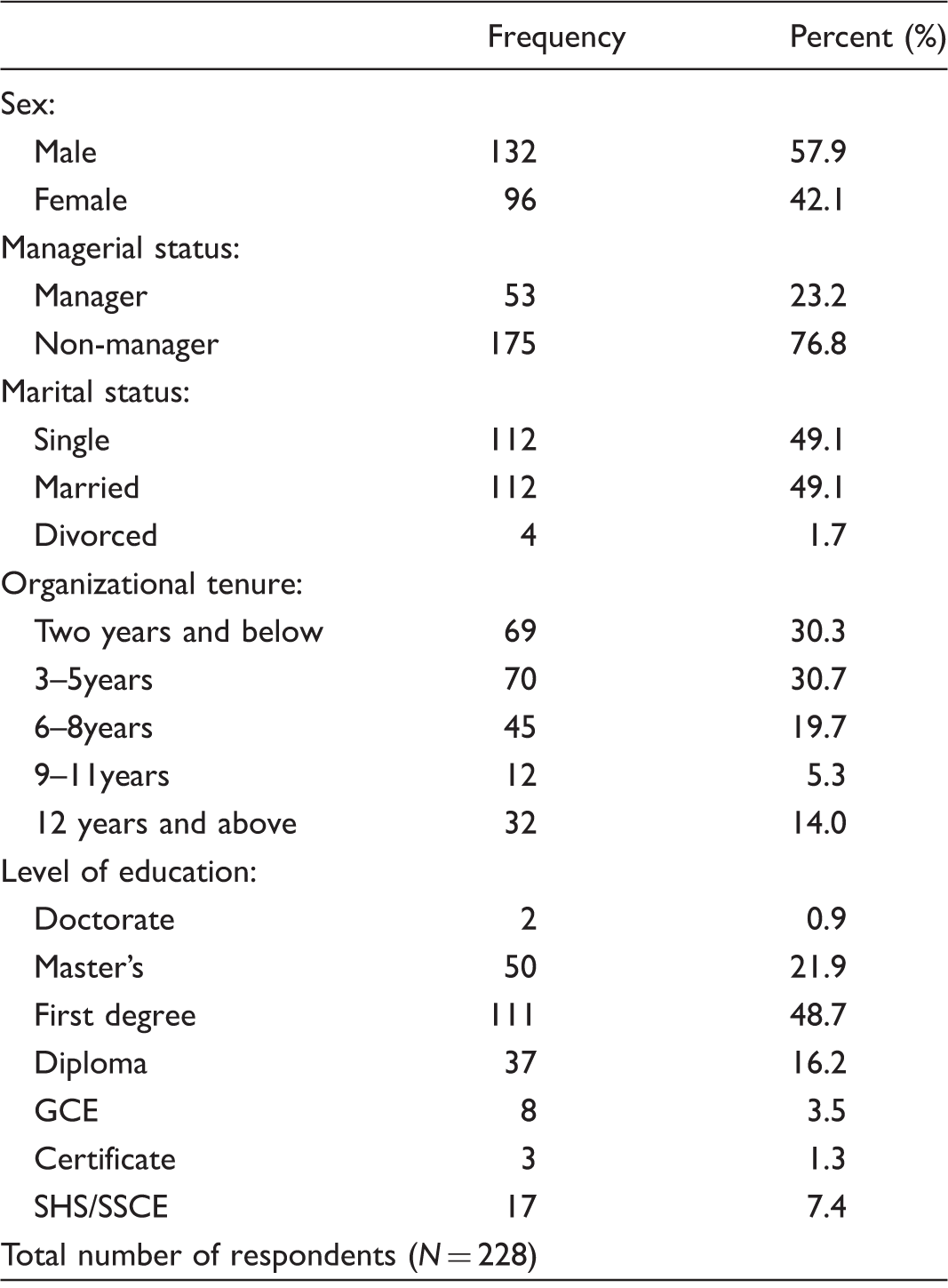
Notes: GCE: General Certificate of Education; SHS: Senior High School; SSCE: Senior Secondary Certificate of Examination.
Analysis of the sex distribution of respondents in this study revealed that 57.9% were males while 42.1% were females. In addition, 76.8% of the respondents were within non-managerial ranks while only 23.2% were in the managerial bracket. It was also observed that majority of the respondents were either single (49.1%) or married (49.1%), while 1.7% were divorced. In terms of organizational tenure, it was found that 30.7% of respondents had worked in their respective organizations for between three and five years, 14.0% had worked in their respective organizations for over 12 years, while 30.3% had worked there for two years and below. Finally, 48.7% of respondents had a Bachelor’s degree qualification, 21.9% had a Master’s degree qualification, while 16.2% had Diploma certificates.
Measures
For the purposes of this study, a questionnaire divided into three sections was used to collect the data. The first section on codes of ethics was developed by the researchers following an extensive review of literature. We proceeded to test for the reliability of this instrument. Codes of ethics was measured with 28 items. The items were anchored on a five-point Likert scale, with responses ranging from strongly agree (5) to strongly disagree (1). Sample items on this scale included: ‘This organization has a code of conduct’ and ‘The management of this organization has established an ethical tone by setting good examples of ethical conduct and supporting ethical conduct’. The second section was on organizational commitment, which adopted Allen and Meyer’s (1991) 20-item scale. The statements were anchored on a seven-point Likert scale, ranging from strongly agree (7) to strongly disagree (1). Sample items on the scale included: ‘I would be very happy to spend the rest of my career with this organization’ and ‘I enjoy discussing my organization with people outside it’. Significant research evidence exists to address the issue of using different scales to measure different variables within the context of a particular study (Dawes, 2008; Tims et al., 2015 ). For instance, Dawes (2008: 75) has opined that there is ‘no appreciable differences in terms of standard variation, skewness or kurtosis when using 5, 7 and 10 scale formats’. Consequently, this study does not suffer any defects from adopting both scales. The final section collected demographic data such as sex, educational level, marital status, managerial status and organizational tenure.
Data collection procedure
The researchers initially sought permission from the Human Resources Directorate of all the selected public service organizations in Ghana. Questionnaires were then sent to individuals within the Human Resources Directorate of each organization, who assisted in administering the questionnaires on our behalf. Each questionnaire provided clear instructions on how the questionnaires were to be completed by employees who consented to be part of the study. To guarantee the confidentiality of responses, respondents were provided with envelopes for concealing the completed questionnaire. This was done to ensure that respondents felt comfortable in providing answers to the questions with the assurance that only the researchers would have access to their opinions.
Research results
The study investigated the nexus between codes of ethics and employee organizational commitment in the public sector of Ghana. We specifically investigated the relationship between codes of ethics and organizational commitment as a whole, as well as the relationship between codes of ethics and affective, normative and continuance commitment. We first performed an initial analysis, which included reliability analysis, normality testing, means and standard deviation scores for the main variables.
Preliminary analysis
Summary means, standard deviation scores, reliability coefficients and normality scores.

Correlational Matrix of Relationship between Demographic Factors, Independent and Dependent Variable
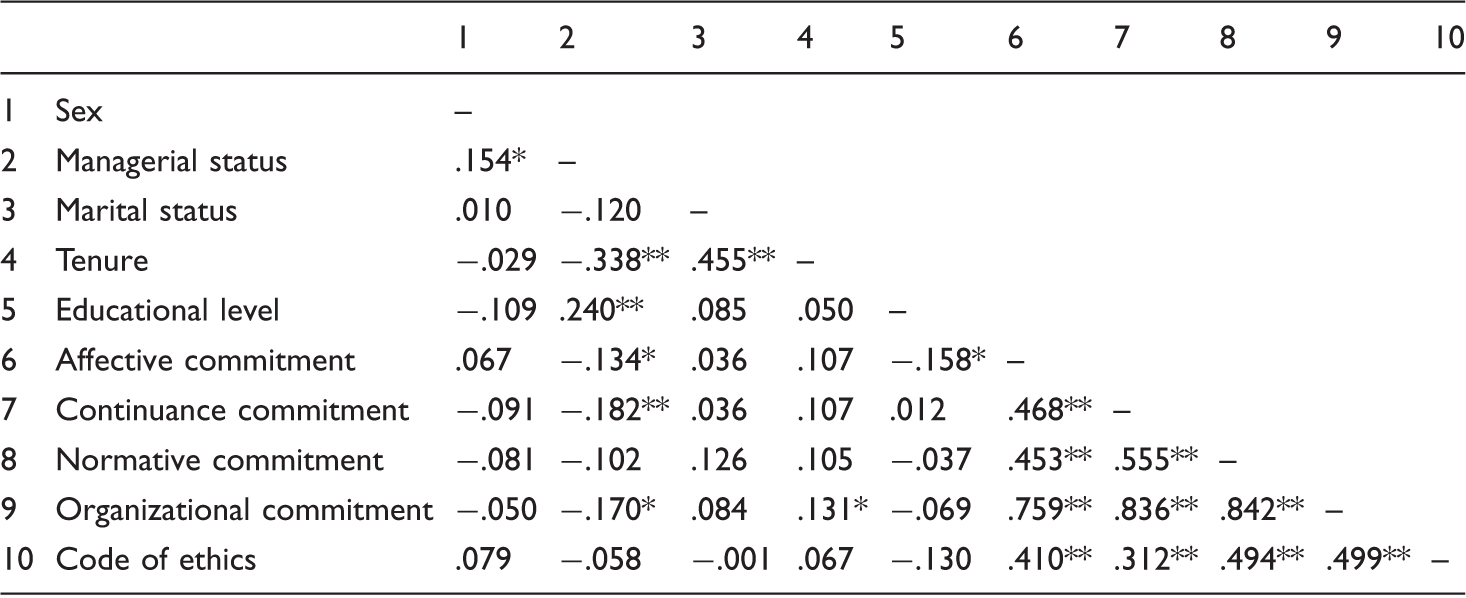
. Correlation is significant at the 0.01 level (2-tailed)
. Correlation is significant at the 0.05 level (2-tailed)
The result in Table 3 indicates that none of the demographic factors (sex, managerial status, marital status, tenure and educational level) relate significantly to the independent variable (i.e. codes of ethics). Only two demographic factors: managerial status (r = −.170, p < .05) and organizational tenure (r = .131, p < .05) were significantly associated with the dependent variable (organizational commitment). Therefore, managerial status and organizational tenure were controlled in the regression analysis since they related significantly to organizational commitment. Further, managerial status (r = −.134, p < .05) and level of education (r = −.158, p < .05) related significantly to affective commitment; therefore, their effect was controlled for in the analysis. In addition, managerial status related significantly to continuance commitment (r = −.182, p < .01).
Hypotheses testing
Hierarchical multiple regression of the direct effect of codes of ethics on organizational commitment.
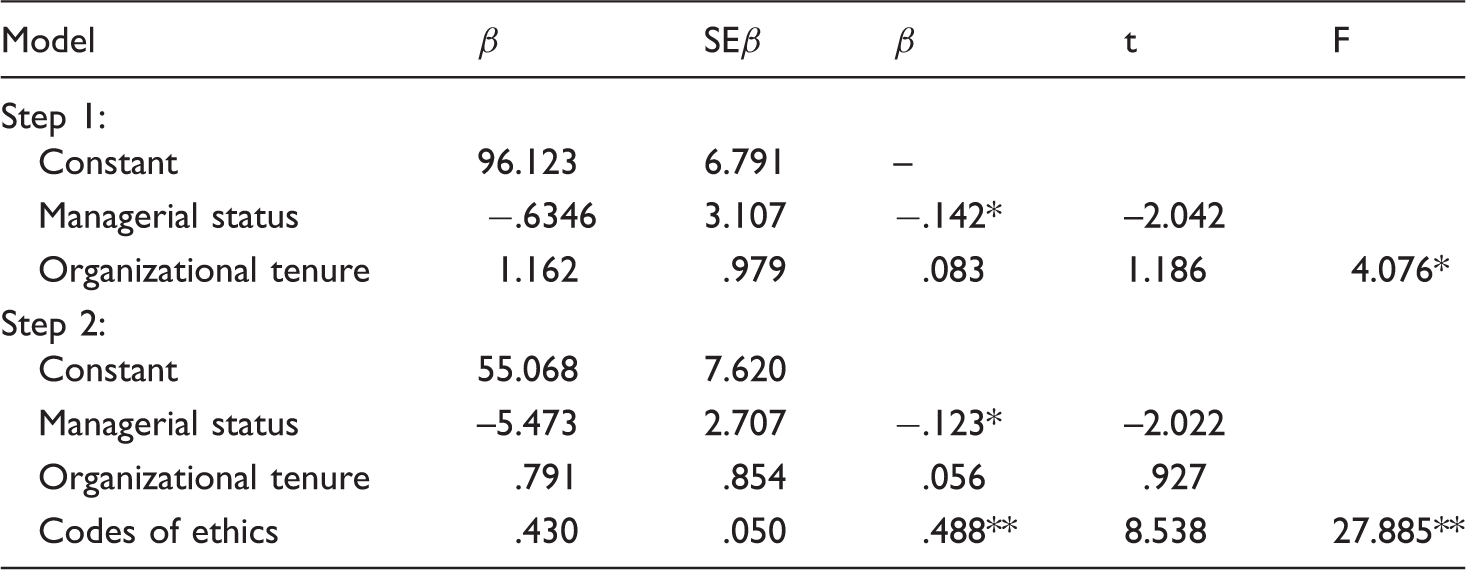
Notes: R2 = .035 and .272 for step 1 and 2, respectively; ΔR2 = .035 and .237 for step 1 and 2, respectively.
Codes of ethics and organizational commitment
The hypothesis testing the direct effect of codes of ethics on employee organizational commitment is: H1: Codes of ethics will be positively associated with organizational commitment.
A statistically significant predictive positive relationship was found between codes of ethics and employee organizational commitment (β = .488, p = .000). In terms of contribution, codes of ethics accounted for 23.7% of the variance in employee organizational commitment. Finally, the codes of ethics–organizational commitment model was found to be significant (F(3, 224) = 27.885, p = .000).
Codes of ethics and affective commitment
The hypothesis testing the direct effect of codes of ethics on employee affective commitment is: H2: Codes of ethics will be positively associated with employee affective commitment.
Hierarchical multiple regression analysis of the direct effect of codes of ethics on employees’ affective commitment.
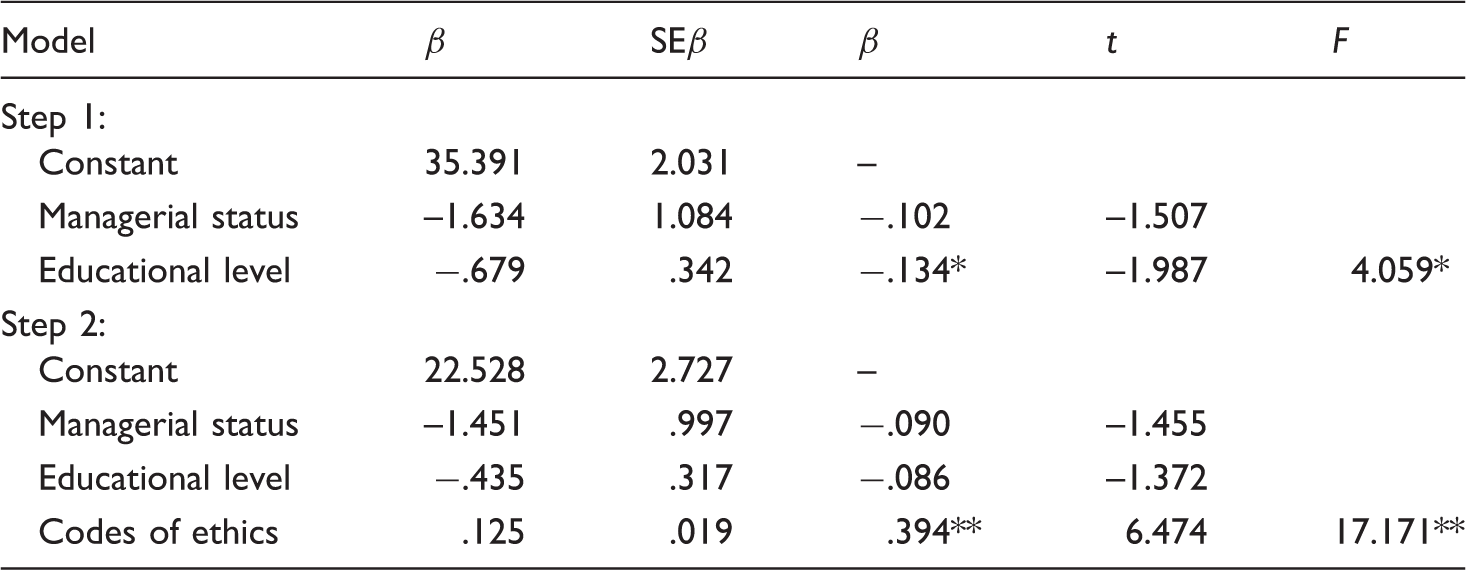
Notes: R2 = .035 and .187 for step 1 and 2, respectively; ΔR 2 = .035 and .152 for step 1 and 2, respectively.
Standard regression analysis of the direct effect of codes of ethics on employees’ normative commitment.

Note: R2 = .244.
Hierarchical multiple regression analysis of the direct effect of codes of ethics on employees’ continuance commitment.
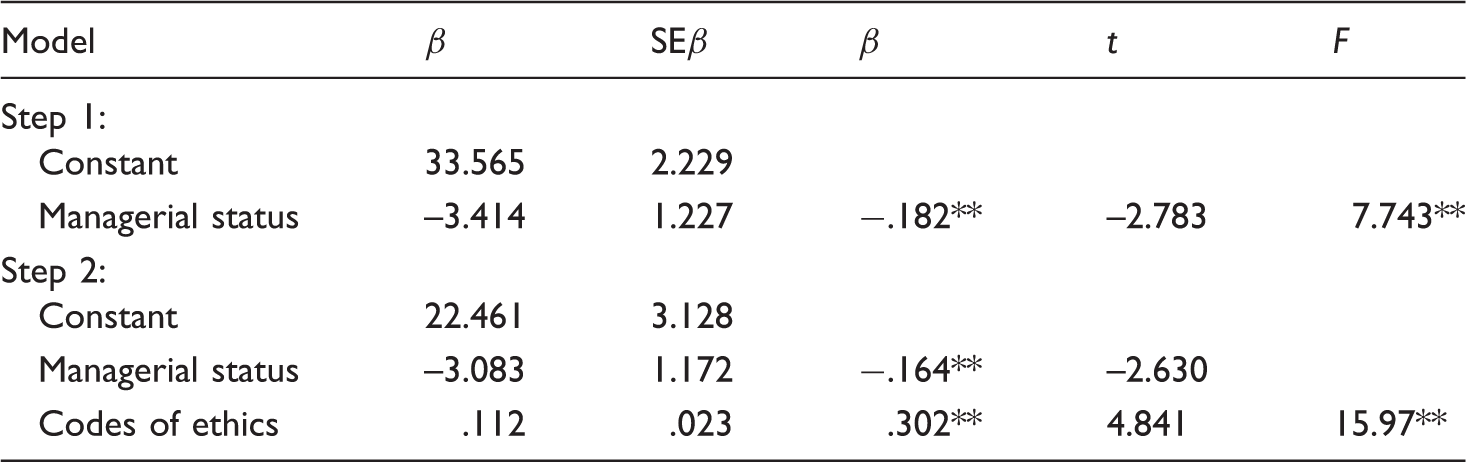
Notes: R2 = .033 and .124 for step 1 and 2, respectively; ΔR2 = .033 and .091 for step 1 and 2, respectively.
Codes of ethics and normative commitment
The hypothesis testing the direct effect of codes of ethics on employee normative commitment is: H3: Codes of ethics will be positively associated with employee normative commitment.
The result in Table 6 indicates that codes of ethics significantly and positively predicted employee normative commitment, accounting for 24.4% of the variance in normative commitment (β = .366, p = .000). The model was also found to be significant (F(1, 226) = 73.131, p = .000).
Codes of ethics and continuance commitment
The hypothesis testing the direct effect of codes of ethics on employees’ continuance commitment is: H4: Codes of ethics will be positively associated with employees’ continuance commitment.
As shown in Table 7, the hypothesis that codes of ethics will positively predict employees’ continuance commitment was supported, with codes of ethics accounting for 9.1% of the variance in continuance commitment (β = .302, p = .000). The codes of ethics–continuance commitment model was found to be significant (F(3, 224) = 15.972, p = .000). This finding is consistent with the findings of Ünal (2012) that codes of ethics have a significant and positive impact on continuance commitment.
Discussion of research findings
A good workplace climate has been found to be an important driver of employee attitudes in organizations. The prevailing organizational climate is informed by the code of ethics of the organization (Singhapakdi et al., 2010). The present study sought to investigate the link between codes of ethics and organizational commitment in the Ghanaian public sector context. Empirical evidence showed that codes of ethics significantly and positively predicted employee organizational commitment, as well as the three dimensions of organizational commitment (affective, normative and continuance commitment). These findings corroborated previous research outcomes (Ali and Al-Kazemi, 2007; Mohamed et al., 2010; Valentine et al., 2011; Zehir et al., 2011).
Commitment is a positive workplace attitude that every organization requires of the workforce. However, the demonstration of commitment is triggered by some factors in the workplace. Since an exchange relationship exists between the individual employee and the work environment, the prevailing workplace policies and practices have the tendency to influence the kind of workplace behaviours an individual employee would exhibit (Singhapakdi et al., 2010). This empirical evidence is also justified because the belief in codes of ethics has been associated with strong organizational commitment (Saks et al., 1996). Therefore, it can be said that the emotional attachment that employees show towards their organization is connected to the prevailing code of ethics in the organization.
Organizations have to develop a work ethic that shapes the attitudes of employees and that eventually improves the loyalty of employees (Bruhn, 2009), as this has far-reaching effect on performance, the creation of organizational value, loyalty and profit (Ali and Al-Kazemi, 2007). Thus, codes of ethics would boost the commitment levels of employees, which, in turn, would create a work environment that encourages social progress, work regulation and ethical behaviour (Kaptein and Schwartz, 2008).
Concluding remarks
The findings of this research provide interesting insights into the study of codes of ethics and organizational commitment, with particular reference to Ghana. The present study could, however, have some limitations. In the first place, common method variance bias could be seen as a limitation of the present findings because data on codes of ethics and organizational commitment were collected at a single point in time from a single source. Second, the significant relationships reported in this study do not suggest cause–effect connections due to the fact that a correlational design instead of experimental design was used for the study. However, the authors’ choice of these methods suited very well the hypothesized relationships in the study. Despite these limitations, salient gaps for future research are highlighted. For example, given that organizations are largely defined by their culture, there is a need to investigate the extent to which organizational culture interacts with codes of ethics to predict organizational commitment. Future studies could also explore the possibility of running an exploratory factor analysis to see what dimensions the code of ethics scale might give. Further, since value congruence is crucial for employees to identify with and show commitment towards their organization, it would be important that research is conducted to ascertain the moderating effect of person–organization fit in the codes of ethics–organizational commitment relationship. Finally, it would be exciting for longitudinal research to be conducted to ascertain the long-term effect of codes of ethics on organizational commitment in public sector organizations in Ghana.
The demonstration of positive attitudes in an organization does not happen by chance. Organizational commitment is a positive workplace attitude that employers expect the workforce to demonstrate daily in the workplace. Codes of ethics have been found to be an important activator of employee commitment, including affective, normative and continuance commitment. Codes of ethics affect the existing climate within the organization positively, leading to the exhibition of positive workplace behaviours (Singhapakdi et al, 2010), which is supported by this research. Against this backdrop, it is imperative that organizations develop, implement and enforce codes of ethics that would produce beneficial attitudes, such as organizational commitment. Additionally, the codes must be accompanied by strict compliance measures and other ethics initiatives, including rewards and punitive sanctions. It is also important that employees are socialized into the value system of the organization. Top management commitment and ethical leadership are also necessary ingredients for the holistic acceptance of the codes leading to employee commitment in the organization. The present study has shown that codes of ethics have the capacity to influence the levels of commitment of employees in organizations.
Footnotes
Funding
This research received no specific grant from any funding agency in the public, commercial or not-for-profit sectors.