



Abstract
This article proposes a new conceptual framework for assessing transparency at the country level. It identifies three distinct interpretations of transparency: access to information; two-way communication; and predictability, or decision-making based on clear and publicly known rules. Each represents an increasingly demanding form of transparency, but all are tied to democratic accountability and the rule of law. Using the case of Romania, the article illustrates how such a framework can be employed to assess the evolution of transparency in a relatively recent democracy.
Points for practitioners
The virtues of transparency have been advocated by international organizations, governments, and civil society. The focus has primarily been on access to information—whether through freedom of information acts or open data. However, realizing the democratizing potential of transparency requires a multifaceted approach. This article suggests that transparency advocates should pay more attention to issues such as increasing citizen participation, opening up decision-making rather than just data, strengthening the rule of law, and fighting corruption. In other words, it argues for a more holistic discourse and practice of transparency.
Keywords
Introduction
From the exponential spread of Freedom of Information Acts (FOIAs) since the 1990s to recent initiatives such as the Open Government Partnership, efforts to increase government transparency have proliferated over the last two decades. The popularity of “transparency” is due, in part, to its multifaceted nature, and to its framing as both an intrinsic democratic value (Birkinshaw, 2006 ) and an instrumental value (Heald, 2006). While this multifaceted nature increases the popularity of transparency, it also makes it difficult to assess actual government transparency and to identify salient areas for reform.
To help address these challenges and deepen our understanding of transparency as a democratic value, this article proposes a conceptual framework that combines three related yet distinct perspectives on transparency: (1) access to information (e.g. Meijer, 2013); (2) two-way communication (e.g. Coglianese, 2009); and (3) predictability in decision-making (e.g. Hood, 2006). Each perspective represents an increasingly complex interpretation, and each places increasingly strong demands on governments, citizens, and civil society organizations (CSOs). Moreover, although each perspective is discussed in the transparency literature, they are rarely, if ever, discussed in tandem.
By bringing these perspectives together in a conceptual framework, this article provides an approach for assessing the democratic value of transparency at the macro-systemic, governmental level. To illustrate the value of this approach, the article uses the framework to inform a case study of Romania, a relatively young democracy with a growing focus on transparency efforts. The findings suggest that a narrow focus on access to information can obscure the broader democratic potential of transparency. If this potential is to be realized, transparency researchers and activists should consider how the principle of transparency is reflected in mechanisms for citizen consultation, as well as in the broader system of rules and procedures for public decision-making.
To this end, the article first details the conceptual framework by exploring the three interpretations of transparency. It then uses the framework to investigate the evolution of transparency in Romania over the last decades. It concludes with recommendations for researchers and practitioners who want to strengthen the nexus between transparency and democracy.
Transparency in government
Transparency, like other governance-related concepts, has a variety of meanings that are often used inconsistently. Perhaps the most concise definition is “the ability to find out what is going on inside government” (Piotrowski and Van Ryzin, 2007: 306).
Considerable research has focused on the micro-level of transparency (i.e. how it is enacted in day-to-day administrative decision-making), but less research has examined the macro-level of transparency (i.e. how it is codified in laws and policies, and reflected in government behavior at a systemic level), where the concept has the most power as a democratic value. This macro-level is particularly relevant for “newer” democracies, where the idea of transparency as a public value and the legal and institutional infrastructure supporting it are more recent than in established democracies.
Transparency legislation is particularly important because it enshrines transparency-related rights and obligations into law at the systemic level. Such legislation includes, for example: FOIAs; asset, income, and conflict of interest disclosures for high-level officials; Administrative Procedure Acts (APAs) requiring public consultation in decision-making; Open Meetings Laws (OMLs) or sunshine laws; and whistle-blowing protection laws. Other transparency-related policies, regulations, and practices include the general publication of government statistics (Islam, 2006), elements of e-government (Wong and Welch, 2004), efforts to improve budget and fiscal transparency (De Renzio and Masud, 2011), open data initiatives (Huijboom and Van den Broek, 2011), and various mechanisms for increasing transparency and accountability in service delivery (Kosack and Fung, 2014).
However, actual transparency is difficult to achieve through legislation alone. The adoption of legislation can be purely symbolic, resulting in a “transparency illusion,” or only in “nominal”—as opposed to “effective”—transparency (Heald, 2006, 2012). Many transparency laws get “lost in implementation” due to a lack of compliance from public agencies (Darch and Underwood, 2010; OSJI, 2006). Even pro forma compliance can be ineffective if agencies use tactics that undermine transparency while remaining within the confines of the law (Heald, 2012; Pasquier and Villeneuve, 2007). Effective transparency requires active demand from the public to “find out what is going on inside government,” and the capacity and willingness of public agencies to comply not only with the letter, but also with the spirit, of the laws (Darch and Underwood, 2010; Pasquier and Villeneuve, 2007).
Therefore, before effective implementation can take place, agencies, public officials, CSOs, and citizens have to understand the meaning and purposes of transparency, and its democratic potential. As noted earlier, this can be difficult given the multifaceted nature of the concept. To address this challenge and to help scholars and practitioners better assess the democratic value of transparency, the next sections present a conceptual framework that unpacks three different, but related, perspectives on transparency: access to information; two-way communication; and predictability.
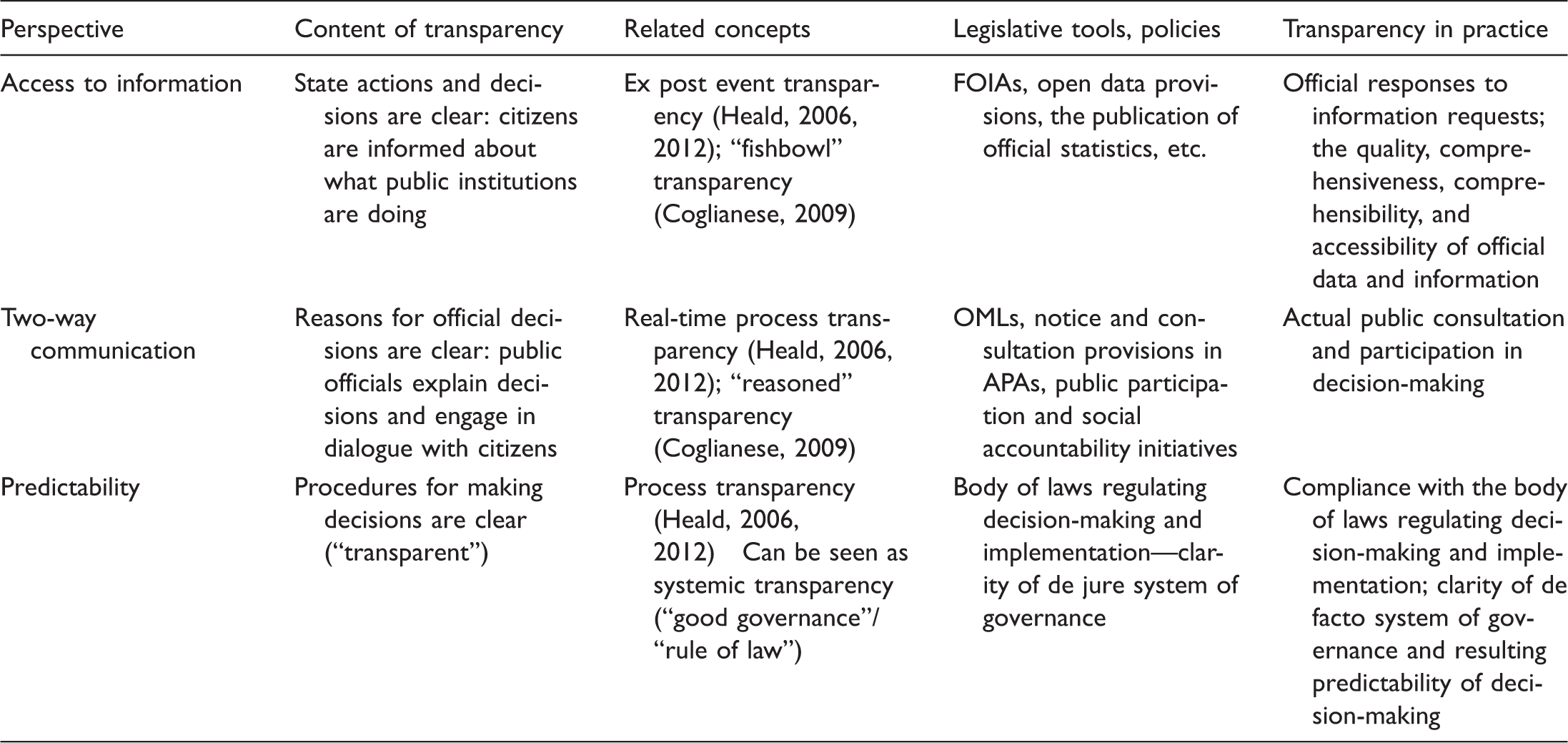
Transparency as access to information
The most basic understanding of transparency is “not hiding” information, or, in a more ambitious formulation, “lifting the veil of secrecy” (Roberts, 2006). Coglianese (2009) calls this “fishbowl transparency” to highlight its passive dimension and its focus on already-existing information. A more active interpretation calls for measures that improve access to information, whether through legal provisions like the “obligation to publish” in FOIAs or notice obligations in APAs, or through other forms of proactive disclosure, such as open data, information portals, and communication officers. Measures that “force” the release of information, such as “leaking” or whistle-blower protection, also increase access to information (Meijer, 2014).
This interpretation of transparency can be a powerful democratizing element if based on the idea that ordinary citizens have the right to access government information (Ackerman and Sandoval-Ballasteros, 2006). Yet, if the result is only access to “raw” government information, its democratizing potential is limited. Large amounts of decontextualized information are difficult to interpret and require high processing and interpretation capacity from specialized intermediaries, such as the press, CSOs, or specialized institutions (Heald, 2012; Roberts, 2012). Moreover, various actors may use the information selectively to pursue their goals and even conceal important facts or intentions (Heald, 2012; O’Neill, 2006). If this is the case, simply granting access to information does not improve transparency, as citizens cannot really “find out what is going on inside government” (Piotrowski and Van Ryzin, 2007: 306).
In addition to the availability and accessibility of information, more complex definitions also emphasize its comprehensibility, completeness, and accuracy (Heald, 2012). The demand is not just for more information, but for better information (e.g. IMF, 1999, 2007). However, even these more demanding interpretations of transparency require only one-way action, from the government to the public, treating “information as detachable from communication” (O’Neill, 2006: 81). This limits the potential for effective transparency if “huge quantities of information are… made public in order to meet transparency requirements, but a great deal of it is not actually communicated to anyone” (O’Neill, 2006: 81).
Transparency as two-way communication
A second perspective on transparency focuses on two-way communication. For example, Coglianese (2009: 537) advocates for “reasoned” transparency, where the government goes beyond disclosing information to explaining the reasoning behind its decisions and actions. Such explanations require more than just “lifting the veil of secrecy”; they require substantive argumentation based on normative principles and empirical evidence (Coglianese, 2009). Moreover, this substantive argumentation cannot simply be top-down, there must be an exchange of arguments to achieve a common understanding (Mercier and Landemore, 2012).
Thus, “reasoned transparency” requires two-way communication, and is reflected in the broader concept of open government, whose varying interpretations couple access to information with participation, collaboration, responsiveness, and similar values (e.g. McDermott, 2010; Meijer et al., 2012). All these imply some “give and take” or exchange of arguments between governments and citizens. Examples of this perspective on transparency include notice and consultation requirements in OMLs and APAs (Piotrowski and Borry, 2010), alongside a variety of other so-called “transparency and accountability initiatives” (Kosack and Fung, 2014).
Transparency as two-way communication is more complex and demanding than “just” increasing access to information. In addition to informing citizens about, and providing substantive explanations for, already-made decisions (ex post output transparency in Heald’s (2006) terms), it also requires informing them about ongoing decisions (real-time event transparency) and providing space for dialogue with the government. Two-way communication also has more potential for democratic development. It not only increases the ability of citizens to find out what is going on inside government; it also facilitates a better understanding of what is going on and why, and empowers citizens to use this understanding to shape government decisions more directly.
However, limiting our understanding of transparency to this perspective also has its shortcomings. A more ambitious interpretation of transparency considers not only the opportunity for citizens to know why certain decisions are made, but also the ability to understand how decisions are made—both retrospectively and prospectively. The idea of transparency as predictability reflects such a view.
Transparency as predictability
By demanding clear reasoning behind public decisions, transparency as communication puts the emphasis on their substantive legitimization. Laws and regulations provide an alternative, procedural, basis for the legitimization of public decisions (Prechal and De Leeuw, 2007). These procedures limit the scope for arbitrary—hence non-transparent—state actions and decisions, thus increasing the predictability of administrative behavior. The perspective of transparency as predictability reflects this logic, emphasizing decision-making according to clear and publicly known or knowable rules. This interpretation is the most complex and demanding, and also the least well researched. This is, in part, because predictability is the result not of “specialized” transparency legislation, but rather of the overall body of laws that regulate decision-making and implementation, as well as of compliance with these by public authorities.
Transparency as predictability goes beyond access to information and two-way communication to focus on the nature of the system of governance itself. For example, Hood (2006: 5, emphasis added) states that “transparency denotes government according to fixed and published rules, on the basis of information and procedures that are accessible to the public, and (in some usages) within clearly demarcated fields of activity.” Transparency as predictability is linked to legal or procedural definitions of accountability, that is, public officials acting in accordance with given rules. Transparent administrations are those that behave in accordance with formal—and thus publicly known—rules, as opposed to informal—and thus “non-transparent”—practices.
Even more importantly, this perspective has important implications for democratization because it embraces a substantively different view of fairness. In the access to information and two-way communication perspectives, transparency is a prerequisite for judging fairness—lack of transparency creates the suspicion of wrongdoing. However, in the predictability perspective, transparency becomes an element of fairness. It highlights the importance of equality (i.e. treating like cases alike) and impartiality (i.e. objective decision-making) as fundamental principles of procedural justice and rational-legal governance, which are, in turn, key foundations for functioning democracies (Prechal and De Leeuw, 2007; Rothstein and Teorell, 2008).
In sum, the framework outlined here suggests three main interpretations of transparency: access to information; two-way communication; and predictability. Each of these is increasingly complex in terms of the democratic values they represent, and increasingly demanding in terms of the capacity required to translate them into practice. Guidelines on “good practices of transparency” in different policy and administration areas implicitly include all these perspectives—in terms of the information that has to be made available (access to information), explanations that have to be given (communication), and the clarity and publicity of rules and regulations (predictability) (e.g. IMF, 2007; OMB, 2009).
Perspectives of transparency.
Case study: government transparency in Romania
Romania, a relatively young democracy, is a particularly relevant case for showcasing how the framework can be used. The former regime was among the most repressive ones in the former communist bloc. When democratization began in 1990, Romania had weak democratic institutions and values, including an entrenched tradition of secrecy, and a weak understanding of the role of transparency as a public value. While challenges remain, Romania has achieved significant progress in democratization over the last 25 years. Thus, it is particularly suitable for applying the conceptual framework to investigate the evolution of transparency as a democratic value.
The case-study research question is thus: how have the three perspectives on transparency evolved in law and in practice as democracy deepened in Romania? The focus is on cross-cutting transparency-related legislation that affects both the central (executive) and local governments. Data were collected in the autumn of 2011 and spring of 2012 from two sources: public documents on transparency in Romania; and key informant interviews. The document review included: (1) legislation and official government strategies, reports, and statements; (2) statements and reports from CSOs and think tanks engaged in transparency policy in Romania; (3) reports from international governmental and non-governmental organizations; and (4) media reports and news articles on transparency from leading Romanian national newspapers.
The document analysis was complemented with semi-structured interviews, carried out between November 2011 and February 2012. Using a snowball sampling technique, interviewees were selected from among current or former government officials (six interviews, coded G1 through G6) and civil society actors (12 interviews, coded C1 through C12) involved in the development and implementation of transparency legislation. Three main interview questions informed the study: (1) “What are the main laws and policies for advancing government transparency?”; (2) “What is the current status of their implementation?”; and (3) “What are the major challenges that these policies face?” Based on these sources, the case study first explains the general framework for and evolution of transparency in Romania, and then investigates how the three perspectives are reflected in Romanian law and practice.
General framework and evolution of transparency in Romania
Article 31 of the 1991 Romanian Constitution enshrines the right to information as a fundamental citizenship right, but a law operationalizing this right was not adopted until 2001. This indicates that while acknowledged as a democratic value in theory, transparency was not a key concern of the first post-communist governments in Romania. Instead, transparency rose up the political agenda as part of the anti-corruption drive in the late 1990s and early 2000s.
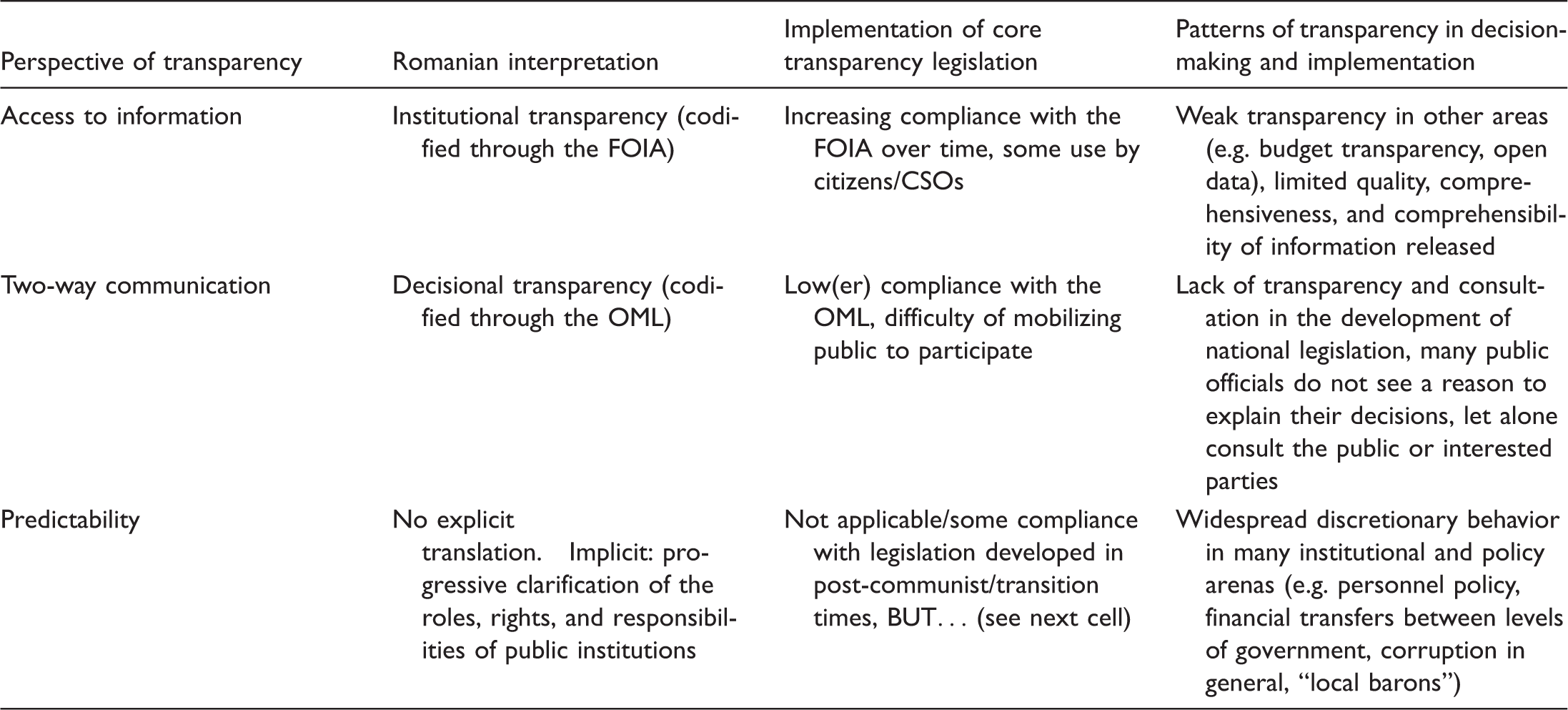
In Romania, as in most countries, there is no “transparency policy” per se, in the sense of a deliberate government strategy or set of related actions and goals (C1, C2, C4, C6, C7, C8, C9, G4, G5). Rather, there are a few key transparency laws. The most important ones are the 2001 “Law on Free Access to Public Interest Information” (FOIA) and the 2003 “Law on Decisional Transparency” (OML). These laws clearly reflect the first two interpretations of transparency: access to information and two-way communication.
Moreover, these two laws introduce an element of transparency as predictability in how government agencies interact with citizens by specifying the rules, procedures, and boundaries of transparency. As one interviewee put it, “both laws were a reaction to civil society pressure against chaotic decision-making by government, Parliament, the political class, and the public administration” (C6). For example, civil society activists who pushed for an FOIA critiqued not the absence of public information, but the fact that access to it was erratic and determined by “connections,” bribery, and leakage of information to discredit opponents (cf. Mungiu-Pippidi, 2001). While well-connected parts of the media were able to obtain “scandalous” information, routine government information useful for citizens, such as parliamentary votes, budget data, property records, statistics, and so on, was missing or hard to obtain (Mungiu-Pippidi, 2001).
In addition to the two core transparency laws, other government strategies also include measures that reflect the three perspectives of transparency. Romania’s anti-corruption strategies (GoR, 2001, 2005, 2008, 2012) emphasize the need to increase access to information, strengthen consultation requirements in regulatory processes, and provide clear, streamlined, and predictable regulations and administrative procedures. Likewise, the 2008 “Strategy for Better Regulation” includes measures to increase consultation (and thus transparency) in decision-making (G4), and Romania’s Open Government Partnership (OGP) Action Plans focus heavily on improving access to information via strengthening open data systems (GoR, 2011, 2014).
As noted earlier, however, legislation is necessary but insufficient for achieving effective transparency. To realize their democratic potential, transparency laws and provisions need to be consistently implemented, and the principles they embody need to be followed in practice. The next sections investigate whether this is the case—both in terms of compliance with FOIA and OML, and in terms of broader patterns of access to information, consultation, and predictability in decision-making.
Transparency as access to information
The adoption of an FOIA, following an intense campaign by CSOs, was considered a breakthrough for democratic values in Romania (Mungiu-Pippidi, 2001). After the government adopted the implementation norms in 2002, FOIA compliance rates and response times improved markedly, especially between 2002/2003 and 2006/2007 (APD and TI Romania, 2007a; also C1). Romania’s FOIA also performed well in international comparison. In 2006, it had among the highest compliance rates and consistency of answers out of 14 countries studied (OSJI, 2006). The use of the FOIA is also substantial. In 2008, Romania ranked sixth internationally for annual FOIA requests per 100,000 inhabitants (Vleugels, 2009). While some observers report a decline in FOIA use and compliance after 2008 (GIR, 2008, 2010; also C1, C8), the FOIA seems to have been institutionalized and routinized to a significant degree (World Bank 2012; also C10, G2).
This is not to say that the FOIA functions seamlessly. However, lack of uniform compliance across public institutions and types of requests (CJI and IPP, 2009; also C12) is not unique to Romania (OSJI, 2006). Even in established democracies with longer FOIA histories, public agencies have many strategies at their disposal to avoid compliance (Pasquier and Villeneuve, 2007). Furthermore, in a context of low administrative capacity, problems such as lack of training, lack of financial and human resources, and weaknesses in internal communication and information management systems create additional hurdles for implementation and compliance—especially at the local level and in rural areas (Dragos et al., 2012).
Beyond compliance, the more profound question is whether the FOIA has generated a shift in how public administrators relate to citizens. This is difficult to ascertain due to a lack of data on the democratic values of public servants. Inconsistency in FOIA implementation has often been attributed to a “culture of opacity” (C2, G1, G3, G4) and a tendency towards secrecy and reliance on informal, personalized communication (CJI and IPP, 2009). Anecdotal evidence also suggests that paternalist, top-down attitudes persist among some public officials, who see citizens as “subjects” rather than “owners” of government information. For example, in 2004, public institutions asked for a justification for 70% of the FOIA requests placed by CSOs, even though such justification was not required by law (APD and IRIS, 2004).
Yet, there are signs of improvement. In a 2007 follow-up survey, requests for justification were no longer a problem (APD and TI Romania, 2007a), and, as noted, routine FOIA compliance functions relatively well. Perhaps the most illustrative story comes from a local civil society activist (C10). As he explained, the initial public reaction of local authorities to a FOIA request was confusion, fear, and resistance: he had to wait outside the building while the local official, who doubted such a law existed, looked it up and got approval from his supervisor to communicate the information. Yet, by 2011, local authorities “had gotten used to it,” and answering simple and non-sensitive FOIA requests had become a routine activity.
While FOIA led to an improvement in access to “raw” government information, there seems to be less progress in proactively publishing relevant, comprehensive, and clear information in a number of policy areas (G2). Budget transparency exists in theory, but the information released is difficult for citizens to use (GIR, 2008). Despite the obligation to publish all regulation in the Official Gazette, only 52% of legal acts were published in 2007 (APADOR-CH and SAR, 2008). Even the OGP action plan shows significant weaknesses: only five out of 15 commitments of the first action plan were specific, relevant, transformative, and completed on schedule (Open Government Partnership—Independent Reporting Mechanism, no date).
Transparency as two-way communication
The “twin” transparency law to FOIA is the OML, which requires public institutions to: (1) publish information on legal acts under development; (2) allow interested parties and citizens to formulate comments and proposals; (3) organize public hearings; and (4), since 2010, offer reasons for rejecting proposals made during the consultation process. At the time of its adoption, the OML represented a significant step forward from previous legislation, which forbade public employees from disclosing any information during the drafting process (Ristei, 2010).
Surveys of OML implementation show low compliance over time, both from central- and from local-level authorities (APADOR-CH, 2007; APD and TI Romania, 2007b; Dragos et al., 2012). In some cases, the quality of the local-level reports of OML compliance was so low that CSOs described it as showing “outright contempt for the law and the citizens” (APADOR-CH, 2007: 40). CSO activists were sometimes denied access to meetings that were supposed to be public (APADOR-CH, 2007). Citizens rarely made comments and suggestions on proposed local laws or decisions, and even when they did, local authorities rarely took these into account (APADOR-CH, 2007; Dragos et al., 2012).
Interviews with CSO and government representatives confirmed that the OML is only weakly used in practice, not just because of resistance from public agencies, but also because the demand side is weak (C2, C9, G5). At the local level, especially outside of the capital city and a few other urban centers, few CSOs are capable of representing citizens and engaging in public decision-making processes (C1, C2). Even where such organizations exist, they have difficulties mobilizing the public to participate (C2, C10).
Even at the central level, one of the most enduring criticisms of the Romanian government is that it acts in haste and does not allow enough public consultation and debate on important legislative measures (APADOR-CH, 2012; ARC, 2012; also C2, C6, C11). The lack of consultations has been criticized not only by CSOs, but also by “technocrats” concerned with the quality of decision-making (G4, G5). While government agencies comply relatively well with formal requirements for publishing draft legislation on their websites (G5), they rarely engage in consultations in earlier stages of policy development, such as problem formulation or assessment of policy options (G4, G5). The top-down decision-making style is aggravated by a lack of policy analysis and impact assessment, which further limits the potential for substantive debates about policy proposals (Mungiu-Pippidi, 2010; also G4).
In sum, while the intent behind the Romanian OML was to promote transparency as two-way communication, its democratic potential has not been fully realized. Not only is the implementation of the OML weaker than that of the FOIA, but neither public authorities nor citizens seem to be strongly invested in putting the principle of transparency as communication into practice. The result is a lack of communication in the development of legislation (C6, G4, G5). As argued in the next section, this also reduces the predictability of decision-making.
Transparency as predictability
As noted earlier, both the FOIA and OML lay out procedural requirements, and thus introduce the concept of transparency as predictability. Indeed, increasing predictability in decision-making was also among the central reasons for the adoption of the OML (C6, C11). As one interviewee pointed out, if more consultation were carried out during the development of legislation, there would be less need for frequent revisions of legislation after adoption (G5). A comment from a Romanian businessman sums up this challenge well: “The problem is not just that the laws change.… It is that the government never explains itself. If you want people to endure hardship, you have to involve them in the decision making process.” (Dietrich, 2000: 20).
Frequent, unexplained changes in laws—and thus lack of transparency as predictability—have been highlighted as a key overall problem of public decision-making in Romania (Mungiu-Pippiddi, 2010). However, even in areas where laws are relatively stable and clear, administrative behavior is marked by unpredictability. For example, as noted, even compliance with the two main transparency laws themselves—the FOIA and OML—is inconsistent and dependent on both the particular public agency and specific individuals involved.
Beyond specific legislation, the high level of corruption in Romania is itself an expression of inconsistent compliance with the overall legislative framework regulating administrative behavior. As Mungiu-Pippidi (2003: 83, emphasis added) argues: Abusive treatment by the various state administrations is not universal. It is simply arbitrary and unpredictable, as summed up by the answer to the question “How often do you have to bribe?” To this, 53 percent of Romanians … answered: “Depends on the civil servant you encounter.”
The arbitrary and nontransparent nature of decision-making is also visible in the often-criticized politicization of personnel policies, especially for top- and middle-level management (Ionita and Freyberg-Inan, 2008; Mungiu-Pippidi, 2010). Current reform proposals emphasize the need not only to limit political appointments in the public sector, but to do so in consultation with political parties so that this is “supported by everyone openly and transparently, and regulated accordingly” (Tudorache, in Pantazi, 2016, emphases added). The goal is to ensure compliance with regulations in order to achieve “a level of predictability that allows the administration to function well” (Tudorache, in Pantazi, 2016 , emphasis added).
Another area that illustrates well both the progress achieved on transparency as predictability, and the challenges that still exist from this perspective, is the relationship between local and central government. As part of the transition process to democracy, the roles, responsibilities, and allocation of funds between central and local government have been progressively clarified through a series of laws and administrative acts. Ionita (2004: 25, emphasis added) argues that in 1998/1999, “new legislation dealing with local finance instituted for the first time in Romania the system of resource sharing based on automatic formulas, thus making the local budgetary process more autonomous, transparent and predictable.”
Nevertheless, discretionary behavior is still widespread. Key decisions about the allocation of equalization transfers between counties and local councils are often made in a nontransparent manner, and the impact of clientelism and patronage is still high (Ionita, 2005). Even the term “local barons” (local political and economic power-holders), with its semantic reminiscence of feudalism, highlights that the predictability embodied in rational-legal governance is still weak in Romania.
In sum, while there have been improvements over the last decades, transparency as predictability seems to be the least understood and least practiced among public officials. This is not particularly surprising given that this perspective is the most complex and challenging to implement. Thus, despite the fact that various laws and regulations have been established to guide decision-making, decision-making practices often remain arbitrary and unpredictable.
In conclusion, Romania has seen some significant progress on transparency over the last decades. Transparency—in its three interpretations—has gained a more prominent place in public discourse, and is being prescribed through an increasing number of legislative acts and provisions. The adoption of the FOIA and OML represented a significant break from the past.
Transparency in Romania: key legislation and patterns of behavior.
Discussion and conclusion
The previous sections provide a number of insights. First, they illustrate that access to information, two-way communication, and predictability represent three related, but distinct and increasingly complex and demanding, perspectives on transparency. Second, they show how differentiating among these interpretations can deepen our understanding of how transparency is both preached and practiced. Finally, they reaffirm the limitations of trying to achieve effective transparency through legislation alone. Effective transparency is likely to remain elusive unless public officials, CSOs, and citizens accept it as a fundamental democratic principle and develop the skills and capacities to supply and/or demand it. This is particularly challenging in transitioning or developing countries with a relatively recent history of democracy, where transparency provisions are new(er).
The framework and the findings of the case study also have implications for advocates of greater transparency as a way to strengthen democratic governance. They suggest that access to information is a necessary but insufficient condition for effective transparency, and that improved two-way communication and predictability are also needed. Measures to increase transparency as two-way communication include OMLs, sunshine laws, or notice-and-consultation provisions in administrative decision-making. Such measures must also be accompanied by efforts to strengthen the communication and consultation capacity of public authorities, CSOs, and citizens.
Transparency as predictability is perhaps the hardest to support through specific measures. It is largely achieved through the progressive definition of the roles and responsibilities of public institutions, including rules for decision-making, accompanied by measures to increase compliance with legislation and reduce informality in the public sector. That said, transparency as predictability is a broader feature of a functioning rational-legal system of governance, and can only emerge as part of the general process of political, economic, and administrative development. Still, understanding the principle of transparency as predictability can help officials and activists also strengthen its practice.
The framework and the case study also provide directions for further research. First, they illustrate the value of combining multiple perspectives on transparency. Normatively, such a definition captures the richer essence of transparency compared to a narrow focus on access to information. This is especially important when discussing the democratic importance of transparency. Considering whether the reasons and procedures for making decisions are “visible” and “comprehensible” to the public can shift the debate from a passive—and easily manipulated or “gamed”—form of transparency, to one that places more emphasis on how transparency facilitates a better understanding of what the government does and how it does it.
Second, from an empirical perspective, they highlight the need for more research on transparency at the country level, in addition to the current focus on organizational transparency. While there are a number of success stories of individual transparency initiatives in developing countries, as well as some of failures (Kosack and Fung, 2014), there is less evidence on the impact of systemic transparency measures, such as cross-cutting or sector-specific transparency legislation (Gaventa and McGee, 2013). Yet, it is unlikely that individual successes are sustainable if the broader political and administrative system does not reflect the value of transparency.
Exploratory in nature, the case study generates some preliminary questions and hypotheses for further research on macro-level transparency. The findings show that the three interpretations of transparency are closely intertwined, and that progress on one depends on progress on the others. Transparency as access to information is perhaps the “easiest” to achieve. Opening up decision-making processes, and behaving according to “clear and publicly known rules,” are more demanding—both for government and for citizens. Investigating when, whether, and how progress on all three dimensions happens across countries is challenging, as cross-national country-level data on the three perspectives is limited, especially regarding de facto as opposed to de jure transparency. However, applying the framework to other country-level case studies can help overcome the limitations of cross-national data and give us a richer picture of how transparency evolves as systems of governance change. This can also help move forward the research agenda on how “large forces” shape the evolution of public administration (Roberts, 2013) beyond developed countries and established democracies.
Footnotes
Acknowledgments
The author would like to thank Tina Nabatchi, Jennifer Brinkerhoff, and Gjalt de Graaf for their comments and suggestions.
Funding
This research received no specific grant from any funding agency in the public, commercial, or not-for-profit sectors.