



Abstract
Although the percentage of women in Japan’s workforce has increased substantially over the last 30 years, gender inequality in terms of income and position has persisted. A major problem is the lack of consciousness around gender inequality in society. Our study aims to explore the factors, particularly the Japanese style of management and cultural norms, that prevent workers in the public and private sectors from recognizing gender inequality. The Working Life Survey data collected from 1999 to 2011 were used for empirical analysis. The research finds that while there are no significant differences in the perceptions of gender inequality between public workers and their private counterparts, the factors influencing their consciousness of gender inequality do differ. The article also discusses the implications of our findings for efforts to promote gender equality throughout the Japanese workforce.
Points for practitioners
Gender equality in the Japanese workplace is considerably low in a global context. Despite substantial gender gaps, the Working Life Survey of 1999–2011 reveals that 32.4% of 9231 workers answered that different treatment based on gender in Japanese workplaces is “fair” or “almost fair.” Examining these data, the study finds that there are no significant differences in the consciousness of gender inequality between public workers and their private counterparts. In addition, while distinctive Japanese management practices are influential on private workers’ consciousness of gender inequality, they do not affect that of public workers.
Introduction
The international community of public administration has long addressed gender equality in government workforces from a variety of perspectives, including pay and status (e.g. Guy, 1993; Lortie-Lussier and Rinfret, 2005; Riccucci, 2009), job performance (e.g. Andrews and Miller, 2013; Park, 2012), and representative bureaucracy (e.g. Groeneveld and Van de Walle, 2010; Keiser et al., 2002; Meier and Nicholson-Crotty, 2006). Compared with these main strands, however, far less attention has been given to the perception or consciousness of gender inequality. Yet, the consciousness of gender inequality within labor forces is the necessary foundation for the promotion of gender equality in the workplace. Especially in those countries where ignorance or apathy toward gender discrimination has been persistent, the promotion of gender equality cannot be achieved without raising the consciousness of gender inequality.
This article examines the consciousness of gender inequality in public and private workforces in Japan, which holds relatively low levels of gender equality in a global context. 1 Japan has been strongly influenced by Confucianism, which stresses a hierarchical societal structure with subordinates’ obedience to superiors and men’s dominance over women and children (Sugihara and Katsurada, 2002). Previous comparative studies of gender role attitudes between Japan and Western countries, including the US, Germany, and Nordic countries, revealed that Japanese individuals have more traditional attitudes toward women than those in Western countries (Melkas and Anker, 2003; Morinaga et al., 1993; Trommosdorff and Iwawaki, 1989). Furthermore, unlike the public sector in the US, the Japanese public sector has been slow compared to the private sector to promote women to key decision-making positions (Cabinet Office, 2014; Martin, 2003). Holding a legacy from the pre-war imperial government, Japanese bureaucracy has been described as a remarkably powerful institution in the English-language literature (e.g. Cicco, 1975; Koh, 1989; Tsurutani, 1998). Thus, the impact of gendered public management on the whole society could never be negligible. We believe that investigating the perceptions of gender inequality in the public and private workplaces of Japan can provide meaningful insights into effective gender equality policy for non-Western patriarchal societies.
The article first provides a chronological overview of gender equality in Japanese management and relevant legislation. It then addresses the research question: what factors prevent public and private workers in Japan from recognizing gender inequality? In identifying the factors, we draw on the Japanese government’s priority fields of its gender equality plan, along with the pertinent literature. The Working Life Survey (WLS) data collected from 1999 to 2011 are used to test the significance of the hypothesized factors with ordered logistic models. We then discuss the implications of our findings for promoting gender equality throughout Japanese workplaces.
Gender equality in Japanese management
In 1968, 20 years after the Second World War, Japan recorded the second highest gross domestic product (GDP) in the world. In the 1970s and 1980s, Japan led the world economy. Many Western observers regarded Japanese management practices as the best practices and worthy of emulation. Indeed, numerous articles and books discussed such Japanese management practices as lifetime employment, seniority wage and promotion, and collective decision-making (Brown et al., 1998; Whitehill, 1991). Dr William Ouchi’s (1981) “Theory Z,” based on W. Edwards Deming’s management and motivation theories, popularized the belief that focusing on employee well-being and providing a job for life would increase employee loyalty to the firm and therefore promote stable employment, employee morale, satisfaction, and productivity.
These practices have been rooted in not only private firms, but also public agencies (Fiftal Alarid and Wang, 1997; Jun and Muto, 1995). Gordon (1988) sees lifetime employment and seniority wage, in part, as products of Japanese totalitarianism during wartime. In the late 1930s, the imperial Japanese government issued a series of regulations on wages and company welfare policies (e.g. wages should rise with age, the best single proxy for need; income should meet minimum livelihood needs and should therefore be stable; and incentive pay, subject to fluctuation and rate-cutting, should be reduced or eliminated).
In the 1990s, however, the Japanese economy experienced lengthy recession and stagnation, and some of the management practices were criticized as structural impediments. For instance, government advisory bodies and business leaders raised the concern that the Japanese management system was designed to sacrifice the value of the personal life of the worker, and was thus not sustainable (e.g. Morita, 1992; National Life Council, 1991). Also, a large body of scholarship argued that Japanese management practices prevented women workers from entering and staying in the workplace (e.g. Brinton, 1993; Lam, 1992). Until the late 1980s, the Japanese government did not adequately recognize women’s potential role to overcome the shortage of labor in the workforce and their potential impact on the long economic recession.
Legislation for gender equality in Japan
The enactment of the national Equal Employment Opportunity Law (EEOL) in 1986 was the first legislative effort by the Japanese government to minimize pervasive discriminatory hiring and promotion practices (Estevez-Abe, 2005). An amendment to the EEOL in 1999 prohibited gender discrimination at all stages of employment, including recruitment, deployment, promotion, and dismissal. Some scholars argue that the EEOL, while being criticized for the lack of enforcement power, made a contribution to raising awareness of gender inequality and increasing women’s entry into higher education and the labor market in the 1990s (e.g. Estevez-Abe, 2005; Gelb, 2000; Molony, 1995).
The Basic Law for a Gender-Equal Society (BLGS) was enacted in 1999 as the first basic law for gender equality in all aspects of society, such as education, politics, and social security. As a practical action plan for implementing the BLGS and developing policies to promote gender equality in Japan, the Basic Plan for Gender Equality was then formulated in 2000 by the central government and implemented at each government level. The Basic Plan was revised in 2005, 2010, and 2015. It set up key priority fields, such as: (1) expansion of women’s participation in policy decision-making processes; (2) reconsideration of social systems and practices, and raising awareness of gender inequality; (3) securing equal opportunities and treatment between men and women in employment; (4) men’s and women’s work–life balance; and (5) the creation of an environment in which people such as the elderly, the disabled, and non-Japanese people can live safely (Cabinet Office, 2010, 2015).
Recent trends on gender equality in the Japanese workforce
Partly due to the legal mechanisms discussed earlier, women’s entry into the Japanese labor market slowly increased. The Japanese Ministry of Health, Labor and Welfare (MHLW) reports that the number of women employees grew from 15.5 million in 1985 to 24.3 million in 2014, and the proportion of women in the national workforce rose from 35.9% in 1985 to 43.59% in 2014 (MHLW, 2014).
Even given such remarkable progress, there is still a notable gap between men and women in Japanese workplaces in terms of wages and representation. As of 2013, the average earnings for full-time women employees was 73.4% of the average earnings for full-time men employees. Among Organisation for Economic Co-operation and Development (OECD) countries, it was 84.7% on average (OECD, 2015). The 2014 Report of the Japanese Cabinet Office for a Gender-Equal Society reports that the proportion of national women representatives is 15.7% in the upper house and 9.5% in the lower house. At the local level, the proportion of women is 4.3% of prefectural governors and 8.9% in prefectural councils. 2 Furthermore, the proportion of women workers who are division heads or higher was 3.3% in the central government, 7.2% in prefectural governments, and 8.3% in private firms that have over 100 employees.
Despite these substantial gender gaps in the workplace, the WLS of 1999–2011 conducted by the national research institute, the Japan Institute for Labour Policy and Training (JILPT), reveals that 32.4% of 9231 workers answered that different treatment based on gender in Japanese workplaces is “fair” or “almost fair,” 45.1% answered “not so fair,” and 22.4% answered “unfair.” Additionally, the proportion of the workers who answered “fair” or “almost fair” increased from 28.8% in 1999 to 38.6% in 2011 (JILPT, 2013). Figure 1 displays trends of men and women for the ratio of the responses “fair/almost fair” to those “not so fair/unfair.” It shows that both men and women workers became less conscious about gender inequality over time, while women workers were more likely to recognize inequality than men workers each time.
Percentages of men (N = 4313) and women (N = 3437) who view different treatment based on gender as fair/almost fair, 1999–2011.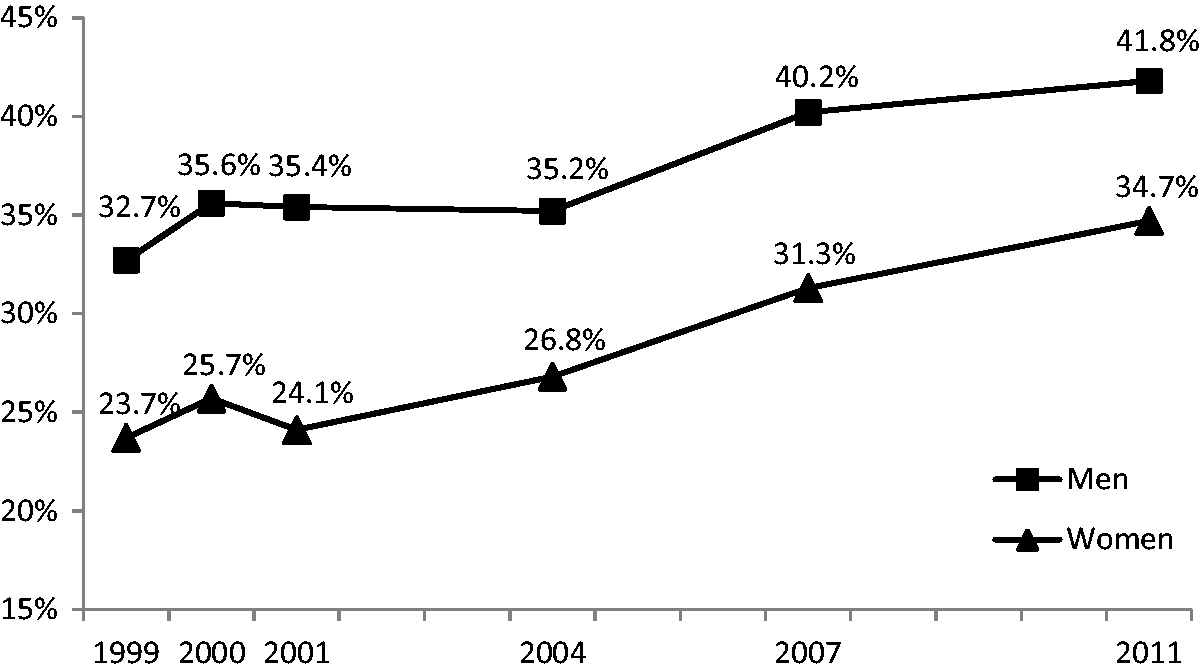
Although gender gaps have gradually shrunk overtime (Cabinet Office, 2014; MHLW, 2014), there is still a long way to go to achieving consensus on gender equality, especially in the government workforce. Thus, along the national gender policy framework, “The Basic Plan for Gender Equality,” this study will examine the factors that prevent workers from perceiving gender inequality generally in the Japanese workplace. By comparing public workers with their private counterparts, it will identify a unique mechanism of determining perceptions of gender inequality in the government workforce.
Determinants of gender inequality consciousness
The Basic Plan for Gender Equality sets the priority fields of action: low representation of women in the government workforce; gendered management practices; and the multiple challenges of elderly, disabled, and/or non-Japanese women. Along these policy priorities, we develop hypotheses regarding the determinants of gender inequality consciousness among Japanese public and private workers to investigate whether the legislation is hitting the target of gender equality. As noted earlier, few gender studies in public administration have examined the consciousness of gender inequality in the workplace. Also, Japanese public administration has not been much discussed in the international forum. Thus, we draw on not only the public administration, but also the sociology and business, literature to develop the hypotheses.
Gender
As demonstrated in Figure 1, men workers are less likely to recognize gender inequality than women workers. Such perceptual difference is backed by personal goal theory (Bolzendahl and Myers, 2004), which argues that individuals’ personal goals determine their attitudes. When people benefit from gender equality, they are likely to hold more egalitarian gender views (see also Davis and Robinson, 1991). Bolzendahl and Myers (2004: 761) also state that “women, on the average, favor gender equality more than men since it seeks to provide direct benefits to women.” Therefore, we hypothesize: H1: Women workers are more conscious about gender inequality in Japanese workplaces than men workers.
Public sector
The Basic Plan attempts to increase the proportion of women in leadership positions in the central and local governments in order to achieve representative bureaucracy. One may argue that both men and women officials, due to their positions in government, are more likely to support laws and policies enacted by the government than their counterparts in the private sector. Yet, affirmative action policies have created a challenge here, especially for men officials who have occupied leadership positions. According to personal goal theory, men officials may view affirmative action as a threat to their career goals, and therefore deny the existence of gender inequality. Kobayashi (2004) illustrates how Japanese women officials at the Bureau of Women and Minors struggled with unreasonable opposition from their male counterparts in promoting gender equality within the bureaucracy. Thus, we test contradicting hypotheses regarding the effects of government employment on the consciousness of gender inequality: H2: Public workers compared to their private counterparts are more or less conscious about gender inequality in Japanese workplaces.
Acceptance of Japanese management
The Basic Plan aims to achieve equal treatment of men and women in employment through government initiatives such as “eliminating wage disparit[ies] between men and women, reviewing systems for the treatment of employees, and supporting women to enter and stay in jobs (Cabinet Office, 2010).” Among several Japanese management practices, lifetime employment (shushin-koyo) and seniority wages (nenkoh-chingin) have been called sacred treasures, which significantly contribute to the efficiency of the Japanese management system: low turnover and absenteeism rates and low rates of strike activity. Since the 1990s, however, a substantial body of scholarship has argued that the sacred treasures hinder gender equality in the labor force (e.g. Brinton, 1993; Kawaguchi, 2008; Lam, 1992). Specifically, lifetime employment expects all regular workers, both male and female, to stay at one organization from recruitment to retirement, and regular workers acquire higher wages and positions mainly based on age and years of continuous service. Japanese women workers, similar to women in the US, have suffered high penalties for dropping out of this regular career track due to childbirth and other family responsibilities (e.g. Guy et al., 2008; Mastracci et al., 2012). Both public and private organizations provide little support and opportunities for women to re-enter employment. Therefore, women are placed in a disadvantaged position in the Japanese seniority system. Hence, we hypothesize: H3: Workers with a higher acceptance of the lifetime employment practice are less conscious about gender inequality in Japanese workplaces. H4: Workers with a higher acceptance of seniority wages are less conscious about gender inequality in Japanese workplaces.
Satisfaction with pay and promotion
The underdog thesis regarding perceptions of class and racial inequality predicts that individuals who are disadvantaged by the distribution of opportunities, treatment, and conditions will be more conscious of inequality than individuals who are advantaged (Robinson, 1983; Robinson and Bell, 1978). Applying this thesis to gender inequality, we assume that workers who are satisfied with their promotional opportunities and wages in their workplaces are less conscious about gender inequality in the Japanese workplace. Therefore, we offer the following hypothesis: H5: Workers who are satisfied with pay and promotion are less conscious about gender inequality in Japanese workplaces.
Consciousness of multiple inequalities
The Basic Plan proposes to create an environment in which elderly, disabled, and/or non-Japanese people can live without distress. Recent feminist scholars argue that gender inequality has been simultaneously produced with class, race/ethnicity, and other forms of social inequality (e.g. Holvino, 2010; McCall, 2005). In the Japanese context, racial/ethnic inequality is far less prominent than in the US since Japan is a highly homogeneous state. However, non-Japanese women, such as resident Koreans and former colonial subjects, have encountered additional disadvantages in employment (Nakahara, 1993). Although such racial/ethnic discrimination still remains, the circumstances began to change after the rise of global human rights norms led by the ratification of the International Covenants on human rights in the late 1970s (Tsutsui and Shin, 2008). The drastic change of consciousness about women’s human rights has also occurred since the world conferences set women’s rights into global human rights discourses in the 1990s (Chan-Tiberghien, 2004). Hence, we hypothesize: H6: Workers who recognize inequality among minority racial/ethnic groups are more conscious about gender inequality in Japanese workplaces.
Controls
The study controls for three socio-demographic factors in the model: age, income, and education. Empirical studies have shown that age, income, and education are associated with gender ideology (e.g. Brewster and Padavic, 2000; Ciabattari, 2001; Corrigall and Konrad, 2007). We also control for survey years since the data were collected from multiple years from 1999 to 2011. Using the longitudinal data to study changes in gender ideology in the US, several researchers have found period effects, although the impetus for change continues to be unclear (e.g. Brewster and Padavic, 2000; Ciabattari, 2001).
Methods
Data
For this study, we rely on the data of the WLS, which, as discussed earlier, is conducted by the JILPT. The WLS has been gathered six times in 1999, 2000, 2001, 2004, 2007, and 2011. It should be noted that the start of the WLS accords with the enactment of the BLGS in 1999. The JILPT allows academic researchers and Japanese public officials to use the survey data based upon their requests. The WLS used the same two-stage sampling approach at each time of data collection. Specifically, 47 prefectures of Japan were divided into 11 regions, and each region was further divided into 22 blocks according to municipal areas. Based on the population size of 20 years old or greater in each block, a sample of 4000 people was proportionally invited to participate in the survey. The sample size and response rate of the WLS in each year are as follows: 2724 respondents and 68.1% in 1999; 2778 and 69.5% in 2000; 2751 and 68.8% in 2001; 2729 and 68.2% in 2004; 2315 and 57.9% in 2007; and 2264 and 56.6% in 2011. We integrated data from all six years, with 15,558 responses in total.
With the purpose of investigating the public’s perception of working life, the WLS targets both workers and non-workers. We extract only the responses of workers (9507) to focus on their perceptions of gender inequality. Further, to make private workers comparable to public workers in government agencies, we limit the entire private workforce to those who belong to organizations that have over 50 workers. 3 This means that our sample omits freelance, self-employment, or small family industry and focuses on organizational members. Excluding the missing values, the final sample of this study consists of 3467 Japanese workers, including 3026 from the private sector and 441 from the public sector.
Measurement
A considerable challenge for measuring gender equality is its multiple dimensions. Sapiro and Conover (2001) argue that the distinction between general and domain-specific measures is critical to devise adequate measures of gender equality. In this article, we focus on Japanese workers’ consciousness regarding national-level gender equality in the workplace rather than specific domains such as a public agency or an automobile company. It should be noted that workers may perceive lower gender equality in one domain (e.g. blue-collar) than another (e.g. white-collar) while they can respond to a question about gender equality generally in Japanese workplaces. The relationship between gender equality and different domains would vary from person to person.
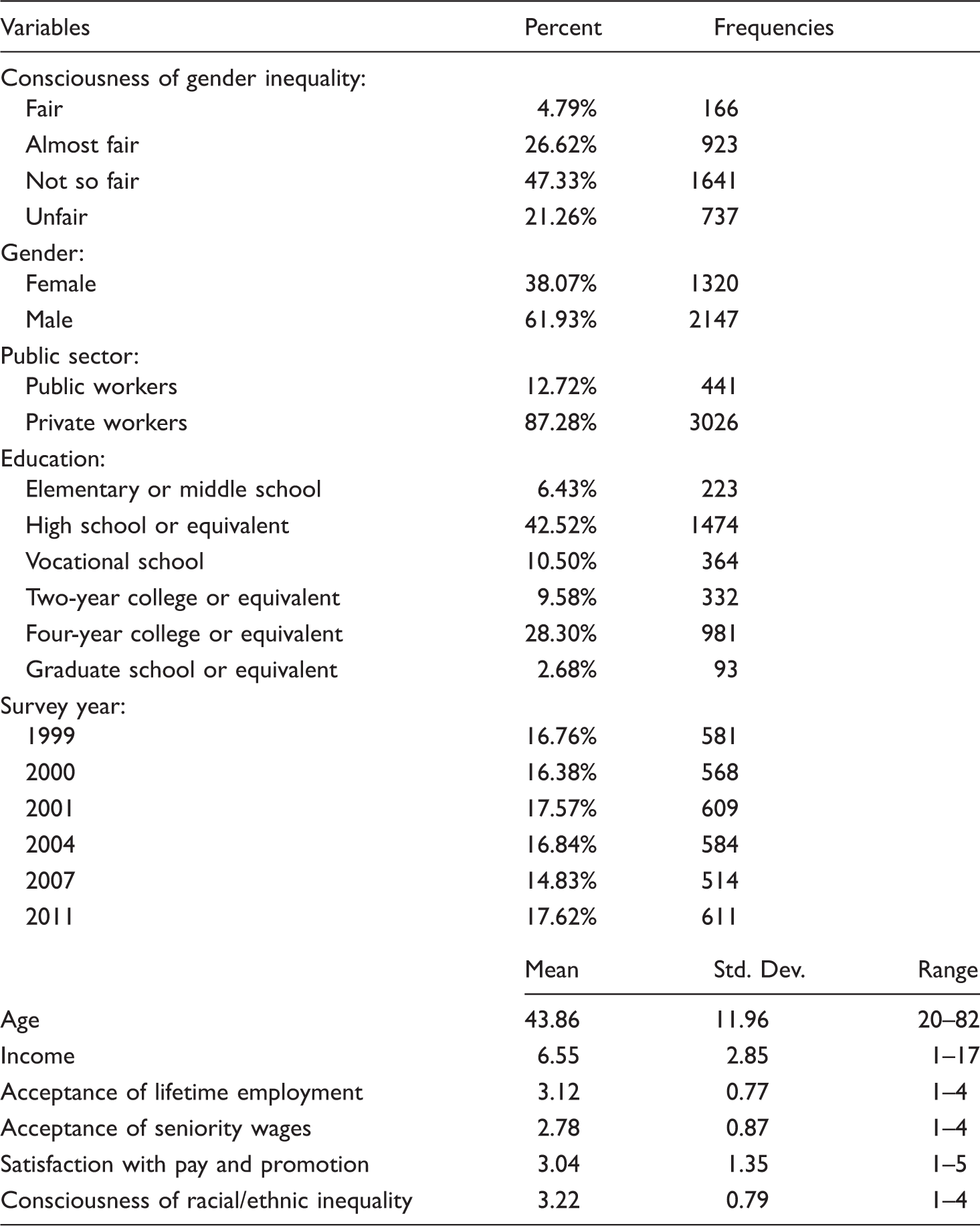
The consciousness of gender inequality, as the dependent variable, is measured by Japanese workers’ responses to the question “Generally, in modern Japan, do you think that different treatment based on gender is fair?” in the WLS. The original Japanese term for “treatment” is “shogu.” According to a major Japanese dictionary, Daizirin, “shogu” means “workers are assessed, and then treated based on the assessment” in the context of workplace. As the survey particularly collects information about working life, and because Japan is a very male-dominant country where females are in a disadvantaged position in workplaces, the survey question should be able to reflect respondents’ consciousness toward unfair treatment against female workers generally in Japan. This variable takes a four-point scale (1 = fair, 2 = almost fair, 3 = not so fair, and 4 = unfair), while a high value indicates respondents’ high level of consciousness of gender inequality.
The measurement of the independent variables is as follows. Gender was coded as 0 for male and 1 for female. “Public sector” is a dichotomous indicator of whether respondents work for the public sector (1) or private (0). Acceptance of lifetime employment is measured by responses to the question “What do you think about the Japanese lifetime employment system where employees stay at one company from recruitment to retirement?” on a four-point scale (1 = bad one, 2 = relatively bad one, 3 = relatively good one, and 4 = good one). Similarly, acceptance of seniority wages was measured by the question “What do you think about the Japanese seniority wages where wages increase based on years of continuous serving?” Satisfaction with pay and promotion is measured by the survey question “Are you satisfied with the merit system for promotion and pay at your current job?” on a 1–5 scale (1 = dissatisfied, 2 = almost dissatisfied, 3 = neutral, 4 = almost satisfied, and 5 = satisfied). Consciousness of racial/ethnic inequality is measured by the question “Generally, in modern Japan, do you think that different treatment based on nationality and race is fair?” on a four-point scale (1 = fair, 2 = almost fair, 3 = not so fair, and 4 = unfair).
Descriptive statistics of variables (N = 3467).
Test procedures
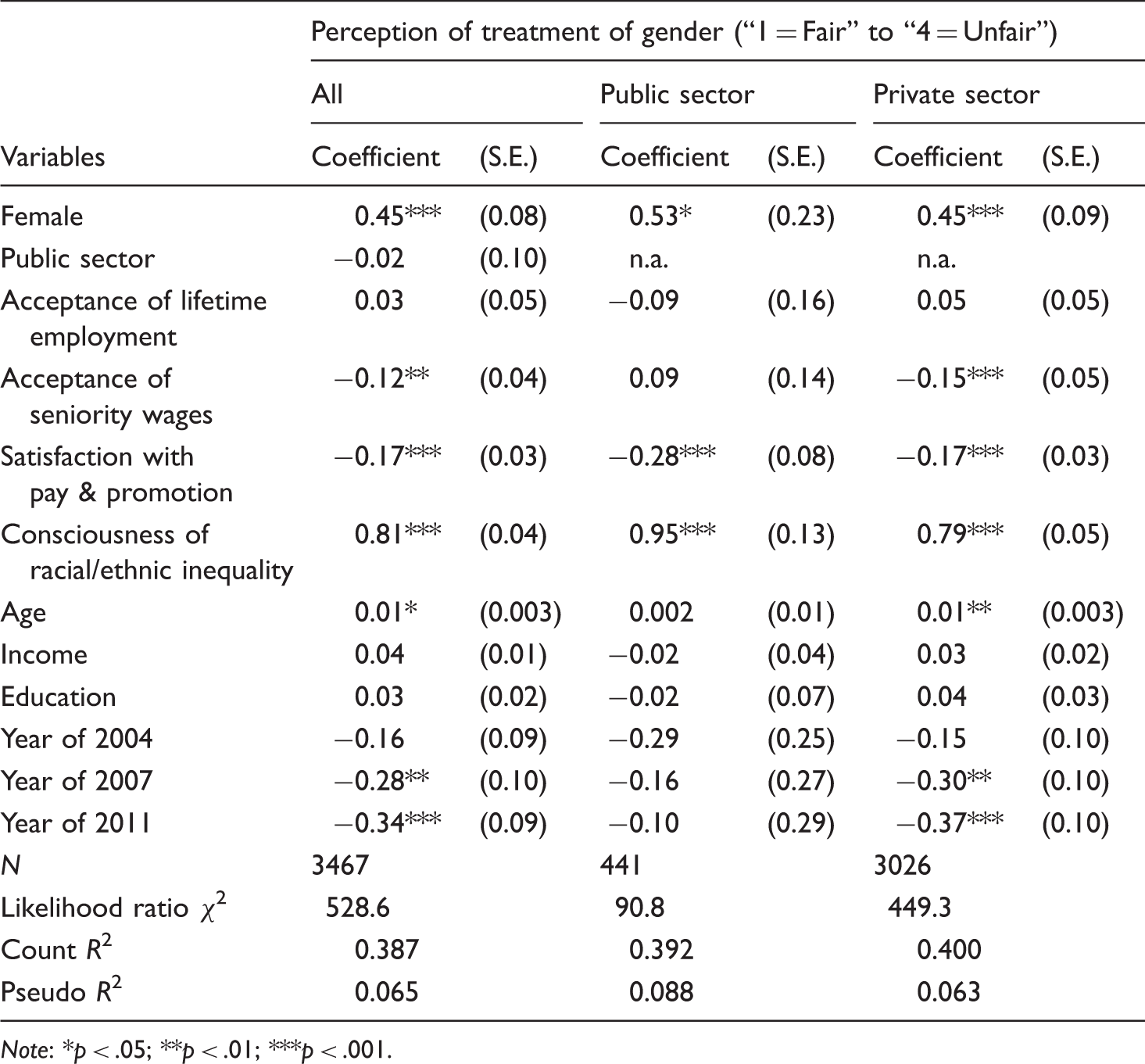
Ordered logit models for workers’ consciousness of gender inequality.
Note: *p < .05; **p < .01; ***p < .001.
Prior to running the models, we conducted correlation analysis and variance inflation factor (VIF) tests (the tables are not presented in this article) to detect the threat of multicollinearity. The highest correlations are 0.56 between gender and income and 0.30 between education and income. The highest VIF score is only 1.75, suggesting that multicollinearity is not an issue in this research. According to the likelihood ratio χ2 tests, all models are statistically significant at the .0001 level.
Findings
The results in Table 2 indicate that gender is significant in the models for all workers and private workers at the .001 level, and in the public sector model at the .05 level. Women workers are more likely than men workers to view different treatment based on gender in the Japanese workplace as unfair. Thus, H1 is empirically supported. The public sector is not significant in the model of all workers, suggesting no significant difference between public and private workers in terms of perceiving gender inequality in the Japanese workplace. Thus, H2 is not supported by the survey data.
Acceptance of lifetime employment is not significant in any of the models. On the other hand, acceptance of seniority wages is negative and significant in the model of private workers, but not in the model of public workers. This means that private workers, who favor seniority wages, are more likely to view different treatment based on gender in Japanese workplace as fair, while in the public sector, the traditional managerial norm does not impact workers’ perception of gender inequality. Therefore, H4 is partially supported.
Satisfaction with pay and promotion demonstrates a significant impact on consciousness of gender inequality among both public and private workers. Higher satisfaction with the pay and promotion system is associated with a lower probability of recognizing gender inequality generally in the Japanese workforce. H5 is empirically supported. The consciousness of racial/ethnic inequality is the most significant predictor for all workers in perceiving gender inequality, which provides empirical support for H6. In other words, workers are less likely to be conscious about gender inequality if they neglect other forms of inequality due to nationality and race, which reflects the strong influence of traditional norms in the culture.
Regarding control factors, income and education are not significant in all the models. This differs from empirical evidence in the US context that people with higher incomes and education are more likely to have gender-egalitarian views (e.g. Brewster and Padavic, 2000; Ciabattari, 2001; Corrigall and Konrad, 2007). Age is positive and statistically significant in the private sector but not in the public sector. The results imply that the consciousness of gender inequality within the Japanese bureaucracy does not automatically improve over generations; a reverse trend has surprisingly appeared in the private counterpart that younger workers are less likely to be conscious about gender inequality, which contradicts the US empirical studies (e.g. Brewster and Padavic, 2000; Ciabattari, 2001). This finding deserves close attention by scholars, social activists, and policymakers. The coefficients of survey year 2007 and 2011 are negative and statistically significant in the models of all and private workers. This is in concert with Figure 1, which indicates that more Japanese workers view different treatment based on gender as fair in recent years. Such a decline in the consciousness of gender inequality over time is worth an in-depth investigation in a separate research project.
Additionally, although the results are not presented here, we ran the model of all workers with the samples of 1999–2001, 2004, 2007, and 2011, respectively, to see the difference in coefficients between survey years. We found no significant difference between the models of each year cohort except that the acceptance of lifetime employment is positive and statistically significant at the .05 level in 2011 while it is not in other survey years.
Conclusions and implication
According to existing reports and studies in recent years, the problem of unfair treatment of women workers is still persistent in the Japanese workplace. It is essential to raise the consciousness of gender inequality in order to promote gender equality in the male-dominant society. Our present study makes efforts to identify the systematic barriers that prevent workers from recognizing gender inequality, especially the factors in the managerial system, as well as cultural norms (see Mastracci and Bowman, 2015). Although the statistical analysis shows no significant difference in the level of consciousness of gender inequality between public and private workers, it indicates that workers between the two sectors may have different considerations when they view the gender inequality issue.
While Japanese workers have a relatively high acceptance level toward lifetime employment in both public and private sectors, such acceptance does not significantly influence their consciousness of gender inequality. Workers’ attitude toward seniority wages works differently for public and private workers. In the public sector, it does not affect workers’ consciousness of gender inequality; however, in the private sector, support for seniority wages is associated with a lower level of consciousness of gender inequality in the Japanese workplace. Given the fact that the levels of acceptance of Japanese management practices are higher in the public sector than in the private sector (see Appendix 1), the model results do not suggest that private workers are less conscious about gender inequality due to higher levels of acceptance of Japanese management practices. Instead, the results may imply that public workers tend to take seniority wages and gender equality as separate issues, while private workers may view the gender equality issue based on their own benefits caused by the traditional seniority system in the workplace.
Previous studies have rarely addressed the association between workers’ satisfaction with extrinsic rewards and consciousness of gender inequality. We found that, in both public and private sectors, Japanese workers are less likely to be conscious about national-level gender inequality when they are satisfied with pay and promotion in their workplace. These results may imply that satisfied workers tend to neglect unequal treatments generally in the workplace while they might benefit from gendered management. Future studies are needed to develop theoretical and empirical frameworks along this line, especially for patriarchal societies like Japan.
Workers’ consciousness of inequality due to nationality and race is a strong predictor of consciousness of gender inequality in both public and private sectors. This finding implies that perceptions of gender equality are deeply constrained by the traditional norms that center Japanese over resident Korean or Ainu indigenous people in northern Japan. Consciousness of gender inequality cannot be improved without comprehensive human rights initiatives.
The study partially supports the attempts of the Basic Plan for Gender Equality, which has set gendered management practices and inequality in multiple social aspects as priority fields. Although lifetime employment does not show an influence on the view of gender inequality, acceptance of seniority wages and racial/ethnic inequality all explain the variation in gender inequality consciousness, especially for private workers. Therefore, the Basic Plan is targeting some of the systematic barriers rooted in the Japanese distinctive management system and culture to gender equality.
This study has some limitations. First, the dependent variable is measured by responses to the question of how respondents view different treatment based on gender as fair or unfair. In the Japanese workplace, women are much under-represented and underpaid, thus different treatment based on gender should normally be perceived as unfair treatment to women workers. However, there is still a slight chance for respondents to perceive it as unfair treatment to men workers. Our study cannot exclude such possible bias in the measurement. Second, job characteristics, such as occupation and position, may also shape workers’ perceptions of gender inequality. However, due to data unavailability, we did not include factors of job characteristics in our model and suggest that future research develop a more comprehensive model.
Despite these limitations, this study, as the first quantitative analysis to address gender inequality in Japanese public and private sectors, reveals unique mechanisms determining the consciousness of gender inequality in each sector. We hope that this study can serve as a catalyst for further studies to address more in-depth issues of gender inequality consciousness in not only Japan, but also other patriarchal societies.
Footnotes
Funding
This research received no specific grant from any funding agency in the public, commercial, or not-for-profit sectors.