




Abstract
This article examines links between innovation and inter-organizational learning in the context of public service reform. The theory-building and empirical research draws on longitudinal analysis using mixed methods and multiple stakeholder respondents, set in the context of the Beacon Scheme, an instrument of UK public service reform. The research examines two questions: first, how does inter-organizational learning contribute to innovation? Second, how do changes in the approach to inter-organizational learning shape changes in the approach to innovation over time? The research on the whole of English local government (N = 388) used temporal bracketing to examine developments in three phases over nine years. The article builds theory about the inter-organizational learning underpinning innovation, and shows that the approach to innovation changed over time, shifting from learning to imitate, to learning to innovate.
Points for practitioners
• Innovation is underpinned by inter-organizational learning.
• Organizations improved over time in their ability to acquire and use learning.
• Innovation involves the sharing of tacit as well as explicit knowledge.
• Over time, organizations learnt to shift from learning to imitate, to learning to innovate.
• Improvement through inter-organizational learning was not uniform. Initially, differences between organizations widened as those able to acquire learning used it to improve more rapidly.
• Adaptation to local context, not adoption of a single approach, is apparent but is underemphasized in public service reform.
• Learning pull, not dissemination push, aids learning and improvement.
Innovation, inter-organizational learning and public services reform
The concept of innovation has become more prominent in public administration theory and research (De Vries et al., 2016; Hartley, 2005). There is increasing recognition that innovation is a key means by which public services can become more effective, more efficient or more legitimate (Moore and Hartley, 2008; Windrum and Koch, 2008).
The drive for public service reform across many countries championed innovation as a key means of public service improvement (Hartley et al., 2013; Pollitt and Bouckaert, 2011). However, the processes by which innovation leads to improvement (where it does) have not been fully mapped. There has been recognition of the role of networks in fostering and enhancing innovation (Sørensen and Torfing, 2011) but how networks create the learning that underpins innovation is less clear (Beeby and Booth, 2000).
Behn (2008) shows that learning is central to innovation because the latter requires the acquisition of new tacit knowledge, not just explicit knowledge (the former can be hard to articulate) (Nonaka, 1994; Polanyi, 1966). In private sector innovation studies, learning by the organization has been conceptualized as knowledge acquisition and use, and is seen as central to innovation (e.g. Nonaka, 1994; Szulanski, 2003). Absorptive capacity (Cohen and Levinthal, 1990; Zahra and George, 2002) is an organizational competency in acquiring, translating and using knowledge and learning in new settings.
There is also a substantial gap in the literature about innovation over time. Osborne et al.’s (2008) study of innovation in the voluntary sector over time is a rarity. Most studies of innovation are either at a single point in time or are retrospective, with consequent reporting bias (Pettigrew et al., 2001). The study here examines innovation and learning contemporaneously over nine years.
The Beacon Scheme can be conceptualized as an inter-organizational learning initiative across local public services. Applicable to all local governments over nine years, it raises some valuable theoretical questions. First, how does inter-organizational learning contribute to innovation? Second, what changes take place in approaches to innovation over time?
These questions are examined using mixed-methods multi-respondent longitudinal research, with the tracking of all 388 local governments in relation to the Beacon Scheme over nine years using primary and documentary data, both qualitative and quantitative. This degree of depth and length is relatively unusual in public sector innovation research (De Vries et al., 2016). We deploy a process analysis strategy called temporal bracketing (Langley, 1999; Langley et al., 2013), which ‘goes beyond descriptive utility’ to enable ‘structured process analysis and sensemaking’ (Langley et al., 2013: 703). We use theory and empirical evidence to conceptualize three phases of institutional-level reform and learning: duplicative imitation, adaptation and creative innovation.
The article draws on but also extends theory on learning processes and innovation at the level of a group of organizations. It examines interactions and influences not only horizontally across local governments, but also vertically between the UK national government and local governments. Finally, theory is developed about how inter-organizational learning over an extended period of time can create a shift in emphasis about innovation.
This study makes several contributions to the literature on innovation, inter-organizational learning and public service reform. First, we extend theorizing about innovation by examining the inter-organizational learning processes that enable innovation to occur across a group of organizations. We show that the ability to use inter-organizational learning to create innovation varied among local government organizations initially and changed over time, so learning cannot be assumed in innovation and is not uniform within a sector. The research avoids the critique that innovation studies are biased towards success (Denrell, 2003; Overman and Boyd, 1994) because the whole population of local governments is analysed.
Second, we contribute to the time dimension of innovation and learning by undertaking a process analysis in temporal periods. There are surprisingly few studies of these processes over time (Easterby-Smith and Lyles, 2005; Kim, 1998; Pettigrew et al., 2001) and fewer that are contemporaneous. Yet, innovation and learning are dynamic processes and inevitably have chronological aspects. The research data show a shift from imitation to innovation over time as some local governments created greater learning capacity.
Third, we contribute to how learning and innovation are linked to public services reform. A learning approach to improving services is relatively rare in research on public services reform (O’Flynn et al., 2011; Rashman and Hartley, 2002).
The article is structured as follows. First, we examine the literatures on innovation, learning (including inter-organizational learning) and public service reform, exploring their links. We then apply these concepts to English local government over nine years through the Beacon Scheme through analysis using temporal bracketing. Finally, we develop insights from this temporal analysis to contribute to the linking of innovation and learning processes.
Innovation and learning
There are many and varied definitions of innovation (De Vries et al., 2016), so innovation is defined here as the implementation, not just the invention, of new ideas and practices (Bessant, 2003). Innovation is disruptive, involving step-change, not just incremental improvements. Innovation may come about through invention within the organization or it may derive from the adoption of innovation from elsewhere.
Organizational learning is conceptualized here as a socially constructed and contextually embedded collective practice, underpinned by the concepts of explicit and tacit knowledge (Nonaka, 1994; Polanyi, 1966). The sharing of learning across organizational boundaries constitutes inter-organizational learning (Holmqvist, 2004). Organizational learning and innovation are influenced by the accumulation of tacit and explicit knowledge. Tacit knowledge forms the core of an organization’s knowledge base, which underlies its effective performance as a learning system (Kim, 1998). Tacit knowledge can only be acquired through practical experience, including observation, imitation and learning by doing, whereas explicit knowledge can be shared through written and spoken text relatively easily, for example, in books, manuals and websites (Nonaka, 1994). Organizational learning occurs where learning coexists at several levels, and where organizational practices and structures produce, share, interpret and embed learning (Easterby-Smith and Lyles, 2005). An emphasis on the socially constructed, dynamic and contextual nature of organizational learning and knowledge (Chiva and Alegre, 2005; Crossan et al., 2011) is important for public organizations, whose activity systems are inherently contested, political and participative (Feldman, 2005).
The institutional field level emphasizes the influences of the organizational environment in explaining behaviour, horizontal and vertical relationships, and common meaning systems (Scott, 2008). Understanding learning across an institutional field highlights variations in organizational processes and the impact of the regulatory system and policy context. Thus, innovation and learning may be shaped by the institutional context.
Learning and public services reform
Public service reform has been regarded as a global movement (Pollitt and Bouckaert, 2011). The emphasis on ‘new public management’ (Hood, 1991) and ‘reinventing government’ (Osborne and Gaebler, 1992) stressed the role of structural policy instruments, including organizational restructuring, target setting and performance management, to achieve change. Analysis of reform has largely ignored the learning processes that underpin these policies (Jas and Skelcher, 2005; Rashman and Radnor, 2005). Little attention has been paid to how external demands for change are translated or enacted by organizational actors (Donahue and O’Leary, 2011; Kelman, 2005). There is surprisingly little literature about inter-organizational learning between a set of organizations, though this is of particular relevance to public service reform, where the public value of innovation and learning is at the sector, not solely the organizational, level.
Institutional theory has been used to explain public service reform (e.g. Ashworth et al., 2007), emphasizing pressures to conform through processes of mimetic isomorphism (Di Maggio and Powell, 1983). This implies that reform initiatives result in the active copying of the practices of those organizations perceived to be successful across the population. However, critics argue that the theory of isomorphism risks overlooking local, relational and political factors, as well as interactional influences (Suddaby et al., 2010), which can lead to unintended consequences, novelty and divergence among organizations – in other words, innovation.
Innovation and inter-organizational learning over time
The literature on inter-organizational learning or innovation over time is sparse. We draw on but extend the theory developed by Kim (1998) based on longitudinal research. Kim (1998) develops concepts of learning in a single industrial and private sector organization, whereas we apply ideas about cumulative learning and innovation to local government. In particular, Kim’s research alerts scholars to the iterative, dynamic and cumulative relationship, taking place over time, between learning and innovation.
We turn now to examine the empirical evidence about innovation and inter-organizational learning derived from the public reform instrument called the Beacon Scheme in order to examine how local and national governments used organizational and inter-organizational learning to improve performance.
Research design and methods
Research design
The research design is based on process analysis over time. It draws on Langley’s (1999) and Langley et al.’s (2013) strategy of temporal bracketing. The aim of temporal bracketing is to achieve a process analysis of inter-organizational learning and innovation over time, based on inductively identifying periods or phases. Within each phase, there is continuity of activity and discontinuities on its frontiers with the activities of the later phase (Langley, 1999): ‘Beyond its descriptive utility, this type of temporal decomposition offers interesting opportunities for structured process analysis and sense-making’ (Langley, 1999: 703).
The aim is to use the mixed-methods data collection over nine years to identify phases, and to use those phases to analyse the relationships between inter-organizational learning and innovation, revealing change over phases, each being affected by the preceding phase (Langley et al., 2013; Tsoukas, 1989). This provides a dynamic and non-linear perspective on inter-organizational learning and innovation (Barley, 1990; Dutton and Dukerich, 1991).
Consistent with longitudinal research, qualitative and quantitative methods were deployed simultaneously, aiming to understand processes of inter-organizational learning and innovation, and to analyse the extent of learning and innovation by local authorities in each phase. Research methods include three multi-respondent surveys of the population of English local governments, in early, middle and late phases of the Scheme. There were 314, then 448 and then 360 responses from senior leaders and service managers, representing 47%, 49% and 45% of all local authorities, which is representative of the whole population in the three surveys. The survey used multiple respondents to increase the reliability and validity of responses (Walker and Enticott, 2004). It was distributed to six different respondents within each organization in order to cover political and managerial leadership, and strategic and operational management (including four different operational service managers).
We undertook 36 intensive case studies (consisting of site visits, multiple interviews and documentation) of local authorities, both those engaged and not engaged in the Beacon Scheme. Some cases were longitudinal. Interviews were undertaken with local politicians, central government civil servants, strategic and operational managers, agency partners, and customer-facing staff. The researchers had close interaction with the Independent Advisory Panel (IAP) and the relevant government minister and analysed relevant documents. Details of the research methods are provided in Table 1.
Research methods and data on the Beacon Scheme.

Taped interviews and field notes were transcribed and coded, deploying thematic analysis systematically (Radnor, 2002) by within-case analysis and cross-case analysis. Thematic analysis examined innovation and learning over time, set against the changing context and emphasis of public service reform in the UK. These different methods provided triangulated and longitudinal empirical data on the learning experiences of Beacon and non-Beacon councils.
The analysis of phases was constructed inductively, following good practice (Langley et al., 2013), drawing together data from the surveys, case studies, interactions with the IAP and documents. Phases were mapped to time periods (Phase 1 = 1999–2001; Phase 2 = 2001–2004; Phase 3 = 2004–2008) and our contemporaneous notes indicated the key activities of the wider reform programme. These are phases, not stages, because there is no assumption that there is a logical or developmental progression.
The researchers interacted repeatedly with multiple respondents, enabling cross-checking of perceptions and practices over time (cf. Barley, 1990; Donahue and O’Leary, 2011). Some detail of particular research methods is provided in other publications about the Beacon Scheme. Data were collected whether the local authorities engaged or declined to engage with the Scheme over time, and are not therefore biased towards innovation ‘success’.
Research context: the English Beacon Scheme
The context for this research is the Beacon Scheme, a national programme that operated for nine years between 1999 and 2008 and was widely used among the 388 local governments in England (Hartley and Downe, 2007). The Beacon Scheme was one policy instrument in a set of public service reforms in the UK (Martin, 2003).
The Beacon Scheme aimed to improve the performance of all English local governments through two aims: to provide national recognition of high-performing and innovative local authorities through a competitive award (Beacon award); and to diffuse ‘best’ practice among other local authorities. Unusually, it paid explicit attention to the ‘dissemination’ of practices (in our analytical terms, inter-organizational learning) and innovation as policy objectives.
The Beacon Scheme awards were given in service themes, around 10 annually. Once awarded, there were four types of events designed to promote the sharing of practice: national and regional conferences that included all award-holders in a theme; open days held by individual local governments to provide direct contact with the service providers and users; web-based materials; and tailored events such as work shadowing. These can be conceptualized as providing learning, with different degrees of tacit and explicit knowledge and with different degrees of uniformity or tailoring to the visitors. It is possible to discern two distinct groups of local government organizations: award-holders (Beacons) or solely learning from the award-holders (non-Beacons).
Findings
The research inductively led to the identification of three discernible phases of inter-organizational learning and innovation over the nine-year existence of the Beacon Scheme. Each phase was characterized by incremental changes in the policy aims, annual award themes and processes of learning and innovation. We use these phases to address the two research questions.
Initially, the Scheme focused on identifying excellent practice, and inter-organizational learning was limited to ‘dissemination’ (Rashman and Hartley, 2002), with emphasis on the imitation of ‘the best’ local government. In the second phase, there was greater recognition of the value of enhancing inter-organizational learning, and of adaptation to the local context and conditions. In the third phase, a shift in the Scheme took place from focusing on historical performance measures (best practice) as the basis of awards towards an emphasis on innovation (promising or next practice). We now analyse these phases in more detail.
Phase 1: Duplicative imitation
The Beacon Scheme initially provoked mixed responses from local governments and varied degrees of engagement, from making several applications to shunning the scheme (Rashman and Hartley, 2002). In interviews, many local government politicians and managers welcomed the Scheme’s aims of identifying and sharing ‘best practice’ but some expressed cynicism, uncertainty over the Scheme’s relationship with other instruments of public service reform and confusion between the competitive element of applying for the award and the collaborative element of sharing learning. These tensions reflected the ambiguity, fragmentation and contradictions inherent within wider public service reform (Rashman and Hartley, 2002).
The dissemination of ‘best’ practice from Beacon award-holders to learners can be conceptualized as inter-organizational learning (though this language was not used by policymakers and practitioners at the time). The Scheme assumed dissemination ‘push’ rather than a learning ‘pull’ approach. The dissemination design emphasized explicit rather than tacit knowledge sharing that underpins innovation. The approach to dissemination ignored the distinctive characteristics of local contextual factors affecting the assimilation of knowledge by a learner organization (e.g. geography, political culture, innovation climate) and instead emphasized a singular view of high performance. The Scheme’s focus on broadcasting information about Beacon winners overlooked the preferences and capabilities of those in particular roles (e.g. operational or strategic, service or corporate) to acquire new knowledge, although the research was starting to identify this (Rashman and Hartley, 2002). Consequently, learning activities tended to be more generic than tailored.
Among ‘learner’ local governments, there was little evidence of a strategy about how to acquire knowledge from Beacons. The approach to inter-organizational learning was rudimentary. Only a small proportion (8%) of learners reported in the 2001 survey that they learned a great deal from Beacons (Downe et al., 2004). They sought new ideas about ‘best practice’ and wanted to understand how Beacons mobilized and managed change (which we conceptualize as tacit knowledge). They prioritized learning from local governments with similar geographical and political features, seeking similarity and imitation rather than adapting learning from a different context. Participants in strategic leadership roles, such as local politicians and chief executives, sought learning that would improve strategic organizational performance and foster long-term innovation. Operational managers sought explicit and tacit knowledge of routine and non-routine behaviours, and insights into processes of cultural change (Downe et al., 2004).
The dissemination events focused on acquiring existing knowledge from Beacons rather than the creation of new knowledge by learners. Few local governments understood that organizational learning through the Scheme would be complex, requiring understanding of the current practices, as well as the Beacons’ prior knowledge base and learning capacity (which we conceptualize as absorptive capacity) and intense effort to achieve good practice. The Scheme was intended to assist the learning of underperforming local authorities but, paradoxically, increased the innovative and learning capacities of those that already had a more extensive prior knowledge base, mainly Beacon award-holders (Downe et al., 2004), which is explainable in theoretical terms by differential absorptive capacity.
Phase 2: Adaptation
The 2001 survey had shown that events with higher levels of tacit knowledge (open days and tailored events) were related to higher reported learning and improvement. Therefore, they attracted more funding and national attention in the second phase. Other UK public service reform initiatives were intensifying, with the overall approach less experimental, more mechanistic and focused on prescription, measurement, compliance and, if necessary, coercion (Martin, 2003).
The Beacon policy reflected this new emphasis by tightening the award criteria to emphasize excellence, though continuing to include the goal of innovation. Tensions within the Scheme reflected conflicting approaches in reform: the first dominated by audit, inspection and coercive and competitive pressure; the second through the voluntary and collaborative sharing of good practice to build capacity for inter-organizational learning and thereby improve services.
In 2002, the IAP reported initial successes with the Scheme’s future. They now had evidence that high-performing local governments had been selected as Beacons, and that the Scheme contributed to improving local government services and to boosting staff morale. The IAP decided that there was a need to better understand local governments’ capacity to learn, as well as for the more effective targeting of inter-organizational learning to bring about improvement.
Case study research in 2001/2002 with five longitudinal case studies examined the features and processes of learning from a Beacon by a learner local government. The research found, first, a clear and often urgent organization-level ‘crisis’ for the learner organization, for example, an education service at risk of national control (Rashman et al., 2005). Second, the perception of proximity and similar contextual features between the learning partners aided reciprocal trust, which is critical to sharing tacit, not just explicit, knowledge and to exploring failures as well as successes. Third, peer-to-peer tacit knowledge exchange enabled a deep appreciation of the practices and learning to be transferred and adapted (not just adopted) from the Beacon council. Learning between and within local authorities included gaining migratory knowledge through visits, exchanges and work shadowing. Fourth, a local government senior manager or politician in the ‘learner’ organization championed the adaptation of learning to local conditions and culture. There was also greater confidence in developing innovation through learning from dissimilar as well as similar local authorities. Fifth, there were measurable improvement outcomes from adaptation shown in the case studies.
The IAP identified the Scheme’s potential to encourage greater inter-organizational learning and increased resources for this, becoming more confident in asserting the learning benefits of the Scheme. The increased policy understanding of the value and methods of inter-organizational learning underpinning change led to greater clarity about structured learning activities, and the importance of differentiating between explicit and tacit knowledge. The IAP started to encourage learning networks, viewing learning for innovation and improvement not just within local governments, but also with partner organizations.
In the 2004 survey, local governments reported using Beacons strategically to support organizational change, not just to imitate ‘best practice’. In the 2004 survey, 79% of respondents who attended a Beacon learning event reported making a change in their organization attributable to learning from a Beacon, up from 55% in the 2001 survey. The learning process was better understood, and 82% of learner organizations (compared with 67% in 2001) reported that they prepared for participation in learning activities, indicating that they had a learning strategy. The transfer of migratory knowledge was an active process, building upon prior organizational learning: 63% of respondents in the 2004 survey reported making changes by adapting a Beacon idea to their local context, compared with 8% who adopted the idea based closely on the Beacon. These results suggest inter-organizational learning involving adaptation, not direct adoption, and increased absorptive capacity across local government in aggregate.
The improvement in inter-organizational learning strategies affected those applying for Beacon status. In the 2004 survey, 84% of local government applicants found the application process itself useful in promoting learning and improvement within their own organization. Beacons themselves reported that they learnt from hosting learning events. These findings challenge the distinction between learner and teacher organizations and reinforce ideas of ‘communities of practice’ (Lave and Wenger, 1991). Inter-organizational learning in this phase can be seen as dynamic and mutual, with emerging confidence in adaptation, not duplicative imitation.
Phase 3: Creative innovation
In the third phase, the IAP changed aspects of the Scheme to keep pace with public services reform, which was increasingly focused on tighter performance management, but also had an emphasis on collaboration and partnerships. The Scheme’s strengths and achievements were promoted in policy documents and government reports as ‘the gold standard’ of award schemes for public services, and the IAP started to explore its international positioning as an award scheme. The selection of annual themes shifted from single services to cross-cutting areas of service, reflecting greater confidence in the effectiveness of inter-organizational learning to tackle more complex service issues. There was a modest increase in financial and practical resources and the award was extended from one year to 15 months to increase inter-organizational learning opportunities.
The Scheme widened its inter-organizational learning goals by initiating education activities through peer-to-peer interaction. This gave greater emphasis to sharing tacit knowledge, to understanding the underlying processes of learning across organizations and to using learning to mobilize and embed innovation. Mentoring training for Beacon politicians and employees to become accredited as peers extended the sharing of learning and innovation. Beacons increasingly tailored engagement to the specific needs of individual local governments and clusters rather than broadcast-style dissemination. The Scheme strengthened in local government, which, as a sector, increasingly understood the morale-building, reputational and service and organizational improvement value of inter-organizational learning to build confidence and foster an innovation climate (Hartley, 2008).
Participation rates in Beacon learning events increased between the 2004 and 2006 surveys, which suggests that local authorities increasingly wanted to learn from others. Beacon open days showed an increase from 30% to 58% in participation rates (survey data) and there was a substantial increase in tailored one-to-one support (working with a Beacon increased from 4% to 16%; study tours with a Beacon increased from 20% to 39%), which can be conceptualized as supporting the sharing of tacit knowledge. Overall, the rate of participation in at least one Beacon learning event increased from 41% to 68% of respondents between 2004 and 2006. The greater interest in learning from others was confirmed in the case studies.
In spite of the performance emphasis in public service reform, Beacon learning events were increasingly focused on innovation, with an interest in ‘promising practice’, not just ‘best practice’. In the 2004 national survey, 51% of respondents reported learning about innovative practices from Beacons. By 2006, 69% agreed that the Beacon Scheme increased confidence in being innovative (69%) and encouraged the introduction of innovative ideas and practices (68%). In both surveys, those respondents who had participated in learning events reported that they learned most about three areas of deeply tacit knowledge: how high performance had been achieved by Beacon councils; practical details of how to implement specific improvements in service delivery; and developing new solutions to problems.
Beacon local authorities continued to benefit from learning through the Scheme, to a greater extent over time than non-Beacons. They reported markedly greater organizational capacity for learning than non-Beacons, greater effectiveness in focusing effort on learning and the use of prior knowledge to adapt and innovate, which suggests greater absorptive capacity.
Beacons became increasingly influential in the development of national policy and guidance, and national government interviewees reported policy learning as well as good and promising practices being shared vertically between central and local governments. These vertical interactions between local governments, and with national government departments, indicate wider and vertical inter-organizational learning.
Discussion
What can be learnt from this longitudinal process analysis of the phases of inter-organizational learning and innovation? We explore the two research questions, developing temporal and dynamic links between these two key concepts in the context of public service reform.
First, how does inter-organizational learning contribute to innovation? Learning, within or across organizations, is a temporal precursor to innovation. The variety within the local government sector shows that inter-organizational learning was not uniform or automatic. Some local authorities learned from others very quickly and others were slower or initially inert. At first, the Scheme increased rather than reduced differences in local government performance. This sounds counter-intuitive (Why would they not all learn from each other?) unless there is an explicit theory of inter-organizational learning. Those authorities with a higher absorptive capacity were better able to acquire, interpret and use new ideas and learning, creating a widening gap in ability to learn from others. Public service reform generally assumes equivalent organizational units each affected uniformly by a policy instrument. However, this research shows that public service reform does not have uniform effects.
This research, conducted over an extensive period, shows that local governments changed over time, learning to seek tacit and explicit knowledge. The evidence shows that inter-organizational learning is socially created and involved migratory knowledge (Kim, 1988), extended interactions to achieve change and the increased use of tailored exchanges, with learning pull, not solely the broadcast of explicit information. Increased skill in inter-organizational learning preceded any noticeable developments in innovation capacity and skill.
This study is unusual in examining organizational learning across a whole service sector. At times, innovation studies have suffered from studies of ‘winners’ (Denrell, 2003) but this study avoids that bias. The research shows considerable variation in initial responses to the opportunities for inter-organizational learning. Initial engagement in the Beacon Scheme (as award-holder or learner) was individualized but marked by assumptions that learning was easily transferable from one context to another. Those organizations with a more extensive prior knowledge base were more likely to acquire and assimilate learning. These findings call attention to the literature on the embedded nature of tacit knowledge (Nonaka, 1994), and the platforms of knowledge that determine absorptive capacity (Cohen and Levinthal, 1990). The limited spread of learning in the initial phase of the Scheme was due, in part, to inadequate conceptualization (by the IAP and by local governments) of inter-organizational learning.
The second question concerns innovation over time, and whether and how it may change. Too little innovation research has examined innovation in real time; instead, there are many studies of innovation in retrospect, which can create biases due to hindsight, selective memory and the narrative of ‘the winners’ (Pettigrew et al., 2001). This study has doggedly followed the unfolding of processes of innovation in real time over nine years. The analysis at the macro-level has used temporal bracketing to inductively interpret innovation over three identifiable phases. The analysis here shows a shift from inter-organizational learning focused on learning to imitate, to learning to innovate. The learning goals and practices of local government focused initially on the dissemination of ‘best’ practice, so innovation practices were largely about replication. In the second phase, local governments understood more about what helped and what hindered organizational and inter-organizational learning. Those with higher absorptive capacity experimented with a greater degree of adaptation from one context to another. This greater sophistication in the learning strategy produced greater adaptation rather than adoption in the innovation approach. By the third phase, understanding of how to use the Scheme strategically to support innovation had spread across the sector and while there was still variation, there was a significant overall shift in interest from ‘best practice’ to ‘promising practice’ and knowledge of creative innovation. The trajectory overall can be seen as a shift in innovation approach from learning to imitate, to learning to innovate, once inter-organizational learning had been mastered.
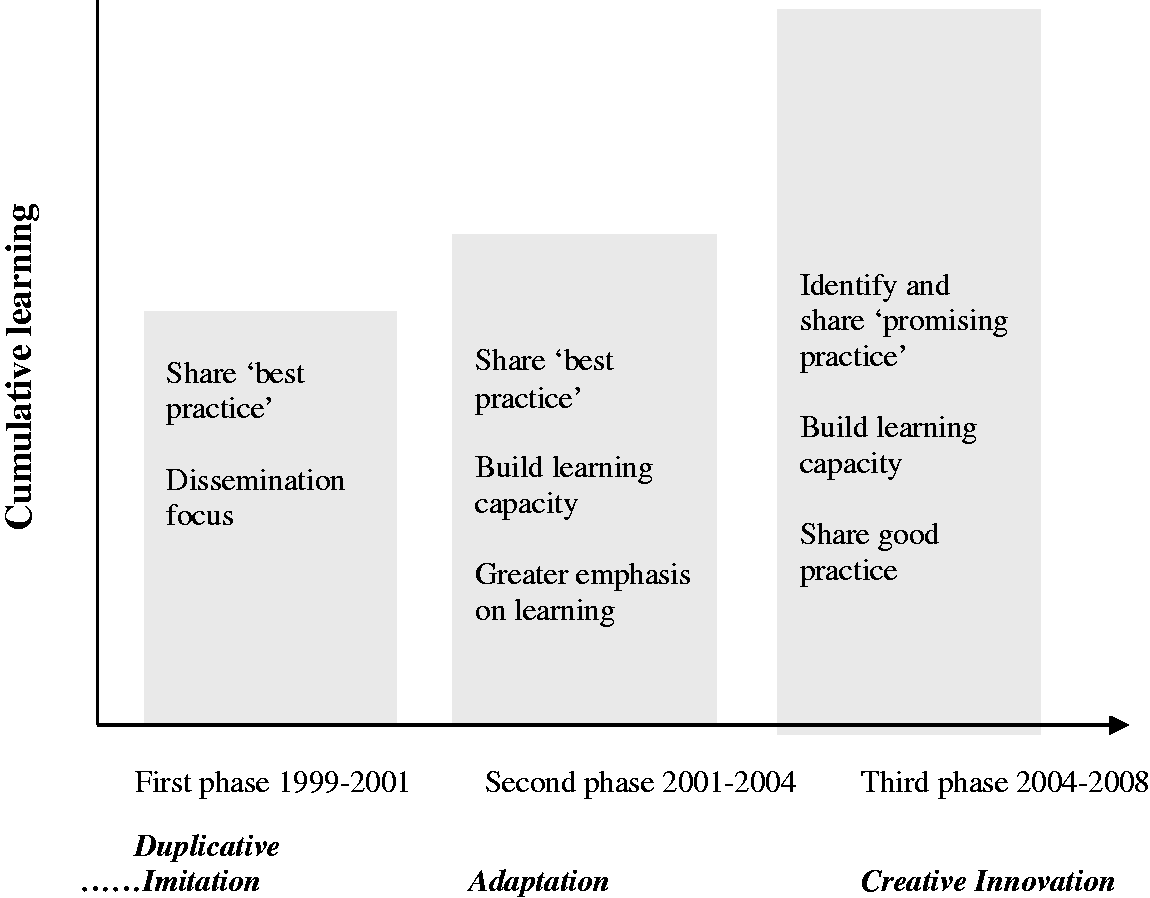
Having used temporal bracketing to analyse data and both deductively and inductively create ‘sense-making’ (Langley, 1999) and theory-building (Langley et al., 2013), we now bring this together by presenting a model or framework of inter-organizational learning, organizational learning and innovation over time. Figure 1 outlines this dynamic, iterative model conceptually. It builds on Kim (1998) but applies these ideas of cumulative learning capacity and approach to innovation through processes across a whole sector.
Phases of learning and innovation.
This research suggests that innovative capability within an organization is built up over time. The need to catch up with Beacon local governments initially led to learners undertaking imitative learning, based on the dissemination of what was already known in local government about ‘best’ practice. (The term ‘best practice’ itself assumes uniformity of context, culture and goals.) Phase 2 of the Scheme showed local governments increasingly recognizing that what worked for one authority in terms of effective practice was not automatically the same for another, so adaptation, not adoption, became more widespread. In the third phase, with inter-organizational learning better understood and practised, innovation started to come to the fore – an interest in future and promising practice (or next practice), not just historical ‘best’ practice. There are similarities with the learning trajectory of Hyundai, analysed by Kim (1998), which we have shown for a whole field of organizations, whereas Kim’s work was with a single firm. Moreover, we demonstrate relevance to understanding public services not just private firms.
The understanding of learning and innovation is set in the policy and institutional context of public service reform. The UK was particularly vigorous, brutal even, in its use of public service reform (Pollitt and Bouckaert, 2011). The Beacon Scheme goals shifted as the wider policy context changed. The Scheme also became more performance-focused (in awarding Beacons), though the inter-organizational learning element was extended as it was increasingly recognized as underpinning effective change and especially innovation. The Scheme reinforced the value and necessity of inter-organizational learning to underpin the diffusion of good practices and understanding of innovation.
The reform context had a major impact on the Beacon Scheme. Organizational learning cannot be separated from its policy or environmental context. This research shows how public service reform needs to be conceptualized in terms of its impact on organizational processes (innovation and learning) and not just as a policy. While the organizational learning literature pays lip service to the importance of context, relatively few studies have tracked how policy affects learning and also how learning may affect policy.
Conclusions
Langley et al. (2013: 4) observe that ‘temporality hugely matters in organizational life’. Through the use of theory and empirical evidence, and the research strategy of temporal bracketing leading to the identification of phases, this article has examined a number of issues. First, the article linked inter-organizational learning and innovation through cumulative processes. Second, it examined learning over an extended period of time and in a changing policy context. Third, we examined learning as an approach to public service reform. We showed how the learning arising through the Beacon Scheme was used reflexively by both local governments and the national government to extend the ambitions of the Scheme through a more realistic policy approach to organizational and inter-organizational learning in the service of organizational change and public service reform, and recognition of the foundational features of learning in innovation.
Finally, the theoretical implications relate not only to local government, but also to the wider debates about learning, innovation and reform in public services. Learning underlies all public service reform because all organizational change involves new knowledge, and this requires learning new ideas and practices (and unlearning old ideas and practices). This article extends theoretical development by examining learning across a sector, not just within organizations, and extends theory and understanding about how inter-organizational learning underpins innovation adoption and adaptation. The public services reform literature has taken less interest in these insights, tending to view organizational changes in reform as either a black box or as (relatively unproblematic) ‘implementation’, ‘rolling out’ or routine administration. Yet, learning how to use learning effectively in change is an acquired capacity, and it underpins innovation. Innovation is integral to the public services reform agenda, and this research shows that local governments build innovative capacity over time with increasing experience and confidence in using learning from other organizations. The Scheme has relevance for many public organizations about whether, how and why inter-organizational learning and innovation take place, over time, in the context of public services reform.