



Abstract
The connection between public administration and behavioral economics goes back to Herbert Simon, who recognized the tension between the institutional demands of rational efficiency and the reality of individuals’ alternate objectives. There is now a concentrated research push at the intersection of behavioral economics and governance, following recently publicized evidence of favorable synergies. Public administration can use behavioral economics in a variety of implementations, from boosting public service motivation to improving policy compliance. This article reviews the current discourse on the development of behavioral public administration, describes some dominant concepts currently being applied, and then offers a framework with propositions for a theory of behavioral public administration in order to enable further experimental inquiry and inform better governance.
Points for practitioners
Behavioral public administration is a developing theory that may enable practitioners to employ alternative approaches to policy design and implementation. Using concepts of behavioral economics that describe individual decision-making with alternative objectives to traditional utility maximization, behavioral public administration shifts the reliance on traditional causal models away from rational ideals and toward actual behaviors that inhabit empirically evident biases.
Introduction
The rise of behavioral economics for administrative purposes is upon us. Behavioral policy departments have taken hold worldwide, starting from the British and Australian governments and now reaching into East Asia. There is growing recognition that the grounds of public policy should be open to alternatives to the standard economic rationalities in light of empirical findings of differing behaviors (Benartzi et al., 2017; John, 2013; Oliver, 2015). The natural affinity between the disciplines goes back to Herbert Simon, a pioneer of the less dismal science of behavioral economics. The potential contribution to public administration—the institutions and activities of the executive branch—is significant; the marriage of bounded rationality (Simon, 1955) to “predictable irrationality” (Ariely, 2008) can bring new insights to public administration for improved outcomes.
The intersection of behavioral economics and public administration—what Tummers et al. (2016) and Grimmelikhuijsen et al. (2017) have coined “behavioral public administration” (BPA)—is situated in the broader context of a global emphasis on inter-/multidisciplinary approaches to research and practice. This reflects the broad trend of inter-organizational studies that permeates the current public administration research literature. Behavioral economics is at the vanguard of this movement as its application to other social sciences affirms its own relevance as a mix of social psychology and political economics (Kahneman, 2003). The growth of “nudges”—a policy that employs behavioral insights to counter biases in decision-making (Benartzi et al., 2017; John and Stoker, 2017; Oliver, 2015; Thaler and Sunstein, 2008)—from financial interests to health care and environmental issues, attests to its potential for broad social impacts.
Public administration, as an academic discipline and bureaucratic practice, depends on a coherent body of theory to legitimize its authority for telling people what they can and cannot do. Behavioral economics prompts public administration to reorient its perspective from what regulation and policy dictates it to do, and toward a position that initially considers what people are likely to do and then revises policy to accommodate it in an appropriate manner. This is a change from the traditional bureaucratic modus operandi, notwithstanding public choice or the notion of public administration as the execution of the democratic will. To that end, a functional theory of BPA must be developed to situate the research and practice in various policy contexts.
This article looks to fundamental concepts of administration that are complemented by behavioral economics to shore up the foundation for a theory of BPA. The format is a qualitative inquiry that presents: a synopsis of behavioral economics philosophy for public administration; a brief review of selected literature; the recounting of several current BPA examples and practices; prospects for future BPA applications; and the formulation of the theory with propositions. This article takes a high-altitude pass over developments that are contributing to the formation of BPA, noting the higher peaks but not focusing on all features of the landscape. The perspective is primarily looking at decisions and interactions by citizens in the context of administrative policies, rather than including such fields as decision theory, behavioral psychology, or even organization theory, which considers the decisions inside a group. The intended purpose of a theory of BPA is to enable further research and the eventual integration of behavioral insights into the design and implementation of policy for better outcomes.
Behavioral economics in public administration
Taking the position that the purpose of public administration is to provide solutions to public problems, this entails an understanding of how and why those problems exist in order to meet them with policies. For the most part, the problems are met by attempts to impose rational explanations for their existence and rational policies to correct the situation in the traditional economic mold of decision-making. Many day-to-day problems are met adequately in this manner, be they instances of information asymmetry, conflicts of interest, or market failure, as public administration has appropriated lessons from traditional economics in its decision-making processes. Much of the internal working of bureaucracy is based on cost–benefit analysis, which assumes the paradigm of utility-maximizing rationality.
The conflict between the theories of behavioral and standard economics is centered on questions of human motivation in decision-making. Empirical evidence is accruing against the idea that human behavior is adequately explained as maximizing self-interested utility values, much less that we are consistently guided by rational cause–effect calculations (Jones, 2017). That we do not always seek profit or make economically optimal decisions is befuddling to traditional models, especially when regarded from a bureaucratic-rationalist perspective. It presents a philosophical conundrum: how to evaluate behavior absent a priori, infallible, and fundamental tenets for our cognitive operations. The best idea available to accommodate the variety of rationalities is affixing the label “multiculturalism” or “value pluralism” and qualifying situations as being contextually determined, while still harboring rational economic tendencies behind concessions to the tagline: “it depends.”
Behavioral economics seeks to understand instances when people do not act in accordance with principles of utility maximization and make choices that do not cohere with their assumed best interests (Ariely, 2008; Jones, 2017). Before the advent of behavioral economics, bad decisions were dismissed as faulty thinking or misappropriated heuristics, rather than considered as potentially valid alternative choices under different objectives. Simon (1955, 1997) offered “bounded rationality” as an excuse to legitimize the human condition in organizations, yet it sidesteps situations wherein the decision is something other than normatively bad. While heuristics may become outdated and lead to suboptimal outcomes, they nonetheless result from a natural process for efficient problem solving that cannot be dismissed out of hand.
The implications for public administration theory are significant. If the epistemic model for governance—used here to indicate the activity of government—is a standard rationality and yet society displays behaviors that do not follow the standard, then the mismatch must be resolved through some concessions in the epistemic model. There are demonstrated instances where the bureaucratic understanding of how people should behave does not cohere with how people actually do behave, such as expecting people to respond positively to the obvious need for certain disease vaccinations but not getting full compliance by the public. While nobody wants to get sick and it is perfectly rational to get a vaccine, people still neglect to do so for a variety of reasons that are not accounted for in the current administrative episteme.
This seems a nod to postmodernism in that public administration needs to accept alterity and meet the varieties of behaviors on the part of the public with a variety of tools on the part of bureaucracy. This is an opening for theory to develop; the empirical evidence that people behave contrary to administrative expectations demands a reconciliatory response. Research has advanced to this point (Grimmelikhuijsen et al., 2017; James et al., 2017; Jones, 2017) and it is time to formulate a theory in this vein.
Theories in public administration must pay special attention to public service values, such as democratic participation, the rule of law, transparency, accountability, governance ethics, efficiency, effectiveness, and equity. Overlaying these is a broader notion of morality, which is perhaps the greatest source of divergence for public administration from economics, implicating behavioral economics as similarly amoral by association. Sunstein (2016), Oliver (2015) and the Nudge movement (Thaler and Sunstein, 2008) have done yeoman’s work in raising questions about the ethical dimensions of nudges, yet there is still the need for a coherent theory of BPA that will allow the dominant praxes—such as performance management, public–private partnerships, and e-government—to integrate behavioral economics lessons.
Literature review: the neighborhood of the intersection
This research echoes and extends several of the recent works on behavioral administration (Benartzi et al., 2017; Grimmelikhuijsen et al., 2017; Jones, 2017; Oliver, 2015), while also faceting the theoretical angle for how BPA can be applied in governance. The objective of this section is to recount a few important works that go toward the formulation of a theory of BPA without getting swamped in the entire history of behavioral economics. The foundation for this research goes back 60 years to Herbert Simon (1955, 1997), with sporadic contributions over the interim (Arrow, 1974; Bretschneider and Straussman, 1992; Jones, 2003; Lynn, 1986) until the onset of a renewed interest and study of behavioralism in recent times (Hursh and Roma, 2013; McAuley, 2013; Marvel, 2016; Olsen, 2015; Weaver, 2015).
For the purposes here, there is a conveniently prescient provision from Herbert Simon in an operational definition that differentiates the shift from standard economics: Behavioural economics is concerned with the empirical validity of these neoclassical assumptions about human behavior and, where they prove invalid, with discovering the empirical laws that describe behavior as correctly and accurately as possible. As a second item on its agenda, behavioural economics is concerned with drawing out the implications, for the operation of the economic system and its institutions and for the public policy, of departures of actual behavior from the neoclassical assumptions. A third item on the agenda is to supply empirical evidence about the shape and content of the utility function … so as to strengthen the predictions that can be made about human economic behavior. (Simon, quoted in Eatwell et al., 1987: 221)
The journals have published articles at irregular intervals, suggesting that public administration has been curious about—but not committed to—embracing behavioral economics. On the heels of the first major conference on behavioral economics at the University of Chicago in 1986, Lynn (1986) began an assessment of how policymaking is connected to behavioral sciences. Bretschneider and Straussman (1992) conducted an experiment testing a very common behavioral economics topic—probability judgment—in the governance context, finding that people have a hard time adhering to standards of rationality. Jones (2003) did a more thorough expansion of the relationship between behavioral economics and policy decision-making, echoing Simon’s (1955, 1997) position “to advocate a solid behavioral base for the analysis of political and economic systems” that will result in “a public administration and public policy oriented more toward the dynamics of information processing and away from a fascination with control” (Jones, 2003: 10).
More recently, McAuley contributed a summary of how behavioral economics could apply in policy design, suggesting that, “in its reliance on evidence, [it] can bring more rigour into policy-making, thereby helping regulators make lighter but more effective interventions in the market” (McAuley, 2013: 29). Hursh and Roma (2013: 98) posit that “behavioral economics can serve as a broadly applicable, conceptual, methodological, and analytical framework for the development and evaluation of empirical public policy.” After outlining instances where behavioral economics excels in the explanation of market anomalies, they offer potential applications for several public policy concerns, with the caution that “the variability observed in any behavioral-economic measure must correspond to people’s behaviors and choices in the ‘real world’ that public policy seeks to shape” (Hursh and Roma, 2013: 121). The proposal of BPA by Grimmelikhuijsen et al. (2017) is built on a trend of research in the field that may inspire structured scholarship and academic programs.
Several edited collections tout the virtues of behavioral economics for administrative applications (Schmid, 2004; Shafir, 2013), as well as the best-selling Nudge (Thaler and Sunstein, 2008), which introduced the eponymous term to behavioral economics’ modern vocabulary. A recent “virtual issue” centered on BPA in the Journal of Public Administration Research and Theory (Tummers et al., 2016), a special symposium issue of Public Administration featuring various BPA experimental research, and an increasingly frequent appearance of articles in other public administration journals have driven the point home in the academic literature. The nascent Journal of Behavioral Economics for Policy is emerging as a repository for early experimental research on nudges, and, more recently, the Journal of Behavioral Public Administration has been launched.
Current practices for BPA
The question of how behavioral economics can influence public administration poses the effect it has on affects: does it change the perception and experience of government in a good way? This section presents four major behavioral economics concept groupings for public administration contexts, with examples of successful realizations and extensions of concepts that might yield beneficial outcomes for governance. The concepts described in this section can be—and, in some cases, have been—shaped into testable hypotheses for empirical research. One aspect to keep in mind regarding these concepts is that they are essentially cost-free to integrate, entailing only careful forethought in how policy is presented. Indeed, many of the problems identified by behavioral economics orbit issues of information asymmetry that can be rectified through better education and awareness of conflicts between optimal choices and heuristic patterns.
Anchoring, framing, and confirming for purposive perspectives
How something is previewed and presented can have a significant effect on the recipient. Anchoring the description of the steak as “gut-bustlingly massive” on the menu will taint your impression of it when it is served to you. Furthermore, framing a large steak on a dainty plate will incite a greater impression than the same portion on a huge platter. Now, imagine if a citizen entered an agency that was painted in a pleasant pastel blue, scented with lilac, and decorated by a large banner reading “Top-rated service for 10 years!” Surely, the forthcoming experience would be different than if they entered a dingy bureaucratic hall stinking of copy toner and carpet glue, regardless of the offices having equal competency. Extend this line of argument beyond the material trappings of public administration into the realm of policy branding and initial conceptions may color final assessments of effectiveness.
Frank (1997) called attention to how the framing of public goods can change people’s perspectives on their value and curb the effect of relativism in consumer behaviors for generalized improvements to well-being. He argues that actively confronting an individual’s subjective views on issues can solve apparent dissatisfaction with policies. In this vein, BPA can apply framing to reduce relativistic assessments of its objectives and efficacy. The anchoring effect—placing a positive focal piece of information about bureaucracy in citizens’ minds before an experience—may also be employed to advance administrative purposes in a similar manner.
Public administration could improve compliance with the anchoring effect by emphasizing risks or threats of penalty for violations of safety regulation, much in the way of labeling on cigarette packs (Benavides and Peters, 2015). Dropping the “anchor” of a graphically diseased lung has proven an effective measure for improving public health in several nations. Arbuthnott and Scerbe (2016) investigated how framing issues play on tendencies of loss aversion to influence public perceptions on economic development and environmental protection. The effects of equivalence framing on bureaucracy are also significant, as Olsen (2015) demonstrated by testing responses when citizens are asked to rate their level of satisfaction or dissatisfaction with public services. Olsen’s study could be extended to improve perspectives on any aspect of governance by framing response options on a spectrum of positive impressions, rather than having options for negative choices.
Confirmation bias, closely related to the concepts of anchoring and framing, can also be utilized for improved governance. People tend to favor what they already believe to be true, even when shown evidence to the contrary, in a manner similar to the phenomenon of selective hearing, whereby individuals will accept information that adheres to their beliefs. This concept works to bolster prejudices, such as fulfilling negative impressions of public service in a culture of bureaucrat bashing (Marvel, 2016). For administrative purposes, confirmation bias may be leveraged to recruit employees by playing on the public service perks of tenure, pension, and other benefits conferred by working for the government.
Excuse the exaggeration
People tend to be a bit short-sighted when it comes to their future. If a patron was offered a 5% discount on their dinner now or a 10% discount on their next meal within six months, assuming they enjoyed the first one enough to return to the restaurant, most would—and should—opt for the latter deal. Yet, the more rational behavior is not consistent over time or amount, as many studies have shown in the prospect theory model (Kahneman and Tversky, 1979). As the benefits and the time horizon increase, people tend to favor the bird in the hand over the pair in the bush. This helps explain much of consumer behavior when it comes to incurring credit card debt now rather than saving funds to make the same purchase at a later date. Governments tend to demonstrate a similar myopia due to the confluence of political aspirants, the populism of Keynesian economy-boosting strategies, and the all-too-human nature of overoptimistic expectations.
Axtell and McRae (2006) discuss several instances where differences in discounting methods have led the government’s objectives into conflict with citizens’ desires. While bureaucracies use rational and consistent cost–benefit analyses to estimate present costs versus future values (known as exponential discounting), people on the street do their calculations under the influence of emotions, social pressures, and imperfect information (known as hyperbolic discounting). The incongruence between perspectives on time and benefit can explain why people are loathe to approve expensive long-term public projects that are undoubtedly necessary, such as reconstructing a highway bridge or disaster mitigation measures, but the polity is quick to demand small repairs, such as filling in a pothole.
Bureaucrats can use discrepancies in valuations over time to the advantage of government and the general public, sometimes simultaneously. The Social and Behavioral Sciences Team (SBST, 2016) has already begun efforts to counter hyperbolic discounting by nudging military personnel into retirement plan enrollments. If a cost–benefit analysis of a program is favorable to its implementation but runs contrary to prevailing sentiment, exposing the consistency of exponential time discounting on the value of the project may win over public support. Conversely, a project that is politically popular but realistically improbable to be completed on time or budget could be stalled by administrators who emphasize the long-term consequences over the near-term rewards. In other words, bureaucracy has the credit card in its wallet and can hand it over with a smile or an admonishment, depending on the context.
Optimizing the default option
Would you like a baked potato with your steak? The option that people defer to is not always the one that is best for them. The menu may be arranged to the interests of the restaurant management, rather than the maximal benefit of the customer. In such settings, we do not want to belabor a decision that is supposedly made for our tastes by the server, despite potential conflicts of interest or apathy. Whether it is by blind trust or inherent laziness, people tend to accept the default setting, regardless of what it means to them. We have been conditioned to this behavior through various everyday practices; from ignoring the small-print terms and conditions on a contract to letting smart devices have access to usage data, we accede to innocuous requests that may not maximize our utility. Given the choice of opting out or opting in to some course of action, people often accept whichever option is assumed on their behalf without due consideration of their self-interests. For governance, if the desired outcome can be set as a default option, then it would follow that this phenomenon should be exploited to the fullest extent. The default option serves the administrative value of efficiency in that “defaulting” the administrative objective can save the paperwork and process needed for exceptions and help people to make (or accept) the better decision.
There are several studies confirming this behavior, such as setting the default to enroll employees in a retirement plan (SBST, 2016) or having driver’s license applications “volunteer” people into organ donation programs (Thaler and Sunstein, 2008). An Oregon law signed in 2016 requires voters in that state to opt out if they do not want to be registered to vote, thereby increasing the potential of democratic participation (an administrative “good,” by most measures). The concept can be flipped to make choosing the less desirable behavior a hassle, depending on the context of application. These are simple instances of choice architecture that are both effective and efficient in achieving desired outcomes with myriad opportunities for further extensions in public administration.
Related to default options and choice architecture is the notion of structured regulation: an indirect approach to shaping behavior by using designs that prompt compliance (Yeung, 2016). Cheng (2006: 662) discusses the puzzle of regulating behavior with a call for more structural approaches to policy as “structural laws often offer a more effective alternative for influencing everyday behavior than statutory prohibitions … Its philosophy is more preventive than reactive.” Examples of structured regulation include speed bumps in the road that do not explicitly stop one from driving too fast, but certainly make it difficult to exceed posted speed limits without incurring damage. Creative public policy formulation can incorporate this concept in efforts to curb waste, ease traffic congestion, and even encourage civility. Public organizations can practice the same techniques inside their own offices, such as strategically placing recycling bins with clear signage to reduce landfill waste or posting checklist protocols for serving citizens to ensure quality and consistency.
Herding donkeys into compliance
“I’ll have what she’s having,” is a thoroughly acceptable choice (as a deferral of choice) when options are risky, have unknown costs, or attract unwanted attention. Risk aversion and social norms have significant traction, leading people to follow the crowd when in doubt of their relative status. People alter preferences and behavior to complement or contrast that of others (Clifton et al., 2017), depending on their commitment to social norms (Benavides and Peters, 2015). Basic sociocultural foundations, such as collectivism or individualism, help to inform a tendency to herd mentality. Poor people may emulate rich people, while those who consider themselves thrifty may redouble their efforts when they are made aware of somebody who spends much more than they do. The phenomenon of social proof—basing one’s behavior on that of others for approval and acceptance—has strong implications for policy, especially in the realm of gaining compliance.
Weaver (2015: 807) defines compliance as “behaviors that are compatible with governmental preferences while recognizing that such preferences are made with varying degrees of insistence—and thus varying degrees of obligation imposed.” The operative term in the definition is “insistence” as compliance in the administrative sense is often enforced as a reaction to non-compliance. Government effectiveness hinges on the ability to inspire compliance in the most efficient way possible. Behavioral economics has considered the tone of compliance enforcement in various studies, drawing a distinction between the positive reinforcement approach of light paternalism to encourage good behavior and the negative fear of correction in nanny state scenarios. Sunstein (2017) has emphasized the approach of more carefully constructed choice architecture, labeling it as “simplified active choosing.” Whether the carrot or the stick will be most effective depends on context and the administrator’s discretion, but BPA is decidedly leaning toward the tasty carrot option.
In poignant research, Oldfield (2016) discussed how compliance with public health and sanitation regulations regarding hand-washing could be improved by employing the pressure of conspicuity. The social pressure to be regarded by others as behaving correctly can be reinforced by public administration through carefully constructed regulations that support norm compliance (Benavides and Peters, 2015). Weaver (2015) treats several specific issues of compliance and discusses the varieties of strategy that public administration may use, including lessons from behavioral economics.
One way of gaining compliance, similar to Oldfield’s (2016) proposal, is by showing what other people do, right or wrong. Wang (2014) pointed out the effectiveness of reference points for reducing water use: if one is aware of their neighbor’s consumption, then that may inspire conformity to a relatively similar level. In the absence of proper examples, public administration can present an optimal level as a target for compliance and pair this approach with incentives or penalties that exert pressures for conformity. Within an agency, small nudges can be utilized by savvy BPA managers to improve compliance with organizational regulations and adherence to ethical guidelines.
Future directions in BPA
There are many more concepts for application in governance beyond anchoring, framing, discounting, confirmation bias, choice architecture, and social proof. Indeed, there may yet to be discovered behavioral economics concepts that can emerge from anomalies observed in governance contexts that will contribute to other disciplines. In the meantime, this emerging field is missing a supply of evidence from experiments whereby BPA is tested against traditional administration. Such tests would assess comparative benefits in efficiency, effectiveness, equity, and other public service values. Following the compilation of empirical results and further extensions of behavioral economics concepts, public administration can then use BPA at its discretion, rather than just through special programs blessed by the executive (SBST, 2016). From that point, a theory of BPA can be codified in the framework of administrative philosophy. The theory can feed the further development of behavioral economics concepts that are indigent to governance itself, rather than just modifying the existing concepts into the panoply of administrative practices.
One problem with adapting behavioral economics into the public service context is that experiments testing the effectiveness of concepts have been conducted with college students, game-theory subjects, Mechanical Turk surveys, or other constructs that show how things work in one particular experimental setting, but not necessarily holding external validity for broader application. The irony of behavioral economics is that while it tries to predict irrationality, it then forms a different rationality that may also be unpredictable when tested in alternate contexts.
Furthermore, there is need for cross-cultural examinations of BPA as the preponderance of research has been from developed Western nations’ perspectives. It is incumbent on BPA to demonstrate its validity in a commensurate manner, meeting empirical reliability and standards of rigor for broader generalization. An intriguing synthesis of behavioral sciences and Big Data analysis for policy innovation is proposed by Ruggeri et al. (2017), which essentially turns the traditional method of theory-guided empiricism on its head. While social scientists balk at putting data before theory, the obvious retort is that BPA hinges on instances where the theory and the behavioral data do not fit. This necessitates an alternative—and possibly inverted—approach to empirical policy research.
This runs into two significant issues: (1) “Should a paradigm changing field have to play by the old rules to be acceptable?”; and (2) “Is it really possible to have credible tests of public policy where contextual differences are often so material to the effects as to challenge any hopes for generalizability?” Furthermore, we may add questions about the ethics of employing bureaucratic “tricks” to test theory in the public sphere, especially if public administration blurs lines between influence and compulsion (Sunstein, 2016). Weaver’s (2015) work notes that the use and effectiveness of BPA strategies is highly dynamic, that is to say, that public administrators must be wary of unintended consequences or reversals in effectiveness that may come about from such strategies.
There are promising examples of research that bolster the foundation for more experiments. May (2005) tested hypotheses concerning compliance motivations that are coherent with the kind of carrot-or-stick questions posed in behavioral economics, concluding that traditional regulatory tools are inadequate to meeting administrative objectives. Mann and Wüstemann (2010) argue that behavioral economics helps to resolve information asymmetries if public administration takes an active role. There is also an expanse of research to be conducted on taking advantage of process utility over outcome utility, as evidenced by people’s motivation to vote (Rogers et al., cited in Shafir, 2013: 91–107) and the broad trend for public administration to encourage participatory democratic processes.
Outlining a theory
Based on the current and potential applications of behavioral economics in public administration, it is now possible to outline a theory of BPA with propositions as to what it may empirically accommodate and hypothetically enable. This must be situated on the operative plane of governance: a space described by the dimensions of the people and public administration. The array of behavioral economics concepts are applied to two groups of disconnects: from behavioral economics, there is the difference between what people think they want and what people actually do; and in administrative behavior, there is the gap between what public administration is expected to do and what public administration actually can do. The space in between is where the theory of BPA is located (see Figure 1).
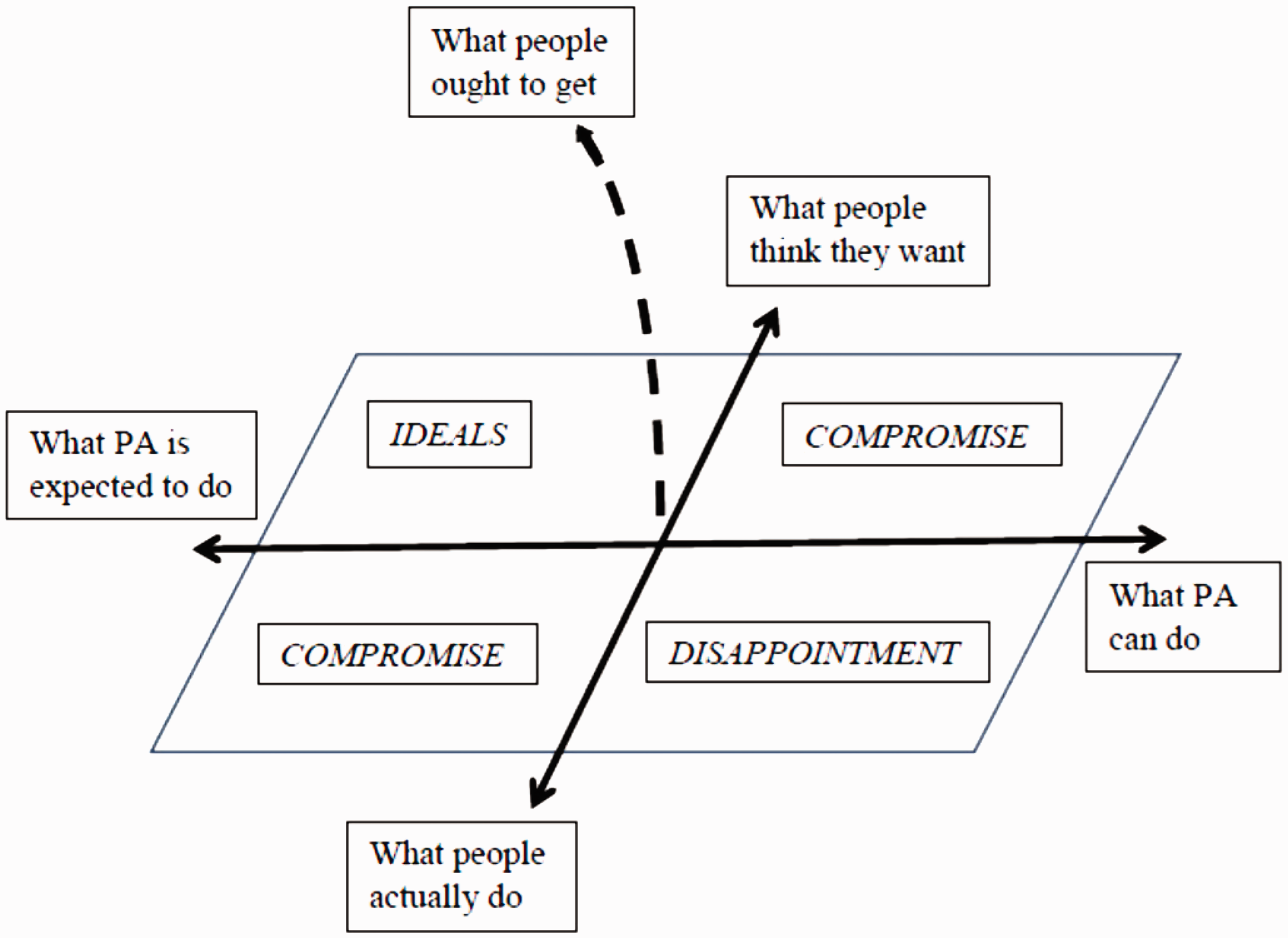
The location for a theory of behavioral public administration.
BPA meets at the intersection of the two disconnects to address what people expect and what they receive by extending a third dimension with the provision of what people ought to get. Policy has been located somewhere on the plane comprised of ideals, disappointments, and compromises, with only the traditional rationale of economic utility-maximization thinking. The BPA dimension lifts policy possibilities from this flatness to allow greater access to the “ideal” quadrant; we might imagine a curved vector emerging that bends administrative potential in that direction for more desirable outcomes of governance. In essence, BPA offers a reconciliatory approach between citizens and policy, bringing the empirical-positive aspects of their behavior into alignment with the objective (normative) aspects of policy designs. The theory of BPA proposes a corrective measure for the disconnect between “should” and “would.”
There need to be conditions that satisfy certain criteria to justify the use of BPA, such as: evidence of anomalies in rational behavior—that is, the common biases found in behavioral economics—on the part of individuals and institutions; information asymmetries that cause inequitable distributions of benefits or failures of market mechanisms; and instances of unexplained non-compliance with otherwise harmless regulation. As Sunstein (2016) views it, government is justified in using nudges and choice architecture to improve outcomes if it upholds people’s welfare, autonomy, and dignity. Yeung (2016) echoes this position, with an emphasis on individual freedom. This coheres with the objective of the theory offered here, in that public administration should be striving to deliver the ideals of what people ought to get, using tools that can transcend the compromises and shortcomings of rational behavior.
To this end, the following three propositions may provide guidance for the testing and application of the theory, as well as sparking discourse for further refinements to the theory. These are derived from the extant literature, as well as the trends and analysis discussed in this article. The propositions argue for the continued development of BPA by virtue of what has already been demonstrated as effective and what can be possible given the current momentum.
Proposition 1: BPA is an alternative toolset for optimizing the implementation of policy. The curve of the policy vector stemming from the government and citizen intersect is nudged toward the ideal outcomes and away from compromise or failure outcomes if BPA supplements the traditional processes to accommodate non-rational anomalies in citizen or bureaucratic behaviors. This may be verified as research develops to compare the outcomes of BPA policies versus those of the traditional ilk.
Proposition 2: BPA is ethically sound and upholds administrative values. Assuming that BPA adheres to the deontological precepts of democratic governance, such as protecting individual choice and maintaining transparency, wielded from an attitude of light paternalism, then it is coherent with the ethics and values of public administration. Recognizing that there are different perspectives on utility, BPA implicitly legitimizes value pluralism and thus serves the democratic will. As there are continued questions about the ethics of privatizing and other bureaucratic behaviors, it seems necessary to iterate that BPA is actually respecting ethics at its very foundation through transparency and greater information provision.
Proposition 3: BPA research is a unique stream of policy experimentation and methodology. The calls to shift perspective from the importing of behavioral economics tools to the development of behavioral administration tools speaks to the validity of BPA as a unique school in administrative theory (Grimmelikhuijsen et al., 2017). This can inspire the establishment of academic agendas to continue developing BPA in conjunction with practice, as demonstrated by the introduction of dedicated journals and symposia. There is opportunity to focus the behavioral economics lens on the functioning of bureaucracy itself to contribute to governance from within its own institutions, including the investigation of the biases and assumptions of rational paradigms in current administrative thinking.
These propositions pave the way to advance practices in public administration that are not adequately served by current policies. For example, New Public Management’s espousal of “bottom line” policies only accounts for utility-maximization behaviors by both bureaucrats and citizens, rather than taking into consideration the subjective values that influence individual choices away from simple rational efficiency. Basing implementation guidelines on observed behaviors will help integrate the inherent biases that individuals demonstrate, such as the social norm of “bureaucrat bashing” that prompts a knee-jerk resistance to even well-intentioned policy. The ensuing hypotheses for BPA may be better at identifying factors that improve effectiveness and outcomes (in preference to efficiency and outputs), with models that habituate biased behaviors, as well as hypotheses that address big questions and core values of public administration, such as democratic participation, transparency, accountability, and equity. This may result in research with enhanced external validity insofar as there are no presumptions of economic rationality in the range of allowable data. Furthermore, we now have some understanding of alternative stimuli and non-traditional behavioral relationships that exist in the interactions of administration and the polity.
Conclusion
A slew of bestseller books, a series of Nobel Prizes in Economics from associated scholars (Richard Thaler in 2017, Angus Deaton in 2015, Daniel Kahneman in 2008, Gary Becker in 1992, Herbert Simon in 1978, and Kenneth Arrow in 1972), and even a burgeoning industry in behavioral economics policy consulting suggest that the prospects for its use are growing along a demand curve. As the SBST reported modest success (Benartzi et al., 2017; SBST, 2016), we can hope that such work will continue to test BPA in more administrations.
Future research in BPA will need to identify actual changes in policy formulation and implementation practices that can achieve greater compliance with policy objectives. What specific advances have been made in this vein compared to traditional approaches? How do bureaucrats inside agencies and at street level perceive BPA in terms of equity, efficiency, and effectiveness? Is this a fad or a real opportunity for public administration to develop novel means for improving public service? Do the effects of BPA fade over time as populations become acclimated to nudges? These questions must be considered in experiments seeking to extend BPA’s internal validity into the policy arena for tangible, experienced benefits to society, as well as illuminating the strengths and weaknesses of the developing theory.
One last aspect to address is what exactly BPA is: a subset of public administration, a methodological discipline unto itself, or a hybrid of hybrid social sciences that operates above and beyond its own foundations? The reflection by Grimmelikhuijsen et al. (2017) posits BPA as a compliment to traditional public administration. This article advances BPA as a theory that takes a more activist perspective toward governance, envisioning a public administration that is committing to objectives by employing sharper tools made from stronger empirical materials. This analysis and discussion of BPA should enable public administration to recognize the assumptions of behavior in policies and, if necessary, the potential means to make those policies better suited to demonstrated behavior.
Footnotes
Declaration of conflicting interests
The author(s) declared no potential conflicts of interest with respect to the research, authorship, and/or publication of this article.
Funding
The author(s) disclosed receipt of the following financial support for the research, authorship and/or publication of this article: This article was supported by the Sungkyun Research Fund, Sungkyunkwan University, 2016.