




Abstract
High employee turnover is a critical policy issue for public managers to solve. The US government is concerned about slowing turnover rates, which have accelerated from 14–15% to more than 18% since the Great Recession. Explanations for increases in employee departure are more difficult to pin down. The expected wave of baby-boomer retirements did not materialize and cannot explain turnover. The impact of the Great Recession on employment makes it more difficult to theorize about the relationship between employee–organizational fit and turnover. This study analyzes US government employees’ turnover using data from the 2003, 2006, 2010, and 2013 editions of the National Survey of College Graduates. The data provide a unique opportunity to study cohorts of US government workers before and after the recession. Statistical models of employee turnover focus on comparing the factors that lead to employee departure. The exodus of workers from government offices can be explained more by the fit between the individual and organizational needs than by a mismatch between the skills required in the job and the needs of the organization. The results show that when there is a mismatch between individual skill level and the skills in their job, individuals are more likely to move within government. Workers that made job changes after the recession (2010–2013) had a greater gap in organizational fit than those that made job changes prior to the recession (2003–2006).
Points for practitioners
This study describes turnover in public organizations and provides conclusions showing how managers can minimize the risk of turnover to ensure effective government. Public managers should modify management policies to meet the needs of modern-day employees and make the government more resilient within changing work environments. Organizations can begin to mitigate turnover rates during hiring by matching employment opportunities with the job skills and expectations of candidates through careful hiring, appropriate placement, and providing employee training and support.
Keywords
Introduction
The way in which organizations—both private and government entities—manage their human resources plays an important role in improving productivity and achieving strategic objectives. Hiring and turnover are of particular concern globally as the labor force across countries shares common concerns with the availability of skilled labor or retirement (Guthrie, 2001; Jung, 2010; Liu et al., 2010; Shim et al., 2017). The US government, in particular, is increasingly concerned about accelerating turnover rates. During the 2008 Great Recession, government turnover rates decreased to 14.6% but have seen a resurgence since 2010. By 2017, the public sector turnover rate reached 18.3% (Bureau of Labor Statistics, 2018). Turnover effects vary by type. Voluntary turnover occurs when the departure is the decision of the employee. Conversely, involuntary turnover occurs when the employer decides to terminate him or her. Voluntary turnover has greater negative organizational effects than involuntary turnover because it impacts employee morale and individual performance (Griffeth et al., 2000; Shaw et al., 2013). The three main reasons for voluntary turnover are pay or promotion opportunities (38.2%), working conditions and environment (31.9%), and change in career or professional interests (29.9%) (National Science Foundation, 2013). Within the US government, voluntary turnover rates rose from 7.2% in 2013 to 9.1% in 2017 (Bureau of Labor Statistics, 2018; Lee and Whitford, 2007). 1 Thus, the US government needs to better understand employee turnover in order to effectively manage it.
To retain highly qualified employees and enhance their capacities, organizations are increasingly turning to new and improved techniques in human resource management (HRM). Previous work has found that multiple individual and organizational factors impact voluntary turnover (Wynen and Op de Beeck, 2014). Some of the most critical individual-level characteristics that have been used to explain turnover at the organizational level include age, gender, or race/ethnicity (Kellough and Osuna, 1995). Empirically, government agencies with a younger workforce experience higher voluntary turnover. In other research, scholars have shown that job satisfaction (Griffeth et al., 2000), expectations (Porter and Steers, 1973), and mismatches between the job and the education level of the worker (Sullivan and Arthur, 2006) are especially important factors in predicting turnover rates.
This article focuses in on the theory of person–environment (P–E) fit, which can be used to hypothesize that better matches between the skill of the employees to the demands of the job will result in lower rates of turnover (Beer et al., 1984). This study compares two time periods—2003–2006 and 2010–2013—using data from the National Survey of College Graduates (NSCG) to determine how the turnover behaviors of government employees changed, both external and internal (i.e. employees transitioning to other government agencies). Unlike previous studies (e.g. Pitts et al., 2011), however, we classify both changing agencies and changing jobs within the government as internal turnover. 2 Our analysis is also based on employees’ actual turnover, while previous studies used employees’ intention to turnover. Turnover is captured at all levels of government, namely, federal, state, and local. This study contributes to turnover research in two ways: first, it tests actual external and internal turnover; and, second, it analyzes individual and organizational factors that affect employee turnover with organizational theories.
Theoretical background and literature review
Managing voluntary turnover
Turnover decisions have significant positive and negative impacts on employees and employers (Finkelstein and Hambrick, 1990). On the positive side, organizations can improve their capacity following the voluntary departure of a poor performer because they can recruit a more energetic, high-performing individual with new skills (Kellough and Osuna, 1995). Individuals, similarly, might perform better with a job that matches their individual skills and abilities. Turnover, therefore, allows people and organizations to perform better, providing greater advancement and promotion opportunities (O’Toole and Meier, 2003).
However, turnover can also have negative effects on organizations. Losing an experienced employee means increased costs of recruiting and training a replacement. Turnover can also create disruptions in service delivery (Kellough and Osuna, 1995). Costs associated with turnover are both visible and invisible, in that they can directly impact productivity, which is a transparent effect, but can also have invisible outcomes by harming morale or decreasing trust in the organization and its mission. Scholars estimate the cost of turnover in the private sector at approximately 150% of an employee’s annual compensation package (Schlesinger and Heskett, 1991) or between one and two times an individual’s salary (Kepner-Tregoe Business Issues Research Group, 1999). When organizations hire a poorly performing employee to replace a departing worker, the loss in output or service disruptions can equal approximately 30% of the employee’s potential first-year earnings (DeLeon, 2015). Visible costs (e.g. advertising, recruiting, hiring, selection, education, and training) are associated with the replacement of retiring and voluntary turnover employees (Cho and Lewis, 2012). Invisible costs (e.g. loss of institutional knowledge) are specifically associated with departing trained and experienced employees (Government Accountability Office, 2014) and are often exacerbated by the amount of time it takes to train and educate new employees—particularly when they must become accustomed to new environments and systems of organization (Lee and Whitford, 2007). Furthermore, workplaces with significant turnover often precipitate employee dissatisfaction and can diminish neutral competence in the public sector (Lewis, 1991). While no such estimates have been found for government employment, it is evident that government turnover is nevertheless costly, is generating increasing concern, and requires greater attention for effective management (Lee and Whitford, 2007).
External turnover, or leaving an organization completely, has a different impact on an organization than that of internal turnover, or changing jobs or department/agencies within an organization. Internal turnover gives organizations a way to move people who have significant skills to different units where those skills are needed (Kim and Fernandez, 2017). Internal transfers also provide opportunities for employees to enhance their skills, advance, be promoted, and network (Wynen et al., 2013). Thus, handling external and internal turnover requires skilled organizational management (Government Accountability Office, 2014).
P–E fit
Organizations want to find people who fit well with their work needs. After such employees are hired, organizations want to retain these skilled workers by adjusting job duties to match their skills or goals. Similarly, workers want to find organizations where the job demands match their specific skills. P–E fit theory explains the relationship between workers and organizations, and how this impacts employee behavior (Edwards, 1996; Kristof, 1996). Building on this theory, this study examines how the lack of fit affects an individual’s decision to leave his/her organization.
P–E fit studies are classified into one of two categories: person–organization (P–O) fit or person–job (P–J) fit (Lauver and Kristof-Brown, 2001). While P–O fit studies describe the value of compatibility between the person and organization (Kristof, 1996), P–J fit studies explain the match between a person’s characteristics and the characteristics of the job or task (Kristof, 1996). Our study fits best into the P–J category because it focuses on the relationship between employees and job-related factors in the organization.
P–J fit is further divided into the need–supply (N–S) and demand–ability (D–A) approaches (Cable and DeRue, 2002). While N–S fit describes the congruence among personal needs, expectations on the job, and organizational support, D–A fit explains the match level between job demands and a person’s knowledge, skills, and abilities (Cable and DeRue, 2002). A good N–S fit means that individuals can fulfill their needs, preferences, and desires through organizational support. A good D–A fit means that individuals have sufficient knowledge, skills, and abilities to perform the tasks that organizations demand. These concepts also describe how a person’s emotional processes are influenced by the level of fit between the individual’s goals and his/her job or organization (Lam et al., 2018). However, each N–S fit and D–A fit affects employees’ behavior differently (Cable and DeRue, 2002). In the following sections, we describe how N–S fit and D–A fit are used, giving the variables in this study.
N–S fit
N–S fit is measured by the gap between an employee’s needs, desires, and preferences regarding a job or task and the actual or perceived state of organizational support (Kristof, 1996). That is, this fit shows the mismatch or consistency between what employees initially expect and what they actually experience of work-related factors in the organization, measured by their level of satisfaction.
Expectations are what people believe, desire, and pursue in their organizations and work (Porter and Steers, 1973). The gap between expectation and job satisfaction is the difference between what people value, need, expect, or desire and what they actually experience or perceive in their role. When the reality of a job or task environment does not fulfill an employee’s expectations, needs, desires, and preferences, there is a higher deviation in N–S fit. This mismatch may increase stress (French et al., 1982) or result in negative attitudes toward the job and organization, poor performance, or turnover (Mensah and Bawole, 2017). Unfortunately, there are few studies on how N–S fit specifically affects behaviors such as turnover. This study clarifies these connections using well-developed studies of job satisfaction. Previous studies have found that employees with lower job satisfaction are more likely to experience turnover (Griffeth et al., 2000). Among the several types of satisfaction, satisfaction with intellectual challenge and interest (associated with a principal job) is most highly related to employee behavior (Mount et al., 2005). For example, Mill (2001) found that intellectual challenge is specifically related to organizational loyalty. Furthermore, the performance and retention of employees is motivated by whether the work environment enables the further acquisition of knowledge and skills. In other words, employees are more likely to be satisfied with (and stay in) their organizations where they have greater interest in their work (Van Iddekinge et al., 2011).
Satisfaction with opportunities for advancement can also significantly affect turnover decisions. Indeed, these two factors are negatively related (Johnston et al., 1993). When employees are not satisfied with their opportunities for advancement or promotion, they are more likely to exhibit lower organizational commitment, less job involvement, and a greater desire to leave their organizations (Johnston et al., 1993). Government employees tend to believe that the processes for advancement are more transparent and fair, and that there are greater advancement opportunities than workers in private and non-profit organizations (Pitts et al., 2011). Given this understanding of the association between job satisfaction in terms of intellectual challenge and opportunities for advancement and turnover, we can evaluate the N–S fit of employees to predict their performance and agency turnover. Wynen et al. (2013) documented how a better N–S fit is related to positive outcomes, such as low turnover and high performance.
This study examines whether the studies regarding N–S fit and employee behavior apply equally to government employees, particularly with respect to intellectual challenge and opportunities for advancement:
Hypothesis 1: A higher deviation in N–S fit for intellectual challenge is positively associated with external and internal turnover.
Hypothesis 2: A higher deviation in N–S fit for advancement opportunities is positively associated with external and internal turnover.
D–A fit
While N–S fit describes job discrepancies between expectation and job satisfaction, D–A fit refers to the gap between job requirements and education. According to Saks and Ashforth (1997), D–A fit is measured by the question “To what extent do your knowledge, skills, and abilities match the requirements of the job?” In other words, how much workers can use their educational knowledge in their jobs (Allen and Van der Velden, 2001) is a good indicator of D–A fit. The more an employee’s skills match the job requirements, the more he/she can effectively utilize their knowledge and skills (e.g. expertise acquired from colleges/universities) to increase their performance levels (Allen and Van der Velden, 2001). Cable and DeRue (2002) also found that employees with good D–A fit performed well.
People who are not able to use or challenge their skill sets on the job often feel frustrated, perform poorly, and tend to seek other employment (Allen and Van der Velden, 2001; Wolbers, 2003). Conversely, employees who possess knowledge, skills, and abilities that are in alignment with organizational demands are more productive, perform better, have higher job satisfaction levels, and exhibit less turnover (Wright and Pandey, 2008). Wilk and Sackett (1996) found that employees are more likely to seek new jobs to find a better fit if they feel that their skills are underutilized in their current job. Conversely, other studies have found that employees who have good D–A fit are high performers and are in high demand (Trevor, 2001), leading to higher turnover. This turnover is also explained by the attraction–selection–attrition theory (Schneider, 1987). People are first identified, attracted, and selected by organizations because of a good D–A fit. However, they leave their organizations or jobs if a poor D–A fit occurs (Van Iddekinge et al., 2011).
This study examines whether studies regarding D–A fit apply equally to government employees, as P–E fit theory has indicated.
Hypothesis 3: A higher deviation in D–A fit is positively associated with external and internal turnover.
Data and measurement
Our analysis uses data from the National Science Foundation’s NSCG for 2003, 2006, 2010, and 2013. The data sets are a nationally representative sample of a population of college graduates with bachelor’s, master’s, doctoral, and professional degrees living in the US. It is a longitudinal survey intended to collect career history and demographic information. The response rate for the NSCG was around 63% in 2003, 88% in 2006, 78% in 2010, and 74% in 2013. This study compares two data sets: one from 2003 to 2006; the other from 2010 to 2013.
For this analysis, we utilize data focusing on individuals who were (1) employed by the government (federal, state, or local government) during the 2003 or 2010 survey and (2) employed in any job sector (i.e. government or non-government) during the 2006 or 2013 survey. For 2003 to 2006, 84.2% of respondents appeared in both years. For 2010 to 2013, 42.5% of respondents appeared in both years. To keep the study focused on voluntary turnover, we excluded employees who retired or were laid off (6.57% in 2003–2006 and 6.29% in 2010–2013).
Method
This study measures how much N–S fit and D–A fit impacts the likelihood of turnover, using discrepancy between expectation and job satisfaction (based on intellectual challenge and opportunity for advancement), and between education and job requirements. First, we compare two groups of government employees: those who had left the government and those who remained employed by the government. As the dependent variable (used in this analysis) is binary, we perform logistic regression analysis. Second, we utilize a multinomial logistic regression model to estimate the significance of the factors affecting government employee turnover choices (i.e. job change, employer change, or job and employer change) within the government.
Dependent variables
The measure of external (leaving the government) and internal turnover (mobility within the government) is taken from employees’ actual turnover levels. Due to the cost and time needed to track employees’ behaviors, many studies have used turnover intention as a proxy for actual turnover (Kim and Fernandez, 2017). Even though turnover intention has a positive relation to actual turnover (Cho and Lewis, 2012), stronger results are generated from using actual data (Jung, 2010). The NSCG focuses on employees working during the survey period; they are asked the following question: “During these two time periods (from the previous survey date to the current survey), were you working for…?” Respondents can choose their job sector, whether they are working in the government or not, at the same job or not, and at the same agency or not. In this analysis, the previous survey dates referred to are 2003 or 2010 and the current survey is 2006 or 2013. Turnover variables are constructed based on the categories. First, a dummy variable indicates voluntary leave from the government. This dummy variable is set to 1 if the respondents are not working in the government and to 0 if the respondents are working in the government. Second, categorical variables indicate all types of turnover within the government for multinomial logistic regression.
Independent variables
First, N–S fit is measured by discrepancy between expectations and satisfaction. This is measured by a questionnaire designed to measure respondents’ perceptions of certain job-related factors (expectation and job satisfaction). We can identify a discrepancy between employees’ expectations and job satisfaction via comparisons of anticipated/desired outcomes and actual outcomes. For example, if an individual considers intellectual challenge on the job to be very important (rated on a four-point Likert scale: 1 = not important at all to 4 = very important), and this person is very satisfied (on a four-point Likert scale: 1 = very dissatisfied to 4 = very satisfied) with the intellectual challenge on the job, the discrepancy is 0 (4 minus 4). However, if this person only feels somewhat satisfied, the discrepancy is 1 (4 minus 3). Thus, discrepancy values from 3 to −3 are possible (seven-point Likert scale: −3 = absolutely suitable to 3 = absolutely unsuitable). 3 Second, D–A fit is measured by job–education mismatch. This marks the level of disconnect between an individual’s education and his or her principal job. Respondents are again asked to rate the extent to which their current work is related to their degrees, using three categories: not related, somewhat related, and closely related.
We consider several demographic, socio-economic, and organizational factors as control variables for this study: age, race/ethnicity, gender, length of service, training, wages (while employed by the government), professional meeting attendance, supervisor, marital status, children, job field, employer size, employer location, and government type (i.e. federal, state, or local).
Findings
Table 1 presents the descriptive statistics for the variables, including means and standard deviations for the measures. The external turnover rate is 10.0% for 2003–2006 and 6.9% for 2010–2013. The rate of internal turnover varies by type: (1) different job and same agency (10.3% in 2003–2006 and 10.6% in 2010–2013); (2) same job and different agency (2.4% in 2003–2006 and 1.8% in 2010–2013); and (3) different job and different agency (1.3% in 2003–2006 and 0.8% in 2010–2013). Table 2 shows the relative likelihood of the turnover patterns of government employees via the utilization of a binary logistic and multinomial logistic regression over the time periods of 2003 to 2006 and 2010 to 2013. The coefficients are transformed into odds ratios.
Descriptive statistics.

Logit and multinomial estimates of different type of turnover of government employees.
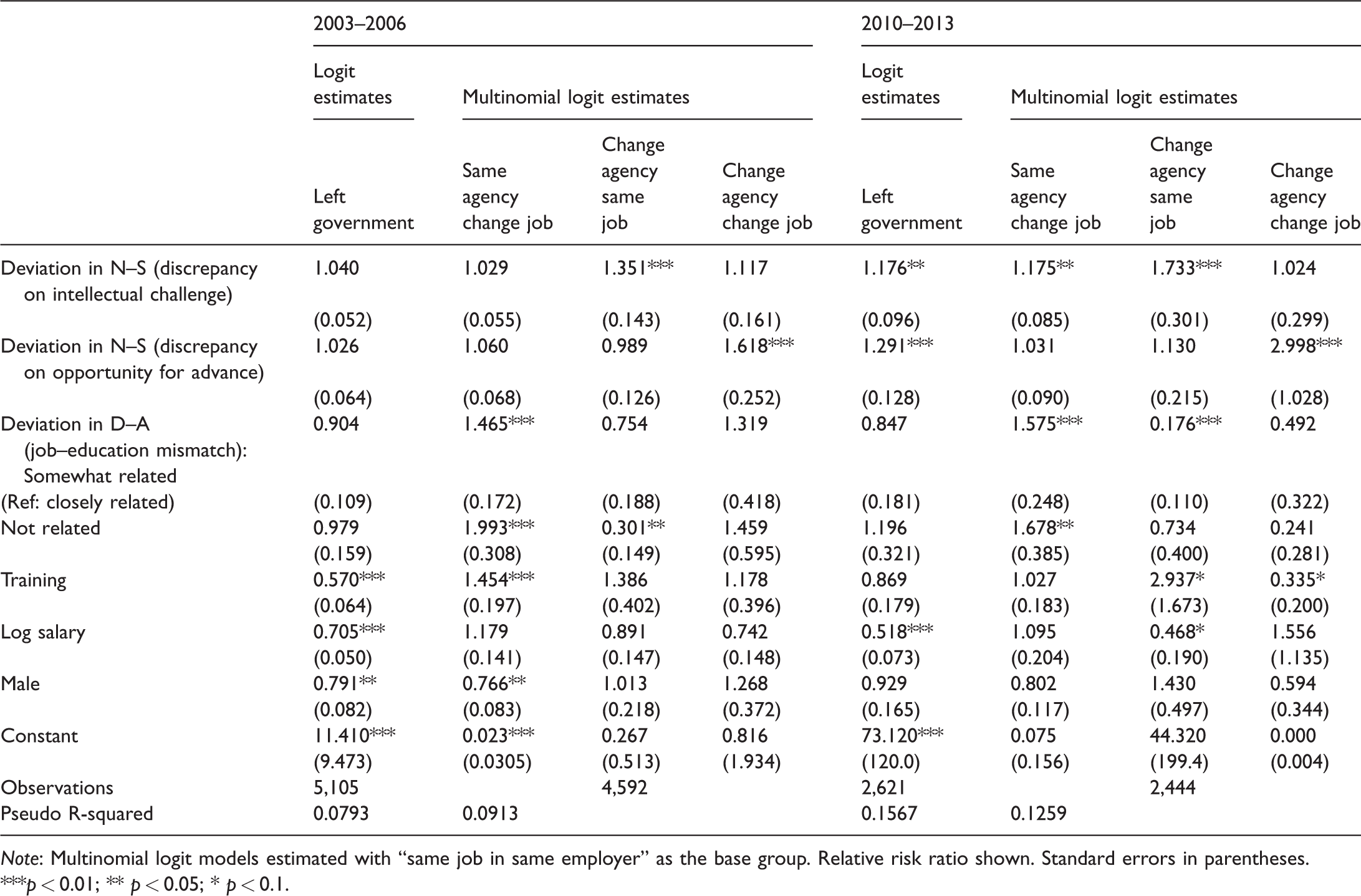
Note: Multinomial logit models estimated with “same job in same employer” as the base group. Relative risk ratio shown. Standard errors in parentheses. ***p < 0.01; ** p < 0.05; * p < 0.1.
The left portions of each time period in Table 2 provide a logistic regression estimate for external turnover (i.e. leaving the government). The results of estimation reveal that some types of N–S fit are positively related to leaving the government and changing one’s agency and/or job (the existence of a gap between expectation and actual job satisfaction) for intellectual challenge and opportunities for advancement (according to the 2010–2013 data set). The odds ratios of the variables reflecting gaps in intellectual challenge at work are significant and greater than 1. Thus, every additional intellectual challenge increases an individual’s odds of leaving the government by 17.6%. Furthermore, every additional discrepancy in N–S fit associated with opportunities for advancement increases an employee’s odds of leaving the government by 29.1%. These results support earlier findings that (1) intellectual challenge is associated with employee behavior (Mount et al., 2005) and (2) the provision of advancement opportunities is a key method for retaining government employees (Pitts et al., 2011).
The right portions for each time period shown in Table 2 show the relative likelihood of internal turnover (i.e. mobility within the government) via the utilization of a multinomial logistic regression. Government employees who change jobs within the same agency did so because of increased opportunities for advancement (according to the 2010–2013 data set). Every additional opportunity for advancement increases individuals’ probability of changing jobs within the agency by 17.5%. Furthermore, government employees who changed agencies without changing jobs also experienced more opportunities for advancement (according to both data sets). Every additional opportunity for advancement increases an employee’s probability of changing agencies but remaining in the same type of government job by 35.1% in the 2003–2006 data set and by 73.3% in the 2010–2013 data set.
Government employees in both time periods who changed jobs and agencies did so because they experienced less intellectual challenge in their current positions. Every additional opportunity for advancement increases an employee’s likelihood of changing his or her government job and agency by 61.8% in the 2003–2006 data set and 199.8% in the 2010–2013 data set. Relative to internal turnover, employees who experienced more opportunities for advancement are likely to either change jobs or change agencies in the 2010–2013 data set; additionally, employees who were less challenged intellectually were more likely to change jobs and change agencies. The effects of the two variables on internal turnover are larger for the 2010–2013 data set than for the 2003–2006 data set. In multinomial logistic regression estimates, the discrepancies associated with intellectual challenge and opportunities for advancement are positively related to mobility for both external and internal turnover. These results support the finding that intellectual challenge and advancement opportunities are related to employee behavior (Mount et al., 2005; Pitts et al., 2011).
Thus, we can conclude that Hypothesis 1 is supported, as is Hypothesis 2: employees who have a higher deviation in N–S fit for intellectual challenge or advancement opportunities are more likely to undergo external and internal turnover. Our analysis also reveals that respondents represent themselves as prioritizing intellectual challenge and opportunities for advancement when they decide to leave the government or move within the government more in the 2010–2013 data set than in the 2003–2006 data set.
The gap between employee skill sets and job requirements (higher deviation in D–A fit) is positively related to internal turnover (changing jobs with the same agencies). In the 2003–2006 data set, government employees whose work did not match or challenge their skill sets were about 99.3% more likely to change jobs within the same agency. In the 2010–2013 data set, this same group was 67.8% more likely to do so. Even where the gap was minimal (work somewhat matched or challenged their skill sets), government workers were likely to change jobs within the same agencies: 46.5% in the 2003–2006 data set and 57.5% in the 2010–2013 data set were more likely to change jobs within the same agency than their peers who experienced a better D–A fit. These results support the notion that complementary organizational and individual characteristics can affect such behavioral changes (Wright and Pandey, 2008). However, these results only support Hypothesis 3 (a higher deviation in D–A fit is positively associated with external and internal turnover) for internal turnover.
Discussion and conclusion
Many organizations in many countries are challenged by turnover and seek human resource tools and planning to manage it. Given the increase in the voluntary turnover rate among government employees, the US government needs a better understanding of employees’ decision-making processes that affect external and internal turnover. Understanding the crux of the problem, the government can then implement strategies to retain skilled employees, better manage turnover, and motivate employees (e.g. via work, performance, and loyalty). Failure to do so is likely to have negative effects on the public sector (e.g. shortages of certain skills).
This study analyzed how deviations between job desires and organizational support, and the skill sets and job requirements of government employees, affected turnover by comparing two NSCG data sets (from 2003 to 2006 and 2010 to 2013) to identify and utilize a better measurement of public sector employee behavior. We find that recently (from 2010 to 2013), more government employees experience less intellectual challenge and opportunities for advancement than identified in the 2003–2006 data set. Furthermore, such employees tended to leave government employment or move to a different government job. Hence, there is more employee mobility in recent years. Unlike other articles, this study analyzes the actual turnover of government employees using both fit of employees’ job desires and organizational support, and fit of employees’ skill sets and job requirements.
This study suggests two workforce-development policy and management objectives. First, it is important to properly understand the effects of opportunities for intellectual challenge and advancement in government work on external and internal turnover. Thus, it is important to understand the mobilization of employees and how managers can minimize turnover risk (Pitts et al., 2011) to ensure effective government. Second, organizations can begin to mitigate turnover rates during hiring by prioritizing the matching of employment opportunities with the job skills and expectations of candidates through careful hiring, appropriate placement, and providing employee training and support (Moynihan and Landuyt, 2008).
In all fairness, this study has limitations. First, time gaps may have occurred between the occurrences of actual turnover and the turnover variable that we use. The collections of NSCG data takes place biennially or triennially, resulting in a three-year time gap. This study partly mitigated this issue through the selection of people who were employed during both survey time frames. However, control of this element is not perfect. Second, we cannot control for external factors affecting turnover (e.g. economic conditions and unemployment rates). Additionally, we excluded those employees that voluntarily separated from the government (i.e. moved to a private or non-profit sector job).
Despite these limitations, the results of this study provide practical implications and underline the importance of organizational efforts for human resource managers in managing turnover. This study finds that management policies should be modified to meet the needs of modern-day employees and make the government more resilient within changing work environments. Organizational leaders must manage disparate factors—both foreseen and unforeseen—that affect turnover (Reivich and Shatté, 2002). Further studies should consider how to better match employee skills, education, and expectations with government positions, and intervene when there is a discrepancy.
Footnotes
Declaration of conflicting interests
The author(s) declared no potential conflicts of interest with respect to the research, authorship, and/or publication of this article.
Funding
The author(s) disclosed receipt of the following financial support for the research, authorship and/or publication of this article: The project was supported by a grant from the US National Institutes of Health (2U01GM094141-05), funding recipient: Joshua Hawley ( ), titled ‘A Model-Based Examination of Behavioral & Social Science Workforce: Improving Health Outcomes.’