



Abstract
The relationship between government agencies is an important basis for the continuous innovation and diffusion of policies. This research explores how government agencies, as policymakers and promoters, play an important role in the innovation and diffusion of intellectual property policies in China. Based on the reference relationship in the policy literature, we build a large sample of intellectual property policy diffusion networks in China and present the trends and characteristics of government agencies’ policy diffusion. The results show that intellectual property policy diffusion in China is positively related to many institutional factors, for example, network positioning, authority, economic development level, and policy timeliness, but it is not significantly correlated with geographical proximity.
Points for practitioners
This study helps to understand how government relationships affect policy diffusion in this particular political environment in China. The conclusions of this study on the role of government agencies in policy diffusion can provide some guidance for public administration departments to formulate and disseminate policies, and expand the study of intergovernmental relations and policy innovation from the perspective of policy text mining and quantification.
Introduction
In its most generic form, policy diffusion is defined as one government’s policy choices being influenced by the choices of other governments (Shipan and Volden, 2012). The pressure of policy innovation has led to the spread of policies among different government agencies, and there are four mechanisms of policy diffusion: learning from earlier adopters; economic competition among proximate cities; the imitation of larger cities; and coercion by governments (Wu and Zhang, 2018). Previous studies found that the authority and geographical proximity of government agencies and the issue the similarity of policies have an impact on policy diffusion (Gu, 2015; Hughes et al., 2018; Liu and Li, 2016; Ruiz-Villaverde et al., 2017). Scholarly and public discussions have separately highlighted important influences on policy diffusion from various intergovernmental relations, such as interpersonal relationships between agencies, hierarchical relationships, financial relations, or competitive relationships (Huang et al., 2017; Liu and Li, 2016; Wu and Zhang, 2018; Zhu and Zhao, 2018), but a lack of comprehensive understanding of relationships between governments means that little is known about how an agency’s own attributes and connections with other agencies influence policy diffusion.
Moreover, despite focused attention on the diffusion mechanism of social policy innovations at different levels of government, how to identify intergovernmental relations from policies is still a difficult problem to be solved. Previous studies have identified the relationship between policies and their issuers based on historical events through policy text coding and the manual identification of policy adoption in order to build a policy diffusion network (Motta, 2018; Zhu and Zhao, 2018). However, while this research method can ensure the high accuracy of policy diffusion data, its sample selection is bound to be limited, and it is difficult to establish a wide-ranging relationship between policy-issuing agencies. This article draws on the method proposed by Huang et al. (2017) to extract the reference relationship in China’s intellectual property (IP) policy literature and related policy literature in an automated way, and builds China’s IP policy diffusion network in order to explore the role of government agencies in the network. Since the 1990s, with the increasing protection of IP rights in China, the wide geographical coverage of IP policies, and the establishment of a relatively complete IP policy system driven by the needs of social and economic development in developed regions, the innovation and diffusion of China’s IP policies has been accelerating (Awokuse and Yin, 2010; Kshetri, 2009). Based on the aforementioned reasons, this study selects IP policies as the research object in order to analyze the role of government agencies in policy diffusion. The key to building the policy diffusion network is to find reliable and standardized policy literature data sources, and the Chinese Legal Knowledge Database (CLKD) under the Chinese National Knowledge Infrastructure (CNKI) provides us with standardized policy data containing policy reference information.
In this study, we focus on the reference relationship between policy documents in the field of IP in China and explore the role of government agencies in policy diffusion by analyzing the network locations of government agencies with different characteristics in the policy diffusion network. By examining institutional differences in network positioning for policy diffusion, and whether and how network benefits are contingent on governments’ own attributes and relationships, it is possible to identify critical factors related to the network positioning and policy diffusion of governments, and to inform theoretical perspectives about mechanisms of policy diffusion more generally. The study aims to answer two questions: “Do the current network characteristics of government agencies in China’s IP policy diffusion network affect its future policy diffusion?”; and “What are the characteristics and laws of the policy diffusion of Chinese government agencies in the policy diffusion network?”
The environment and characteristics of China’s policy diffusion
There are large differences between the political systems of China and Western countries, which lead to different characteristics and laws regarding their policy diffusion. Unlike Western countries that generally implement a decentralized democratic system, China has implemented a centralized authoritative system, which makes the driving force and communication mode of China’s local government policy innovation and regional policy diffusion different. It is worth noting that the two key factors affecting policy diffusion between Chinese government agencies are the vertical compulsory intervention of the central government and horizontal political competition between peer governments (Zhu, 2017).
In Western countries, policy implementation is more susceptible to a system of the separation of three powers, while policy innovation and diffusion in the particular political system and environment of China are more susceptible to factors such as nomenklatura members’ age, political chances, and desire for political promotions (Wu and Zhang, 2018). The process of China’s policy divergence and convergence is usually influenced by factors such as the policy objectives of superior agencies, the political goals of local governments, and the coercive power of superior agencies (Liu and Li, 2016). The relationship between Chinese government agencies plays an important role in promoting the diffusion of social policy innovation. The adoption of new social policies by local governments is affected by many factors, such as higher-level administrative orders, subordinate financial relations, and competitive pressures in the same city, while higher-level government agencies can also gain the opportunity to learn from local policy experience (Zhu and Zhao, 2018).
Cross-regional policy learning is an important mechanism for the diffusion of urban policies in China. The cities that successfully implement a policy are considered to be best-practice cases and are studied by neighboring or other similar cities, but the outcome of policy learning is unlikely to be realized in these cities because of leadership turnover, cautious decision-making, and the discovery of alternative solutions (Ma, 2017). In view of the strong political purpose of policies, we must first grasp the characteristics of government agencies, such as administrative level, departmental areas and regions, their position in the policy diffusion network, and so on, and then truly understand how the laws and reasons behind China’s various policy diffusion phenomena are different from Western countries.
Hypotheses
The network literature is clear that technical knowledge diffuses through social networks of relations. Similarly, policy diffusion is based on the relationship between governments (Zhu, 2017). Social network analysis methods provide useful tools for the analysis of complex relational social networks (Krause et al., 2017), and the importance of nodes can be measured by their network location in the network (Musial and Juszczyszyn, 2009). In the policy diffusion network, an agency’s network positioning reflects its network characteristics and can be measured by network indicators, such as outdegree, indegree, centrality, and broker/brokerage role, the value of which is mainly determined by the agency’s own attributes and its relationship with other agencies. According to social network theory, social capital is the link between nodes, and the difference in the network positions of nodes can bring different social capital (Jordana et al., 2012). Higher network indicators are beneficial to facilitating communication between nodes in the network (Hoffmann et al., 2016), as well as to making agencies that occupy important positions in the network more likely to play a key role in policy diffusion. Thus: H1: The network indicators of a government agency in the policy diffusion network are positively correlated with the probability of its policy being adopted.
Authoritative superior government agencies will supervise or motivate subordinate government agencies to implement their policies through appropriate measures (Kontokosta, 2011; Shipan and Volden, 2012), and the vertical policy diffusion considered to be a top-down mandatory policy diffusion facilitated by administrative commands relies mainly on coercive mechanisms, the main influencing factors of which are the financial capacity of the state and the personnel capacity of local governments (Kim et al., 2018). The higher the authority of government agencies, the more likely their policies will be implemented in the long run (Huang et al., 2017). For example, the basic IP laws formulated by the National People’s Congress and the IP strategy documents formulated by the State Council can provide permanent guidance for the establishment and optimization of China’s IP protection environment. In this sense, the years that an agency has been in the policy diffusion network can also reflect its authority to some extent, and policies issued by agencies with higher authority are more likely to continue to diffuse over a long period of time. Therefore: H2: The authority of the government agency as a policy issuer is positively correlated with the probability of its policy being adopted. H3: Government agencies are more likely to adopt the policies of an agency in developed regions or that are geographically close to them.
Data and methods
Data
To explore a policy cross-reference relationship between Chinese IP policy issuers, we use Chinese Legal Knowledge Law and Principle (CLKLP), 1 one of the sub-libraries of CLKD, which has collected the various policies formulated and promulgated by various legislatures and government agencies in China since 1979. As of December 6, 2018, there were 1,015,016 policies included in the CLKLP. Policy documents usually contain information such as the title, publishing authority, body, and issue date. Similar to the citation relationships of scientific literature, the reference relationships between policy documents refer to the relationship formed by a policy with reference to other policies, that is, the A policy literature uses the B policy literature or the C, D, F, or G policy literature as the basis for its formulation. Huang (2016) believes that the policy literature reference network is a network formed by the reference relationships between policy literatures linked with other isolated policy literatures. Given that policy diffusion in the policy literature reference network is more vertical, this study focuses more on the influence of institutional authority on vertical policy diffusion. In addition, policy diffusion is not necessarily reflected in the reference to the policy text, which is similar to the limitations of the scientific literature citation. Since policies referenced in a policy text are usually the most influential policies, it is acceptable to measure policy diffusion with the policy reference relationship in the policy text. The research framework used to pursue our goals is shown in Figure 1.
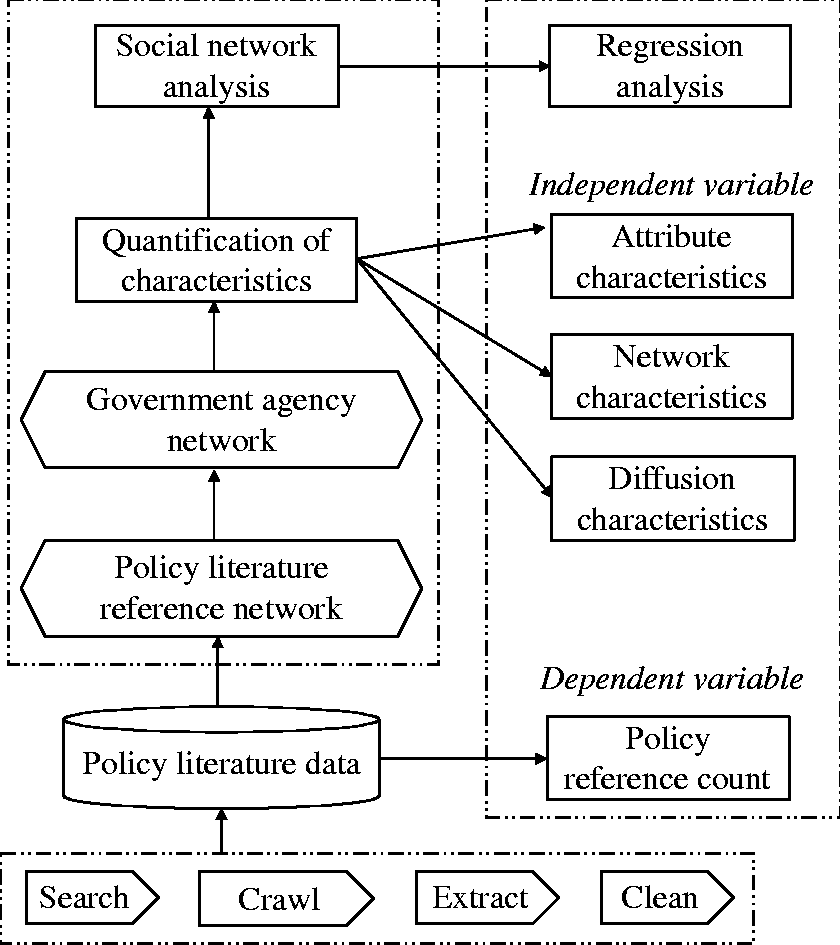
Research framework.
The steps for data acquisition and processing are as follows. First, through the standard search function provided by CLKLP, we click the “retrieve literature” button and limit the policy area to the IP field in the application area list at the bottom right. The retrieved policy documents constitute the seed policy literature (D) in this study, with a total of 4103 policies.
Second, through our own web crawler, we also obtained the bibliographic information of all seed policy literatures, as well as referencing policy literatures (D1) and referenced policy literatures (D2), including policy issuers, release dates, the implementation date, keywords, effectiveness levels, and timeliness. If a policy document is referenced by other policy documents in the library, CLKLP will mark it out (see Figure 2). We obtained a total of 82,266 policies by extracting the referenced policies and referencing policies of the seed policy literature.

Example of identifying the reference information of a policy document.
Third, the data were cleaned in the following manner. The release date was used as the default birth time for the policy document, or when the release date was missing, the implementation date was used as its birth time. We removed duplicate policies and policies where information on the issuing authority and the birth time was missing. In addition, we unified the name of the policy-issuing agency as the final name of the agency after institutional reforms.
Fourth, we: (1) built a policy literature reference network based on the reference relationship between bodies of policy literature; (2) extracted the reference relationship between policy issuers; and (3) obtained the government relationship network in policy diffusion, which contains 10,205 government agencies and 114,360 reference pairs between them. The government agencies involved in the policy literature are the basic units of analysis for the empirical research.
Method
We model from two aspects. First, the data of the current attributes and network characteristics of agencies are used to predict the referenced or referencing odds of their policies in the next year. Second, an agency’s historical observation data are used to assess the effects of institutional attributes, network characteristics, and policy diffusion characteristics on cumulative policy referenced or referencing count.
Table 3 presents odds ratios of maximum likelihood estimates from a set of logistic regression models that predict the probability of institutional policy being referenced or referencing in the next year through the agency’s attributes, network characteristics, and diffusion characteristics. The agency-year pair is the basic unit of analysis in these models, and cluster (robust) standard errors and fixed-year effects are used to explain the repeated measures of agencies over a certain period of time. The policy diffusion delay between the issuance, implementation, and reference of policies was set to one year in the models, and similar results were obtained after the delay was set to three or five years.
All models include the relevant variables of each agency’s own attribute characteristics: whether the agency belongs to an IP agency (1 = yes); the agency’s administrative level (5 = national level, 4 = provincial level, 3 = municipal level, 2 = county level, 1 = township level); the number of years the agency has been in the policy diffusion network; the number of policies issued by the agency in the current year; whether or not the agency is from the central and eastern regions of China (1 = yes); and whether or not the agency is a specific type of agency, such as administration (e.g. State Council and its subordinate ministries and people’s governments at all levels and their affiliates) or legislature (e.g. people’s congresses at various levels and their standing committees) (1 = yes). The network characteristics include degree centrality, indegree, outdegree, and brokerage role (as shown in Table 1), while policy diffusion characteristics include the spatial distance, the difference between the issue date, the proportion of IP policy, and the difference in agency level of the referenced agency and the referencing agency. The variables of the agency’s attributes, network characteristics, and diffusion characteristics are then integrated into a set of interaction variables with national administration and national legislature to fit the final models.
Network measures and definitions.

As shown in Table 1, the social network analysis indicators selected in this article are degree, indegree, outdegree, degree centrality, and broker/brokerage role. These indicators, which have been widely used in the measurement of networks, measure the importance of nodes in a network by calculating the number of nodes connected to them and the benefits of information control and first access to knowledge and opportunities to recombine ideas for a node occupying the sole intermediate position between others (Fleming, Mingo and Chen, 2007; Jordana et al., 2012). Therefore, we use these indicators to quantify the extent to which a government agency plays a role in the policy diffusion network, whether role differentials exist between agencies when considering frequently invoked network measures, and how they may differ in the types of policy reference agencies that they have.
To further analyze the influence of institutional attribute characteristics, network characteristics, and policy diffusion characteristics, we replace the dependent variable with the cumulative referenced count and referencing count of an agency’s policies in the models (shown in Table 4). These models incorporate a negative binomial count modeling strategy, and incidence rate ratios are the result of this series of models, which include variables such as an agency’s attribute characteristics and network characteristics, as well as the diffusion characteristics of government agencies.
Results
China’s IP policy diffusion network and policy diffusion characteristics
Figure 3 shows the network of reference relationships between China’s IP policy literature and other policy literature, which clearly reveals the links between the two types of policies (IP policies versus other policies, marked in black and grey, respectively). We extracted the policy reference relationship between governments from the policy diffusion network and built a government relationship network based on policy diffusion. The nodes in Figure 4 represent different levels of government agencies. Different levels of government agencies are gradually spreading out from the high to the low level in the network, indicating that there is a clear hierarchical diffusion phenomenon in the diffusion of China’s IP policies. The black nodes are national agencies, the grey nodes are provincial agencies, and the white and green nodes are other agencies. Figure 5 shows the percentages of different types, different levels, and different regional government agencies, and Table 2 shows a basic description of government agency policy diffusion.

Diffusion network between IP and other policies.
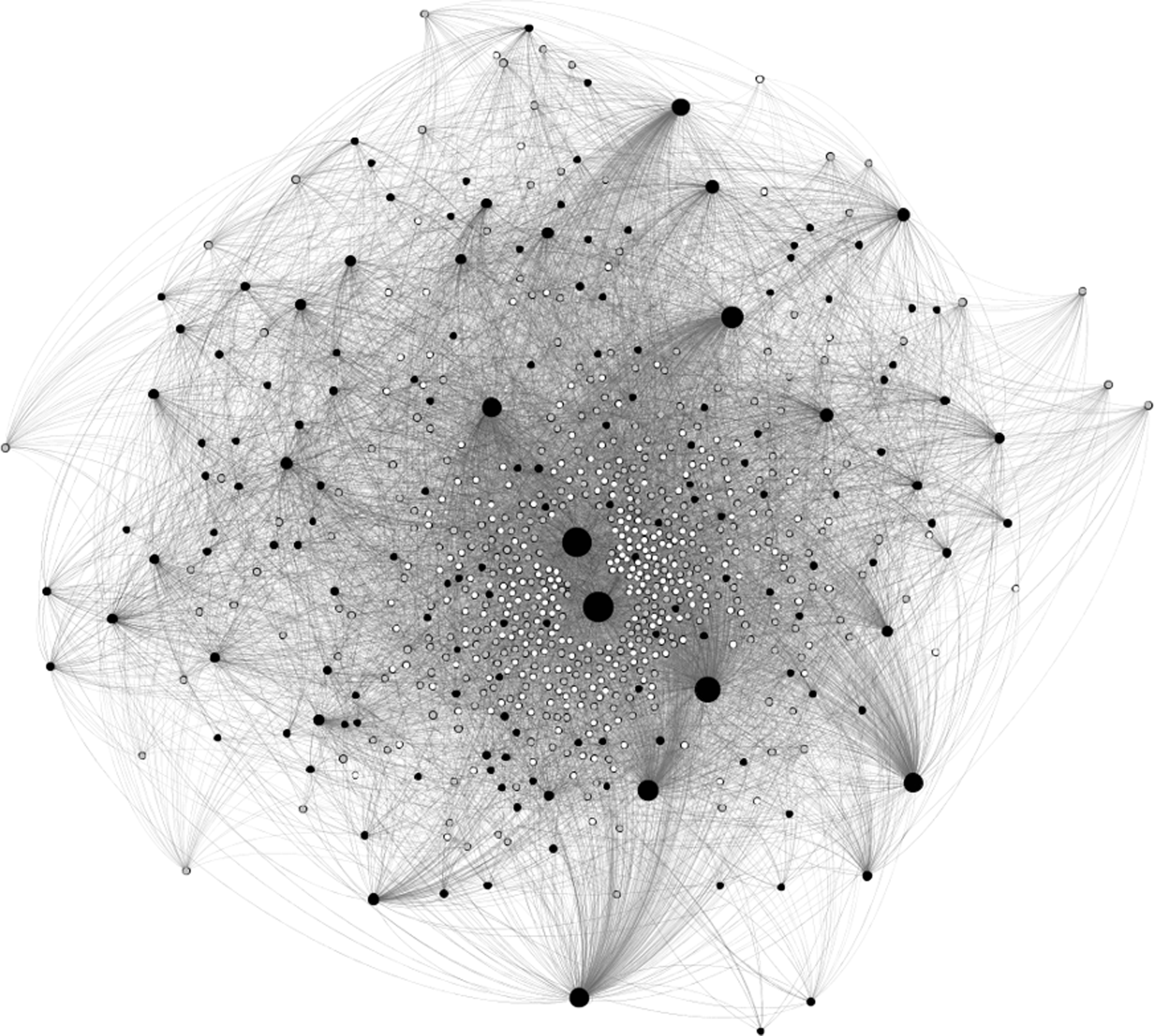
Network of relationships between different levels of government agencies.
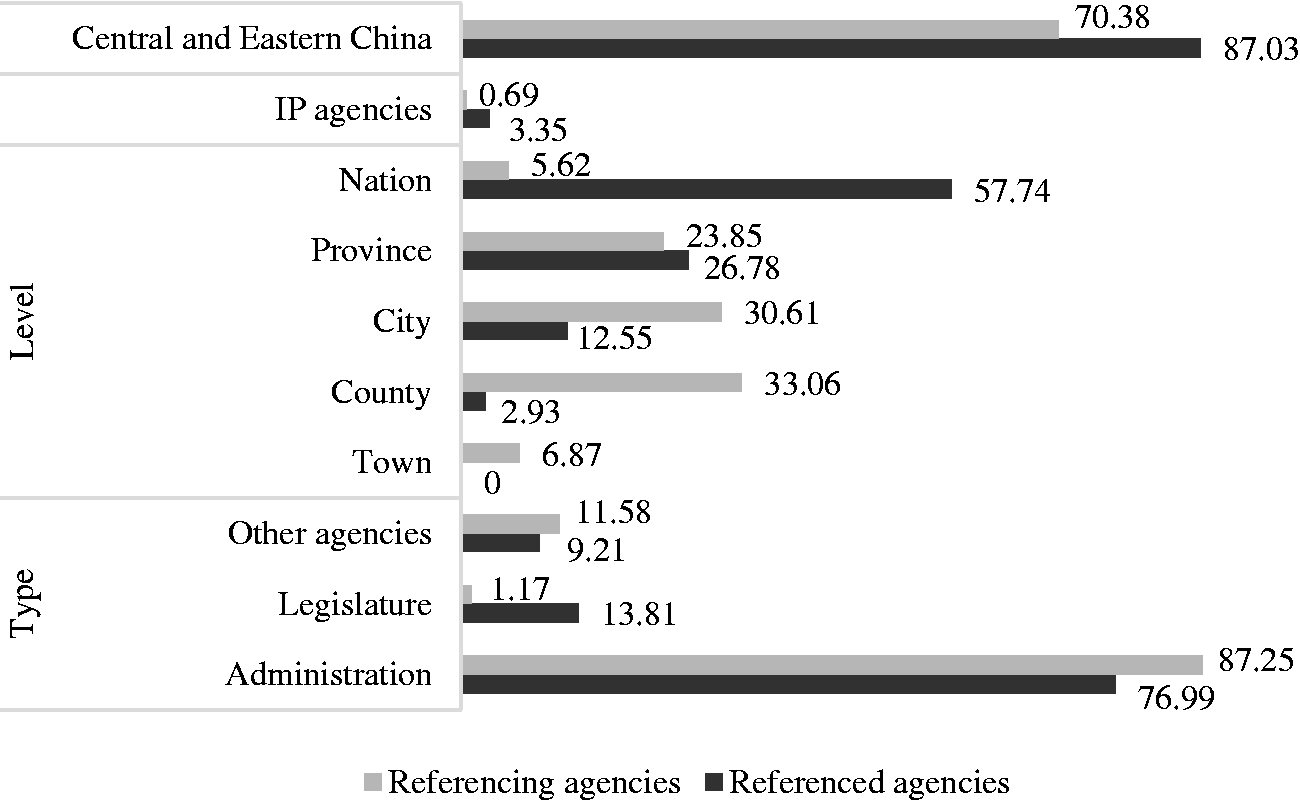
Percentage of different agencies.
Policy diffusion profiles of government agencies.

Notes: The values in parentheses are the standard deviations.
Maximum likelihood estimates (odds ratios, logit) of referenced or referencing (t = 1) given agency characteristics and network characteristics (t – 1).

Notes: *p < 0.10; **p < 0.05; ***p < 0.01.
Negative binomial incidence rate ratios of an agency’s total reference count.

Notes: *p < 0.10; **p < 0.05; ***p < 0.01.
Positioning in the network and future policy diffusion
Hypothesis H1 examines the effects of the network characteristics of government agencies on policy diffusion. In all the referenced models, the referenced odds of an agency’s policies are significantly affected by most network characteristics. If an agency has a high degree centrality or indegree, a low outdegree, or a small number of times that it has acted as a broker, the agency’s policy is more likely to be referenced. The model shows that the odds of an agency being referenced by policies or referencing policies increase as it becomes increasingly important in the network, controlling for agency characteristics, prior experience, and policy diffusion characteristics. The longer government agencies have been in the policy diffusion network, the greater the referenced or referencing odds of their policies. In Models 7–10 with a one-year delay, only an agency’s outdegree in the network significantly increases its odds of referencing other policies, while its degree centrality and number of times acting as a broker are even negatively correlated with the referencing odds in Models 11–12 with three-year and five-year delays. Obviously, compared with a referencing agency as the recipient of policy effectiveness, a referenced agency as the issuer of policy effectiveness needs to occupy an important position in the network, supporting H1.
Hypotheses H2–H3 examine the effects of a government agency’s characteristics and policy diffusion characteristics on policy diffusion. The administrative-level difference between the policy-issuing agency and the policy-receiving agency is significantly positively correlated with the odds that that agency references other policies, suggesting that it is easier for agencies to reference the policies of higher administrative-level agencies across levels. Figure 3 shows that a large number of local government agencies directly reference the policies of the State Council, the National Office of the State Council, and the National People’s Congress Committee and other national agencies. The referenced odds of legislatures in Models 1–3 with a one-year delay are lower than those of other agencies, which may be related to the fact that the referenced delay mean of legislatures is longer than that of all agencies (8.04 versus 4.88, respectively). When the delay is set to three years (Model 5), the referenced odds of legislatures are much greater than those of other agencies. In addition, after setting the delay to five years (Model 6), the referenced odds of the national administration rise significantly, which may be related to the referenced delay of the national administrative agency policy being longer than that of all administrations’ policies (5.9 versus 3.52, respectively). Obviously, the authority of an agency is significantly positively correlated with the delay in its policy diffusion. Hence, H2 is accepted.
For agencies in underdeveloped western areas, their spatial distance has a significant impact on the referenced or referencing odds of their policies. In Models 1–4 with a one-year delay, western agencies’ policies are more easily referenced without considering their network characteristics and policy diffusion characteristics, while in Models 11–12 with three-year and five-year delays, western agencies are more likely to reference other policies. The average diffusion distance of a government agency’s policies is significantly positively correlated with the referenced odds of the agency’s policies, even though the odds are close to 1, indicating that an agency’s policies are more easily referenced by local agencies’ policies.Also, an agency’s policy diffusion delay is significantly positively correlated with the referenced and referencing odds of its policies. Therefore, H3 is accepted.
The influence of agencies and their relationships on policy diffusion
From the perspective of an agency’s network characteristics and diffusion characteristics, the cumulative referenced agencies with a higher degree centrality are predicted to receive 1.67 more referenced counts than other agencies in Models 1–3. Although an agency’s indegree, outdegree, and broker role have a significant impact on its cumulative referenced counts or cumulative referencing counts in some models, this effect is negligible, with only an increase of less than 0.001 counts. An agency’s number of years in the policy diffusion network is positively correlated with its policy referenced and referencing count in Models 2, 4, 5, 6, 7, and 8. Therefore, H1 is accepted.
The agency’s level is positively correlated with its cumulative referenced count in Models 1–4, but negatively correlated with its cumulative referencing count in Models 5, 6, 7, and 8. That is to say, the lower the administrative level of the agency, the easier it is to reference other agencies, while the higher the administrative level of the agency, the easier it is to be referenced by other agencies. A national administration’s policy is predicted to receive 1.41 more referenced counts than other agencies in Model 4, while a national legislature has an additional 0.9 referencing counts than other agencies in Model 8. The policies formulated by legislatures are higher in legal effectiveness than the policies formulated by the administration, so legislatures reference more to the internal policies of the legislative system, which has shortened the delay of policy diffusion to a certain extent by reducing the relevant intermediate links in the process of policy cross-system diffusion, supporting H2. In addition, there is a negative relationship between an agency’s cumulative referenced count and the agency being from a central or eastern region. The mean of the diffusion distance between an agency and other agencies in policy diffusion is not significantly correlated with the dependent variable in most models. However, the mean of the diffusion delay is significantly positively correlated with the policy referencing counts in Models 6 and 8, so H3 is partially accepted.
Conclusions and discussion
Previous studies on policy diffusion mechanisms and their influencing factors have affirmed the important influence of government agencies and their relationships on policy diffusion, but few studies have been able to analyze the role of government agencies in policy diffusion. Based on the reference relationship between China’s IP policy literature, we have revealed how Chinese government agencies exert or receive influence in IP policy diffusion.
First, we find that some network indicators of government agencies in the policy diffusion network have a positive impact on policy diffusion in China. Those agencies whose policies are easier to reference by other agencies have a higher degree centrality in the network or have always been in the network, which is in line with the relevant views of social network theory (Musial and Juszczyszyn, 2009). In addition, the referenced probability and the referencing probability of an agency’s policies are significantly affected by its indegree and outdegree in the network, respectively. It is worth noting that the frequency of an agency as broker in the network is negatively correlated with the referenced probability of its policies, indicating that the strong intermediary role of agencies is not conducive to the diffusion of their own policies. For example, a national agency’s policies have both direct and indirect effects on municipal agency policies, and a provincial agency’s policies have an intermediary role between national agency policies and municipal agency policies (Zhu and Zhao, 2018). However, our results suggest that provincial government agencies that act as intermediaries in the top-down policy diffusion process have limited influence on local government agencies, the main reason for which may be that the policy documents issued by the highly authoritative national government are much more effective than provincial policies. Therefore, in the case of both national and provincial policies, local governments are more willing to directly refer to more effective national policies. These conclusions indicate that focusing on the network characteristics of agencies in policy diffusion networks is of great significance for analyzing the factors affecting policy diffusion from a perspective of the relationship between government agencies.
Second, we find that the probability and delay of policy diffusion are related to a government agency’s authority. In the context of China’s centralized political system, high administrative-level government agencies are more authoritative. As mentioned earlier, Chinese local governments have directly adopted a large number of policies issued by national government agencies, especially national administrative agencies, in order to respond to central policy requirements, or to obtain administrative or financial incentives from the central government (Zhu and Zhao, 2018). However, when a national agency’s policy diffusion delay is set to a long period of three or five years, the influence of the national agency’s high administrative level on the probability of policy diffusion will be more significant. There are two possible reasons for the long delays in the national agency’s policy diffusion. On the one hand, there are many factors that are independent of institutional authority. For example, the political capital of policy proponents independent of the authoritative factors of government agencies is more likely to influence the probability of policy adoption regarding actual social needs for policy (Hannah and Mallinson, 2018), and policy trajectories and the movement of ideas and people between municipalities have been important for policy diffusion (Segatto, 2018). On the other hand, it will take some time for the national government to coordinate and promote horizontal policy diffusion between local governments through learning and competing with each other. Some studies have found that the vertical influence of the central government has positive conditional effects, which can promote horizontal interaction between local governments (Kim, 2013).
Third, we find that policy diffusion is affected to some extent by the socio-economic development of the area where a government agency is located and the timeliness of the agency’s policies. Previous studies have shown that a mapping of the adoption and diffusion of zoning bylaws banning fast-food drive-through services across Canadian municipalities reveal parallel geographic diffusion patterns in western and eastern Canada (Nykiforuk et al., 2018). However, this study reveals the direction of policy diffusion, and government agencies from the relatively developed central and eastern regions in China are more likely to be exporters of policy influence than agencies from western regions. In China, the migration of capital and investment from wealthy coastal areas into poorer central and western provinces has continued over recent years, and policy diffusion is delayed as policy adoption depends on economic conditions, which vary widely across China and change over time (Ang, 2018). In addition to economic conditions, the delay in policy diffusion may also be due to policy learners waiting for the policies of other regions to be effective (Li, 2017), but studies have confirmed that policy diffusion and learning without delay can help achieve optimal policy implementation (Alizamir et al., 2016). As Gu (2015) has noted, a fundamental non-linear connection between neighborhood structure and policy transition is unveiled. However, our results suggest that the proximity of the geographical location of a government agency has little effect on its policy diffusion, which may be related to the fact that policies are easier to diffuse across the agency’s administrative levels and more likely to diffuse to farther regions in China because China is a vast landscape.
The conclusions in this article are also of great significance for our understanding of the role of government agencies in policy diffusion in China’s unique political environment. The differences between Chinese and Western political systems have led to a very different relationship between government agencies and their roles in policy diffusion (Liu and Li, 2016; Sellers, 2017; Wu and Zhang, 2018; Zhu, 2017), and these critically important antecedents of government agencies have implications not only for views on the positioning and role of government agencies at all levels, systems, and regions in their policy diffusion, but also for policy selection, development, and promotion in scientific agencies or regions. At the same time, based on Huang et al. (2017), this article has extracted the policy diffusion relationship of government agencies from the perspective of the policy literature and analyzed the role of government agencies in policy diffusion, which provides further ideas for studying policy diffusion.
Footnotes
Declaration of conflicting interests
The authors declared no potential conflicts of interest with respect to the research, authorship, and/or publication of this article.
Funding
The authors disclosed receipt of the following financial support for the research, authorship, and/or publication of this article: This article is supported by the National Natural Science Foundation of China (No. 71420107026).
