



Abstract
Collaborative innovation has been increasingly adopted by the public sector to address complex issues and improve its efficiency. Despite the developments in the literature on this subject, recent studies still indicate the need to investigate how public governance could be organized to support collaborative processes of innovation. Through a systematic review of 36 empirical studies, this article aims to contribute to bridging this gap by identifying the characteristics that should form governance in order to support the collaborative innovation process in the public sector. The results show that the establishment of relationships of trust, supported by technology tools and promoted by leaders committed to well-established goals, is a characteristic of governance that has a positive influence on collaborative innovation processes. However, there is still a need to develop more studies that indicate the characteristics of governance that may contribute to the implementation of innovation and not just to its creation processes.
Points for practitioners
Collaboration has been shown to be a more positive strategy for innovation in the public sector in comparison with strategies that seek isolation or competition. However, it is necessary to establish governance mechanisms that contribute to the involvement of stakeholders and to the achievement of the intended results so that this strategy becomes successful. By reviewing the results of prior empirical experiences, this article identifies that in order for collaborative innovation processes in the public sector to be successful, governance must predict: the participation of top management and managers with decision-making power; the setting of clear goals and needs; the generation of useful innovation that benefits stakeholders; and the establishment of tools that facilitate communication, interaction, and the sharing of information and knowledge. This information provides managers and public policymakers with key indicators, learned from prior mistakes and accomplishments, for the implementation of this innovation strategy in their organizations.
Introduction
Innovation and collaboration have been adopted by public organizations as strategies to achieve better results in the management of common crises (Elston et al., 2018; Nohrstedt et al., 2018), the optimization of available resources (Diamond and Vangen, 2017; Lewis et al., 2018), and as a response to technological and social development (Seo et al., 2018). The combination of both strategies, promoting collaborative innovation, brings advantages over other innovation strategies as collaboration can benefit all steps of the innovation process and enables the sharing of costs, risks, and benefits (Sørensen and Torfing, 2011; Torfing, 2019).
Many studies indicate that the models of leadership, management, and governance adopted in public administration have obstacles to be overcome for the adoption of innovative practices (e.g. Andersen and Jakobsen, 2018; Boon and Verhoest, 2018; O’Neil et al., 2016), and some researches on collaborative innovation in the public sector have focused on the internal dynamics of organizations (Bernier et al., 2015), highlighting the limitations imposed by traditional bureaucracy and ways to overcome them (Wegrich, 2019). However, the study of this form of innovation encompasses both the concepts inherent to the innovation process itself and the interrelationships among public organizations and between the public sector and society (Bekkers and Tummers, 2018).
Despite the advances in the literature, these aspects were not fully explored, and recent studies indicate the need to investigate how different management strategies influence the innovation and collaboration process and how public governance could be organized in order to support collaborative processes of innovation (e.g. Agger and Sørensen, 2018; Torfing, 2019). Therefore, through a systematic review of the literature, this article aims to contribute to bridging this gap by answering the following question: what characteristics must form public governance in order to support collaborative innovation process in the public sector?
Collaborative innovation in the public sector
The search for innovation in the public sector was stimulated by the administrative reforms of the 1990s, in the wake of New Public Management (NPM), particularly aiming at performance improvement and cost reduction (Damanpour et al., 2009), as well as gaining efficiency and quality in the services provided (Arundel et al., 2015). This search is still present in current governments as society and private companies continue to have a growing demand for high-quality, comprehensive and efficient public services, which must be provided by states with increasingly scarce resources (Sørensen and Torfing, 2011). The combination of financial constraint and growing demand creates the need to adopt new solutions to meet new demands without increasing public spending (Sørensen and Torfing, 2011).
In contrast to managerialism and the focus on the improvement of internal processes recommended by NPM, current governments, aligned with the principles of New Public Service (NPS) and New Public Governance (NPG), have been searching for new solutions through collaboration with citizens in the identification of problems and development, and in the implementation of public policies (Denhardt and Denhardt, 2015; Osborne, 2006). The involvement of citizens in the development of new public policies is related to the nature of the innovation in the service sector, in which “clients” are co-producers and their experiences, knowledge, and involvement in the production of services influence their satisfaction (Gallouj and Savona, 2009). Therefore, interaction and cooperation among multiple actors is an intrinsic characteristic of innovation in the service sector, representing a process that is not only stimulating, but also necessary for the innovative process (Agger and Sørensen, 2018; Hartley et al., 2013; Lewis et al., 2018).
Innovation through collaboration represents the essence of the open innovation concept established by Chesbrough (2003), who suggests that companies must seek interaction with other companies or external agents to create ideas and improve their products and services, as well as involve their clients in a co-creation process to improve their experiences and achieve their objectives. Thus, studies on co-creation and open innovation offer the main insights into the collaborative innovation strategy (Hartley et al., 2013).
In the public sector, collaborative innovation is brought closer to discussions about networked government (Bommert, 2010), in which the provision of public services may be improved through the interaction of multiple actors, and politicians and public employees play a mediating and managing role in these relationships (Bovaird, 2005; Osborne, 2006). Thus, the interaction of the public sector with non-governmental organizations and other stakeholders is a key factor for state innovation capacity (Godenhjelm and Johanson, 2018).
Collaborative innovation processes are inserted into “institutional arenas of interaction that can be analyzed as governance networks” (Sørensen and Torfing, 2011: 860). These arenas provide rules, standards, and routines that create interaction patterns and structure the actions of the actors involved, and they can be transformed by the governance models adopted (Ansell and Gash, 2012; Sørensen and Torfing, 2011, 2017).
The term “governance” is used in several ways, thus making its definition a little imprecise (Rhodes, 1996), and reflects an attempt to improve coordination among relatively dependent actors in order to solve common problems among them (Klijn, 2008). Governments seek to manage their challenges through governance structures, which are necessary for decision-making (Janssen and Van der Voort, 2016). Governance encompasses a set of structural arrangements that, on the one hand, are influenced by social changes resulting from innovation processes and, on the other hand, influence innovation processes in the public sector (Scupola and Zanfei, 2016).
In more concrete terms, Lynn et al. (2000) indicate that governance involves environmental factors, client characteristics, processes, technologies, and managerial actions, and refers to “the means for achieving direction, control, and coordination of wholly or partially autonomous individuals or organizations on behalf of interests to which they jointly contribute” (Lynn et al., 2000: 235). Thus, the authority patterns (vertical or horizontal), focus (on procedure or outcomes), and priority (control and stability or creativity and change) of the organizations, as well as their operational perspectives (intra-organizational or inter-organizational), which jointly shape governance, directly influence collaborative innovation processes in the public sector (Agger and Sørensen, 2018).
Based on many fields of knowledge, Lynn et al. (2000) presented a methodological model for the study of governance, which includes a set of common variables that can be used in empirical research, regardless of the adopted logics, conception, or theory regarding governance. These variables include: (1) outputs and outcomes; (2) environmental factors; (3) client characteristics; (4) treatments (primary work, core processes, and technology); (5) structures; and (6) managerial actions and roles (Lynn et al., 2000).
To outline the aspects that will be analyzed in this article, we have followed the governance concept and the variables indicated by Lynn et al. (2000) in order to identify the characteristics that have a positive impact on the collaborative innovation process in the public sector and that could form a governance structure to support this process. From this methodological model, we aim to identify specific characteristics, even if they are individualized, since the governance model used in a considerable number of studies that address collaborative innovation in the public sector is not fully explored, making it difficult to bring it closer to a specific model or theory.
Research method
This work consists in a systematic review of the literature, based on the Preferred Reporting Items for Systematic Reviews and Meta-Analyses (PRISMA) approach, in order to clarify the criteria for the identification, selection, and evaluation of relevant research on the studied subject in search of a solution for the identified problem (Moher et al., 2009).
Eligibility of articles
Scientific articles published in English at any date that met the following three criteria were included in the review:
Analysis field: the articles must provide empirical results on any of the variables used for the study of governance indicated by Lynn et al. (2000) and that are related to collaborative innovation practices in the public sector: outputs and outcomes; environmental factors; client characteristics; core processes and technology; structures; and managerial actions and roles. For this study, “collaborative innovation” refers to the formulation and implementation of new policies regarding and ways of providing services that entail a qualitative change in their outcomes or development and performance processes, and that occur with the collaboration, cooperation, or participation of actors who are external to the organization (Bommert, 2010). Methodology: only empirical studies were included, regardless of approach or methodology, with the aim of summarizing evidence rather than theoretical contributions. In addition, other reviews were excluded in order to avoid duplication. Types of publication: articles published in peer-reviewed scientific journals in any field of knowledge that were identified in Scientific Journal Rankings (SJR) or Journal Citation Reports (JCR) were included as journals indexed in SJR or JCR already go through a prior quality assessment process.
Information sources and search strategy
The searches were made in two scientific databases with a recognized coverage, Web of Science and Scopus, due to their wide coverage of the subject of this study. The terms “collaborative innovat*,” “co-creat*,” and “open innovat*” were searched in titles, abstracts, and keywords near the terms “public” and “government.” The terms “co-creat*” and “open innovat*” were also included because they predict the collaborative innovation strategy in their conception (Lee et al., 2012). Alternative search sources, for example, indication by specialists, were not included in order to avoid any bias in the set of studies analyzed.
The searches was carried out in October 2018 and initially resulted in 400 articles. After the exclusion of duplicated articles and after applying the inclusion and exclusion criteria, 36 articles were identified for review, as detailed in Figure 1.
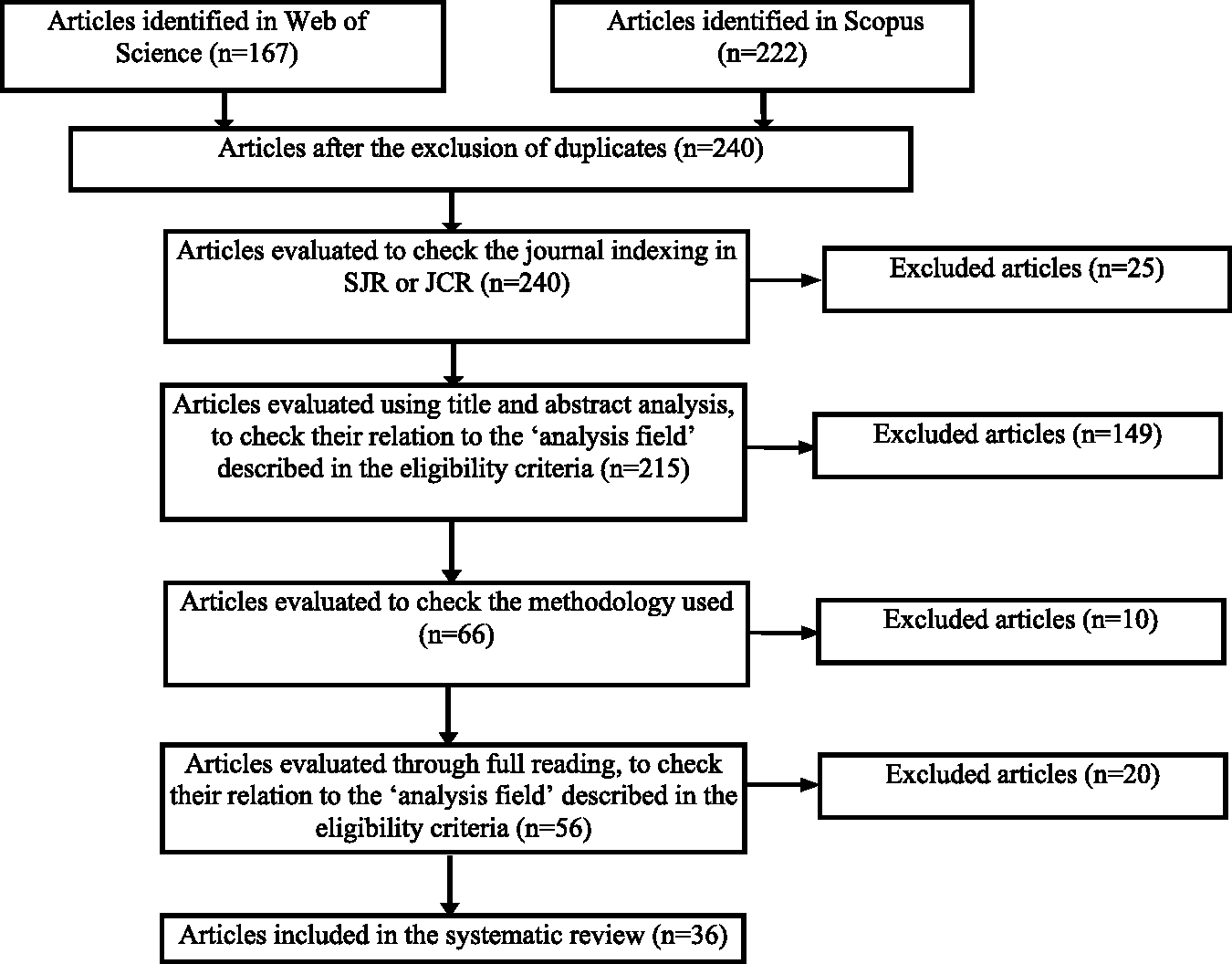
PRISMA flowchart for the literature review process.
Results and discussion
General characteristics of the studies
The studies that constitute this review were published in 30 different journals, involving 102 researchers, and including authors and co-authors, with most publications (63.8%) occurring in 2017 and 2018. A total of 30 articles resulted from research in only one country and six articles made a comparison between countries, among which one article carried out research involving data from 68 unspecified countries.
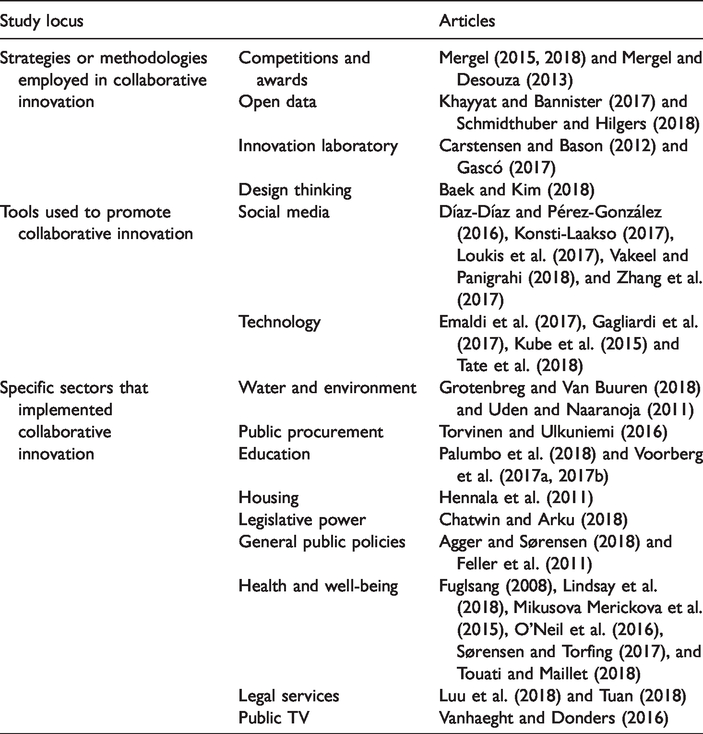
Except for the latter, the studies were carried out in 23 different countries, among which Denmark, Finland, and the Netherlands were the most recurrent countries, with four studies each. The largest concentration of countries is in Europe, representing 69.5% of the total. The other countries are located in Asia (three countries), North America (two countries), Oceania (one country), and Africa (one country). The works analyzed in this review are mentioned in Table 1 and organized according to their main study locus.
Articles included in the systematic review.
Characteristics of governance that foster collaborative innovation
The characteristics that must be present in governance in order for it to contribute to the collaborative innovation process in the public sector were initially identified according to the variables suggested by Lynn et al. (2000): (1) outputs and outcomes; (2) environmental factors; (3) client characteristics; (4) treatments (primary work, core processes, and technology); (5) structures; and (6) managerial actions and roles.
Following this identification, the characteristics were organized into four groups in order to represent the focus of this study in a more didactic way and to facilitate future discussions about potential specific governance arrangements to support collaborative innovation in the public sector. This organization is represented in Figure 2.
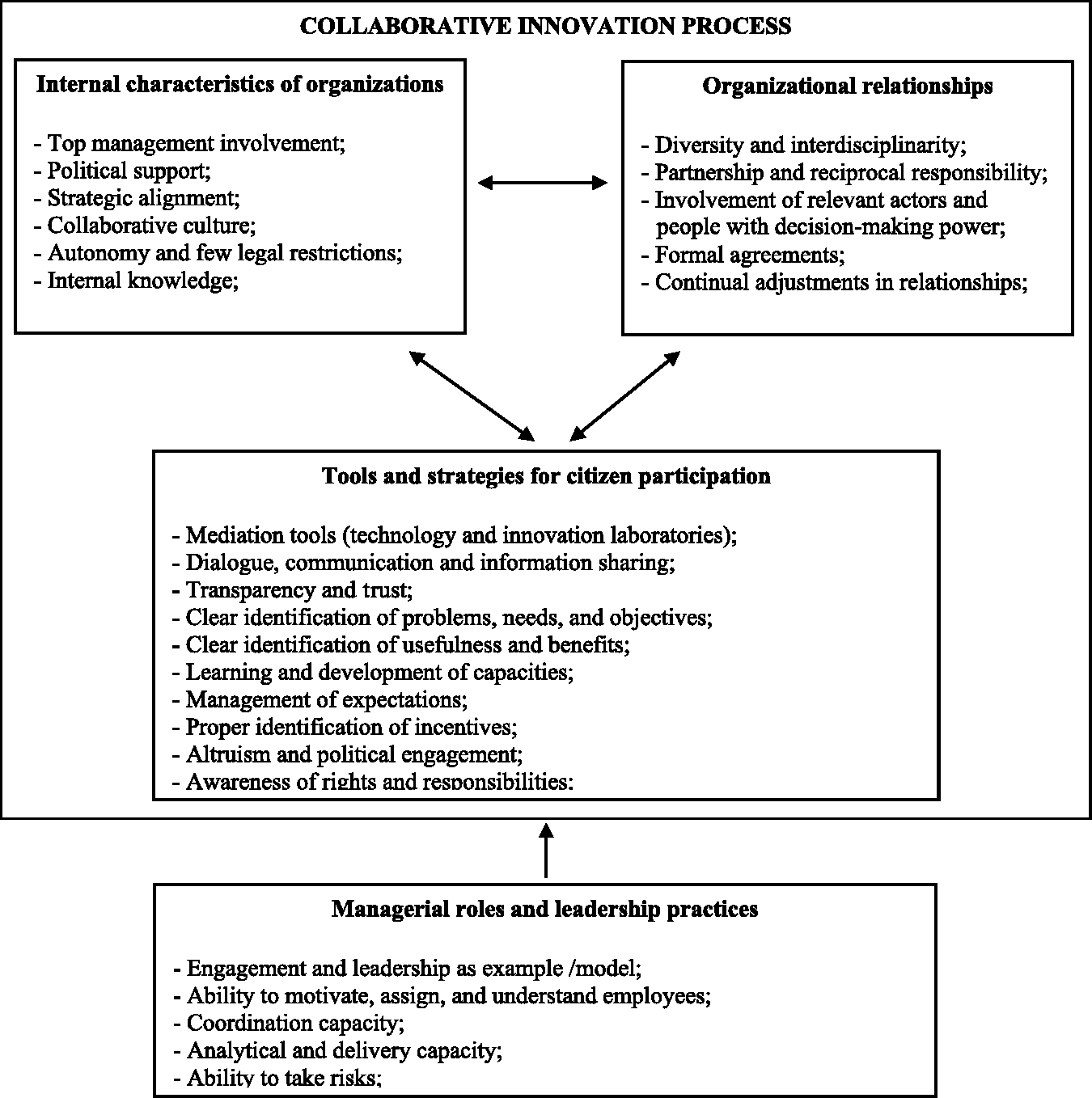
The characteristics of governance that support the collaborative innovation process in the public sector.
The first group—internal characteristics of organizations—includes structure and treatment variables. In the second group—organizational relationships—there are variables related to environmental factors. The third group—tools and strategies for citizen participation—comprises variables related to outputs/outcomes and client characteristics. The fourth group—managerial roles and leadership practices—includes variables related to managerial actions and roles.
Internal characteristics of organizations
The characteristics related to this group were referenced in 10 articles, pointing to the top management or political support as the most recurrent features. As pointed out by Grotenbreg and Van Buuren (2018), authorities need to use all of their capacities to support the collaborative innovation process: regulatory capacity, adjusting their policies and rules; delivery capacity, increasing the viability of implementing solutions; analytical capacity, providing the necessary information; and ability to coordinate, reach the alignment of expectations and the achievement of objectives.
The authoritarian tradition of the government and the few legal restraints were also pointed to as relevant characteristics in two case-related studies in Estonia. These characteristics are related to the autonomy and decision-making capacity of the actors responsible for the collaborative innovation process, making the introduction of it faster and eliminating the need for articulation or agreements with multiple instances of power for its realization (Voorberg et al., 2017a, 2017b). Some studies have also highlighted the importance of aligning the objectives of the collaborative innovation process with the strategic objectives of the government or the organization, that is, the collaborative innovation process must be part of a bigger strategy for achieving a goal (Agger and Sørensen, 2018; Díaz-Díaz and Pérez-González, 2016; Mergel, 2018; Mergel and Desouza, 2013).
Organizational relations
A total of 10 articles (27.7%) identified characteristics related to intra- and inter-organizational interactions. The need for the involvement of multiple actors with diverse roles and interdisciplinary knowledge was highlighted by most of these studies. Lindsay et al. (2018) point out that employees who described more positive experiences of collaborative innovation acted closer to users, prioritizing learning and interdisciplinary collaboration. For these authors, employees must act beyond the specific functions of their jobs and get involved in a more flexible and responsive way in problem solving (Lindsay et al., 2018).
Sørensen and Torfing (2017) suggest the need for a meta-governance strategy to support innovation in order to increase the efficiency, effectiveness, and legitimacy of governments. The authors point out that collaborative innovation requires a diversified group of actors, with different knowledge and experience, which allows for the identification of creative solutions to the identified problems (Sørensen and Torfing, 2017). The participation of relevant decision-making actors so that the innovations can be carried forward is also seen as a success factor for the process (Grotenbreg and Van Buuren, 2018; Tate et al., 2018; Touati and Maillet, 2018).
Agger and Sørensen (2018) draw attention to the importance of actors playing multiple roles: playing a pilot role that aligns collaborative innovation activities with governance objectives; motivating through encouraging other actors to collaborate with the innovation process; being a culture creator, who seeks to develop a culture of collaborative innovation; and being a communicator, who should have the role of creating a mutual understanding between the other actors, who have diverse knowledge, experiences, and perspectives on the process of collaborative innovation. The studies also identified the need to establish formal agreements in which reciprocal responsibilities between different actors should be defined, and that undergo constant adjustments, in order to stabilize relationships and require each participant to support shared commitments (O’Neil et al., 2016; Touati and Maillet, 2018).
Tools and strategies for citizen participation
The characteristics that favor citizen participation were addressed by most of the articles analyzed (25 studies or 69.44%). The importance of a tool or intermediation strategy in the process, such as the use of a technological platform, social media, or innovation laboratories, was the main characteristic pointed out. The use of social media facilitates the identification of the knowledge external to the organizations and communication related to public policies (Loukis et al., 2017), as well as allowing the awareness of citizens’ problems and concerns (Konsti-Laakso, 2017).
The use of technology, both to aggregate information and manage ideas (Emaldi et al., 2017), as well as to facilitate non-face-to-face communication, is also pointed to as an important factor for citizen participation (Baek and Kim, 2018), and the lack of a data management system can be a hindrance to this process (Chatwin and Arku, 2018). Mergel (2018) points to the use of technology as a component of the very essence of open innovation, using online platforms to broaden the inclusion of ideas. On the other hand, the technological platform selected needs to be user-friendly (Chatwin and Arku, 2018; Díaz-Díaz and Pérez-González, 2016; Luu et al., 2018; Mergel, 2018).
Some characteristics that favor citizen participation, though sometimes cited separately, seem to be part of the same set of qualities or attitudes of governments: dialogue, transparency, and trust in both the innovation process and the government itself were pointed to as fundamental for this mobilization (Baek and Kim, 2018; Chatwin and Arku, 2018; Hennala et al., 2011; Khayyat and Bannister, 2017; Konsti-Laakso, 2017; Kube et al., 2015; O’Neil et al., 2016; Palumbo et al., 2018; Torvinen and Ulkuniemi, 2016; Uden and Naaranoja, 2011). The use of monetary incentives is not always relevant, which leads to the need to identify more clearly which incentives actually motivate participation, which may be the very possibility of collaborating with the improvement of public services, the recognition of having one’s own idea used, solving a problem that strikes you, or simply learning (Hennala et al., 2011; Mergel, 2018; Mergel and Desouza, 2013; Torvinen and Ulkuniemi, 2016; Vanhaeght and Donders, 2016).
Thus, the usefulness of the intended innovation or the perceived benefit in relation to the innovation process are also important characteristics for citizen engagement (Gagliardi et al., 2017; Torvinen and Ulkuniemi, 2016), which are also related to the importance of clearly defining the problems to be faced and the objectives to be achieved (Baek and Kim, 2018; Fuglsang, 2008; Mergel and Desouza, 2013). Finally, from the point of view of the characteristics of public service users themselves, their participation is influenced by their knowledge and ability to collaborate with the process (Palumbo et al., 2018; Vanhaeght and Donders, 2016), as well as their sense of social responsibility and awareness of their rights as citizens (Chatwin and Arku, 2018; Kube et al., 2015).
Managerial roles and leadership practices
Characteristics related to leadership or direct managers of the collaborative innovation process were approached in six (16.6%) articles. Luu, Rowley, and Dinh (2018) point out that ambidextrous leadership, characterized by the ability to simultaneously exploit new skills and make the most of existing skills, fosters co-creation. Thus, managers must be able to motivate their employees to develop new skills and make the most of their abilities to more effectively meet citizens’ needs (Luu et al., 2018), as well as create value for themselves and the users of public services (Tuan, 2018).
Studies also point to the importance of some specific managerial skills, such as coordination capacity (Grotenbreg and Van Buuren, 2018), the ability to take risks (Mergel, 2018), and a commitment to process organization (Hennala et al., 2011). For Tuan (2018), the leaders must have a patrimonial characteristic and a certain amount of authoritarianism in order to keep employees aligned with the central objectives of the organizations.
The role of leadership becomes even more important when we consider that the very factors that drive collaboration and innovation are themselves contradictory. While collaboration tends to be favored by a certain similarity of opinions, values, and knowledge among the actors involved, innovation tends to be more productive when there are different visions, ideas, and experiences that complement and counter each other in the search for creative solutions (Torfing, 2019). Thus, the leadership role of mediating potential conflicts through motivating and coordinating the actors involved is fundamental for the success of the collaborative innovation process.
How can governance support the collaborative innovation process?
Innovation in the public sector needs to overcome several barriers, especially those related to the bureaucratic organization model, such as change aversion, rigid controls, and vertical hierarchy (Agger and Sørensen, 2018). Innovation has as its important components interaction between multiple actors and risk exposure: not all solutions are within organizations and not all innovations will be successful. It is important to understand innovation as a collaborative process, which involves different expectations, knowledge, experiences, and roles. To support this process, governance structures need to be appropriate to a reality where the public sector is neither the only nor the most important actor in the innovation process, and the studies evaluated in this review point out ways to do this, as summarized in Figure 2.
Governance structures, in their various models, aim to achieve the direction, coordination, and control of individuals and organizations in pursuit of an expected result (Lynn et al., 2000). Governments seek to organize their governance systems by defining management processes, technologies, and roles to support public policy decision-making and implementation (Janssen and Van der Voort, 2016). In the case of collaborative innovation, the characteristics that should compose a governance model are close to the collaborative governance model proposed by Ansell and Gash (2008): a government arrangement in which public organizations interact with non-state actors to implement or manage public policies through joint decisions.
This arrangement is essentially based on trust and interdependence, involving the collective work of public and private actors to establish rules and procedures for the provision of public services (Ansell and Gash, 2008). In order to foster collaborative innovation, the revised studies point out that the governance structure should therefore predict the building of intra- and inter-organizational relationships based on partnership and the mutual sharing of responsibilities, including multiple relevant actors, with diverse profiles and decision-making power. The potential for stakeholder gains needs to be clear, and the actors involved need to understand the usefulness of the outcome of the innovation process.
On the public organization side, this sense of utility may be related to the need for the strategic alignment of the collaborative innovation process itself with the objectives of organizations or governments. This alignment can be both a cause and a consequence of political support or top management by governments, which is also pointed out by the reviewed studies as a major factor in the success of this innovation process. Contrary to the very conception of collaboration, the authoritarian decision of top management to implement collaborative innovation processes was pointed to as a possible success factor since bureaucrats would tend to follow the superior decision that was made, without imposing any resistance. Thus, a governance structure that supports the process of collaborative innovation needs to have mechanisms that favor integration with citizens and non-governmental organizations, in line with the assumptions made by NPG, but must also include a clear definition of roles, responsibilities and the results to be achieved, the involvement of appropriate decision-makers, and the provision of necessary operational tools, bringing the governance structure closer to the concepts of NPM and the traditional public bureaucracy itself.
Limitations and research agenda
This article has some limitations, especially due to its methodological choices. The study survey considered the terms related to collaborative innovation, open innovation, and co-creation in order to identify research that directly addressed this innovation strategy. However, research that addresses public policy design, while not focusing directly on the topic of innovation, can also provide important insights into building a governance model for collaborative innovation.
Moreover, as reported at the beginning of this article, the term “governance” has several interpretations. The authors chose to identify studies based on the elements indicated by Lynn et al. (2000), which restricts the research to a governance evaluation model. Nevertheless, this article contributes to the advancement of knowledge about the organization and implementation of collaborative innovation processes in the public sector, as well as suggesting possibilities for future studies in this field, as indicated later.
The reviewed studies are concentrated in the investigation of the innovation process, leaving little empirical assessment of the results of innovation. Thus, it remains an open question for future researches to identify the characteristics of a governance model that contributes to the implementation of innovations that lead to transformation or improvement in public services.
Few empirical studies that address leadership in the collaborative innovation process were also identified. Studies of this kind may indicate possibilities for improvement in the process of the selection and qualification of public managers, besides providing important insights into the management of the innovation process.
Finally, the reviewed studies deal with the conditions already installed in the collaborative innovation process, without addressing the path taken to their establishment. New studies could specifically address the process of organizational and cultural change that enables public governance to foster this innovation strategy.
Conclusions
Collaboration has been cited as an important strategy for innovation in the public sector, which leads to the need to further study the different management strategies and governance models that may favor their implementation (e.g. Agger and Sørensen, 2018; Torfing, 2019). This article aimed to identify the governance characteristics that could support the collaborative innovation process in the public sector. The results of the study indicate that the governance structure should predict organizational and managerial principles that involve relevant actors and align the intended results with the strategic objectives of the government or the organization, besides the needs of the citizens themselves. This structure should predict: the participation of top management and decision-making managers; the definition of clear needs and objectives; the generation of useful innovation that brings benefits to stakeholders; and the establishment of tools that facilitate communication, interaction, and the sharing of information and knowledge. The reviewed studies in this article also confirm that collaboration is an important strategy for innovation in the public sector, and it is up to managers and public planners to establish governance principles that could benefit this process.
Footnotes
Declaration of conflicting interests
The authors declare no potential conflicts of interest with respect to the research, authorship, and/or publication of this article.
Funding
The authors received no financial support for the research, authorship, and/or publication of this article.
