



Abstract
This article studies the contribution of exploitative and explorative innovation to the perceptions of economic and social value of local authorities in charge of sustainability-related innovation. The model proposed is tested capturing the perceptions of 656 local authorities. The research findings contribute evidence of complex linkages between innovation forms (i.e. exploitative and explorative) and facets of perceived value. Overall, the link between the perceptions of both forms of innovation and economic value fits March’s (1991) view. A positive effect of both exploitative and explorative innovation on economic value is found, coupled with a negative interaction effect. The influence of exploitative innovation is stronger than that of explorative innovation. However, this is only part of the story. We also consider the link between exploitative/explorative innovation and one additional facet of value: social value (in the form of network identification). The roles of both predictors are virtually opposite: identification is mostly explained by explorative innovation, rather than exploitative innovation. The social value dimension considered in this research adds an explanation as to why public organisations may focus on exploration or combine both exploitation and exploration.
Points for practitioners
• Public managers may focus on exploitative innovation (when economic value considerations are dominant) and on explorative innovation (when social value thinking prevails), or combine both activities.
• Network promoters should not assume that public managers favour exploitative innovation over explorative innovation.
Introduction
March (1991) discussed managers’ perceptions of exploitation and exploration, as well as their effect on the survival of organisations. In essence, he understood exploitation as the refinement and extension of existing competences, technologies and paradigms, and exploration as experimentation with new alternatives. He also explained why managers give priority to exploitation and drive out exploration, employing three core arguments. First, while exploitation outcomes tend to be perceived as proximate, clear and predictable, and are usually positive, exploration returns tend to be viewed as distant, diffuse and uncertain, and are often negative. Second, there are increasing returns from experience, which produces strong path dependence. Third, exploitation and exploration are by nature different activities that require specific and sometimes contradictory resources, which are difficult to bring together. He viewed these factors as drivers of a self-destructive process in which managers favour projects with lower potential returns that nevertheless fall within the current area of expertise of the organisation and do not sustain the reasonable level of exploration that is needed for long-run survival.
This challenging view generated an enormous research effort that has improved our understanding of organisational learning, though we are far from achieving a consensus in many aspects (Junni et al., 2013; Lavie et al., 2010). What is surprising, however, is the overreliance of this literature on the private sector. Some recent studies have focused on the public sector (Boukamel and Emery, 2017; Cannaerts et al., 2016; Choi and Chandler, 2015; Gieske et al., 2019; Kobarg et al., 2017; Palm and Lilja, 2017; Plimmer et al., 2017; Smith and Umans, 2015). These contributions have mostly addressed the concept of ambidexterity (i.e. how public sector organisations (PSOs) may combine/balance exploitation and exploration). As there is a consensus on the idea that ambidexterity is necessary for the long-term success of PSOs (Boukamel and Emery, 2017; Gieske et al., 2019; Plimmer et al., 2017), some of these studies have focused on the barriers and drivers of ambidexterity (Boukamel and Emery, 2017; Cannaerts et al., 2016; Palm and Lilja, 2017). Although these contributions have provided important insights, our knowledge regarding the behaviour of public managers in relation to ambidexterity and its precedents and consequences is still limited (Cannaerts et al., 2016; Gieske et al., 2019). Overall, prior research has focused on how PSOs, which have been mostly designed for exploitation (e.g. centralisation, formalisation and specialisation), could also implement exploration. An interesting response focuses on the concept of contextual ambidexterity, which suggests that ambidexterity could rely on the day-to-day activities of PSO managers, who could combine/balance exploitation and exploration within a supportive organisational context (e.g. decision-making authority or the allowance of errors) (Boukamel and Emery, 2017; Kobarg et al., 2017). Similarly, our study addresses public managers’ perceptions, which is also consistent with March’s seminal approach.
The first parsimonious objective of this research is therefore to test March’s view in a public sector setting. Specifically, our first research question (RQ) is: RQ1: Do public managers’ perceptions of exploitation and exploration fit March’s view?
While testing March’s view is a logic/parsimonious departure point, we believe that it does not provide a complete picture of public managers’ perceptions. In particular, March essentially draws on an economic, not collaborative, organisation-centric perspective, which could be limited in explaining public managers’ behaviour (Kasdan, 2018; Zandberg and Morales, 2019). He implicitly assumes that managers adopt an organisation-centric view, estimating returns, albeit myopically, and costs and risks, and making decisions accordingly; the possible contribution of inter-organisational collaboration and other behavioural drivers is not considered. We draw on more recent networking-focused exploitation/exploration literature (Lavie et al., 2010) and social identity theory (Abrams and Hogg, 1988; Tajfel and Turner, 1979) to supplement March’s view by considering: (1) extra-organisational resources, which have proven to be crucial for innovation; and (2) a social conceptualisation of the value derived from exploitation and exploration activities, which recognises that managers are individuals, not just administrators. While the salience of external sources of knowledge has been noted in previous ambidexterity-related public sector research, no prior study has addressed the social value facet of public managers. Hence, our second RQ is: RQ2: How do exploitation and exploration activities affect public managers’ perceptions of social value?
Research setting
We study networks of municipalities promoted in Spain by regional and/or provincial governments, which are used to foster sustainability. Municipalities constitute the lowest level of government in Spain. The country is divided into regions, provinces and, lastly, municipalities. Spain is a relatively decentralised country, which implies that powers are shared between the different levels of government. Networks are therefore non-hierarchical and informal (there are no legal ties between members), and participation is voluntary.
These networks were promoted in Spain in the mid-2000s. The major rationale for the creation of these networks is clear: most municipalities in Spain are small and virtually unable to meet their sustainability-related goals in isolation because they lack the necessary resources (Barrutia and Echebarria, 2019).
Building on prior research, we describe the networks that we studied as ‘collaborative governance networks’. The term ‘network’ is broadly understood as a set of actors linked by a set of ties. The term ‘governance’ indicates that the main actors in our networks are governments, with decisions concerning network goals and activities being consensus-oriented. Finally, the term ‘collaborative’ stresses the idea that networks involve transformational objectives that are linked to non-trivial, in-depth interactions (Innes and Booher, 2010).
Theory development
Model overview
The model proposed is represented in Figure 1. We propose that the different natures of exploitative and explorative innovation produce diverse effects on economic and social dimensions of value, with value determined by managers’ perceptions. This approach is similar to that of prior private sector research on the link between exploitation and exploration (and/or ambidexterity) and results/performance (e.g. Atuahene-Gima and Murray, 2007; Cao et al., 2009; He and Wong, 2004). The heterogeneity of respondents and their municipalities, and the existence of extra-organisational (mostly network-related) resources, are captured by including covariates.

Model and hypotheses.
Hypotheses development
Effects of exploitative and explorative innovation on economic value
March (1991: 71) defined exploitation as ‘the refinement and extension of existing competencies, technologies, and paradigms’, which are knowledge-related activities involving ‘refinement, choice, production, efficiency, selection, implementation, and execution’. According to Katila and Ahuja (2002), exploitation involves refinement activities that imply learning within the present knowledge frontier of the organisation. Similarly, Lavie et al. (2010) suggest that exploitation is associated with building upon the organisation’s existing knowledge base.
An economic view of value involves a comparison between benefits and costs, and suggests that the perception of value of the local authorities is positive when the benefits stemming from exploitative and/or explorative innovation are perceived as higher than the sacrifices (Zeithaml, 1988). Local authorities are expected to experience positive economic value perceptions from exploitation efforts because exploitation activities: (1) are relatively easy to manage and low-risk; and (2) lie within the area of expertise of the public organisation. Results therefore tend to be consistently positive (March, 1991). When learning efforts are linked to the current knowledge base, organisations may more accurately predict their costs and potential returns (Cohen and Levinthal, 1990), which means that exploitation activities tend to fit expectations, and returns from exploitative innovation are visible in the short term. Therefore, we expect that: Hypothesis 1: Exploitative innovation will have a positive effect on economic value.
March suggests a positive link between exploration and long-term performance, and sees exploration as the only way to guarantee the environmental fit and survival of organisations. This view has been commonly accepted in a public sector context (e.g. Boukamel and Emery, 2017; Geiske et al., 2019). He also contends that managers are not able to properly assess long-term benefits and adopt myopic decisions. In our view, this means that managers perceive exploration activities not as providing negative value, but as producing smaller, and/or more distant and uncertain, levels of value than exploitation activities. Therefore, we expect that: Hypothesis 2a: Explorative innovation will have a positive effect on economic value. Hypothesis 2b: The effect of explorative innovation on economic value will be weaker than that of exploitative innovation.
Public sector research on ambidexterity has mostly achieved similar conclusions. Thus, Boukamel and Emery (2017) suggest that the public sector has traditionally been conceptualised/arranged for exploitation (e.g. silo functioning, the lack of integration and barriers to knowledge sharing), and that transition towards ambidexterity is contemplated as necessary but difficult to implement. Therefore, we expect that: Hypothesis 3: The positive effect of exploitative innovation (explorative innovation) on economic value perception will be weaker as explorative innovation (exploitative innovation) increases.
Effects of exploitative and explorative innovation on identification
Social value is represented in this research by identification. Identification is understood as ‘the degree to which people merge their sense of self with the group’ (Tyler and Blader, 2003: 356) or, in our context, the extent to which a public manager working and co-working comes to see themselves as a person merged with a network of public managers who face sustainability challenges in a collaborative way.
We draw on social identity theory (Abrams and Hogg, 1988; Hogg, 2000; Tajfel and Turner, 1979) to propose that public managers, as individuals, perceive value from identifying with social groups (in our case, networks) due to four major motives, which are interrelated:
Enhancing their self-esteem and positive distinctiveness: self-esteem is evaluated in terms of the prestige, status and social valence (i.e. positive distinctiveness) of the in-groups (i.e. groups to which individuals feel they belong). People therefore need to identify with social groups to elevate their self-esteem (Abrams and Hogg, 1988). Accessing rewarding interpersonal relations: in-groups provide rewarding interpersonal relations, which positively affect the value derived from attachment (Tajfel and Turner, 1979). Reducing uncertainty: individuals like to know the social world and their place within it. When individuals know who others are and how they could behave, they have the necessary information to properly understand who they themselves are and how they should behave. This information emerges by belonging to groups (Hogg, 2000). Achieving optimal distinctiveness: it is argued that individuals pursue optimal distinctiveness, which is understood as the optimal mix of the two characteristics of individuality/distinctiveness and inclusiveness/sameness (Abrams and Hogg, 1988). While isolation may only provide individuality, attachment to certain groups could provide the desired mix.
We argue that sustainability-related innovation networks are appropriate to improving self-esteem, reducing uncertainty, generating rewarding interpersonal relations and providing optimal distinctiveness, which leads to identification.
First, sustainability-related innovation networks are established to respond to crucial societal challenges, which may attach high prestige and status to them, and positively influence the self-esteem of their members. Second, innovation activities can generate high-quality connections due to their natural richness (Dutton, 2003), which leads to task engagement. When all collaborators are engaged in their tasks, they help one another and strong, positive social relationships blossom (Rhoades and Eisenberger, 2002), which contributes to in-depth feelings of attachment to collaborators (O’Leary and Bingham, 2009).
Third, responding to sustainability and innovation challenges is complex and involves a high degree of novelty for many public managers, who are used to focusing on providing traditional services with increasing efficiency. They are therefore highly uncertain about how to behave in order to tackle these challenges. Network membership provides access to methodologies, best practices, in-situ visits and knowledge about how peers are facing up to these challenges, which reduces uncertainty. Lastly, networks could provide optimal distinctiveness. While small groups (such as internal relations within PSOs) satisfy individuality better than mid-size or large groups, they are poor in terms of inclusiveness.
Our specific PSO context seems to provide additional support to explaining the link between exploitation and exploration activities and identification. Specifically, identification could be particularly salient in our public sector context for two reasons:
There is no bottom line in public organisations, which means that (questionably or not) economic value and organisation-centric considerations may not be so dominant for both politicians and administrators (Niskanen, 1971). Public managers could be particularly interested in creating and maintaining a favourable identity within their social context as suggested, for instance, by political marketing views (Scammell, 2015).
Therefore, we expect that innovation activities inside networks, both exploitative and explorative, lead to identification: Hypothesis 4: Exploitative innovation will have a positive effect on identification. Hypothesis 5a: Explorative innovation will have a positive effect on identification. Hypothesis 5b: The effect of explorative innovation on identification will be stronger than that of exploitative innovation.
Methodological issues
Data collection
To test our model and hypotheses, we collected data from 656 municipal managers (273 administrators and 383 politicians), representing municipalities that are members of provincial and regional networks. To access these experts, we first identified the universe of sustainability-driven regional networks in Spain (i.e. 18 networks). Each municipality was represented by a manager in these networks, and these individuals formed our sample framework. We randomly contacted them. Data were collected through a self-reported survey, using computer-aided telephone interviewing (CATI). The average experience of public managers with sustainability-related innovation processes spanned 5.03 years.
Covariates
We considered a variety of individual, organisational and environmental factors in the estimated model. These factors mostly refer to resources, which is consistent with March’s view. At an individual level, we considered the expertise of the respondent, as represented by his/her job tenure (Cao et al., 2009). At a municipality level, we included municipality size and eco-leadership. Eco-leadership is understood as the degree of involvement of the municipality’s key individuals in promoting sustainability-related innovation. The inclusion of this variable is consistent with the crucial role that the public sector innovation literature attaches to the presence (or absence) of key individuals/champions (O’Leary and Bingham, 2009). At a supra-municipality level, we considered environmental munificence, understood as the amount of external resources that the municipality can readily access (Cao et al., 2009). Beyond resources, we also considered the type of respondent (politician versus administrator). Politicians may differ from administrators in terms of their goals and perceptions.
Measurements
Verification of the model was performed on the basis of public managers’ perceptions. Likert-type scales with scores between 0 (completely disagree) and 10 (completely agree) were used. The measurements for the study constructs respond to the concepts provided in the previous sections of this article and were adapted from existing scales. A pre-test of the questionnaire was performed using seven municipal managers (Hair et al., 2010). The comments gathered from these experts led to several minor modifications of the wording and the elimination of some items that were perceived as redundant or confusing. Furthermore, an online pilot study was conducted involving another 20 managers. Table 1 summarises the measurements used, including their sources, along with the descriptive statistics.
Convergent validity and reliability assessment.

Notes: CR: composite reliability; AVE: average variance extracted. ***p < .01; **p < .05; *p < .10.
Exploitative and explorative innovation were measured using three-item metrics adapted from Jansen et al. (2006). The perceived economic value of the innovation was measured with three items resembling those commonly used in previous research (Cronin et al., 2000). Identification was measured using three items from Chiu et al. (2006), who developed an identification scale for a virtual community, a context that is relatively similar to a network.
For control purposes, we considered both latent and observational variables. We used latent variables to measure the eco-leadership of the municipality (Howell et al., 2005) and environmental munificence (Barrutia and Echebarria, 2019). The remaining variables (i.e. politician versus administrator, manager’s job tenure and municipality size) were measured using observational, single-item measurements.
To control for the potential effect of common method variance (CMV) in our results, we obtained responses from two local representatives in 236 municipalities. The complete model was tested for both samples (n = 236 and n = 656) and the results proved to be similar, which indicates that CMV is probably not a concern.
Findings
Measurement model
The measurement model shows a reasonable fit to the data (CFI = .974). Table 1 presents the results of the analyses of convergent validity and reliability for the model. Scale wordings, composite reliability and average variance extracted (AVE) are shown. All items significantly load on their respective dimensions, ranging from .684 to .984. The AVE values obtained are between .690 and .920 (all above .50), indicating convergent validity among items for each latent construct (Hair et al., 2010). All variables show good internal consistency, with construct reliabilities ranging from .868 to .931.
Table 2 shows the results for the assessment of discriminant validity. All comparisons between construct pairs meet the requirements of the criteria (i.e. the correlation between two factors is lower than the square root of the AVE for each factor).
Correlation matrix for discriminant validity assessment.

Notes: Correlations between construct pairs are shown below the diagonal. Square root of the AVE for each construct is shown on the diagonal. *Significant at a 5% level.
Structural model
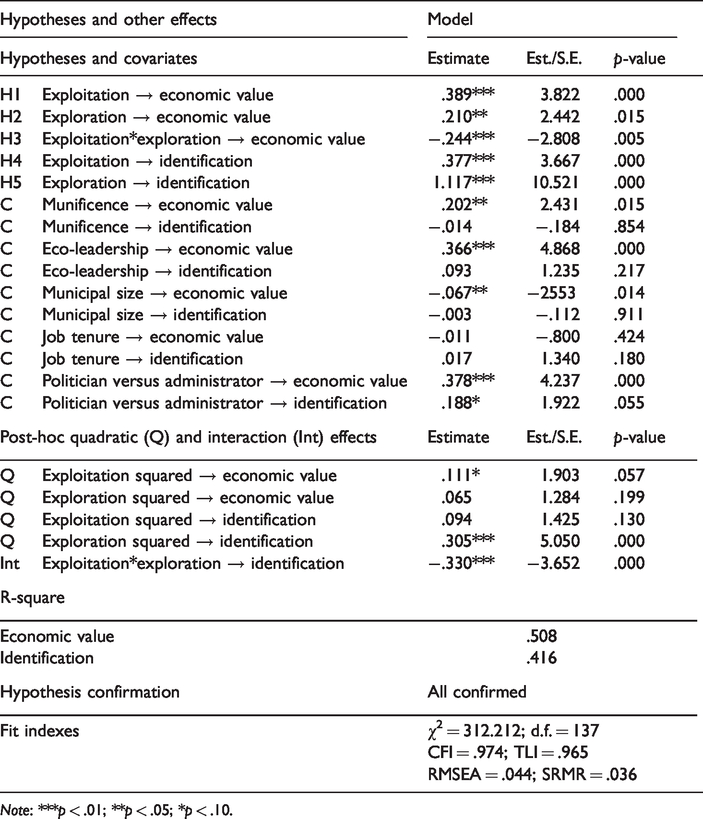
Table 3 shows the results of the structural model, together with the fit indices. All hypotheses are confirmed. The linear effect of exploitative innovation on economic value is proven to be positive (β = .389), corroborating H1. Explorative innovation also has a positive effect on economic value (β = .210), which confirms H2a. As expected, the strongest effect is that of exploitative innovation, corroborating H2b. Finally, the expected negative interaction effect is also confirmed (β = –.244), which corroborates H3. Exploitation and exploration have a significant effect on social value (β = .210 and β = 1.117, respectively), which confirms H4 and H5a. The strongest effect is that of explorative innovation, corroborating H5b.
Structural model estimation.
Note: ***p < .01; **p < .05; *p < .10.
Covariates are proven to have different effects on both facets of value. Municipal and environmental resources seem to be more important for economic value than for social value. Thus, the effects of eco-leadership (β = .202) and environmental munificence (β = .366) on economic value are proven to be significant and relatively strong. However, both variables are proven to have no influence on identification. Municipal size and a manager’s job tenure have no effect on both economic and social value. The impact of the type of respondent (politician or administrator) is significant for economic value (β = .378; p = .000) and marginally significant for identification (β = .188; p = .055).
As Table 3 shows, the estimated model appears to satisfactorily explain the data variance. A substantial proportion of variance in economic value and identification is explained (50.8% and 41.6%, respectively). The fit indexes fall within the recommended limits (CFI = .974, TLI = .965, RMSEA = .036).
Post hoc analyses
To further explore the links between the model constructs, we examined all the possible quadratic effects of exploitative and explorative innovation on both facets of value, as well as the interaction effect of exploitative and explorative innovation on the social facet of value (i.e. identification). As has been suggested, we jointly considered all possible quadratic and interaction effects (Aiken and West, 1991). To estimate these effects, we used latent moderated structural (LMS) equations (Klein and Moosbrugger, 2000).
A positive quadratic effect of exploitative innovation on economic value was observed, though only marginally significant (β = .111; p = .057). This finding is consistent with March’s view of exploitation as a self-reinforcing activity that yields increasing returns to experience. However, the possible increasing return effect of explorative innovation on economic value, due to learning effects, was not confirmed.
A positive quadratic effect of exploration on social value was found (β = .305), indicating increasing returns, coupled with a negative interaction effect of exploitative and explorative innovation on social value (β = –.330). It seems that explorative innovation contributes synergistically to identification by broadening the intensity and diversity of connections. However, when high levels of exploration are associated with high levels of exploitation, the complexity can become unmanageable and local politicians may not be able to provide their ties with the reciprocity they need.
Discussion
We see this research as a first attempt to understand the perceptions of public managers on exploitative and explorative innovation by using cross-sectional research. These perceptions matter as they could be precursors of decision-making and the behaviour of public managers. Our contribution is an attempt to improve our knowledge on public sector innovation and enrich the wider literature on exploitation and exploration, which suffers from an overreliance on the private sector and an economic-driven perspective.
As far as we know, no previous cross-sectional research has tested March’s view in a public sector context. We have taken a step forward towards covering this gap by addressing RQ1. We hypothesised a positive effect of exploitation and exploration on economic value, and a negative interaction effect; the positive effect of exploitation was expected to be weaker than that of exploration. Our data supported these hypotheses. We cannot compare the findings from this part of the model with previous results in a similar setting. However, a large number of research efforts in private sector contexts have addressed the link between both forms of learning/innovation and results/performance; the findings should be compared with care but they represent the nearest thing to a reference point that we have. A meta-analysis conducted by Junni et al. (2013) found a positive link between both exploitation and exploration, and performance, which matches our findings. However, many studies have tested the interaction effect of both variables, obtaining controversial results (some positive, some negative and some with insignificant effects). Our findings fit the results reported by Atuahene-Gima and Murray (2007), who jointly tested quadratic and interaction effects, as we did.
The first part of this research seems to confirm March’s view. However, our data indicate that municipal managers are able to combine exploitation and exploration, at least at a certain level (see the positive and significant correlation in Table 2), which is inconsistent with March’s prediction of exploitation displacing exploration. This apparently controversial result is explained by RQ2, which considers network identification as an additional outcome of exploitation and exploration activities. While the contribution of RQ1 is only empirical, RQ2 tries to provide a theoretical contribution. We draw on social identity theory to argue that the social dimension of value matters and should be included in the ambidexterity debate, which has neglected it. We argue that both exploitation and exploration activities lead to network identification, which creates value for public managers by improving their self-esteem, reducing their uncertainty, generating rewarding interpersonal relations and bringing them closer to optimal distinctiveness. These core mechanisms of social identity theory are particularly applicable to innovation networks, especially in the case of exploration. We have not found a similar contribution in previous ambidexterity literature.
The empirical test confirmed our approach. We found that both exploitation and exploration contribute to identification, though, interestingly, their roles change. The effect of exploration is higher, though exploitation contributes as well. We also found a positive quadratic effect of exploration on social value, along with a negative interaction effect. We have interpreted the negative interaction effect in the sense that an excess of complexity and workload does not fit well with the building of relationships, which should be based on helpfulness and reciprocity.
As the joint effect of exploitation and exploration is difficult to interpret due to the co-presence of positive quadratic and negative interaction terms, we plotted them in Figures 2 and 3. Overall, the contribution of both forms of innovation to the two facets of value is positive. However, while focusing on exploitation seems to be a good strategy to create economic value (see the bottom line in Figure 2), a plausible strategy for enhancing identification (social value) could require combining medium levels of exploitation and exploration (see the middle line in Figure 3).

Economic value perception as a function of exploitative innovation.

Identification perception as a function of explorative innovation.
We controlled for a variety of individual, organisational and environmental factors in the estimated model. Eco-leadership and environmental munificence were proven to have a significant and relatively strong effect on economic value. These findings are similar to those of previous local sustainability literature (O’Leary and Bingham, 2009). The absence of impact of the different forms of resources on identification seems to confirm Tyler and Blader’s (2001) findings that the positive effect of resources on identification could have been overemphasised.
We tested the possible quadratic effects of both forms of innovation on the two facets of value. The marginally significant effect of exploitation on value is particularly interesting as March considers exploitation as a self-reinforcing activity that yields increasing returns to experience. Atuahene-Gima and Murray (2007) and Lavie et al. (2010) extended this argument to both exploitation and exploration when studying a private sector context. This is due to the fact that exploration and exploitation are specialised activities that require distinct sets of skills, capabilities, resources and routines, with the former being particularly complex (March, 1991; Lavie et al., 2010). However, our data do not confirm the increasing return effect of exploration on economic value.
Networking is a popular concept between academics and practitioners interested in the governmental response to sustainability challenges. The United Nations summit held in Rio in 1992 proposed a model of networked governance that has led to the creation of numerous networks of governments at many territorial levels. This research provides some findings that could guide the management of these networks. First, the effects of the exploitation and exploration efforts of municipalities on economic value may be leveraged by external resources. Network orchestrators could therefore provide economic, human and knowledge-related resources that reinforce the link between the innovation efforts of municipal managers and their perceptions of economic value. Beyond resources, network orchestrators could take advantage of the interest of public managers in creating positive connections within their social environments. Exploration is particularly powerful for exploiting this interest and could be promoted by network orchestrators to palliate public managers’ myopic perceptions of the long term.
Conclusions
Public managers’ perceptions of exploitative and explorative innovation are mixed. While exploitation contributes more to economic value, exploration contributes more to social value. This implies that public managers may focus on exploitation (when economic value considerations are dominant) and on exploration (when social value thinking prevails), or combine both activities. Therefore, while this research verifies March’s view within a public sector context, his prediction that exploitation displaces exploration might only be found in public organisations where an economic, organisation-centric perspective dominates. The social value dimension considered in this research adds an explanation as to why public managers may focus on exploration or combine both exploitation and exploration.
Limitations and further research
Factors specific to our context (i.e. Spanish intergovernmental networks) may limit the applicability of the results to other settings. For instance, the financial crisis strongly affected Spain, resulting in major financial constraints for Spanish governments (e.g. a fiscal deficit was not an option for municipalities). As has been suggested in related studies, this situation may have affected the goals and mindsets of Spanish public managers (e.g. Lewis et al., 2017). However, it is not clear how this contextual factor could affect our specific results. Financial constraints may have led to biases in the perceptions of local authorities (e.g. public managers may have overrated the short-term economic value of exploitative innovations and underrated the long-term economic value of explorative innovations). However, it may also be the case that financial constraints led to greater concern for the economic impact of initiatives and more accurate measures of economic value. Further studies conducted in other settings may shed light on the generalisability of our results.
Biases inherent in the perspectives of respondents may also affect results. We found that politicians report higher levels of economic value than administrators. However, the interpretation of this result is not clear. We cannot know whether politicians are too optimistic to justify their decisions or whether administrators are too conservative and exaggerate the costs and efforts involved. While we did not consider the perceptions of citizens, these are critical to assessing the public value of innovation efforts, which should be the main goal of municipalities. There is no guarantee that the perceptions of economic value of public managers lead to public value (e.g. public managers may focus on internal considerations while neglecting the true needs and aspirations of citizens). Further studies may adopt more complex methodological designs that consider citizen perceptions.
Footnotes
Declaration of conflicting interests
The authors declare no potential conflicts of interest with respect to the research, authorship and/or publication of this article.
Funding
Financial support from the Spanish government (Grant number ECO2016-76348-R), the Basque government (Grant Number GIC12/57-IT 60-13) and the University of the Basque Country (Grant Number UFI11/51; Grant Number GIU11/17) is gratefully acknowledged.
