



Abstract
A survey of Canada’s top public servants was used to test the effects on them of the agency version of the public service bargain held by the Conservative government of Stephen Harper (2006–2015). Most results were as expected: increasing politicization and prime ministerial influence added much complexity to the deputy minister’s job; and ministers’ political staffers acted as guardians of the agency bargain. However, the survey led to the observation of a decline in ministers’ powers and to the surprising increase of the parliamentary accountability of deputy ministers, as well as to some challenge to the concept of public service bargains.
Points for practitioners
It is a good idea to consider what the main components of the public service bargain are in any public workplace, that is, what expectations exist about duties, competencies, criteria of evaluation, rewards, and discipline for permanent employees and political staffers. Too strong an agency bargain creates confusion about responsibilities, accountability, and a culture of risk avoidance. Staffers should not disrupt the chain of command and should treat public servants with respect and courtesy.
Keywords
Introduction
How do senior officials cope with attempts to change the conditions under which they work? Interviews with the federal government of Canada’s top public servants in 2015 allowed us to evaluate the impact of changes in the implicit bargain between politicians and public servants in the years 2001–2015, the most important and significant being the arrival in power in 2006 of Prime Minister Stephen Harper (Conservative), at the head of minority governments in 2006 and then a majority government from 2012 to 2015.
This article aims to look at the impact on the public service bargain (PSB) flowing from those changes, both from a conceptual standpoint and as they were thought of by the two leading political parties in Canada. While some literature exists about the perception of chiefs of staff (CoS) of the PSB’s evolution (Craft, 2015; Wilson, 2016), few recent studies deal with the Canadian deputy ministers’ (DMs’) participation in the PSB (Bourgault and Van Dorpe, 2013). This article’s scientific contribution and originality is aimed at learning how the 2015 DMs described the impacts of this evolution on their role.
The concept of PSBs
The concept of PSBs has been used to include “the understandings … that exist between senior public servants and other political actors over loyalty, competency and rewards” (p.17), (Hood and Lodge, 2006). Those questions have long been at the centre of political science debates about politics and administration. They matter, write Hood and Lodge (2006: 10), “because they go to the heart of politics. They are part of the living constitution of any state.”
If we go back to the 19th century, representative government brought with it a struggle between executives and legislatures over the control of public budgets and employment. In personnel, this led to a spoils bargain, which, while still existing as a practice, finds few defenders in the 21st century. In their comparative study of Public Management Reform, Pollitt and Bouckaert (2011: 96) identify the great debate as between a trustee bargain in which senior public servants are seen as trustees or guardians of the public interest insofar as it is embodied in the institutions and practices of the state, and an agency bargain in which public servants are agents or servants whose task is to implement the decisions of the elected government.
The trustee bargain may be recognized by: a certain sphere of autonomy for the public service; the existence of a career service chosen and promoted on the basis of merit competition; the competency of sages; the loyalty of providing safeguards for ministers; relatively predictable rewards; impartial or non-partisan administration, anonymity; loyalty; and accountability to ministers. The agency bargain may be recognized by: an increased concern for political sensitivity; a limited length of time for direct contact with ministers; the absence of a reserved sphere of autonomy for public servants; direct operational responsibility for management but a reduced policy adviser role; a greater sensitivity to media coverage and the direct political influence of pressure groups; moving easily across political and administrative boundaries (personal contacts between the government and senior officials); and performance-based pay and personal accountability.
Comparative bargain components.
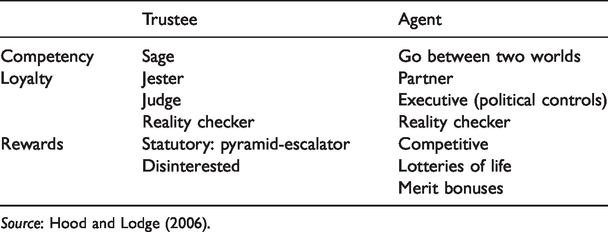
Source: Hood and Lodge (2006).
for competencies: the sage involves intellectual and moral insight; the deliverer gets things done; the wonk possesses the technical knowledge and judgement; and the go between is able to work across different worlds;
for loyalty: the jester acts as reality checker for the ruler; the executive pursues defined goals in some limited and revocable space of action; the judge is a semi-autonomous player being loyal to some higher entity; and the partner acts as an interlocutor and collaborator with rulers, enjoying a right to be heard; and
for rewards: the classical bureaucrat may enjoy a pyramid and escalator career; the noblesse oblige demonstrates a disinterested attitude; and there may be a competitive turkey race or a lotteries of life curriculum.
However, the authors recognized that labels are not mutually exclusive (Hood and Lodge, 2006).
This recent research has considered other players in the PSB: central agencies acting on behalf of the government or the prime minister; and CoS and the staffers who make up the ministers’ political staff (Eichbaum and Shaw, 2007; Shaw and Eichman, 2017). These new players are extensions of the authority of the elected government, and the defining characteristics of PBS systems still lie in the relationship between politicians and career public servants. The aim of this article is to analyze the effect of evolutions in the political-administrative system on the PSBs of top civil servants and to critically reflect on what this implies for our broader insights into evolving PSBs.
Bargains in Canada
Canada provides an interesting case study of the PSB. It was not included in the original study of Hood and Lodge, and it stands at the crossroads of two of the great public service traditions. As Halligan (2009: 307) put it: “Canada has been an enigmatic anglophone country, with a public service system that reflects both the Westminster tradition and the influence of the United States but retains an administrative tradition and public service that are distinctively Canadian.”
Canada has a Westminster-type constitution as some major aspects of political life are governed by convention rather than by written rules, for example, the Crown as metaphor for the state, the rule of law, responsible government and ministerial responsibility, among others. The Public Service Employment Act (S.C. 2003, c. 22, ss. 12, 13) does not provide for a permanent career public service, but, in practice, Canada does have such a service. Bourgault (2003: 28–33) considers that the degree of depoliticization evident in the appointment of DMs is unique among comparable countries.
While a Conservative prime minister at the head of a coalition government in 1918 completed the adoption of the merit system for the Canadian public service, the Liberal Party, by virtue of being in power for over 70 years in the 20th century, had largely shaped the institutions of the Canadian public service in existence when they returned to power under Prime Minister Jean Chrétien in 1993 (Gow, 2004: 6). Conservative Prime Ministers John Diefenbaker (1957–1963) and Brian Mulroney (1984–1993) doubted the impartiality of senior public servants but did not change the basic rules of the PSB. Indeed, while Brian Mulroney had threatened to give them all “a pink slip and a pair of running shoes,” he failed in his goal of recruiting DMs from outside the public service (Bourgault and Dion, 1990: 154).
Canada thus had a trustee PSB, as summarized by Savoie (2003: 5–6): public servants exchanged overt partisanship for permanent careers, or at least indefinite tenure, anonymity, selection by merit, a regular work week and the promise of being looked after at the end of a career that did not require paying close attention to their own material self-interest. Politicians meanwhile exchanged the ability to appoint or dismiss public servants and change their working conditions at will for professional competence and non-partisan obedience to the government of the day.
Even so, the PSB remained much more a trustee bargain than an agency one. As the Task Force on Public Service Values and Ethics, composed mainly of senior officials, wrote, the job of the professional public service was to “speak truth to power” and their loyalty was to “the public interest as expressed in the law and the constitution and interpreted by a democratically elected government” (Tait, 1997).
The 1994 downsizing operation showed how much the Liberal government trusted the public service. Departments were asked to propose a ranking of their activities in order to meet targets set by the Department of Finance, identifying which programs were necessary and which met the public good (Armit and Bourgault, 1996). As Aucoin (2002: 43) added: “It is difficult to imagine that the process used in this case, with its heavy reliance on the public service to manage strategic change, could have been adopted in any of the other three Westminster systems.”
During the years 1993–2006, the Privy Council Office (PCO) stuck to the full classic version of ministerial responsibility, under which each minister is responsible for everything done in his or her department. At the same time, there were pleas to recognize an implicit constitutional convention that the public service was an institution with its own rules and practices (Aucoin, 1997: 24; Savoie, 2006; Sossin, 2006).
However, the first Conservative legislation for administrative reform, the Federal Accountability Act 2006, did not indicate any move towards the agency model. For our purposes, the most important change was to designate DMs as accounting officers, who were responsible before Parliament for financial management, enabling them to require instructions in writing from the minister if the latter wanted to override the DM’s interpretation of any administrative policy or directive. This was a formal amendment of the doctrine of ministerial accountability.
For the remainder of their time in power, the Harper Conservatives were in conflict with many institutions of the state, as well as professional groups and their particular ethical codes. The principal cases include: the firing of the president of the Canadian Nuclear Safety Commission in 2008; cutting scientific positions in the public service; requiring scientific public servants to have a departmental “chaperone” accompany them to scientific conferences and forbidding scientists to give direct interviews to the media (CBC, 2014); long delays in responding to requests for access to information and interference by ministers’ political staff in the material that was provided; and the resignation of the director of Statistics Canada in protest over the decision of the government to make the participation of citizens in the next census voluntary instead of compulsory. They politicized government information to enhance the visibility of the Harper government (Heintzman, 2013: 99–100).
In sum, the Conservative government had a hostile relationship with higher and scientific public servants. It did not accept the previous trustee bargain and clearly thought that public servants should be their servants and not in any significant way guardians of the public interest.
The 2015 study
Assumptions
The general assumption is as follows: in the view of the 2015 Canadian DMs, some elements of the PSB make it more an agency bargain departing from the traditional trustee bargain. We do not expect the total disappearance of the trustee model or the absolute prevalence of the agency model. Rather, we expect some overlap of the two.
The specific assumptions derive from the differences between the agency and trustee bargains: the latter is more autonomous on general mandates; the former is prescribed, being controlled to some extent, and DMs must report on specific results. With the agency bargain:
DMs would feel more pressure to respond quickly to core executive requests; since delivering specific results becomes so important for DMs, we would expect DMs to feel less accountable to parliamentary agents as the search for results would take precedence over concerns for other values of the public service; we expect the Prime Minister’s Office (PMO) and ministers to have less patience with legal safeguards than in the past; and we expect one’s rewards to be based on specific short-term results.
Methodology
The research is mostly based on interviews. Other literature was considered, as well as the performance appraisal program issued by the PCO. Out of 43 DMs, a series of interviews was conducted with 34 in the summer of 2015 before the general elections were launched. All of the interviewees had spent a minimum of one year in the DM community, but four. We also experienced one refusal and four cancellations due to time constraints.
The research replicated the 2001 questionnaire administered to the DMs of the time by the same researcher and method (Bourgault, 2003). Interviews were conducted in the respondent’s language. Respondents were offered the chance to review the notes but only three took advantage of the offer, with two bringing nuances to their answers. This study followed the anthropological approach that Rhodes used for observing administrative elites: hear, see, and report (see Rhodes et al., 2007). To code the major themes, we followed Crozier and McNabb, who recommend “memoing” by combining notes and the empirical patterns of the relevant information since it was a non-structured questionnaire (Crozier, 1964: 45; McNabb, 2013: 401); answers were then regrouped into those categories.
Respondents were not provided with differentiated options to choose among. With such an open-ended questionnaire, the words expressed are spontaneous and the context of the sentence may reveal a position, though interviewees did not overtly mention a specific element. This is why the expressed positions become more significant. Given the approach and methodology adopted, the reader cannot expect precise figures and percentages. The results are presented as 2015 tendencies distinct from with 2001. 1 Quotes are provided to illustrate the opinions.
Results
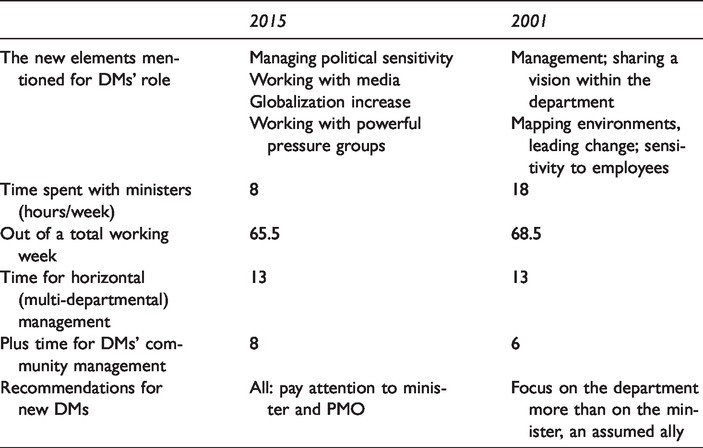
As per Table 2, the interviews revealed that the DMs’ concerns moved from looking inward to the department (vision, morale, leading change) to looking around (media, globalization, pressure groups).
Comparing critical factors and time allowed (hours/week).
Competency component
From the interviews, we see that in the DMs’ opinions, the intellectual and moral insight competency has not disappeared, while getting things done properly mattered the most. The ability to work across different worlds became more important, and as DMs are moving between departments, possession of full technical knowledge is rather infrequent.
Competency for delivering
The 2001 governmental agenda was not that specific. While only one interviewee said the situation is the same as before, most of the 2015 DMs spontaneously said that they felt intense pressure to deliver on the government’s agenda, with little discussion on its merits: “This government had a firm agenda and the will to deliver it … including when needed, against the public service.” In 2001, they devoted most part of the agenda to departmental projects. In 2006, there were five strong electoral priorities interpreted restrictively by the Prime Minister: “By chance, the department was within the priorities!” said a 2015 DM, while another regretted that “his projects were left on the back burner at the expense of the public interest.” Then came the deficit reduction action plan (DRAP), and DMs were controlled and appraised on this basis.
In 2015, the terms “speed,” “velocity,” and “instantaneous responses” were mentioned by all respondents. Much more than in 2001, ministers and PMO staffers wanted quick and valid responses to questions, issues, and projects; some staffers were activists and promoted the PMO’s views since a staffer’s career is decided by the PMO. Many DMs said that this may create dangers of errors and rebounds.
As delivering specific results became so important for DMs, we expected 2015 DMs to feel less accountable to Parliament and parliamentary agents since the emphasis on results may diminish concern for other values of the public service. We expected that resources invested in accountability to Parliament would diminish. However, to the contrary, we found that the multiple agents of Parliament demand and receive lots of time, attention, and resources from departments. DMs’ accountability is now more multiple, public, divided, and complex. Resources devoted to parliamentary accountability have increased.
Many 2015 DMs referred specifically to the central values of public service guarded by the more numerous parliamentary agents (for example: Office of Auditor General; environment and sustainable development; Public Service Commission; ethics and conflicts of interest; public sector integrity; official language; privacy; lobbyism; access to information; etc.). Accountability before the Parliament was described as much more important: I appeared 104 times in seven years. Before, it was one to two times a year (especially for main estimates); now, it could be 10 times a year. Preparing for those appearances is so important and may be time-consuming … not less than if you miss the point when you appear!
Competency for going between the two worlds
Institutional rules have changed over the last 20 years, particularly under Harper’s government. The following examples were provided spontaneously by the respondents: a majority viewed the cabinet’s role as reduced in the formal decision-taking process, with the reduction of cabinet meetings and their replacement by private conversations, letters from the Prime Minister, and the Plan and Priorities Committee decisions as an inner cabinet (Brodie, 2017: 53); the reduction of authority for most of the ministers impacts on the DMs’ loyalty and responsibility; DMs viewed the red lines separating politics and administration as more difficult to respect (Heintzman, 2016); modes for resolving conflicts make the PMO more influential than ministers; the ministers’ secretariats evolved from mailboxes to brain trusts since ministers’ offices have more staffers than previously, who mostly do analytical work (“DMs say staffers, advocating more than analysing, replicate what public service does in providing due diligence, and in the end, there is not a lot of political input added by staffers”); and DMs spend less time in direct meetings with ministers (from 18 hours to eight in 2015). Political staffers were described as intrusive, obstructive, intimidating, and rude. With more staffers and more ambitious ones, some red lines needed revision. Relations with politicians are no longer partnerships. DMs’ telephone access to the minister in certain departments is restricted. Some DMs said that they would only have frank conversations with ministers when nobody else was in the room.
Concerning political sensitivity, DMs spend more time reviewing information on the nets, checking the tone, angle, words, confidentiality, and the protection of department’s interests, and trying to match media lines with the minister’s secretariat and PMO’s communication unit, all this before transferring it formally to the PMO. DMs in 2001 were the uncontested principal advisers for ministers, and they expressed no fear for their own authority. In 2015, DMs made the point that CoS, chosen and controlled by the PMO, had a weekly meeting directed by the PMO, providing space for connections and transactions. There were also morning phone calls on issues at 7 a.m. and CoS were expected to have ready answers. The PMO was said to be involved in government initiatives, as well as in a department’s core agenda, acting as a relay and a screen. It got to the point that some ministers asked for DMs’ advice as they feared that their CoS were too close to the PMO! It could also be the opposite: “Sometimes the CoS can get my advice to the minister better than I,” said a DM. Another was happy with this, preferring the CoS to be in the room and getting the opportunity to be convinced. DMs needed to adapt to the new type of relation with staffers. They saw political interference in the routine course of operation of a department; a vast majority of DMs said that they had to “set the rules of engagement firmly at the very start and stand by them.” Some DMs admitted that they had not succeeded.
DMs in 2015 said that any memo coming from the public service was matched with a memo from the political staff. Staffers might have the last word with the minister, which is a significant change. If the CoS was young and ambitious, DMs were not sure that all their pieces of advice made it to the minister and many decisions were said to be made solely by the CoS. Some DMs wanted to make sure that any decision or instruction came from ministers themselves and asked to have something written down. When staffers insisted, the DM would write to the minister: “Is it really the case…?” It happened that the minister replied: “Tell this guy to calm down.” … it was more difficult for a newly appointed DM. In sum, 2015 DMs viewed a greater importance in navigating proactively between political and administrative waters.
Parliament’s agents are now more numerous than in 2001. More reporting has increased media attention, requiring more time from the DM as a manager of the organization’s reputation, its morale, and his own reputation; in doing so, the DMs became more visible. The interviews revealed that parliamentary accountability requires more resources for dealing with agents’ reports (preparation, validation, negotiation, reforms). DMs say that the reporting mechanisms are a control, consuming time, energy, attention, and resources, and countering innovation, risk management, and flexibility.
The loyalty component
Moving from a trustee to an agency bargain, we expected the DMs to feel that the PMO and ministers had less patience with legal safeguards than in 2001. Do the 2015 DMs see themselves moving from jesters and judges to executives and partners?
After 2006, changes in procedures and personnel caused DMs to move from the minister’s executive to the Prime Minister’s one. There was a proliferation of letters to the Prime Minister becoming the real decision-making process that a memorandum to cabinet would only confirm later. This raised an accountability issue.
The most disconcerting factor was the decrease in the role of ministers, as DMs put it: “My primary role as a deputy minister is to support the minister, not the PMO. This is more difficult to accomplish when ministers have less authority.” Lots of ministers were said to be under close supervision by the PMO, not only for huge projects, but also for little things.
The Treasury Board (TB) ministerial committee was described in 2015 as ideological and “looking too much into the details.” Some DMs expressed dissatisfaction with the PCO: “We feel the heat.” Central agencies tend to act as political intermediaries and as firewalls, creating a system of controlled loyalty. There was dissatisfaction with political institutions like the PMO, “moving from being an influence to being an interference.” Political controls intervened; in 2015, there were restrictions on the expenses that a DM could authorize and on the communication function—a DM should request a specific authorization to make a speech to a university class.
The traditional DM’s role included reality checking for rulers (jester’s role), as well as loyalty to some higher concept like the public interest. The Harper government’s attitude toward the civil service was said to be more one of suspicion, with low levels of trust toward the quality of professional advice (its capacity, speed, and skepticism: “They see us as an opposition in residence”). “I have to choose my battles,” said a 2015 DM. As many 2015 DMs put it, staffers intervened despite conventional rules, though many claimed that relations with departments were “good” (Craft, 2015). The old rules of non-partisan interventions were at bay; some clerks were described more as a representative of the government vis-a-vis the public service than the opposite (Heintzman, 2016).
Very little evidence appears for loyalty between partners, except for the bonus system, which does not qualify as ideological partnership! Loyalty does not play out as it did traditionally, when ministers would usually take the heat for everything on behalf of their administrative partner. DMs sense that they need to insist that the difficult decisions be made officially by the minister and engage their accountability. To many, the core executive has made the new managerial accountability divided and multiple: “There is separation now between the two responsibilities. The minister will say in private, ‘This part is your business and I will say it publicly.’ They tend to distance themselves from us.”
Political masters asked not only for active compliance, but also for enthusiasm: “emerging from anonymity to become public actors in their own right” (p.305), (Grube, 2014). The culture of entrepreneurialism creates a moral obligation to look at short-term results, which a learned panel has seen as a “dictatorship” (Public Policy Forum, 2015) that may lead to servility (Heintzman, 2016).
Once exceptional, the dispute resolution mechanism—a brokering strategy for resolving conflicts—became a frequent process after 2006. One DM said that he attended more than 100 such encounters. For these “square dance meetings,” the PMO, PCO, the minister’s office, and the DM’s office meet to discuss, and ideally settle, issues and conflicts. It is usually called by the PMO in cases where they are not satisfied with how a file is progressing and it seems that the PCO and the minister’s office are muted. For questions about issues in Harper’s days, the PMO would go directly to departments. DMs are very uncomfortable with this since it changes relations with ministers.
Rewards’ component
Rewards are viewed by Hood and Lodge on a continuum moving from a pyramid and incremental career to some wild competition, with the noblesse oblige or disinterested and the lotteries of life curriculum. With the agency bargain, DMs would experience more rapid turnover and comply more with the government’s targets in order to get promotions and bonuses.
In 2001, interviewees had been in the job for 3.4 years at the moment of the interview and would keep their assignment for 4.7 years in all. In 2015, those figures moved to 1.89 and 2.27 years, respectively, but need three qualifications: first, duration has constantly been reduced since 1867 (from 13.3 years to 6.76 years in 1997); second, duration is linked with government changes and a government change occurred in 2015 2 ; and, third, those figures need to be completed with duration in the community, 3 which moved from 6.5 years in 2003 to 4.8 years in 2015.
Rewards in money changed over the years. The new 2001 system for annual performance appraisal insisted on bureaucratic targets, which led to quotas and modest pay bonuses. The 2015 performance agreement bears four components, with results on: governmental policies and programs; management; o leadership (including government objectives); and departments’ objectives. Very many DMs mentioned the importance of the budget DRAP in their annual performance evaluation. In 2015, the Prime Minister played a more active role in the final decision. Apart from economic progression and scale progression, one can enjoy an “At risk bonus”, 4 plus a premium if the person has outperformed the expected results. Depending on the DM’s grade, the two latter bonuses can reach up to 39% of basic pay when they outperform the targets. All those sums contribute to the individual’s pension plan. This performance appraisal system is taken very seriously since many DMs prepared for the interviews, handling their departmental managerial accountability framework (MAF) results and the results of the employees' survey result. Since not everyone gets the 39% maximum bonuses (only 15% of them got it), there may be a competition for this. The performance appraisal process is a tool that politicians took advantage of for budget reduction targets and for the implementation of the Phoenix pay system.
Discussion
The general assumption is that in 2015, some elements of the PSB made it more of an agency bargain, departing from the trustee bargain. We did not expect the full disappearance of the trustee model or the absolute prevalence of the agency model. Differences between agent and trustee bargains are about autonomy, political controls for specific results, and rewards.
This article demonstrated the impacts of the changes to the governance system within the core executive (Craft, 2015) on the DMs’ role in Canada. DMs say that they feel the political heat. They view the weakening of the PCO as a central political-administrative agency to the PMO’s benefit as a tool for the Prime Minister’s personal power, creating a new governance mode. Consequences were observed for cabinet, for ministers, for the PMO, for DMs, for staffers, and for the public service.
We have observed more specific governmental political objectives to meet, more political controls, and less autonomy for senior officials. Most of the findings tend to confirm the move towards the agency bargain. DMs face competition, with greater political influence from components of the core executive like the PMO (for policies and issue management), CoS and ministers’ staffers (for policy analysis and results control). The centralization of communications at the PMO further impinged on DMs’ control of their jobs. The decline of the power and influence of ministers themselves further complicated the task of DMs since a DM can hardly play their role for a lame minister.
Changes in the bargain.
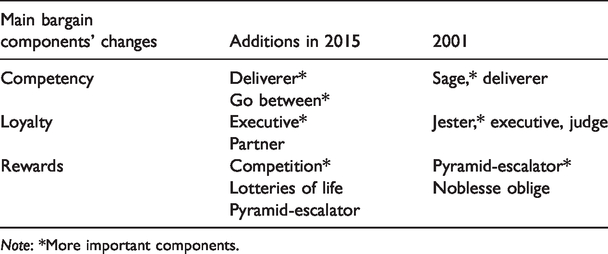
Note: *More important components.
We expected bad relations with and direct political interference from staffers. New roles for staffers after 2006 include intervening in departmental management to get sensitive information or instructing departments in preparing proposals in line with governmental agendas (Craft, 2015; Wilson, 2016). DMs are challenged to navigate through those practices that draw the public service into the political arena. The move toward an agency bargain had already involved some functional politicization 5 of DMs (Savoie, 2003). The reality-checker function now involves as much political as legal and practical consideration.
Some important elements of the trustee bargain have remained: for competency, recruitment still allows for merit and intellectual and moral insight; for loyalty, DMs are still advising as jesters and judges; and for rewards, the system is still following career patterns, and seeking peer group opinions on individuals’ performance.
Accountability to Parliament has not shrunk, but rather increased, possibly because of two factors: first, the MAF developed by the Treasury Board Secretariat (TBS) includes the political system’s expectations in terms of policies to perform: transparency, accountability, parliamentary agents’ mandates (public sector ethics, people management, information management, etc.); and, second, the Accountability Act made DMs Accounting Officers who will have to answer precise questions in the Public Accounts Committee—“There are pressures to accelerate the issues and cases processed. It is not easy to do with the budget reductions. Not all ministers understand the issue for a DM.” Performance concerns are a matter of pride for DMs and departments. Some respondents mentioned the dark side of performance: it is impaired by avoiding risk, and DMs’ performance appraisals may not reflect the real performance since the most sensitive targets are narrow.
The rise of information technology is seen as a risk since whatever a DM writes could be in the news the next day, when social and mass media take it, the political class comments, and ministers want an instant response. The performance management system for Canadian DMs contributes boldly to the rewards, impacting on mandates, salary increases, bonuses, and careers. The government’s priorities play a more important role in setting the performance targets and deciding the final appraisal, which contributes to the agency bargain.
DMs spent more time managing the community in 2015 (eight hours/week) and said that they seek more experience around the DMs’ table. Among departures of DMs, identifying firings is a tricky matter: some DMs would not suffer those staffers’ intrusions anymore; some others retired to avoid another change of government in 2015; some could be pushed gently to leave; or some could leave due to the discomfort with the way things are unfolding. The shorter assignments signal that the DMs’ relation to politicians is moving toward the agency type of bargain, while a longer duration provides networks, experience, and confidence, which are all tools for any DM. DMs have a more public role but they need to play it with some prudence when the loss of anonymity may make someone targeted quit.
Gow’s (2004: 21) study of the Canadian model of public administration found that senior public servants in Canada exhibited a “fairly strong tolerance for ambiguity” because they had to keep in mind the overlapping nature of governmental jurisdiction in Canada, the multiplication of parliamentary control agencies, and the omnipresence of native peoples’ rights and environmental conditions. Here, we found increased ambiguity because of the increased role that political actors wanted to play. In these circumstances, new competencies are required of DMs. According to Bourgault and Van Dorpe (2013: 16), managerial bargains: need to recruit a new type of top official: a decrease in law and technical expertise for the job; greater manager-leader competencies; a capacity to cope with the increasing role of the political center accompanied by more administrative accountability; a greater sensitivity to governmental political agendas; a new role of policy advisor … and a greater degree of attention paid to service delivery.
A retired federal mandarin proposed to rewrite the bargain clauses and make the “moral contract” explicit in a charter of public service that would include a catalogue of public service values and the moral contract between ministers and the public service (Heintzman, 2013: 85). Finally, our analysis is consistent with the finding of the Auditor General of Canada in his spring 1918 report that the government suffers repeated “incomprehensible errors” because the short-term emphasis on results and obedience has created a public service culture “that fears mistakes and risk” and is “unwilling to hear hard truths” (AGC, 2018).
Concerning the PSB, this article on a country case like Canada brings some contributions to the literature. The agency bargain derives from principal–agent theory in modern political institutions (Buchanan, 2002). However, here, we have found more than one principal (Parliament, the Prime Minister, the PMO, the PCO, CoS, and staffers), as well as a great variety of actors. Therefore, predictability is not always possible. Confirming Hood and Lodge’s (2006: 163) remarks on two elements changing PSBs, Harper’s election and process reforms are the sudden change, accompanied with some cheating on the old rules. Evolution may create a mishmash of bargains since elements of the trustee bargain survive the move towards an agency bargain. Findings lead us to believe that the agency bargain does not have to be a partisan one. Devices for selection, promotion, bonuses, and community control may avoid the need for hiring partisans. With this increased influence from the staffers and the PMO, one could ask as to whether the political component overshadows the administrative component. Minister’s offices are no longer a simple mailbox, but have become a political screen and minders’ nest.
Further research has shown that due to institutions, the political context, and new politicians’ needs, the PSB model quickly becomes much more complicated than a model with two parties and three components each. This recent research has included other players in the PSB: central agencies acting on behalf of the government or the Prime Minister, CoS, and the staffers who make up the minister’s political staff (Eichbaum and Shaw, 2007; Shaw and Eichman, 2017). These new players are extensions of the authority of the elected government, and the defining characteristics of PBS systems still lie in the relationship between politicians and career public servants. Our results concur with those observations, though there is a hierarchy of influence on the 2015 DMs: the PMO’s CoS, the PMO, the PCO’s clerk, the TB, the TBS, and other CoS.
Conclusion
This study allowed us to evaluate the notion of PSBs. The notion of an agency bargain was a useful tool in suggesting where to look. For senior officials, the new loyalty basis became accepting and coping, and there was little welcome for safety advice. Competency became the ability to deliver from inside the department after being told what to do by political masters. Rewards were concentrated around performance bonuses.
“Bargain” is a misleading word. A bargain requires consent on both sides, which is not really present here. Mulroney overcame his distrust of the public service, while Harper did not. Political actors have the initiative and administrators are left with the choice between conforming, moving, or subtly sabotaging unwelcome political initiatives. Between Parliament and the government, there is a concern with accountability, the latter integrating and interpreting elements of parliamentary accountability. Moreover, as Cooper (2016) demonstrated, both of these bargains, and their claims to universal application, run up against changes over time in the dynamics of political-administrative relationships.
From our observations, it could be said that a bargain’s performance zones moved from separate to superimposed in the Harper years, where DMs were seen as entrepreneurs expected to deliver on plans. Some DMs claimed that there is an issue with this blurred accountability and the loss of influence of the public service. Those remarks on Canada’s case bear imitations due to its institutional, historical, and cultural particularities.
Agency theory reminds us that although the bargain is not a true bargain, unless the political masters give some attention to the needs and wishes of competent senior public servants, they may find themselves faced with the kind of recruiting and staffing problems encountered by the Trump administration after 2016. Nothing here is irreversible. The Prime Minister retains discretionary control over the organization and operation of the core executive. Canada may not be alone in this situation of increased political control over the administration. It also seems that it is not only a priority of Harper since Trudeau, whose election was widely saluted by federal public servants, continued many of those practices. Some echoes tend to demonstrate that fundamental changes have remained, like the centralization around the Prime Minister. 6 Everywhere, there is more pressure from the core executive to have the public service respond quickly to political requests concerning governmental agendas and hot issues (Connaughton, 2015; Rhodes, 1995).
Footnotes
Acknowledgements
The authors are grateful to the anonymous reviewers, who provided useful suggestions.
Declaration of conflicting interests
The author(s) declared no potential conflicts of interest with respect to the research, authorship, and/or publication of this article.
Funding
The author(s) received no financial support for the research, authorship, and/or publication of this article.
