




Abstract
What do employees think when their organization’s change programme has led to a growth or reduction in the number of employees in their work unit or workgroup? While we take for granted that employees generally do not respond well to organizational initiatives that reduce the number of personnel, we are less certain about their response to organizational efforts that raise the number of personnel. Using the Australian Public Service Employee Census, containing over 24,600 responses, this research finds that employees’ exposure to a major organizational change that raises or reduces the number of personnel in their workgroup is related to two employee outcomes: (1) implementation of innovation-related change in their workgroup; and (2) optimism about the long-term benefits of the change on their workgroup’s performance. Innovation-related change also moderates the relationship between personnel-related change and optimism about the long-term benefits of change.
Points for practitioners
Employees who experience a reduction in the number of personnel in their workgroup may pursue innovation. When employees experience personnel growth in their workgroup, those who implement innovation report higher levels of optimism about organizational change than those who do not implement innovation. Finally, how well leaders manage the change process during personnel-related change can shape the employee implementation of innovation and optimism about organizational change.
Introduction
Organizational change is now a common phenomenon in the public sector across many countries (Cejudo, 2008; Rochet et al., 2008; Van der Voet and Vermeeren, 2017). Organizational change often involves a change in the number of employees. What do employees think when their organization’s change programme has led to a growth or reduction in the number of employees in their immediate unit or workgroup? Although there are numerous studies on cutback management (Brockner et al., 1985; Kickert et al., 2015; Raudla et al., 2015), studies on personnel growth, especially employee responses to it, are scarce.
On the one hand, the addition of new personnel into a workgroup may be well received by its members, particularly when they are understaffed or it is a result of a prioritization of a particular policy domain. Under such conditions, employees may respond positively to personnel growth in their workgroup, as suggested by the psychological contract theory (Coyle-Shapiro and Conway, 2005). On the other hand, employees may view personnel growth as disruptive. The addition of new personnel to perform new roles may cause structures to change. If the organization is facing a turbulent environment, then such structural changes may further destabilize it (Boyne and Meier, 2009a) and undermine performance, as suggested by the structural inertia theory (Hannan and Freeman, 1977). Here, employees may not respond positively to personnel growth.
This study examines the work attitudes of Australian federal government employees who have been directly affected by changes in the number of personnel within their workgroup as a result of major organizational changes. Most employees may not be fully aware of changes occurring across their organization, but they are likely to notice organizational changes that have recently been implemented in their immediate unit or workgroup. This study compares employee perceptions of major organizational changes that are linked to personnel growth with those that are linked to personnel reduction at the workgroup level.
The objectives of this study are twofold. First, it examines the relationships between perceived major organizational changes that raise and reduce the number of personnel (henceforth called personnel-related changes) and two employee outcomes. The first outcome is perceived implementation of innovation-related changes. Organizational innovation is broadly defined as the adoption of a new idea or practice in an organization (Damanpour, 1992). Innovation is viewed as crucial for maintaining or improving public service delivery, especially during cutbacks (Torfing and Triantafillou, 2016). Yet, there is an ambivalence about cutback management’s relationship with innovation. According to Van der Voet (2019: 152), these two concepts ‘have largely remained separate areas of interest’ in public administration. This study can contribute to the public administration scholarship on cutback management and innovation.
The second outcome is employee optimism about personnel-related change. Change failure is often attributed to employee resistance to or cynicism towards the change (Buick et al., 2018). The latter is defined as ‘a pessimistic viewpoint about change efforts being successful’ (Choi, 2011: 487). Conversely, employee optimism refers to optimistic perceptions about the long-term success of the change efforts in terms of their capacity to deliver benefits to workgroups, such as improving their performance. Employees undergoing organizational changes often face uncertainty. Perceptions that the change efforts can deliver work benefits can improve their response to change (Rodell and Colquitt, 2009).
Second, this study investigates whether the implementation of innovation-related change moderates the relationship between personnel-related change and optimism about the change. If innovation-related change contributes to favorable attitudes (Kiefer et al., 2015), then it is possible that innovation-related change strengthens the positive relationship between personnel-related change and optimism about the change. This article starts by drawing upon two contrasting viewpoints about the effects of personnel-related changes on employee outcomes.
Psychological contract perspective of personnel-related changes
Exchange and reciprocity are central to psychological contract theory. The psychological contract is an individual’s beliefs about the terms and conditions of an exchange relationship with another party (Rousseau, 1989). The discrepancy between what is promised and what is fulfilled provides the basis on which employees reciprocate (Coyle-Shapiro and Conway, 2005). The promissory obligations between parties to this exchange are not necessarily explicit. The presence of incomplete contracts would suggest that they are often unspoken and implicit.
A psychological contract breach occurs when employees are cognitively aware that their organization has failed to fulfil one or more promissory obligations (Morrison and Robinson, 1997). This breach is a disruption to the ongoing exchange process in the psychological contract (Coyle-Shapiro and Conway, 2005). When employees believe that an organizational change violates explicit/implicit promises made by their organization, they are likely to experience emotional distress, as well as feelings of betrayal.
Public employees are generally more sensitive to a psychological contract breach associated with organizational change than private sector employees. Compared to private organizations, public organizations traditionally enjoy more protection from economic cycles (Conway et al., 2014) and more predictability in resource inflows (Pandey, 2010). The social contract in public organizations, which emphasizes job security, employee benefits and equitable treatment (Kelman, 2006), suggests that employee expectations of organizational stability, job security and equitable treatment are traditionally greater in the public sector than in the private sector (Pandey, 2010). The implicit psychological contract between public employees and their organizations is therefore likely to be stronger. They may also view government cutbacks as conscious policy decisions rather than events imposed by impersonal forces (Kelman, 2006). Based on this theory, the relationship between personnel-related change and desirable employee outcomes can differ, depending on whether a psychological contract breach occurs. This is discussed later.
Structural inertia perspective of personnel-related changes
According to structural inertia theory, personnel-related change can undermine performance because organizations ‘spend most of their time adjusting structure and very little time in organizational action directed at other ends’ (Hannan and Freeman, 1997: 958). Boyne and Meier (2009b: 806) state that: ‘When structural change occurs, internal routines are destabilized and uncertainty is created.’ Power and Reid (2005) went as far as to argue that an organization’s performance is hindered more by internal instability than external instability.
In their 1993 study, Amburgey and associates (1993) argued that the disruptive effects of structural change can make it harder for organizations to perform effectively in a turbulent external environment. If an organization is experiencing external turbulence, then the internal turbulence generated by structural change can make things worse. Employees may face more challenges in completing their tasks. In contrast, internal stability enables an organization in a turbulent environment to devote its attention and energy to dealing with the external challenge instead of struggling with the many problems of implementing personnel change (Fernandez and Rainey, 2006). For example, Greenhalgh and McKersie (1980) argued that layoffs can disrupt teamwork and reduce productivity.
The negative effects caused by the disruption associated with personnel change are not confined to downsizing. They can also occur with personnel growth. Using an eight-year panel data set of the performance of more than 1000 Texan school districts, Boyne and Meier (2009b) found that the organizations that pursued structural change in response to a turbulent environment performed more poorly than the organizations that maintained structural stability. They stated that ‘regardless of the content of the change itself’ (Boyne and Meier, 2009b: 806), internal change undermines performance because the process of change is disruptive. The addition of new people in an organization is likely to lead to changes in structures and personnel. Structural change can negatively affect other internal organizational characteristics, such as work procedures and budgetary processes (Koberg, 1987). This implies that both personnel growth and decline are inversely related to desirable employee outcomes.
Personnel-related changes on employee outcomes
Reduction in the number of personnel
Based on both the structural inertia and the psychological contract theories, personnel reduction can undermine desirable employee outcomes. Public employees often view layoffs as a breach of the implicit psychological contract of lifetime job security in return for hard work and loyalty (Brockner, 1992; Kets de Vries and Balazs, 1997). In fact, layoffs can ‘breach both the psychological contract and employee notions of equity’ (Esteve et al., 2017). Employees often experience unfavorable working conditions during cutbacks, such as longer working hours. Their notion of equity is likely to be violated when they compare their working conditions during cutbacks with those prior to the cutbacks (Esteve et al., 2017).
Layoffs can contribute to perceptions of disruptions in the workplace (structural inertia view) and/or violations of the exchange relationship (psychological contract view), which, in turn, can be linked to low levels of engagement in innovation. This view is supported by the organizational slack literature. If slack resources are essential for organizations to adopt and implement innovation (Fernandez and Wise, 2010), then cutbacks, which reduce the availability of resources, can undermine innovation.
Similarly, cutbacks can reduce employee optimism about their long-term benefits in the workplace. Cutbacks reduce employee trust in the organization (Battaglio and Condrey, 2009; Feldheim, 2007), which undermines social exchanges, including employee trust in the organization’s capacity to deliver future benefits (Conway et al., 2014). In short: H1a: Perceived personnel decline is negatively related to the implementation of innovation-related change. H1b: Perceived personnel decline is negatively related to optimism about the long-term benefits of organizational change.
Growth in the number of personnel
Whether personnel growth leads to desirable employee outcomes is unclear. The structural inertia theory suggests a negative relationship. The addition of new personnel can be disruptive to existing team members. A change in personnel represents a form of instability in public organizations (O’Toole and Meier, 2003). The resultant disruption can reduce employee engagement in innovation and optimism about the benefits of change. Whether this negative relationship between personnel growth and outcomes is supported by the psychological contract literature depends on whether a breach occurs. A psychological contract breach is unlikely to occur if personnel growth is the result of a positive event in the organization (e.g. a prioritization of a specific policy domain). However, this may be quite different when personnel growth is the result of a negative event. For example, an unfavorable event or crisis in an organization can influence a management or political decision to increase the number of personnel. Employees may end up feeling that they are being unfairly blamed for not performing up to par in a crisis that is outside of their control. Under such circumstances, employees may not respond positively to personnel growth.
The literature on organizational slack mentions human resource slack, that is, when an organization has more employees than required to provide routine operations (Mishina et al., 2004). Studies on organizational slack, albeit private sector studies, suggest a curvilinear relationship between slack and innovation (Bourgeois, 1981; Chen and Huang, 2010; Nohria and Gulati, 1996). Innovation is impeded at low and high levels of slack. Low levels of slack can discourage the development of creative ideas with uncertain outcomes, while excess slack can encourage the implementation of wasteful projects. However, in most instances, an increase in slack is associated with an increase in innovation. Slack resources improve organizational capability to adopt more innovations, and offer organizations some leeway to tolerate potential losses caused by unsuccessful innovations (Damanpour, 1992; Fernandez and Wise, 2010). Based on the preceding arguments, there are two sets of conflicting hypotheses: H2a: Perceived personnel growth is positively related to the implementation of innovation-related change. H2b: Perceived personnel growth is negatively related to the implementation of innovation-related change. H2c: Perceived personnel growth is positively related to optimism about the long-term benefits of organizational change. H2d: Perceived personnel growth is negatively related to optimism about the long-term benefits of organizational change.
The moderating effects of innovation-related changes
If the conditions under which an organizational change occurs matter (Wright et al., 2013), then the implementation of innovation-related change can moderate the relationship between personnel-related change and optimism about the benefits of organizational change. Kiefer et al. (2015) reported that cutback-related changes have negative effects on employees but innovation-related changes have positive effects on employees’ well-being, job satisfaction and engagement over time. They stated that innovation changes often introduce novel organizational procedures and processes, which is a more participative and involving process from the employee perspective than that experienced during cutbacks. Employees may also think that innovation delivers benefits to them in their workplace and to their clients (Van der Voet et al., 2017). The motivation to contribute to society or the public service motivation (PSM) that often characterizes public employees can heighten receptivity towards organizational change, based on the premise that the change delivers benefits to clients (Naff and Crum, 1999; Wright et al., 2013). Earlier, Perry and Wise (1990: 371) proposed that PSM encourages employees ‘to engage in spontaneous, innovative behavior on behalf of the organization’.
Conway et al. (2014) reported that commitment to the public sector, which is similar to PSM, moderates the relationship between the psychological contract breach associated with cutbacks and the withdrawal of employee contributions. Recently, Van der Voet et al. (2017) tested whether the meaningfulness of organizational change for society and clients moderates the relationship between prosocial motivation (which is also similar to PSM) and commitment to change. They reported that prosocial motivation and client meaningfulness function as substitutes for commitment to change. Respondents are highly committed to change when they perceive the change as meaningful for their clients, regardless of their prosocial motivation. When they do not perceive the change as meaningful, their commitment to the change is high only when prosocial motivation is high. When innovation is ‘viewed as an investment with … the promise of future returns’ (Fernandez and Wise, 2010: 993), the following hypothesis can be formulated: H3: Implementation of innovation-related change moderates the relationship between perceived personnel-related change and optimism about the long-term benefits of organizational change.
Methodology
Data and sample
This study used data from the 2016 Australian Public Service Employee Census. Employee retrenchment in the Australian public service (APS) was at its peak around 2014/2015 over the 2000–2019 period, as shown in Figure 1. It is thus appropriate to examine the effects of the change on employee attitudes in 2016.
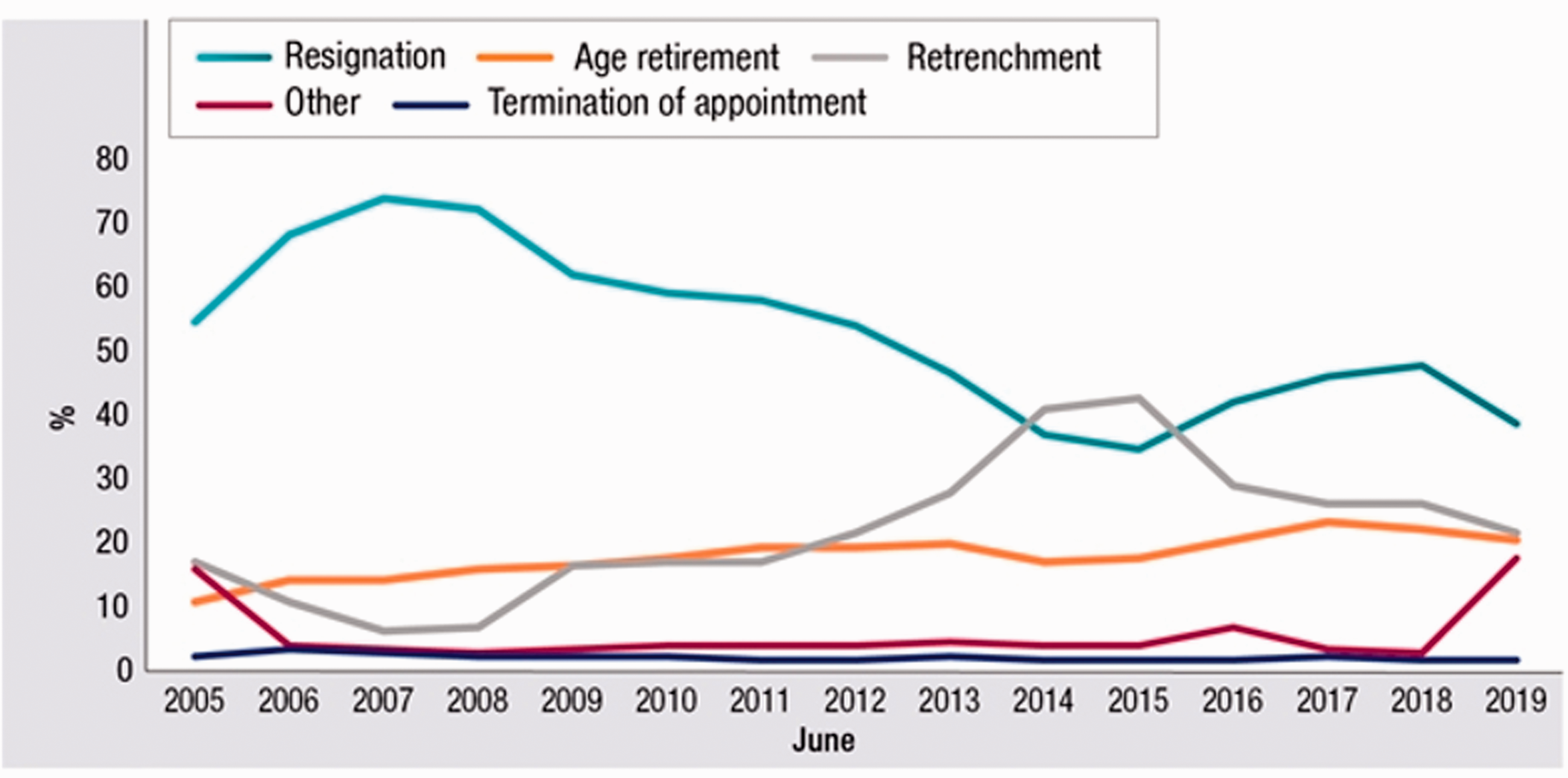
The APS: separations by type, 2000–2019.
The Australian Public Service Employee Census was conducted by the Australian Public Service Commission on Australian federal agencies containing at least 100 employees. The sample was stratified by level, agency size, agency and location. A total of 91,859 responses were received. Since this study focuses on personnel-related changes, only three groups of respondents were selected: those who reported a reduction in the number of personnel within their immediate workgroup; those who experienced no organizational changes within their workgroup; and those who had an increase in the number of personnel within their workgroup. This amounted to 24,620 respondents.
These respondents have a demographic profile that is quite similar to that of the larger group of respondents. Most were women (57.7%), in permanent (89.7%) and full-time (83.1%) employment. They were at least 40 years old (62.5%), and occupied positions below middle management (73.7%). A majority had worked for at least five years in their organization (65.2%), and the APS (76.6%).
Measures
This study uses single-itemed perceptual measures. Although multiple-itemed measures are preferable, this study’s single-itemed measures are appropriate because the constructs of interest are sufficiently narrow (Sackett and Larson, 1990; Wanous and Hudy, 2001).
The independent variable – personnel-related change – measures the respondents’ perceptions of the change in personnel number within their workgroup: ‘In the last 12 months, what was the single biggest workplace change experienced by your immediate workgroup?’ The responses are coded as follows: –1 for ‘decrease in personnel number’, 0 for ‘no major changes’ and 1 for ‘increase in personnel number’.
The dependent variable – optimism about the long-term benefits of change – measures the respondents’ views about the longer-term impact of personnel-related change on their workgroup’s work performance: ‘How are these changes likely to impact on your team’s ability to do their work in the longer term?’ The data set only included responses from employees who had been subjected to personnel-related changes. The response scale focuses on the direction of impact, ranging from 1 for ‘very negatively’ to 5 for ‘very positively’.
Innovation-related change, which is tested both as a dependent and moderating variable, measures the respondents’ views about the implementation of innovation by their workgroup: ‘In the last 12 months, has your workgroup implemented any innovations?’ Responses are dichotomous: 1 for ‘yes’ and 0 for ‘no’.
Perceived organizational change practices is added as a control variable. How a change programme is implemented can affect employee support for the change (Fernandez and Rainey, 2006; Van der Voet and Vermeeren, 2017). Using two items, this variable assesses perceptions of how well the organization has handled the change efforts: ‘Change is managed well in my agency’; and ‘In my agency, senior leaders effectively lead and manage organizational change’. A five-point Likert scale assesses the extent of agreement, that is, 1 for ‘strongly disagree’ to 5 for ‘strongly agree’. The reliability (Cronbach’s alpha [α]) value is 0.83.
Other control variables include gender, age, education, employment status and tenure. These variables are often added as controls in organizational change studies with mixed findings (Esteve et al., 2017; Fernandez and Pitts, 2007; Van der Voet and Vermeeren, 2017).
Results
Personnel-related and innovation-related changes: incidence
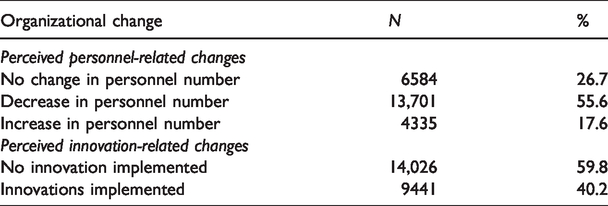
Table 1 presents the frequency distribution of personnel- and innovation-related changes. According to the respondents, personnel reduction was more prevalent in their workgroup (55.6% of respondents; N = 13,701) than personnel growth (17.6%; N = 4335), and no organizational change (26.7%; N = 6584). Most (59.8%) had not implemented innovations within their workgroup.
Distribution of organizational changes.
Since the identity of organizations in the census is not publicly available, the census data are checked against the aggregate data reported in the APS Employment Database Internet Interface (APSEDii). Despite some differences in the timing of the data-collection period from these two sources in 2016, the data were quite similar. The 2016 APSEDii data reported the total number of separations and transfers at about 13,000, and engagements (of APS levels 4–6) at about 4600.
Regression analyses
The binary logistics regression method was adopted for the dichotomous innovation-related change variable, and the ordinary least squares (OLS) method was used for the optimism about change variable that utilized a Likert-scale response. Typical regression diagnostic tests were conducted, with fewer for binomial analyses. First, the issue of multicollinearity was assessed by calculating the variance inflation factors (VIFs) of the included predictors. None of the VIFs exceeds a value of 3, which suggests that multicollinearity is not an issue. Second, the assumption of normality of regression residuals was tested with the normal P–P plot of the residuals and associated histogram. Both figures show normally distributed residuals. Third, the assumption of individual independence was tested. In this study’s sample, public employees are clustered within agencies – they are not independent. The respondents cannot be assigned to an agency because there is no publicly available data on the organization to which they belong. To address this issue, this study adopted George et al.’s (2019) approach of running an additional model that included only data from the highest hierarchical level of employees as there should be few highest-ranked employees who share the same agency. This new model’s findings did not differ from the original model’s findings, which suggests the robustness of the findings. Fourth, homogeneity of error variance was assessed with scatter plots and the Breusch-Pagan test, and there is no indication of heteroscedasticity. Finally, influential data were checked by calculating the Cook’s distance, and there was no distance above the cut-off point of 1.
Table 2 shows that personnel-related change is negatively related to innovation-related change (B = –0.13, SE = 0.02, p < 0.001). Respondents who had experienced personnel reduction in their workgroup implemented significantly more innovations in their workgroup than their counterparts who had faced personnel growth. The finding rejects H1a and H2a but supports H2b.
Regression results on the relationship between personnel-related change and innovation-related change.

Notes: *p < 0.05; **p < 0.01; ***p < 0.001.
Table 3 shows three prominent findings. First, personnel-related change is positively related to optimism about organizational change (β = .73, p < 0.001). Respondents who had experienced personnel growth in their workgroup were more optimistic about the long-term benefits of these changes for their workgroup’s performance than those who had faced a personnel reduction in their workgroup. This finding supports H1b and H2c but rejects H2d.
Regression results on the relationship between personnel-related change and optimism about the long-term benefits of change.
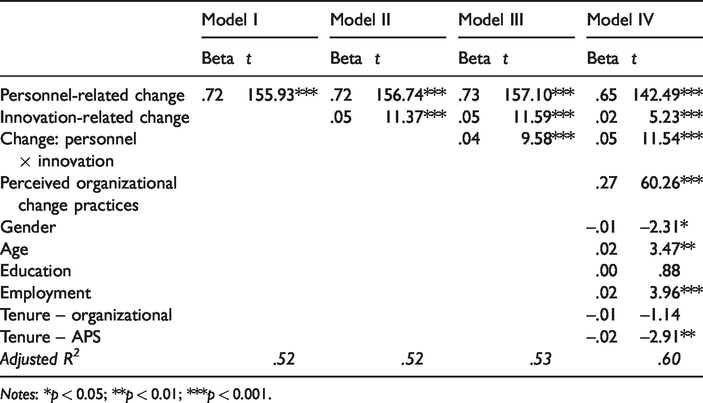
Notes: *p < 0.05; **p < 0.01; ***p < 0.001.
Second, the positive association between innovation-related change and optimism (β = .05, p < 0.001) suggests that the respondents who had implemented innovation in their workgroup were more optimistic about the change than those who had not implemented innovation in their workgroup. Third, the interaction between innovation-related change and personnel-related change is positively related to optimism (β = .04, p < 0.001), which supports H3.
Figure 2 shows that the slope that accounts for the relationship between personnel-related change and optimism about the change is slightly more positive (i.e. steeper) in situations that involve innovation-related change. However, the increase in optimism levels as a result of innovation implementation is larger for personnel growth than personnel decline. The optimism levels of respondents who had experienced personnel decline were quite similar, regardless of whether innovations were implemented. Those who experienced personnel growth and implemented innovations reported the highest optimism levels.
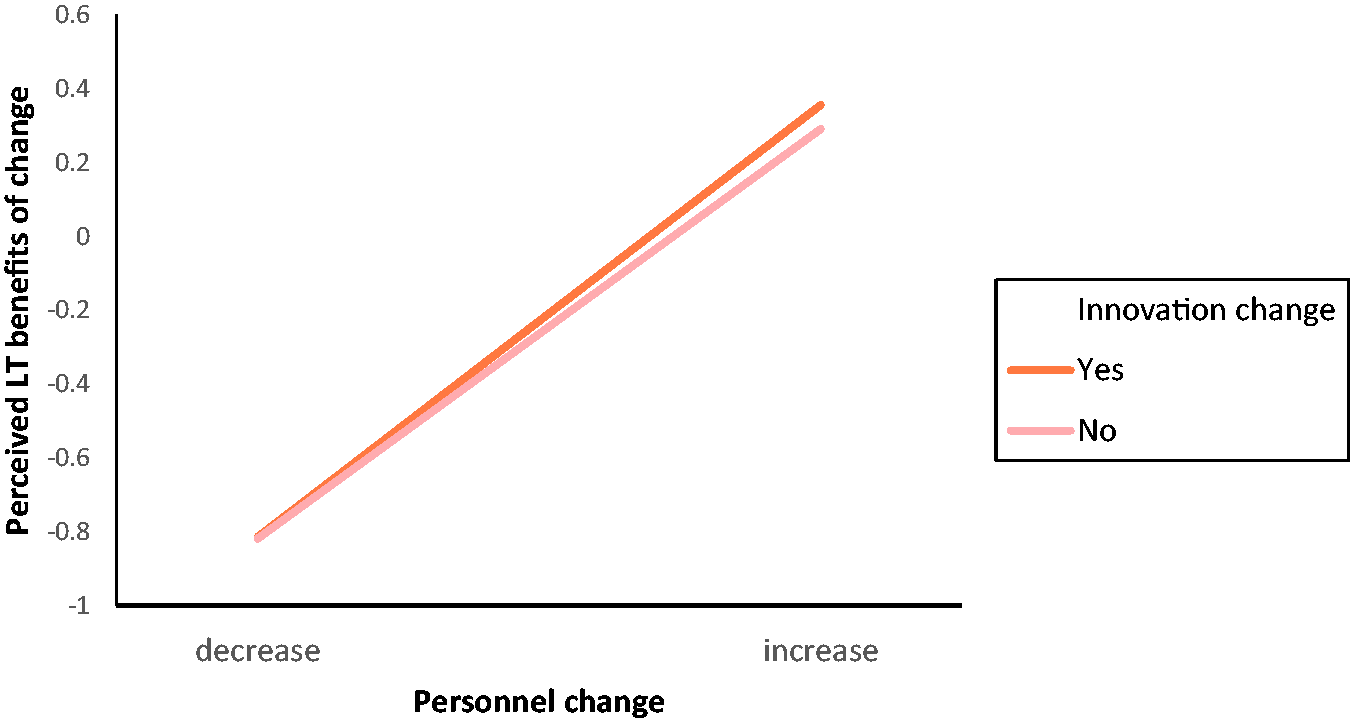
The interaction effect of innovation-related change and personnel-related change.
Discussion
This study makes two contributions to the organizational change literature. The first contribution is on change leadership and how this affects the relationship between personnel decline and optimism about the long-term benefits of organizational change. Leaders must effectively manage the change process, as evident in the significant finding of favourable organizational change practices as a control variable. Most change initiatives fail because leaders often overlook or underestimate the role that employees play in the change process (George and Jones, 2001). All too often, leaders justify a change programme primarily from their or the organisation’s perspective, such as a budget deficit. This study shows the importance of leaders also considering the employee perspective in a change programme, particularly employees’ longer-term concerns, in order to generate support for change. When communicating that cutbacks are inevitable, leaders should consult with employees about the change and actively listen to their individual needs and concerns (Schmidt and Groeneveld, 2019).
The second contribution is on the relationship between cutbacks and innovation. Workgroups that face personnel decline can innovate. Respondents who had experienced personnel decline in their workgroup implemented more innovation-related changes than those who had experienced personnel growth. Although this finding is inconsistent with both the psychological contract and structural inertia theories, it supports the view that ‘necessity is the mother of invention’, that is, employees can respond to organizational decline by pursuing innovation (Van der Voet, 2019). Three possible explanations are provided. First, respondents who face personnel decline may pursue innovation in order to cope with having to do more with less. Those who experience downsizing can adapt to the challenging environment by searching for innovative ways to maintain their capability to deliver public services (Greve, 2003), as supported by the behavioural theory of the firm (Cyert and March, 1963).
Second, personnel decline may increase anxiety and risk-taking behaviours among the survivors, thus fostering an entrepreneurial orientation. Anxiety about layoffs can prompt employees to raise their performance in the short term (Brockner et al., 1986). Conway et al. (2014) suggest that perceptions of a psychological contract breach as a result of cutbacks can slightly raise the service behaviour among job-insecure employees, or those who perceive few employment opportunities elsewhere. The service behaviour may include a willingness to pursue innovation. Survivors of cutbacks may perceive that they have nothing to lose by taking the risks associated with implementing innovation-related changes. Reduced resources may encourage them to weight decisions for potential gains higher than the potential loss of doing nothing, and, in turn, drive entrepreneurial behaviour, as suggested by prospect theory (Kahneman and Tversky, 1979; Singla et al., 2018). Third, the respondents who experience personnel decline may undertake innovation-related changes as a means to enhance their legitimacy in the face of cutbacks (Meyer and Rowan, 1977).
This study does not in any way suggest the use of cutbacks as a means to drive innovation. An inadequate number of personnel impairs a government’s capacity to provide a desired level and standard of public services. Leaders who are hoping to spur innovation should instead note the abundant empirical evidence of investing in sufficient resources to foster innovative actions (Fernandez and Wise, 2010; Singla et al., 2018; Walker et al., 2015). Latham and Braun (2009) report that the availability of slack resources moderates the relationship between organizational decline and innovation. If ‘innovation efforts are risky and can (by definition) fail. And failure can sting’ (Sundheim, 2013), then organizational slack can facilitate innovation by providing a safety net for failure. Van der Voet (2019) elaborates by differentiating between unabsorbed slack (uncommitted liquid resources in organizations that are easy to recover) and absorbed slack (excess organizational costs in organizations that are more difficult to recover, e.g., in the form of personnel or managerial capacity). He argues that while inefficient organizations can easily use unabsorbed slack by implementing across-the-board cuts, efficient organizations cannot because they have little or no unabsorbed slack. The latter often rely on targeted cuts. O’Toole and Meier (2010) show that absorbed slack in the form of managerial capacity could mitigate the negative impact of targeted cutback strategies by protecting public organizations from a decline in performance levels.
This study shows how innovation influences the relationship between personnel-related change and optimism about organizational change. The respondents who were facing personnel-related changes were slightly more optimistic about the benefits of the changes when they had also implemented innovation-related changes relative to those who had not implemented innovations. There appears to be some value in implementing innovations during personnel-related changes, particularly personnel growth. Two possible reasons are provided. First, respondents may have viewed the implementation of innovations within their workgroups as meaningful because they have been provided with an opportunity to participate in the design and/or implementation of these changes. Unlike cutbacks, which often involve doing more with less across a wide range of functions, innovation-related changes often involve the design and implementation of novel processes and services. The latter, which is argued to be a more participative process, is linked to higher well-being, job satisfaction and job engagement (Kiefer et al., 2015). The process of paying attention to employee views during change, as supported by the Hawthorne studies, may be one factor.
Second, employees may have found the innovation-related changes meaningful, which, in turn, raised their optimism levels, as suggested by the positive relationship between innovation-related changes and optimism. Beliefs that the concurrent implementation of innovation in times of organizational change can personally help them to better perform their tasks lead them, in turn, to be more optimistic about the long-term benefits of the change. In addition, public employees, especially those with high PSM levels, may be willing to overlook the negative personal consequences of organizational change if they think the (innovation-related) change improves public service delivery, which ultimately benefits their clients (Naff and Crum, 1999; Van der Voet et al., 2017; Wright et al., 2013).
Limitations and directions for future research
The findings are subject to four caveats. The first relates to the measures. Due to a lack of other data sources, this research has used secondary data to address a question that was not considered when the survey was conducted. The concepts in this study are measured from a data set that is not designed to provide a comprehensive measure of these constructs. Single-itemed measures are developed from this data set. The fact that this study has relied on a government census to develop the measures, and the limitations associated with this approach, should be noted. Future studies on organizational change could consider Boyne and Meier’s (2009b) use of turbulence as a variable to study the effects of organizational changes. The benefit of using turbulence as a measure of instability is that it captures not only whether changes are large or small, but also whether changes are predictable and unpredictable, which is valuable in studies on organizational change.
The second caveat relates to the self-report methodology, which increases the risk of common source bias (CSB). In their review of the literature on CSB, George and Pandey (2017) argue that some variables are, by their nature, perceptual. Although employee perceptions may not always accurately correspond to formal policies, or even the judgements of neutral or observing third parties, they are real to the individuals holding these views, and should be taken into account (Morrison and Robinson, 2004). The Australian government also took measures to lessen evaluation apprehension in the census by assuring the confidentiality of results and anonymity of respondents, including not tracking individual responses over time. Although this study attempts to check the respondents’ reports of personnel changes against sector-wide archival data, future studies can minimize CSB by collecting multisource data, including using archival data about objective changes in the number of personnel and innovation implementation in organizations, to supplement self-report data.
The third caveat deals with the cross-sectional data. This study cannot conduct an analysis at the individual level over time because the APS Employee Census does not track individual responses over time. The data also protect organizational anonymity. Organizations that have reduced their number of personnel cannot be distinguished from those that have raised their number of personnel. With cross-sectional data, this research examines the strength and direction of the relationships between the study variables. Future studies with a longitudinal design can test for causality. Furthermore, follow-up research using a qualitative design can provide deeper insights into the explanations for this study’s findings.
The fourth limitation involves the research setting. This study is conducted in Australia. As different contexts can affect the results, future studies should be conducted across other countries in order to discern whether the findings reported here are generalizable to other public sector settings.
This study focuses on major personnel-related changes at the workgroup level. Some of these major personnel-related changes at the workgroup level may not be connected to broader organizational change efforts. Future studies on personnel-related changes could focus on the organizational level. If we can identify organizations that have implemented personnel-related changes in year X (e.g. 2020), then we can assess the impact of these changes using employee surveys in year X + 1 (e.g. 2021).
This research examines personnel growth without differentiating whether it is a result of a positive or negative event. Since different events can cause employees to respond differently, future studies should test this for a better understanding of the influence of personnel growth.
Further studies should examine more closely the interaction between cutbacks and innovations in the public sector (Van der Voet, 2019). This study draws on past studies to present probable explanations for the relationship between personnel decline and innovation. Future studies can confirm whether these factors actually affect the relationship. Personnel decline is found to be associated with more innovation implementation than personnel growth. Yet, the increase in optimism as a result of innovation implementation is smaller for personnel decline than personnel growth. Future studies, particularly of a qualitative design, should delve deeper to understand the reasons for these findings. Other questions asked can include the following: when do cutbacks encourage employees to pursue innovations in the public sector workplace? What is the nature and efficacy of the innovations adopted during cutbacks? What types of innovation cushion the negative relationship between cutbacks and desirable employee outcomes? Finer-grained analyses of both concepts can be useful, particularly when there are multiple forms of innovation and cutbacks (Raudla et al., 2015; Van der Voet, 2019; Walker et al., 2015).
