




Abstract
Context.
While there is ample research in the social sciences on the role of private consulting firms in public policy, there is little information about their intervention in managing public health crises and epidemics. The COVID-19 pandemic revealed how much public administrations across the globe have been using these firms. The purpose of this exploratory review of the scientific literature is to identify research on the involvement of these firms in governing epidemics and health crises since 2000.
Methods.
This review investigates the following question: what research evidence about the role of these firms is there, and what research methods and analytical categories are used? Following the stages of the PRISMA methods, we identified 24 references since 2000.
Findings.
We classified authors’ analyses of the role played by those firms using three analytical categories: the management approach, the consultocracy phenomenon and the phenomenon of elite hybridization. Only two references were explicitly related to the work of consulting firms in the context of epidemics (e.g. COVID-19). The others focused on public health reforms. This finding confirms the scarcity of research evidence on the role played by consulting firms in the management of epidemics.
Conclusions.
This review reports on a blind spot of the scientific literature and calls for additional empirical research.
Points for practitioners
Consulting firms’ intervention during epidemics remains a blind spot of academic research. The COVID-19 crisis prompted a significant growth of consulting firms’ intervention in health policymaking. Three analytical categories can be useful to study consulting firms’ interventions, namely: the management approach, the consultocracy phenomenon and the phenomenon of elite hybridization. The phenomenon of elite hybridization reflects a promising heuristic approach.
Introduction
There is a large body of research in the social sciences on the role of private consulting firms in public policy (Empson et al., 2015; Hurl and Vogelpohl, 2021; Saint-Martin, 2006). Several studies have reported the increase and standardization of their intervention with national and international public organizations for more than 30 years (Belorgey and Pierru, 2017; Bezes, 2012; Gautier et al., 2021; Henry, 2012; Kipping, 2021; Saint-Martin, 1999). Among this work, research in the health sector focuses on the intervention of private consulting firms in the framework of national health sector reforms, such as those of the National Health Service in the United Kingdom since 1974 (Kirkpatrick et al., 2016) or the 2009 hospital reform in France (Belorgey, 2010; Belorgey and Pierru, 2017). The issue of epidemics, and more generally of public health crises, remains little studied in these writings. However, the COVID-19 pandemic has been an opportunity to highlight the use of private consulting firms by many administrations worldwide (Aron and Miguel-Aguirre, 2021; Castonguay, 2020; Collington and Mazzucato, 2021; Petitjean, 2021; Rice, 2020; Vogelpohl et al., 2022). In France, for example, the controversy about the use of private expertise by the French central administration dates from the beginning of the COVID-19 health crisis (Braun and Momtaz, 2021; Cohen and Vazquez, 2021; Girard, 2020). The publication of the report of the French Senate Committee of Inquiry (Commission d’enquête sur l’influence croissante des cabinets de conseil privés sur les politiques publiques, 2022) revived the controversy. A recent journalistic investigation showed a similar phenomenon in Quebec where one of the most important transnational consulting firms has worked with the central administration to manage the COVID-19 pandemic (Gerbet, 2022).
The objective of this exploratory study is to review the academic knowledge on the worldwide intervention of consulting firms in public policy during epidemics and public health crises that have occurred since 2000. We unravel the theoretical approaches and methods used by authors to study the role of private firms.
Method
Scoping reviews (Arksey and O’Malley, 2005; Dagenais et al., 2021; Peters et al., 2020) produce information on an issue within a reasonably short timeframe; they include research works regardless of the methods employed by their authors (Munn et al., 2018; Saul et al., 2013). We followed the stages referenced in the PRISMA-ScR model (Tricco et al., 2018). We presented them in the review protocol (Gallardo et al., 2022).
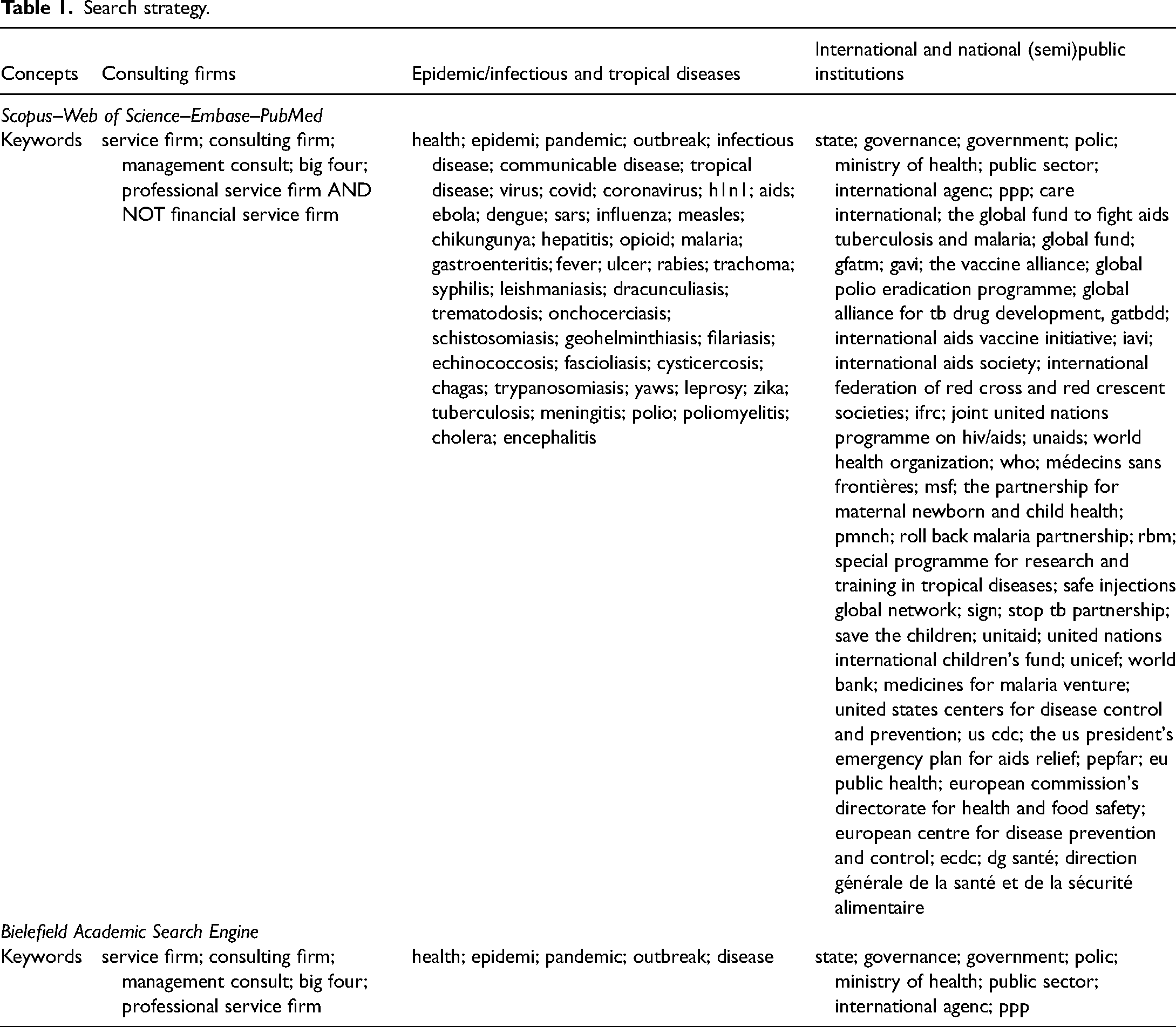
We built the search strategy (Table 1) around three themes: keywords referring to consulting firms; keywords referring to epidemics and public health crises; and, finally, keywords involving national and international public administrations. After several search attempts, we realized the paucity of works on epidemics and health crises. We thus decided to review works on public health policy more broadly, so as not to miss some pertinent research.
Search strategy.
We identified six inclusion criteria. References must be:
related to consulting firms, that are private firms (both cross-industry multinationals and specialized companies with national or even local roots), with for profit ambition, which sell expertise services to public actors; related to epidemics or health crisis issues which have emerged from the 2000s; published between 1 January 2000 and 31 December 2021, the time frame being justified because of the important growth of private consulting firms since the 2000s; published in English, French, Spanish, Italian or Portuguese; original research papers using qualitative, quantitative, and mixed methods; peer-reviewed journal articles and books/book chapters.
We excluded non-academic documentation, that is any reports and working documents also named “grey literature” which are not subject of a peer-reviewed evaluation (e.g. think tank or international and national organization reports). This choice is linked to the objectives of the scoping-review that are to make a state of academic knowledge about our research object.
Based on these pre-established inclusion and exclusion criteria (Gallardo et al., 2022), we used a step-by-step approach that is summarized in the PRISMA-ScR flow diagram (Figure 1, online only). Of the 964 initial references identified in five databases (Embase, PubMed, Scopus, Web of Science and Bielefield Academic Search Engine), we retained 15 items through sorting and double proofreading. We decided to use Bielefield Academic Search Engine because this European database integrates non-anglophone academic publications that are not always referenced by mainstream databases. Through analyzing bibliographies, we manually added nine references found outside the databases, leading to a total of 24 references.
We grouped the data using an extraction table (Appendix 1, online only). The MMAT grid (Appendix 2, online only) was used to appraise the quality of study methods included in systematic and scoping reviews (Hong et al., 2018). This assessment was done by one member of the team.
The analysis of the selected articles and the identification of analytical categories (see the Results section) was carried out by the first author, and subsequently refined by each of the different co-authors, and discussed in group discussions by the whole team.
Results
Within the 24 references selected, there are 20 peer-reviewed journal articles and four book chapters. The articles have been published in peer-reviewed journals specializing in health, management or public administration, and in generalist interdisciplinary or disciplinary journals (Figure 2, online only).
Two references were published between 2000 and 2009, 13 between 2010 and 2018, and nine between 2019 and 2021. Most of the cases studied were carried out in the West European and North American contexts (Figure 3, online only). No research reflected the context of a low- or middle-income country. Two references investigating the work of consulting firms with international organizations are not included on the map (Momani, 2017; Tchiombiano, 2019).
The majority of the first authors were affiliated or associated with North American and Western European universities (n = 18), including almost half of them being affiliated with British universities. A total of nine women and 10 men were the first authors. Of the multi-author publications (n = 14), some were the result of repeated collaborations (Begley and Sheard, 2019; Begley and Sheard, 2021; Kirkpatrick et al., 2019; Sturdy et al., 2020).
Only two references related specifically to the work of consulting firms in the context of the COVID-19 pandemic (Atkinson et al., 2020; Untermaier-Kerléo, 2021). The others focus on health policy analysis and public health reforms. This finding confirms the scarcity of work on the issue of epidemics before the emergence of COVID-19.
Methods of investigation and analysis
Most studies used qualitative research methods (n = 21), such as analysis of archives and interview administration (n = 4) and ethnographic observations combined with interviews (n = 8). Interviews only were also used (n = 4) in combination with grey literature (n = 1). Grey literature as the only source of data was also used (n = 4). Two studies employed a longitudinal quantitative method, while one research used a mixed quantitative and qualitative methodology that combined ethnographic and prosopographic surveys, which is a method of statistical analysis of the biographies of a social group. Methods for data analysis included thematic content analysis (Paillé and Mucchielli, 2012) and semantic or qualitative discourse analysis (Seignour, 2011).
The selected studies had some limitations. In particular, the MMAT tool (Figure 4, online only) identified a lack of transparency on the methods (n = 4).
Analytical categories to study the relationship between the state and consulting firms
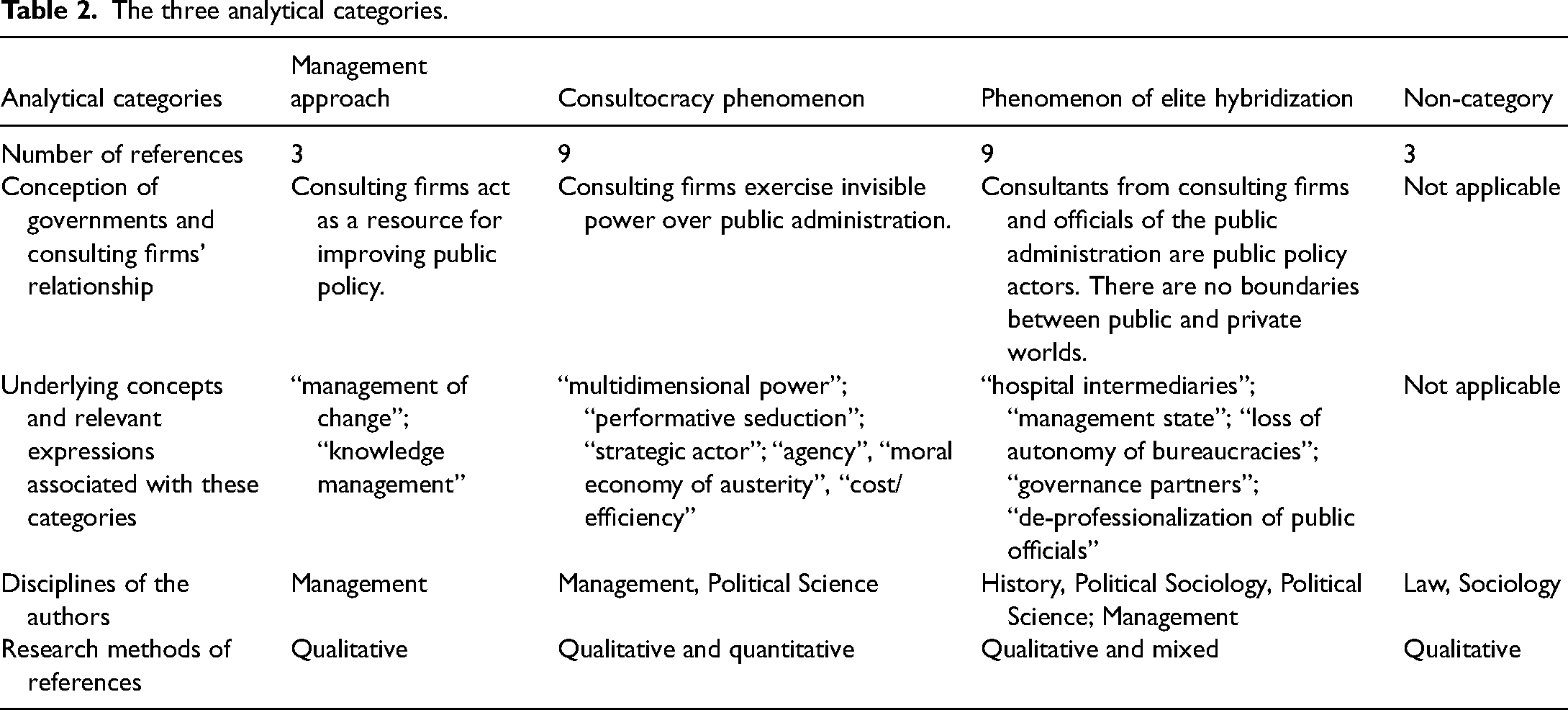
Through our analysis of the 24 references, we identified three analytical categories used by the authors to study their object, which we conceptualized as follows: the management approach, the consultocracy phenomenon and the phenomenon of elite hybridization (see Table 2 for details). By analytical categories, we mean ways of considering the relationship between public and private actions, the market and the state, and the processes of production and implementation of public policies (Hassenteufel, 2011; Weible and Sabatier, 2017). These categories determine the ways in which consulting firms' roles are analyzed by the authors. They also reveal the theoretical approach, the conceptual tools underlying analyses, and the authors’ specific disciplinary fields or subfields. Three references did not fit into the proposed analytical categories because of their research methods, their authors’ discipline or the research question.
The three analytical categories.
First analytical category: The management approach
Authors who used the management approach considered the intervention of consulting firms with public institutions as a resource or expertise to improve public policy. This approach is based on the idea that management pertains to technical expertise that improves public or private organizations. These works aimed to uncover the conditions or “factors of success” (Wye et al., 2015) of the intervention of consultants with public administrations, without questioning it. Three studies adopted this approach. For example, they applied the concepts of “change management” (Kuna, 2017) or “knowledge management” (Radnor and O’Mahoney, 2013) to define the role of consultants considered as beneficial for public administrations. These concepts are not specific to public policy, but they are also applied to the corporate world. Two studies in this category reflected the perspective of the consultants and their experiences of collaborating with public health institutions. This is the case, for example, of the work of Radnor and O’Mahoney (2013), who analyzed the differences in methods and functioning used by the consultants compared with those of the agents of public administrations. The authors produced recommendations to improve the intervention of management firms in the public domain. The prescriptive aspect of this approach is also reflected in the work of Wye et al. (2015), based on the 2012 case study of the Health and Social Care Act in the UK. They identify three “success factors” of the consultants' intervention with the health administration: the consultants’ ability to “solve problems”, the “co-production of solutions” and the consultants’ ability to produce a joint analysis of the results of their intervention (Wye et al., 2015: 7).
Second analytical category: The consultocracy phenomenon
The consultocracy phenomenon brings together works that considered the role of consulting firms in public health in terms of influence and power. These studies used other research that considered the crucial role of these private actors in governing contemporary societies (Guttman and Willner, 1976; Howlett and Migone, 2014; Lapsley and Oldfield, 2001). We owe the term “consultocracy” to the two political scientists, Christopher Hood and Michael Jackson. They used this concept to qualify the involvement of management consultants in the public administrations of several English-speaking states (Hood and Jackson, 1991). While the selected studies did not systematically refer specifically to this concept, all of them critically considered the role of private consulting firms in contemporary democracies. The actions of these firms would participate in the phenomenon of state withdrawal. Of the selected studies, nine adopted this analytical category; the most common discipline of their authors was management sciences.
The concepts used by these authors reflected this idea of the preponderant influence of firms on public policy. Authors of works in this category employed the following concepts and relevant expressions: “multidimensional power” (Horrocks, 2009), “performative seduction” (Ford and Harding, 2021), “strategic actor” (Lalonde and Gilbert, 2016) and “agency” (Lalonde and Adler, 2015) to analyze the multiple forms of power used by firms to influence public agents and administrations. For example, Lalonde and Adler analyzed the evolution of information asymmetries in the consultant–client relationship within health organizations in Canada. The authors showed how this asymmetry evolved between the actors according to the stage of the consultation process, even though the said asymmetry remained more favorable to consultants who reportedly took turns in the roles of “doctor, facilitator, and expert” (Lalonde and Adler, 2015: 194). Through the case study of the institutionalization of the concept of talent management within the National Health Service (NHS) in the UK in the early 2000s, Ford and Harding showed the “hidden power” of management consultants, which proceeded in two stages: first, the creation of this expertise as a “product” for the firms’ clients; and second, the practices of “seductive performativity” of consultants behind the “closed doors” of administrations (Ford and Harding, 2021: 230). Consulting firms’ strategy of making themselves indispensable was present in other studies (Lalonde and Gilbert, 2016). It was reflected in Momani's analyses of consulting firms’ work with different international organizations. The author showed that firms positioned themselves as the only holders and analyzers of global knowledge and data related to the areas of interest they were solicited for. The promotion of a technical expertise presented to public actors by consulting firms as unique and essential was one of the elements used by the author to explain their growing influence. Such expertise was then presented as being at the origin of the sparking phenomena of empowerment of consulting firms in different sectors and public organizations.
Finally, two studies focused on the impact of consulting firms’ intervention on the effectiveness/efficiency or the performance of public health policy (Kirkpatrick et al., 2019; Sturdy et al., 2020). Using longitudinal quantitative methods, the authors of these studies showed the correlation between the increase in the use of consulting firms and the adoption of “commercialization practices” which refer to the externalization of non-core clinical services and private financing (Sturdy et al., 2020: 492). The authors of these works also showed “that higher levels of spending on management consultants have had a statistically negative effect on two separate indicators of efficiency (‘operational efficiency’ and ‘adjusted cost efficiency’)” in the hospitals studied (Kirkpatrick et al., 2019: 90). The increased dependence of public organizations on consulting firms was also highlighted. However, unlike the other references included in this category, public servants were not considered passive actors merely exposed to the presence and intervention of firms. Despite this nuance, most of these studies highlighted the increasing dependence of public administrations on consulting firms, as well as a form of submission, if not impotence, to the firms’ practices and power. Authors of selected papers highlighted the major role these firms played in public health policies. These studies also showed how consulting firms participated in implementing New Public Management practices in public health administrations and public health policies, as well as in normalizing an austerity economics and the state's diminishing role (Hurl, 2018: 58) in the various contexts studied.
Third analytical category: The phenomenon of elite hybridization
The studies corresponding to this third category analyzed the making of public policy using a relational perspective, which breaks the boundaries between the state and the market. To do that, the authors of these studies emphasized the trajectories of public policy actors, their changing positionality between the public and private worlds, and the proximity of their social paths and positions. Consulting firms and administrations are considered as interdependent spaces where hybrid elites are positioned at the crossroads of these two worlds.
The nine studies mobilized concepts that underline this relational perspective. Concepts and relevant expressions associated with this category included, for example, the notion of “hospital intermediaries” to define consultants 1 who are, with others actors, positioned between administrations and caregivers and who play a role of translators and transmitters of norms (Belorgey, 2010). The notions of “management state”, “loss of autonomy of bureaucracies” (Pierru, 2012), “governance partners” (Kirkpatrick et al., 2016), and “de-professionalization of public officials” (Belorgey and Pierru, 2017) also illustrated the blurring of the boundaries between the private and public worlds.
The first type of studies was history studies. Begley, Sheard, and Weiss focused on tracing the history of consulting firms working with health authorities. Their study showed the anteriority of relations between consulting firms and public administrations of the advent of so-called neoliberal policies in the 1980s. The authors were particularly interested in the relationship between McKinsey & Company and the British NHS. Their analyses revealed the structural interdependencies between the two organizations as early as the 1940s (Begley and Sheard, 2021) but also the sharing by NHS agents of a vision of management consulting as conducive to public service improvement (Weiss, 2018). Weiss thus considered the firms’ consultants under the service of the “administrative power”; hence the author suggested that private advice was a “legitimate source of expertise” and objectivity (Weiss, 2018: 137). Weiss showed that these collaborations contributed to the rise of a modern “hybrid state”, “where the lines of public and private sectors are blurred, and agents of both sectors act in the delivery of public services” (Weiss, 2018: 15).
This category includes a second strand of work that investigated consulting firms in the wider space of actors involved in public health policymaking. These studies examined the practices and the role of consulting firms in the competition and alliance relationship with other actors involved. To do that, Belorgey analyzed the position of consultants among the “galaxy of hospital intermediaries” involved in the implementation of the 2009 French hospital reform. He showed how their “composite [professional] capital” tended to make them special, and positioned them at a “high degree of reticular centrality” compared with other intermediaries like department heads, hospital directors, health executives and engineers (Belorgey, 2020: 418). Belorgey analyzed the consulting firms’ expertise as a key resource to legitimize themselves in hospital reform processes. In an article co-written with Pierru a few years earlier, the authors used this approach by showing how consulting firms participated in the implementation of the New Public Management and acted as “essential actors in the reorganization of the health system” (Belorgey and Pierru, 2017: 45). The authors nevertheless nuanced the consultants’ role in two ways. On the one hand, Belorgey and Pierru showed that the consultants remained “at the service of the programming elites” within public administrations. On the other hand, the authors highlighted how the omnipresence of consultants was a “manifestation of the growing hybridization of political, technocratic, and economic elites” (Belorgey and Pierru, 2017: 57). In relation to the same 2009 French hospital reform, Pierru also showed how the extensive use of consulting firms is part of a larger phenomenon of “bureaucratization”, which is characterized by the hybridization of private and public organizational models. The author positioned this phenomenon in the broader “neoliberal” process of the strengthening of a “managerialized state” (Pierru, 2012: 34). While strengthening administrative and management teams, such process did not, however, completely remove “the autonomy of the medical field” (Pierru, 2012: 50). Building from the adoption of the accrual method of accounting in the Norwegian Health Administration in the early 2000s, Kaarbøe and Robbestad considered private consulting firms as “change agent” stakeholders in competitive and alliance positions with other agents (like politicians, agents of the Norwegian Ministry of Health, directors of healthcare departments, other consultants, etc.) to legitimize their expertise. The consultants of these firms were “institutionalized” actors, positioned “at the center of the executive machinery” because of their double proximity to agents at national and local levels (Kaarbøe and Robbestad, 2016: 402). Similarly, Kirkpatrick and colleagues considered consultants, not as providers outside public policy but rather as “partners in government” (Kirkpatrick et al., 2016: 2). For this purpose, the authors studied the specific phenomenon of a “revolving door”, i.e. the professional roundtrips between the private and public worlds. By analyzing the social proximity between consulting firms’ consultants and public administration agents, they showed how their collaborations “have contributed to the privatization agenda for public services” and also to the transformation of consultants “into somewhat less ‘private’ and more ‘public’ actors” (Kirkpatrick et al., 2016: 530). In other words, they have contributed to implement the business approach to public policy, which is now relatively common in public administrations worldwide.
References excluding categories
The work of Atkinson et al. (2020) focused on the receptiveness to the UK's national COVID-19 policy of healthcare professionals and local health officials. The authors showed how these groups acting on the front lines had fuzzy interactions with centralized public policies. Atkinson and colleagues also investigated these groups’ perception of private consulting firms. The role of consulting firms in public policy was less prominent in this study. The study by Richman and Mercer (2001) reflected on the experience of using management consulting firms and a task force of healthcare professionals by the administration of the Special Hospital of Ashworth in England between 1992 and 1994. The authors analyzed the strong criticism of the head of the institution's services of these two groups (the consulting firms’ consultants and the task force of healthcare professionals). Nevertheless, their work was overly descriptive; it did not make it possible to identify the conceptual and analytical orientations.
Finally, starting from the controversy over the massive use of private consulting firms during the public management of COVID-19 in France, Untermaier-Kerléo explored the legal texts allowing the use of consulting firms. The author identified two “legal risks related to outsourcing”: administrative “loss of competence” and conflict of interest (Untermaier-Kerléo, 2021: 3). The study also was very descriptive and difficult to link to any of the above-mentioned approaches.
Discussion
The analytical categories used to study the role of consulting firms in public health action, in addition to being diverse, depended on the disciplinary or sub-disciplinary traditions of their authors. For most of the work in management sciences, consulting firms were seen as either a technical device at the service of what is perceived as an improvement of public policy or as a threat to democracy. The authors of these studies made a normative judgment on the intervention of these firms and essentialized the boundaries between the public and private domains. For example, authors who adopted the management approach considered New Public Management through the action of consulting firms as “the best way to govern well” (Peters, 2019: 411). As “government sciences”, management sciences adopt a normative and prescriptive dimension and aim to inform and guide public policy (Ihl, 2019; Ihl and Kaluszynski, 2002). In addition, the concepts used by scholars in management sciences are also used by management consultants, thus recalling the fuzzy boundaries between management studies and the professional world of management (Boussard, 2008).
This normative dimension was also present in political science studies that mobilized the consultocracy phenomenon. Authors using this analytical category tended to consider the action of consulting firms as a takeover of the public administration. Yet the ways they conceived public problems were often due to the research paradigm of symbolic interactionist, an approach derived from American sociology, which is based on the observation of inter-individual relations (Le Breton, 2004). These studies seldom considered how more structural dynamics (political reforms, people's social position, etc.) participated in the decision to use consulting firms.
The references pertaining to the category of elite hybridization were at the crossroads of several subfields of social science research such as the sociology of the elites, public policy analysis, and the historical sociology of the state (Bezes and Pierru, 2019). Several of these subfields are close to French political sociology works, which have criticized the normative and essentializing bias described above (Halpern et al., 2018). While a criticism could be made of the neoliberal orientation of contemporary public policy, the rigorous empirical research methods used and the analysis of the key actors’ trajectories made it possible to be as close as possible to reality (Olivier de Sardan, 1996). For this reason, the analytical category of elite hybridization provided a promising heuristic approach to study the intervention of consulting firms in public health policy. Indeed, analyzing individual trajectories enables scholars to closely follow the professional circulations of actors. Such analysis also helps reveal the connections built throughout these trajectories within diverse public policy arenas. This analysis of individual career trajectories can also be found in global health works, which explain the action of “diffusion entrepreneurs” in the wide spread of health financing policies in sub-Saharan Africa that are in line with the New Public Management (Deville et al., 2018; Gautier, 2019). For example, in the case of health systems performance-based financing, the initial training (in economics and medical sciences) and “founding” experiences with certain international organizations that piloted the premises of this policy (Médecins sans frontières and Belgian and Dutch private consultants’ firms, in particular) were key. This experience helped the entrepreneurs to consolidate the policy's underlying systems of representations of transnational actors that will commit to defending this financing policy in the long run. Building from their own systems of representations, they develop the theoretical foundations of this policy and use their knowledge, experiences and professional networks to diffuse the policy, by going through different institutions (universities, international organizations, non-governmental organizations, consulting firms, and private training agencies; Gautier, 2019). These transfers from the public to the private sector are subsequently reproduced by the “African experts”, who are trained and convinced of the relevance of this policy. These “national” experts themselves become diffusion entrepreneurs. In addition, the “revolving door” phenomenon occurs in professions other than those of consulting, especially in the pharmaceutical industry (Gautier and David, 2022), European lobbying (Laurens, 2015), and business lawyers (France and Vauchez, 2017), to name a few. In the case of the pharmaceutical industry and the regulation of pharmaceutical products in the USA, professionals frequently move from pharmaceutical companies to public regulatory agencies in the pharmaceutical sector (the US Food and Drug Administration, in particular), and vice versa. Moving across these spheres of government facilitates the dissemination of the idea that the pharmaceutical industry is indeed good for US economic interests, and that it should therefore be regulated as little as possible (Davis and Abraham, 2013).
The diachronic perspective which we identified in most of the studies in the elite hybridization category, finally, invited us to question the novelty of the intervention of consulting firms in public health policy. It also invited us to ask how this phenomenon has emerged and has evolved over time, depending upon diverse and dynamic political spaces.
Conclusion
This exploratory review identified three categories to analyze the intervention of private consulting firms in public health management. However, the scarcity of work in the field of epidemics and public health crises led us to formulate the hypothesis that this field remains a blind spot of academic research, which should be filled. The complexity of carrying out empirical studies on this topic, which is often considered controversial and affecting strategic and commercial issues, certainly explains such a scarcity (Daho et al., 2020).
Supplemental Material
sj-docx-1-ras-10.1177_00208523241242664 - Supplemental material for Private consulting firms’ intervention in public health policymaking: An exploratory review
Supplemental material, sj-docx-1-ras-10.1177_00208523241242664 for Private consulting firms’ intervention in public health policymaking: An exploratory review by Lucille Gallardo, Lara Gautier, Fanny Chabrol, Lola Traverson, Sydia Oliveira and Valery Ridde in International Review of Administrative Sciences
Footnotes
Acknowledgments
We would like to acknowledge Laurence Goury, from the Scientific and Technical Information Service of the Institute for Sustainable Development and Research (IRD), for her advice and support in the formulation of the protocol of the scoping review. We would also like to thank Heather Hickey for translating the first version of the paper, Flore-Apolline Roy for producing Figure 2 and the laboratory for interdisciplinary evaluation of public policies (LIEPP) team for proofreading this work.
Declaration of conflicting interests
The authors declared no potential conflicts of interest with respect to the research, authorship, and/or publication of this article.
Funding
The authors disclosed receipt of the following financial support for the research: This work was supported by French National Research Agency as part of the “Investissements d’Avenir” program LIEPP, GRIP and the Paris University IdEx (grant numbers ANR-11-LABX-0091, ANR-11-IDEX-0005-02 and ANR-18-IDEX-0001).

Notes
References
Supplementary Material
Please find the following supplemental material available below.
For Open Access articles published under a Creative Commons License, all supplemental material carries the same license as the article it is associated with.
For non-Open Access articles published, all supplemental material carries a non-exclusive license, and permission requests for re-use of supplemental material or any part of supplemental material shall be sent directly to the copyright owner as specified in the copyright notice associated with the article.
