



Abstract
The objective of this study is to analyze the social impact of the use of royalties and special participation, and sovereign and social funds, in the context of the pre-salt oil reserves in Brazil. With the pre-salt discoveries, the royalty values will grow considerably, justifying academic efforts to ensure the socially equitable application of this wealth. There has been enormous growth in the revenue from royalties in oil-producing municipalities; however, this has had little or no impact on social development, social justice, and human rights. It is concluded that oil, and resources derived from oil, are assets of the Union, requiring adequate social control.
The objective of this study is to analyze the social impact of the use in Brazil of royalties 1 and special participation, 2 and sovereign and social funds, in the context of the country’s pre-salt oil reserves. 3 The work also aims to contribute to the disclosure of the history of Brazilian social inequality, which continues amid economic growth. It is well known that countries with high levels of social inequality are more prone to violence, disease, and all forms of illegal activity (Fajnzylber et al., 2002; Wilkinson and Pickett, 2010). ‘Such inequality undermines the trust, solidarity, and mutuality on which responsibilities of citizenship depend’ (Reich, 2010). Considerations regarding sovereignty are based on the arguments presented by Rousseau, Foucault, and La Pierrère, which support the use of the concept in relation to social development and social justice.
The data and analysis presented in this article are discussed in the context of social development and social welfare. A qualitative approach is employed, focusing on royalties and special participation in the oil-producing municipalities of the Brazilian States of Bahia, Espírito Santo, Rio de Janeiro, Rio Grande do Norte, and Sergipe. 4
The article is organized in five main sections. The first section provides a brief introduction concerning problems surrounding the oil industry, the economic and social situation in Brazil, and the risks of ‘Dutch disease’. The second section presents information about royalties (revenue data, legislative changes, social impacts, etc.). The third and fourth sections explain the importance of monetary transfers, and the implications of the latest proposals for changes in royalty legislation, respectively. The sovereign wealth fund and social aspects in Brazil and elsewhere are then discussed. A summary of the main conclusions is provided at the end of the article.
Sovereign state, aspirations and needs of its population
The present study is guided by the assumption that the social funds created during the government of President Lula are either socially equitable or (if not) are not sovereign funds. Here, socially equitable refers to a national structure that guarantees, amongst other aspects: access to land for all who need it; labor relations based on the basic rights of workers; use of public resources by the Republic; and universal good quality public education. As regards sovereignty, according to the legal principles of medieval theologians and jurists, which lasted until the 16th century, the fundamental basis of the notion of sovereignty is territory. Hence, the central concern of Machiavelli in The Prince is how to maintain the sovereignty of a sovereign over a state or a territory (Foucault, 2012).
Foucault (2012) informs us that according to La Perrière, at that time the concept of sovereignty had one circular purpose. It must serve the common good, with this common good concerning the obeying of laws, respect of order, and the correct exercise of public office, or put more simply, it must serve the sovereignty. Since laws derive from the sovereign, whether terrestrial or divine, what sovereignty proposes is obedience and subservience to a single purpose, which is itself.
As a legacy of this period, it is important to stress that the most well known and publicized conception of this term denotes absolute power: possession of political power, and the power to make the final decision. However, this is not the only possible use of the term. Since Rousseau and the social contract, the same expression is understood as involving rationality in pursuit of the general interest, volition, and contract (Matteucci, 1998: 1180). For La Perrière, a reversal began with Rousseau. Unlike in the 16th and 17th centuries when the theory of sovereignty was sought as an art of governing, after Rousseau, in contrast, the objective was to build a legal framework, an institutional form, featuring the sovereign state as an entity concerned with the aspirations and needs of its population.
Again, according to Foucault (2012), Guillaume de La Perrière goes further than Rousseau concerning the evolution of the notion of sovereignty as related to territory, to the concept of government related to the set of men in their relationships with things:
that are the riches, resources, livelihoods, the territory within its borders, with its qualities, climate, drought, fertility, etc.; the men in their relationships with other things that are the customs, habits, ways of acting or thinking, etc. (Foucault, 2012: 415)
Unlike sovereignty, according to La Perrière, the government must have a number of specific purposes. Apart from the safeguarding of power and territory, as proposed by sovereignty, the goal of government should be to serve the people, to ‘improve the fortunes of the population, increasing their wealth, the duration of their lives, their health, etc.’ (Foucault, 2012: 425). In this interpretation, the population becomes seen as subject to needs and aspirations.
Applying the concept of sovereignty initially presented by Rousseau, and incorporating the concept of government presented by La Perrière, the funds recently created in Brazil will be sovereign to the degree in which they are used to serve the general interests of the Brazilian population, in combating the nation’s brutal social inequality.
Oil, power and inequality
The sheer scale of the numbers involved in the oil business is impressive. The word petroleum is commonly associated with positive connotations: wealth, power, and grandeur. However, such simplistic notions do not stand up to close scrutiny. Contrary to what is often preached, the oil world is riddled with contradictions.
The conflicting elements that surround the oil industry can be seen from a variety of perspectives: a) political, b) social, c) labor, d) economic, and e) environmental. For this reason, it has been at the root of wars in the Middle East. In Brazil, the national petrochemical company (Petrobras) has historically contributed to the country’s development in various ways, although the firm has sometimes been contradictory in terms of its relationships with employees.
The last five decades have been marked by major accidents involving oil: Atlantic Express (1979), Exxon Valdez (1989), contamination of Guanabara Bay (2000), the sinking of the oil platform P-36 (2001), the Deepwater Horizon accident in the Gulf of Mexico (2010), and the leak at the Campos Basin oil well operated by Chevron (2011). These accidents illustrate the capacity of both upstream and downstream sectors of the petroleum industry to cause environmental damage.
With the exploration of new oil deposits in Brazil comes a growing potential for environmental disasters. The leak of 2.4 thousand barrels of oil from the Chevron well in the Campos Basin in 2011 is indicative of the severity of the risks. The operating conditions in the pre-salt region are radically different from those that have been experienced previously. This implies the need to develop new exploration technologies that are safe, as well as to ensure that the workforce is properly trained.
The discovery of the pre-salt reserves places Brazil in a globally advantageous position. Despite the inherent geological uncertainty, reasonable estimates project a growth of Brazilian reserves from the current 15 billion to 50 billion barrels. 5 The newly found deposits have the potential to make Brazil one of the largest and most important players in the global geopolitics of oil (Romão, 2012).
In contrast, the large consumer countries, including the richest nations such as the United States, are increasingly faced with the dilemma of high consumption that exceeds forecast production levels. For many analysts, the reactivation of the United States’ fourth fleet, mothballed since 1950, could be one consequence of the growing uncertainty regarding oil supplies.
In Brazil, academic and social efforts are urgently needed in order to ensure the equitable distribution of the new wealth from oil revenues. The historical ability demonstrated by the Brazilian elites to acquire control of the power structures at executive, legislative, and judiciary levels, and to use the agencies and framework of the national state for their own ends, is all too well known. The Brazilian elites in possession of state political power use their positions to divert public assets to private ownership for their own enrichment. The state that has effectively been appropriated privately is used to gain economic power, and this serves to maintain political power in a feedback process.
The promiscuous relationship between the state, the elites, and private initiatives has been repeated throughout the centuries. The state, while behaving extremely undemocratically towards the working class, and often harshly suppressing many forms of popular dissent, 6 is feeble and subservient in its interaction with the elites. This dichotomy has led to an alarming growth in corruption and the misuse of public 7 resources
Since the founding of the country, the elites have benefitted from several earlier positive economic cycles in Brazil, 8 excluding the majority of the population from benefitting from the wealth that had been produced collectively and molding one of the most socially unequal nations in the world. It is vital that history does not repeat itself in relation to the wealth generated from the pre-salt oil reserves. Because of the appropriation of the state by the minority elite, Brazil can now be characterized as possessing a first world economy, while at the same time the statistical indicators relating to social development, justice, and human rights remain extremely low. Brazilian GDP growth of 7.5 percent in 2010 elevated the country to the seventh-largest global economy (BAND, 2011). However, this important news favored the obscuring of an ongoing and embarrassing problem, namely Brazil’s stark social inequalities.
Closer examination of the major global economies (the G7), comparing economic performance with the 2010 Human Development Index (HDI) (United Nations Development Program [UNDP], 2010), readily shows that the news did not reveal everything concerning Brazilian reality. The G7 has historically comprised the United States, Canada, Germany, Japan, France, Italy, and the United Kingdom. In the 2010 HDI, these countries were ranked in positions 4, 8, 10, 11, 14, 23, and 26, respectively. In other words, the countries were at the top of the economic league table, and held similar positions in terms of the social well-being of their populations.
In contrast to the G7 member countries, and despite having gained seventh position because of recent economic growth, Brazil is ranked 73rd in the HDI 2010. With a value of 0.699, the HDI value for Brazil is below the average for Latin America and the Caribbean, which is 0.706 (UNDP, 2010). Brazil continues to suffer from harsh social inequality: a rich country with a poor population.
An ever-present risk is the possibility of contamination with the so-called ‘Dutch disease’, where countries in possession of substantial natural resources do not have socially equitable distribution of the wealth generated. This problem can be an outcome of exchange rate fluctuations (Stevens, 2003). However, it can also be associated with an absence of reputable institutions, corruption, and scarcity of resources for education, amongst other difficulties (Atkinson and Hamilton, 2003; Kronenberg, 2003; Mehlum et al., 2006). It is possible that the degree of industrialization and the strength of the Brazilian economy will not now permit contamination with the ‘Dutch disease’. Nonetheless, this problem is manifested in different ways, such as the predatory ownership of mineral or monetary resources at the regional level, as already occurs with royalties distributed to local producer municipalities.
The royalties
Between the years 2000 and 2011, royalties to the value of $58.8 billion dollars, 9 were distributed to States, Municipalities, a Special Fund, the Naval Command, and the Ministry of Science and Technology (Figures 1–4). Over the period, the transfer of royalties to these public entities grew (1999–2011) by 3188 percent. Concerning specifically the municipalities, between 1999 and 2011 $20.0 billion dollars, 10 were distributed. The increase over the period 1999–2011 was 3547%. 11
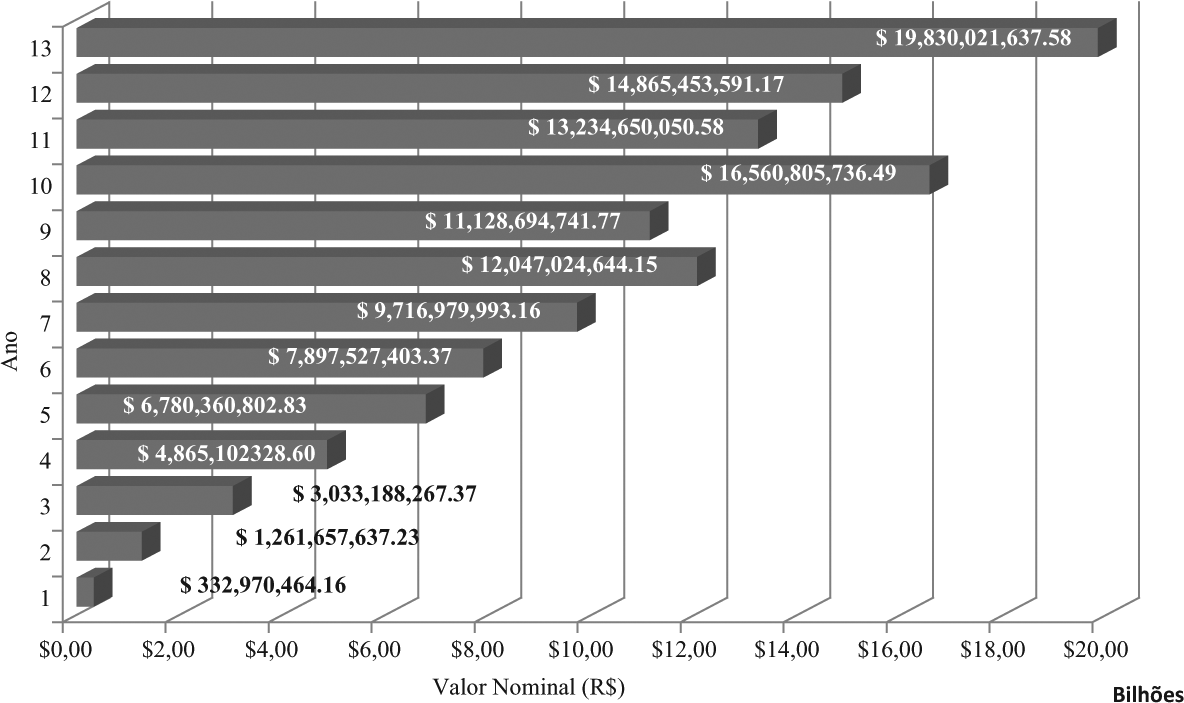
Royalty payments and special participation, Brazil, 1999–2011.
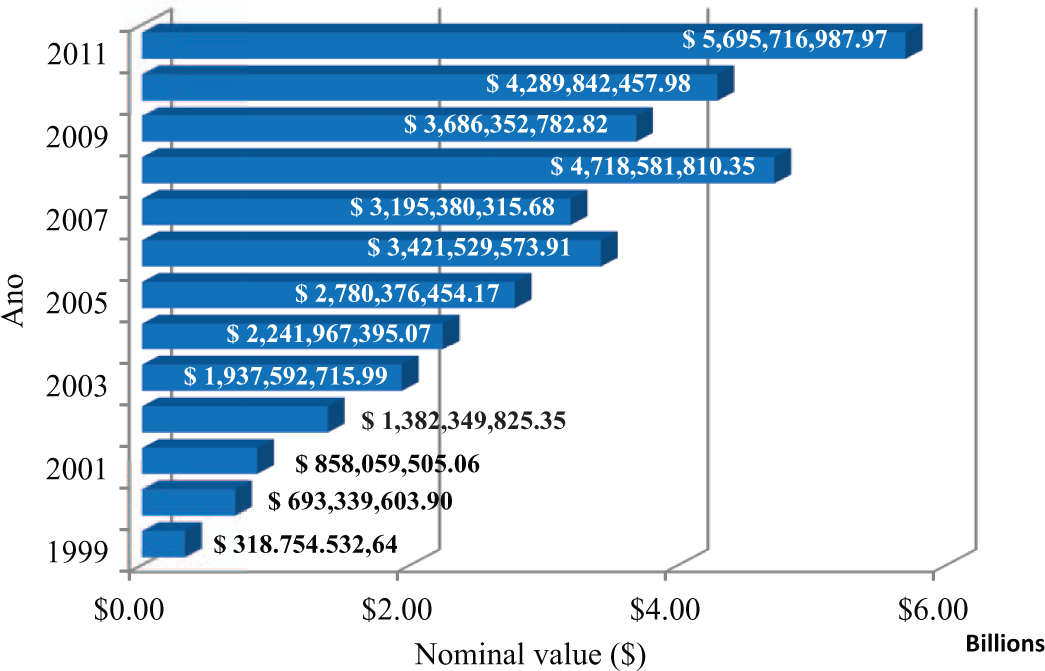
Royalty payments and special participation, Municipalities of Brazil, 1999–2011.
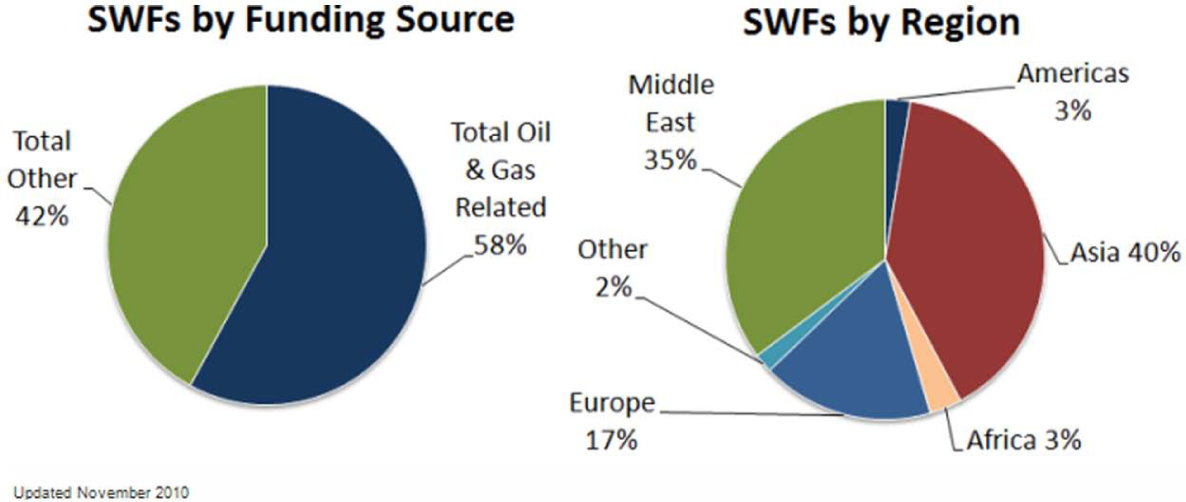
Sovereign funds.
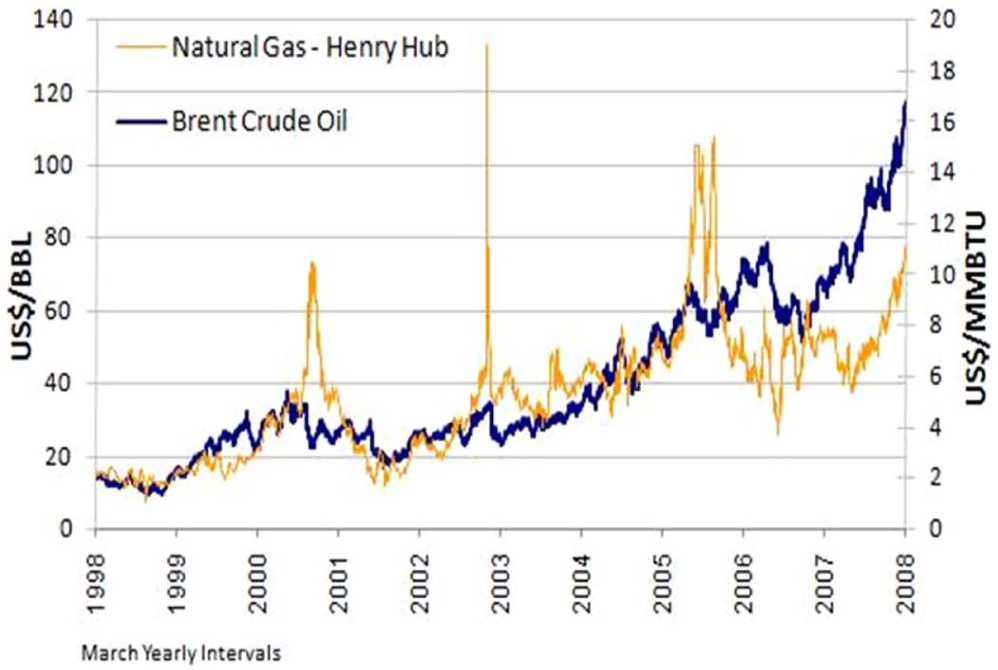
Oil & gas commodity prices.
Impact of royalties in the producer municipalities
Analysis of the distribution of royalties in the oil-producing municipalities of the States of Bahia, Espírito Santo, Rio de Janeiro, Rio Grande do Norte, and Sergipe reveals extraordinary growth. 12 In the Norte Fluminense region (Rio de Janeiro), the income from royalties and special participation, was of the order of $41.9 million dollars in 1997; by 2002, this value had increased to $341.07 million dollars, corresponding to growth of 814 percent (Honorato, 2008: 552). In the States of Espírito Santo and Amazonas, the increases in revenue were by 3950% and 3400%, respectively, between the years of 1996 and 2003 (ANP, 2011).
In Carmópolis, a city in the Sergipe oil-producing region (the RPS), gross domestic product (GDP) grew by 71.73 percent between 2000 and 2005 (Silva, 2008: 86). During the same period, Brazilian GDP growth was 15.2 percent (IBGE, 2011). The income from oil contributes more than 50 percent of the economy of Carmópolis. The municipalities of Rio Grande do Norte saw growth in oil income (including royalties and special measures) of more than 250 percent between the years 1999 and 2005 (Silva, 2007: 52).
Royalties: Social impact
The municipality of São Francisco do Conde (in the State of Bahia) receives significant oil income, and in 2008 had the highest per capita GDP in Brazil, with a value of $148 million dollars, 13 per inhabitant (EXAME, 2010). 14 At the same time, this town occupies 4565th position in the Brazilian HDI ranking. 15 In the 2009 national high school examinations (ENEM, 2009), only in the State of Rio de Janeiro did the larger of the cities receiving royalties achieve results that were above the national average. 16
In 2003, the municipality of Conceição da Barra was ranked 18th in Espírito Santo State in terms of per capita GDP, with the value of $241.55 hundred dollars; however, the same municipality was ranked in 75th place in the HDI 17 (Caçador, 2005: 101). Despite plentiful oil resources, life expectancy in the Sergipe oil-producing region (SPR) at the beginning of the decade of 2000 oscillated between 62 and 68 years, below the Brazilian average of 70.4 years (Silva, 2005: 91).
In 2001, the dropout rate in elementary schools in the State of Rio de Janeiro was 5.61 % in the Norte Fluminense region, which produces more than 80 percent of Brazil’s oil, it was 6.26 percent (Honorato, 2008: 560). This is an indication that even those regions that receive most royalties cannot properly distribute that wealth amongst their populations.
The reasons for the disparity between revenue and social outcomes
In the State of Rio Grande do Norte, in the year 2000 the municipality of Mossoró spent more than $507 thousand dollars 18 on each council member (Silva, 2007: 103). The city of Quissamã, in the State of Rio de Janeiro, in 2004 spent 10 times more than the State of Rio de Janeiro average on council members (Honorato, 2008: 562). In 2005, Pirambu and Divina Pastora, in Sergipe State, invested 857 percent and 300 percent less, respectively, than the royalties received (Silva, 2008: 183–5). Between the years 2000 and 2003, Aracruz (in Espírito Santo) showed growth in its revenue per capita of 72 percent. At the same time, there was a decrease in municipal investment of around 19 percent (Caçador, 2005: 95–8). There is, therefore, often a blatant mismatch between revenue and investment.
Distribution, implementation, and supervision of royalties
Over time, there have been changes in the distribution, implementation, and supervision of the royalties. Since 1953, changes in legislation have enabled an expansion in the number of municipalities that receive the royalties. There has also been rapid growth in the transfer of money to producer municipalities, especially after enactment of Law no. 9,478/97. Conversely, over recent years there has been a loosening with respect to the processes of enforcement and monitoring.
It was originally stated that the resources should be preferentially used for the production of electricity and the paving of roads. 19 In 1989, the options available for the use of the royalties were expanded, and only ‘the investment of resources in payment of debt and on permanent members of staff’ was vetoed. 20 Because of subsequent changes in the law, in practice the royalties are currently being used for any purpose.
Initially, it was the function of the Court of Auditors of the Federation to exercise supervision of these resources. Subsequently, changes in interpretation of the law transferred the role of implementation monitoring to the Courts of Auditors of the member States. This shift has rendered the administration of royalty resources more susceptible to political interference, hence benefitting the economic interests of the private elites who have historically retained political power in Brazil.
A number of studies have highlighted the disparities between the distribution of oil resources, especially royalties, the ways in which these resources are used, and the poor living conditions of the populations of the producer municipalities (Silva, 2007; Caçador, 2005; Reis et al., 2005; Silva, 2008).
Municipalities, income, and inequalities
Arretche (2010) identifies the importance of monetary transfers, both constitutional and conditional, in reducing inequalities in the expenses/investments of Brazilian municipalities. Use of the Gini coefficient revealed that when the municipalities relied solely on their own tax levies, their spending capacities were extremely unequal: a coefficient in the region of 0.550 in 2006. With the inclusion of the transfers, the value of the coefficient dropped to around 0.280.
In the same work, Arretche (2010) observes the effect of ‘federal regulation and supervision policies implemented by sub-national governments’ on the expenditures of the municipalities. The amounts spent according to sector (as a percentage of the total expenditure) were 25 percent (education), 20 percent (health), 10 percent (housing), and <5 percent (public transport). It is clear that the sectors that are regulated, such as health and education, have higher priority in terms of municipal expenditure.
When a similar analysis is performed for the resources derived from royalties, it is observed that the favored sectors are those that are not regulated, with the distribution being at the whim of municipal officers, without any fiscal checks or any effective social control.
Implications of the Simon amendment
The emergence of the pre-salt oil discoveries has stimulated new efforts to establish a fresh approach to the management of the regulatory framework involving oil. This is especially important since even the most conservative forecasts indicate that the new discoveries place Brazil in a highly advantageous position, and make the country a major player in the global geopolitics of oil.
To this end, the Federal Government sent to Congress four legal proposals aimed at bringing new governance to the oil sector. 21 Controversy surrounding the new legal framework has focused primarily on two questions: a) should the concessionary system be maintained?; b) should the form and payment percentages of the royalties be altered?
With respect to item a), Law no. 12,351 (22 December 2010) asserts that the system involves shared benefits: ‘The exploration and production of oil, natural gas and other fluid hydrocarbons in the pre-salt and in strategic areas will be contracted by the Union under shared production arrangements, in the form of this Law.’
With respect to the royalties, the pressure of non-producer States and municipalities (MNP) was reflected in the approval (on 10 March 2010) of Federal Law no. 5,938/09, incorporating a constitutional amendment (SGP 387). According to this amendment, all municipalities and States would receive royalties composed as follows: 50 percent according to the States Participation Fund (SPF), and 50 percent according to the Municipalities Participation Fund (MPF).
In turn, pressure from the producer municipalities (PM) resulted in the amendment of Senator Pedro Simon, which maintained the distribution of royalties based on SPF and MPF, but required the Union to pay compensation for the losses of the PM. 22 On the basis of agreements and under increasing pressure, in 2010 President Luiz Inácio Lula da Silva 23 sanctioned Law no. 12,351, but with a veto concerning the question of the distribution of royalties, deferring further debate to the succeeding government.
In practice, therefore, adoption of the Simon amendment or any other legal instrument that simply extends the distribution of royalties and special participation for the producer municipalities, without any clear focus or adoption of responsibilities and supervision, will result in increased dispersion of resources. At the same time, it will diminish investment capacity, as well as the ability of the State to control and regulate the use of the royalties and special participation. All this will result in maintaining the concentration of wealth in the hands of the economic and political elites, contributing to an increase in social inequality and a weakening in terms of human rights.
Sovereign and social funds
The new perspectives created by the pre-salt oil discoveries, the preoccupation with not being contaminated by the ‘Dutch disease’, and the desire for a socially just distribution of the wealth that might compensate the historical debt the Brazilian nation owes to its excluded citizens, resulted in discussion of the need for the country to create national social and sovereign funds.
Global sovereign funds
Sovereign funds are investment vehicles administered by national governments. The objectives of these funds include their use as guarantees for anti-cyclical policies; provision of savings for future generations; and prevention of exchange rate appreciation.
The assets comprising the funds are commonly derived from a variety of sources, such as international reserves, surplus tax revenue, or the profits of state-owned enterprises. A large fraction is often derived from the exploitation of petroleum resources (oil and gas). Globally, the greatest numbers of sovereign funds are located in Asia and the Middle East.
The first sovereign fund was created in Kuwait in 1953. There are now more than 50 funds of this nature spread across all continents. At least 17 new funds were created in the last six years. A possible explanation for such growth is the increase in the price of commodities, especially oil and gas (SWF, 2010; The Economist, 2008).
According to the estimates of the Sovereign Wealth Fund Institute (SWF), the accumulated assets of the various funds amount to $4.2 billion dollars. The International Monetary Fund forecasts that in 2012 the assets of the funds could reach $10 trillion dollars (The Economist, 2008). The largest sovereign funds are those of Abu Dhabi (Abu Dhabi Investment Authority [ADIA]), at $875 billion dollars, and Norway (Government Pension Fund [GPF]), at $380 billion dollars (SWF, 2010).
The funds have gained importance due to their influence on international assets. Positive attributes of the funds include the possibility that they may provide a mechanism for public control of private capital, since they are the property of national governments and can exert control over a substantial fraction of the shares of foreign companies. Aspects of the funds that cause concern include the possibility of economic interference of one nation in the affairs of others, and a lack of transparency in their actions and control structures. These issues have attracted strong criticism, especially since precise data concerning the funds are only available to their managements (Carvalho, 2010; SWF, 2010).
The Brazilian sovereign fund
The Brazilian sovereign fund (BSF) was created by Law no. 11,887 (24 December 2008) and has assets in the region of $5.97 billion dollars. Its creation occurred during a period of significant growth in Brazil’s international reserves, which in 2007 amounted to around $100 billion dollars and in 2008 surpassed $200 billion dollars. The objectives of the BSF are ‘to promote investments in assets in Brazil and abroad, provide public savings, mitigate the impacts of economic cycles, and encourage projects of strategic interest located abroad’.
From the point of view of the governance of the BSF, it will be ‘composed of the Minister of State for Finance, the Minister of State for Planning, Budgeting, and Management, and the President of the Brazilian Central Bank, who will determine its mission, structure, and competencies’.
The circumstances that surrounded the creation of the BSF and the establishment of its objectives, and the hegemony of its administration by ministers from the areas of finance and management – noting that not even one minister from social areas is involved – are indicative of the clear objective of providing mechanisms aimed mainly at securing fiscal stability.
The Social Fund
The Social Fund was elaborated amidst the prospective benefits envisaged following the pre-salt discoveries. It was created by Law no. 12,351 (22 December 2010), and its objectives are described as follows:
Art. 47: The Social Fund, a financial instrument linked to the Presidency of the Republic, is created with the objective of providing resources for social and regional development, in the form of programs and projects in the areas of poverty reduction and development: I – education; II – culture; III – sport; IV – public health; V – science and technology; VI – environment; VII – climate change mitigation and adaptation. Art. 48: The objectives of the SF are to: I – provide long-term public savings based on income received by the Union; II – provide resources for social and regional development, as stated in Art. 47; and III – mitigate income and price fluctuations in the national economy resulting from variations in the income generated by the activities of production and exploration of oil and other non-renewable resources.
According to the same law, the resources of the Social Fund will be derived from the income from oil. The law stipulates that the SF be linked directly to the Presidency of the Republic, which sets the composition and remit of the Financial Management Committee of the Social Fund (FMCSF). This Committee, which coordinates investment policy, involves the participation of the Minister of State for finance, the Minister of State for planning, budgeting, and management, and the President of the Brazilian Central Bank.
Although the goals and purposes of the Social Fund are different to those of Brazil’s Sovereign Wealth Fund, a factor common to both funds is that their implementation has not involved any ministers from those sectors most sensitive to social issues.
Conclusions
There has been substantial growth in the distribution of royalty resources to Brazil’s oil producing municipalities. However, the producers receive these large sums in the absence of any clear policies for their use, and without adequate or effective supervision. While, over the years, legislation has resulted in an increase in the values of the royalties received by the municipalities, there has been a decrease in monitoring and a corresponding increase in the ways in which the values are used. In practice, the royalty benefits can now be used for virtually anything. This remarkable systematic growth in revenue, with concomitant reduction of supervision and the control of transfers of royalties, has resulted in a situation where the large values distributed have not been reflected in social improvements, development, or social justice in the producer municipalities. On the contrary, it has promoted a dependency of these municipalities on finite oil resources, characterized as a variant form of the ‘Dutch disease’.
Oil, and all the resources derived from it, must be the patrimony of the Union. Many studies have demonstrated the beneficial effects of centralized regulation of public resources.
In agreement with the principles according to which it was created, the Social Fund must be socially equitable (in the absence of which it should not be described as sovereign), with absolute transparency in the management and use of its resources. The application of these resources must clearly address the inequalities present in Brazilian society, in a focused, systematic, and continuous manner.
Footnotes
Funding
This research received no specific grant from any funding agency in the public, commercial, or not-for-profit sectors.