




Abstract
The gap between theory and practice in social work has been the subject of considerable debate over recent years. This study aims at exploring the reasons for the gap between theory and practice in Kuwait, and the most significant reason for this gap. A convenient sample of 342 participated from different institutions. The results showed that the major reasons for the gap were job challenges and requirements, followed by curriculum, job description, and self-development. Results also showed significant differences between gender, type of university, major of the participants, and the institutions in which the participants work.
Keywords
Social work is a relatively new profession which came to prominence in the early years of the 19th century. According to Parton (2000), social work ‘is still seen as [a] newer, younger, less developed’ science, which needs much research and analysis (p. 450). The core of the profession of social work is the helping process. Help is provided to individuals, groups, and communities through different agencies in society. In fact, social work can be defined as the profession of helping people reach ‘an effective level of psychosocial functioning and effecting societal change to enhance the well-being of all people’ (Barker, 2003: 408).
As an applied science, social work depends on theory and practice to fulfill its aims of ‘improving societal conditions and enhancing social functioning’ among people (Greene, 1999: 1). In social work, theory is defined as an official knowledge, which informs practice (Collingwood et al., 2008). As Aldamigh (1998) explains, the profession of social work does not rely on one theory or a specific model of intervention; it is a profession with a rich knowledge base, from which practitioners can choose the model/theory that is most appropriate for the case on which they are working. Examples include ecosystem theory, cognitive behavioral therapy, the client-centered model, crisis intervention, and family theory, all some of the popular theories and models that practitioners apply to their cases. In fact, the social work profession encourages the eclectic approach, in which practitioners may use different interventions from different models at the same time. Interventions also depend on evidence-based practice as well as the experience and practice wisdom of the practitioner (Aldamigh, 1998).
Social work as a science is not as definite as other sciences like mathematics or physics. Although social work as a profession and science has its own rules and procedures of applications, it is also open to modification and personal input from the practitioner. Because social workers appreciate the uniqueness of each case and client, they believe that the application of a theory or intervention model should be distinctive and tailored to a particular case. However, the authors believe that there are some difficulties in applying this idea in practice settings, which creates a gap between theory and practice in the field of social work in Kuwait. The purpose of this study is to explore the reasons of the gap between the theory and practice in social work as it is practiced in Kuwait, and determine which one of these reasons social workers in Kuwait consider to be the most significant. Moreover, the study examines the differences between gender, type of university, study major of the participants at the university, and the ministries in which the participants work.
Literature review
The relationship between theory and practice in the social work profession should be collaborative. Knowledge can arise from conducting theoretical or empirical research and from field practice (Sheppard, 1998). When knowledge is derived from research, it needs to be applied in the field to test its effectiveness. When this knowledge is derived from practice, it needs to be tested to evaluate its validity. However, several studies have discussed the relationship between theory and practice in the social work profession and have concluded that there is a gap between theory and practice (Al-brathen, 2010; Aldamigh, 1998; Clapton et al., 2008; Parton, 2000; Sheldon, 1978). This gap has been the subject of considerable debate over recent years.
Aldamigh (1998) suggested that there is a problem with the actual application of theory and research to the practice of social work. He explained that students of social work are not well prepared to use and apply what they learn in class to practical situations with a client. He also demonstrated that it is difficult to apply many social work theories and research in the field; therefore, practitioners find themselves having to try different strategies to solve the client’s problem instead of depending on a solid research foundation; that is, they resort to a trial-and-error strategy. Aldamigh (1998) illustrated that there is a need to bridge the gap between theory and practice and to prepare a practitioner who is able to use evidence-based practice techniques as well as what he/she learned from his/her experience in the same situation.
Again, researchers believe that a ‘solid research foundation’ does not mean a molded solution that can be applied to solve similar problems; rather, it means a general framework that gives guidelines to practitioners, yet allows them to be creative and work with each case in a unique way. Likewise, Thompson (2000) illustrated that the gap between theory and practice reflects the differences between what is taught in school versus what one experiences in the field. He demonstrated that ‘theory has come to be seen as the preserve of the academic and practice as the domain of the practitioner’ (p. 84). This statement implies a disjuncture between theory and practice in the field of social work, which can be explained by the existence of two sub-cultures in the field of social work.
The first, the ‘theoretical sub-culture’, appears in the academic discipline and is concerned about questions of evidence and validity. The second, the ‘practice sub-culture’, is usually ‘forced to develop itself in extremely unpropitious circumstances’ and tests the outcomes by individual impression (Sheldon, 1978: 2). Although Sheldon discussed the idea of sub-cultures in 1978, there are a number of current authors who continue to follow Sheldon’s idea of two worlds or sub-cultures in their research; among them are Aldamigh (1998), Clapton et al. (2008), and Parton (2000). Another explanation for the gap is related to the nature of social work, which is based on helping and understanding clients. As Sheppard (1995: 267) explains, ‘The precise recreation of meaning and experience of the client is fundamentally an intuitive process’. Consequently, social workers’ assessments of the clients’ problems are more likely not to rely on the theories that social workers learned, but rather, they are spontaneous, which helps them to be more sensitive toward clients (England, 1986).
Clapton et al. (2008) found the division between theory and practice becomes apparent when social work students go to the field where they have to apply what they have learned in school. Usually, students find that what they learned in school ‘came to be unhelpfully counter-posed. What was highlighted was the apparent split between the classroom and the field’ (Clapton et al., 2008: 335). Clapton et al. (2006) found that the schools of social work do not train their students adequately for field placement, although field placement is supposed to be ‘designed to bridge the gap between the theoretical world of academe and the real world of professional practice’ (Fernandez, 1998: 173).
The literature suggests some reasons for the gap between theory and practice. One of the reasons for the existing gap between theory and practice is what practitioners refer to as ‘out-of-date interventions’, which means that what is being practiced in the field placement agency lags behind what is being taught in school (Clapton et al., 2006). Another reason for this gap is the large number of theories in social work, which sometimes can be confusing and overwhelming for students regarding how each of these theories or models can fit the cases on which they are working (Collingwood et al., 2008).
In the literature available in Arabic, there are very few studies that examine the relationship between theory and practice in social work. Sid (1992) studied the effect of social work students’ preparation in the health field in Egypt. Sid’s (1992) findings show that social workers who work in healthcare institutions such as hospitals and clinics did not benefit in their practice from the social work courses related to practice in medical or mental health settings. They benefitted neither from courses related to social work as a profession in medical settings, nor from social work courses in general, leaving a major gap between the courses they took and their practice.
Salem (1998) conducted a study on social workers who work in the education field in Egypt, to examine their commitment to use the social work models in their interventions with clients. The findings of Salem’s study show that 57 percent of the sample is not familiar with social work models and does not use them in interventions. In addition, Salem (1998) found that the interventions that are used with clients do not build on social work theories, due to a lack of knowledge of social work theories and models.
Literature on the reasons for the gap between theory and practice in social work is scarce, especially in Kuwait. To understand and examine the relationship between theory and practice from the point of view of social workers in Kuwait, a focus group of 15 social workers in Kuwait from different settings such as Kuwaiti social workers, the social work profession in Kuwait, and field practice students at Kuwait University discussed this issue with the authors and revealed a noticeable gap between what they learned in classes and what they are obligated to apply in their work settings. The authors asked the focus group one open-ended question, which is: ‘In your opinion what are the reasons for the gap between theory and practice in social work in Kuwait?’ The social workers in the focus groups illustrated many reasons for the gap. These reasons were revised and any duplications were removed. The focus group discussion led to identifying four reasons for the gap between theory and practice in social work, as it is practiced in Kuwait. The authors developed four sub-scales based on these four reasons: curriculum, job challenges and requirements, job description, and self-development.
Curriculum
The first reason is curriculum, which includes social work courses and field practice. In these courses students learn about theories, cases, and therapies that are relevant to the social work profession. In addition, social work students apply what they have learned in their classes to field practice. In these courses, the professors provide the students with the most current knowledge in the social work field. However, social workers who work in the field continue to use old information. Therefore, there is a gap between what is taught in the social work program at Kuwait University and what social workers practice in the field. As a result, the curriculum of social work practice at Kuwait University is more advanced in knowledge of social work than the field practice is.
Job challenges and requirements
The second reason for the gap is job challenges and requirements, which means that the workplace of social workers does not require social workers to use new theories and therapies when they work with cases. For example, the social workers in the focus group explained that their supervisors in the field insisted on using Freud’s theory of psychoanalysis with clients because they were familiar with this theory, although there are other therapies, like solution-focused therapy, that can also be helpful with clients. However, as they explained, their supervisors do not allow new practitioners to use other theories mainly because they are unaware of them. Moreover, their workplace does not encourage them to attend workshops and conferences that are related to their specialties in social work. In addition, their workplace does not provide social workers with current issues of research journals and books in their area of interest in social work.
Job description
Another reason for the gap is job description, which means that social workers do not have a clear job description that helps them to expand their knowledge in social work and helps them to apply the model that is close to their way of thinking when they are working with a case. In Kuwait, social work as a profession has many obstacles. One of them is the job description for social workers in the public sector (Ministry of Health, Ministry of Education, Ministry of Social Affairs and Labor). The job description is written by officials who are not social workers; therefore, we often see some tasks that social workers are required to do when in fact they are not related to the profession of social work. For instance, social workers who work in the Ministry of Education have to keep track of students’ attendance in classes, give sick students their medication, and sometimes cover for teachers when they are absent. Most of the time, social workers working in the public sector in Kuwait do not read their job description or they are not given a job description at all when they are hired, and there is no negotiation about their job description at the time of hire.
Self-development
The last reason for the gap is the lack of professional self-development. Whether or not social workers stay abreast of the newest theories and therapies in the field beyond graduation can open the gap further or can help to close it. Also, using their knowledge in the field of social work based only on their experience in the field of social work can also impact the gap.
Research question
This is the first study in Kuwait that explores the reasons for the gap in the field of social work in Kuwait and its relationship with other variables such as gender, type of university, major, and field of practice. At this point, the authors are more concerned with finding out whether or not there is a relationship between the four reasons and the other variables. However, other areas, such as the characteristics of the gap, profession, and practice also need to be explored. These areas will be the goal of our next study, which will build on the results of the study at hand. In the current study, we mainly aim to answer the following research question: Are there any differences between the four reasons for the gap between theory and practice (curriculum, job challenges and requirements, job description, self-development) and gender, type of university, major, and field of practice among a sample of social workers in Kuwait?
Hypotheses
H1: There is a significant difference between gender and the four reasons for the gap between theory and practice (curriculum, job challenges and requirements, job description, self-development) among a sample of social workers in Kuwait. H2: There is a significant difference between the type of university social workers attend (Kuwait University or other Arab universities) and the four reasons for the gap between theory and practice (curriculum, job challenges and requirements, job description, self-development) among a sample of social workers in Kuwait. H3: There is a significant difference between the major of social workers at the university (social work, sociology, psychology) and the four reasons for the gap (curriculum, job challenges and requirements, job description, self-development) among a sample of social workers in Kuwait. H4: There is a significant difference between the field of practice of the social workers (Ministry of Education, Ministry of Health, Ministry of Social Affairs and Labor, and others) and the four reasons for the gap (curriculum, self-development, job challenges and requirements, job description) among a sample of social workers in Kuwait.
Methods
The goal of this research was to explore the reasons for the gap between theory and practice in social work. A survey approach was selected to address the research questions. Survey research is used for descriptive and explanatory purposes (Rubin and Babbie, 2001).
Participants
This study used a convenience-sampling method to recruit the study participants. The questionnaire was administered to social workers who work in different institutions in Kuwait who agreed to participate in this study on a voluntary basis. A total of 324 participants from the Ministry of Education, Ministry of Health, and the Ministry of Social Affairs and Labor in Kuwait participated in the study. In addition, there were other participants from other institutions in Kuwait, such as the Kuwait Center for Autism, Center of Social Development, and the Council of Ministers General Secretariat. Participants’ ages ranged from 18 to 63 years old (mean = 36.99). Females comprised 69.1 percent of the sample, and males comprised 25.6 % 73.1 percent of the sample were married, 16.4 percent were single, 3.7 percent were divorced, and 1.2 percent were widowed. In terms of educational level, 92.9 percent of the sample had a bachelor’s degree, 2.8 percent had a diploma, and only 2.2 percent had a master’s degree. Of the total sample, 72.8 percent had a degree in social work, 16.7 percent had a degree in psychology, and 9.3 percent had a degree in sociology. The majority (68.2%) of the sample had received their degree from Kuwait University and only 28.7 percent had received their degree from universities in other Arab countries. The majority (64.2%) of the sample worked in the Ministry of Education, 14.2 percent of the sample worked in the Ministry of Social Affairs and Labor, 10.8 percent worked in the Ministry of Health, and 8 percent worked in public and private institutions in Kuwait (Kuwait Center for Autism, Center of Social Development, Council of Ministers General Secretariat).
Instrument of the study
The participants in this study completed a questionnaire developed by the researchers to explore the reasons for the gap in the social work profession in Kuwait. The questionnaire consisted of five parts. In the first part, the researchers used seven items, which included statements about the curriculum taught in the Department of Sociology and Social Work in Kuwait University. The second part included four items that describe the self-development tendency of the social workers. The items in the third part of the instrument were five items about job description. The fourth part included seven items about job challenges and requirements. The last part included relevant demographic items such as marital status, age, level of education, living with family, gender, and year of graduation. A five-point Likert scale was used, from strongly agree, agree, neutral, to disagree and strongly disagree.
Internal consistency
Cronbach’s alpha for the curriculum scale was found to be 0.84. For the self-development scale, Cronbach’s alpha was 0.61. Cronbach’s alpha for job challenges and requirements scale was found to be 0.76. The last scale was job description, with Cronbach’s alpha of 0.79.
Factor analysis
A factor analysis of the seven items of the curriculum scale, using the principal component method, yielded one factor, which is curriculum, which accounted for 51.7 percent of the variance. The eigenvalue associated with this factor was 3.6. This factor included the following items: the theories that we studied in the social work program at the university are relevant to the culture of Kuwaiti society; the examples used by the professor at the university to explain the theories of social work are relevant to Kuwaiti society; the theories that we studied in the social work program at the university can be applied in the field of practice; there is no difference between what we have learned in the classroom and practice; there is no difference between the nature of work with individual cases and what we studied at the university; courses in the social work program cover all aspects of professional practice; and my professional degree contributed adequately toward preparing me for practice. All of the above items were loading on the curriculum factor. In this factor (curriculum), all of the loadings were greater than or equal to 0.50, which is considered practically significant (Hair et al., 1998).
A principal component analysis of response to the self-development scale yielded one factor with an eigenvalue of 2.6; this factor accounted for 56.6 percent of the variance. The self-development factor included the following items: I read many references related to my job; I follow new knowledge in the field of social work; I depend on scientific research in dealing with professional situations; and accumulated practice experience in the field of social work may be more useful than relying on theories.
In addition, the job description scale contained five items. A principal component method yielded one factor. This factor accounted for 51 percent of the variance. The eigenvalue associated with the job description factor was 2.5. This factor included the following items: I have an evident professional identity at work; I use the medical model in my professional interventions; I can apply the model that is close to my way of thinking when working with cases; there are specific/fixed models of practice that I have to follow at work; and recording individual cases in the files follows the current theories.
Moreover, a principal component analysis of response to the job challenges and requirements scale yielded one factor associated with an eigenvalue of 3.2; the job challenges and requirement factor accounted for 45.9 percent of the variance. This factor included the following items: my job requires that I follow many current theories and information; my job requires that I should be clear in using scientific foundations during my practice; my job requires high creativity and vision in practice, I seek help from others (professionals and academics) when I face obstacles in my practice, my job encourages me to attend workshops conferences, and courses; my workplace provides me with current issues of research journals and books in the field of social work, and there is a rich library in my workplace that includes many current journals and books in the field.
Results
The results of the t-test showed that there are significant differences at p < 0.05 between the type of university a participant attended and the four reasons for the gap (curriculum, job challenges and requirements, job description, self-development). There are significant differences between Kuwait University and other Arab universities in terms of curriculum (t = 2.81, p = 0.01), with a mean of 23.20 for Kuwait University and a mean of 24.99 for other Arab universities; self-development (t = 3.38, p = 0.001), with a mean of 14.47 for Kuwait University and a mean of 15.56 for other Arab universities; job description (t = 3.74, p = 0.001), with a mean of 19.32 for Kuwait University and a mean of 20.80 for other Arab universities; and job challenges and requirements (t = 2.9, p = 0.01), with a mean of 25.39 for Kuwait University and a mean of 27.09 for other Arab universities. In other words, social workers who earned their degrees from Arab universities reported less agreement with reasons for the gap mentioned in the questionnaire than did Kuwait University graduates in the four scales (see Table 1).
t-test between type of university and the four reasons for the gap.
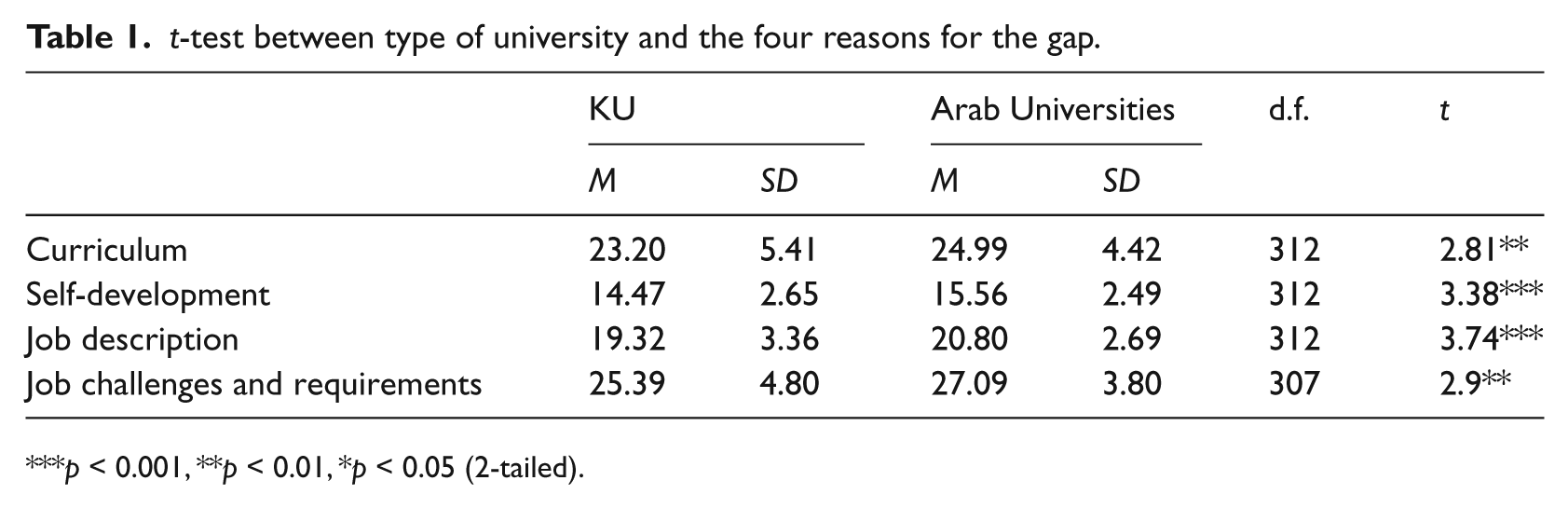
p < 0.001, **p < 0.01, *p < 0.05 (2-tailed).
When a t-test was conducted to examine differences between genders, we found that males showed less awareness of the gap than did females in three scales except in job description. The results showed that there are significant differences between Kuwaiti males and Kuwaiti females in terms of curriculum (t = 3.14, p = 0.05), with a mean of 25.34 for Kuwaiti males and a mean of 23.26 for Kuwaiti females; self-development (t = 3.21, p = 0.01), with a mean of 15.58 for Kuwaiti males and a mean of 14.50 for Kuwaiti females; and job challenges and requirements (t = 2.14, p = 0.05), with a mean of 26.80 for Kuwaiti males and 25.52 for Kuwaiti females. However, the analysis indicated the means of job description did not differ significantly at p < 0.05 (see Table 2).
t-test between gender and the four reasons for the gap.

p < 0.001, **p < 0.01, *p < 0.05 (2-tailed).
The results of one-way ANOVA showed that there are significant differences between the field practice where the participants work and the four reasons for the gap. Field practice included four categories, which are the Ministry of Education, the Ministry of Social Affairs and Labor, the Ministry of Health, and public and private institutions in Kuwait. Participants who work in the Ministry of Education scored significantly higher on the curriculum and self-development sub-scales than did those in the other field practice categories. Participants who work in the Ministry of Health scored significantly higher on the job description and job challenges and requirements sub-scales than did those in the other field practice categories (see Table 3).
One-way ANOVA between field practice and the four reasons for the gap.

p < 0.001, **p < 0.01, *p < 0.05 (2-tailed).
One-way ANOVA was conducted to test differences between groups in terms of the majors, and the four reasons for the gap (curriculum, job challenges and requirements, job description, and self-development). The participants of this study reported three majors, which are social work, sociology, and psychology. There are significant differences at p < 0.05 between the majors of the participants and the four reasons for the gap. Participants who had majored in social work or psychology scored significantly higher on the four reasons for the gap (curriculum, job challenges and requirements, job description, and self-development) than did those who had majored in sociology (see Table 4).
One-way ANOVA between majors and the four reasons for the gap.
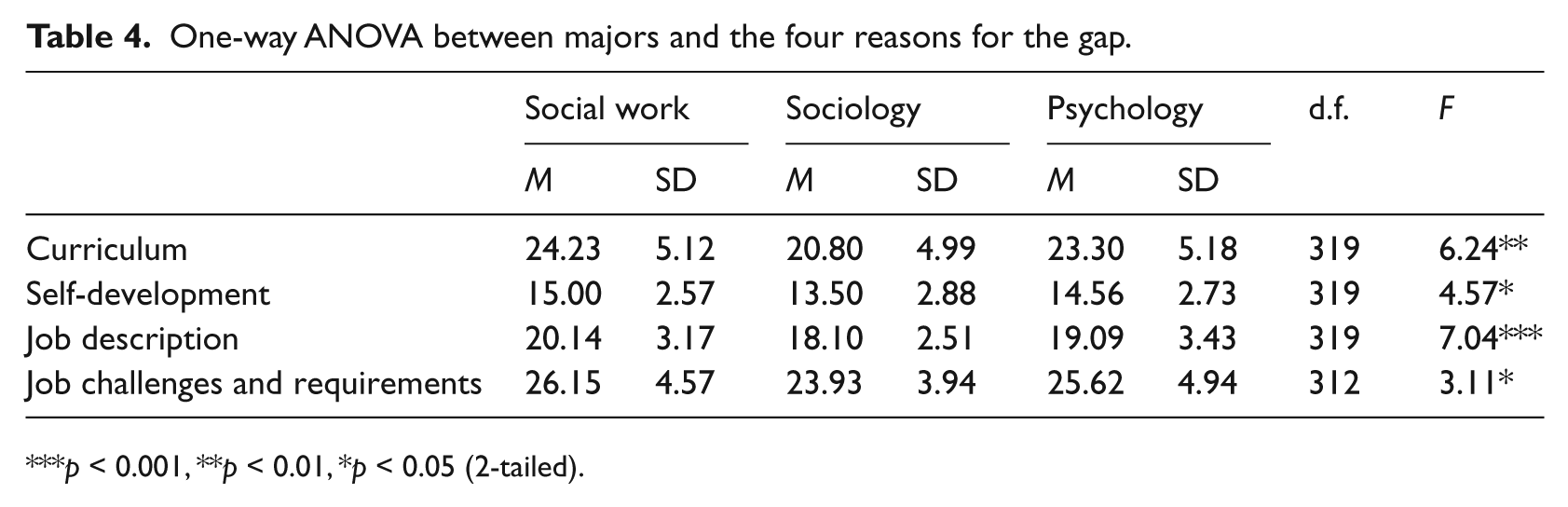
p < 0.001, **p < 0.01, *p < 0.05 (2-tailed).
Discussion
To our knowledge, this is the first study to examine the gap between social work theory and practice in Kuwait. After reviewing the literature and working with the focus group, the authors constructed an instrument in which they stated four main reasons for this gap, in the form of four scales. The four reasons to be tested in Kuwait were as follows: curriculum, job challenges and requirements, job description, and self-development.
The researchers hypothesized a significant difference between social workers earning their degrees from Kuwait University and those graduating from other Arab universities. The results of the t-test supported the hypothesis and showed significant differences at p < 0.05 between Kuwait University and Arab universities in all four scales (curriculum, self-development, job description, and job challenges and requirements). The differences were in favor of Arab universities. Social workers who earned their degrees from Arab universities reported less agreement with reasons for the gap mentioned in the questionnaire than did Kuwait University graduates in the four scales.
This difference might be explained by the type of curriculum used in each university. Obviously, the social work program in Kuwait University depends on current Western theories and models of practice adapted to Kuwaiti culture, as well as interactive teaching methods that encourage student participation and discussion. However, this was not enough to shrink the gap between theory and practice. The social work program at Kuwait University is one among three departments (sociology, social work, and anthropology) unlike at other Arab universities in which social work is an independent college or school. A college of social work offers more in-depth courses and a variety of specialties in the major, while a social work major within a department including two other majors usually offers less opportunity for students to grasp all types of intervention models or practice theories. For example, in the College of Social Work at Cairo University, there is an independent department for social work with individuals, while at Kuwait University, social work with individuals is limited to a single course in the social work curriculum.
The difference in the self-development scale can be explained in terms of learning habits developed while studying at the university. In Kuwait University, students are encouraged to read articles and books other than the required textbooks for the course and present their findings or point of view. They are also encouraged to participate in relevant workshops and training courses to enhance their skills and develop their knowledge. Again, this leads to a conflict between new and old practitioners in the sense that younger generations want to apply the up-to-date models, but receive no encouragement from their superiors. Therefore, professors of social work at Kuwait University have started a new intensive training program for supervisors in different social work institutions, especially those in which students do their field placement. The aim of the intensive program is to introduce new practice models and theories for older practitioners in order for them to be on the same level with the new graduates.
To explain the significant differences in the job description scale, we can depend on the fact that usually those who set job descriptions and manners are those who are considered to be experts in the field. In the case of Kuwait, those in a position to decide on job descriptions are supervisors who are more likely not to have a social work degree. Therefore, they set the job descriptions with missions that are not related to the social work profession. For example, if a teacher wants to punish a student, the teacher sends that student to the social work office in the school.
When a t-test was conducted to examine differences between genders, we found that males showed less awareness of the gap than did females in three scales except in job description. Looking at the educational background of both males and females, we find that a majority of the males are graduates of Arab universities and a majority of the females are Kuwait University graduates. By looking at the sample descriptions, we can see that Kuwaiti males who obtained their degrees from Kuwait University comprised 16.5 percent of the sample compared to Kuwaiti males who obtained their degrees from other Arab universities, who made up 54.5 percent of the sample. On the other hand, Kuwaiti females who were Kuwait University graduates comprised 83.5 percent of the sample, while Kuwaiti females graduating from other Arab universities comprised only 45.5 percent. This takes us back to the previously discussed reasons for the gap between graduates of local and Arab universities. It illustrates that males who are graduates of other Arab universities should feel less challenged in their practice than females who graduated from a system that does not help them much in their field practice because it is too advanced and does not match what is actually practiced in the field.
ANOVA showed that health field practitioners experienced the highest awareness of the gap, while social workers in academia experienced the lowest awareness of the gap. A logical explanation for this is that the Ministry of Education is very supportive of the profession of social work. Unlike the Ministry of Health, the Department of Social Work and Psychology at the Ministry of Education encourages practitioners to attend workshops, conduct research, and join training courses to improve their knowledge and skills. In fact, the Department pays all expenses for practitioners to attend training courses and workshops. In addition, the Department is in constant contact with professors from the social work program in Kuwait University to give intensive courses to their practitioners year round.
An additional significant difference among groups was related to the major in the bachelor’s program. Practitioners who majored in social work reported less awareness of the gap than did practitioners with degrees in psychology and sociology. Clearly, practitioners with an educational background in the same field of practice would be more prepared and equipped with the needed knowledge and skills to intervene with the clients. Psychology major practitioners showed less awareness of the gap than did sociology graduates because psychology and literature courses, as well as field placements required in Kuwait University are, to a great extent, related to the field of social work. Therefore, the authors expected to find that practitioners with a sociology degree would complain more about a gap between theory and practice.
Implications
The researchers developed an instrument consisting of four scales measuring four different areas to confirm the suggested reasons for this gap. This instrument, which has been proven to be valid and reliable, could be used as an evaluation tool for practitioners and/or practitioners under training to assess their benefit from the knowledge they have as they practice in their profession.
The instrument of this study, which is described in the methodology section, could be used to evaluate the practice setting. Supervisors can use it to verify whether the setting/agency is competent or not. In addition, the instrument should be useful in determining the extent to which the setting/agency provides practitioners with adequate opportunities to bridge the gap between theory and practice. If a gap exists in a certain setting, then it is an indication for the need to use a different manner of practice, such as research-based practice, empirical practice, or action research to enhance practitioners’ knowledge and skills. For example, action research helps social workers to narrow the theory-practice gap by discovering a new approach that works with uncertain and undetermined practice situations. Action research is an approach that aims to develop new knowledge from practice in order to solve unexpected social problems. However, this new knowledge is based on existing knowledge. Moreover, social workers in their practices will not only apply theories developed from research, but they will discover new theories based on their own experiences (Kaplan, 1964; Schön, 1987; Sung-Chan and Yuen-Tsang, 2008).
Limitations and future research
Although this study is pioneering research on the gap between theory and practice in Kuwait, it holds a notable limitation. In this study the scales have been administered to a convenient sample which limits its generalizability. Future research needs to attend to this point and recruit a larger sample. Future studies also need to evaluate different approaches to bridge the theory–practice gap.
Footnotes
Funding
This research received no specific grant from any funding agency in the public, commercial, or not-for-profit sectors.