




Abstract
The 21st century has created renewed interest in developing culturally relevant social work where it does not exist, especially for children affected by armed conflict and disaster, in order to ensure that local professional standards guide responses to these types of distress. In this context Afghanistan’s National Strategy for Children at Risk required the development of professional guidelines for social work practice with children in crisis. This article illustrates the collaboration of the Afghan government with two international schools of social work to initiate national social work standards and curricula by engaging local practitioners in defining their work and core competencies through the DACUM (Develop-A-Curriculum) method. Strengths and limitations of the method are explored, as are implications for social work development in Afghanistan and other conflict and disaster affected countries.
Keywords
The social worker is the doctor of the society: The social worker diagnoses and treats social problems, both at their roots in society, and through the symptoms that appear in the community, the family, the child. (Program Director, Afghan Child Protection Organization)
Introduction
The effects of globalization, rapid development, and disasters on vulnerable populations have created a renewed interest in developing culturally relevant social work in countries where it does not exist as a formal profession. However, the practice of importing Euro-American social work systems to meet the needs of developing countries has been found to be ineffective at best and damaging at worst, as it often sidelines the very traditions that ensure the well-being of children and families, raising questions for the profession about the wisdom of developing such programs (Dominelli, 2010; Dominelli and Hackett, 2012; Gray et al., 2008; Haug, 2007). When social work does not exist in conflict affected-countries, international organizations often bring in outside experts to provide social work services to enhance child, family, and community well-being. This approach may weaken the rebuilding of a sustainable, locality-based, and transparent system of care (Ghani and Lockhart, 2008; Lavalette and Ioakimidis, 2011). This article addresses the question of how social work theory and practice might be formalized in a crisis-ridden country. Can a participatory methodology ensure that a culturally relevant, effective and sustainable profession emerges?
Background and development of child protection social work in Afghanistan
For the past 30 years, Afghanistan has been affected by war and natural disaster placing extraordinary stress on children, families and communities (Muhmand, 2010). The armed conflicts destroyed Afghanistan’s physical and service delivery infrastructure, while earthquakes and droughts stressed the community’s capacity to cope (Ghani and Lockhart, 2008). Traditionally, Afghan children received protection and care within the extended family and community; when these systems proved insufficient, elders and community leaders stepped in (Bragin, 2002). Once a country that prided itself on caring for its children, Afghanistan now ranks among the riskiest countries for every indicator of child survival (UNICEF-CSO, 2012). Twenty-five percent of children ages 5 to 14 are engaged in child labor, 46.3 percent of girls under the age of 18 are married, 4.7 percent of children are classified as orphans (though 12% are living in orphanages), and 37,000 children are working on the streets of Kabul alone (UNICEF-CSO, 2012). War-related emotional distress affects a majority of children and families (Miller et al., 2008).
To address these issues, the Ministry of Labor, Social Affairs, Martyrs, and Disabled (MoLSAMD) identified the need for technical assistance in child protection to ‘guide the process of institutional transformation, reform management and new community-based services development’ (MoLSAMD, 2004: 23). As a result, MoLSAMD, supported by UNICEF, launched the National Strategy for Children at Risk (NSFCAR) in 2006. A key element of NSFCAR is the development of professionally qualified social workers specialized in community-based child protection (MoLSAMD, 2004).
Professional social work is an established profession in all the countries that border Afghanistan. From India, Pakistan and Iran, which have long established social work educational institutions guiding public policy and practice, to the emergence of social work education in Uzbekistan and Tajikistan, social work policy development and service delivery is informed by locally developed social service research, with specific attention to the needs and resources of children, families and their communities in the local context (Nadkarni, 2011).
Without a professional social work system in Afghanistan, communities developed ad hoc systems to meet challenges resulting from war and natural disasters, including some problematic practices such as institutionalization and sending children to live with wealthy or powerful persons, including leaders of armed groups (Muhmand, 2010). These practices, the cumulative result of 30 years of conflict and occupation, concerned many Afghan activists and organizations (Muhmand, 2010).
To address these issues, international and national non-governmental organizations introduced a dedicated workforce, without specific educational qualification or recognized occupational skills standards, to meet community needs (Muhmand, 2010). Called ‘social workers’ (madadkaar ejetimaayee) in Dari, staff members of these organizations were engaged in all required modalities, including casework, group work, and community organization and development. They worked in areas such as juvenile justice, protection from abuse, family mediation and reconciliation, awareness raising and prevention activities (Muhmand, 2010; MoLSAMD, 2004). Capacity-building programs were offered piecemeal to upgrade their knowledge, however they did not build upon a body of Afghan social work theory and resulting competencies.
With no systematic education or standard qualification for social work, local practitioners were limited in their capacity to conduct professional needs assessments, deliver services, and distribute resources within the country (Pardington and Coyne, 2007; Wulczyn et al., 2010). This left responsible government ministries to commission external research on Afghan children and families to better child and family welfare services, rather than relying on existing Afghan institutions (Muhmand, 2010).
A crucial first step for a government seeking to re-assert its sovereignty following the destruction of its formal institutions is to regain control over the provision of services to citizens (Ghani and Lockhart, 2008). National social welfare services are essential in developing citizen ownership of local institutions in the 21st century (Lavalette and Ioakimidis, 2011). Accordingly, MoLSAMD sought consultation to build a formal system of social work and social welfare to provide transparent, culturally relevant services to the population; these services would be informed by Afghanistan’s best traditions and conform to international standards and social work’s universal human rights vision (Muhmand, 2010). The National Skills Development Program (NSDP), under the aegis of MoLSAMD contracted with the Silberman School of Social Work at Hunter College and Boston College Graduate School of Social Work (HC/BC team) to collaborate in developing national skills standards (NOSS) for child protection social work and curricula for social work education. This approach involves the development of a comprehensive educational program alongside the development of accompanying job codes, enabling newly qualified social workers to become employed. Experience suggests that without developing such standards in tandem with curriculum, the work of social workers remains hampered by a lack of formal recognition and makes it difficult for potential social workers to take a professional lead in service provision, program planning, and resource allocation (Hugman et al., 2007; Yuen-Tsang and Ku, 2008). The purpose of the partnership was to develop these standards and curricula based on Afghan-specific knowledge and values, supported by relevant international knowledge and research.
Developing social work curricula in the context of political conflict
There is a small but significant literature on the development of social work curricula in times of political conflict (Campbell and Duffy, 2008; Duffy, 2012; Duffy et al., 2013; Lindsay, 2008; Ramon, 2008). These authors emphasize the need to individualize the response based on the nature of the conflict and the safety of participants. Close attention to the culture and traditions of service users and practitioners is especially important in countries experiencing occupation and weak or missing national institutions (Dominelli, 2010; Duffy, 2012; Lavalette, 2011; Murphy, 2011). Therefore, the authors, both international and Afghan, sought to employ a participatory methodology for developing a curriculum that included current practitioners and service users.
Unpacking the role of Islam: Developing professional social work in an Islamic republic
Unpacking the complex and multi-layered role of Islam in Central Asia as it relates to the development of social work is an important issue beyond the scope of this article. It has been addressed in a small but significant literature (Crabtree and Baba, 2001; Haynes et al., 1997; Murphy, 2011).
Afghanistan, like its neighbors Pakistan and Iran, is an Islamic republic. The first three articles of the current constitution protect universal human rights; establish Islam as the state religion; and forbid speech or actions contrary to the laws of Islam (Constitution of Afghanistan, 2004). Like neighboring Tajikistan and Uzbekistan, where professional social work is being introduced as a formal profession, the Afghan population is predominantly Muslim (Murphy, 2011). However, the country remains home to Hindus, Sikhs, Christians and Jews. Among the issues plaguing Afghanistan throughout the years has been harsh rule by warring parties, many of whom imposed a repressive, narrow interpretation of Islam as an instrument to suppress the rights of religious and national minorities, women and girls, and dissenting citizens (Murphy, 2011). While Islamic scholars in social work and child protection state that these interpretations directly contradict Qur’anic teaching, and that practices derived from them must be eradicated (Crabtree and Baba, 2001; Islamic International Center, 2005; Key, 2008; Walton and Abo El Nasr, 1998), cultural attitudes and conservative mores remain an obstacle to change (World Bank, 2005).
The 2004 Afghan constitution guarantees freedom of religion, speech and dissent and accords full rights to women, religious, cultural, and national minorities, as well as all those who may suffer discrimination. National social work standards include advocacy for these rights, and the underlying values that social workers across the world are expected to follow (IASSW and IFSW, 2004). Obstacles to implementing these rights, however, exist on multiple levels: family, community, society and its organizations. New professional standards and curricula must equip social workers to address them.
The method used by the authors to develop the curriculum and national skills standards maximized the participation of Afghan voices on all levels so that what emerged could be truly Afghan. The female legal scholars, civic leaders, and community activists on the advisory committee were particularly concerned that social work curricula emphasize awareness of the provisions of Afghan law and constitution that embrace a strong rights perspective (Constitution of Afghanistan, 2004). To insure that the competencies necessary to advocate for these rights formed an essential part of any present and future social work project, knowledge of international human rights standards and instruments were incorporated into the National Skills Standards and curricula emerging from the effort.
From their locally informed perspective, Afghan human rights advocates stated that social workers with a strong knowledge of Islam could best implement human rights imperatives and international social work standards (IASSW and IFSW, 2004), in the face of this adversity. We concur with those scholars who believe that social work, to be effective and legitimate in Afghanistan, as in other parts of Central Asia, would be required to engage, and be informed by, Islam in all of its complexity, coupled with international human rights instruments and the code of ethics of the IASSW/IFSW. In this way they could effectively address challenges to those rights in the family, community and larger society (Murphy, 2011).
Social transformation begins with engaging society’s traditions, and in so doing, social workers place themselves at the forefront of efforts to educate the public on the need to advance children’s women’s and human rights sustainably and effectively (Dominelli, 2010; Murphy, 2011: 164).
The social worker must be the mediator between the society and the person. In fighting for rights they must understand the true meaning of Holy Qur’an; that it is not the same as local prejudice, custom and belief . . . They must have the strength and capacity to teach these things, so that children and families can be protected from abuse even in the most difficult times . . . (Program Coordinator, Afghan Women’s Rights Organization)
Methodology
Countries new to developing professional social work begin by identifying cultural theories and practices, and integrating them with global standards (Healy and Links, 2011; Hugman et al., 2007; Key, 2008; Rankopo and Osei-Hwedie, 2011; Tsang and Yan, 2001; Yuen-Tsang and Ku, 2008). Hugman et al. (2007), for example, employed a survey method in developing the Vietnamese social work curriculum. Surveys are easily replicable, creating a transparent base for any study. The weakness of this approach is that it requires the same process that Key (2008) cautions against – namely using terminology constructed internationally to define and, perhaps, to confine the way social work becomes locally constructed by service users, practitioners and policy-makers. Accordingly, any methodology seeking to draw on local knowledge and tradition needs to be participatory, gathered from the ground up, traceable, and replicable (Healy and Links, 2011; Hugman et al., 2007; Key, 2008; Rankopo and Osei-Hwedie, 2011; Tsang and Yan, 2001; Yuen-Tsang and Ku, 2008).
The DACUM methodology
The NSDP uses the DACUM methodology to develop national skills standards for all occupations in Afghanistan. This methodology was used to learn about Afghan specific theory and practices and develop an Afghan social work lexicon. DACUM, an acronym for ‘Developing a Curriculum’, is an occupational analysis method aimed at achieving results that may be immediately applied to the development of training curricula (ILO/CINTERFOR, 2011: 38). A participatory method, DACUM requires that the occupation be identified, described, and analyzed by persons using them in a particular setting and locale. A competency-based framework, it lays out the knowledge, skills, personal qualities, and tools needed to accomplish a particular job (Adams, 1975; de Onna, 2002). The process provides a job description and a listing of ‘knowledge, skills, values, traits, and tools needed by high performing workers’ that are organized into charts (Wolford et al., 1996: 176). There is little academic literature on the DACUM method; a search of EBSCO Host and Academic Search Complete of the keyword DACUM in all languages yielded only six articles published since 1996. Additional literature on the subject is largely available on the website of Ohio State University, where it was developed (ILO/CINTERFOR, 2011; Norton, 1997). Other papers, published in newsletters, were located through general search engines.
Some authors found advantages to the method when modified to specific circumstances. Conway and Jeris (2006) used the DACUM method in Sri Lanka (a country experiencing political conflict) when tasked with quick development of a training curriculum. The authors found that employing the DACUM method allowed participants to define their work and its nature in a context that they understood, aligning it to the participatory learning in action model developed by Freire (1970).
Baldwin (2012) provides examples of participatory action research used to develop culturally relevant social work curricula in Ghana (p. 472). Including a focus group discussion within the method may improve the likelihood of uncovering cultural relevance, especially in conflict-affected contexts (Baldwin, 2012; Miller, 2012). The use of the DACUM method seemed appropriate for this project. Conway and Jeris (2006: 2) also found that the DACUM methodology, used flexibly, was replicable and traceable, thus creating a middle ground between the open-ended method recommended by Key (2008) and the survey design used by Hugman et al. (2007).
DACUM has been traditionally applied to vocational standards, as it provides a step-by-step breakdown of tasks that may be repetitive, sequential and prescribed. It is designed for the production of curricula for training manuals, rather than university level syllabi (ILO CINTERFOR, 2011). The methodology for professional social work was modified but retained the competencies framework to ensure that the information gathered reflected the range of participant experience (Key, 2008).
Procedures
The project involved a comprehensive desk review of the assessment documents completed by national and international participants, as well as the formation of an advisory committee comprising MoLSAMD and UNICEF engaged stakeholders in child protection social work. Included in the advisory committee were government ministries that employed or wished to employ social workers for children and families, including the Ministries of the Interior, Justice, Culture Youth and Sports, Public Health and the sponsoring ministry, MoLSAMD, as well as Afghan and international non-governmental organizations who work in coordination with the ministries and UNICEF. The advisory committee identified key informants, as well as local and national focus group participants to inform the study. Members of the advisory committee, and numerous key informants, included representatives of relevant Afghan organizations promoting human rights, women’s rights and child rights. The identified field-based participants were representatives of Afghan institutions active in the region where the focus groups were held. 1
Sampling
The DACUM methodology requires purposive criterion sampling. Based on the advice of the advisory committee, representatives from three levels of social work practice in Afghanistan were recruited to participate, including community workers, social workers, and managers or supervisors. (See Table 1 for breakdown of DACUM participants by location and gender.) Service users were also recruited on two levels, grassroots and professionals/administrators who needed professional social workers to support their own work. (See Table 2 for a breakdown of grassroots level service users by location and gender.) Due to strong, distinct regional differences, the team travelled to centrally located cities in the three main regions (northern, eastern, and western) outside of the central one represented by Kabul. Travel to the southern region was cancelled for security reasons; these participants were brought to Kabul for the sessions.
Professional levels of DACUM session participants by location and gender.
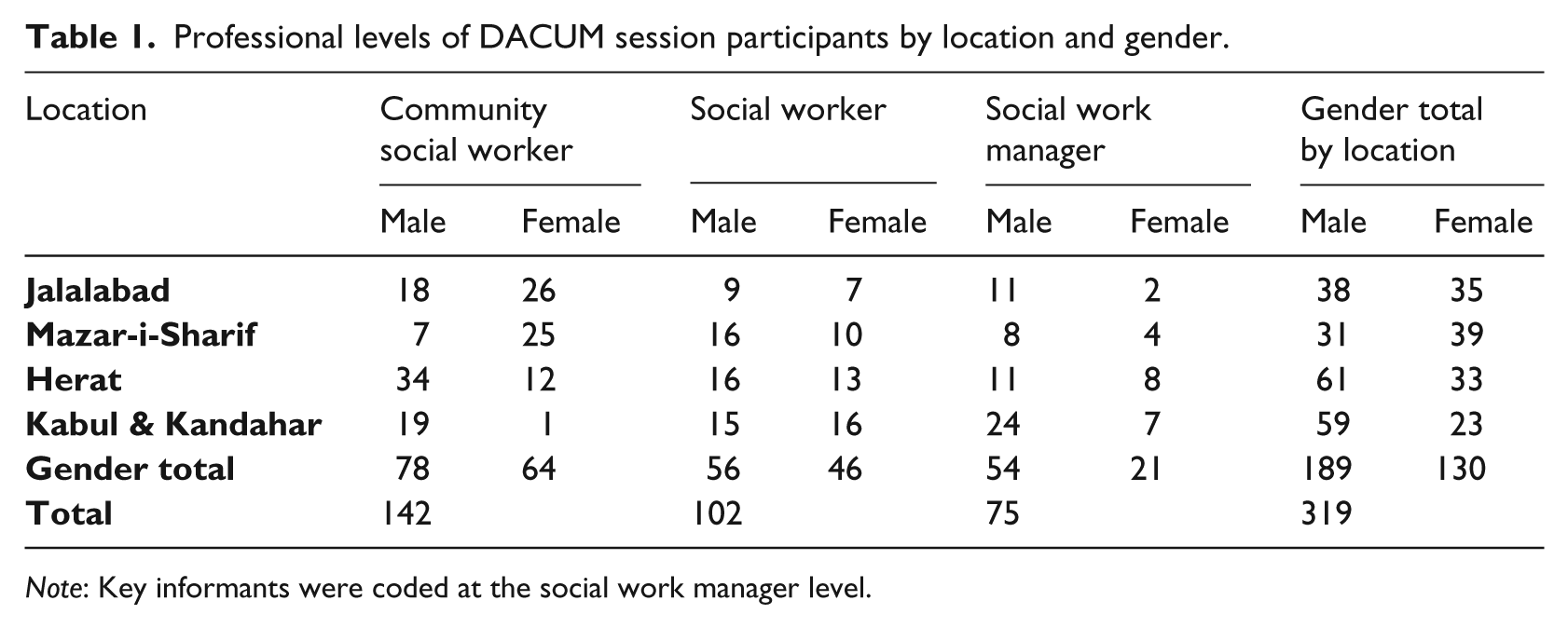
Note: Key informants were coded at the social work manager level.
Community service user participants by location and gender 2 .
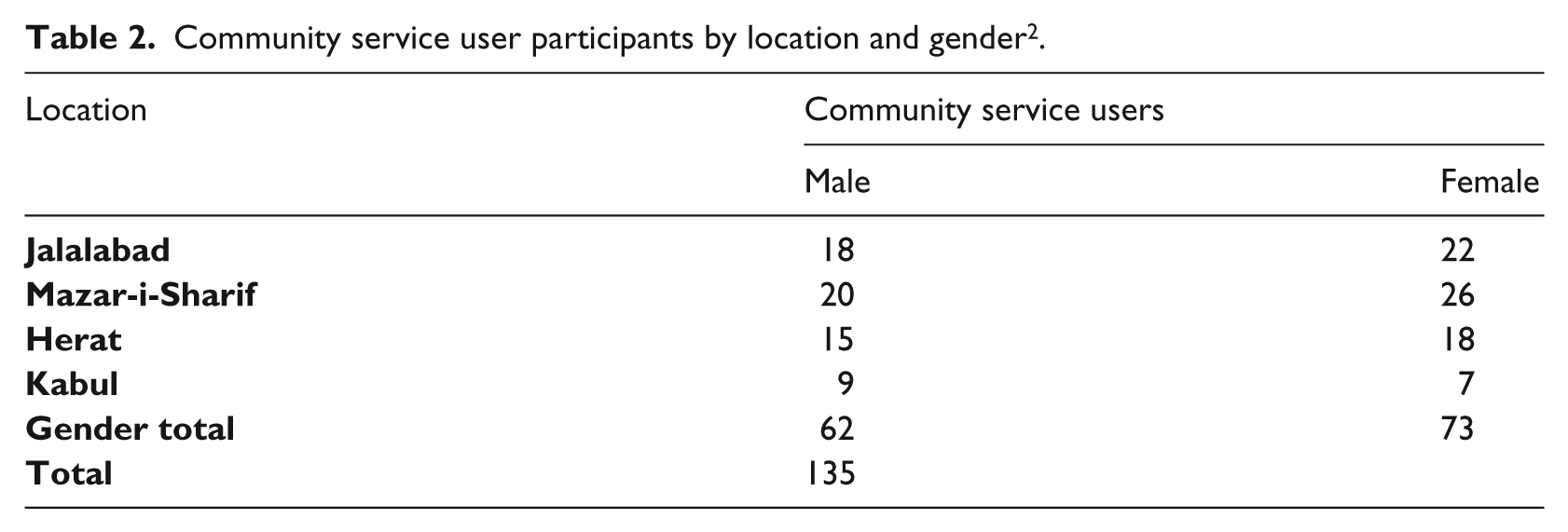
Due to repressive interpretations of Islam by many armed groups, including Taliban, as well as the dangers presented by active conflict, women were systematically excluded from education and the workplace from 1992 through 2002 (Bragin, 2002). Many went into exile outside of the country, resulting in a smaller number of women in the professional workforce (World Bank, 2005). While this number has begun to increase, along with university enrollment and graduation rates, the numbers remain small (UNICEF and CSO, 2012). This is reflected in the lower number of women represented in the sample. 3
Community level social work is well-developed outside of Kabul, and in the countryside, but not in Kabul itself. Therefore there were few community workers attending DACUM sessions in Kabul. Their work is confined to the Internally Displaced Persons camps on the outskirts of Kabul, primarily populated by people fleeing fighting in the highly contested Kandahar region. The community workers, mostly men, are from the communities themselves and are not paid for their services. Most women are engaged in income-generating activities and the care of their children. The child protection organization that provides the service sent one Kabul-based woman community worker to attend the session, along with a group of the women coworkers, a larger group of male community workers, and a small group of male service users. This accounts for the low level of community social workers from Kabul included in Table 1, as contrasted to the larger number at the practitioner and managerial levels.
Conducting sessions
The sessions each lasted three full days, one for each level of participants. Supervisors and supervisees were not in the same groups to protect confidentiality and promote open discussion. Each session began with an orientation explaining the project and its purpose to develop standards and curricula to make their work, social work, a profession in Afghanistan. Participants signed informed consent documents, which were not saved to ensure confidentiality.
The aims were explained, namely to define social work in Afghanistan, as well as what knowledge, skills, and qualities Afghan social workers needed to perform their jobs well. The DACUM method and charts were introduced. Participants were separated into groups of six to eight. Charts were completed during a group ‘report back’ and the results were transcribed into the chart format.
The key informant interviews
Interviews were completed with selected individuals, groups of three including colleagues, key informant experts in Afghan social work practice or in the need for social work to key sectors. Procedures similar to those described above were followed. Some of the key informant interviews were conducted in English with people who had formal education in related fields in Pakistan, the United Kingdom, or India where the instruction language was English. 4 The researchers worked with key informants to validate the thematic groupings that were made in English when organizing the DACUM charts for use in developing initial drafts of the National Standards.
Adaptations in the DACUM methodology
While the DACUM methodology allows for practitioners to define their jobs in their own language and terms (Conway and Jeris, 2006), it had some limitations in this context. People have been called social workers without having any definition or limitations given to their work (Muhmand, 2010). This results in social workers at all but the supervisory level having difficulty articulating their overall duties, as distinct from the component tasks, or knowledge and skills required for their work. Duties were often defined as ‘planning and organizing your work’ or ‘writing reports’, while the critical issues, assessment, intervention to protect children, and evaluation were subsumed under the competencies, or the knowledge, skills and expected worker behaviors. Therefore, a full discussion was facilitated to ensure that participants gave a complete picture of their work.
Methods of analysis
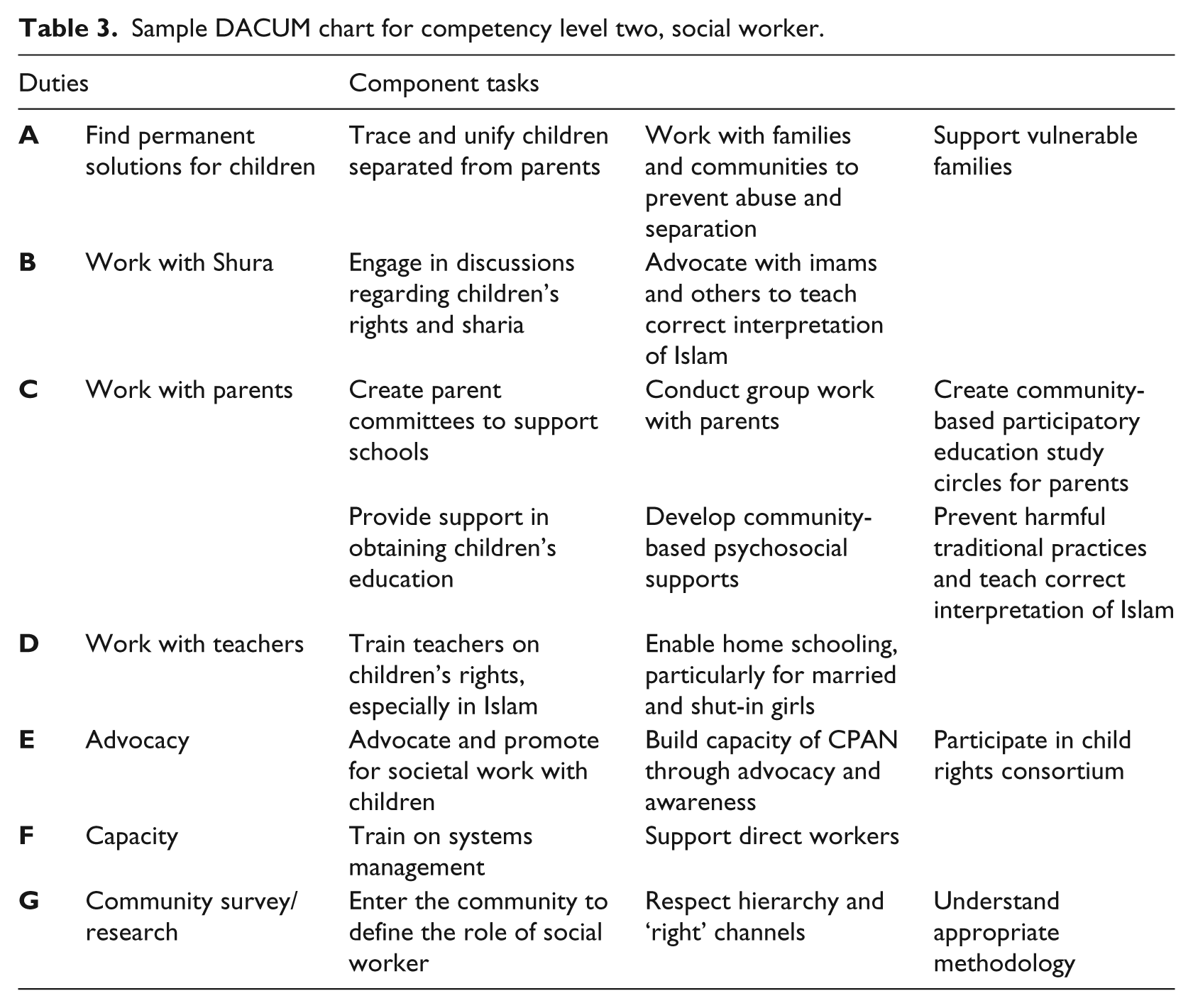
The material was coded using Atlas-ti to develop and clarify themes and subthemes. The coded data were then analyzed for frequency and consistency of issues raised by the participants. (See Table 3 for a sample DACUM chart from the second competency level of interviewees, social workers.) The thematic groupings were then compared to key informant interviews, and reviewed with key informants and NSDP staff members to assure that the ideas were understood and grouped correctly. To achieve triangulation, the team consulted with NSDP staff to obtain their input on the National Skills Standards and the Faculty of Social Sciences at Kabul University to obtain their input on courses that would be needed.
Sample DACUM chart for competency level two, social worker.
Based on the literature (Baldwin, 2012; Conway and Jeris, 2006; Key, 2008), we coded the competencies sections of the charts by subject, frequency, and emphasis of mention.
The original DACUM charts in Dari and Pashto, as well as the analyzed charts in English, are available through UNICEF Afghanistan and the NSDP. Also available are the resulting National Occupational Skills Standards at the community social work associate, social worker and social work manager level.
Results: The development of the National Skills Standards and social work curricula
The National Skills Standards require that the roles of social workers be broken down into duties and tasks, specific to each competency level, and that each task is further elaborated by a ‘performance standard’ that included subtasks, knowledge, skills, values, and tools needed to accomplish the work.
The sessions revealed that the duties of the social worker were not well defined by the participants. This is partly due to the fact that heretofore they were defined differently by each of the agencies who engaged people they called ‘social workers’. This may account for the relatively low level of agreement among the participants on the dimensions of social work most important to them reflected in the sample chart provided in Table 3. Some duties performed at a higher level, such as developing systemic solutions for child protection problems including social safety nets, writing legislation, and organizing research, were unknown in Afghanistan, although common in neighboring countries (Bragin and Garcia, 2009; Muhmand, 2010). There was a strong interest in having those duties defined according to international standards. Colleagues from Kabul University Faculty of Social Sciences concurred with this view.
To address these issues the investigators used the EPAS (Education Policy and Evaluation Standards) method (CSWE, 2008) to organize major duties required by the NSDP. The EPAS method employs a set of generic social work competencies, allowing for maximum flexibility and local specificity in the knowledge, skills, personal qualities and tools necessary (CSWE, 2008; Tsang and Yan, 2001; Voss et al., 2005; Yuen-Tsang and Ku, 2008). The specific tasks, subtasks, performance standards, enabling requirements (including knowledge, skills, values and personal qualities), and necessary equipment were developed based on the material from the DACUM charts and accompanying notations from key informant interviews. Completed NOSS standards require compliance with the ethical standards of the International Association of Social Workers and the International Federation of Social Workers (IASSW and IFSW, 2004). The NOSS contain specific standards requiring advocacy for women’s and children’s rights, and human rights as defined by international conventions. They also contain standards that refer to recognizing diversity in practice, learning from and with religious and cultural minorities, and advocating for the needs of any marginalized person or population. The curricula were pegged specifically to the educational needs for each duty and competency level, again referring to the IASSW/IFSW standards for the profession (IASSW and IFSW, 2004).
The charts indicated that social workers at all levels gave greatest importance to the capacity to work in and with communities and their traditional structures. A specific Afghan social worker category emerged, one we called the community social work associate. This person is a community member with limited education, often a woman, who is expert in working with community structures, a knowledgeable advocate regarding difference, marginalization and concern for those who suffer, and someone able to address prevention issues in the community context. Such community social work practices are widely noted in the literature on social work with populations affected by conflict and colonialism (Federico et al., 2007; Gray et al., 2008; Key, 2008; Lavalette and Ioakimidis, 2011; Lyons, 2006; Murphy, 2011; Rankopo and Osei-Hwedie, 2011; Walton and Abo El Nasr, 1988).
In keeping with the emphasis on community social work, knowledge of Islam was included, as a way to explain how Islam, in the view of participants, could serve as a protector of rights, allowing potential social workers to defend human rights in the framework of both religious law and the Afghan constitution (Murphy, 2011). Participants at all levels stated that social workers must be familiar with the teachings of Islam in order to differentiate requirements of Islam from harmful cultural practices, or interpretations that violate human rights (Crabtree and Baba, 2001; Haynes et al., 1997; Islamic International Center, 2005; Walton and Abo El Nasr, 1988).
We need to lift up our wives and children, even our daughters, so that we are not reduced to poverty and begging. They should go to school to be doctors and teachers and artisans. Those who come to help us must be honest people, understand Holy Qur’an, and use the knowledge to teach us to fight for ourselves, for our families and educate our people. (Service users from Kandahar) People can be tricked into following repressive and stringent interpretations of law and custom by those who do not really study these things in depth. To defend people on the community level, it is vital that our professionals know human rights instruments, international social work standards and yes, the true teachings of Islam. (Director, Afghan Child Rights Organization)
While key informants and managers were most concerned with the community functioning of practitioners, the community practitioners were determined to ensure that curricula emphasized methods such as case management and group work solutions for needy children and families. The authors realized that expecting community workers to conceptualize ways to professionalize their work was not reasonable, and that key informants’ ideas could be combined with international standards to create a practice competency for professional case work and case management on a supervisory level (Tsang and Yan, 2001; Voss et al., 2005). Participants were concerned about professional social work identification and the need for broad knowledge of social work theories, techniques, and their interface in order to provide effective services.
The NOSS required specific knowledge, skills, and values in these social work areas: advocacy, collaboration, prevention, engagement and comprehensive service planning. Those with a BSW and MSW qualification had additional requirements in intervention and evaluation. All practitioners had as their first requirement to identify as a social worker and provide high level competent services to potential service users.
Following earlier research findings, the areas of social work recommended by IASSW standards formed the basis of curricular requirements (Duffy et al., 2013; IASSW and IFSW, 2004). To meet these requirements, students begin with Introduction to Social Work followed by semesters of Human Behavior in the Social Environment that focus on methods of analysis and critical thinking. Also included were specialized courses in Afghan Ethnography to develop capacity to work with diversity. Required courses on Children in Islam and Social Work and Human Rights include classroom exercises designed to help students handle challenges to social work values presented by discriminatory practices they are likely to encounter in the community.
Four semesters of required generalist practice courses were designed to build capacity on assessment, planning, intervention and evaluation methods, accompanied by four semesters of supervised field practice. Four additional semesters of required coursework included two semesters on the topic of child well-being and communities, and an additional two semesters on community organization and development. Community social work techniques include sections on conflict resolution and transformation. To meet the needs of practitioners in conflict and disaster was a required one semester course entitled Child Protection in Emergencies, followed by Children Associated with Armed Groups. Elective specializations include work with disabilities, the justice system, children deprived of parental care, and social work in the health care system. Research method courses include Participatory Rural Appraisal, Participatory Action Research and Participatory Learning in Action. In addition, graduate students will learn to conduct and understand quantitative research and statistical analysis, preparing them to lead national programs for child and family welfare.
Discussion
Afghanistan’s National Strategy for Children at Risk (2004) included the establishment of National Occupational Standards for social work, with accompanying curricula for study. The DACUM method ensured that these were based on Afghan-specific theory, knowledge, practices and values.
A number of limitations occurred when applying the DACUM method for this purpose. Translation was problematic as Afghanistan has two official languages, and native speakers of each reside throughout the country. Additionally, different locations and agencies use their own terms to describe social work activities which may have led to a privileging of English speakers in the analysis of information. The ongoing conflict limited travel and access, privileging participants able to travel to the regional centers where sessions were held. The participation of representatives from the Southern region was particularly limited as the team needed to interview selected participants who traveled to Kabul.
The brief timeframe allowed us to initiate the development of culturally relevant and locally owned social work theory, practice standards, and curricula in a new location compared with that recommended in the literature posed another limitation, forcing a heuristic model (Gray et al., 2008; Hugman et al., 2007). The use of outsiders on a time-limited basis assists Afghan leadership in further development of the profession and was taken into account when NSDP initiated the process. The DACUM methodology enabled systematic learning from Afghans working in child protection social work from community through managerial levels. Further, the method engaged practitioners and rights advocates with government and university partners in collaborative processes to develop the profession in cultural context, preparing Afghans to set and implement national priorities in social welfare.
Nonetheless, this project was a ‘jumpstart’ effort. The work was drafted quickly, allowing participants to have materials to discuss, adapt, critique and change over time. The intent of this project was to enable participants, under the leadership of the appropriate academic, governmental and non-governmental bodies, to refine and develop the standards to become an inextricable part of the Afghan context. There will be much to learn from the results.
Footnotes
Appendix
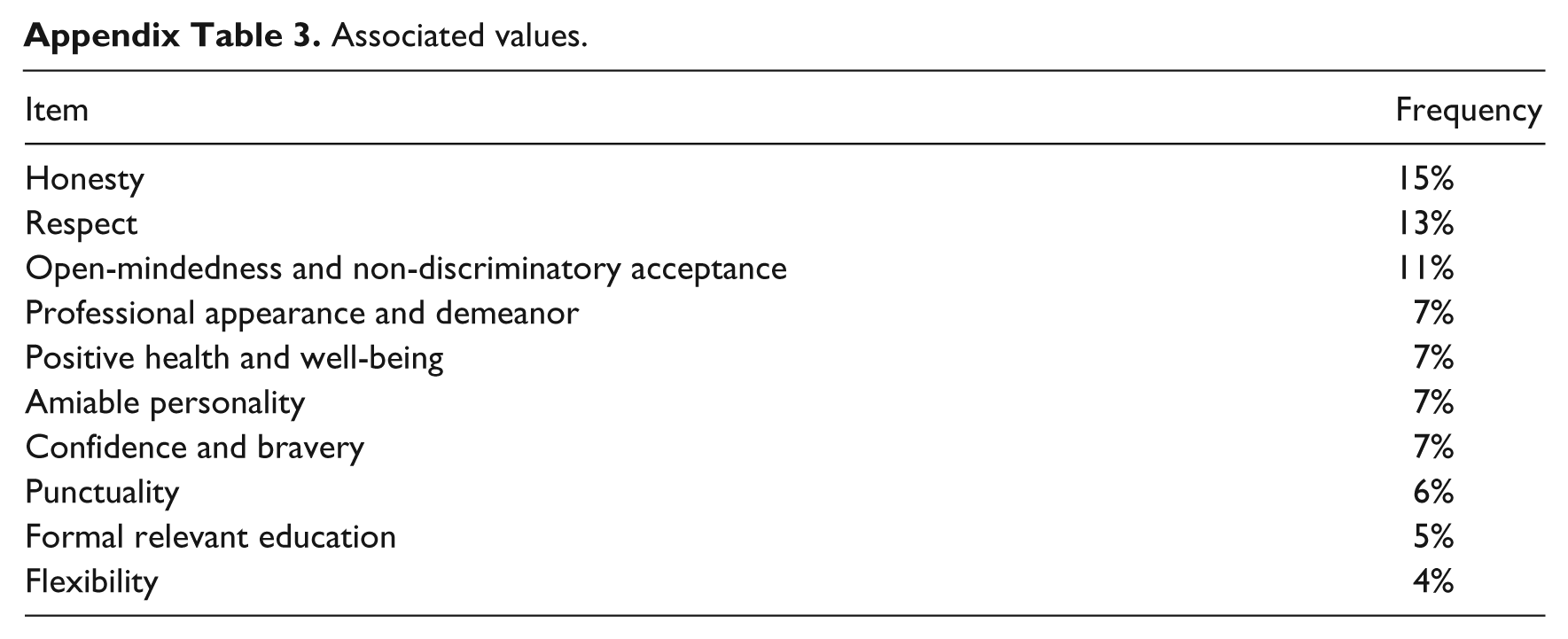
Associated values.
| Item | Frequency |
|---|---|
| Honesty | 15% |
| Respect | 13% |
| Open-mindedness and non-discriminatory acceptance | 11% |
| Professional appearance and demeanor | 7% |
| Positive health and well-being | 7% |
| Amiable personality | 7% |
| Confidence and bravery | 7% |
| Punctuality | 6% |
| Formal relevant education | 5% |
| Flexibility | 4% |
Funding
The research recorded in this paper was funded by the United Nations Children’s Fund UNICEF Contract #AFGA/RFP/2010/009.