



Abstract
Young children (N = 381) from three institutions in St Petersburg (Russian Federation) who were transitioned to intercountry (USA) adoption or to various domestic families in Russia did not differ in birth weight, length, head circumference, and rated condition at birth, nor did they differ upon departure from the institutions with respect to physical growth and behavioral development. These results provide little support to the occasional allegation for the possibility that intercountry adopted children are selected to be developmentally more (or less) advanced, or that outcomes for children in alternative family placements simply may be associated with pre-placement developmental differences. The generality of these results to other institutions and countries is unknown.
Intercountry adoption is a controversial issue (e.g. Bartholet, 2007; Oreskovic and Maskew, 2008). Some international organizations (e.g. UNICEF) and national government organizations (e.g. USAID) favor domestic placements over intercountry adoptions (e.g. US Government, 2012), and some countries (e.g. Guatemala) have stopped all intercountry adoptions. Opponents of intercountry adoption argue that the process often lends itself to child buying, profiteering, trafficking, coercion of vulnerable birth parents, and other unscrupulous practices (Oreskovic and Maskew, 2008). Further, most intercountry adoptions are conducted by private agencies, which may be motivated to maximize their profit and minimize their risk, and in some countries legal protections pertaining to intercountry adoptions do not exist or are not well enforced. Some (e.g. Bartholet, 2007) argue that such abuses are rare, while others (Carro, 1994; Smolin, 2006) contend they are not rare and provide some documentation (e.g. Corbett, 2002; Oreskovic and Maskew, 2008; US Bureau of Customs and Immigration Enforcement, 2004).
Proponents (e.g. Bartholet, 2007) have argued that intercountry adoptions are highly successful and give children the opportunity to live in stable families rather than in orphanages or on the street. A substantial literature demonstrates that intercountry adoptees adjust and develop as well as non-adopted children within their adoptive countries if they are adopted at early ages (McCall, 2011; Van IJzendoorn and Juffer, 2006). Most intercountry adoptive parents are relatively affluent, highly educated, and satisfied with their adoptive experience, and 98 percent of US adoptive parents would recommend it to their friends (Hellerstedt et al., 2008). Further, although there have been some failed adoptions and even homicides of adoptive children in the USA (Miller et al., 2007), rates of intercountry adoption failures are lower than for families with step parents, for example (Van IJzendoorn et al., 2009).
However, even in countries with relatively strong central regulatory systems (e.g. Russian Federation, China, Philippines, India, Columbia, South Korea), opponents of intercountry adoption sometimes allege that the ‘best’ children are selected for international adoption, whereas, others contend regulations favor transitioning the ‘best’ children to domestic family alternatives. To the authors’ knowledge, no systematically collected data have been published that describe the developmental status of children transitioned from institutions to intercountry adoption versus different domestic programs of family care including adoption, foster care, and reunification with biological families.
As countries move toward the creation of child welfare systems that support family alternatives to institutional care, one might also ask which form of alternative care tends to be more supportive of the development of infants and young children. The published literature on different family-care alternatives as typically practiced indicates that children tend to develop better in adoptive homes, next best in foster care, and less well if they are reunified with their biological families (Julian and McCall, 2011). However, understandably, few of these comparative studies used random assignment, so it is possible that these differences reflect the developmental status of children entering these forms of alternative care rather than the influence of the specific form of alternative care on children’s development. Although the current study does not report children’s development while residing in different care settings, it does report data on children departing from the institutions for different family alternatives. Thus, it can address whether children have different backgrounds and developmental status upon placement into one versus another category of family care, at least for three institutions in one country.
The purpose of the present study is to provide information on the developmental status at birth, the pre-institutionalization experience, the ages and duration of residency, and the physical and behavioral development of children at departure from three institutions in St Petersburg, Russian Federation, who transitioned to adoptive families in the USA and to adoptive, foster, and biological families and kin in the St Petersburg region. Specifically, do children who go to these different family alternatives differ on their birth conditions and developmental status? Is there evidence of selective placement based upon the child’s development status? A very small number of children were placed in a newly created foster care program, and they are included despite the few cases, because foster care is now being emphasized in Russia (see Table 1) and by some international and national government agencies as an alternative to institutionalization (e.g. US Government, 2012). This study reports data from two of the largest and most comprehensive studies of orphanage children for which substantial data exist on the nature of the institutions; characteristics of caregivers and the caregiving environment; and the physical, behavioral, and social-emotional development of children (The St Petersburg-USA Orphanage Research Team, 2005, 2008).
Procedures for the placement of children in Baby homes in St Petersburg, Russian Federation.
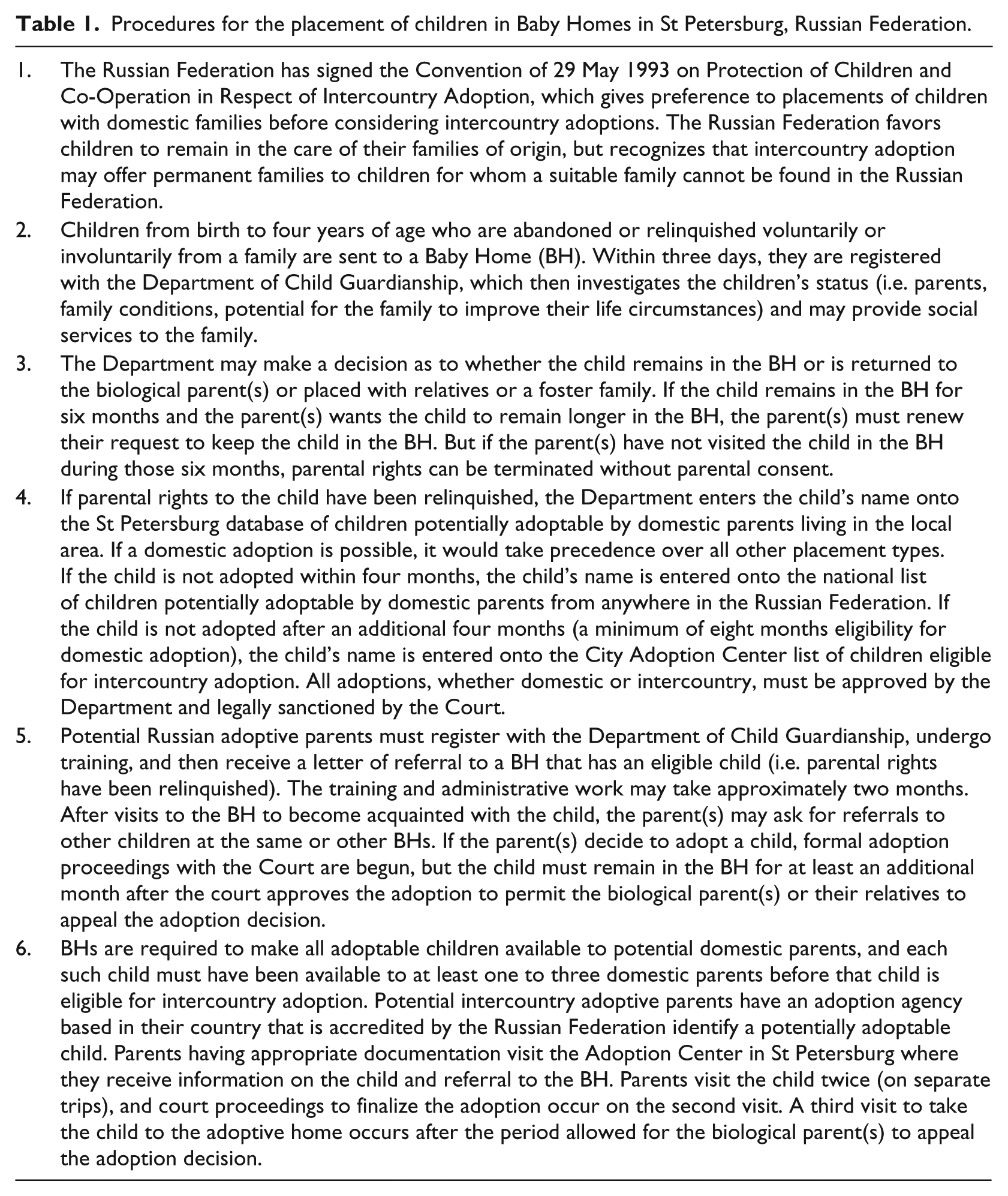
Children are not randomly assigned to different family placements, and the procedures employed could influence the developmental status of children transitioned to different types of families. Table 1 presents a summary of St Petersburg policies and practices used to place children into family alternatives, especially domestic versus intercountry placements. A few relevant themes emerge. First, children of parents who immediately relinquish parental rights tend to arrive at institutions (called Baby Homes = BHs) at very young ages and the timetable for their disposition starts immediately (see Table 1, point 4). Such children are available for domestic placements for the next eight months and only thereafter for intercountry adoption. Second, some parents do not relinquish parental rights immediately and may keep their children at home for weeks or months before giving them into the care of the BH for some period of time. Many of these children return to their biological parent(s) or kin, but they are then often older at intake and at departure from the BH than children who were relinquished immediately and who are more likely adopted (domestically or intercountry). Third, preference is given to domestic placements over intercountry adoption.
Method
Participants
Participants constitute a subset of children who were enrolled in two studies of three orphanages (i.e. BHs) for children 0 to 4 years of age in St Petersburg, Russian Federation. The first study, the intervention study, conducted in 2000–05, consisted of providing training to caregivers and creating structural changes in one BH designed to encourage warm, sensitive, contingently responsive, and child-directed caregiver–child interactions in a more family-like environment. For example, group sizes and the number of children per caregiver were reduced, primary caregivers were assigned to a group of children and one of them worked most waking hours during the week, groups were integrated by age and disability status, and periodic graduations of children to new groups of peers and caregivers were terminated. A second BH received only training, and a third conducted business as usual. These interventions produced substantial differences in the nature and extent of caregiver–child interactions as well as children’s development while residents (The St Petersburg-USA Orphanage Research Team, 2008), and these BH differences have been maintained for six years after the intervention project ended (McCall et al., 2013).
Two years after the end of the intervention, the second study, a follow-up project, was begun in which children were studied from these same three BHs who transitioned to one of several destinations: 1) USA adoptive homes, 2) St Petersburg adoptive families (including ‘non-relative kinship families’ which consist of non-relatives who receive a child before parental rights are terminated with or without the intention of adopting the child), 3) St Petersburg foster care families, and 4) St Petersburg biological families (birth mother or kin, usually a grandmother). Results of this study are not yet available.
Participants in the current study were 1) all children in the intervention study who entered the BHs after any interventions were completely implemented and remained in residence for at least three months before having their departure assessment and transitioning to one of the above destinations, and 2) all children in the follow up study who had been in residence for at least three months before departing to one of these four destinations. All children adopted to the USA were under the auspices of the International Assistance Group, a USA adoption agency specializing in the placement of Russian children. No data collection occurred during the two years between the end of the intervention and the beginning of the follow-up project due to lack of funding.
A maximum of 381 children contributed some data to the current sample, but the specific Ns for each destination group varied as a function of the particular measurement and missing data. There were 144–235 children who were adopted to the USA, 20–46 who were adopted by St Petersburg parents, four to nine who were placed in foster care in St Petersburg, and 47–91 who were reunited with their biological families. Although the number of foster placements was exceedingly small, they are included and appropriately interpreted because this is one of the few reports of government-operated foster care placements in relatively low-resource countries and because this was a new program in the Russian Federation.
The sample did not include children who spent less than three months in a BH, and those who were not part of the larger follow-up study, specifically children adopted to the USA through other adoption agencies, children who were placed in countries other than the USA, children placed in Russia but outside of the St Petersburg area, and children who were not placed in these four types of families (i.e. remained in the institutional system).
Assessments
Assessments were made in four categories including birth condition, relinquishment information, residency ages and duration, and children’s behavioral and physical development at departure from the BHs.
Birth condition
Birth weight, birth length, and birth head circumference were obtained from BH records based on narrative obstetrical records transferred to the BHs from birth hospitals. Such information was available on the vast majority of children but not all (e.g. those who had been abandoned). These physical growth measures required a birthdate (also not available for all children) and were converted to standard scores (z scores with a mean = 0 and a standard deviation = 1.00) using the USA Centers for Disease Control standards for non-institutionalized parent-reared USA children (which are commonly used around the world). This transformation provided growth indices that could be compared for children of different ages.
The birth records also commonly included a three-point rating of birth condition made by the attending physician – that is, satisfactory, moderately grave, and grave. No more specific definitions of these conditions are available.
Relinquishment information
Some information in the BH records pertained to the child’s location before intake into the BH, and whether the child was placed in the BH involuntarily. Most children were transferred to the BH directly from the birth hospital or a secondary hospital, but some spent time with their biological parents or relatives prior to entering the BH.
Residency ages and durations
BH records also provided the dates of intake and departure, which coupled with birthdate, were used to calculate age in months at intake and at departure from the BH and the duration of residency.
Developmental status at departure
Departure assessments were usually conducted two to four weeks before the child’s departure from the BH. For these data, only children whose departure assessment was at least three months after intake were included in the sample. This criterion was implemented by the follow-up project, the purpose of which was to assess whether differences in children produced by the interventions persisted after the child transitioned to one of the family destinations. Three months was considered minimum exposure to the interventions to produce some improvement in children’s development (The St Petersburg-USA Orphanage Research Team, 2008).
Children’s height, weight, and head circumference at departure were assessed by BH pediatricians on a routine basis, and their measurements were transformed by the CDC standards into z scores (for details, see The St Petersburg-USA Orphanage Research Team, 2008).
The children’s behavioral development at departure was assessed with the Battelle Developmental Inventory (LINC Associates, 1988). The Battelle is a standardized assessment of development for children up to 96 months of age. It contains subscales of Adaptation (common self-maintenance skills), Motor, Cognition, Communication, and Personal-Social. Scores can be converted to Developmental Quotients (similar to IQ scores) that have a mean of 100 and a standard deviation of 15 in a USA non-institutionalized sample. Because of the age of the standardization sample, comparisons to this population are approximate and not a focus of this study. Although children departing during the intervention project were given the full-scale Battelle, only the Personal-Social and Communication subscales were administered to children in the follow-up project, because those subscales reflected the largest differences between the intervention conditions in the intervention project. Only these two subscales are reported here (The St Petersburg-USA Orphanage Research Team, 2008).
Psychology graduates were trained in administering the Battelle either at the beginning of the intervention project or two years later. To provide data for inter-rater reliability, assessors conducted several Battelle assessments working in pairs. For the Battelle total, 87 percent of the score pairs differed by no more than two points, and the average discrepancy within score pairs was less than two percent of the average subscale score (for details, see St Petersburg-USA Orphanage Research Team, 2008).
Statistical analyses
The primary analyses of metric data were univariate or multivariate Destination (four groups) X Baby Home (three) analyses of variance; frequency data were analyzed with Destination (four groups) Chi square analyses. The primary focus of the current study was to compare children who transitioned to the four different destinations. Differences between children as a function of intervention condition (i.e. BH) are not relevant here. Across all analyses, BH differences were statistically significant, but importantly for the current paper, no interactions with destination were significant. This means that any differences reported here for family destinations are similar for all three BHs, and only Destination effects are reported here.
Results
The means, standard deviations, and Ns for all measures as a function of destination are presented in Table 2. Bold lines indicate statistically significant differences between destinations, with details provided below.
Differences between institutionalized children transitioning to different family destinations.
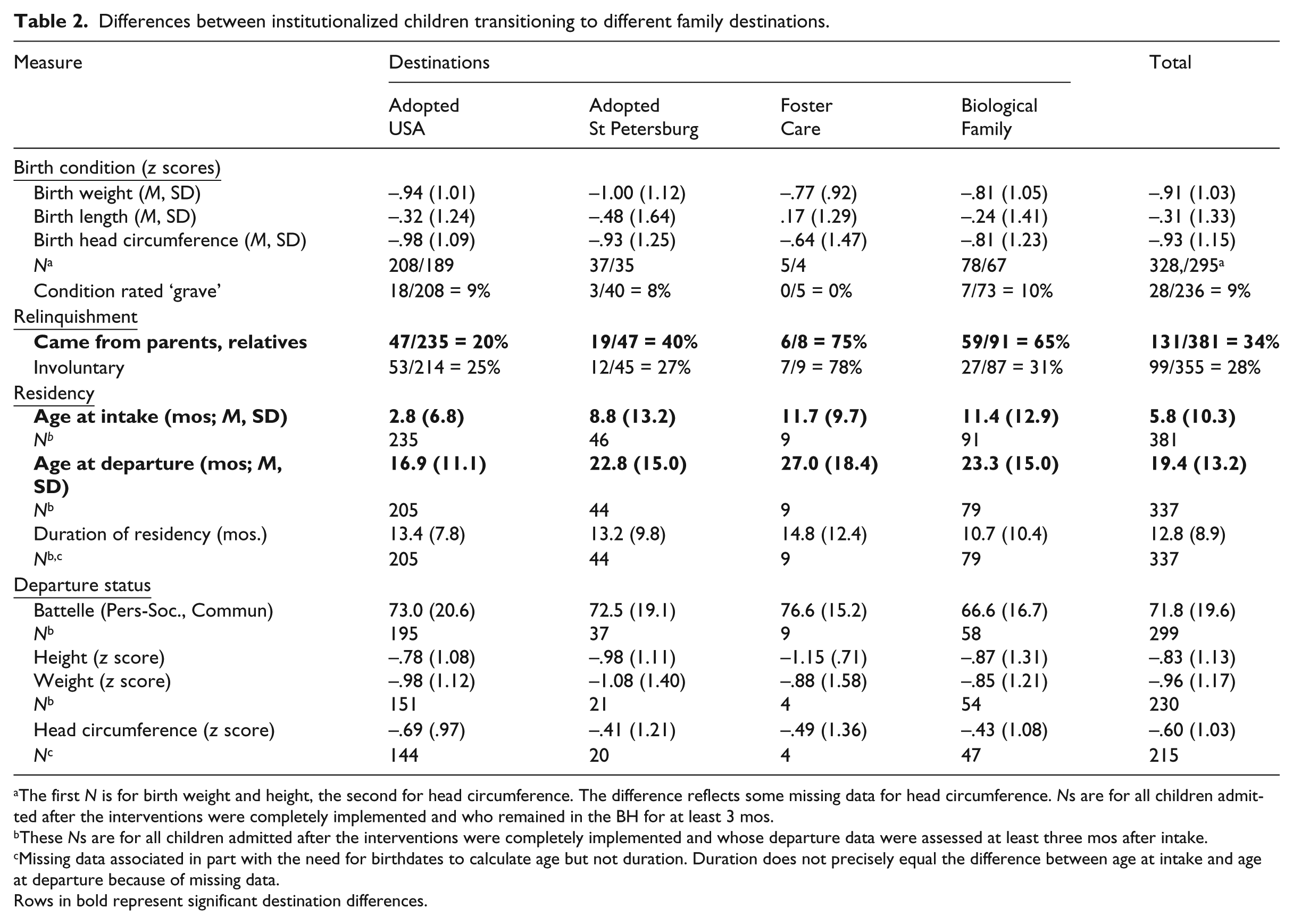
The first N is for birth weight and height, the second for head circumference. The difference reflects some missing data for head circumference. Ns are for all children admitted after the interventions were completely implemented and who remained in the BH for at least 3 mos.
These Ns are for all children admitted after the interventions were completely implemented and whose departure data were assessed at least three mos after intake.
Missing data associated in part with the need for birthdates to calculate age but not duration. Duration does not precisely equal the difference between age at intake and age at departure because of missing data.
Rows in bold represent significant destination differences.
Birth condition
There were no significant differences between destination groups for birth weight, length, and head circumference. Specifically, birth length and weight are related and were analyzed with a Destination X BH multivariate analysis of variance. The destination effect was not significant, F < 1. 00. Univariate tests for destination on length and weight were also non-significant, Fs < 1.00. A univariate analysis of variance on head circumference similarly produced an F < 1.00 for the destination effect. It is important to observe that children transitioning to their biological families (and to foster care) were slightly larger than those adopted to either the USA or St Petersburg (a smaller negative number implies slightly larger physical status). While these differences are not statistically significant, they are consistent with the conclusion that children going to their biological families and to foster care were not less developed physically than those going to USA or St Petersburg adoptive families.
Table 2 also presents the percentage of children whose birth status was rated as ‘grave’. The average was 9 percent, and none of the destination groups except foster care (which had 0%) deviated from this average by more than 1 percent. Clearly, there were no differences in severe birth circumstances as a function of destination, and again none of the few children in foster care had a grave birth status.
Relinquishment
Table 2 presents the percentage of children in each destination group who spent the most time prior to coming to the institution with parents or relatives (as opposed to hospitals). Here, as might be expected, the differences between destinations were statistically significant, χ2 (3) = 64.65, p < .001. Only 20 percent of the children adopted to the USA spent time with parents or relatives, compared to 40 percent of those adopted to St Petersburg parents and 65 percent of those who were reunified with biological parents or relatives. Similar to those returning to their biological parents, six of eight = 75 percent of the foster care children had been with families prior to entering the institution.
The percentage of children involuntarily relinquished by their parents was very similar for the two adopted groups and biological families (25%, 27%, 31%), although seven of nine = 78 percent foster children had been involuntarily relinquished.
Residency ages and duration
The destination groups differed significantly on the age of the child at intake into the institution, F(3, 369) = 15.41, p < .001. Children adopted to the USA were substantially younger at intake (M = 2.8 months, SD = 6.8) compared to those adopted to St Petersburg families (8.8 months, 13.2) and those returning to biological families (11.4 months, 12.9). This corresponds to the percentages of children who came predominantly from parents and relatives, who could have been expected to have spent more time in those families before entering the institution than those coming directly from a hospital, especially the birth hospital.
Age at departure also differed as a function of destination, F(3, 325) = 3.60, p = .014. Children being adopted to the USA departed earlier (16.9 months, 11.1) whereas those transitioning to domestic destinations did so at somewhat older ages (22.8 months (15.0) for adoption, 23.5 (15.0) for biological families, 27.0 (18.4) for the few foster care children). Consistent with these parallel differences in ages at intake and departure, there were no significant destination differences in the duration of residency in the institutions (on average = 12.8 months (8.9), +2 months to − 2.1 months for destinations).
Development at departure
The Personal-Social and Communications Battelle subscale developmental quotients were very similar and were averaged for each child to produce a general index of behavioral development, and the means and standard deviations for the four destination groups are presented near the bottom of Table 2. The effect for destination group was not significant, F(3, 287) = 2.19, p = .09. Children who returned to their biological families scored a bit lower (M = 66.6, SD = 16.7) than foster care (76.5, 15.2) and the two adopted groups (73.0, 20.6; 72.5, 19.1), but a post hoc specific comparison between those returning to their biological families and those adopted was not significant, F(1, 287) = 2.34.
Departure weight and height were analyzed with a multivariate analysis of variance; there was no multivariate destination effect, F(6, 434) < 1.00, and both univariate Fs were less than 1.00. An analysis of variance on head circumference was also non-significant, F(3,203) < 1.00.
Discussion
Summary of results
This study investigated whether children who departed three Baby Homes for intercountry adoption to the USA, adoption in St Petersburg, foster care in St Petersburg, and reunification with their biological families had different birth conditions, relinquishment circumstances, residency ages and duration, and physical and behavioral developmental status upon departure from the institutions for their family placements. The four destination groups did not differ with respect to birth weight, length, head circumference, and rated condition at birth, nor did they differ on developmental status at departure from the institution as measured by the Battelle Developmental Inventory subscales of Personal-Social and Communications or on their departure height, weight, and head circumference. However, children who were adopted to the USA were more likely to come directly from the birth hospital or a secondary hospital than those adopted in St Petersburg and especially those reunited with biological families. Correspondingly, children adopted to the USA arrived at the orphanage at a younger age and departed at a younger age than the other groups, especially those who were reunited with biological families, but children regardless of destination spent approximately the same average length of time in institutional residency.
Selective outplacement
This study shows that children who transition to different destinations were not substantially different in birth status, institutional history, and physical and behavioral development at departure from the institution. However, it does appear that children who are reunited with their biological families had often spent time with a family, presumably the same family or relatives, before coming to the institution, and as a result they arrived at the institution at a somewhat older age (11.4 months) than children who are adopted, especially to the United States. It is not clear whether having spent their first months in a family represents a developmental advantage or disadvantage to these children. On the one hand, they may have benefitted from having had only one or two consistent caregivers and more caregiver–infant stimulation than children who spent their early months in a hospital and institution. Conversely, the experience could be harmful if the family was neglectful or abusive, although children reunited with their biological parents had not been involuntarily relinquished at higher rates than the other groups. Although such children were not statistically different from those transitioning to other destinations with respect to general physical growth and behavioral development at departure, having experienced a family may influence other aspects of development, such as attachment relationships and later social-emotional relationships that were not measured in the current study.
Although these data predominantly do not indicate selective placements of children into different types of families, children from these institutions are indeed selected in other ways by at least some of the parents. For example, the majority of USA parents want typically developing, healthy children and they want them as young as the intercountry adoption system will allow. Children who arrive at the institution as young as possible, usually from hospitals and usually with parental rights relinquished at intake or shortly thereafter, start the intercountry waiting process immediately (see Table 1) and could be eligible for intercountry adoption in eight months. Consequently, USA adopted children arrive at the BH at a younger age and depart at a younger age, but these children are not ‘better’ than those transitioning to domestic families in terms of birth circumstances and developmental status at departure.
Further, policies in the Russian Federation favor domestic adoptive parents who have ready access to the BH, can spend time observing children on the wards, and face a shorter and less cumbersome bureaucratic process in adopting a child. But such parents need to be approved by the Department of Child Guardianship and trained, which may delay adoption somewhat. Recently, some children have been identified in the birth hospital as eligible for domestic adoption and transitioned to families before spending three months in the BH, which would exclude them from the current sample. Had these children been included in this study, the average age at adoption would have been younger for domestic adopted children.
Families who take back their own biological children essentially have no choice of one versus another child. They also tend to keep the child a few weeks before sending the child to the BH, they do not relinquish parental rights, and some take the child back. Therefore, their children arrive and depart the BH at older ages. It is reasonable to expect that certain characteristics associated with a family (e.g. teenage mother, poverty, insufficient parenting skills, parental drug and alcohol problems) and perhaps characteristics of the child (e.g. disabilities, difficult temperament) may contribute to the mother relinquishing the child temporarily to the BH. Many of these characteristics may persist to a certain extent even when the family is ready to have their child returned to them. However, these characteristics are not associated very strongly with the developmental status of their children at departure (although they may influence children’s longer-term development).
However, there may be longer-term developmental differences for children transitioning to different destinations that are not documented here. Children who experience families during their early months before going to the BH may be better socially and emotionally in the long-term for having had a few consistent caregivers early; conversely, they may be worse for having been neglected or abused. But from a practical standpoint, parental rights are not likely to be relinquished early (if at all) for such children. Further, although children going to all destinations spent about the same length of time in institutional residency, those going to the USA departed at a younger age (16.9 months) than domestically placed children (22.8–27.0 months), although many domestically placed children departed in less than three months and are not included here. Whether length of residency or specific ages of residency contribute most to post-institutional children’s long-term developmental deficiencies and behavioral problems is not settled. Children adopted to the USA from these same institutions before 18 months of age (i.e. more than half those going to the USA) do not have higher than expected rates of certain behavioral, cognitive, and social problems, but children adopted after that age do have higher than expected rates of these problems (McCall, 2011). Thus, because children were placed in St Petersburg families at an older age (more than half after 18 months of age), they may have higher rates of deficient development or problems in the long term than those adopted to the USA.
The data on foster care were exceedingly limited, but generally children sent to foster care were not different in substantial ways from children transitioning to other destinations, and on some measures they were non-significantly better. The only suggestion of a difference for foster care children was that a very substantial percentage of them (75%) had spent time with parents or relatives before arriving at the BHs at a relatively older age, and 78% (seven out of nine) had been relinquished involuntarily compared to 25–31 percent of the other groups. This suggests that children sent to the foster care system early in the development of this program tend to be those who have experienced an unfavorable family environment prior to entering the institution. It should be noted, however, that many more children who had experienced a family and/or who had been involuntarily relinquished were transitioned to adoptive and biological families than those who went to foster care.
Consequently, this study provides little evidence of selective outplacement of children from these institutions to different family environments. Certainly, children adopted by Russian parents, who have preferential choice (Table 1), are not developmentally superior or inferior to those being adopted to the USA, and those children reunified with their biological families are not obviously developmentally inferior. Thus, these data provide little support for those who oppose intercountry adoption because the ‘better’ children are selected for such placements. Similarly, these data suggest that results from studies comparing the development of children in different family alternative care environments as typically practiced may not be obviously or substantially influenced by children’s differential developmental status at birth or upon departing the institution.
Limitations
To the authors’ knowledge, this study presents some of the first empirical data on birth circumstances, relinquishment information, institutional residency, and children’s developmental status at departure from three Baby Homes in St Petersburg (Russian Federation). Of course, although some data are better than none and three BHs are better than one, the generality of these results to other BHs in the Russian Federation or to institutions in other countries is unknown. The Russian Federation is one of the few countries that has a centralized regulatory system for intercountry adoption; while unscrupulous practices and selective placements can exist anywhere, they are less likely to occur in countries with such a centralized regulatory system (Oreskovic and Maskew, 2008).
Although several measures are presented, as previously noted, it is possible that differences between children transitioned to different destinations might be revealed in other measurements and at later ages. For example, children transitioned to foster care and biological families are more likely to have spent time with parents or relatives before being admitted to the institutions than children who were adopted. Such children may benefit from this early family experience or be harmed by it if it were abusive or neglectful. Thus, they may have more or fewer difficulties with later attachment and social relations associated with the possibility of higher neglect and abuse rates.
The main result of limited statistical differences in the developmental status of children transitioning to different destinations essentially is one of failing to find evidence that differences exist rather than confirmation of the null hypothesis. If more children were available, ultimately statistically significant differences would be obtained. However, the size of the differences between destination groups were not large, the samples reported in this paper are large relative to much of the literature, and in some cases non-significant differences were in the opposite direction to what one might expect if selective placement were operating.
It is possible that the present study underestimates the positive status of domestically adopted children, because a disproportionate number of such children were transitioned after less than three months of residency in the BHs and thus were not included here. Certain other children were not included, because they did not fit the follow-up study requirements, specifically those who did not transition to families, those adopted to the USA or other countries through other adoption agencies, and those placed with families outside of the St Petersburg area, although these conditions seem less likely to be related to child status.
Thus, under the circumstances of this study, selective outplacement appears minimal and is not a substantial confound with developmental differences of children placed in contrasting alternative family care.
Footnotes
Funding
This article is supported in part by grants R01HD39017 and R01HD50212 from the Eunice Kennedy Shriver National Institute of Child Health & Human Development, USA. The content is solely the responsibility of the authors and not of the funder.