




Abstract
This article presents an overview of the rhetoric and main discourses presented in the sphere of social policy and social services provided in Russia especially with regards to social inclusion of migrants. Inclusion policies in schools for children from migrant families are described and contrasted with lack of developments in police practices. A case study of two social service organizations in one of the regions in Privolzhsky Federal District is presented in order to analyze the micro-level of social policy and to find out whether their practices display inclusive culture.
Keywords
Introduction
Recently the concepts of social inclusion and social cohesion have assumed greater importance in both the European and Russian contexts, with implications for policies and practices. In Russia the ‘inclusion’ discourse is closely connected to the perceived problems of the adaptation and integration of migrants and people with disabilities into mainstream society. As the United Nations Department of Economic and Social Affairs underlines, ‘an inclusive society must be based on respect for all human rights and fundamental freedoms, cultural and religious diversity, social justice and the special needs of vulnerable and disadvantaged groups, democratic participation and the rule of law. It is promoted by social policies that seek to reduce inequality and create flexible and tolerant societies that embrace all people’ (DESA, 2009: 8). Hence, it can be argued that, in order to demonstrate the main features of an inclusive society, public institutions should possess inclusive institutional cultures: this is particularly the case for the institutions that interact directly with the public, such as education and social services, in increasingly diverse societies.
The European Commission in concert with the Council of Europe has recently published a pioneer document in this field: ‘Constructing an Inclusive Institutional Culture: Intercultural Competencies for Social Services’ (Council of Europe, 2011). This methodological guide discusses seven stages in constructing an inclusive institutional culture, starting from the presentation and explanation of the pluricultural realities and institutional responsibilities of organizations in a highly diverse world and ending with an introduction to ways of incorporating intercultural diversity in an institution’s policies, strategies, management and practices (Council of Europe, 2011: 13). This provides a number of valuable and informative case examples of best practices. Contributions to the guide were provided by a multicultural group of researchers, including from Russia, but also from Belgium, Canada, Denmark, Germany, France, Italy, Sweden and the United Kingdom. However, implementation of policies deriving from this important document is unlikely to be successful in the near future because there is currently little understanding of the need for an inclusive institutional culture, for instance in social services.
In order to establish this type of culture, there first needs to be recognition by the Russian public of diversity as an important feature of society: there would then be support for the development of relevant policies and of intercultural skills among those who are professionally involved in social services delivery through public institutions. Corresponding programmes and policies have to be backed by proper legislation and accompanied by mutual efforts from the state, clients of social services and NGOs to accommodate diversity and promote inclusion in public social services.
The period over the last decade or so has been marked by profound social changes which have called for a number of reforms including in the spheres of migration, medical insurance, secondary and higher education, the system of social benefits and unemployment and the labour market. Since 2011 a draft of a new Federal Law on the Basics for Social Services in the Russian Federation has received critical attention from experts and the public. According to Josef Diskin, a member of the Public Chamber of the Russian Federation, the main argument against the draft suggests that its conceptual basis rests on an old institutional approach which presumes that the state alone should be the main subject/operator providing social services. However, a more contemporary view on this issue considers the state as a coordinator of the entire system that includes a number of non-government operators (Obshchestvennaya Palata Rossiiskoi Federatsii, 2012). The same expert identifies particular shortcomings of the document, such as: the concept of quality assessment of services by the professional community is lacking; the ratio between services which people have to pay for and services provided free of charge is not clear; service user choice (between providers of services) is not established as the norm (Obshchestvennaya Palata Rossiiskoi Federatsii, 2012). In 2012 Boris Altshuler, Vice-Chairman of the Public Chamber of the Russian Federation Committee on Social Policy, Labour Relations and Quality of Life, pointed to the necessity of offering NGOs, non-commercial organizations and socially oriented businesses the right to be among the providers of social services. A number of comments suggest introducing a concept of ‘social maintenance’ as a structural component of ‘social support’. Social maintenance would enable the consolidation of efforts by the public authorities, NGOs and volunteers to support a person (or family) in need (Trukhina, 2012). These are just a small selection of the criticisms made of the draft mainly by independent experts of NGOs and the Public Chamber of the Russian Federation.
This article starts with an overview of the recent rhetoric and main discourses evident in social policy and social services in Russia, particularly in relation to migrant labour, before aiming to assess whether public social services in Russia are moving towards building an inclusive culture.
Labour migrants and structural shifts in migration
As previously mentioned, labour migration and integration of migrants in Russia are currently significant issues requiring development of appropriate policies and an inclusive culture in public institutions. Labour migration from foreign countries (primarily from those which were former members of the Soviet Union) is a relatively new phenomenon for Russia and it seems that formal institutions have not been sufficiently prepared to effect appropriate regulation of integration processes (Fofanova and Borisov, 2013: 190). In order to successfully develop inclusive public institutions it is important to consider migrants above all as people with different experiences of migration. Some people may be ‘temporary migrants in the sense that they continue to belong to households in their home country even if they work abroad for a long time’ (Barbone et al., 2013: 8); and they may have legal or illegal status. Increasing numbers of migrants now seek permanent residence in Russia and want to bring their families here so they apply for citizenship. Whatever their particular situation, migrants have exercised an act of territorial mobility and have found themselves in a new social and cultural environment. From the point of view of social workers, and the wider social services, migration is included in the context of change and development of social relations between groups of people or individuals within the host social environment (Akmalova and Kapitsyn, 2008: 7).
Russia is now dealing with a significantly different scale of migration compared to 10 years ago. The share of migrants from the countries of Central Asia is continuing to grow within the overall structure of labour migration to Russia. In the middle of the first decade of the 21st century, the aggregate share of three countries of Central Asia (Uzbekistan, Tajikistan and Kyrgyzstan) amounted to one third of the overall migrant labour flow: by 2010 it exceeded half of it (Figure 1) (Zayonchkovskaya et al., 2011: 5–6).
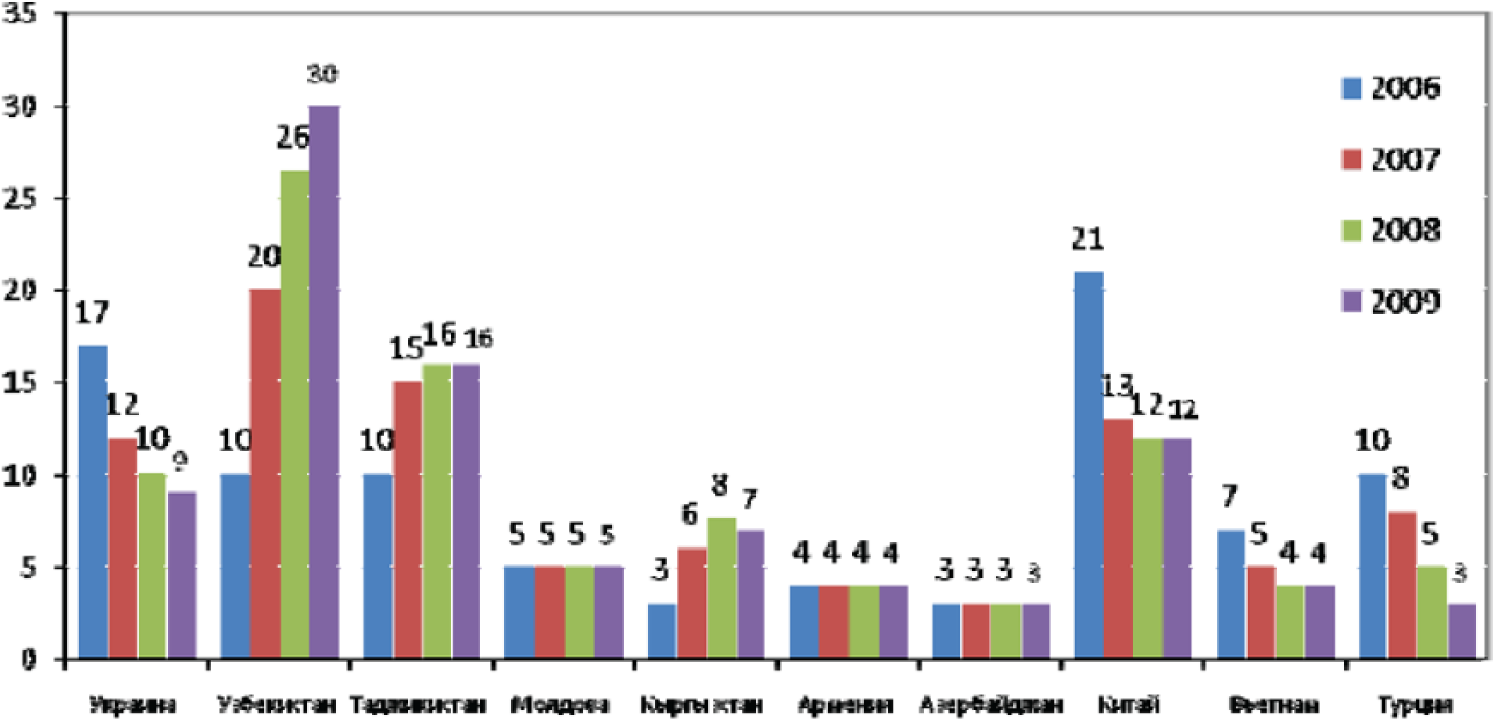
Shares of the principal migration-generating countries in the Russian labour migration structure, 2006–2009, %.
Most migrants now come from small towns and villages and the level of education and training of migrants has tended to decline, making integration into large Russian urban communities more difficult. According to sample surveys of labour migrants from the CIS, 50 percent of new migrants have no education or training equipping them for the labour market and they are identified as poor groups according to the social spectrum indicator (Zayonchkovskaya et al., 2011: 7–8). Based on the data from the survey conducted in April and May 2010 by VTSIOM and commissioned by OPORA-DRUZHBA ANO, Zayonchkovskaya et al. argued that in 2009 foreign workers were employed by 22.7 percent of construction organizations, 16.3 percent of production enterprises and 12.7 percent of retail outlets (Zayonchkovskaya et al., 2011: 9).
Although illegal immigration apparently declined following reforms in 2007, its scale still remains unacceptably large: it is estimated to be up to three times larger than regulated migration (Zayonchkovskaya et al., 2011: 9). The principal factors accounting for the growth of illegal migration include legislation limiting immigration but also the growth of a shadow economy which attracts unskilled foreign workers and creates migrant enclaves of low paid, so-called 3D labour (i.e. working in jobs which are Dirty, Dangerous, Demeaning) (Zayonchkovskaya, et al., 2011: 13). In Moscow and adjacent regions, and also in some other territories, these niches have already acquired a visible shape. As a rule, migrant labour work is represented not at the level of a specific sector of the economy (except the construction industry), but at the level of certain operations and types of work. In Moscow, for example, it is the cleaning of streets and premises, road repair and construction, public transport drivers, sales agents (e.g. in real estate), sale and processing of vegetables, etc. (Zayonchkovskaya et al., 2011: 13).
Since Moscow appeared to be the most attractive destination for migrants (primarily those from the former Soviet Republics), several Russian studies have recently been published on contemporary migration and its impact on the composition of Moscow’s population; on the city’s migration policy; on integration of migrants into the urban community; on how migrants are represented in the labour market of the capital city; and on how tolerant Muscovites are towards migrants (Zayonchkovskaya, 2009).
Looking at the structure of migrants, Elena Tyuryukanova argues that the majority of labour migrants are illegal; are increasing in number; and form a ‘parallel’ or ‘second’ society. Based on empirical data she concludes that the composition of the migrant population has changed dramatically in the last decade (Tyuryukanova, 2009: 153). Development of transport and information communication systems and the creation of migrant networks and communities have enabled more poor and uneducated people from rural areas to seek work in Russia, primarily in Moscow. As a result an increase in the cultural gap between migrants and the Russian urban population has become more evident, bringing problems for migrants (in terms of adaptation and integration) and also for the host society in terms of toleration and mechanisms available for inclusion.
It is evident that in such circumstances the development of inclusive cultures in public institutions is important for both the migrants and recipient communities. Given that the state and its institutions should guarantee policies and measures aiming at successful integration of migrants into mainstream society, such a development could provide legal and human conditions for migrants. However, there are few organizations and policies in Russia which support labour migrants and help them to adapt to the new realities of urban life in Russian cities. In addition, as Tyuryukanova underlined there has been virtually no development of ‘programmes on tolerance education and development, which are especially needed in the case of ethnic minorities migration’ (Tyuryukanova, 2009: 154). In fact, there have been some attempts to develop measures and actions aiming at increasing tolerance in recent years in Russia. Among these, ‘The Federal Task Programme on Forming Tolerance Awareness and Extremism Prevention in Russian Society (2001–2005)’ should be mentioned. There have also been a number of regional initiatives, for example, ‘The Programme for Harmonization of Inter-Cultural, Inter-Ethnic, Inter-Faith Relations and Tolerance Development in St. Petersburg in 2011–2015’. However, it is difficult to identify any significant effects which these documents or similar programmes have had on Russian society in general.
One more aspect sheds light on migration in Russian cities as a changing and complicated phenomenon that calls for development of inclusive public institutions. Among the agents that deeply affect labour migration in Russia, private business plays the leading role, leaving only a minority position to the state and its institutions in terms of the regulation process and control of migration. As a result migration appears to be located in those spheres of action which might be considered as either unlawful or unregulated and where business plays a more significant part than the state and its institutions (Tyuryukanova, 2009: 166; Zayonchkovskaya and Mkrtchyan, 2009: 41).
If developed, the inclusive capacities of public institutions could help establish more transparent and socially approved mechanisms and approaches to integration and adaptation of migrants in Russia, decreasing the risks to them of being involved in criminal practices or illegal enterprises where exploitation is rife.
Responding to ethnic diversity: Examples from education and the police
In 2005 Arutunyan pointed out that ‘contrary to basic logic Moscow now, when it is no longer the capital of a multinational Soviet Union, has become significantly ‘‘polyethnic’” (Arutunyan, 2005: 36). The growing ethno-cultural mosaic in Moscow paves the way for the institutionalization of ethnicity when the moral, religious and social aspects of particular ethnic groups penetrate a number of social practices existing in the recipient society. Specific ethnic social institutions emerge, for instance in relation to health care, marriages, diet, civic and political life, social support and cohesion. The area of pre-school and school education is one of the most important spheres in which to introduce and promote ethnically sensitive policies and practices. In the Russian capital ‘there are 5 child-care centres and 46 schools which include a so-called ethno-cultural component in their educational programmes (Tatar, Azerbaijan, Georgian, Armenian, Korean, Jewish, Tadjik, Lithuanian, etc.)’ (Vendina, 2009: 121). Since the 1990s the Moscow ‘Conception of Ethno-Cultural Education’ has been significantly adapted and a new ‘Conception of the Further Development of Ethno-Cultural (Multicultural) Education in Moscow’ calls for the development of intercultural competencies and toleration among students; the recognition of the civic identity of the citizens of the Russian Federation; and promotion of patriotism among all students, whatever their ethnic origin (Goryachev et al., 2007: 19–40).
It is possible to assume that promotion of a multicultural approach to education in all Moscow schools (not only in those using ethno-cultural component in educational programmes) is a clear indication of the need for development of an inclusive culture of public institutions and social services. However, in order to succeed, multicultural education has to be implemented by well qualified professionals, supplied with appropriate teaching materials and equipment, and supported by the organizational climate of the schools. Such programmes as ‘International Education and Moscow School’, ‘Ethnic Processes and Issues of Education in the Capital Megapolis’ can be cited as examples of programmes aiming to increase the professional capabilities of teachers, administrators, social workers and psychologists working in schools in relation to intercultural competencies (Goryachev et al., 2008: 70).
Since 2003 a training course for public servants has been provided by the Centre for International Education ‘EthnoSphere’ under the guidance of the Committee for Regional Relations and National Policy of Moscow and the Moscow Department of Education (Goryachev et al., 2008: 68–71). Therefore it seems that, in Moscow, the education sector, as a part of public social services, demonstrates some aspects of an inclusive culture and that Moscow authorities have relatively well developed mechanisms for introducing this culture to increasing numbers of public institutions and agencies.
The foregoing conclusions are supported by evidence from elsewhere, including from some empirical data from a qualitative research project conducted in St Petersburg. The Report on the State of Children of Migrants in St Petersburg (UNICEF, 2012) gives high priority to inclusion policies and culture in schools as a way of promoting the successful adaptation of children of ethnic migrants. A number of factors support or inhibit adaptation and integration of children from migrant families. For example, the important role of teachers was underlined by a schoolgirl who came to St Petersburg from Armenia:
It was very difficult for me to learn Russian. But she [a teacher] helped me a lot. She offered me a lot of extra lessons in summer, so now I speak almost fluent Russian.
An interview with a school director in St Petersburg (see later) suggested that teachers appreciate the fact that children from migrant families face a lot of problems when they enter an unfamiliar school environment in an unknown city. Therefore, teachers need to be friendly and open to them; to offer extra help and support with doing homework tasks and class assignments; and generally to pay attention to those children, on at least an equal basis with the local children:
Any child could come along (with no difference whether he or she is a migrant or not) and ask for help. Any child will get professional consultation and advice from a teacher, free of charge. It doesn’t matter if this child is from a migrant family or not. We make no difference between children on this basis. How successful is that or this child at school depends only on what are the goals of the family and whether parents come here to get a job and go ahead in life, to give education to their children. If so, such a child will come and ask for assistance and will receive that assistance from a teacher for sure.
In other words, teachers generally do not consider the problems that face children from migrants’ families as directly related to their ethnic background. For teachers these children are just schoolchildren who have found themselves in a critical life situation and do not yet possess enough competencies (UNICEF, 2012: 68). Research conducted in 2009–2010 suggested that inter-ethnic conflicts, xenophobia and intolerance are not considered as problematic issues in schools in St Petersburg (Aleksanldrov et al., 2012: 176–99). Teachers and directors at schools usually mention language difficulties as the most significant barrier to social inclusion.
It is important to say here that such a tolerant picture could not be considered as the norm for all schools in Russia’s cities. Based on surveys conducted, sociologists drew their own conclusions and made recommendations for promoting good relations and inclusive practices in schools (UNICEF, 2012: 39–41) as follows:
– the percentage of children from migrant families in each school should not exceed 50% of the total number of schoolchildren;
– all schools should be polyethnic;
– a number of social activities should be developed in schools to help migrant children to socialize and master Russian language.
Moreover, as the presence of migrants’ children in schools invariably calls for a deeper involvement of teachers in communications with these children and their families, this should be considered as constituting additional teaching and extra-curricular activities. Therefore, there is a need for assistance from social workers, and additional funding for schools and social services should be provided. If such collaboration exists and the special needs of migrants’ families are recognized, then it is likely that the more inclusive behaviour of teachers and other pupils will result in fewer problems in both schools and communities.
In 2011, separate funds were allocated for the first time in St Petersburg to cover remuneration of teachers providing extra classes and individual consultations to migrants’ children who have poor command of Russian (Brazhnik, 2014: 2). In the same city, social assistance to migrants with children and to families in critical living conditions has been specially organized in six local Centres of Social Assistance to Families and Children. Social work specialists provide psychological, legal, social and other types of support to migrants’ families (Brazhnik, 2014: 2).
Notwithstanding some indications of positive developments in policies and practices in education, in general, the need for ethnically sensitive approaches in social work is not widely recognized in Russia. As Iarskaia-Smirnova (2011) underlines, the Russian discourse on ethnicity in popular manuals on social work currently published in Russia do not place a specific emphasis on discussion of multiculturalism. What is more important:
the notion of ethnicity in analyzed social policy and social work textbooks is determined with a different degree of anxiety in relation to social security and order. Such characters as migrants or minorities are qualified as special clients of a social welfare system who are able to integrate but remain a source of real or potential social danger. These books avoid issues of non-discriminatory or multicultural social work, active tolerance and social criticism. (Iarskaia-Smirnova, 2011: 427)
Moreover, if multicultural education can be considered as good practice for schools, it appears to be more complicated to introduce and develop an inclusive culture in another important public institution, namely a law enforcement agency like the Russian police.
At the same time as the developments in education, the institutions of the police and some social service organizations were considered as target groups in a Federal Task Programme ‘Forming Tolerance Awareness and Extremism Prevention in Russian Society (2001–2005)’ (Sungurov and Boyarkov, 2011). A specific training course – Sociology of Interethnic Toleration – was developed and delivered for students undertaking professional education as public servants, social workers and police (Drobizheva, 2005). It is logical to assume that such education was expected to result in more tolerant and fair treatment of ethnic minorities by police and in more effective management of ethnic diversity of Russian society in general.
On the contrary, a deep analysis of the everyday practices of the Russian police with regards to ethnic migrants in two large Russian cities – St Petersburg and Kazan – shows that, despite the attempt to develop tolerance and intercultural competences among the police, the main practices that police utilize on an everyday basis reject notions of inclusion and present an example of racially and ethnically biased mechanisms of discrimination and unlawful treatment of ethnic minorities (Voronkov et al., 2011). This research has shown that the interactions of police and non-Russian people have been marked by: 1) racial/ethnic profiling; 2) carrying out raids on illegal migrants at places of their work and habitat; 3) unlawful detention of migrants from ethnic minority groups and use of violence towards them; and 4) fabrication of administrative cases and protocols regarding particular ethnic minorities (Voronkov et al., 2011: 176–7). Thus, not all the measures that federal and regional governments have tried to implement to introduce an inclusive culture into public social services have been successful.
Developing a new federal policy to manage ethnic diversity in Russia
As illustrated in the discussion above, initiatives and practices related to the development of an inclusive culture of public services is more noticeable at the local and regional than national level with regards to institutions in the education sector in particular. At the federal level the problem of the lack of an inclusive culture of public institutions and services is not well articulated. However, one important document should be mentioned to underline that this issue is of increasing importance. This is ‘Strategia gosudarstvennoy natsional’noy politiki Rossiyskoy Federatsii na period do 2025 goda’ which was developed by the Council for Nationality (Ethnic) Relations under the President of the Russian Federation and was implemented in December 2012 (Strategia gosudarstvennoy natsional’noy politiki, 2012). Among the tasks of the state nationalities policy with regards to citizens’ rights and public administration in Russia the following are listed (Strategia gosudarstvennoy natsional’noy politiki, 2012):
(to) empower the bodies of state power at different levels with authority to execute state nationalities policy;
(to) provide training [. . .] and professional development of public and municipal servants acting in the field of state nationalities policy.
A number of measures for building up an inclusive culture of public social services and institutions are mentioned in the strategy as obligatory for achieving the aims of this document.
However, it is not easy for regional governments to develop up-to-date documents illustrating and explaining ethno-cultural relations in the regions. A recent attempt to create such a document was made by the Russian non-government organization ‘Look into the Future’. This was based on information supplied by the Federal Department for Migration Service in St Petersburg and Leningradskaya oblast and resulted in the publication of Spravochnik trudovogo migranta (2011). This document received significant criticism in the mass media and in specialist communities as well, since migrants were portrayed as animated tools (such as a roller, broom, brush and spatula) rather than as people. At the same time the members of the host community (e.g. police, public servants, tour guides and doctors) were drawn as human beings.
This detracted from some of the positive aspects of this guide. For instance, it is available in four languages (Russian, Kyrgiz, Tadjik and Uzbek) and the content steers the migrant from the moment he/she crosses the border through possible difficulties they might meet and alerts them to different traps they could fall into because of problems with the Russian language or lack of familiarity with Russian traditions and culture. It also recognizes that migrants may not know what kind of public services to contact. On the one hand, this document could be seen as an indication of a wish to promote a more inclusive approach to migration, but, at the same time, the way it was produced seemed to show a lack of respect for the very people it was aiming to help (ethnic minorities). The guide demonstrated the lack of multicultural and inclusive competences of the authors and risked perpetuating prejudiced attitudes among public servants, NGOs and the wider citizenry of Russia.
The foregoing analysis of the main trends in the discourse of inclusive culture of public services in Russia, in particular with regard to migration, has shown that at the institutional level a real concern has been exposed. Several amendments have been made to the institutional principles and practices of delivering services; and to the legal framework for the functioning of such institutions (e.g. school and police). Some examples of policies or guidelines with regards to integration and adaptation of migrants can be found at all levels of government. Some results from a research project exploring developments in this field in one of the Russian regions are presented next followed by discussion and conclusions.
Developing an inclusive culture of social services with regards to ethnic minority migrants and their families: A case study in the Volga region
A research project utilizing a case study approach was undertaken in two social service organizations in the Volga region. The aim was to analyse the micro-level of social policy to assess whether public social services were displaying an inclusive culture. Both organizations can be described as specialized social services providing a limited range of services for a specific group of clients. The first organization is a centre (located in the region’s capital) providing assistance to families and children here called ‘The Family Centre’. The second organization is a social and rehabilitation centre (located in a town in the same region) here called ‘The Rehabilitation Centre’.
Embarking on the research using the contextual framework discussed in the first part of this article it was assumed that aspects of social inclusion could be identified within the ideology of the social services under scrutiny; within the professional competences of the staff; within the communication models of the organization with clients and the local community; within organizational culture; and within the practices and projects/programmes executed by the organization. As the issue of migration has been one of the most discussed and developed themes in terms of inclusion and integration practices, the case study was aiming to find out how inclusive the culture of the two organizations would be towards ethnic-minority families. Various research questions were explored: ‘is there a place for the rhetoric of inclusion and how is it being articulated in the inner language of the organizations as well as in the practices and programmes of the “The Rehabilitation Centre” and “The Family Centre”?’; ‘do the regulation documents of the two centres include any specific references to non-discriminative polices and equal opportunities for all?’; ‘are any specific approaches to working with ethnic minority migrants and their families being developed to meet the specific needs of these clients?’; ‘are there any formal or informal rules guiding communication and interaction between the clients and the services providers’; ‘what are the main barriers to implementation of inclusive and non-discriminatory principles at the two centres?’; and ‘what strategies and tactics are being developed by services providers and clients alike to overcome existing barriers and promote an inclusive culture?’. It was assumed that the case study would be able to explore at least two types of barriers for creating an inclusive culture: external (organizational, social and ideological barriers that prevent clients from getting access to social services) and internal (formal and informal, open and more subtle ways of making access to social services differentiated according to the type of the client).
In planning to examine two centres it was expected that both positive and negative examples of ethno-sensitivity would be identifiable in the findings from the interviews with staff as well as in the approaches and techniques to formalizing these practices in the normative documentation of the two centres. 1 At both centres semi-structured interviews were carried out with four staff responsible for different aspects of the centres’ activities and with different types of professional careers and experiences in social services.
Results of the case study and discussion
First of all, it is useful to present some of the information gathered from the informants about their clients in order to clarify who is being considered for inclusion: women experiencing abuse in families; people who have official status as a refugee or asylum seeker; families living in poverty; ‘mixed’ families (in most cases, Russian women with men from an ethnic minority group, who may also be illegal migrants); families under extraordinary life circumstances. These groups are considered to be most frequently in need of help from the social services and they constitute the common range of clients at both centres.
According to an informant from ‘The Family Centre’ the following problems in the families of migrants and refugees are on their agenda: ‘family relations problems; increasing violence against women in families; human rights problems; poor marital and child–parent relations; social adaptation problems of children in migrant families’. But within these rather broad categories more specific issues could be identified, for example:
. . . we had some teenagers on rehabilitation here. In the first instance it was (for) assistance in acquiring citizenship, getting required documents. (Informant #1)
In the second organization, migrants live for some time at ‘The Rehabilitation Centre’. Besides helping them with acquiring citizenship some important issues related to adaptation of the ethnic minority families to the local community and their behaviour within the local communities are on the agenda of ‘The Rehabilitation Centre’:
As I have said already, they [migrants from the Caucasus] come here in big groups; their children start going to one of the closest schools. . . It is in tradition of the peoples from the Caucasus to be able to defend themselves. . . There have been some cases when psychologists and pedagogues from our Centre had to intervene in the life of some schools: to attend meetings of the parents and class tutor; to do different types of diagnostics; psychologists sometime had to [intervene to] harmonize and stabilize an atmosphere, [and promote] emotional peace of the class. . . (Informant #1)
What is even more important, the informant is aware of the ways which are being used to disseminate information about any problems or tensions in the migrants’ families from the Caucasus:
I could say that information about any tensions in the family never leaks from the family itself or from a diaspora. They [migrants from the Caucasus] always try to solve their problems between themselves, within the family and are not asking for help from outside . . . If some information about the troubles in some family appears – it definitely comes from some organization or service – from school, local administration, but never from a diaspora. (Informant #1)
This knowledge about the ‘channels of distributing information’ helps social services to work more proactively and monitor migrants’ families to try to prevent the occurrence of social, psychological or other problems. At the same time the main thing in preventive work or in providing services in time – and of matching type and quality of response to need, as the same informant underlines, is as follows:
We know about different kinds of problems from schools, from the neighbours. If a situation takes place in the village – mainly from the doctors and school administration. And if a problem occurs, it doesn’t matter what nationality the family belongs to, the main task is to solve the problem and help. (Informant #1)
While the social service workers have a clear picture of what and who are the main problems of the migrants’ families, no specific data about those migrants, the structure of their families, the places they came from, etc. is being collected and stored. Neither centre provides a so-called ‘Social Passport’ of the client (sotsialny passport), nor a ‘Social Record of Services Provided’. The informant from ‘The Rehabilitation Centre’ pointed out that it is because there are not so many cases with families of migrants as before, and no one usually asks for this kind of information, although occasionally the Ministry of Social Policy and Health Care (at regional level) could ask for such statistics. If a request is received, ‘The Rehabilitation Centre’ communicates with another organization which deals with the migrants and refugees directly and asks for recent figures there. This is a kind of ‘Refugees Centre’, where refugees stay until they get a place to live (an apartment), on the basis of the requisite number of federal documents related to refugees and their rights.
At ‘The Family Centre’ there is a register of those women with children or families who have stayed in the centre since 2000 and an indication of the nationality of those women is kept. It was the idea and initiative of the informant from this organization to develop such a document and update it regularly:
We never had such statistics on the nationality of our clients. I decided to develop a table and have some information about those who receive our services in this table. There are names, nationalities, places they came from, city or village category, etc. It was completely my initiative. When I was told yesterday that you were coming, I consulted that table to be prepared for the meeting with you. (Informant #2)
It can be seen that there is no formalized procedures for collecting statistics with regards to nationality or ethnicity of the social services clients, even in those organizations where migrants and refugees are the majority of the service users. This suggests that the governmental bodies have little interest in this data even though it can reveal the diverse range of origins of migrants and refugees; what kind of claims and problems they have; how they are being served and whether there are any trends in social services delivery to ethnic minorities in the regions.
When migrants or refugees come to the ‘The Family Centre’ to get help, it is very important how communication between the client and the member of staff is established and whether the appropriate services are available for each particular client. The informant from the ‘The Family Centre’ recalled the following situation:
A family from Armenia first learnt about our centre, about the opportunity to receive financial and economic support from us. But after that, all the family including children participated in the classes we have – dancing, physical and health rehabilitation, etc. So parents started asking for help for their child, and later they identified that they have some issues to be discussed within their own relationship, as they have got some spare time to sit and analyse how they live all together. And parents have come to get consultations from a psychologist. (Informant #2)
It is important to recognize that migrants are a very diverse group and have very different expectations from the social services: they make varied claims and have different abilities for adaptation. The same informant from the ‘The Family Centre’ pointed out:
We have this kind of wish – to create a specific group within our centre to support and to psychologically rehabilitate those families from migrants that still keep ‘genetic memory’ that everything is bad, they are poor and their circumstance will never improve. After living for a long time in very deprived circumstances, even when life becomes better, in some families the quality of life is lower than it could be objectively. For example, a family has money for buying clothes and toys for children but the parents don’t do that because they have lost the skill of purchasing stuff (as they have been getting some from social services and donors) and the skill of celebrating with children on different occasions. So these families together with children are more likely to feel deprived, insecure, vulnerable and depressed. (Informant #2)
An understanding of the complicated nature of migrants’ family problems is shared by all of our informants as well as a desire to do everything possible to alleviate the migrants’ difficulties and enable them to adapt to a new and hopefully less stressful life more quickly.
Conclusion
In order to demonstrate an inclusive culture, public social services need more than just a legislative framework which declares that every citizen should be treated equally despite his or her ethnic origin, nationality, gender, age, etc. One most visible and diverse group of service users are ethnic minority migrants and their families. Ethnic minority groups as clients of public social services are not homogeneous. Among the most vulnerable are refugee women who are being abused in their own families (see also data from the United Nations’ Survey on the Role of Women in Development, 2006), those with official status of refugee and asylum seeker; poor families; so-called ‘mixed’ families; and families under extraordinary life circumstances. According to respondents in this research, refugee women and girls face particular problems regarding their legal and physical protection especially if they lack Russian citizenship and reside in Russia illegally (UN, 2006: iv–v).
All these groups have different claims and expectations in relation to the social services provided. In terms of an inclusive culture of public social services they should be treated fairly but with some specific attention to ethnicity and cultural differences. The case study findings suggested that some social services in Russia are taking important steps towards developing an inclusive culture of their services, but these are being taken primarily at the micro-level of social policy. In selected social services, administrators and professionals have created special programmes and projects to serve ethnic minority migrants and their families; to collect and keep appropriate data; to nurture good relations with a number of institutions working with ethnic minority migrants. However, the institutional and legal framework does not provide public social services with coherent polices and legislation. In order to formalize their practices and programmes and develop them further, local social services require macro-policy developments which support the establishment of an inclusive culture in all public services.
Footnotes
Acknowledgements
The author wishes to thank Dr Karen Lyons and Dr Elena Iarskaia-Smirnova for reading the manuscript, suggestions given and valuable advice provided. Also the author is grateful to the anonymous reviewers for profound comments and criticism.
Funding
This study comprises research funding from the project “Professional culture of Social Services” supported by the Russian Foundation of Humanities No.: 14-03-00778. This study was also implemented in the framework of the Basic Research Program at the National Research University Higher School of Economics (HSE) in 2014.