




Abstract
Since 2011, Sichuan has started to provide personalized service for people with disability, which is a local innovation in China. This article analyzes the background, operation, and features of the personalized service, examining the service in an integrated way by analyzing four dimensions of social welfare policy, and evaluating the capacity of personalized service, mainly by interviewing persons with disability and policy implementers in Chengdu, the capital city of Sichuan Province. It is found that personalized service does benefit people with disability; however, there are several issues and challenges in terms of the target, items, delivery, and financing of the service.
Introduction
According to China’s second national sample survey on disability in 2006, the number of people with disability was 82.96 million, which accounted for 6.34 percent of the total population. The large number of people with disability creates great demand for public services. 1 However, service provision for the disabled in China lags behind the demand among people with disability. The requirements of many disabled people for public services cannot be met. Statistics showed that 72.78 percent people with disability needed medical service and aid, 67.78 percent needed living assistance or support, 38.56 percent needed assistive devices, and 27.69 percent needed rehabilitative training or services, but the percentage of people with disability who had received the above services was only 35.61 percent, 12.53 percent, 7.31 percent, and 8.45 percent, respectively. 2
Sichuan Province has a large population; the number of people with disability is 6.22 million which ranks the second highest in China, and the proportion of people with disability to the population is 7.57 percent which is the highest in China. Similar to the national situation, many people with disability in Sichuan Province have difficulties in meeting their requirements for public services (Yang, 2013). In order to solve the problem, after several years of pilot work in Chengdu, the capital city of Sichuan Province since 2011, Sichuan has started to provide a new type of service for people with disability across the entire province, which is considered a local innovation in China. Sichuan Disabled Persons’ Federation calls this new service model a personalized service. It means that every community has to understand the basic status and service requirements of every person with disability, and design personalized supportive and developmental plans for each one according to current services and welfare policy developed by different government agencies. Thus, the requirements of people with disability and the services provided by the government can be matched, which is an innovative way of providing public services for people with disability in the entire country.
Some researchers in China have noticed this innovational practice. Existing studies describe a personalized service provided for the people with disability, and point out that this service is different from traditional ones provided by disabled persons’ federations which has implications for other provinces (Mao, 2013; Xu, 2009; Yang, 2013). However, there has been little integrated examination of this new service model and little evaluation of the capacity of personalized service offering effective support for people with disability. This study attempts to fill a research gap by examining and assessing this new service model and by analyzing four dimensions of social welfare policy and investigation from both the supply and demand sides.
Four dimensions of social welfare policy analysis were put forward by Gilbert and Terrell (1998). They developed a basic analytical framework for examining and assessing social welfare policy, with four main questions as follows: Firstly, who shall receive benefits? There has been a long history of heated debate on the universality and selectivity in the allocation of social benefits (Ditch, 1999). Evidently, it is cheaper for the government to pay benefits only to those members of a vulnerable group than to all social members (Huang, 2003; Shaver, 1997). Hence, selective payments may be more effective and efficient for promoting the equity than universal payments. Secondly, what is offered? Social provisions can be paid in two basic forms: in cash and in-kind, and there have been debates on which form of social provision is preferable (Gilbert and Terrell, 1998). Cash benefits provide monetary benefits for either exceptional needs or regular payments. In-kind benefits entitle recipients to free or subsidized use of goods or services, or to a refund of all or part of the charges for a specific service (Huang, 2003). Although cash benefits could make the recipients realize the individual’s freedom of choice, some researchers argue that when there is a need to realize specific policy goals, the government often prefers the choice of in-kind subsidies because in-kind benefits focus on the needs of the target population and ensure the state control over public spending (Huang, 2003; Subbarao et al., 1997). Thirdly, how to deliver? Service delivery mainly contains two key elements: one is provision, the design and organization of a service; and the other is the production and creation of a service (Subbarao et al., 1997). Based on the responsibility of the service provision and production, the delivery system can be divided into two main models: the public delivery model and private delivery model (Gilbert and Terrell, 1998). When examining the design of the delivery system, Gilbert and Terrell (1998) argued that the emphasis should be put on the local community system, the level at which the overwhelming majority of providers and consumers usually come together. Fourth, how to finance? Generally speaking, funds to pay for social welfare benefits are obtained in three fundamental ways: taxes, voluntary giving, and fees (Gilbert and Terrell, 1998). Social welfare service for vulnerable groups is characterized by the fact that the full program costs are non-contributory in most countries (Huang, 2003). They provide benefits for vulnerable groups including the disabled, while their contributors – the taxpayers – do not benefit directly. As a result, funds mainly come from general tax revenues at different levels of government, but not from any social insurance funds (Barker, 1999).
The article has four substantive sections after this introduction, with an analytical framework. The following section presents the background, operation, and features of personalized service in Sichuan. The ‘Methodology’ section presents the methodology of this research. Basic research findings are presented in the ‘Results’ section and the which is followed by the discussion and conclusion.
Background, operation, and features of personalized service in Sichuan Province
This section of the article analyzes the background of personalized service emerged in Sichuan and examines the operation and features of this new service model.
Background
Personalized service for people with disability in Sichuan Province emerges in a background which can be understood from two aspects.
First is the national disability policy orientation (Yang, 2013). Since 2007, by issuing a series of policy documents by the China Disabled Persons’ Federation, the Communist Party of China (CPC) Central Committee, and the State Council, requirements of persons with disability have been given the highest priority in the service system for people with disability. That means government resources should be allocated according to the requirement of those with disability to bring them into the public service system. This idea belongs to the state intervention strategy referred to by Thornton and Lunt (1997) when it comes to the disability policy. In addition, it conforms to the social model of disability where the disability is seen as a consequence of restrictions in society which marginalizes people with disability and excludes them from full participation in society (Askheim, 1999; Priestley, 2006). The social model of disability is different from the traditional medical model because it articulates that disability is a product of social process, involving political power, organizational attitudes, social structure, social relations, and so on (Abberley, 1987; Barnes et al., 2002; Morris, 1991; Oliver, 1996). Thus, in order to avoid social exclusion and protect their rights to be included, people with disability should be given the support and service as required (Engel and Munger, 2003; Heyer, 2007). In Chengdu, the capital city of Sichuan Province, a pilot scheme which provides personalized service for people with disability has been in operation since 2005. This pilot scheme just tallies with the national disability policy orientation. It naturally provides a clear reform direction for the program of people with disability in Sichuan Province.
Second is the actual situation in Sichuan Province. According to China’s second national sample survey on disability in 2006, there were 6.22 million disabled people in Sichuan, which accounted for 7.57 percent of the population (the highest in China). 3 The distribution and type of the population with disability can be seen in Table 1.
Distribution and type of the disabled population in Sichuan.
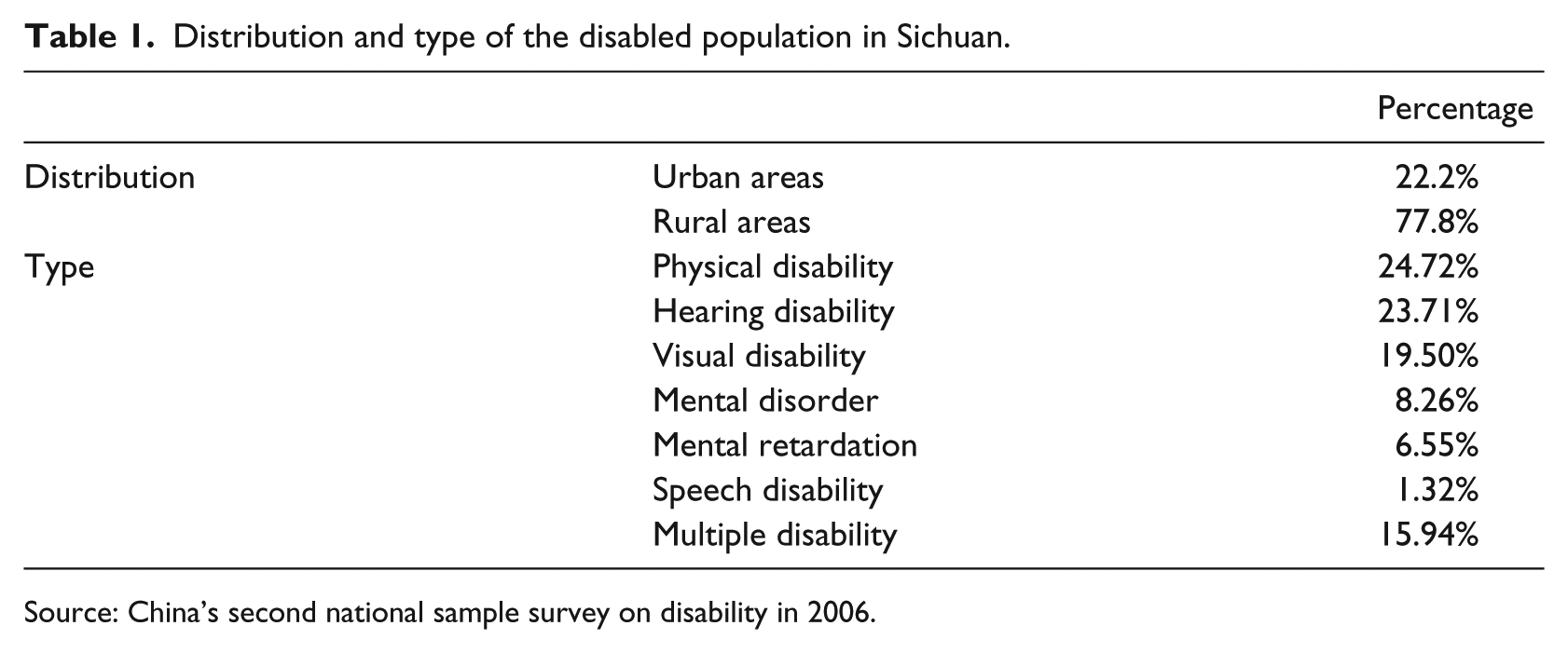
Source: China’s second national sample survey on disability in 2006.
Because of catastrophic earthquakes in May 2008 and April 2013, there has been a rapid increase in the number of people with disability in Sichuan (Yang, 2013). The large number of people with disability poses a great demand for public services. 4 What is more, due to the complex structure of people with disability, service requirements vary. Socioeconomic development in Sichuan, located in west China, is relatively sparse which restricts to some degree the development of service provision for people with disability. According to statistics, 53.75 percent of the rural population with disability in Sichuan were unemployed and mainly lived on provision from other family members (Li and Sha, 2012). For people with mental retardation and mental disorders, 31.67 percent of them needed medical service or aid and 16.49 percent needed rehabilitation training and service provision. Only 24.96 percent and 6.29 percent of them had received the required service (Research Group on the Change in the Number of People with Disability in Sichuan, 2008). Moreover, the coverage of social welfare for people with disability was limited and their living conditions were always poor. 5 For example, about 25 percent of poor disabled people were excluded from the Minimum Living Standard Guarantee System (Li and Sha, 2012). Faced with such a situation, Sichuan Disabled Persons’ Federation decided to reform the service provision pattern to meet the challenges and has been providing personalized service for people with disability since 2011.
Operation
In China, disabled persons’ federations at all levels are semi-official institutions. The federations have always focused on administrative functions, and have neglected the service functions (Yang, 2013). Thus, they have had little direct contact with people with disability and do not have a close relationship with the disabled. In 2004, a survey conducted by a university showed that more than half of the investigated people with disability held a negative attitude toward the statement that disabled persons’ federations could successfully serve them, and 62.2 percent were not satisfied with the attitude from officials (Zhou, 2008). Hence, it was necessary to promote a functional transformation from administrative to service function. The emergence of personalized service for people with disability altered the top-down service provision pattern of Sichuan Disabled Persons’ Federation. It proritises requirements of people with disability, and the provision of public services is decided jointly by the staff and those with disability or their relatives. This is a bottom-up pattern and is compatible with the new value of public service which focuses on serving instead of steering (Denhardt and Denhardt, 2007). It also provides a good example of functional transformation of disabled people’s federations (Yang, 2013).
Personalized service focuses on the survival and development of people with disability, that is to say, personalized service does not only try to bring the eligible people with disability into the coverage of social assistance such as the urban and rural Minimum Living Standard Guarantee System (MLSGS) as well as social insurance, 6 but also provides the rehabilitation, education, employment, and other services to help those with disability to gain more development opportunities. For this purpose, disabled persons’ federations have to mobilize and integrate different kinds of resources and services from government departments.
In order to provide personalized service provision for people with disability, four steps can be followed. The first is to carry out investigations in the form of home visits. At this stage, grassroots workers who are responsible for the disability affairs have to thoroughly understand basic conditions and the service requirements of the people with disability via two questionnaires during home visits. The second is to make developmental plan, which is supportive. At this stage, grassroots workers have to carefully analyze the actual conditions and requirements of the people with disability and then make personalized plans to help them gain the support and development with current resources and services. In the process of making the plan, grassroots workers should fully communicate and negotiate with the people with disability and their family members. The third step is to organize and implement the plan. Problems should be solved through different channels. In this process, services and resources from different government departments should be fully considered and utilized. The fourth is to supervise and inspect the plan. In order to guarantee the effect of personalized service provision, disabled persons’ federations at the street office and community level as well as grassroots workers should be inspected. In addition, some persons with disability should also be inspected through home visits. 7
Features
There are mainly three distinct characteristics of personalized service.
First is the requirement orientation. The traditional way of providing services for people with disability is top-down, which means the disabled persons’ federations neglect the requirements of the disabled. In addition, the service is provided randomly and discretionarily (Wu, 2012). Personalized service changes the traditional model of providing services, and the requirements of the people with disability have become a decisive factor (Yang, 2013). The above-mentioned four steps of personalized service provision clearly show how the requirements of those with disability are investigated, understood, and, at last, met.
Second is the information construction. The Sichuan Disabled Persons’ Federation has established a Personalized Service Information Management Platform (hereinafter called Platform) in the process of providing the service. During the four steps, after the investigation, the grassroots workers use a computer to input answers of the questionnaires in the Platform, and thus different service requirements can be automatically classified and summarized by the Platform (Mao, 2013). After making the support and development plan, the content of plans are written in the ‘Plan’ column on the Cards of Personalized Service and finally input into the Platform (Mao, 2013). During the stage of organizing and implementing the plan, when the service requirements of the people with disability are met and the people with disability are satisfied, the information is written in the ‘Implemented’ column on the Cards of Personalized Service and finally input into the Platform. During the supervision and inspection stage, the Platform can be used to select the staff and people with disability in order to implement the inspection. Through the information construction, the information can be shared between different government departments, thus improving the quality and efficiency of personalized service (Yang, 2013). By collecting information on the basic conditions and service requirements of people with disability, the demand objective across the entire province can be easily defined, and thus specific supportive resources can be found. Policy makers can make decisions with the information from the Platform which can make scientific and reasonable decisions on the service provision. It helps avoid the blindness of making decisions based only on experiences and insufficient information. Moreover, through the information construction, the process of service provision can be easily inspected and supervised.
Third is the integrated service system. In China, the public service provision is different according to functional division of government departments, meaning that fragmentation is an obvious phenomenon. For example, the civil affairs department is in charge of social assistance for people with disability, and the human resource and social security department is in charge of the employment and training of people with disability and aims to enhance their basic medical treatment and pension level. The health department is in charge of the rehabilitation and other medical affairs for the people with disability, such as corrective operations for physically disabled children and cataract operations. The education department is in charge of the education affairs for people with disability, including the improvement of the special education system and the extension of Braille and sign language. In addition, the culture and sports department, statistical department, industrial and commercial department, local taxation department, urban planning department, and so on, are all related to the service provision for people with disability. Under these circumstances, those with disability cannot get access by themselves to public services provided by different government departments, because of the information asymmetry. The personalized service in Sichuan has established a brand new network which breaks department boundaries and has constructed a public service network for persons with disability (Yang, 2013). The construction of inter-departmental cooperation can better utilize limited resources and can provide gap-free public services instead of fragmented services (Pollit, 2003). The emergence of the personalized service manifests that integrated service system for people with disability is taking shape in Sichuan.
Methodology
Results presented in this article are based on relative document reviews and outcomes of a qualitative interview in Chengdu. Relative documents are mainly official documents on personalized service provsion in Sichuan Province. Besides, the data and statistics from the Sichuan Personalized Service Information Management Platform are used for the purpose of analysis. However, the lack of firsthand information supplied by involved persons has always handicapped the in-depth understanding of the policy and its effect.
This article aims to examine the personalized service through a four-dimensional framework of social welfare policy and to assess the capacity of personalized service from both the supply and demand side. Thus, in this article, the documentary analysis is supplemented by a qualitative interview. Official documents of personalized service mainly reveal the events happening at the policy-making level and can provide useful information on the four dimensions of personalized service analysis. Yet it is equally important to learn about what is really happening at the operational level to assess the capacity of personalized service. During the implementation of the policy, the actual program implementation determines the performance or output of the policy. Therefore, through the interviews with policy implementers (i.e. disabled persons’ federation officials at different levels, including grassroots staff who are responsible for disability affairs) and people with disability who have received personalized services, namely, the supply and demand side, the first-hand data of the policy in operation can be collected, and personalized service provision can be examined and evaluated.
The qualitative interviews were carried out in Chengdu. The reason for selecting Chengdu as the research site is that as the capital city of Sichuan, Chengdu takes the lead in providing personalized service for people with disability in the whole province. It is the first city to establish the new service model, and so far has achieved much more successes than many other cities in Sichuan. This lends the case of Chengdu much representativeness. The interviews were carried out between March and July 2013, during which 7 policy implementers and 12 persons with disability were interviewed. Of the 7 policy implementers, 1 was from Municipal Disabled Persons’ Federation, 1 was from the District Disabled Persons’ Federation, and 5 were grassroots staff at community level. Of 12 persons with disability, 9 had a physical disability and 3 had visual disability. During this in-depth semi-structured interview, the policy implementers were asked about four dimensions in the analytical framework mentioned in the ‘Introduction’ section. Specifically, they were asked about their knowledge of personalized service in respect of the recipients, the items of personalized service, as well as the delivery and financing systems. When talking about the delivery system, they were asked about their computer skills in using the Platform, their attitudes and interactions with people with disability, and their personal practice, difficulties, and challenges at work. It is suggested that the only way to study truly disadvantaged people is through some form of an in-depth case study approach (Sjoberg et al., 1991). Besides, no-one would be better placed to comment on the policy than persons with disability who have received personalized service. So, 12 people with disability were interviewed, mostly at their homes. In the interview, they were asked open-ended questions about their disability experience, and the service they received before and after the introduction of personalized service. They were also asked if they could receive the service conveniently and whether they were satisfied. The above questions mainly relate to the ‘what is offered’ and ‘how to deliver’ dimensions in the analytical framework. The data analysis process included three main phases: identifying a significant statement for coding, categorization, and theme definition. To avoid the loss of nuance within original narratives, the data were not translated into English until the stage of writing up the research. It should be noted that the small sample of this qualitative study naturally limits the generalization; however, it can point to directions for future research in the field of personalized service in Sichuan.
Results
Who shall receive benefits?
Persons with disability are one of the vulnerable or disadvantaged groups; thus, personalized services are by their nature selective and target at the persons with disability through the mechanics of identity testing. That means all the people with disability in Sichuan should be covered, and this is confirmed in relative official documents of the Sichuan Disabled Persons’ Federation. However, since it is a new service which is being promoted, in practice, it has not covered all those with disability. According to the statistics on the Platform, by the end of 2012, 2.8 million people with disability had received personalized service, accounting for only 45 percent of all people with disability in Sichuan. In Chengdu and other developed cities, personalized service developed well and rapidly, while in less developed areas, personalized service had not been carried out well which has meant that persons with disability in less developed areas are seldom provided with personalized service. In Table 2, it can be seen that the task accomplishment ratio of personalized service was highest in Chengdu, which was 123.3 percent, while the lowest was only 18.8 percent in Panzhihua, a less developed city in the south of Sichuan. Of all the 21 cities and areas in the entire province, only 6 reached the ratio of more than 100 percent. Thus, it was undeniable that many people with disability were excluded from receiving personalized service, especially those in less developed areas.
Development of personalized service in every city (prefecture) in Sichuan (27 August 2012).

Source: Circular on development conditions about personalized service for disabled people in Sichuan: http://www.scdpf.org.cn/content/zdzt/rdzt/ltcy/jdtb/jdtbxl/cms_5170.html.
In addition, by interviewing policy implementers, another issue on the target of personalized service emerged. An official in the municipal disabled persons’ federation said, ‘At present, we provide personalized services for those who have the disability certificate. In the near future, we hope we can help those without certificates’. This means that if people with disability have disability certificates, they can take advantage of this new service. But if not, they cannot receive any service. People with disability who do not have a disability certificate are often those living in remote and undeveloped areas or those who have a severe disability. It is very inconvenient for them to go to hospital for the disability identification and to apply for the disability certificate. These people are in urgent need of personalized service, but they are excluded.
What is offered?
In early 2013, the Sichuan Disabled Persons’ Federation integrated 66 service items and welfare programs from different government departments for people with disability and designed the questionnaire on investigating their requirements accordingly. Personalized service offers not only social security services such as applying for social assistance, social insurance subsidy, and welfare for people with disability, but also special services such as rehabilitation, education, employment, and other services which can help the disabled to gain more development opportunities. Among all the 66 service items, social security services involved 18 items which can be divided into 3 categories, and special services involved 48 items which can be divided into 6 categories (see Table 3). In general, personalized service is mainly in-kind provision, with limited cash provision as the supplement.
Content of personalized services items for people with disability in Sichuan 2013.
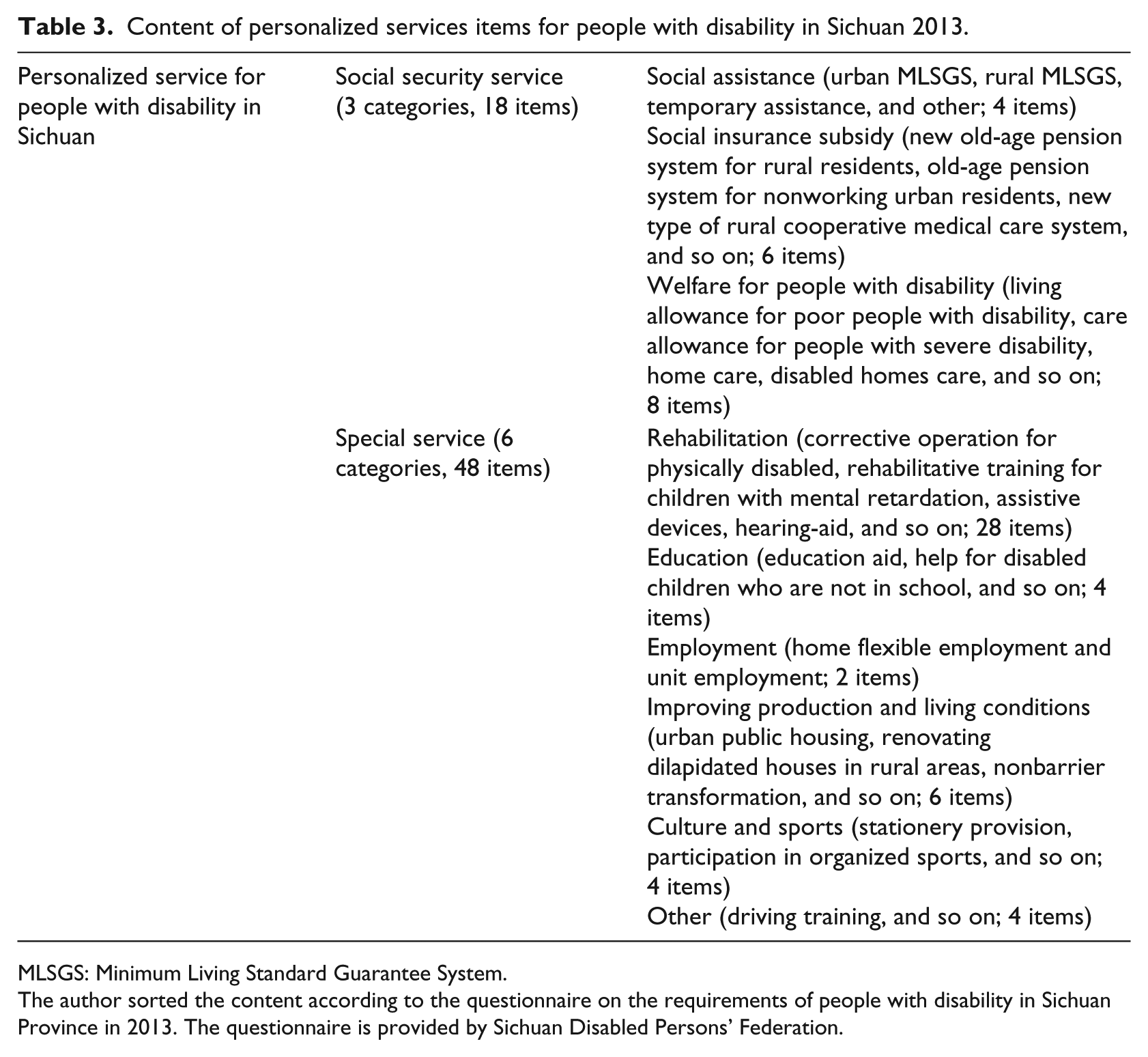
MLSGS: Minimum Living Standard Guarantee System.
The author sorted the content according to the questionnaire on the requirements of people with disability in Sichuan Province in 2013. The questionnaire is provided by Sichuan Disabled Persons’ Federation.
It is undeniable that the service scope has been substantially extended and the demands of people with disability have been taken into consideration. As an official in the district disabled persons’ federation noted, Current items of personalized service have undergone several changes. They are finally decided through many investigations and discussions which manifest the great attention on the service provision. Now services basically conform to the actual situations of the people with disability and cover their requirements.
As to the extension of the service scope, he stated that In the past, our service has mainly been simple basic projects such as cataract operations and providing wheelchairs for free. After the implementation of personalized service provision, our service includes hundreds of comprehensive projects related to almost every aspect of the life of people with disability, including employment promotion, social security, education, housing, poverty alleviation and barrier-free environments, etc.
From the above descriptions, it can be seen that the items of personalized service are designed through much investigation. In addition, the service has been extended significantly and considers various demands of people with disability. But there is also a problem, as a grassroots worker said in her interview: I think existing services are good and comprehensive, but a problem remains. The items of personalized service are too complicated. People with disability usually can’t understand some of them. Even I can’t fully understand all of them and have to review documents and regulations issued by different government departments.
By interviewing the people with disability, an interesting finding is that three-quarters of them do not know exactly what personalized service is and one-quarter of them have never heard of this kind of service. This indicates that the policy advocacy should be further strengthened. But when being asked whether there is a difference in service provision between the past and present, almost all of them expressed that current service provision is broader and better than before, and showed they are satisfied. A person with physical disability said, The staff responsible for the disability affairs in our community helped me apply and gain minimum living standard allowance and social insurance subsidy last year. The staff usually asks me about the requirements for public service through home visits. Several years ago, they didn’t come to my home and I had no chance to express my demands and attitudes I think there is an improvement on the service provision and I’m satisfied with current service.
A person with visual disability also expressed his gratitude: The staff here helped me find a job. In the past, I had no skills and had to stay at home. About three years ago, a staff member from disabled persons’ federation came to my home and asked me about my demands for government support. I told her I wanted to get a job but I didn’t count on it. A month later, the staff member came to my house again and told me to go to a massage parlor to receive training, and after the training, I worked there. During my training and working process, the staff often asked me if I was adapting to it and if I needed further support. I am really grateful to the staff and satisfied with the service.
As for the cash provision, some some of those with disability interviewed expressed that they had received social assistance allowance, but none of them had received the living allowance for poor disabled or care allowance for severely disabled. This may be partly because the above cash provision had only been implemented for a short time, and people with disability and grassroots staff had little knowledge about them, partly because the eligibility criteria are stringent in order to save the funds of the disabled persons’ federations. Limited cash provision restricts the freedom of choice of the recipients to some degree. As a person with physical disability said, ‘I have no idea about many of the service items. They seem to be complicated and are not suitable for me. I think the cash provision is most beneficial. Money can buy almost everything, can’t it?’. This indicates that current services offered by the disabled persons’ federations are much better than those before and focus on urgent demands of the people with disability, such as social security and employment. Most of the interviewed recipients are satisfied with the personalized service provision. However, there is also a complaint about the complexity of service items and lack of cash provision.
How to deliver?
In the personalized service delivery system, the government undertakes both the service provision and production. As discussed earlier, the delivery of personalized service consists of four steps which show that service delivery mainly depends on disabled persons’ federations at the street office and community level, especially grassroots workers or staff in these federations. These workers bear the responsibility of carrying out the investigation through home visits, making the support and development plans, and organizing and implementing plans. Disabled persons’ federations at the provincial and municipal levels mainly take responsibility for the policy making and inspection. In order to deliver the service, a large number of grassroots staff who are responsible for the disability affairs are required. Therefore, the Sichuan Disabled Persons’ Federation has actively increased the number of grassroots workers. It has required that every street office (town) should have at least one worker and every community (village) should have at least one worker who is responsible for disability affairs. 8 By the end of 2013, there were about 58,000 workers at the community (village) level in Sichuan Province. 9
This delivery method has changed the passive provision pattern of the past and started to provide services based on the requirements of people with disability, which puts into practice the idea of ‘putting people with disability first’. Grassroots workers in disabled persons’ federations are required to understand precisely the actual requirements of people with disability, then make supportive and developmental plans which adapt to actual situations, and finally organize and implement the plans. As a grassroots worker said, Personalized service provision not only helps the people with disability get different aid and social security, but also help them obtain the development opportunity. Of course, my workload is much heavier than before, but I feel fulfilled through serving people with disability. At work, I put myself in their position: you treat them well, and they treat you well. Once a person with mental disorder lost his way at the time of an attack caused by his disease, and when the police found him, he didn’t remember his address but he still remembered my name and telephone number.
By interviewing the grassroots workers and the service recipients, it is found that most grassroots staff are responsible for delivering personalized services, and people with disability trust the staff, express their requirements and the obstacles in day-to-day life with the staff, and show their gratitude for the staff’s stressful work. The relationship between staff and disabled people is quite good which partially indicates that the service delivery is effective.
In addition, this method of delivery is beneficial to the protection of the rights of people with disability. In the past, people with disability only accepted public services passively. They did not have information about the services provided, such as service type and resources, meaning that they lost the right to know. At present, the provision of personalized services can guarantee their right to know their rights through regular home visits. People with disability can also choose the service they want to accept, meaning they have certain options. What is more, the supervision and inspection provide the opportunity for the people with disability to express their opinions on the personalized service provision, which means they have gained the right of expression.
However, there are also issues and challenges to be addressed in the process of the service delivery. First, the grassroots staff’s workloads are heavier and the pay is less than other workers in the federations: Sometimes I really want to quit. This is not because of the discrimination of persons with disability – it is mainly because I am too tired. I just can’t handle it. After work, I am too tired to move.
As a grassroots worker, this woman’s monthly salary was around RMB 1200. Even people with disability protested about the unfair situation of the grassroots staff, and some of them even asked me to report the situations to upper-level federations in order to remedy the staff’s low salaries. They put it very simply: ‘Who is going to provide the service for us if they leave?’ Second, the quality and ability of some grassroots staff need to be improved. During the service delivery, they have to use a computer to put relevant information into the Platform. Computer skills are a basic working ability. But during the interviews, it was found that some staff lacked this basic skill. A grassroots staff member who is responsible for disability affairs said, ‘I am over 58 years old and I do not know how to operate the computer. When inputting records on the Sichuan Personalized Service Information Management Platform, I have to ask others to help me’. Likewise, an official in the municipal disabled persons’ federation expressed that, In order to carry out personalized service, a lot of staff at the district (village) level are recruited and employed. Their salaries are low, and some of them lack basic skills and vocational knowledge. Their abilities need to be improved urgently.
No wonder that in practice some grassroots workers need others to help them input records on the computer and some cannot fully understand the content of personalized service. Well-designed training on computer skills and policies on various service items of personalized service can help improve the ability of grassroots staff. However, none of the interviewed grassroots workers have received any kind of training. The official from the municipal disabled persons’ federations talked about the reason for this: ‘Although there is a need to provide the training for grass-root workers, we have no budget to do that mainly due to insufficient funds for personalized service’. Third, the coordination between different government departments needs to be strengthened. As outlined earlier, personalized service provision coordinates various public services which belong to different government departments, but in practice, many departments still consider disabled affairs as the business of disabled persons’ federations (Mao, 2013). They neglect the services for people with disability and the coordination between different government departments is also not very efficient, which influences the final effects of personalized service delivery. As a district disabled persons’ federation official expressed, ‘Our federation could supervise other government departments to provide public services for people with disability. We do not have the power to enforce them’. Thus, during the process of organizing and implementing plans, it is usually not easy for the grassroots workers to fulfill the plans. From the interviews, it was found that many of the staff have to go to relevant departments again and again to apply for support, and the results are not always satisfactory. They reported that some departments evade their responsibilities in providing service for persons with disability because they consider disabled affairs to be the business of disabled persons’ federations.
How to finance?
Funds to pay for personalized service in Sichuan are obtained mainly from tax revenues and the employment guarantee fund for the disabled. Social donor funds are also encouraged (Mao, 2013). It is the responsibility of the municipal disabled persons’ federations and the subordinate district disabled persons’ federations to fund personalized service. 10 Thus, it is not surprising that for cities and districts with a relatively strong financial performance, personalized service provision would develop rapidly. It has resulted in inequalities among people with disability in receiving personalized service due to the disparity of financial ability in Sichuan.
In general, the investment in personalized service is insufficient. Even in developed cities with strong financial performance, the financing gap in personalized service provision still exists. An official in the Chengdu Disabled Persons’ Federation told us, ‘Due to fast development of personalized service, there is a great demand for the investment. But our budget is insufficient, that is why we can’t cover all the people with disability and can’t increase the salary of grassroots workers’.
As a result it can be seen that the fund for personalized service is insufficient. Some issues in the targeting, content, and delivery of personalized service, such as exclusion of disabled without disability certificates, limited cash provision, low salary of grassroots workers, and lack of training for these workers, are all related to insufficient funds.
Discussion and conclusion
This article has examined and evaluated emergent personalized service provision for people with disability in an integrated way by analyzing a four-dimensional framework, which comprises who shall receive benefits, what is offered by the service, how to deliver the service, and how to finance the service.
Based on official document reviews, as well as interviews with both supply and demand sides, namely policy implementers and service recipients, it is found that personalized service does benefit persons with disability. Official documents and all the interviewed policy implementers mentioned that the scope of personalized service has been extended and various kinds of service items from different government departments are integrated. Most of the interviewed people with disability who have received personalized service expressed that current service provision is broader and better than before, and they were satisfied with personalized service. The new delivery model of personalized service helped realize the efficient linkage between the requirements of people with disability and current policies, and eliminated the information asymmetry. Many of the interviewed recipients said that they had gained the rights and opportunities to be made aware of public service and to express their demands through regular home visits by grassroots workers. It is undeniable that the rights of people with disability are better protected. In summary, there have been great achievements for the emergent personalized service in Sichuan with people with disability benefiting. In fact, personalized service in Sichuan has already drawn much attention from the China Disabled Persons’ Federation and other provinces and cities. 11
However, the analysis of the four dimensions in the analytical framework also indicates that there have been a number of issues and challenges during the development of personalized service in Sichuan.
Exclusion of some people with disability
The regulations on personalized service answer the question of ‘who shall receive benefits’. It is clearly stated that all those with disability in Sichuan are entitled to receive personalized service. But according to the statistics of the Platform, only 45 percent of the people with disability have received this new service, meaning that some are excluded. The reasons for exclusion can be attributed to two main aspects. First, in practice, official paperwork requirements such as disability certificates, prevent some people with disability from receiving personalized service. In China, the process of applying and issuing disability certificates is cumbersome and lengthy. For people with disability who live in remote areas or those who have a severe disability, it is very inconvenient for them to go to hospital for the disability identification and to apply for the disability certificate. These people are in great need of personalized service, but they are not covered. Second, personalized service in less developed and underdeveloped areas in Sichuan has not been carried out well due to lack of funds or human resources. Thus, people with disability in these areas are seldom covered by personalized service. The exclusion of some people with disability affects the equality of personalized service provision.
Complicated content and limited cash provision
Personalized service integrates current service from different government departments, and has extended the service scope to 66 items of service provision. Although the scope is comprehensive, it is too complicated to be fully understood by most people with disability. Even some grassroots workers have difficulty in understanding all the items and have to review documents and regulations issued by various government departments. This can have a negative impact on the effectiveness of personalized service provision. Cash and in-kind provisions are two basic forms of social provisions. As shown in Table 3, personalized service mainly provides in-kind benefits that entitle recipients to use goods and services for free which are mainly provided by different government departments. Cash provisions, such as the living allowance for poor people with disability or care allowance for people with severe disability, are only supplements. They are provided by the Sichuan Disabled Persons’ Federation. In the interviews with 12 recipients, it is found that none of them have received the allowance. According to statistics, in 2014, the Sichuan government spent 550 million Yuan on care allowance for people with severe disability. It is estimated that 660,000 people with severe disability could receive this cash provision, and they only accounted for about 30 percent of all the people with severe disability in Sichuan. In addition, the benefit level of the care allowance is very low, only 50–80 Yuan every month. 12 Whether the cash provision can provide substantial support for people with disability can therefore be called into question. It should be noticed that the limited cash provision in personalized service means that the Sichuan Disabled Persons’ Federation prefers in-kind provision, which is more effective in social control, and the freedom of choice of the people with disability is restricted to some degree. The interviews indicates that there have been complaints from persons with disability about complicated service items and the lack of cash support. According to the UN Convention on the Rights of Persons with Disabilities in 2006, it is demanded that ‘the importance for persons with disabilities of their individual autonomy and independence, including the freedom to make their own choice’ be recognized. 13 With the cash provision, people with disability could choose to buy goods and services on the market and would not be restricted to the list of services provided by the governments. Thus, the cash provision of personalized service should be given more attention and be strengthened.
Low salary and lack of training for grassroots workers
Personalized service delivery mainly depends on a large number of grassroots workers or staff in disabled persons’ federations. These workers bear the responsibility of carrying out the investigation through home visits, making support and development plans, and organizing and implementing plans. Although they bear great responsibility and a heavy workload, their salaries are low. Some of the interviewed grassroots workers complained about the low salary and heavy workload, and expressed that they wanted to leave the profession. Even people with disability protested against unfair conditions of the grassroots workers. In addition, it is found that some grassroots workers do not know how to use a computer and cannot fully understand the content of personalized service. Their ability to deal with the task of inputting records in the Platform by using the computer, and how they can make and implement reasonable support plans for people with disability under the circumstance of uncoordinated cooperation between different government departments is then called into question. In order to carry out personalized service, many grassroots workers are recruited on a low salary and many of them lack basic skills and vocational knowledge. They are in great need of training. However, none of the five interviewed grassroots workers have received any kind of training. They expressed that they were learning by doing. In summary, low salary and the lack of training for grassroots workers are profound challenges for the effectiveness of personalized service delivery.
Inadequate funding of personalized service
Funds to pay for personalized service in Sichuan are mainly from government financial allocation, but the allocation is insufficient. According to statistics, the fund for personalized service was about 0.5 Yuan and there were 2.8 million recipients in 2013. 14 It is calculated that each recipient received only 17.8 Yuan on average, which was very low. To some degree, inadequate funding is related to all the above issues, such as exclusion of some people with disability, limited cash provision, and low salary, as well as lack of training of grassroots workers. Specifically, it is the responsibility of the municipal disabled persons’ federations and the subordinate district disabled persons’ federations to fund personalized service (Yang, 2013). Thus, it is not surprising that the inequality of financial power and economic level brings out uneven development of personalized service in different cities or areas.
To summarise, based on the analysis and assessment in this article, it is found that the new personalized service in the Sichuan Province of China does benefit people with disability; however, there are also a number of issues and challenges in terms of the targeting, items, delivery, and financing which adversely affect its performance. The policy implication of the research relates to four dimensions in the analytical framework. As a target, all persons with disability should be covered. A disability certificate should not be the obstacle to receiving the service. The service items should include support for issuing a disability certificate to those who have difficulty in applying and getting certificates. In relation to the items or what is offered, complicated content should be expressed in a clear and simple way, and pamphlets which explain the policies for every service item should be compiled and provided to grassroots workers and people with disability. The cash provision has to be improved and strengthened to help those with disability to gain more freedom of choice and individual autonomy. In terms of the delivery, grassroots workers’ salary should be increased and their skills should be enhanced through various kinds of training programs. The coordination between different government departments needs to be strengthened in the process of organizing and implementing plans. As for financing, more should be invested for personalized service and a provincial transfer system should be established. Only with sufficient funding can all the above policy suggestions be implemented. What is more, the issue of uneven development of personalized service among regions could be solved to some degree through provincial transfer.
Footnotes
Funding
This research received no specific grant from any funding agency in the public, commercial, or not-for-profit sectors.