




Abstract
By 2019, the United States plans to resettle approximately 50,000 refugees from the Democratic Republic of the Congo. The purpose of this study was to identify and understand the challenges, risks, and strengths of adult Congolese refugee women resettled in the United States to help policymakers, service providers, and other stakeholders prepare for the arrival of Congolese women and their families. Researchers conducted in-depth interviews and focus groups with Congolese refugee women (n = 28) and resettlement service providers (n = 29) in three US cities. The findings of this study reveal the complex and dynamic nature of Congolese refugee women’s resettlement experiences in the United States and highlight the importance of recognizing the intersection of pre- and post-migration factors during resettlement. This article offers concrete implications for the social work profession and practitioners.
Keywords
Between 2014 and 2019, the United States plans to resettle approximately 50,000 refugees from the Democratic Republic of Congo (DRC). 1 At least 20 percent of incoming Congolese refugees are expected to be resettled under the ‘women-at-risk’ category. The United Nations High Commissioner for Refugees (UNHCR) (2011) defines women-at-risk as ‘women who have protection problems particular to their gender’ (p. 263) and the category is widely operationalized in practice by UNHCR as refugees who are ‘single women and single mothers’. In January 2013, UNHCR (2013) released a report that highlighted key issues that surround the resettlement of refugee women under the women-at-risk category. Simultaneously, momentum began to grow within the US resettlement community to prepare for an increase in Congolese arrivals raising questions for resettlement and social work practitioners around how to address what was being reported as high needs. This study emerged from the confluence of these concerns and trends. Its purpose was to identify and understand the challenges, risks, and strengths of adult Congolese refugee women resettled in the United States under the women-at-risk category to help policymakers, service providers, and other stakeholders prepare for the arrival of Congolese women and their families.
Conflict and displacement in the DRC
The DRC has endured nearly two decades of war and chronic instability, fueled in part by its colonial history and a legacy of systematic extraction of natural resources by external actors. Millions of people have died from disease and malnutrition as a result of the conflict (International Rescue Committee, 2007), and hundreds of thousands of women, children, and men have been assaulted, tortured, and sexually terrorized (Human Rights Watch, 2010). The suffering, pain, and loss resulting from the conflict defy quantification. Since 1996, civilians in eastern Congo have been chronically displaced, and in 2012 alone, UNHCR reported that 2.3 million people were displaced within the country and that more than 70,000 had fled across the border into Rwanda and Uganda (UNHCR, 2014). Hundreds of thousands of people have fled the abuses of armed groups who seek to extend economic, political, and military control over territory and resources (Human Rights Watch, 2010). The threat and perpetration of violence and looting in eastern Congo have forced individuals, families, and communities to leave their homes in pursuit of safety. However, respite often has been temporary or elusive. Some communities flee far enough to avoid confrontation with an armed group but close enough so that they can return to tend to their fields and to prevent their land from being seized. Others seek refuge in larger towns or cities or make their way to camps. In either case, as displaced persons, they rarely have access to sufficient food, shelter, health care, or security. Some return home only to be dislocated again. An estimated 500,000 refugees from the DRC are currently seeking refuge in more than 10 different African countries, the majority of whom are in Uganda, Rwanda, Tanzania, Burundi, and the Republic of Congo.
The use of sexual violence in DRC is widely understood as extreme, given its scope, brutality, and duration. The physical, psychological, and social impacts of sexual violence perpetrated in DRC on women has been severe. Survivors describe psychological symptoms consistent with depression, anxiety, and post-traumatic stress disorder (Bass et al., 2013). In addition, feelings of abandonment and rejection by family and friends, concerns about providing for self and family, fear, and stigma are pronounced (Bartels et al., 2010, 2013; Kelly et al., 2012). While conflict-related sexual violence has been rampant in the DRC context, it must be understood within a broader context of gender inequality and other forms of violence against women and girls (Watts et al., 2013; Guimond and Robinette, 2014). For instance, women in the DRC also report high rates of violence perpetrated by intimate partners with 35 percent of women reporting sexual violence and 57 percent reporting physical violence by a partner (MEASURE, 2007–2012, as cited in Watts et al., 2013).
US refugee resettlement
Approximately 70,000 refugees from around the world are resettled in the United States each year through the US Refugee Admissions Program (USRAP) (Bruno, 2015). The USRAP provides social services for refugees with the goal that they quickly integrate into US society and become economically self-sufficient (Office of Refugee Resettlement, 2012[1980]). Refugee resettlement funding and programs focus social service funds on employment-related services, English language training in non-work hours where possible and cash assistance, in a manner as not to discourage their economic self-sufficiency (Vongkhamphra et al., 2011). Given that refugees’ adaptation to the United States is measured in terms of employment, other aspects of their experience and condition tend to be seen through the lens of economic self-sufficiency (Cook et al., in press).
Each refugee approved for resettlement in the United States is sponsored by a resettlement agency that holds a cooperative agreement with the US Department of State and in turn maintains a nationwide network of some 350 affiliated offices. In 2013, the Bureau of Population, Refugees and Migration (PRM) provided these resettlement agencies US$1875 per refugee to provide for their basic needs and core services for the refugees’ first 30–90 days in the United States. States, counties, non-profits, faith-based organizations, and communities provide additional resources to augment the complex myriad of federally funded programs and social services available to resettling refugees. Employment services are considered key as the goal is to assist clients become economically self-sufficient within 120–180 days (Office of Refugee Resettlement, 2014).
Social workers are well-positioned to provide a wide range of direct services at the individual and family level, as well as broader organizational and institutional levels. In fact, social workers are already deeply embedded within the work of refugee resettlement, employed as case managers, mental health counselors, program administrators, evaluators, and policy advocates. The social work profession also plays a key role in supporting the resettlement process for refugee women as they make meaning of pre-migration stressors and navigate and respond to shifting circumstances in the United States (Cook-Heffron et al., 2015; Williams and Graham, 2014). Case management services, in particular, form the foundation of service provision for this population, in helping resettling refugees navigate complex processes and services. Furthermore, refugee resettlement agencies draw from social work practice, values, and ethics to guide their work with these vulnerable populations (Cook-Heffron et al., 2015). Given the anticipated caseload of Congolese refugees to resettle in the United States, research with this population is of particular importance to the social work profession tasked with supporting refugee clients as they contend with complex external and internal process to adapt.
Theoretical framework: Factors affecting refugee ‘integration’ in the Global North
The conceptual framework for this study is rooted in empirical research and theory surrounding factors affecting refugee integration in the Global North. In particular, it builds on and contributes to understanding the significance of both pre- and post-migration factors in determining the resettlement experiences of women. Scholars have emphasized that both pre- and post-migration experiences impact the health, well-being, and ability of refugees to attain economic self-sufficiency and psychosocial integration in new communities (Beiser, 1990; Benson et al., 2012). Trauma and duress, signature components of refugees’ experiences, are often present pre-, during, and post-flight stages and have direct effects on resettlement outcomes. In the pre-migration stage, women, men, and children often face the sudden loss of home, family members, and friends; rape; torture; witnessing atrocities; and food insecurity or starvation (Balgopal, 2000; Gerard and Pickering, 2014; Hutson et al., 2014; Mayadas and Segal, 2000; Potocky-Tripodi, 2002). Gender-based violence, particularly sexual violence, is a pervasive risk for women in violent conflict and humanitarian crises and is often used as a strategic tool of war, colonization, and genocide (Nawyn et al., 2009). The threat of sexual violence persists in flight, and women may have no choice but to exchange their bodies as commodities to gain access to basic necessities for themselves and their families.
During the post-migration stage, resettlement in the United States brings additional stressors to refugee individuals and families. Language, employment, and transportation barriers complicate efforts to adapt to new environments, and the continuing impact of pre-migration or flight-related trauma, torture, violence, and hardships present further medical, social, and economic challenges (Choi et al., 2013; Fozdar and Hartley, 2013; Nsonwu et al., 2013). Where family, social, and community systems have broken down due to war or violence, refugees often lose key support structures that may have previously served as protective factors from stress and psychological distress (Ahearn, 2005). In addition, many refugees suffer a loss of status when their education, occupational skills and experiences, and roles in the community do not easily translate into the new culture. Research has demonstrated that being a woman can increase the chance of experiencing mental health challenges in the new country particularly as a result of post-migration stressors such as these (Porter and Haslam, 2005).
It is important to recognize that there is no agreed upon definition, theory, or model in the United States of refugee (and immigrant) integration despite its prominence in resettlement policy and programming (Ager and Strang, 2008; Castles et al., 2001), which presents inevitable challenges to furthering understanding of integration processes and outcomes for the individuals experiencing it. In 2012, the US Government Accountability Office (GAO) (2012) offered a working definition of integration as ‘a dynamic, multidirectional process in which newcomers and the receiving communities intentionally work together, based on a shared commitment to acceptance and justice, to create a secure, welcoming, vibrant, and cohesive society’ (p. 31). Inherent in many conceptualizations of integration is an implicit assumption that ‘successful’ integration is contingent on the receiving/host community being cohesive and welcoming, when the reality facing immigrants, migrants, and refugees alike is often one of inequality, racism, and poverty in the Global North (Castles et al., 2001; Snyder, 2012). Understanding the pre- and post-migration experiences of Congolese women resettled in the United States under the women-at-risk designation is critical to social work practitioners and other resettlement actors and policymakers preparing for newcomers and laying the groundwork for healthy, multi-dimensional integration of refugee families into US communities.
Methods
This study employed a qualitative approach to explore the concerns, challenges, risks, and strengths faced by adult Congolese refugee women resettled in the United States under the women-at-risk category. Its aim was to help policymakers, service providers, and other stakeholders prepare for the arrival of Congolese women and their families. We conducted in-depth interviews and focus group discussions with Congolese refugee women and resettlement service providers (n = 57) in three US sites: Lexington, KY; San Antonio, TX; and Salt Lake City, UT. Study sites were selected after reviewing PRM data that indicated that Congolese women under the women-at-risk designation had been resettled at high rates to these cities. Rooted in a social constructionist epistemology, this study recognizes that there are multiple ways of ‘knowing’ and values the role Congolese women, researchers, and language interpreters play in co-constructing meaning of the experience (Daly, 2007).
Participants
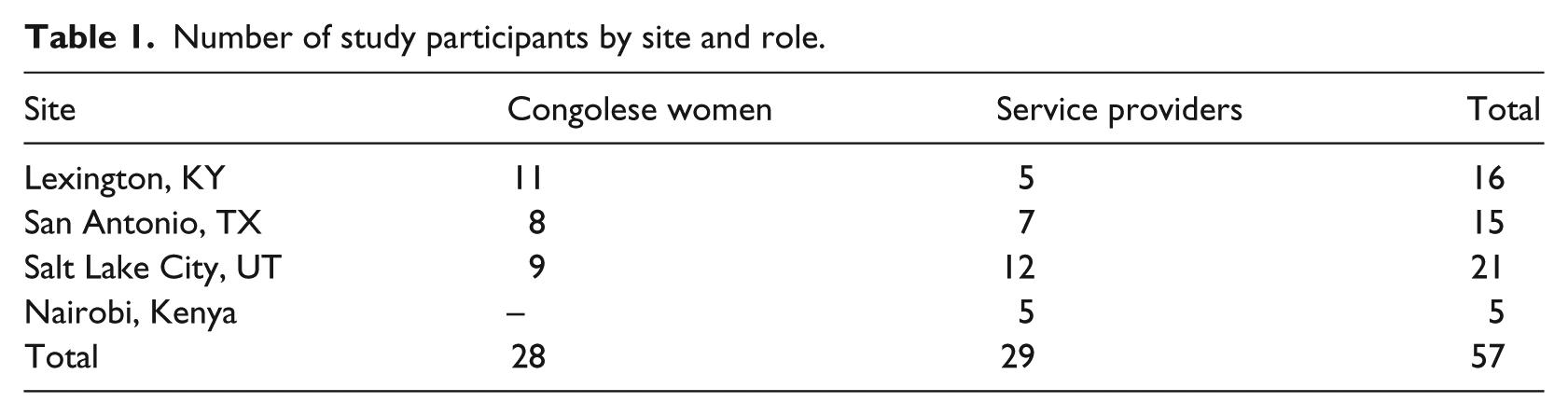
A total of 57 individuals participated in this study (28 Congolese women and 29 service providers who work with Congolese refugee women). All participants were recruited through purposive sampling strategies, in coordination with PRM and local service providers. All refugee participants were adult Congolese women, resettled through USRAP under the women-at-risk category to the United States within the last 10 years. Service providers in each of the study sites were identified primarily by the participating resettlement agencies and in consultation with UNHCR. One focus group was conducted by telephone with UNHCR resettlement staff based in Nairobi, Kenya. Table 1 describes the numbers of interview participants by role and geographic site.
Number of study participants by site and role.
Data collection
A team of five researchers with direct practice background and research experience in this topic area collected the data in 2013. For interviews with refugee participants, researchers used a semi-structured interview guide that consisted of a series of demographic and open-ended questions related to the following areas: resettlement services and experiences with housing, employment, training, language, school, childcare, health care, and spirituality; community support; safety and security; and recommendations for resettlement. Interviews lasted 1–1.5 hours and took place in participants’ homes, refugee resettlement agencies, or neutral locations, depending on the preference of participants. The majority of interviews with Congolese women were conducted with professional language interpreters in Kiswahili or Kinyarwanda, based on participants’ preference.
Interviews and focus group discussions with service providers included additional questions about the women-at-risk category and preparations for the Congolese caseload. These interviews lasted approximately 1–1.5 hours and took place in participants’ offices. All interviews and focus groups with service providers were conducted in English.
Protection of human subjects
The University of Texas at Austin Institutional Review Board reviewed and approved this study. Congolese women gave verbal informed consent, and service providers gave written informed consent. All participating refugee women were compensated for their time and expertise.
Data analysis
Researchers used qualitative thematic analysis to explore the data, which included transcriptions of digitally recorded interviews and focus group discussions, field notes, debriefing with interpreters as cultural brokers, as well as in-person and email communication among the research team. We utilized qualitative data analysis software (QDAMiner) to manage and code all data. The research team met throughout the analysis process to discuss and confirm research findings. In developing the initial codebook, we used an a priori approach to generate ideas from prior theoretical understanding, our own background in working in the field of refugee services and resettlement, and emergent themes from the data collection phase. This resulted in an initial list of potential codes, such as housing, parenting, and mental health. An inductive approach was also used, allowing for the emergence of codes and themes not previously anticipated or investigated. After all transcripts were coded, we utilized a thematic analysis plan (Braun and Clarke, 2006) involving individual reflection and full-team meetings to refocus analysis from initial codes to second-cycle coding and to develop a broader level of abstraction (Saldaña, 2012). This process included the review and refinement of themes and then the defining and describing of these themes.
Rigor and limitations
In an effort to improve and document the rigor and trustworthiness of this study, researchers used two strategies: audit trail and peer debriefing. The audit trail was specifically used to document decision-making during data collection and analysis, in addition to serving as a reflexivity journal and documentation of field observations (Rogers and Cowles, 1993). Peer debriefing was used as a strategy to increase the rigor of a qualitative study through regular meetings of the research team (Padgett, 2008).
Two limitations should be noted. First, although the research team was vigilant about ensuring accuracy in language interpretation, challenges existed in matching interpreters with interviewees, word-for-word translation versus summation, and analysis of interpreted responses versus direct analysis of interviewees’ original words. Second, time constraints prevented the research team from conducting multiple interviews with participants. This constraint limited the teams’ ability to engage with and build rapport with participants over time or to pose clarifying or follow-up questions.
Participant demographics
Congolese women study participants (n = 28) were 18–64 years old. Women had been displaced from DRC for an average of 7.4 years before being resettled (range: 2–19 years) and had been resettled in the United States for an average of 2.5 years (range: 6 months to 5.5 years). None of the participants reported an existing US tie or anchor (family and friends in the United States) prior to their arrival in the United States. Table 2 presents the demographic characteristics of participating Congolese refugee women. Of the 29 service providers, 22 were female and 7 were male. Their roles in the various agencies included agency directors, program coordinators, caseworker supervisors, caseworkers, interpreters, refugee state coordinators, medical and mental health professionals, and resettlement officers.
Congolese women participant demographics.

DRC: Democratic Republic of Congo.
Results
Findings from this study highlight five themes related to the experiences of Congolese refugee women in the United States, in addition to providers’ experiences of developing responsive services: (1) significant trauma; (2) safety and security; (3) alone, lonely, and isolated; (4) disempowered and overwhelmed; (5) precarious survival. Although the following five themes are described separately in this section, they are all intricately interrelated.
Significant trauma
Congolese women participants reported having experienced significant trauma prior to resettling to the United States, including sexual violence, abduction, and sexual enslavement by armed groups, torture, witnessing the death and torture of loved ones and others, and giving birth to children conceived through rape. Although the study was not specifically designed to inquire about these pre-resettlement experiences and their impacts, these experiences appeared to be at the forefront of many of the participants’ minds.
One young woman, Mercy, 2 spoke about how her family was targeted for an attack by a rebel group due to her activism in school around conflict-related sexual violence. She described how the armed group came to their house, pushed in the door, and grabbed her. Her family was crying, and her parents begged them to let her stay. The armed men burned their house and shot and killed her parents in front of them. Then they took her into the forest to their camp where she was repeatedly raped. ‘When they were raping me, I lost my mind’. The rebel group held Mercy captive for nearly a year before she managed to escape with her baby, who was conceived and born in captivity. After making her way to Uganda, Mercy was resettled in the United States with her child and teenage sister, who initially went into the foster care system. Both women now live together, speak fluent English, receive counseling, and report being socially connected with peers.
Women described symptoms of anxiety, including feeling distracted by thoughts of what they had endured and having difficulty concentrating, sleep disturbances, and racing thoughts. Service providers with expertise in providing mental health services to refugees noted the high level and complexity of trauma experienced by the Congolese women. One service provider discussed how the trauma experienced by Congolese women affected her assignment of caseworkers and recommended that future resettlement take into consideration the substantial past and ongoing trauma experienced by caseworkers who are refugees themselves. She described a female Congolese caseworker whose own trauma was triggered by working with other Congolese refugees and ultimately affected her ability to do her job:
She decided she really can’t be a caseworker because it’s too emotional for her to go through this and suffer [the trauma] herself again and again and again. Because of what happened with the soldiers making her husband rape the kids …
Safety and security
Participants resoundingly reported feeling safe in their homes and the cities in which they now resided. As described above, women stated strong preferences to not be on their own with their children but indicated that they were unafraid. ‘I don’t like living alone. Not that I’m afraid. Nobody is going kill me in the middle of the night or anything’. Even women who described having transportation difficulties to and from work at all hours of the day and night did not indicate feeling unsafe. Similarly, participants who had been responsible for children during their displacement and as refugees prior to coming to the United States no longer worried about having enough to feed themselves and their children, in comparison with what they considered to be a lack of adequate food in the camps.
In addition, having been resettled as single mothers may have provided some women with protection from previously abusive partners. Although the study was not designed to inquire into past experiences with intimate partner violence, a small number of participants indicated that they had been subjected to physical and emotional violence by spouses while still in DRC:
Over there, when I was living with the father of my kids, he was very, very abusive, beating and cursing on me. Over here, I feel safe because there is nobody who will have to abuse me as much as I was abused by the father of my kids.
Women, however, continue to be potentially vulnerable to new or continued abuse and violence in the United States. At least three participants spoke about a friend or family member who had experience with intimate partner violence with a Congolese spouse while in the United States. One woman reported ongoing and potentially lethal abuse experienced by her sister. In addition, service providers in one study site expressed concern that single women across nationalities, especially those with mental health needs, were vulnerable to being exploited by men who sought sex, free room and board, and access to food stamps and other benefits in exchange for companionship and protection.
Alone, lonely, and isolated
Women described the concrete fact of being alone (with children), as a factor of resettlement to the United States, as well as the resulting experiences of loneliness and isolation. As described in a previous section, women experienced the loss of and separation from family and spouses at all stages of their migration. Women spoke longingly of the idea of having their mothers, sisters, adult children, or male partners with them in the United States, even at the risk of temporarily delaying their resettlement to the United States. Some participants expressed confusion, grief, and anger in regard to why they had not been resettled with family members. One single mother of three young children reported that her mother, father, and sister were resettled in Canada, while she and her children were resettled in the United States (they were resettled from different countries). Another participant’s husband, with whom she had recently been reunited in the refugee camp, was not resettled with her and their five young children. Many women were unfamiliar with legal immigration procedures needed to reunify with family members.
In addition to women describing the absence of companionship as well as loss and grief related to being separated from loved ones, participants felt the lack of partners’ and families’ contributions to practical tasks particularly related to parenting, childcare, and household income. Women noted, in particular, a sense of ‘aloneness’ in having to care for and raise their children in the United States without the assistance and support that they previously had from extended family and their communities, even as refugees. Women also reported concern about the lack of options available to them as single mothers in the event of an emergency. Furthermore, a number of women expressed concern and anxiety in regard to dying and leaving their children in the United States without any family to care for them.
Disempowered and overwhelmed
As noted earlier, women described the burden of parenting alone and juggling the responsibilities and tasks of raising children and keeping the household financially stable and operated. Participants reported that, unlike the ease with which they left their children with neighbors in their countries of origin, leaving a child with a nonfamily member was troublesome, unpredictable, and anxiety producing. This was the case whether women used a professional childcare setting or had an informal arrangement with a neighbor:
The thing which is really bothering me still, my baby, whenever I go to work, my heart doesn’t feel like she’s in a safe place. I worry too much about my daughter. I wish, if my mom was here, she would take care of her, and I could leave my daughter in her safe hands.
Women stated that their children have a new sense of power in the United States and that they learn in school to call the police or child welfare authorities if they are mistreated. Mothers expressed feeling threatened by and subjugated to their children’s newly discovered power. One woman described her fear of police or child welfare involvement: ‘Here, the police is looking [for] your neck. We keep on looking for the police, and we are worried’. Although many of the women were parenting children in the United States, a number of the participants also had other children overseas. Those women expressed a sense of helplessness about what was going on back home with the children they left behind.
Precarious survival
Women expressed serious challenges with having sufficient means to pay for basic expenses as single parents, particularly given housing costs, low-wage incomes, limited English proficiency, and challenges with childcare. Women cited accommodation as their largest and most stressful expense. Service providers echoed this concern and suggested that rising housing costs and low-paying jobs had overtaken client unemployment as a serious ongoing concern. Women expressed fear of losing their apartments due to their not being able to pay the rent.
Although participants did not express concern about finding jobs, both clients and service providers alike highlighted the pitfalls of low-wage work: ‘You get paid nothing, and then everything goes to the rent’. Both also reported the low possibility of job advancement without English language skills:
Even if most of these folks are working full-time, it’s still $8 or $9 an hour. Really hard to sustain a family. Without knowing more English, getting a better job is really hard. They’re not the kind of jobs that pay the rent. (Service provider)
The majority of participants had very limited English proficiency, with the exception of the youngest participants in the study who attended school upon arrival in the United States. Women reported ceasing to attend English as a Second Language (ESL) classes as soon as they started working, which, for some, was as early as 6 weeks post-arrival in the United States. Women cited a lack of evening ESL classes and difficulties with transportation, as well as not having enough energy or time, as their primary reasons for dropping out of ESL classes. One young woman reported never having attended an ESL class since coming to the United States, and yet expressed an ambition to go back to school and ‘get out of housekeeping’. Many women expressed a desire to find work other than cleaning hotel rooms or other physically demanding low-wage work. Some women did not want to continue indefinitely in their current positions, seeing ‘no future’ in struggling from one day to another to make ends meet.
Discussion
The findings of this study reveal the complex and dynamic nature of Congolese refugee women’s resettlement experiences in the United States. Consistent with the literature, women who participated in this study experienced significant stressors in their resettlement experience (Deacon and Sullivan, 2009). A key finding of this study is the recognition that vulnerabilities that position women for resettlement under the women-at-risk category in the first place are potentially exacerbated upon women’s arrival in the United States. In other words, pre- and post-migration experiences intersect and often compound the challenges that Congolese women face as they seek to integrate into the new society. Far from feeling (re)settled, then, many women end up feeling profoundly unsettled as they attempt to integrate into their new context. Vulnerabilities left unaddressed or untreated have reverberating effects on women’s well-being. The findings of this study identified a number of issues relating to the intersection of pre- and post-migration stressors that are important for social workers and other service providers to understand and seek to address within their practice with resettling refugees.
First, the depth of despair, anguish, and sadness with which many participants expressed their feelings and experiences of being alone and incredibly lonely was noteworthy. Recounting stories of being alone and separated from family seemed to trigger the greatest emotional response for many participants. Furthermore, women were understandably struggling with the practicalities of managing household and parenting responsibilities as single parents alongside a full-time job, coupled with the multitude of tasks associated with resettlement process, all in an entirely new environment with new rules and expectations. The desire for a trusted loved one to lend assistance and relieve some of the weight of responsibility was expressed by many participants with visceral emotion, especially during the initial years of resettlement in the United States. While female refugees often carry the burden of providing for families, they rarely benefit from the status, social support, or economic opportunities afforded to men that could assist them in carrying out these responsibilities (Cook-Heffron et al., 2015). Significantly, this sense of loss was carried over from the pre-migration to the post-migration phase: women experienced the traumatic loss of and separation from family and spouses at all stages of their forced migration, including being abandoned by their spouses in their first country of asylum. Some women fled alone, leaving behind mothers and other key family members. These losses culminated in a sense of being untethered, adrift, and alone at sea. The depth of distress some women experience related to their separation from family and loved ones cannot be underestimated. Similarly, the importance of initiating family reunification processes prior to their arriving in the United States and prioritizing those procedures upon arrival to the United States cannot be emphasized enough in potentially mitigating some of the stress experienced in the crucial early stages of adjusting to life in the United States.
Second, findings revealed the ongoing impact of pre-migration sexual violence in the post-migration resettlement context. The impact of sexual violence on participants and their families in their experiences of the war, displacement, and flight poured forth from many of the participants, although the study did not inquire specifically into these experiences. The pain associated with the violence women had endured and the consequences of that violence they live with do not necessarily dissipate with a change in location. The experiences shared in the context of this study are a stark reminder of how these events are carried into women’s resettlement experiences in the United States and of the importance of having in-place trauma-informed programming that includes the option of high-quality mental health services relevant to refugee clients that can address a wide range of needs (sexual violence, trauma, grief and loss, mental illness). Service providers, however, raised concerns about the scarcity of trauma-informed programming, and mental health services in general, in US resettlement sites.
Third, the findings from this study challenge the notion that refugees generally demonstrate resilience and strength in adapting to life in the United States. Again, we discovered connections with pre-migration experiences. Congolese participants showed a determination, will to survive, and spirit that likely propelled them through the extreme adversity they faced in the war, in fleeing their country, and in seeking refuge for themselves and their children under precarious circumstances. These findings remind us of the importance of making visible and celebrating the deep well of strength and agency women possess. That said, pre-migration experiences combined with post-migration stressors mean that resiliency should not be romanticized, taken for granted, or over-emphasized. Personal material and social and psychological resources require replenishment to protect against resource loss, to be able to recover from losses and regain resources. Those with fewer resources are susceptible to resource loss spirals (Hobfoll, 1998). Furthermore, findings suggest that when substantive long-term support was unexpectedly provided (i.e. from the US foster system), younger women in particular demonstrated the resources and hope to persevere. Service providers, at the very least, also felt a degree of security in one site in particular where a more comprehensive safety net was in place for single parents. Both of these preliminary findings from the study require further inquiry.
Finally, limitations with the resettlement policies that determine how women are resettled under the women-at-risk category by UNHCR were noted during the course of the study that go beyond the scope of this article. These will be examined in detail in a subsequent article.
Implications for social work practice
These findings have a number of concrete implications for social work practitioners working in refugee resettlement in the United States. While US-based social work with refugees is shaped by funding and policy constraints, the prerogative to shape programming and services to respond to clients’ intersecting priorities prevails. In addition to the standard package of support provided to resettled refugees, women-at-risk would benefit from services and programming that prioritize the following areas: extended case management; long-term financial support for housing; accessible long-term English language training; targeted support in building social networks and social bonds to mitigate the potential for and impacts of social isolation; assistance with parenting and childcare; and, quality culturally relevant mental health screening and specialized services in, grief and loss, trauma, sexual violence, and work with refugees. Resettlement practitioners can help bring much needed attention to these priorities, and others, through their macro-practice, policy, and research. Drawing from social work principles, practitioners can shape innovative programming by engaging Congolese women-at-risk and other stakeholders from the refugee community into the design and redesign of programs and interventions. They can launch and engage in an inter-agency process to identify and share existing innovative practice and advocate for resources to develop informed training materials and mentorship for front-line staff.
Furthermore, given that pre-migration experiences with sexual violence and other forms of trauma, and ongoing experiences of grief and loss, may factor into the resettlement experiences of Congolese women and their families, the incoming Congolese caseload presents an opportunity for resettlement actors to (re)connect or deepen collaborations with their local sister sexual assault and domestic violence organizations. Many community-based sexual assault and domestic violence organizations have the potential to enhance local service provision available to Congolese refugee women through their existing case management and counseling services as well as through shelter and transitional housing programs. Subsidized quality mental health services, for example, may be available through these organizations. Together, refugee resettlement and sexual assault and domestic violence organizations could explore mutually beneficial modifications to existing services, particularly by culturally or linguistically adapting them to Congolese and other refugee groups through an exchange of expertise and technical assistance.
Addressing the specific needs of Congolese refugee women who are single parents requires specialized resources and has clear implications for increased funding. Given that resettlement agencies are increasingly asked to provide additional and specialized services without commensurate resources, funding streams must promote innovation and allow service providers the flexibility and incentive required to meet the needs of different groups within the refugee population, such as those presented by at-risk Congolese women. Given the profession’s commitment to social justice and macro practice, social workers are well-positioned to advocate with policymakers and donors – at local, state, and national levels.
At a more structural level, there is a need for social workers to work at policy levels to push for a more holistic understanding of what makes for so-called successful refugee resettlement and integration. This study’s findings indicate that in the urgency to get refugees employed and economically self-sufficient, opportunities to ensure the overall well-being, quality of life, and successful integration of refugee families are foregone. Other resettlement countries, such as Australia and in Europe, have historically devoted more research and resources to understanding refugee’s experiences with integration (Snyder, 2012). One step forward would be to conceptualize a broader definition of integration that goes beyond basic needs and short-term economic self-sufficiency defined simplistically in terms of employment.
Conclusion
This study highlights the importance of recognizing the intersection of pre- and post-migration factors in the resettlement experiences of Congolese refugee women resettled under the women-at-risk designation. Congolese women who meet the criteria for the women-at-risk resettlement category experience unique and persistent integration challenges due, in large part, to the vulnerabilities that initially make them eligible for the women-at-risk designation. These vulnerabilities do not dissipate with a change of context and, in fact, may be exacerbated by the resettlement process itself. The reverberating implications of those factors cannot be underestimated and social workers are in key position to be able to help influence effective change. These findings serve as a reminder that social work bears responsibility for expanding its footprint and influence in migration research and committing greater attention and resources toward the education and preparation of social workers for practice with refugee communities.
Footnotes
Acknowledgements
The article is based on data also used in a previously published technical report: The Continuity of Risk: A Three-City Study of Congolese Women-At-Risk Resettled in the U.S. (N.B. Busch-Armendariz, K. Wachter, L. Cook Heffron, M.B. Nsonwu, S. Snyder, 2014). The research would not have been possible without the assistance from five agencies: Catholic Charities in San Antonio, Texas; Catholic Community Service, The International Rescue Committee and the Refugee & Immigrant Center: Asian Association in Salt Lake City, Utah; and Kentucky Refugee Ministries in Lexington, Kentucky. We are especially grateful to the Congolese women and service providers who participated in the study, and the language interpreters who worked alongside us. We thank UNHCR for their support.
Funding
This project was partially supported by a grant from the Office of the United Nations High Commissioner for Refugees (UNHCR). Points of view in this document are those of the authors and interview participants and do not necessarily represent the official position or policies of UNHCR.