



Abstract
This study was designed to construct a model based on the concept of psychological well-being, in order to verify the relationship between Taiwanese elderly volunteering and their psychological well-being. Research data were collected via a questionnaire administered to the target population of this study, senior residents of Pingtung County aged 65 or more. The data were then tested and verified by confirmative factor analysis and structural equation modeling. The overall model showed higher levels of psychological well-being for the elderly who participated in volunteer work than those who did not, which again confirmed the positive relation between volunteer work and psychological well-being.
Keywords
Research aim
The life awaiting the elderly after their retirement is more free time but less social participation. It is necessary for them to adapt to a less active and more solitary new life. Studies in the past have found that the elderly could rediscover their purpose in life and reestablish a new social support system to increase their satisfaction of life and psychological well-being through participating in volunteer work, recreational activities, academic advancement, or religious activities (Greenfield and Marks, 2004; Haski-Leventhal, 2009; Morrow-Howell et al., 2003; Okun et al., 2010; Thoits and Hewitt, 2001).
The goal for an aging society is to help the elderly live through a blessed life. If they are encouraged to be socially active, it will help to enhance their self-esteem and alleviate their emotional stress. In addition to maintaining their physical health and a higher level of psychological satisfaction, they will be more positive in self-actualization and self-affirmation.
A good starting point to social participation is volunteer work, through which the elderly can expand their social circle and boost their self-affirmation. From volunteer activities, they can also maintain normal physical functioning, as well as good interaction with the society.
Through volunteer work participation, the elderly can not only help others but also gain self-affirmation, which will enrich both their satisfaction of life and psychological well-being. The pursuit of a goal in life and a harmonious relation with others are two of the most important features of psychological health (Ryff and Singer, 1998). Hence, psychological well-being should not only refer to the acquisition of happiness, but should also include the development of an individual’s potential to the fullest as well as the experience of self-actualization (Ryff, 1989). In this respect, participating in volunteer work enables the elderly to realize the value of life through mutual cooperation, gain psychological satisfaction, and further enhance their psychological well-being.
In the past, articles about volunteer work and psychological well-being have not received too much attention, nor did they contain many graphical structural models of psychological well-being. In light of this, this study intends to test and verify the relation between elderly participation in volunteer work and their psychological well-being according to the dimensions of psychological well-being discussed by Ryff (1989).
Ethical considerations
The number of elderly hiked to 11 percent of the population in Taiwan in 2013. According to the definition by United Nation’s (UN) World Health Organization, when the number of citizens aged 65 or more reaches 7 percent of the total population, that society is an ‘aging society’, and 14 percent, an ‘aged society’. By such standard, Taiwan is already an aging society.
With the coming of an aging society, the elderly have to learn to adjust themselves to changes in their physical and psychological conditions, as well as their roles, in order to adapt to various changes in life. Retired elderly are especially prone to suffer from psychological solitude due to terminated work role, reduced social participation, and a diminishing social circle. How to enable them to continue their contribution of experience and wisdom, enhance their sense of social belonging, and boost their self-recognition and pride becomes an important issue.
Active aging is a goal of an aging society. It is imperative that the elderly live a meaningful life for their remaining years. Through volunteer work, they can help others as well as themselves. Volunteer work is a good protective factor for the elderly when they retire, losing both their job and social role (Greenfield and Marks, 2004).
Volunteer work is a good way to remain socially active after retirement. Participating in such service helps the elderly retain their vitality. Besides being both physically and psychologically healthy, the elderly can also maintain good human relations through volunteer work. In other words, volunteer work not only facilitates elderly social participation, but also promotes active aging.
For the elderly, active social participation is a tremendous help in boosting their self-affirmation and relieving their stress. Besides physical and psychological satisfaction, they can also realize their potential and be reassured of their value. Volunteering can lower their stress, frustration, and anxiety (Haski-Leventhal, 2009) and mitigate negative psychological impacts, which will improve their satisfaction of life and their self-esteem and enable them to access plenty of social support.
Volunteer service benefits the elderly not only in their physical and psychological health, but also in their psychological well-being (Greenfield and Marks, 2004; Thoits and Hewitt, 2001). Through volunteer service, they can obtain self-confirmation, improve self-esteem, assimilate into community activities, and maintain sound human relations as well as a lifestyle with purpose and goal.
From the experience of social participation, the elderly can understand the value of life, achieve self-actualization, and further improve their psychological well-being (Thoits and Hewitt, 2001). In addition to improving a person’s well-being, volunteer work can facilitate social integration and lower social isolation and frustration (Musick and Wilson, 2003). Through mutually beneficial interactions, they can enjoy the feeling of helping others and attain psychological balance and satisfaction.
Psychological well-being should not be limited to the acquisition of happiness or bliss, but should also include extensive development of an individual’s potential as well as experience of self-actualization. With both theoretical and practical considerations in mind, Ryff (1989) defined psychological well-being from six distinct dimensions: self-acceptance, positive relationships with others, autonomy, environmental mastery, purpose in life, and personal growth.
The purpose of this study is to verify whether the Ryff Scales of Psychological Well-Being can be applied to studies of Taiwanese elderly and to further discuss whether senior citizen participation in volunteer service can contribute positively to their psychological well-being.
Research methodology
The aim of this study is to verify the positive influence on the psychological well-being of the elderly from their participation in voluntary work through graphical variations from structural equation modeling (SEM). Descriptions about the sampling procedure, the sample selection, and the modeling of variables are as follows.
Procedure
In choosing the population of interest, this study focuses on Pingtung County citizens aged 65 or more, and questionnaires are used for data collection. Pingtung County, which consists of 33 villages and townships, is more of an aging agricultural society. In 2013, this study randomly interviewed 100 senior citizens each from three townships in Pingtung, and ultimately received 250 valid completed copies of the questionnaire.
Sample
Of the 250 senior citizens in our sample, 94 are males (37.6%) and 156 females (62.4%); 125 are aged between 65 and 74 (50%) and the other 125 aged 75 or above (50%); 108 have elementary education (43.2%), 79 are illiterate (31.6%), and 63 have a high school degree (25.2%); 131 are in an overall healthy condition (52.4%), 58 think their health condition is good (23.2%), and the remaining 61 are of poor health (24.2%); 126 participate in volunteer work (50.4%) and the other 124 do not (49.6%); 136 are married (54.4%) and most of them belong to the 107 who live in a three-generation household (42.8%).
Volunteer work
This study is primarily focused on the psychological well-being of the elderly in Pingtung County. Previous research has indicated that volunteer work is an important factor in psychological well-being. Hence, this study includes volunteer work as a dummy variable in our model, and assigns ‘1’ to those who participate in such work and ‘0’ to those who do not. Through confirmative factor analysis (CFA) and SEM, our model intends to verify whether the elderly who participate in volunteer work have a better psychological well-being than those who do not.
Psychological well-being
Ryff (1989) proposed six dimensions for measuring psychological well-being: self-acceptance, positive relations with others, autonomy, environmental mastery, purpose in life, and personal growth.
More detailed descriptions of each of Ryff’s six dimensions are as follows:
Self-acceptance: possessing a positive attitude toward the self; acknowledging and accepting multiple aspects of oneself, including good and bad qualities; feeling positive about one’s past life (Cronbach’s alpha = 0.890);
Positive relations with others: having strong empathy in human interaction; capable of trusting relationships with others (Cronbach’s alpha = 0.890);
Autonomy: evaluating oneself by personal standards; receiving satisfaction and pleasure from self-regulating; able to resist social pressures to think and act (Cronbach’s alpha = 0.760);
Environmental mastery: having a smooth interaction with the environment; able to control the environment and overcome environmental restraints; able to make effective use of opportunities to one’s own development (Cronbach’s alpha = 0.892);
Purpose in life: knowing clearly the aims and directions in life; able to learn from previous experiences and actively move toward the direction guided by the aims in life (Cronbach’s alpha = 0.919);
Personal growth: having the motivation for continued development; open to new knowledge and experiences; steady growth in the journey of life (Cronbach’s alpha = 0.832).
Research methods
Based on the discussions of related literature and explanations of variables, this study adopts the construct which includes CFA and SEM analysis as well as the software AMOS 20.0 for empirical testing and verification. The variables included are explained in Figure 1.
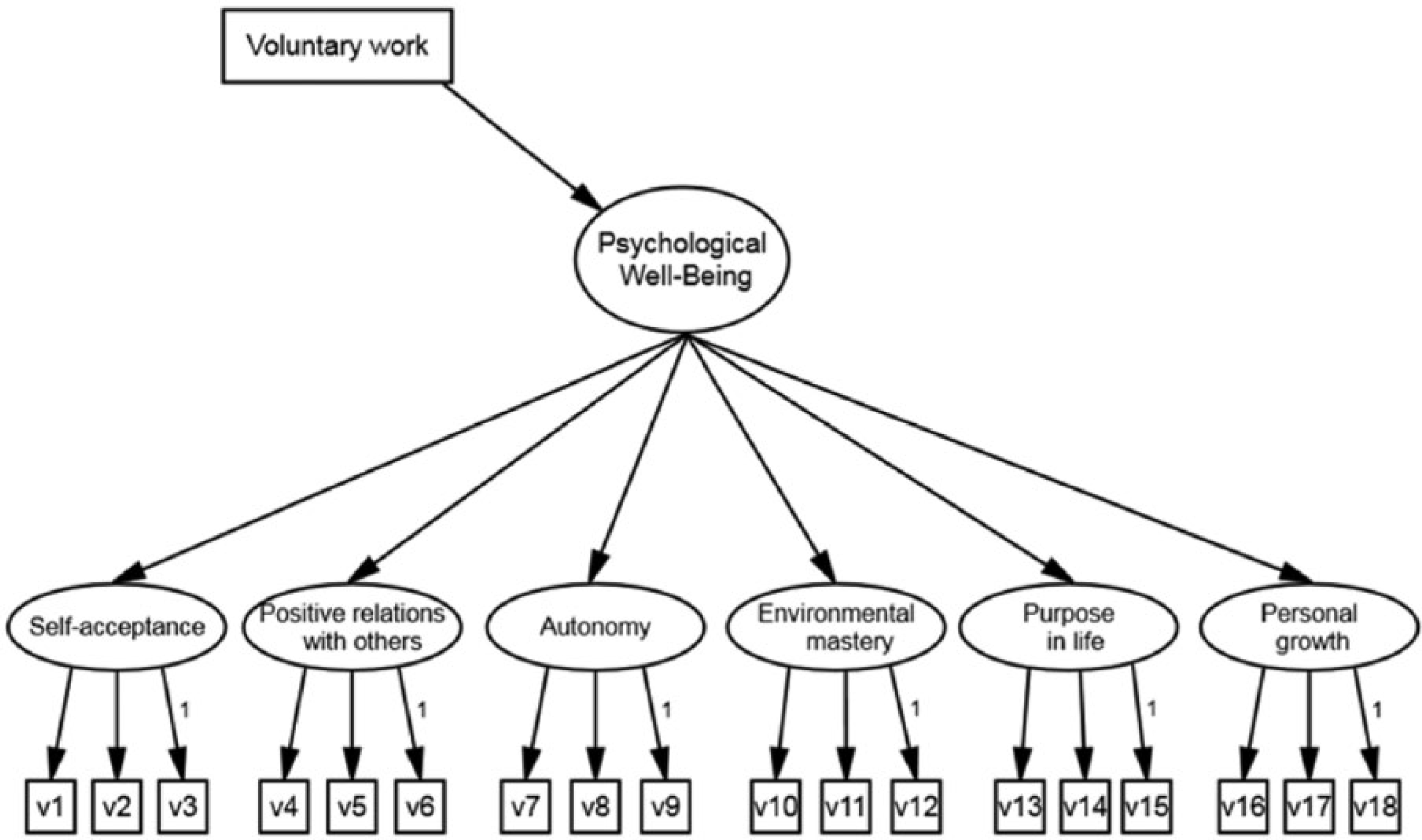
Research Model.
Research findings
Fit of internal structure of model
The fit of internal structure of model can be assessed by convergent and discriminant validity. The higher the convergent and discriminant validity, the better the internal structure of the model.
There are two criteria for evaluating convergent validity: composite reliability (CR) and average variance extracted (AVE). CR is a measure of the overall reliability of all concerned variables, representing the degree of internal consistency of the concerned dimension. An internally highly consistent dimension will yield a high convergent reliability. Fornell and Larcker (1981) suggest that the CR value of a latent variable should be greater than 0.6. Similarly, AVE measures how much the variance of a latent variable is explained by its measurement variables. The higher the AVE value, the higher the convergent validity of the latent variable. Fornell and Larcker (1981), as well as Bagozzi and Yi (1988), suggest the AVE should be over 0.50.
From the first-order factor model (measurement model) in Table 1, the CR values for the six latent variables are, respectively, 0.865, 0.878, 0.811, 0.903, 0.933, and 0.845, all greater than the threshold value of 0.7. Similarly, the six AVE values, which are 0.690, 0.707, 0.588, 0.756, 0.823, and 0.645, also exceed the threshold 0.5. As the sample of our study is not normal, the measurements are adjusted by the Bollen–Stine bootstrap method (Bollen and Stine, 1992). After adjustment, the six CR values for the latent variables all satisfy the assessment standard ‘0.7 or above’. Likewise, the adjusted AVE values for the latent variables are all greater than the threshold ‘0.5 or above’.
Standardized regression weights and Bollen–Stine bootstrap estimate.
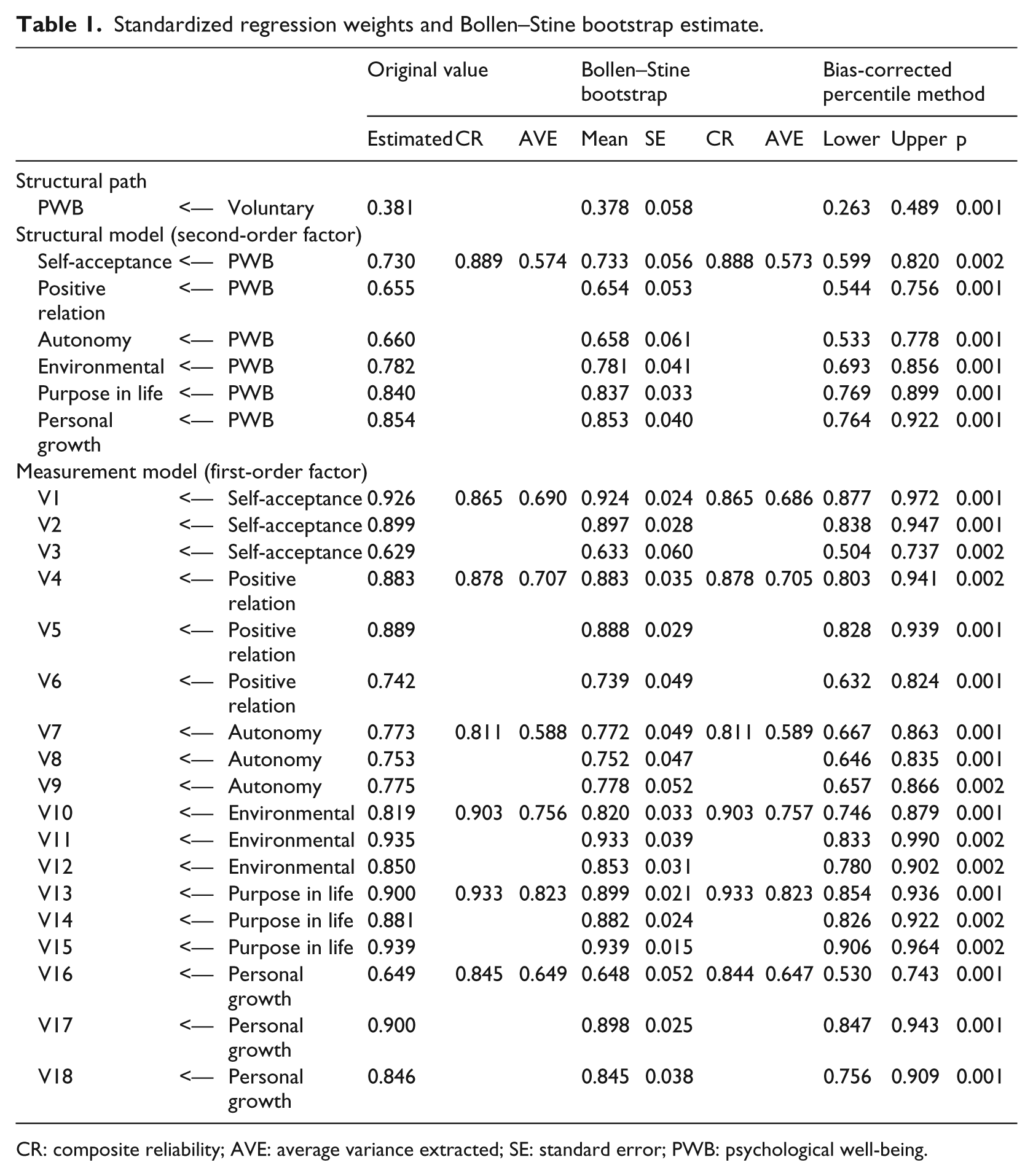
CR: composite reliability; AVE: average variance extracted; SE: standard error; PWB: psychological well-being.
In the second-order factor model (structure model), the CR for the model is 0.889, whereas the overall AVE is 0.574, both meeting the assessment standards. Through Bollen–Stine bootstrap modification, the CR and AVE for the overall model becomes 0.888 and 0.573, respectively, both exceeding the assessment standards.
Discriminant validity is used to see whether there are differences among the dimensions. The items in one dimension should not be highly related to the ones in another dimension. Highly related items essentially measure the same aspect and in turn imply overlaps in the dimensions and collinearity among the items themselves (Torkzadeh et al., 2003).
In assessing the discriminant validity, this study first examines the correlation coefficients between the six latent variables and finds that the coefficients are all smaller than 0.85, which satisfies the discriminant validity check. Next, the bootstrap confidence interval method is applied. When applying the maximum likelihood estimation in SEM, Torkzadeh et al. (2003) suggest using the bootstrap method to calculate standard errors and hence confidence intervals. Furthermore, when estimating the path coefficients, Nevitt and Hancock (2001) suggest at least 250 times of bootstrap resampling. In this study, 2000 times is selected. Table 2 shows that at 95 percent confidence level, none of the confidence intervals for standardized regression coefficients contain the value 1, confirming that discriminant validity exists between and among all of the latent variables.
Correlations and bootstrap estimate of CFA model.
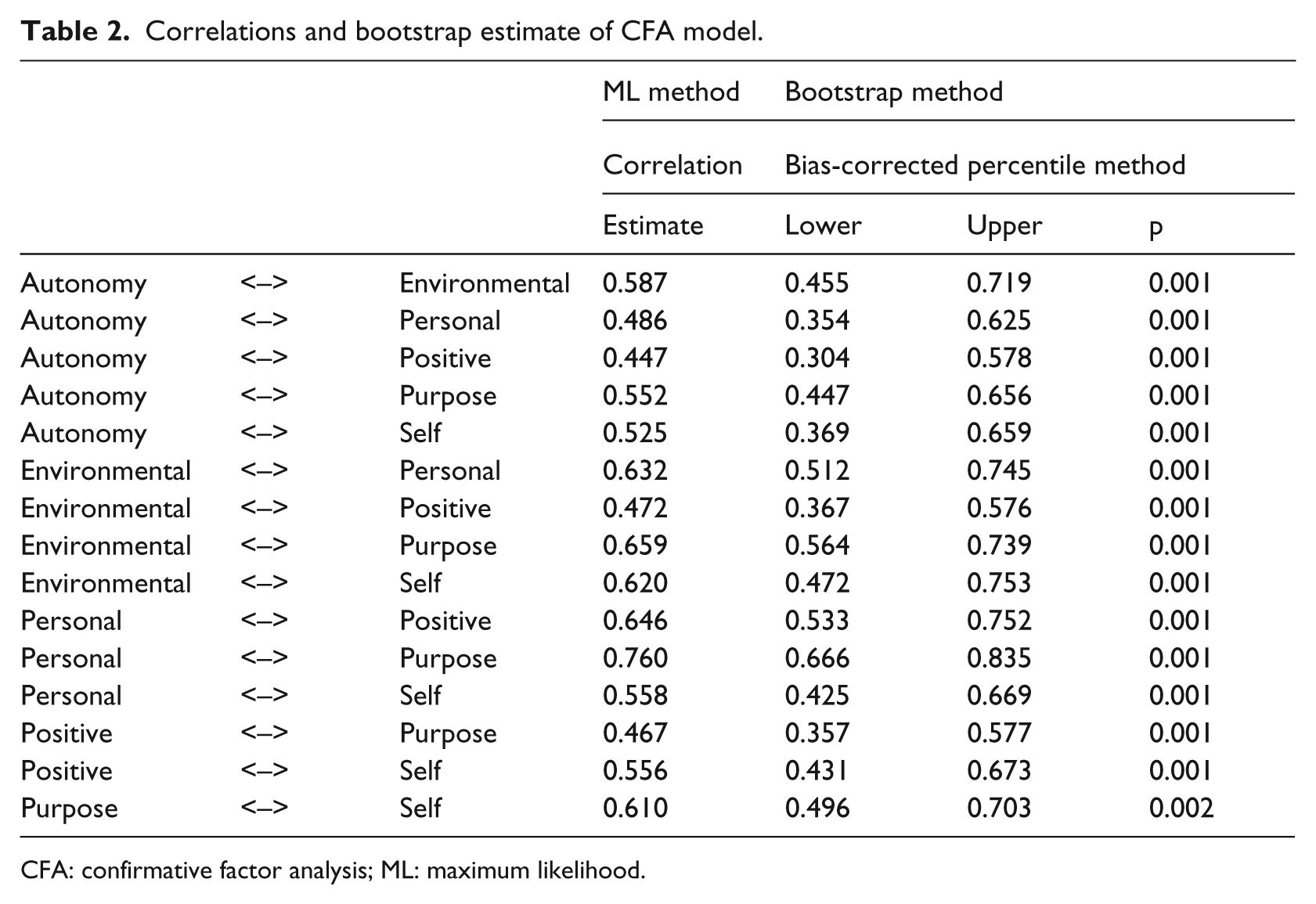
CFA: confirmative factor analysis; ML: maximum likelihood.
Results from the above statistical applications show that the measurements adopted by this study have good reliability and validity, and qualify for the test of goodness of fit of the internal structure of the model.
Overall model fit
In testing the overall model fit, Chi-square (χ2) is used to measure the goodness of fit between the model and the data. The smaller the Chi-square, the better the fit. However, Chi-square alone is not a good indicator since its value grows with the size of the sample. The degree of freedom has to be considered. In this respect, the modified normed Chi-square is adopted.
Normed Chi-square (χ2/df) is the ratio of χ2 to the degree of freedom. The ratio should be between 1.0 and 3.0 to show a satisfactory goodness of fit for the model being tested. For goodness of fit index (GFI), the value should be greater than 0.90 to be acceptable; the closer it is to 1, the better is the fit. Another measure for goodness of fit, root mean square error of approximation (RMSEA), indicates a high goodness of fit when its value is below 0.05 and a reasonable goodness of fit when it is between 0.05 and 0.1. If it is greater than 0.1, then the goodness of fit is poor. Finally, comparative fit index (CFI) is also an incremental fit measurement. It is the ratio of the null model to the independent model. In general, the CFI value should be higher than 0.90 to be deemed satisfactory (Byrne, 2013; Hair et al., 2010).
However, the sample of this study is not suitable for the normality test. Statistical results from the maximum likelihood (ML) method of AMOS 20.0 will usually generate a very large Chi-square, and the p-value at α = 0.05 is usually significant enough to reject the null hypothesis, meaning the model does not fit the data well. Hence, this study applies the bootstrap method from Bollen and Stine (1992) and uses the bootstrap method in AMOS 20.0 to solve the problem arising from non-normal sample data.
For overall model fit, the Bollen–Stine bootstrap method will generate a Bollen–Stine p-value to test the overall model fit. When the p-value is significant, the model does not fit and the null hypothesis is rejected. On the other hand, if the p-value is not significant, the model has a good fit.
Although statistical results from the original model of this study yield a Chi-square of 248.56 and a significant p-value, the normed Chi-square is 1.702, which falls within the ‘larger than 1 and smaller than 3’ acceptable range (Figure 2). Both GFI (0.911) and CFI (0.958) are greater than 0.90, and RMSEA (0.053) is also smaller than 0.08. These parameters all conclude that the model is fit for assessment. However, the significant p-value indicates that the model and the data do not fit.
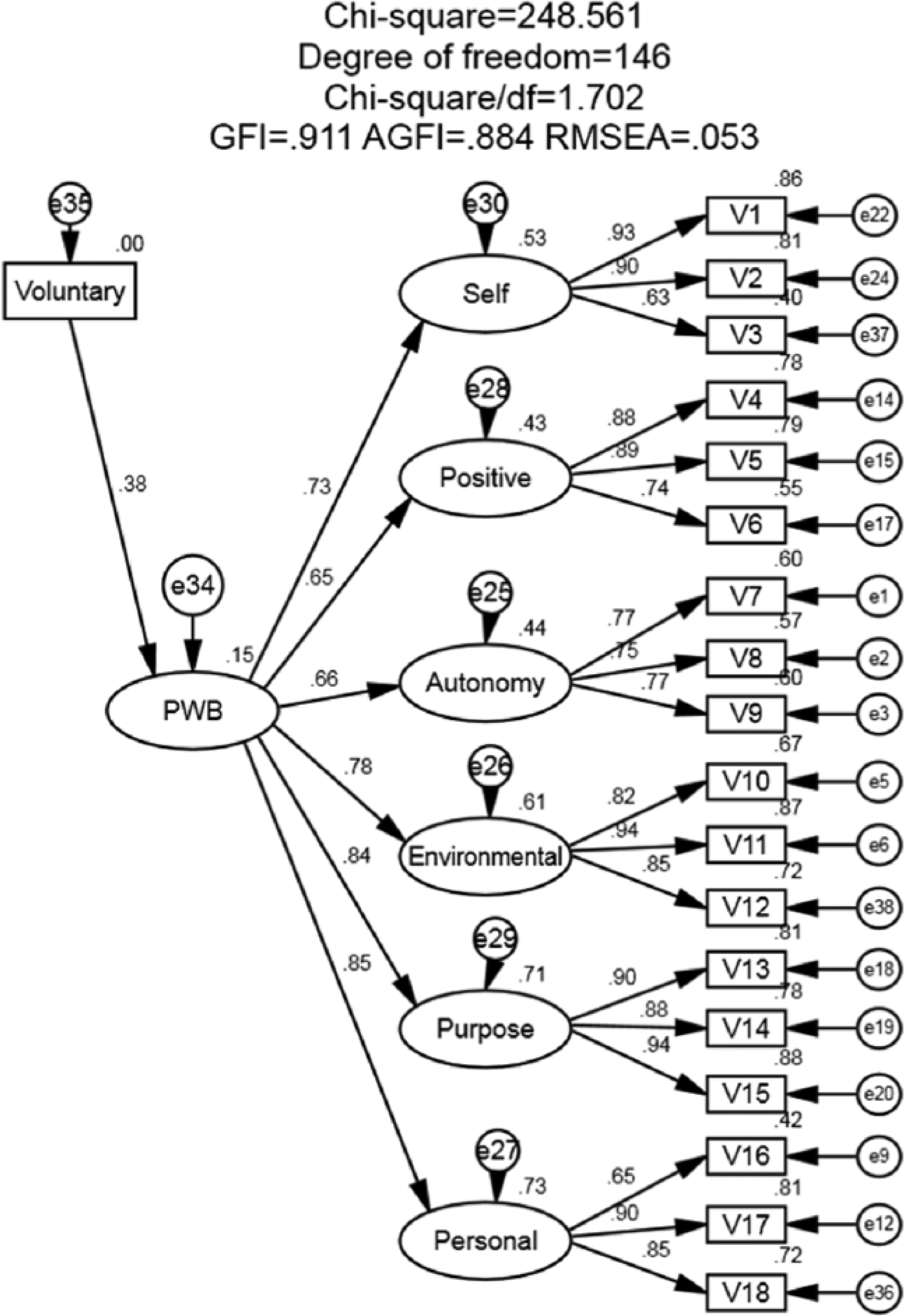
SEM Model.
In Table 3, after Bollen–Stine bootstrap modification, the Chi-square is lowered to 197.14, and the p-value (0.085) is not significant. The normed Chi-square becomes 1.35, satisfying the ‘larger than 1 and smaller than 3’ standard. In addition, GFI (0.94), adjusted goodness of fit index (AGFI) (0.93), and CFI (0.98) are all larger than 0.90. RMSEA (0.04) is also smaller than 0.08. Although the original model does not qualify for normal sample testing, through the Bollen–Stine bootstrap method, the modified values for the estimation parameters all comply with the assessment standards, and thus conclude that the model fits the data well.
Structural equation fit indices.
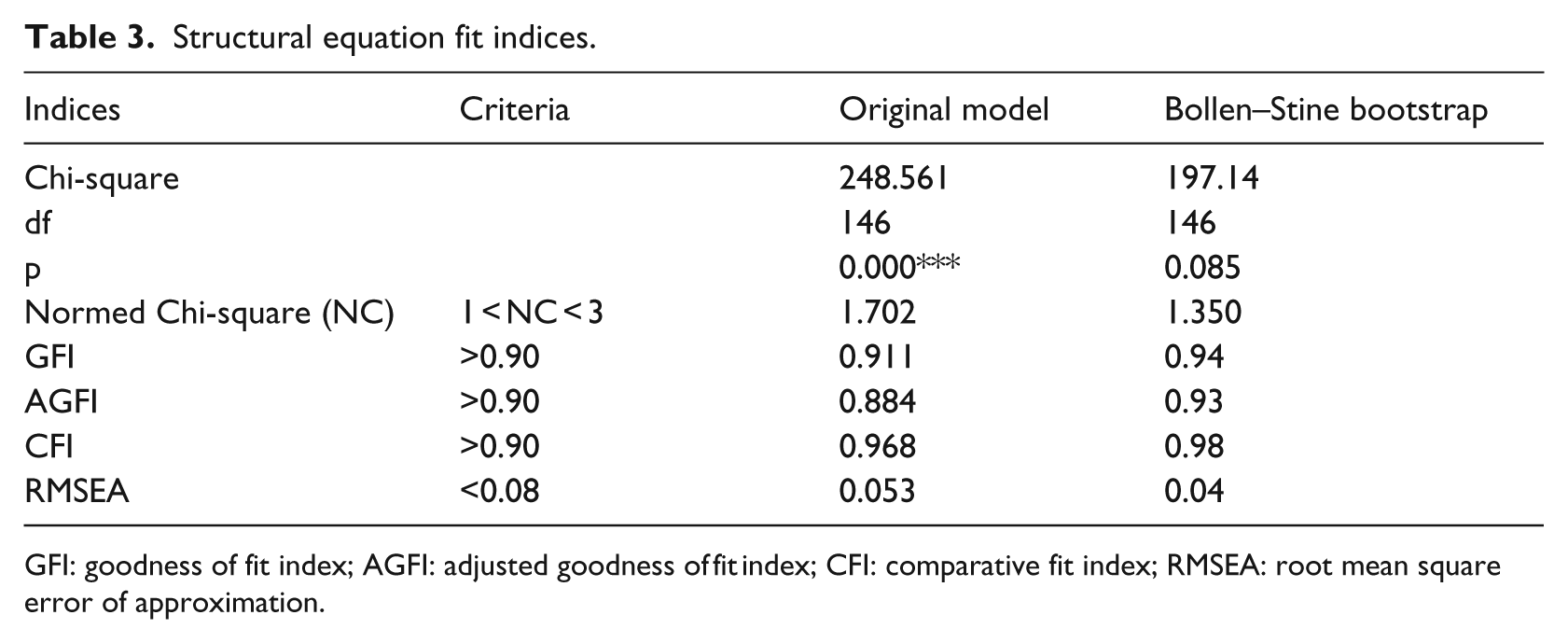
GFI: goodness of fit index; AGFI: adjusted goodness of fit index; CFI: comparative fit index; RMSEA: root mean square error of approximation.
Discussion
The subject of this study is the elderly aged 65 or more who reside in Pingtung County, that is, all elderly residents of Pingtung County are the target for analysis. Although the demographic variables concerning these elderly will vary between individuals, groups, and generations, since the primary objective of this article is to verify the applicability of Ryff’s (1989) scales of psychological well-being to the elderly population in Pingtung County, Taiwan, differences in psychological well-being among demographic variables will not be analyzed here. Once the applicability of Ryff’s scales of psychological well-being to the elderly population in Taiwan is confirmed, researchers interested in such analysis can then apply techniques of group comparison to further study the group variations.
The first objective of this study is to measure the psychological well-being of the elderly. In designing the model for elderly psychological well-being measurement, this study has applied Ryff’s (1989) concept of psychological well-being, which includes six latent variables: self-acceptance, positive relation with others, autonomy, environmental mastery, purpose in life, and personal growth. Based on these latent variables, this study has devised a number of corresponding factors to measure elderly psychological well-being. Are these factors effective in assessing elderly psychological well-being? To answer this question, CFA and SEM are used.
In testing for external validity, which includes convergent validity and discriminant validity, both CR and AVE are favorable, and the six latent variables are all positively related to psychological well-being. As for discriminant validity, which measures whether latent variables are clearly distinguishable and whether there are misplaced items in the dimensions, the results are also favorable after applying the bootstrap method. All of the dimensions are clear and specific, conforming to uni-dimensionality.
Through CFA and SEM, this study has verified that the concept of psychological well-being, the six latent variables, and the items can all be effectively applied to analyze the data in this study. Moreover, the concept also agrees with the results from the test on the survey data. The results show that the concept of psychological well-being by Ryff (1989) is applicable to the elderly.
The second objective of this study was to understand the implications of the six latent variables on psychological well-being through analyzing the factors of the six dimensions for the latent variables and their influence on the psychological well-being of the elderly. For this purpose, structural weights and path coefficients become useful.
A structural weight in CFA represents the centralization and importance of a factor (Marsh and Hocevar, 1985). From our CFA results, the structural weights of personal growth (0.85) and purpose in life (0.84) indicate that these two factors have high centralization and importance, whereas autonomy (0.66) and positive relation with others (0.65) appear to have relatively low centralization and importance.
The result that both personal growth and purpose in life have high centralization and importance implies that the elderly think participating in volunteer work can broaden their horizons and keep them learning, changing, and growing regardless of the aging process. To live and learn is an active, as well as positive, way of life. From providing volunteer service, the elderly can find a goal to strive for; through arranging community activities, they can find a specific direction and live a more meaningful life.
According to previous studies, the living support for the elderly in Taiwan consisted mainly of family support. Under the influence of traditional culture, their living was centered around family and dependent on the resources and care provided by their children. When volunteering, they could often understand their children’s worries and the trouble to the family that might arise from their volunteering. Hence, the influence of traditional culture may explain why in this study the elderly receive a low centralization on autonomy since most elderly live with their children and have to take their opinions into consideration when participating in volunteer work. For example, their adult children may be concerned with the risk of injury in volunteer work, which may interfere with the elderly’s willingness to participate in such work. Hence, the result is a low centralization on autonomy.
Another factor, positive relations with others, also receives a low centralization, and the possible reason is that although the elderly may enjoy chatting and making new friends when volunteering, the short duration and low frequency of such work, such as once a week, may explain the low centralization on the factor.
The third objective of this study is to understand whether the elderly who participate in volunteer work have a better psychological well-being. The answer lies in the results of path coefficients. The standardized path coefficient in SEM represents the direction and strength of the cause–effect relationship. In our analysis, the coefficient (0.378) is positive and significant, meaning the elderly who participate in volunteer work have better well-being than those who do not. The overall model displays a higher psychological well-being for the elderly who participate in volunteer work, which again confirms the positive relation between volunteer work and psychological well-being.
Recommendations and conclusion
Previous studies have more than once concluded that volunteer work is positively related to the health of the elderly. However, its relation to psychological well-being has not received equal attention. Hence, this study has tried to examine and verify the positive relation between them. The intensity of the relations between the latent variables is also graphically presented under SEM. Using our psychological well-being model, this article has verified a positive relation between psychological well-being and volunteer work. In addition, the model, the concept, the dimensions, and the indexes have been verified to be clear and specific, as well as having convergent validity and discriminant validity, which means the model is both reliable and valid. This result implies that the concept model of psychological well-being by Ryff (1989) can be applied across nations and groups, and certainly to the group of the elderly. Moreover, the model shows a higher psychological well-being for the elderly participating in volunteer work, which again confirms the importance of volunteer work.
Footnotes
Funding
The author(s) received no financial support for the research, authorship, and/or publication of this article.