




Abstract
For more than four decades, governments of Ghana have worked with non-governmental organizations (NGOs) to solve rural problems. However, the extent to which NGOs have been able to improve rural conditions is questionable. Many have suggested that NGOs function more as patriarchs than as partners in their rural development work. This article is a critique of NGO strategies for rural development in Ghana, in which I argue that the longstanding limitations of NGO strategies may have contributed to rural underdevelopment rather than development. I conclude that if NGOs are to contribute meaningfully to rural development in Ghana, they will need to change their strategies.
Introduction
The United Nations (1971) defined rural development as the outcome of a series of quantitative and qualitative changes occurring among a given rural population whose converging effects indicate, in time, a rise in the standard of living and favorable changes in the way of life of the people concerned. (p. 1)
In its view, rural development is seen as comprehensive. African nations have been grappling with chronic problems of poverty, squalor, hunger, and general underdevelopment of rural areas for many years (International Monetary Fund [IMF], 2012). Lack of resources, inappropriate approaches, and failures to use all available human and financial capital are some of the reasons adduced to explain the persistence of rural poverty and underdevelopment (Koch et al., 2008; Laird, 2008). African governments are aware of the importance of their rural areas where the vast majority of their populations live. In fact, they serve as the hub around which most national development efforts revolve (Food and Agricultural Organization of the United Nations [FAO], 2012). This awareness has been a compelling factor that caused successive Ghanaian governments to adopt policies to specifically address socioeconomic problems in rural areas and so to enhance the quality of rural lives (Friedrich-Ebert-Stiftung Foundation, 2001).
Worldwide increases in poverty, hunger, and disease were witnessed in the 1980s, particularly among politically unstable developing nations. This provided the impetus for these nations to vie for increasing international assistance. At that time, Ghana identified NGOs as its primary partners in national development, which necessarily meant rural development (Hearn, 2007; Laird, 2008; Lewis and Kanji, 2009; Porter, 2003). The search for sustainable development in Ghana’s rural communities by the government and NGOs has been ongoing since then. NGOs have attempted to provide a variety of services, including those that aim to protect human rights; empower women; provide education, health care, sanitation, safe water and secure food supplies, and other such needed infrastructures and direct services. Such programs have not always been helpful. For example, recent NGO micro-financing programs that have loaned money at exorbitant interest rates to financially inexperienced women have caused many rural Ghanaian women to sink further into debt and so to remain in abject poverty (Ghanaweb, 2005; Lewis and Kanji, 2009).
One of the main purposes of NGO support is to improve the deplorable conditions of Ghana’s rural communities where about half of the population lives (FAO, 2012; IMF, 2012). Agriculture is the main occupation in such communities. The vast majority (77%) of Ghanaians are subsistent farmers (FAO, 2012). In Ghana and many other African nations, a number of NGOs have been criticized for being corrupt, doing shoddy work and taking rural people for granted (Abdul-Raheem, 2000; Ghanaweb, 2005; Obiyan, 2005). For example, Nelson Mandela described some South African NGOs as illegitimate. Some Kenyan-based NGOs have been referred to as ‘pocket NGOs’ because their activities seem so opaque, and NGOs in Tanzania are commonly called ‘briefcase NGOs’ (Chege, 1999). In Ghana, NGOs have been criticized for ignoring a critically important component of any community development activity, namely, local human capital. This has necessarily made many rural development projects less locally relevant and has created tension in the process (Bawa, 2013; BBC News, 2004; United States Agency for International Development [USAID], 2010). Consequently, NGOs generally have a poor public image in Ghana. USAID (2010) documented that ‘neither the government nor the business community has a positive perception of NGOs. Both tend to view them with suspicion, even distrust’ (p. 68). However, rural community residents themselves tend to hesitate to critique NGO ‘self-help’ development projects.
Self-help development projects ought to be self-determined, self-directed, and self-delivered. Ghanaian NGOs, however, typically adopt an external-expert-problem-solver approach to rural development. They tend to initiate projects that they think will be most fundable by external donor agencies. USAID (2010) was surprised that ‘still, the services that NGOs provide … are often determined by donor priorities rather than community priorities or needs’ (p. 2). And Sylvia Bawa (2013) made a similar conclusion based upon her research on NGOs in Ghana. Whether projects are in the best interests of supposed project beneficiaries or not seems a secondary concern to NGOs. Most regrettably, but perhaps not all that surprising under such circumstances, rural communities in Ghana are still plagued by the same problem that led to the demand for NGO assistance more than 50 years ago – poverty (FAO, 2012; IMF, 2012).
Ghana as an African exemplar in this article stems from the fact that it has been identified as African nations’ torch-bearer in African unity, decolonization, planning for total development of its rural communities, and general economic development of its entire nation long before decolonization. Other African nations emulated Ghana’s ideas and achievements in the past and continue to recognize Ghana as a model nation whose initiatives are still worth emulating in contemporary times. Tapan Biswal (1992) qualifies Ghana as the epitome of an African nation that represents ‘both substantively and analytically, a fascinating case study of complexities of political and economic processes in contemporary Africa’ (p. 2). Ghana led African nations in many spheres of development and change including, but not limited to, achievement of independence in 1957, practice of one-party democracy, multiparty democracy, attempting to create a ‘United Nations of Africa (African Unity)’, and the engagement of NGO support in the early 20th century (Biswal, 1992). Ghana was rated in 1945 as the first country in Africa to have a ‘Board of Planners’ responsible for comprehensive planning for the development of its entire urban and rural areas. Following Gordon Guggisberg’s (colonial governor) Ten-Year Development plan for Ghana in 1919, the nation had no less than 10 other development plans between 1946 and 1989 that aimed at achieving comprehensive socioeconomic development of the entire nation, and that included rural areas (Brown, 1986). Ghana registered its first NGO in the 1930s (Ghanaweb, 2005), and the nation continues to benefit from NGO support to date with special attention focused on rural development. For an NGO to operate in Ghana, it must register with the Department of Social Welfare, a department under the Ministry of Employment and Social Welfare. NGOs working in rural areas are expected to register with and be locally accountable to the District Assembly in the region. The Ghana Association of Private Voluntary Organizations in Development (GAPVOD) is an umbrella organization expected to supervise all activities and concerns of NGOs in Ghana (USAID, 2010). The number of NGOs in Ghana and many other African nations continues to rise (see Table 1). Despite this, Ghanaian rural communities continue to wallow in abject poverty. Critiques and social analysts, therefore, question how enthusiastic NGOs are about developing Ghana’s rural communities and the extent to which they have been able to improve upon rural standards of living since their emergence in Ghana’s rural development scene several decades ago. My aim in this article is to tell the story of the proliferation of NGOs in Africa over the past generation, with a special emphasis on their effects upon the people of Ghana. This historical analysis will narratively review and triangulate evidence from four sources: scholarly research, government documents, journalistic reports and census data.
Registered NGOs in selected African Nations: 1990–2010 trends
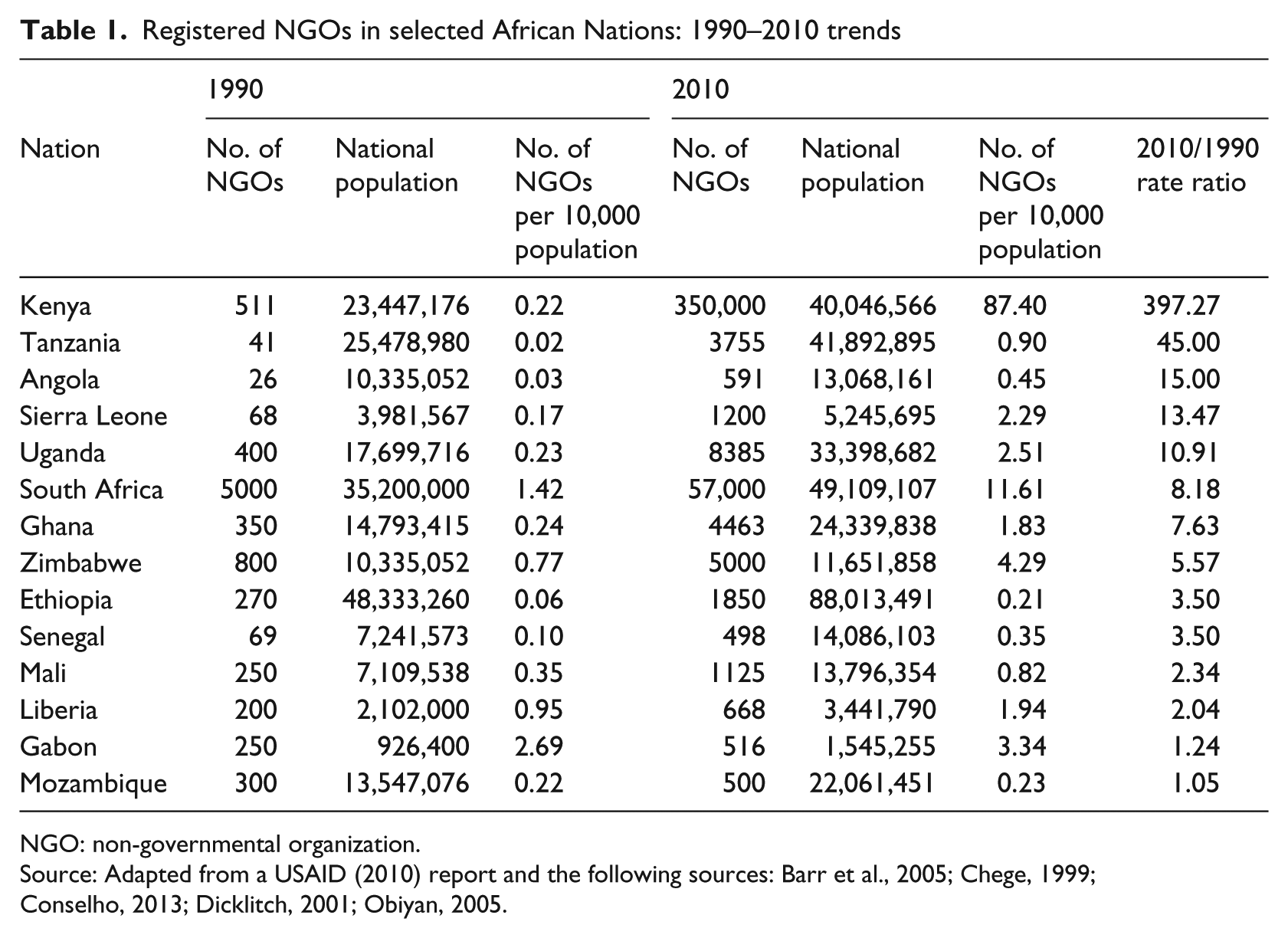
NGO: non-governmental organization.
Source: Adapted from a USAID (2010) report and the following sources: Barr et al., 2005; Chege, 1999; Conselho, 2013; Dicklitch, 2001; Obiyan, 2005.
Hyper-proliferation of NGOs in Africa
Information about NGO activities, counts, and trends in developing countries including Ghana is routinely gathered by USAID and independent researchers from panels of NGO experts and executives. The methods used to gather such information are reportedly accredited and are also used by ‘NGOs, donors and academics’ (see USAID, 2010: 3). Other reliable sources of NGO information are government documents from ministries and departments that are legally responsible for registering NGOs in their respective countries. USAID is a US government agency instituted more than a half century ago. It is responsible for providing financial, material, and technical support to developing countries in Africa, Europe, and Asia. Recently, USAID undertook a sustainability index analysis of NGOs in 19 sub-Saharan African countries, collecting information as noted above. Substantial increased numbers of registered NGOs were observed across all but one of the 19 countries between 1990 and 2010; a near eightfold increase in their incidence is noted in Ghana (see Table 1).
The very rapid growth rate of NGO numbers in African nations has raised a number of concerns. In Ghana, for example, the number of known NGOs stood at 80 in the mid-1980s, 350 in the mid-1990s, and 3000 in 2004, and by 2009 there were an estimated 4463 NGOs working in Ghana (BBC News, 2004; USAID, 2010). This exponential trend has been observed in many African nations. For example, the NGO rate per 10,000 population increased nearly 400-fold in Kenya, nearly 50-fold in Tanzania, and about 8-fold in Ghana between 1990 and 2010 (see Table 1). Commenting on the hyper-proliferation of NGOs in Africa, the late general secretary of the Pan-African Movement, Tajudeen Abdul-Raheem (2000), noted that NGOs can be found everywhere in Africa: They are as present as the tropical climate of the west coast of Africa, the biting sun and dry soil of the Sahel region. So pervasive is their presence that there is virtually not a single district in any part of Africa that does not have contact with them.
While some believe that the striking increase in NGOs can be one viable solution to entrenched, poverty-related problems, especially in rural communities, skeptics wonder whether there is not something untoward, even ‘bogus’, behind the astounding proliferation of NGOs across nearly all African nations including Ghana (Ghanaweb, 2005; Hearn, 2007). Some have contended that the relatively generous financial aggrandizement of NGO executives and administrators has been at least part of the explanation for their hyper-proliferation (Abdul-Raheem, 2000; BBC News, 2004).
NGO executives and administrators the world over are often accused of misappropriating funds belonging to their organizations and earning exorbitant salaries. While a few of such cases are detected and even prosecuted, the majority of them go undetected (Gibelman and Gelman, 2001; Pollack, 2011). The former leader of the Foundation of Peace and Justice NGO of South Africa, for example, was criminally charged with dubiously enriching himself for not less than US$500,000, and the accountant of the same organization went to jail for misappropriating funds belonging to the organization (Gibelman and Gelman, 2001). As of 2010, the salaries earned in US dollars by Chief Executive Officers/Presidents of some International NGOs were enviable and stood as follows: the president of the Asian Foundation – US$262,986, the president of World Vision – US$376,799, and the president (CEO) of Samaritan’s Purse – US$356,494 to mention a few (Pollack, 2011: 601). Although many nations, especially politically unstable nations, do not keep accurate records of the earnings of their NGO executives and workers, it is a general knowledge that they earn high salaries incomparable to what other workers such as civil and public servants earn in their respective countries.
The hyper-proliferation of NGOs makes understanding their effectiveness in championing the interests of the poor all the more important. Some scholars and knowledge users have suggested that NGOs actually preferentially champion the interests of their founders and members, providing them with opportunities to make easy money (Abdul-Raheem, 2000; Foreign Aid Ratings, 2003; Obiyan, 2005). Foreign Aid Ratings (2003), for example, noted that NGOs in Kenya were ‘viewed as vehicles for exploiting donor agencies … where the founders and managers could earn relatively large salaries’. In 2004, the BBC World News Service reported that Ghana planned to blacklist hundreds of its NGOs due to irregularities in their activities, including keeping poor records of their financial transactions, using up to 80 percent of their funding for administrative costs and even using large amounts of NGO funds for their executives’ and managers’ personal use (BBC News, 2004). USAID (2010: 66) observed that Ghanaian NGOs chase after available money. Unfortunately, their statements of account tend not to transparently document how this money was spent in the execution of their work. Ghanaian NGOs are required to submit annual financial reports to the Registrar General and to the Internal Revenue Service, but many do not comply (USAID, 2010). The seeming self-interest of many NGOs in Ghana has caused Ghanaians to refer to them with such disparaging terms as the following: get rich schemes; pocket, illegitimate, briefcase, fake, or husband and wife NGOs (BBC News, 2004; Ghanaweb, 2005). Probably the greatest shortcoming, though, of NGOs in Ghana has been their failure to make rural people part of their rural development initiatives. They tend to be administratively separate from the rural communities that they ostensibly aim to serve. NGO headquarters and administrative offices tend to be in the capital city of Accra and other urban centers. But they also tend to be culturally separate from rural Ghanaians, and because of this they do not understand their daily lives. So NGO assumptions about rural Ghanaians are often wrong, and this naturally undermines their development work.
How NGOs contribute to underdevelopment in rural Ghana
Ghanaian NGOs typically employ problem-focused approaches in their rural development efforts. They tend to see the causes of rural challenges and their effects as rural problems, weaknesses, or shortcomings that must be solved or overcome through external efforts. By defining rural challenges in deficit terms, NGOs often gloss over the wealth of human capacities and community resources that could be tapped and used in rural development processes. The potential beneficiaries of rural development plans ought to have the opportunity to mutually discuss their own challenges and capacities, as well as their ideas about the most important challenges experienced by their communities and their insights into key community resources that could be quite helpful in any community development effort. In this way, true community–NGO partnerships could be formed to develop common plans for rural development. Such mutual discussions would allow NGOs to become well grounded in the daily lives of rural Ghanaians, to better understand not only the challenges they face but also the rich familial, social, and cultural resources that are available to them. This more collaborative approach would probably allow for a very healthy power shift, if rural Ghanaians themselves were to become much more integratively involved, even leading the decision making of rural development projects from their initial goal setting to final evaluation phases. Furthermore, such a collaborative model would probably help to stimulate interest, enthusiasm, and participation of the residents of rural communities. One could quite naturally expect that tapping into such previously unused community resources would bode well for much greater success of any community–NGO rural development projects.
Unfortunately, the consistent application of problem-focused approaches by NGOs in Ghana has prevented the above-described collaborative processes from happening. As a result, prevalent impoverishment persists in rural Ghana. USAID (2010: 40) argued plausibly that 80 percent of NGOs in Ghana have no connection with their constituents or stakeholders. This probably represents the most urgent contemporary challenge to effective rural development. Very little improvement can be expected in the lives of rural Ghanaians until their collective voice along with those of NGOs and the governments is heard in rural development planning and projects. Such people–NGO–government collaboration will likely be a litmus test for future rural development successes.
Different rural communities in the same region can have different development needs and priorities. NGOs, however, merely categorize them as rural communities with the same social and economic needs. NGOs further assume that projects that appeal to the people in one village will also appeal to the people of other surrounding villages. Notwithstanding its essentialism, even racism, such assumed homogeneity of villages downplays the diverse developmental challenges that exist across diverse villages, and it flies in the face of rural development experience (Fowler, 2000). It also prevents NGOs from doing thorough needs assessments before undertaking specific projects in specific villages. Perhaps needless to say, the resulting NGO-driven projects stand the grave risk of neither reflecting the perceived needs of rural Ghanaians nor responding to actual rural community needs. Moreover, NGO dependence on external funders and their external expert standpoint probably further prevent them from striving to fully understand the communities that they aim to serve. Gutierrez and Alvarez (2008) noted that every rural setting is different; hence, investigating and knowing all aspects of a rural community are pertinent for any successful development work. It seems that NGOs still gloss over this important insight. It has been suggested that one key reason why this happens is that NGOs focus relatively more on the needs or missions of their donor agencies so that they can be assured of securing future funding (Bawa, 2013; Koch et al., 2008; Porter, 2003; Warren, 2012). Fowler (2000) described this as an NGO ‘resource dependency’ approach. Consequently, dual phobias seem to have developed over the years in Ghana. On one hand, NGOs fear for their business interests if they fail to follow the mandates of their funders. Rural beneficiaries, on the other hand, fear criticizing NGOs, even if they disagree with them, for fear of losing their support. One NGO informant was quoted as follows: ‘A lot of NGOs in Ghana subsist on foreign funding and they are limited by their fears that donors won’t come back’ (Porter, 2003).
Rural people expect NGOs to provide them with information about the consequences of any developmental plans, but typically NGOs fail to do so. They assume that meeting with a village leader or a group of elders is enough to start up any number of diverse projects, from the relatively culturally benign such as digging wells or constructing health clinics to more culturally radical projects that would, for example, abolish such traditions as the Trokosi system or practices such as female genital mutilation. It is worth noting that rural people resist being forced to change. Failures to challenge rural perceptions and attitudes with the necessary cultural sensitivity are mistakes that NGOs often make in their developmental work. They fail to teach rural people how to plan, execute, and maintain their own development because funds are typically not allocated for that (Lucas, 2001). Evidence has shown that externally planned and implemented rural development projects were more susceptible to complete failure, especially in the African context, than those that have had local input (World Resources Institute, 2003). Bringing development to a rural people instead of assisting them to be their own development agents seems counterproductive. Holmén (2010: 230) maintained that for NGOs to assist rural areas in Africa to develop quantitatively and qualitatively, NGOs must not carry out development, but instead they should strive to remove hindrances to development and allow rural Africans to champion their own development agendas.
Rural development must bring positive change to the lives of beneficiaries. Badu and Parker (1994) suggested that for this type of change to occur, human, social/environmental, and local/regional cultural characteristics must be taken into consideration. They believed that the traditions, cultural values, and belief systems of people who would benefit from any change initiative must be upheld in the change process. Rural people are used to doing things in traditional ways, and these ways are structured and perpetuated by cultural norms, values, and belief systems. Substantial changes require attention not just to physical infrastructures, but also to psycho-developmental factors. Negative attitudes, perceptions, or attachments to certain erroneous beliefs need to be challenged throughout the development process. Culture, ethnicity, class, religion, norms, and related belief systems can be vital tools when used appropriately in development work (Badu and Parker, 1994). Ironically, Ghanaian NGOs tend to see rural belief systems as negative characteristics that adversely impact development initiatives. Hence, many NGOs simply ignore any socio-cultural challenges. NGOs usually realize, often belatedly, that rural belief systems, values, and cultures are inextricable parts of the people, and to attempt to develop rural plans and projects in isolation from the people’s belief systems is an exercise in futility. NGOs ought to recognize, accept, and develop culturally sensitive strategies to deal with psycho-systemic challenges before the start of any project. Regrettably, when they typically fail to do so, NGOs also typically blame the local people for their lack of interest in and support for the NGO’s developmental plans and projects.
Successive Ghanaian governments have developed a number of policies and programs over the years to bridge the gap between the urban and the rural poor, but the gap remains with the rural poor becoming relatively poorer (FAO, 2012; IMF, 2012). Scholars have maintained that paternalistic rural development strategies adopted by Ghanaian governments over the years account for the failure to effectively enhance rural standards of living (Porter, 2003). And NGO top-down approaches have further undermined any real sustained rural development (Lucas, 2001; Porter, 2003). Rural people often confuse NGOs with the government (USAID, 2010: 68), as they perceive both as neglecting their needs and listening to outsiders, rather than to them, as plans are developed to meet their needs.
Instead of NGOs helping rural people to help themselves, they ignore them and construct toilets, boreholes, schools, and clinics on their behalf (Bawa, 2013). Such projects may mean little to people who are chronically hungry or in need of cash to meet other most basic daily needs. A prominent Ghanaian chief, recently speaking to NGO leaders, admonished that ‘development partners must shift from just building toilets and schools and focus on the training of local people’ (Ghanaweb, 2013a). This does not mean that such projects are not necessary, but it does mean that there are more pressing rural needs. Research on rural development in the United Kingdom found that project failures were much more likely when their sole focus was physical infrastructure, rather than community-defined objectives (Diamond, 2004). The same seems almost certainly to be true in African nations such as Ghana.
According to the most recent population census in 2010, a little over 12 million Ghanaians or about half of the population of Ghana live in rural communities. The population is relatively young with about half being younger than 18 years. The majority of these young people live in rural communities. The aggregate population of rural dwellers, men and women, young and old, who were poor and could barely make ends meet was estimated to be 4,637,373 (Ghana Statistical Services, 2012; Rural Poverty Portal, 2011). The regions most affected by what FAO described as ‘severe poverty’ are the Northern, Upper East, and Upper West. The proportion of children in rural versus urban areas was 43.3 and 36.4 percent (FAO, 2012). Despite laws prohibiting child labor, the practice remains pervasive in rural areas due to the prevailing extreme poverty. FAO (2012) reported, Child [labour] remains a pressing issue in Ghana, particularly in the informal rural sector. An estimated 35 percent of children ages 7 to 10 work for 30 or more hours per week, while 40 percent of children of ages 11 to 14 work that much or more. (p. 8)
Such is the situation in Ghana although NGO numbers continue to increase, especially in rural areas.
It can be argued that NGO rural development efforts have not yet brought significant improvements to the lives of rural Ghanaians (FAO, 2012; Porter, 2003). The government, with assistance from the FAO, conducted a national profile of poverty in Ghana in 2012. It reported that some gains had been made in reducing poverty in Ghana; however, poverty remains a prevalent problem especially in rural communities. The report further maintained that the Northern regions of the country remain the most affected by extreme poverty (FAO, 2012; Porter, 2003). The poverty rate in these regions ranges between 42 and 84 percent (FAO, 2012; Ghana Statistical Service, 2008). And very interestingly, these are the regions that have the highest concentration of NGOs in Ghana (USAID, 2010). The profile report also showed that four of every 10 people living in rural communities were poor (39.3% could not meet their basic needs, including food, clothing, and shelter), while only 10.8 percent of urban dwellers were as poor. The FAO report was systematically corroborated by the IMF’s (2012) report on Ghana, which agreed that poverty remains an important challenge (p. 3). The report noted that while there has been an increase in poverty across Ghana, there have been limited improvements in resources such as water supplies in some places.
With all of its longstanding efforts to transform its economy and develop rural communities, Ghana’s external debt increased by more than 300 percent between 2006 and 2012 to reach US$8.8 million (Ghana News Agency, 2013). And presently, Ghana’s public debt stands at 23.4 billion which is 53.5 percent of Ghana’s gross domestic product (GDP): 10.7 billion in external debt and 12.7 billion in domestic debt (Ghanaweb, 2013b). Robert Osei, a Ghanaian economist, was recently quoted as saying that ‘Ghana’s fiscal deficit over the past eight years has been significantly higher than most countries around the world in terms of its share of GDP’ (Ghanaweb, 2013b). Dercon (2009) linked persistent poverty in sub-Saharan African nations, including Ghana, to the very poor performance of their national economies.
Morgan et al. (1993) argued that the poor are knowledgeable about their needs and wants and when given the chance will make good choices. They need to be given opportunities so that they can make choices that are in their best interest. The United Nations agreed that rural areas are reservoirs of vast accumulations of traditional knowledge and experience from which communities and organizations such as NGOs could draw important insights and direction (United Nations, 2008). The wealth of knowledge of rural Ghanaians has been well documented (see Appiah-Opoku, 1999). Unfortunately, NGOs seem to dismiss their wisdom and instead prejudge them as naive, lazy, inflexible, uncreative, uncooperative, and irresponsible (Chambers, 2005; Lucas, 2001). Such perceptions about rural Ghanaian people would naturally lead NGOs to believe that they are solely responsible for planning, organizing, and ultimately achieving any rural development objectives in Ghana. USAID (2010: 40) maintains that more than 80 percent of local NGOs do not employ internal systems to ensure accountability, clarity of goals, visions, strategic frameworks, or plans for resource mobilization, monitoring, and evaluation. Nyamugasira (1998), a former NGO leader in East Africa, agreed that NGOs fail to make rural people part and parcel of their development planning and that this has been a significant challenge for all NGOs in Africa. When rural people are made part of a development initiative, they develop a sense of ownership when the project is completed, and as owners they strive to protect and sustain what they believe belongs to them (Twyman, 2000). Ownership and sustainability as they relate to rural projects can thus be said to be mutually inclusive, but NGOs believe that they are mutually exclusive. Therefore, they have consistently failed to sustain rural development and substantially improve the circumstances of rural Ghanaians. These phenomena made economist Stefan Dercon (2009) lament that there is no large-scale poverty reduction or rural sector improvement in sub-Saharan Africa and that there probably will not be in the foreseeable future.
NGOs are aware that donor agencies are interested in funding weaknesses rather than strengths. Therefore, they commonly use language that portrays pathetic situations in Ghanaian rural communities. Terms such as poor rural people, the poorest of the poor, the suffering rural poor, underprivileged, needy, or vulnerable populations dominate NGO diction. Ultimately, an implicit inferior–superior dichotomy in NGO rural development undertakings has been well established, leaving no room for the assumed inferior rural people to challenge the ideas of the assumed superior NGO executives or managers. Rural Ghanaians deeply resent being portrayed as inferior people without hope. Much hope, however, could go hand in hand with the natural strengths of the Ghanaian people. Proponents of the strengths perspective maintain that to be able to effectively deal with problems, the strengths and capabilities of individuals and their communities should be the main focus during any change process. Focus should not be on problems or weaknesses as it diverts attention away from strengths and solutions. And as has been historically demonstrated in Ghana, projects that focus on problems and limitations often end up not meeting the needs of supposed project beneficiaries (Saleeby, 2006).
Rethinking NGO approaches to rural development in Ghana
NGOs in rural Ghana have essentially one, very positive, goal: to eradicate poverty and its consequences and in doing so to substantially improve the quality of life for all those who live in rural Ghana. External expert, paternalistic models, though, provide little to no chance that this goal can ever be achieved. NGOs need to push for poverty eradication by making rural development self-achieving and self-sustaining. They need to help rural people to provide for themselves and their communities. They will probably have a much better chance of success by adopting people-centered approaches where they are learners and teachers, organizers and facilitators, leaders and followers, trainers and trainees. To be able to assume these multiple roles, NGOs ought to be flexible and patient rather than expert-minded and arrogant (Abdul-Raheem, 2000). They need a framework that helps local people develop attitudes, knowledge, and skills that will help NGOs in their development processes, then help rural people to sustain completed projects, and in the long run help them shoulder their own ongoing development responsibilities through the acquisition of important skills.
Skill development
The potentials and motivations to develop their capacities and assume responsibility for rural and general development initiatives are all inherent in rural Ghanaians. What NGOs need to do in their capacity as organizers is to identify, develop, strengthen, and extend such local human capital and use it in development processes. This should be a collaborative effort between NGOs and rural people. Rather than assuming expert-teacher roles, NGOs ought to assume learner–trainer roles – learning how to best organize rural people from the people themselves, using leaders and committees, as well as regional scholars and policy makers as trouble-shooters.
NGOs need to focus on barriers that prevent people from engaging in development activities. Their strategies should include building on what rural people already know, developing and using peoples’ abilities and skills in planning, implementing, monitoring, and evaluating. The responsibility of NGOs would be to serve as a catalyst, stimulating local involvement through varied locally accepted strategies. The upside of this strategy would be that rural people see development projects as their efforts for their people.
Attitude change
Whether it is physical infrastructural development, environmental intervention, assertiveness training for women, or human rights advocacy, the main focus of NGOs should be on helping rural people to change any attitudes, perceptions, or behaviors that may be barriers to development efforts. This needs to be done with great respect and cultural sensitivity. The objective would be to build knowledge and strengthen skills required for achieving rural development goals. It is very likely that when local capacities are acknowledged and built upon, local participation in development activities will increase. What rural people need, therefore, is to be empowered. This would bolster their confidence to control development projects from start to finish and, thus, to maintain control over their own lives while working with NGOs and when they ultimately depart.
Knowledge development
To the rural person in Ghana, development means more than building schools, health centers, roads, and water sources. Development for the subsistence farmer, whose sole income and very survival depend upon tilling the soil, should start with improvements in practical skills and development of knowledge for more successful farming, fishing, and, for example, the running of profitable local businesses. In short, it is suggested that development should begin with strategies that will help rural people to achieve sustainable incomes. NGOs ought to make this an integral part of any development undertaking without unreasonable conditions on loans to local people, for example. The long-term effects of such knowledge development, skill acquisition, and reasonable outside support will be self-reliance, rural independence, and sustainable development. NGOs need to encourage and push for rural independence rather than rural dependence.
Training
In order for NGOs to achieve their objectives in rural African communities, they will need to provide person-centered training and engage in participatory rural action. Participatory rural action would provide rural people with leadership opportunities, allowing them to more freely express their opinions throughout rural development processes. And NGO developers would be able to get a truer perspective about rural concerns and needs as well as about available rural resources. Adelman and Yeldan (2000) argued that for developing countries to move from underdeveloped to developed stages, their governments and affiliated NGOs must invest in human capital and knowledge development. This can be achieved, in part, through effective training – training that focuses on practical skill development that will ultimately lead to more sustainable incomes. Such training probably should not be wholesale, but a more community engaged, participatory approach where local leaders and key community members are trained, and they, in turn, pass on the training to the local populace. Such would provide forums for the exchange of ideas between the various stakeholders in rural development projects. And its inclusiveness would probably create better chances for effective and sustained rural development.
Conclusion
The solution to rural poverty in developing countries is not solely an issue of building schools, health centers, water sources, and markets. This infrastructural approach to development has so far failed to transform rural Ghanaian communities. There is a need to develop different strategies to solve some of the entrenched problems in rural Ghana. Developing and using local skills and resources through people-centered approaches that allow for local leadership of development projects may better stimulate and sustain the development of rural communities. Infrastructural approaches must be supplemented with psychosocial approaches that engage people’s attitudes, beliefs, and perceptions in culturally sensitive ways. Failure to do so is very likely to produce another generation of largely failed rural development efforts as tensions between NGOs and local people will naturally always result in their opposing many such outside efforts. Helping rural Ghanaians to help themselves will surely yield more effective and sustained rural developments in the future.
Footnotes
Acknowledgements
The author gratefully acknowledges the editorial assistance of Kevin Gorey of the University of Windsor’s School of Social Work who critically reviewed an earlier version of this manuscript.
Funding
The author(s) received no financial support for the research, authorship, and/or publication of this article.