




Abstract
Social media does not just lead to new ways of social participation; it creates new opportunities for serving difficult-to-reach groups in the community. This study examined the experiences and processes of a pioneering cyber youth work project working with young people involved in drug use and the sex trade in Hong Kong. A thematic analysis of online communication records and interviews of social workers and clients was conducted to determine the relating factors concerned, namely, ‘social presence’, ‘autonomy and ‘privacy’, ‘use of text and media’, and ‘time dimension’. The results suggest practice insights for youth workers.
Since the introduction of the Advanced Research Projects Agency Network (APRANET) in the 1960s and the World Wide Web (introduced by the European Organization for Nuclear Research (CERN) in 1989), the ‘revolution’ brought about by the Internet has never stopped changing the world. Inthe last decade, different types of web 2.0 tools or social media have emerged and have been widely used – for example: discussion forums, instant messaging, blogs, Skype, YouTube, Facebook. The rise of social media has not just changed our ways of interpersonal communication, but also the course of policy decisions and even the rise and fall of political regimes.
Following Abels’ (1972) question of whether computers could do social work, discussionsand practices began with regards to using information technology in the profession. Earlier research and discussions focussed on using the technologies for administrative purposes in social service provisions (Bellerby and Goslin, 1982; Giller, 1984; Schoech, 1979; Schoech et al., 1981): it was not until the 1980s that other initiatives of deploying the technologies to facilitate and support frontline services, such as case assessment (Goodman et al., 1989), computer-aided therapy (Zarr, 1994), service networking (Tovey et al., 1990), or data mining (Schoech et al., 2000), began. Globally and locally in Hong Kong, discussions of direct social work practice on the Internet also started along with the emergence of social media (Helton, 2003; Meier, 2000; Reeves, 2001; Yeung et al., 2000).
The ‘Life Architect’ project
Caritas Hong Kong is one of the pioneering organizations that has experimented with cyber youth work since 2009. ‘Life Architect’ (hereafter as the ‘Project’) was an online project piloted by the Youth and Community Service of Caritas Hong Kong and supported by the Beat Drugs Fund of the Security Bureau, Hong Kong Special Administrative Region Government. The Project aimed to serve hidden youth in need via different Internet tools. A team of four social workers would reach out into the cyber world and identify and contact young people at risk. Drug users and girls involved in the sex trade 1 were the primary targets. The Project used the Smart Internet searching service, which was adopted to screen online messages in different social media in order to identify potential clients for the service. 2 Social workers would try befriending these Internet users. The length of this befriending stage would vary from case to case: some young people might take months chatting with the social workers. Social workers would introduce different kinds of help and services whenever appropriate, such as physical examinations, drug rehabilitation programs, or other social activities. On the contrary, some engaged youth might seek the worker’s help directly and briefly, usually due to an emergency or personal crisis, such as being pregnant or arrested by the police. A face-to-face meeting invitation sent by the social worker would then become natural and legitimate so that tangible services and help could be provided. Social workers would then meet their cases in both the cyber and real world. From August 2009 to April 2013, the Project had talked to thousands of Internet users, identified 510 potential cases, and served a total of 216 cases. 3
Cyber youth work
Despite the trials of online guidance services in past decades, there is still no unified definition or clear categorization of them to date (Mallen et al., 2005). Terms such as ‘online counseling’, ‘Internet therapy’, ‘e-therapy’, ‘cyber social work’, and ‘computer-mediated’ or ‘web-based interventions’ are commonly used without clear differentiation (Dowling and Rickwood, 2013). Nonetheless, there are growing concerns and discussions on various aspects of the practices, perhaps particularly on how the practice is compared to its counterpart in the conventional face-to-face context. Advantages of one are often perceived as limitations of the other, and vice versa (Griffiths, 2005; Holmes and Foster, 2012; Murphy et al., 2009; Schultze, 2006). Other studies of online guidance services explore their special attraction to adolescents, and some features have been commonly identified such as anonymity (Hu et al., 2004; Joinson, 2001; Suler, 2004; Valkenburg and Peter, 2011), asynchronicity (Dunn, 2012; Walther, 2007), and accessibility (Gray et al., 2005; Nicholas et al., 2004; Wolak et al., 2008).
Four types of online intervention suggested by Barak et al. (2009) are considered as a more comprehensive categorization of what has been tried so far. They are: (a) online counseling and therapy that refers to the provision of psychological interventions delivered through synchronous or asynchronous online tools; (b) web-based interventions mainly in the formats of online dissemination of information and knowledge for education, prevention, and self-help intervention; (c) Internet-operated therapeutic software which serves similar objectives to the previous type, although sophisticated computer programming is chosen to achieve the purpose; and (d) other online activities including online support groups, self-assessment tools, and so on.
Using this categorization, it is suggested that the Project has adopted all except the third type of strategies in its service provision. This also explains why ‘cyber youth work’, instead of ‘online counseling’, is used in this study. The Project has set up a website (http://playsafe.caritas.org.hk/) as a point of contact with and for young people. Detailed information about harms and myths of substance abuse, knowledge of venereal diseases, and related legal advice are provided. Self-assessment tools are also provided, such as questionnaires of addiction, sexual health, and depression. Information regarding physical examination services for the respective client groups is also shown on the website. Nevertheless, the core strategy of the Project, as mentioned in the previous section, is the outreaching work conducted by the social workers to identify and contact young people at risk in the cyber world. It also characterizes and differentiates the Project from other online youth work projects in which rely more on the initiatives of young people to seek help. 4
Following these years of pioneering work, Caritas Hong Kong wanted to explore how this new form of youth work might compare to conventional face-to-face practice so that better use of the new media might be made in order to benefit the new generations of society. The organization thus collaborated with the authors and conducted an exploratory study to understand the characteristics of the cyber youth work through the social workers’ and clients’ experiences of the service processes.
Methods
The study adopted a qualitative case study approach. Yin (2003), based on a constructivist paradigm, suggests that the approach is often used to understand the complex nature of subjective human creation of meaning, the asking of ‘how’ and ‘why’ people perceive, reflect, and interpret. Baker and Edwards (2014) remind qualitative researchers that reaching data saturation is probably a more important consideration than the number of cases investigated. Saturation is the point when no new or relevant information or idea will emerge from further data collection, although in practice researchers can hardly be certain that the saturation point is reached. Nine cases were selected purposefully in this study so as to include clients of both genders, of both drug use and sex trade issues, as well as of different ages and service durations (from 12 to 38 months). Written or verbal consent from the respective persons, either online or face-to-face, were obtained.
Three types of data from these nine cases were collected. First, online communication records of nine cases were analyzed. The textual records mainly came from computer-mediated platforms including MSN and Facebook. It is expected that these records can reveal the processes of worker–client relationship development.
Requests for face-to-face interviews were then sent to these nine potential participants so that their experiences of receiving the service could be better understood. However, only three out of the nine cases could be interviewed. The other five had either turned down the interview request or could not be contacted. This is a limitation encountered in this study. This second data source was thus supplemented by interviewing the four social workers who were responsible for these nine cases involved. Apart from understanding their views on cyber youth work, the social workers had also helped to clarify some of the online communication records so that researchers could have better contextual understanding of the conversation. Last but not least, the authors had also browsed messages of related online forums, although they were not systematically analyzed.
The textual records together with the interview transcripts were analyzed with the content analysis software NVivo 10. The authors conducted the thematic analysis, which is a common approach when the participants’ perceptions and experiences are of primary concern in a study.
Tables 1 and 2 show brief profiles of the social workers and the nine cases, and their views on cyber youth work, respectively.
Brief profiles of social workers of the Project.

Brief profiles of the nine selected cases of the Project.
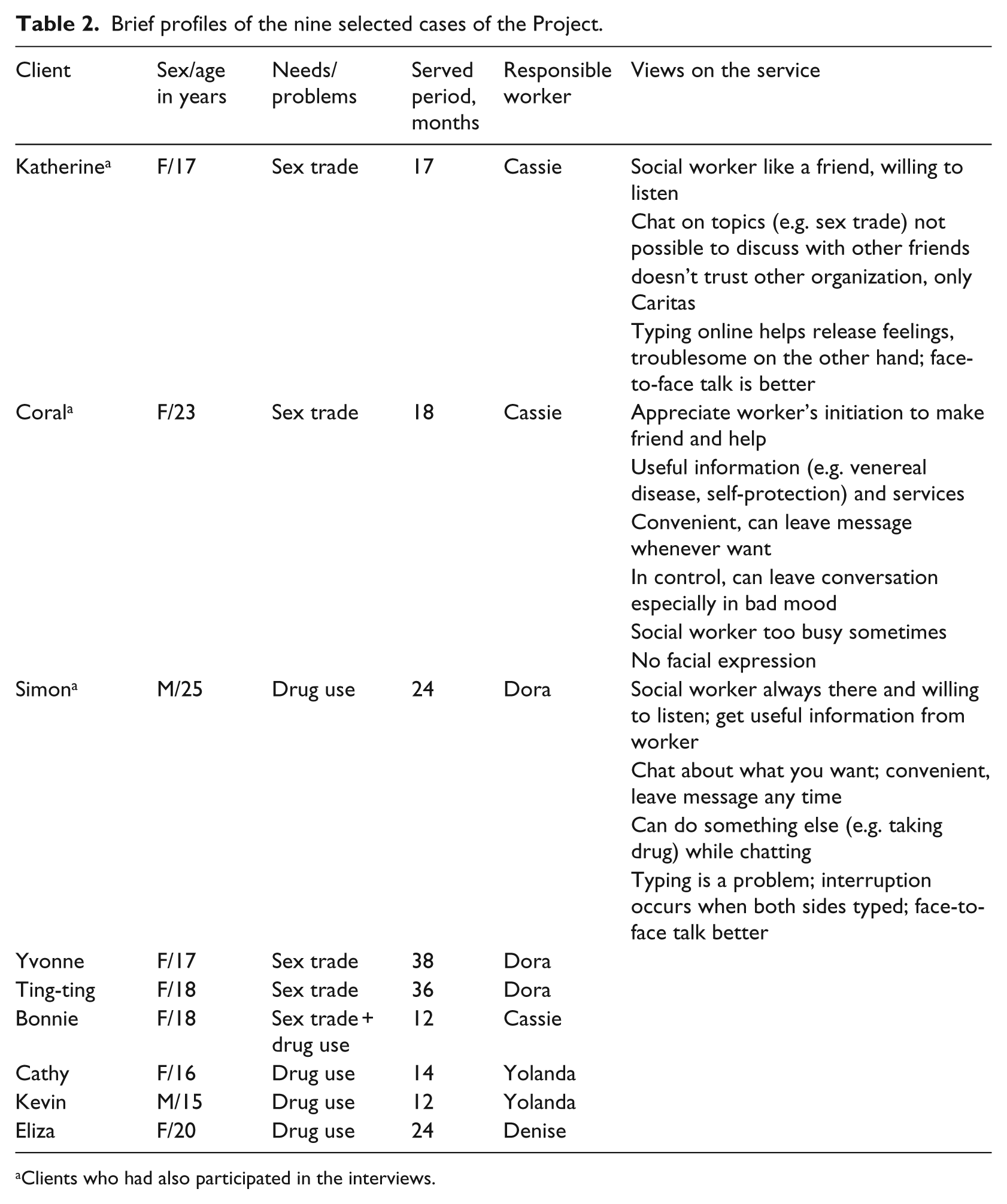
Clients who had also participated in the interviews.
Results and discussion
Four themes are identified in data analysis. They are ‘social presence’, ‘autonomy and privacy’, ‘use of text and media’, and the ‘time dimension’. Each of the themes is discussed as follows.
Social presence
Short et al. (1976) coined the term ‘social presence’ in their theory of telecommunications. They denote that social presence indicates ‘the degree of salience of the other person in a mediated communication and the consequent salience of their interpersonal interactions’ (p. 76). Biocca et al. (2003) see social presence, mediated by telecommunication technology, as the actor’s awareness of co-presence of another sentient actor, accompanied by a sense of engagement with him or her. It also includes one’s ‘primitive responses to social cues, simulations of “other minds,” and automatically generated models of the intentionality of others’ (p. 459). ‘Being there’ and ‘connectedness’ are considered as cores of the concept.
LaMendola (2010) argues that social presence must exist and be directed in the conduct of online social work practices. All interviewed social workers, using the term ‘be real’ to describe how they behaved in the online environment, agreed to the view and considered it a prerequisite of cyber youth work. The authors further see that they have to be socially present in three aspects.
Present to online generation
‘Friending’ is the new term that emerged along with the rise of social networking sites, in particular with regards to Facebook. It refers to creating social ties with others on the Internet, although these ties may mainly be weak, low-commitment ties (Lewis and West, 2009). The Project team adopted a befriending approach to start their work in cyber space. This might take a long time before rapport was established. Dora, for example, spent 3 months chatting with Yvonne on various issues from hobbies, movies and other web-related things, before they started talking about her needs and difficulties due to her being involved in the sex trade.
Social workers thought that they were not just ‘using’ the Internet to do their job; they were ‘living’ in it so that they could be real to the young people they met, as it was also the reality that the young people were living on the Internet, rather than using it as merely a communication channel: … you can’t imagine how much a LIKE [on Facebook] means to them [young people] … this virtual world to us is the real world to them … (Cassie)
As the interviewed social workers are all in their 20s and belong to the Internet generation themselves, this did not create much of a hurdle for them. They were familiar with Internet culture, as well as active and skillful in using various social media. Friending was something they would do daily. 5
Present to online community
The Project team had primarily adopted a befriending approach in their work. The approach is commonly found in projects supporting children and young people; people with mental health concerns; people with suicidal ideations; and so on. McGowan et al. (2009) point out an important characteristic of befriending: that while friendship is a private relationship and mutual choice on both sides, befriending is not. The supporting side, be he or she a volunteer or professional befriender, is the one awaiting to be accepted. The respective organization also plays an important role throughout the process. Service users are not just befriended by the befrienders, but by the organization too.
The Project had a similar approach. Social workers had to present themselves not only as individual Internet users, but also as representatives of their organization. They regarded it important to reveal their professional identities as soon as possible, although there were times when they would be rejected because the young people contacted disliked the possible label of being problematic. They would leave public messages on discussion forums and ‘broadcasting’ what they had been doing, setting up openly accessible Facebook pages, and send genuine and empathetic responses to others’ stories or difficulties. Their persistence had gradually gained them a reputation and people’s trust in the online communities: … worthwhile for what you [social worker] are doing, these guys [drug abusers] do need help. (Message left by a forum discussant) I won’t trust others [organizations], but Caritas is famous here [among girls involved in the sex trade] (Katherine)
The quoted responses indicate that the organization has somehow been recognized and accepted by the respective users as a group, and that the social workers’ participation in these forums and social media are ‘legitimate’.
Present to online individuals
As mentioned, social workers’ reaching out to potential clients would be rejected from time to time. On the contrary, those involved in the sex trade would probably regard these online chats as disguised calls from their potential customers. In other words, although these young people may easily engage in casual chats with strangers, they seldom relate to the opposite side seriously, let alone the motivation or commitment to make a change. To overcome the hurdle, social workers emphasized that they had to proceed at the clients’ pace, start where they were, and have a genuine interest in what was in the young people’s minds. The workers very often started by caring about their health and safety issues, hinting that they could arrange a physical examination service, if needed, and then wait for their responses. The rule of thumb, said Denise, was to withhold any judgment on the worker’s agenda at this stage, such as to ask the client to quit drugs or the sex trade. The young people’s feeling and trust that someone on the other side of the Internet always cares about them is the only way to proceed: So you were just chatting at the beginning, why did you continue? … she (social worker Dora) is different (from my friends), she is always there and willing to listen … whatever I said!
Apart from building the relationship gradually, all the four interviewed social workers suggested that noticing and responding to clients’ critical incidents and moments are of extreme importance in showing their ‘presence’. These critical moments could be obvious when the clients sent explicit messages or emoticons. 6 However, there were also more subtle occasions on which workers’ sensitivity was demanded. For example, clients’ absence from Facebook or changes to their avatars and title messages could give some clues to follow-up. Social workers’ perseverance was sometimes demanded too:
When will we consult the gynecologist as discussed?’
No, I’m fine.
so I’ll meet you in the Central.
When?
Monday morning at eleven?
Ok. (Eventually no show)
Hi there? (no answer)
sent a MSN screen vibration
What’s up?
He got it!
Who? got what?
My boyfriend, the (venereal) disease.
Shall we talk?
Call me
Limitations of the presence
Although social workers can be socially present on the Internet, there is a limitation when compared to the conventional face-to-face situation. Since there are only textual messages conveyed but no facial or verbal expression in the communication, misinterpretations may occur on both sides and affect the relationship. This often happens when slang andemoticons are used: some of them have ambiguous meanings. The inconvenience of typing Chinese on an English keyboard has also hindered the expressions. Clients and social workers had similar expressions in the interviews: It is definitely better to meet face-to-face, you can say whatever comes to you. You will speak five words when talking, but type only two on a keyboard. (Simon) … handling a task is easier (online), but if you want to show your emotional support, it’s not very effective because you don’t see his face. (Denise)
Further discussion on issues of use of text and media will follow.
Autonomy and privacy
Autonomy and privacy are interrelated in cyber youth work. Young people approached by social workers reserve their autonomy to accept or reject such friending invitations. It is well justified and socially acceptable in the cyber world. This autonomy to a large extent is brought about by the anonymous nature of the contact. Schultze (2006) terms this situation psychological anonymity rather than just anonymity – as it does not merely protect the client’s personal data and identity, but also at the mental level. He or she can reserve the right and possibility to withdraw from interaction or even the relationship without worrying about being identified. The clients expressed this sense of control in the relationships: Sometimes I think it’s not easy to do your job [as a social worker], we can block them whenever we like. (Cathy, typing in one of the MSN sessions with Yolanda)
On one hand, this client’s autonomy might threaten the social worker’s sense of control over the intervention process, when compared with the face-to-face format. On the contrary, social workers from the Project considered these features as advantageous for their work. They agreed to what Griffiths (2005) has suggested, that this anonymous and non-threatening context has helped increase the degree of honesty and validity of self-disclosure when young people seek help online – although in reality they usually start by claiming that their friends or siblings were the ones having the problem or concern.
Anonymity and autonomy are perhaps even more important for girls involved in sex trade. Cathy and Dora (social workers) made the following remarks: It is safer for us to know who she (Cassie) is … you need to be sure that you are not talking to a relative, or a friend’s friend, somebody who knows you. … some of them (girls involved in sex trade) frankly admit (in online conversations) that they do like the business, not caring how about our judgements as we don’t know who they are …
It is generally considered that such anonymity, and thus protection from social stigma, can help the clients feel less ‘intimidated’ or ‘scared’. This is of particular importance to clients of the Project as their engagement in drug use or the sex trade would more likely lead them to feel discriminated and isolated. Clients experienced greater equality in the interactions when the power differential was diminished (Day and Schneider, 2000; King et al., 2006).
Autonomy and privacy of the online environment do not just promote clients’ motivations at the early stage; they help sustain his or her involvement throughout the process. Simon, as a long-term drug user, had his urinary bladder damaged. He needed to go to the toilet every 15 minutes and did not dare leave home. He also made fluctuating progress in quitting drugs. He admitted that meeting Dora online could help him feel much less embarrassed, as he neither needed to be excused every 15 minutes, nor did he need to ‘face’ the social worker with regard to his drug-use fluctuation.
Use of text and media
Similar to some previous discussions (e.g. King et al., 2006), both the clients and social workers saw the benefits and challenges in textual communications. As compared to conventional face-to-face counseling in which social workers could only make records of the sessions retrospectively, full records of online sessions are kept automatically. The interviewed social workers reported that they would sometimes review these records before the next online session, especially when they were working with cases of similar backgrounds or situations at the same time. They further added that their recalling of previous discussed topics might let the clients feel respected and give them a sense of significance, and thus help in building rapport. Clients also saw texting as convenient when they felt the need to express themselves, although an immediate response might not be required: I can send an offline message whenever I like, even in the middle of the night. (Simon)
On the contrary, both sides agreed that texting was not the most natural or effective way to express what they thought, and in particular how they felt. As discussed earlier, there were misinterpretations that occurred from time to time, due to the ambiguous meanings of words, and slang used. To minimize the misunderstanding, Denise suggested that they would be as articulate aspossible in their expressions, although that might sometimes appear cumbersome. Another problem of textual dialogues is topic skipping. It was usually initiated by the clients. Although it may also occur in conventional face-to-face sessions, social workers, however, suggested that in the online setting, they lacked other cues to help them judge whether such skipping is just simply side-tracking or reflecting clients’ reluctance in the respective discussion (although in another way it can be interpreted as an expression of clients’ autonomy). Playing safe was the usual coping strategy and that had a significant effect on the intervention pace or plan.
Despite the fact that textual communication may sometimes cause inconvenience to the users, it is found to have served a particular purpose which may facilitate the worker’s intervention. As recorded in a MSN session, Bonnie was discussing with Cassie the abortion she had a few months ago. The client showed great regret concerning her choice and described herself as ‘dirty in the heart’ after the abortion. Cassie purposefully repeated the phrase in the next 20 lines of their dialogue, although she expressed it a little differently each time: No matter what I do now, I’m dirty in the heart … (I’m) worthless. You’re feeling dirty in the heart and it makes you feel worthless? Yes, I know I am. What else does this ‘dirty in the heart’ makes you feel? Nobody loves me, I’m unlovable … So this ‘dirty in the heart’ drove away all those you love. … Bonnie, have you ever beaten the ‘dirty in the heart’? … Has the ‘Angel Bonnie’ ever driven the ‘dirty in the heart’ away? I know I will, some day …
In the episode, Cassie was using the externalizing technique (White and Epston, 1990), which is also commonly adopted in face-to-face narrative therapy. Problem externalization is applied to encourage ‘persons to objectify and, at times, to personify the problems that they experience as oppressive’ (Murphy and Mitchell, 1998: 30). Through the typing process, the client in a way had distanced herself from her problem and thus had further facilitated the effect of externalization. While narrative practitioners would be interested in unpacking what may have become problem-saturated stories and opening up space for generating ‘preferred stories’, a vital means of capturing and embracing these stories is through writing (Speedy, 2000). Furthermore, writing text also provides a permanent expression of what might have been key moments, and people can remind themselves about the ways in which their stories change over time (Payne, 2000).
Apart from text, audio-visual materials and social media were used very frequently in this online youth service. Popular emoticons were used to let the young people know that the social workers were trendy and young at heart. Beautiful photos, lyrics, or music videos on YouTube are often used to show workers’ encouragement and support, according to Cassie. The social workers would often visit the clients’ Facebook pages too, to write a few words, LIKE posts, or just to read the latters’ events. They considered it also as an effective way to update their knowledge of their clients without disturbing them, and definitely as gestures of care and concern too. The authors also see these as means for the social workers to show their presence to the young people concerned.
Time dimension
Features and effects of the time dimension are often discussed in online counseling practice (e.g. Jones and Stokes, 2009; Suler, 2000). Synchronicity of the communication is among other things an aspect that has received much attention. Advantages of synchronous communications are usually considered as disadvantages of asynchronous ones, and vice versa. Synchronous sessions, usually scheduled for specific date and time between the two parties involved, may be interpreted as a sign of commitment and dedication to the service. Furthermore, synchronous communication will induce a stronger sense of social presence, and the spontaneous interactions will result in more revealing and uncensored disclosures by the client. In the Project, social workers had similar experiences. Generally speaking, they would use asynchronous modes of communication more at the early relationship-building stage, such as leaving public or private messages on discussion forums or Facebook pages of the young people they were approaching. A typical example would look something like the following: I am not a customer [of this forum] but a social worker of the Caritas Hong Kong. We provide help to the girls if needed, such as pregnancy test or gynecological checkup …
They regarded it as the socially appropriate way to break the ice without being too pushy and annoying to the young people. When the relationship was secured, they preferred synchronous dialogues.
Nonetheless, the social workers also pointed out the disadvantages of synchronous communication. Some of them are considered largely related to characteristics of these young Internet generations. First, they felt the pressure to respond swiftly as expected by the other party. Delayed responses may mean neglect as felt by the clients, according to the interviewees, as they would receive messages like ‘Hi there?’, ‘Are you listening?’, or simply ‘??’. As reported by the interviewees, they were sometimes talking to five or even more young people simultaneously in a busy evening. The situation would be even worse when they were in different stages of the working relationships involved. Yolanda’s comment would best describe this pressure: … sometimes I’ll just keep hitting the keyboard and deleting (so the client will see that you are typing) … buy me some time to organize my thoughts, or make sure who I’m talking to.
Miscommunication was another common problem in synchronous dialogue. Some were caused by mistyping, but more were due to simultaneous expressions at both ends leading to a loss of track. A third problem was premature termination of online conversations due to technical problems or a client’s withdrawal as somebody had just entered his or her room.
On the contrary, asynchronous communications allowed both parties to better organize their thoughts and ideas. They could have more time to think before responding, correct what had been typed, and send a reply at their own pace. Both the social workers and clients agreed that the offline messaging tools on various social media were convenient gadgets for updating one’s situation as well as keeping in touch.
Specific and yet the same
Youth work is always challenging, especially with respect to delinquency issues. Teenagers generally have lower help-seeking motivation and prefer to access informal support (Boldero and Fallon, 1995). Youth workers often have difficulties in breaking into the social spheres of young people who are detached from conventional institutions such as schools or churches. In the past, they might meet some who appeared to be gangs or individuals wandering in the streets. In the information era, many live as ‘otaku’, which means they spend much of their time at home, on computer games, and the Internet. This makes it even harder for the youth workers to gain access to their private domains. The Project provided a way to reach the unreachable, and gradually gained trust, finally serving two target groups – drug users and girls involved in the sex trade. This could not have been successful if the youth workers had failed to demonstrate that they were real people existing in the virtual space, who genuinely cared about the young people’s wellbeing.Nor could this have motivated the latter if their need for autonomy was not well respected or too much was demanded from the clients right at the beginning, such as revealing their true identities. Social workers also have to be sensitive to the trends and culture of the Internet and social media, to be skillful in using different means and formats of communication, as well as communicating in a ‘youthful’ way. The aforementioned themes thus suggest practice insights for youth workers today.
Nonetheless, the authors see that behind all these manifested characteristics of cyber youth work, the same four youth work principles suggested by Krueger (2005) apply. Krueger (2005) makes improvised modern dance as an analogy of youth work. First, a youth worker as one of the dancers must be present. They must ‘show up’ in the helping process and clearly convey the message that ‘I am here and will go with you’ (p. 26). Rhythmic interaction is the second principle. Beautiful modern dances and trustful youth work relationships both must have close human connections created in which people share a sense of togetherness. However, it should be noted that this would not be a one-off process. Youth workers and the young people, when ‘dancing’, will be moving in and out of synchronization. They may have the same pace at one point but be totally out of step at another. The technology sometimes facilitates the rhythmic interaction and sometimes not. Patience and acceptance are the keys to sustaining and succeeding. Third, Krueger sees both dancing and youth work as a meaning-making process. Youth workers and the young people keep making sense of their interactions as well as the latters’ life situations. The worker must be sensitive and understand the youth’s contextual reality. Last but not least, the atmosphere plays a significant role in defining and shaping the interactions. Youth workers need to be sensitive to the environment in which they are embedded – the Internet in this case. Cyber youth workers have to make good use of their understanding of the Internet culture – trendy use of online slang, gadgets, and multimedia and so on – so as to create an engaging atmosphere for their ‘dance’ with the young people to further improvise and develop.
Footnotes
Funding
The author(s) received no financial support for the research, authorship, and/or publication of this article.