




Abstract
Urban South Africa is a major destination for refugees across sub-Saharan Africa. Based on interviews with urban refugees, this study identified significant barriers to achieving livelihood security for this population, including community violence, crowding, fear of xenophobia, exploitation from officials and oversaturated markets for small businesses. Nevertheless, refugees identified several aspects of service provision from a non-governmental organization which proved helpful, especially through material assistance in helping establish viable, profit-generating small businesses. Recommendations for service delivery to this population include assessing refugees’ level of environmental vulnerability and providing a package of supports that address a clients’ particular living situation.
Introduction
More than half of the world’s 11.7 million refugees live in urban areas (United Nations High Commissioner for Refugees (UNHCR), 2013), a significant shift from conditions several years ago, when only 13 percent of refugees lived in cities (UNHCR, 2009a). The phenomenon of urban refugees can be witnessed globally, and is particularly striking in Africa, where ‘urban growth rates have been the highest in the world’ (Landau, 2004: 3), even though approximately two-thirds of refugees in Africa still live in camps (UNHCR, 2013). Nowhere is the phenomenon of urban refugees perhaps more visible than in South Africa, a country which experiences the highest rates of asylum seekers of any country in the world (UNHCR, 2009b).
Forced migrants in any context are at increased risk of social exclusion (Zimmerman et al., 2011), and particularly in sub-Saharan Africa, migration can have devastating effects on the ability of refugees to generate and sustain livelihoods (Kalipeni and Oppong, 1998). Refugees to South Africa typically rely on an informal economy (Landau, 2004; Lindstrom, 2003), and some have suggested that refugees, in many cases, are less vulnerable than their local counterparts in terms of their abilities to generate income (Landau and Duponchel, 2011). Yet urban refugees in South Africa also face a daunting range of obstacles. Lack of documentation limits access to jobs, housing and other public services (Misago and Monson, 2010; Polzer, 2007) such as rental accommodations and permits for businesses. This problem is compounded by local and institutionalized xenophobia, related to public perceptions of migrants as criminals out to steal local jobs (Misago and Monson, 2010) and perhaps to perceptions that refugees are better off economically (Landau and Duponchel, 2011).
Nominally, refugees and asylum seekers in South Africa benefit from numerous legal rights, including the right to work and access to basic health and social services (UNHCR, 2010).
Yet the South African government struggles to ensure adequate services to its citizens (UNHCR, 2010) and faces further challenges translating legal protections into concrete assistance for refugees and asylum seekers – amid factors such as a steadily mounting backlog of unprocessed applications (UNHCR, 2015). These factors, among others, have created an environment in which ‘legal status [in South Africa] is neither consistently associated with particular migration histories nor a reliable predictor of effective protection’ (Landau and Duponchel, 2011: 2).
Academic literature that directly confronts the obstacles urban refugees in South Africa face is scarce and points towards an integrated response to the problem of settling forced migrants in urban areas. In a context of rapid urbanization, the needs of the displaced are not well understood, nor are humanitarian responses well organized and integrated (Crisp et al., 2012). The purpose of the current study is to contribute to an understanding of this changing field by exploring the context of urban refugees’ lives in Gauteng Province, South Africa, and the challenges they perceive in generating and sustaining income.
Urban refugees in South Africa
South Africa has seen a significant increase in the number of refugees and asylum seekers since 2007, in large part due to the deterioration of neighbouring Zimbabwe’s social and economic infrastructures (UNHCR, 2011) and the conflict in the Democratic Republic of Congo (DRC; UNHCR, 2015). While the phenomenon of urban refugees is not new, the magnitude of these new patterns of migration poses challenges to governments and non-governmental organizations (NGOs). Humanitarian agencies, such as UNHCR and its contracted NGOs, typically have previously provided camp-based programmes. Yet urban refugees exist in a very different context, in which agencies must learn to engage with a variety of actors and challenges (Crisp et al., 2012; Ferris and Ferro-Ribeiro, 2012). Even where programmes are readily available, the nature of urban areas makes it difficult to determine eligible beneficiaries and to distinguish between the displaced and the urban poor (Ferris, 2011).
In South Africa, refugees may find protection in invisibility in spite of their formal legal protections (e.g. Landau, 2006). In spring 2008, a wave of xenophobic violence swept the country leaving 62 people dead, at least 670 wounded, dozens raped and more than 100,000 displaced in the course of less than a month (Misago and Monson, 2010). Beyond the xenophobia of the local populace, Misago and Monson (2010) also place blame on the weak state presence and culture of impunity for offenders, enabled by authority figures who tend to view the majority of asylum claims as bogus (Handmaker, 2001). The ‘obstructive institutional culture’ (Vigneswaran, 2008: 45) contributes to a larger failure to provide adequate protection to asylum seekers and exposes them to further denial of essential services and abuse by local law enforcement (Landau, 2006). The lack of protection cannot be attributed solely to rampant corruption or laxity on the part of officials; rather, in many cases, officials are ‘collectively going out of their way to repel, hinder, and undermine asylum seekers’ capacity to receive fairly adjudicated claims’ (Vigneswaran, 2008: 48).
In the absence of state support and protection for refugees, the humanitarian demands on NGOs are complex and multifaceted. Given the rapid urbanization of refugee migration patterns, the situation in South Africa is further complicated by a lack of evidence supporting effective responses to the needs of urban refugees. In 2011, the Women’s Refugee Commission (WRC) published a report which suggested that existing strategies operating in Johannesburg may actually contribute to heightened vulnerability rather than to increased security (Krause-Vilmer and Chaffin, 2011b). For example, women who received livelihood support were obligated to locate their businesses in unsafe neighbourhoods and with inadequate support for licensing and stocking their businesses. The WRC also published a set of recommendations providing a framework of best practices for building livelihoods with urban refugees. These recommendations focused on addressing the environmental constraints to building livelihoods, leveraging existing services and using a graduated approach to service provision which targets immediate needs as well as longer-term strategies (Krause-Vilmer and Chaffin, 2011a).
Context of this study
This study is part of a series of efforts made since 2011 to strengthen and assess the livelihoods programme of an international NGO working in Gauteng Province, South Africa (Johannesburg and Pretoria). The goal of this assessment was to gather information on the most pressing needs faced by beneficiaries, including, but not limited to, livelihoods and income generation, with a focus on the environmental factors which facilitate or constrain income generation. In their discussion of livelihood security, Jacobsen and Nichols (2011) outline factors which contribute to migrants’ levels of vulnerability in urban settings. As distinct from the concept of poverty, often measured by wealth or income, vulnerability refers to the ability of a household to withstand economic or environmental shocks (Goudge et al., 2009). Factors which can buffer, or exacerbate, the vulnerability of a person or household include security in the areas of employment, finances, housing and physical safety. Greater security in each of these four areas thus contributes to heightened overall livelihood security (see Figure 1). Importantly, this conceptual framework differs substantially from the UNHCR mandate to increase refugees’ self-reliance directly through promotion of income-generating activities – a mandate which ignores the environmental factors which facilitate or constrain refugees’ attempts to build livelihoods and move towards self-reliance (Hunter, 2009).
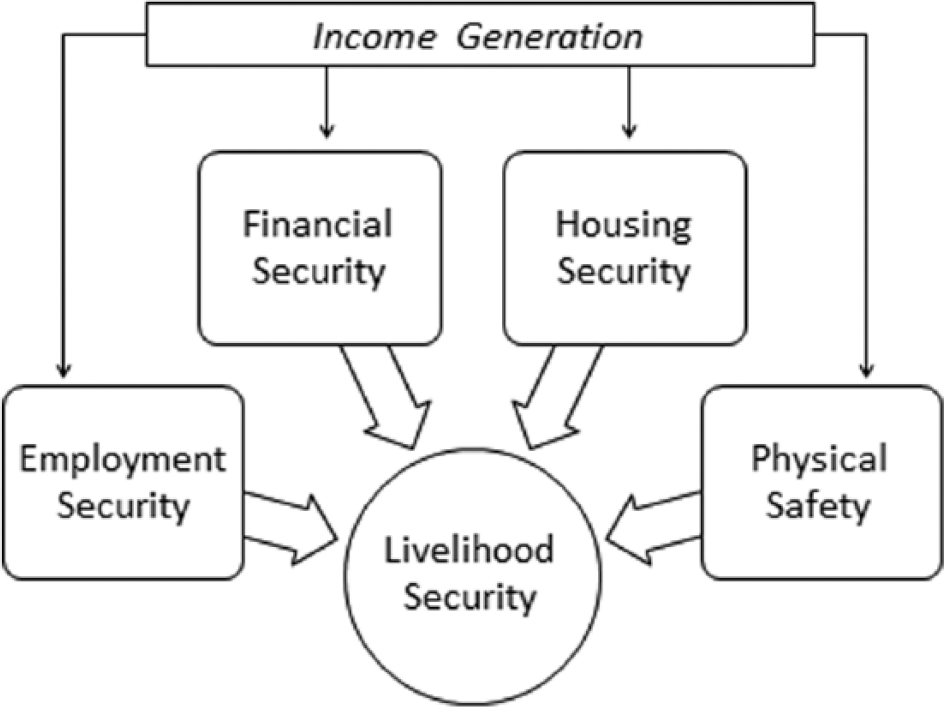
Livelihood security for urban refugees.
The purpose of this study is to explore refugees’ perspectives of the sustainability of their income-generating abilities following their involvement in a livelihoods programme, under the auspices of a UNHCR-contracted NGO in Johannesburg and Pretoria. We are particularly interested in exploring the most pressing needs faced by urban refugees as they attempt to build livelihoods.
Research questions
Specific research questions are as follows:
What are the greatest challenges faced by urban refugees in South Africa?
What are greatest barriers to generating income for urban refugees?
What supports have been helpful, or could be helpful, in generating and sustaining income?
Methods
Sample
For this primarily qualitative study, participants (N = 50) were randomly selected from the population of urban refugees in Gauteng Province, South Africa (i.e. Johannesburg and Pretoria), who previously received services from an NGO in the period ranging from January 2011 to May 2012 (approximately 600 clients). Using a non-probability convenience sample of urban refugees receiving services from an NGO, researchers randomly selected participants with valid contact information from a roster of clients and called to invite them to participate. Each participant underwent informed consent as per the protocol approved by the Boston College Institutional Review Board (IRB). As an incentive, each participant received a gift card worth approximately US$10.00. Beneficiaries had previously received services from one of four programme areas which include small business grants (N = 30), vocational skills training (N = 12) or a combination of programmes (N = 8) which, in one case, also included a participant who received assistance in obtaining professional qualifications.
Sample characteristics are displayed in Table 1. More participants were served in the Johannesburg office (58.0%) which serves a larger number of clients than Pretoria. The majority had asylum seeker permits (59.1%) versus refugee permits. Males and females were nearly evenly split in the overall sample, with an average age of 36.9 years (standard deviation (SD) = 9.5). A total of 40 percent of the sample were married, 44.0 percent graduated secondary school and 32.0 percent had attended or completed university. Most participants’ country of origin was the DRC (72.0%) with a primary language of French (60.0%). All participants spoke English, as being proficient in English is a prerequisite for receiving services from the organization. All interviews were conducted in English.
Sample characteristics.
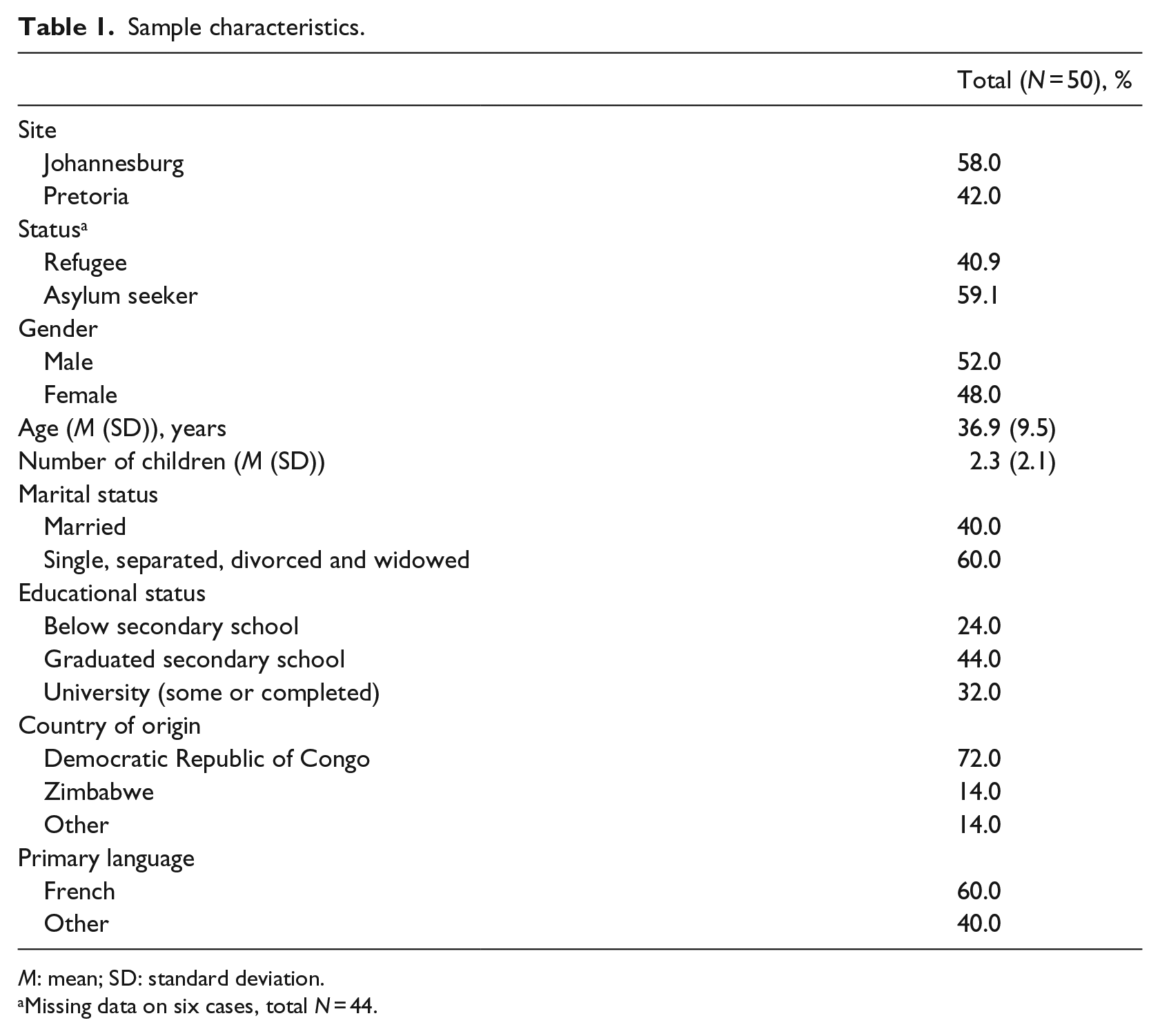
M: mean; SD: standard deviation.
Missing data on six cases, total N = 44.
Measures
A brief survey was used to collect demographic, household and employment information. Participants each took part in a semi-structured interview which lasted for 45 minutes to 1 hour. Researchers took thorough notes on computers during interviews to capture the exact wording of respondents and provide transcripts for analysis. Direct quotations are used in the article to represent participants’ experiences in their own words and to illustrate the themes and codes used in the analyses. As all interviews were conducted in English, each quotation is verbatim based on participants’ responses to study questions.
Analysis
Aggregate descriptive data were generated related to household income (see Table 2). For qualitative analysis, researchers pursued a thematic analysis of assigning codes to transcribed data (Braun and Clarke, 2006) to produce a grounded theory of the lived experience of urban refugees (Strauss and Corbin, 1998). Three researchers reviewed data independently and together to develop and cluster codes into themes for the analysis, using open and axial coding.
Household income information.

M: mean; SD: standard deviation.
Results
Household income
A majority of respondents indicated they were not currently working (63.3%; see Table 2). Only 32.6 percent reported having consistent employment. On average, only one person in the family had earned an income from a job in the past six months, and most households (90.0%) did not obtain income from any other source, such as family members or friends (see Table 2).
Researchers analysed each transcribed interview to answer the following questions: (1) ‘What is it like to be a refugee?’ (the original question was ‘What is your biggest challenge overall?’); (2) ‘What is your greatest challenge to generating income?’; (3) ‘What have been the greatest benefits from working with the NGO?’; and (4) ‘What other services or supports could the NGO or another organization provide?’ The following results, are organized by each of these questions.
What is it like to be a refugee?
Researchers were interested in the larger context of refugees’ lives, and particularly the greatest challenges they face. The question (‘What is your greatest challenge overall?’) was not restricted to livelihoods or income generation, and participants were free to identify any issue of their choosing. Researchers identified 84 discrete comments relating to refugees’ greatest reported challenges. These experiences were clustered into three themes: environmental insecurity, daily struggles and psychosocial issues.
Environmental insecurity
The most commonly cited complaint around personal safety and environmental insecurity
was the difficulty of finding appropriate accommodation. Rent is high in Johannesburg
and Pretoria, and refugees are often not able to pay the rent because of lack of work.
Refugees also express a sense of resignation about their living situation: one stated,
‘It’s not safe, it’s not good. It’s normal’. Another said, ‘It’s not so good but we
accept it because we don’t have any choice’. Related to the issue of accommodation are
the crowded conditions many refugees experience in their homes, and the fear they have
of their neighbours. Sometimes this fear is related to having been robbed: ‘There are
seven people where I stay, at the end of the month people are moving out and can take
people’s stuff when they are not there. It’s a problem and I don’t feel safe’. Other
times refugees fear violence from their neighbours: We are not safe, though. It is a three bedroom flat and everywhere is full, it is
different people and families. We are Congolese but there are Nigerians and
Mozambicans. There is no place for the children to play. Anytime someone must be
there to check them because if they go out, maybe the neighbour will beat them
again. It’s not safe.
The fear of others also extends towards South Africans, fears which are likely
heightened in the wake of ongoing xenophobic attacks and general alienation from home
communities. One refugee said, … I’m living with people who are not from where I am and sometimes I don’t feel
safe … They are South African so I don’t know how I feel about it. Sometimes I feel
like I’m not safe because I don’t know what people there think about me.
Not surprisingly, then, conflict among neighbours and others also emerged as a theme.
One refugee noted the arbitrary nature of rent amounts and relations with landlords: They put the rent up too much for me because a kid is over 12 and they want kids
under 12, those kids can’t pay when he is over 12, he must pay. I don’t know what is
going to happen because the place is on auction.
Problems with authorities and police emerged as a common theme, particularly related to perceptions and experiences of police corruption. Partially, this problem seems linked to problems accessing required merchant licences, such that the police shut businesses down if they are not licenced: ‘When I get the business it was very nice, there was no problems, the problem just came when the metro police came to ask for the licence and then they take the stock’. In other situations, the police are seen in a predatory light: ‘… the police came and they beat me and took everything’; ‘Any time the police can come to check and the police can do anything they want’; and ‘Police also come and take our things sometimes’. Even when refugees place their trust in the authorities, nothing seems to change: ‘… (thieves) took everything in the house and we were held at gun. We called the police and they were gonna find out and until now nothing happened’. The situation for refugees appears to be one of environmental insecurity, in that little safety exists in terms of accommodation or infrastructure.
Daily struggles
Beyond the environmental insecurity are the daily and familial challenges faced by
refugees in urban environments. The largest issue identified by refugees was the problem
of supporting their families. Even after participating in the livelihoods programme,
these refugees were largely unable to secure permanent employment or often even
temporary employment: After the studies I didn’t find a job and therefore I have always to look for
something to help the family. The children must eat, you have to see how to make
them comfortable … What can I say, the way I have been saying, it’s by the grace of
God we are surviving. By myself, I don’t find a way. Maybe you go somewhere and do
something, a little job, you find a little piece job, the minimum for the
family.
Given the lack of job opportunities or challenges to starting a business, as well as
the expenses of daily life, daily subsistence also emerged as a theme in the analysis.
Boredom is coupled with the lack of mobility and a sense of helplessness: When you are a refugee, to adapt, is not easy. You don’t have anything to do but
you have the daily needs that must be covered so it is very difficult … The biggest
challenge is the daily life itself also becomes a big challenge because many things
are involved to be able to sustain the life. You must provide food, accommodation,
everything. So as long as you don’t do anything it is a big challenge … If I want to
move somewhere when I am not working it is too difficult. For me on my side I was thinking that if there is any way to move away from around
here but there is no chance.
Asylum seekers face additional barriers to finding employment compared to refugees and permanent residents, and changing this permit type to refugee status is a long, often fruitless, process. One asylum seeker noted, ‘I’m here now for 10 years but I’m still having asylum seeker. With asylum seeker it is the biggest barrier to find a job. That is the biggest challenge. Even to assist my children with school’.
Psychosocial issues
A third area in which refugees faced the greatest problems related to psychosocial
issues, particularly the lack of social support, personal insecurities and depression.
As is well known in the mental health fields, problems are compounded when individuals
and families live in fear and isolation. One refugee insightfully observed the impact
that life stressors have had on his family and on his own well-being: … when you have a problem with your job, your job is your life and if you are not
doing well it’s going to affect your family and your life. Even inside, it can’t be
good when those things are not going well.
Another respondent cited being in South Africa as a refugee as particularly problematic, but this person had sought help to relieve this sense of isolation: ‘We need counselling because sometimes you feel lonely and not accepted in the South African community. This is not making us happy so we need counselling to help with problems’. The ongoing stress of trying to make a living as a refugee in South Africa wears down resilience, as one refugee observed: ‘For myself, I’m tired for South Africa because whatever you do, it’s not going up. You just take small for eating but for your life to be up, it’s difficult. It’s very difficult. I’m very, very tired’.
Greatest challenges to generating income
Researchers were interested in the context of refugees’ lives as it pertained to supporting or posing barriers to income generation. Researchers found 88 discrete comments relating to refugees’ greatest challenges to generating income. These experiences were clustered into two themes: business sustainability and heightened risk for refugees.
Business sustainability
The most frequently cited challenge to generating income related to the ability to
sustain a business. Most commonly, the greatest barrier to business sustainability
seemed to be balancing business expenses with other costs such as rent and children’s
day care (‘crèche’ in South Africa). The pattern that emerges is that beneficiaries
receive funds to start up their business, if enrolled in the small business grants
programme, but that the expenses of daily living drain any profits away from the
business and make it impossible to maintain and grow the business: It was the rent, it was too much to pay. That was the first of the things to make
the business go down. If I was having some other income aside from that money it
would have been fine, but the same amount [they] gave me, I must pay rent too and
send my son to crèche.
The locations of the beneficiaries’ business also pose problems. Most businesses are
located in the inner city or poorer suburbs, where, despite high rents, business owners
must keep prices low to be accessible to the local consumer base. One beneficiary
stated, My biggest challenge is in the community where I’m staying. If you want to sell
things at a higher price, the community does not have money and there are very poor
people and then you have to reduce the price.
Related to business location is the competition among businesses selling similar
merchandise in the same locations. Establishing a business in a different location may
reduce the competition, but in turn will increase travel costs: I’m facing big competition in the market. My quality is for the poor. So, I must go
where the location of the poor to sell. But to go with the taxi, the bus, is the
biggest challenge. Because if I try to sell around here, it is very slow because of
the competition …
Another factor that contributes to business sustainability for refugees and asylum
seekers is lack of access to bank loans. Beneficiaries are limited to the small start-up
grants they receive from the NGO, but larger loans are reserved for South Africans, as
one refugee notes: Many South African business they have credit from the bank, the bank assist them,
they have a lot of material to improve their business. So that competition it’s
always an undercut to our business. We make a profit, it’s just the competition that
is a problem.
With the above challenges already noted, respondents also indicated the additional
barrier of insufficient start-up capital and the consequence of failed businesses. Even
for businesses that have not failed, refugees also experience slow growth of their
businesses. Sometimes this slow growth is related to making a profit when selling goods,
or the ability to sell certain goods: ‘… Sometime I face difficulty to sell the product
at the price I bought it at. Sometimes also I cannot sell the product.’ In other
circumstances, the growth of the business places strain on the business owner who is not
yet able to hire employees to grow the business further: I am the accountant, I do everything for myself. I’m the one who does the calls,
drives, pays the bills, everything, so it is a bit too much on me … It’s a bit
difficult for me to grow but I will slowly. I’m doing it myself. I do the accounts
at night and the deliveries during the day. So I can basically say I have to
overwork myself.
Heightened risk for refugees
The other broad area which poses challenges to generating income relates to an overall
sense of heightened risk of urban refugees, particularly for those who are looking for a
job rather than trying to establish a business. Several respondents indicated that they
waited many years, or are still waiting, to receive permits to work in South Africa. One
refugee indicated he has been waiting 10 years for a permit; another has waited 14 years
for a permit to work as a truck driver, despite his already having a driver’s licence
from the DRC: ‘They are asking me for a South African driving licence, I have a licence
from Congo … I’m stuck because of the paper. I’ve been 14 years in South Africa and I
don’t have an ID.’ In addition to the problem of obtaining work permits and proper
identification, refugees also encounter a lack of work opportunities once they have
completed their vocational training (where applicable). Another refugee with driving
experience said the following: The problem is there is no job. I am looking for the job. They ask me about my ID …
Yes, there are many people who teach driving. I am able to ask them where they find
a job but it doesn’t lead to a job. There are too many conditions, you need
experience or ID that is the problem.
Two additional barriers to generating income emerged in this analysis: theft of goods
and the need to make money while studying on vocational courses. One refugee told the
story of how lack of proper identification and theft of goods combined to create a
larger problem. This person went to the permit office to pay for her permit renewal, but
the name on her trading licence did not match her permit name. The office staff took
away her licence and the Metro police confiscated her goods. When she claimed her goods
from the police, she found that not all of the goods were accounted for. When asked how
frequently this situation occurs, she replied, ‘Always. Sometimes once a week. Now it
has been three weeks since’. Once again related to work permit issues, refugees often
find it difficult to find and keep work, while also keeping up their studies in the
vocational track. Another refugee noted, When we are learning we are not working as well … Here, it’s very difficult to work
as a refugee. I’m at a learning distance college so sometimes I try to find a job
somewhere but as a refugee it is difficult.
Thus, the difficulty in finding work is compounded by the additional demands of continuing education so as to find more sustainable work in the future.
Greatest benefits from NGO services already received
The researchers were interested in the ways in which respondents may have benefitted from their relationship with the NGO. In total, beneficiaries provided 91 discrete comments which the researchers clustered into the following areas: material assistance and profit and other NGO programme support.
Material assistance
The theme of material assistance refers to tangible ways respondents received benefits
from the NGO. The common sub-theme was a general acknowledgement of appreciation for the
support and services offered, even if the support itself is limited. One refugee
summarized this sentiment well: Actually when I arrived to South Africa they gave me assistance, it wasn’t much but
at least I thank God, I really appreciate it for what they did. It was limited but I
really appreciate for the benefits. They tried their best to help me with like a
small business and I did my best, I already had the business, they gave me some
capital and I add it.
Beneficiaries also identified receiving cash as a major benefit, whether in the form of
small business grants or for tuition for vocational skills training. This benefit, not
otherwise available to this vulnerable population, helped open opportunities. One
refugee said, I’ve been given some money for business, so it’s helped because right now I’m
surviving like paying rent, food to eat, supporting my family, from the business
that I’m doing. And that money was from [the NGO]. The money that was given to me,
today I’ve got two shops, and me and my wife we are working so it helps me a
lot.
For those who are establishing a business, receiving goods to open their business
emerged as the greatest benefit. These beneficiaries noted the goods received, rather
than the cash that provided the goods, as most beneficial. These goods can be in the
form of either sellable goods or equipment that makes goods and services possible, as
noted by one refugee whose work is sewing: I benefit most in the way that they help me to get machines because I was looking
for the machine to sew with because my job is sewing. So they help me to get the
machine which is helping me to perform my skill.
Among the opportunities opened to refugees through the NGO is that a wider pool of
information is available to them. In particular, beneficiaries learn either specific
vocational skills to assist them on the job market or business management skills to help
them establish their own business. One refugee, after receiving the business training
and a small business grant, said the following: I learned how to calculate profits, loss, how to run the business, and after that
they send us for quotation, then they send the money to where I wanted to purchase
the farming equipment. I appreciate it and don’t have any problems with it.
It would seem that the training component is a critical means of preparing a business owner for success. Even without owning a business, beneficiaries also benefit from training alone. One beneficiary observed that ‘… I never know how to do nails before. They show me about quality that I didn’t know before’.
Establishing means for making a profit
The second strongest sub-theme among greatest benefits of previous services received
involved the programme’s helping refugees establish a means of making a profit. Of the
50 refugees interviewed, 17 (34.0%) indicated they made a profit from their businesses.
Most commonly, this profit helped refugees meet basic needs for their daily survival. As
such, beneficiaries were able to maintain and grow their businesses and meet their
families’ daily needs: It’s very fine just because I’m able to have enough food for, to me it’s enough, I
should thank God just for that, they’re able to have their breakfast, lunch, their
supper, they’re able to have it, so that’s great for me. Anything about medication
whatsoever, I’m able to pay, the rent, and also pay electricity.
In some cases, respondents indicated they had been able to save money as well as pay
their bills and support their families, as a result of their businesses. One refugee
said the following: … now that I have [the business] I am saving some money. It is my own and I am
working on my own, I am no longer staying in the shelter and I have somewhere to
stay with my kids … I have accommodation now. I am saving and buying groceries. I
pay school fees for my children.
As related to making profits, researchers also identified some smaller sub-themes, including income generation and growing their businesses.
Other needed services and supports
The researchers were interested in asking respondents about the services from which they felt they might benefit, which are not currently offered. The responses to this question (‘What else could [the NGO] have done to help you?’) totalled 29 comments. Researchers divided these comments into the following themes: concrete assistance not currently provided and insufficient start-up capital.
Concrete assistance not currently provided
Another common theme emerged around desires for concrete assistance not currently provided by the NGO. The most common sub-theme was a desire for assistance with accommodation. This finding is perhaps not surprising, given the high cost of rent in Johannesburg and Pretoria, as well as the crowded and often unsafe living situations enumerated previously. One beneficiary stated, ‘If they could help me get a place, if they could also help me with where I am staying cause it is with other people’. Another said they had specifically requested such assistance from the NGO, but was told this type of support was not offered: ‘I applied for accommodation also but they told me they did not help.’
In terms of needing concrete assistance, respondents indicated a variety of other needs
such as top-up funds for business and various other supports like food or further
support than is currently offered. Four comments related to school, and particularly the
need to continue vocational training so as to qualify for more competitive jobs, as one
beneficiary explained: I would like to ask [the NGO] to push me to finish my course. They paid for me for
three months but the course is for one year. That one someone promised me if I get
the certificate, they will give me a job. So I wish they can push me to finish it
because there is no chance I have somewhere else.
Insufficient start-up capital
A second theme emerged in this part of the analysis, related specifically to those
beneficiaries who had received funds either for a vocational training course or a
business, but said those funds were not sufficient given the demands. One student in a
vocational skills course wanted to take a class that cost much more than the ZAR4000
provided. A small-business grant recipient stated that the amount of start-up ‘was too
small. I just bought few tools. I did apply with a certain amount, they gave me 10% of
that amount which I requested’. Another recipient of a business grant discovered, upon
doing research, that the amount provided by the NGO was far too small to execute his
original business plan: My business plan, when I did my research, I needed a capital of more than R20,000
but due to the limit I had to manage with R10,000. So it was a stress to me because
I had to try to reduce my business plan. I think it would be better if they could
try to tell me before the workshop so I could properly do my research and
everything. That was a big challenge.
This comment also suggests a lack of clear communication between the NGO and the client, as the client in this case did not have sufficient information to plan accordingly.
Discussion
This study provides one of the few examinations of urban refugees’ economic circumstances and the challenging environments in which refugees must subsist, in the context of sub-Saharan Africa. These findings, however, point towards practice and policy recommendations to improve the delivery and quality of livelihood programming to this population.
Findings suggest that these refugees are highly vulnerable, both economically and socially. Only a third of the sample reported having consistent employment, and only 1 in 10 refugees who graduated from a vocational skills training course reported being employed. Furthermore, 90 percent did not receive any financial assistance from social networks. These findings paint a stark picture of urban refugees’ ability to sustain themselves, compared with other urban centres in sub-Saharan Africa such as Nairobi (Raddatz, 2013) and Kampala (Krause-Vilmer, 2011). While urban refugees in these other locales face similar barriers to basic services, recent evidence suggests that they are generally able to generate some income and access social supports for emergencies and education (Krause-Vilmer, 2011).
Refugees reported significant environmental challenges to generating income, largely due to the high cost of living and competing priorities for expenses. Often, the result is that business owners rely on business profits for personal expenditures rather than for business sustainability and expansion. Refugees also lack access to bank loans which could help stabilize and expand their businesses. The refugees in this sample seem less optimistic about their economic prospects. Refugees’ lack of resources makes it difficult to set up a business in a place that will likely generate substantial profit, while staying competitive with other businesses. Refugees also noted that their living environment is one of heightened risk, with lack of work opportunities, lack of proper documentation and vulnerability to police raids and theft of goods. These experiences confirm observations previously documented in the literature (Landau, 2006) and suggest that the urban environments of Gauteng Province continue to be characterized by official corruption.
The reported experiences of refugees suggest a life characterized by fear and insecurity, and alienation from their home communities and cultures. A sense of helplessness emerged from the interviews, where several refugees felt they had no choice in determining the course of their lives. Unsurprisingly, then, psychosocial issues particularly related to social isolation also emerged as a challenge. This pattern stands somewhat in contrast to Raddatz’s (2013) study of urban refugees in Nairobi, who reported having higher levels of social support and a sense of control over their lives in contrast to their previous experiences in refugee camps. The differences between Nairobi and South Africa urban refugees may be related to feelings of insecurity in the wake of xenophobic attacks on refugees in Johannesburg (Misago and Monson, 2010).
In many ways, the challenges faced by urban refugees are the same as those faced by the urban poor in the host communities, namely, lack of financial and physical security, and overcrowded conditions. Yet given the conceptual framework on livelihood security (see Figure 1), when compared to the urban poor in their host communities urban refugees face additional levels of vulnerability, given a lack of opportunities for gaining work permits and the presence of local xenophobia (Misago and Monson, 2010), as is clearly reflected in this study’s findings. The perception that urban refugees have access to NGO services not available to the local urban poor (Landau and Duponchel, 2011) may place refugees at further risk (Krause-Vilmer and Chaffin, 2011b). This dynamic creates a problem for NGOs whose mandate is focused on humanitarian service provision to urban refugees, rather than on development assistance for the urban poor (Ferris, 2011).
Service provision to urban refugees
Refugees noted a number of benefits of services already received from the NGO, notably material assistance in the form of cash or goods, as well as education received through training opportunities. In addition, approximately a third of those interviewed indicated that they made a profit at their businesses which helped meet their basic needs, and in some cases, helped expand their businesses and save money.
Refugees also identified a number of services which the NGO did not provide during the period in which they were beneficiaries, but which would have been helpful. Accommodation assistance emerged as the greatest need, followed by top-up grants and other supports either for food or for school fees. A number of comments highlighted the relatively small amount of the business grant provided, such that the amount given did not match the expenses required. This issue also implied that beneficiaries were not given adequate understanding of the amount offered in the programme, prior to their conducting research on business expenses.
The findings from this study suggest that more needs to be done to prepare beneficiaries in terms of business and financial planning prior to or during their receipt of assistance. One model currently being tested is an intensive case management model of job training, implemented by Church World Service (CWS) (Morand and Leo, 2015). In this model, CWS conducts community outreach of potential employers, as well as capacity-building of refugee beneficiaries, and then matches beneficiaries with potential employers. CWS helps prepare refugees for job interviews, acquiring the necessary documentation and providing access to needed medical or social services. The programme also maps local businesses and documents the required skills and expectations for potential employees. In this way, beneficiaries are accompanied by the programme in their attempts to acquire employment, and not left to develop and maintain their own businesses without the adequate training and resources to do so.
In another model used by the International Rescue Committee (IRC), refugees are given vocational training, as well as access to Village Savings and Loan Associations (VSLA) which are entirely funded and operated by beneficiaries and host community members. This strategy may help offset the need identified in this study for short-term basic needs, like accommodation or school fee assistance. The programme is also bolstered by a couple discussion group series, to help prevent incidences of domestic violence when women gain more financial independence (Morand and Leo, 2015).
Limitations
The study’s primary limitation is its reliance on a small sample of urban refugees who may not reflect the experience of the larger pool of beneficiaries served by the NGO or the population of urban refugees in Gauteng Province. The study also relied on retrospective reports of respondents’ experiences with the NGO. Respondents may have been influenced by a desire to provide socially acceptable responses given their previous receipt of services from the NGO.
Conclusion
This study has identified significant environmental barriers to the ability of urban refugees to generate and sustain income. These refugees are subject to community violence, crowding, harassment from landlords and exploitation from officials and police, all of which have been documented previously in this context (Landau, 2006; Vigneswaran, 2008), as well as fear of xenophobia which places urban refugees at heightened vulnerability compared to the local urban poor. Efforts to build businesses are often hampered by an oversaturated market and significant distances from places of residence. Nevertheless, refugees identified several aspects of service provision which proved helpful, especially through material assistance in helping establish viable, profit-generating small businesses. While respondents identified further needs for support, the material assistance already provided seems to be a foundational aspect of protection.
Findings from this study and from the existing literature point to several recommendations for service delivery to this population. Programmes need to account for refugees’ level of vulnerability and their most pressing needs (Krause-Vilmer and Chaffin, 2011a), as well as provide a package of supports that address a clients’ particular living situation, versus an either–or approach to service provision. For example, support for accommodation in the form of rental subsidies could be provided to offset the high cost of urban living, in tandem with funds to attend vocational skills courses. Potential beneficiaries could be assessed for their level of business skills and experience, with the potential for offering such training, similar to the intensive case management approach outlined earlier and used by CWS. An advisory board consisting of previous and current beneficiaries could help keep an organization accountable and focused on clients’ needs. The context of urban refugees demands organizational responses characterized by innovation and flexibility, in response to the most pressing environmental challenges in each case.
Footnotes
Funding
The author(s) received financial support from the Brazilian Embassy of South Africa, via UNHCR and an international non-governmental organization, for the research behind this article.