



Abstract
The following article revises conditional cash transfers (CCTs) in Latin America, followed by an examination of the history of poverty reduction programs in Chile since the 1960s and the installation of CCT programs in the country with a particular focus on the role of social work in their design and implementation. The article concludes with a discussion of the challenges social work faces in actively participating in the redesign and implementation of the new CCT model from a human rights and social justice focus.
Introduction
Since the late 1990s, conditional cash transfer (CCT) programs have been heralded as the ‘magic bullet’ for overcoming poverty (Adato and Hoddinott, 2007; Bastagli, 2010; Fiszbein and Schady, 2009; Smith et al., 2013). Originating in Latin America, CCT programs have now begun to spread throughout the developing world, with new programs sprouting rapidly in Asia as well as in parts of Africa (Fiszbein and Schady, 2009).
The widespread adoption and exponential growth of CCTs are largely due to the publication of the positive effects of CCTs on health and educational outcomes as well as dominant political economic ideologies that seek maximum program efficiency (Adato and Hoddinott, 2007). Fiszbein and Schady (2009) also attribute the popularity of CCTs to the wide versatility of the program model, which allows countries to specifically tailor programs according to the particular country’s context. Such is the case, for example, of the Cash Transfer for Orphans and Vulnerable Children in Kenya that targets orphans of HIV/AIDS, and the Female Secondary School Assistance program in Bangladesh that specifically seeks to increase female education in the country.
The CCT program Puente, or Bridge Program in English, developed in Chile in 2006, has also been identified as an innovative approach to cash transfers due to its family psychosocial accompaniment component (Fiszbein and Schady, 2009; Larrañaga et al., 2014; Martorano and Sanfilippo, 2012). Nevertheless, despite its innovative focus, recent political and economic developments in Chile have led to a redesign of the Chilean CCT program. The following article revises CCTs in Latin America, followed by an examination of the history of poverty reduction programs in Chile since the 1960s and the installation of CCT programs in the country with a particular focus on the role of social work in their design and implementation. The article concludes with a discussion of the challenges social work faces in actively participating in the redesign and implementation of the new CCT model.
CCTs in Latin America
In 2013, according to data from the Economic Commission for Latin America and the Caribbean (CEPAL, 2014), 28.1 percent of the population in Latin America lived in poverty with 11.7 percent living in situations of extreme poverty. These percentages amount to 165 million people living in poverty in the region. Despite Latin America’s vast geographic terrain, the countries within the region share similar political, social, and cultural histories, facilitating the rapid and vast expansion of CCTs in the region.
Latin America has historically been characterized by its permanent and relatively high levels of poverty and inequality. The region’s developmental pattern can be traced back to colonial times in which wealth through land ownership and political power was accumulated by a few, leading to the entrenchment of the systematic inequality visible in the region to this day (Ferreira and Walton, 2004; Huber et al., 2006). Nevertheless, despite the intimate relationship between poverty and inequality, both have been addressed separately by public policies differencing in objectives, methodologies and intensity with priority focus being placed on addressing poverty rather than inequality.
During the 1980s, the debt crisis in the majority of the countries in Latin America led to a strong restriction in public social spending, which initiated residual and targeted social policies aimed at eradicating poverty (CEPAL, 2010). With the return to democratic governments in the region after the installation of various dictatorial regimes, social spending was channeled toward the poor and vulnerable, which allowed for the implementation of new social policies seeking to balance economic growth with social equity. Thus began a new era in the fight against poverty in the region.
CCT programs began to be implemented in the region in the mid 1990s, differing in coverage and operational implementation (Cecchini and Madariaga, 2011; Fiszbein and Schady, 2009). According to data from CEPAL (2014), 18 Latin American countries now implement CCT programs with a coverage of over 25 million families, which translates into approximately 113 million individuals, or 19 percent of the region’s population. The rapid and vast expansion of CCT programs in the region reveals the appeal of this policy for reducing poverty in the region. In terms of their impact, results indicate that CCTs in Latin America tend to bring families closer to the poverty line rather than overcoming poverty, due to their specific and targeted focus on families living in extreme poverty (Cecchini and Madariaga, 2011). Table 1 shows the current programs implemented in the region by country, identifying year of initiation as well as coverage.
Active conditional cash transfer programs in Latin America (15 countries).
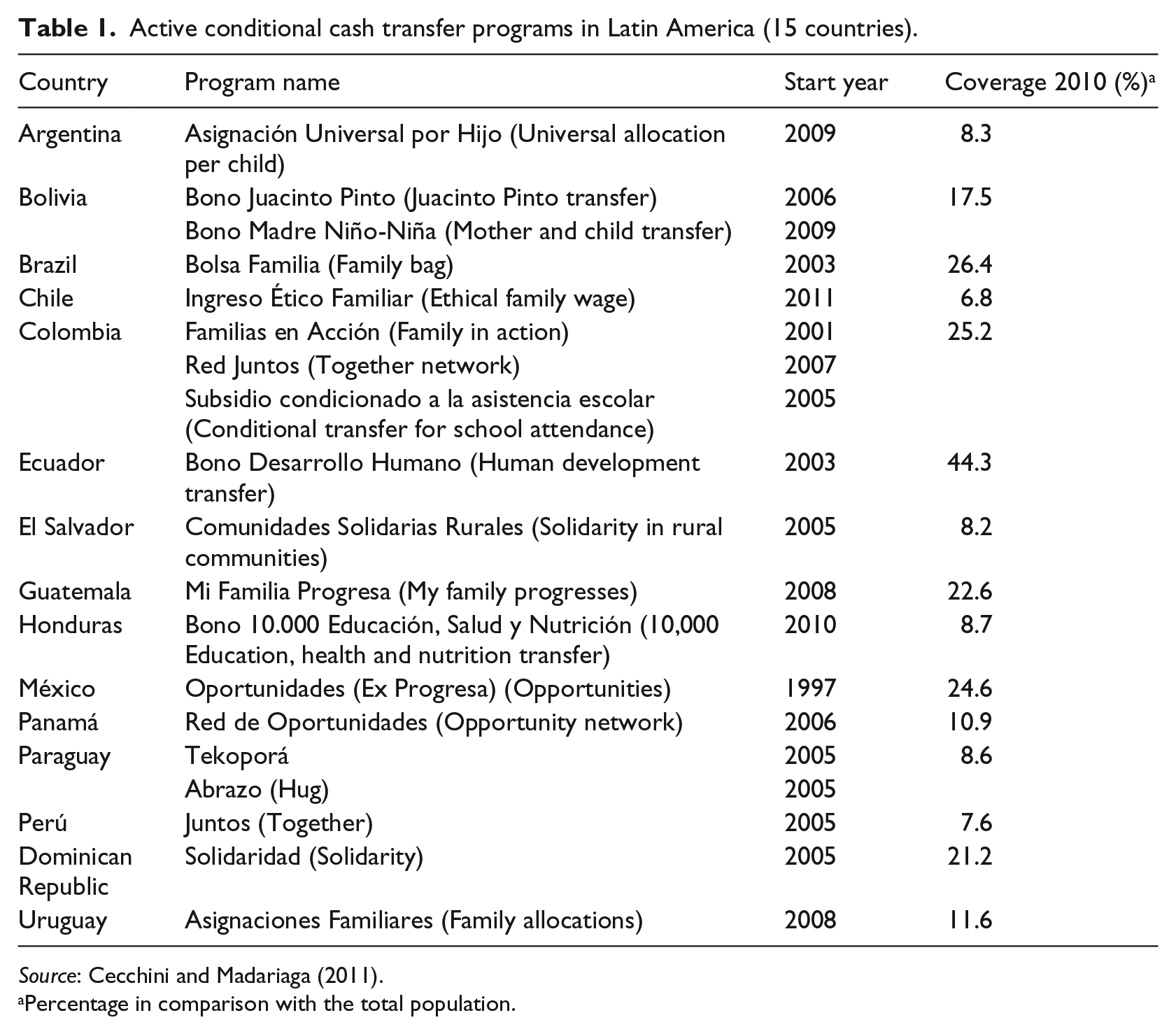
Source: Cecchini and Madariaga (2011).
Percentage in comparison with the total population.
A brief history of poverty programs in Chile
In comparison with other countries in Latin America, Chile has been distinguished as rapidly reducing its poverty rate over the last two decades, situating it as one of the countries with the lowest poverty rate in the region (Fernández, 2015). Despite this positive distinction, Chile has a turbulent history of social policies aimed at poverty reduction.
In Chile during the late 1960s and early 1970s many of the policies aimed at curbing poverty had a collective focus that sought to empower disenfranchised communities to actively partake in their citizenship and improve their well-being (Larrañaga, 2010; Raczynski, 2008). This progressive focus on poverty reduction was briskly cut short with the military coup of 1973. Policies during the military dictatorship of Augusto Pinochet (1973–1990) greatly reduced and privatized many arenas that were previously attributed to the state, such as education, social security, and health. The focus of poverty programs changed radically as well, seeking to insert individuals into the market through employment programs rather than the empowerment of disenfranchised groups. Emblematic programs implemented during this period were the Minimum Employment Program (Programa empleo Mínimo (PEM)) initiated in 1975 and the Occupational Program for Heads of household (Programa de Ocupación para Jefes de Hogar (POJH)), implemented in 1983, which sought to curb the high unemployment rate through precarious employment insertion at the municipal level (Larrañaga, 2010).
A second historic development during Pinochet’s dictatorship was the creation of the socioeconomic characterization survey (ficha de caracterización socioeconomic (CAS)) that sought to efficiently identify and target state aid to those in need of or those ‘worthy of’ state aid (Ruz and Palma, 2005). These programs were insufficient in adequately responding to the needs of a growing poor population and in 1990, when Chile began its transition to a democratically elected government, the country registered close to a 40 percent poverty rate (Denis et al., 2010).
The return of democracy in 1990 marked a sharp paradigm shift with regard to state programs aimed at reducing poverty. The government announced the objective of striving toward greater equality and social justice, not only targeting priority groups such as children, youth, female heads of household, ethnic minorities, older adults, and people with disabilities (Ruz and Palma, 2005), but also with a focus on human rights and active citizen participation (Raczynski, 2008). Nevertheless, while the poverty rate presented a constant reduction from 1990 to 2006, the indigent rate, or extreme poverty, remained stagnant. It was due to the stagnation of extreme poverty that in 2006, the Lagos presidency (2000–2006) announced the creation of the Chile Solidarity Social Protection system (Chile Solidario) whose objective was to address the needs of families living in extreme poverty.
One of the pillars of the Chile Solidario system was the Bridge program (Programa Puente) that sought the active participation of indigent families in overcoming poverty through their insertion in the public welfare system (Larrañaga and Contreras, 2010). As shall be discussed in this article, social work played a central role in the Bridge program. Social workers not only implemented the program on the ground, but also played a protagonist role in its design, utilizing theories and methods espoused by the profession as well as a human rights framework (Saracostti, 2008).
Despite its innovative design, however, the Bridge program struggled with various implementation problems as well as evidence of its effectiveness (Carneiro and Galasso, 2007; Galasso, 2006; Perticara, 2007; Raczynski, 2008). It was with the arrival of the first right wing government since the return of the democracy in 2010 that Chile began a redesign of its poverty programs, implementing the Ethical Family Wage program (Ingreso Etico Familiar), which borrowed heavily from the conditional cash program designs that had been overtaking poverty policy in Latin America and the rest of the developing world (Fiszbein and Schady, 2009).
Chile Solidario and the Bridge program
The Chile Solidario system was originally created due to the existence of a stagnant and hard to reach indigent poor population that experienced exclusion from reaping the economic benefits of Chile’s growing prosperity (Larrañaga and Contreras, 2010; Trucco and Nun, 2008). Under the assumption that families living in extreme poverty experienced exclusion from public services and programs, the Chile Solidario system was based on three central components:
a psychosocial family support program (Bridge program);
preferential access to social welfare programs;
guaranteed access to state subsidies.
The Bridge program (programa Puente) was perhaps the most celebrated and innovative aspect of the Chile Solidario system in that it provided families with an individually tailored psychosocial support program designed with the family and in coordination with a family support professional (apoyo familiar). This component of Chile Solidario was designed under the supposition that poverty was a multidimensional phenomenon that required a holistic family-based intervention (Ruz and Palma, 2005). The Bridge program had a two-year duration in which families were expected to complete 53 minimum conditions in seven distinct dimensions, which included identification (i.e. having the necessary state documents), health (i.e. being enrolled in the local health clinic), education (i.e. children enrolled in school), family dynamics (i.e. participating in family sessions), housing (i.e. adequate housing), employment (i.e. being employed), and income (i.e. securing the minimum income required). At the end of the 24 months, participating families were expected to meet the 53 basic conditions of the program in order to successfully graduate.
Family support professionals played a key role in working with families in order to meet the 53 minimum requirements by establishing a family work contract at the beginning of the program as well as monitoring their completion. Family support professionals were expected to work with families in a participatory manner through home visits, developing family skills and empowerment, as well as assistance in accessing state programs and subsidies. Family support professionals were considered the ‘entryway’ into the social protection system (Larrañaga and Contreras, 2010; Ruz and Palma, 2005).
While Chile Solidario was organized in the Ministry of Planning (Ministerio de Planificación), the implementation of the Bridge program was the responsibility of the solidarity and investment fund (Fondo de Solidaridad e Inversión Social (FOSIS)) and was put into practice locally in coordination with municipalities throughout the country. Family support professionals were either employed directly through FOSIS or employees of the local municipalities. Professionals employed by FOSIS consisted primarily of professionals or para-professionals from the social sciences, while in the case of municipalities, family support professionals were not required to comply with the same professional profile and were often professionals who had been employed in the municipalities for many years (Raczynski, 2008).
The role of social work in Chile Solidario and the Bridge program
Social work played a key role in both the design and the implementation of the Bridge program (Saracostti, 2008). In 2000, the Ministry of Planning, preoccupied with a stagnant indigent rate, undertook the mission of assessing the situation of families living in situations of extreme poverty in the country and designing a program in order to meet their needs. The assessment and design of the new program were led by Veronica Silva, a social worker, head of the social department in the Ministry of Planning. Several programs run by municipalities and non-governmental organizations (NGOs) were examined in the development stage, and a number of elements were borrowed from programs implemented by Fundación Rodelillo as well as the municipalities of La Florida and Quillota.
These programs were unique due to their holistic and integral focus in which interventions were targeted specifically to families living in poverty. Based on these previous experiences, the Bridge program was designed utilizing social capital, social networks, and crisis intervention as conceptual frameworks (Ruz and Palma, 2005), theories, and models widely used in social work.
The role of social workers in the design of the Bridge program was also reflected in its ideological values. The program, as well as the larger social protection policy, was devised under a human rights framework seeking to guarantee families social, economic, and cultural rights. Specifically the Bridge program, through its mission of informing families of their rights and guaranteeing their preferential access to state services and resources, concretized a human rights approach (Ministerio de Planificación Social, 2004). While such a human rights focus was an innovation for social policies and programs in Chile, human rights have been a central and foundational value of the social work profession (Ife, 2008; International Federation of Social Workers (IFSW), 2014). One could suppose then that the participation of the social work profession in the design of the Bridge program as well as the social protection system played a role in the adoption of a human rights framework.
Social work also played a key role in the implementation of the Bridge program (Saracostti, 2008). Family support professionals employed by FOSIS were mostly professionals or para-professionals from the social sciences, with FOSIS openly preferring social workers to assume this role. It was presumed that social workers had the necessary skills required to work closely and intimately with families under a crisis intervention model, while using empowerment techniques in order to increase families’ social capital and insertion in the state’s social protection system (Larrañaga et al., 2014; Ruz and Palma, 2005).
The family support component and the professionals who implemented the program were the highest evaluated features of the Bridge program (Larrañaga et al., 2014). Families consistently identified the relationship forged with the family supports, as well as the information obtained from family supports through home visits, as the aspects they most valued in the program. Participants who had once qualified the State as distant and uninterested, highly valued the State’s initiative in forging closer relationships through family support professionals. Personalized home visits not only permitted tailoring interventions specific to each family’s context but also a space from which to reflect on their goals and processes (Trucco and Nun, 2008).
Nevertheless, despite their central role in the implementation of the Bridge program, family support professionals worked under precarious labor conditions. Family support professionals were paid little and were hired on a part-time basis, thus excluding them from health and security benefits. Family supports were often expected to attend a caseload of over 70 families without the necessary infrastructure to do so, specifically lack of transport and technology. Due to the precarious labor conditions, the Bridge program had a very high professional turnover, which restricted to some degree the relationship that could be forged between participants and family support professionals (Raczynski, 2008). Other critiques of the program also abounded, centering on the lack of success in supporting families out of poverty, critiques which ultimately led to the demise of the program.
Transition and implementation of the Ethical Family Wage program
The lack of evidence of the efficacy of the Bridge program in reducing extreme poverty (Carneiro and Galasso, 2007; Galasso, 2006; Hoces et al., 2011; Martorano and Sanfilippo, 2012; Perticara, 2007; Trucco and Nun, 2008) was one of the main reasons for its demise. The election of the first right wing presidency since the return to democracy was the second instigator of the program’s decline. Adopting the ‘ethical family wage’ concept originally coined by Cardinal Goic in 2007, in reference to the need to augment the minimum wage in Chile in order to provide families with a living wage, Piñera’s right wing government began to promote its new Ethical Family Wage program (Larrañaga et al., 2014).
The design of the Ethical Family Wage program was initiated during Piñera’s 2009 presidential campaign. During his campaign, Piñera created a commission assigned the task of developing a program to ‘end extreme poverty’ during his four-year mandate (2010–2014) (Kast, 2013). The group assigned the mission was led by Rodrigo Vergara, an economist, and included other professionals with similar educational backgrounds (Henoch and Troncoso, 2013). Centered on the argument that all should have the right to escape poverty through employment and entrepreneurship, the program proposal centered its focus on increasing employment options for the poor (Kast, 2013). The original proposal developed by the commission recommended an extension of the youth employment subsidy to all those living in poverty, as well as increasing the amount of the monetary family subsidy. The receipt of the subsidy was, however, conditioned on school attendance and child health checkups as well as employment training initiatives, borrowing heavily from traditional CCT program methodologies (Huneeus and Repetto, 2013).
Taking into consideration the elements proposed by the commission, as well as the positive evaluations of the psychosocial accompaniment of the Bridge program, the new program expanded on its bases and included a socio-employment accompaniment component (Hernando, 2013). The socio-employment component consisted of an individually tailored accompaniment by a professional in the area of employment-seeking. This professional was to aid the family in accessing training, employment opportunities, and the development of business entrepreneurships. Socio-employment professionals and family support professionals were to work in collaboration with one another, but interventions were to be separate and undertaken by different professionals. Furthermore, the title used to refer to the roles of family supports was changed to ‘family advisors’, due to what was considered a transition from a welfare dependency model to one of empowerment (Kast, 2013). The shift in ideologies between the Bridge program and the Ethical Family Wage program is perhaps best visualized in this addition of an employment accompaniment component. Unlike the Bridge program in which the empowerment of families was sought through the psychosocial accompaniment of the family and incorporation into the public welfare system, in the Ethical Family Wage program, empowerment was theorized as being a product of inclusion in the market through formal employment and/or entrepreneurship ventures.
The emphasis on the protagonism of the market with regard to the Ethical Family Wage program was also evidenced in the name of the program (including ‘Wage’ in the title versus Bridge as the previous program name) as well as the increased attention to the cash transfer component of the program. While the Bridge program also included a cash transfer component, it was minimal in value and not considered a central element to the program. The Ethical Family Wage program in comparison introduced three separate but complementary categories, or ‘pillars’, of cash transfers.
The first cash transfer pillar of the Ethical Family Wage program consists of a ‘dignity cash transfer’ which consists of two separate transfers, the first of which is a ‘base transfer’ per family and the second, a ‘protection transfer’ calculated per person. The base transfer translates into approximately US$27 and the per person transfer approximately US$13 per person. The second pillar, called the ‘duties transfer’, consists of CCTs for healthy child checkups as well as 90 percent school attendance for elementary and middle school children and 85 percent school attendance for high school students. The amount for the CCTs translates into approximately US$17 monthly. Finally, the third pillar of the family wage program constitutes the ‘achievement transfers’, consisting of cash transfers for female employment, school achievement, and high school graduation. The female employment transfer is a monthly transfer and is calculated based on the wage received by each woman. The school achievement transfer is a yearly transfer and applies for those children who are at the top 30 percent (approximately US$63) and top 15 percent (approximately US$104) of their class. The high school graduation transfer is a single transfer of approximately US$125 (Cecchini et al., 2012).
The Ethical Family Wage program was partially implemented in 2011, under the name of the Family Allocation program, and in May of 2012 was signed into law as the Ethical Family Wage program (Hernando, 2013). Critiques and commentaries of the program were quick to appear. Some argued that it differed little from the Bridge program, since on paper the Bridge program also included CCTs through the family subsidy but those conditions were never enforced (Hernando, 2013). Others pointed out that the main difference lay in the socio-employment accompaniment component (Irarrázaval et al., 2012; Larrañaga et al., 2014); however, concerns were raised on implementing the socio-employment component separately from the psychosocial accompaniment component due to the fragmentation of services. Concerns were also raised with regard to the low wages and lack of benefits workers implementing the psychosocial component faced, an issue that failed to be addressed by the new design of the program (Irarrázaval et al., 2012). Others critiqued the transfers for school achievement, arguing that it pitted children living in poverty against each other since they were competing against each other in order to achieve a place in the top 15 and 30 percent of their class (Henoch and Troncoso, 2013; Irarrázaval et al., 2012). It was also pointed out that in Chile, school attendance was above 85 percent and the coverage of healthy child checkups was relatively high even before the implementation of the Ethical Family Wage program, thus calling into question the effectiveness and efficiency of the conditional transfers (Henoch and Troncoso, 2013).
The role of social work in the Ethical Family Wage program
As previously mentioned, the largest differences between the two programs lay in the ideologies and language used in their designs. While the Bridge program’s underlying premise for overcoming extreme poverty lay in developing social capital and addressing exclusion through the access to welfare services and psychosocial support, the Ethical Family Wage program was based on the premise that employment was the only solution to extreme poverty (Kast, 2013). In its initial design and implementation, proponents of the Family Wage program argued that families living in extreme poverty should have the ‘liberty’ of choosing their life, that families should overcome poverty through ‘responsibility’ and individual effort and that the State’s responsibility rested primarily in providing individuals with the tools necessary to make those decisions (Arellano, 2013). The language used in the program design can be attributed to the economic and business backgrounds of the majority of the program’s designers, which is a stark difference from the social sciences background of the Bridge program developers.
A further notorious difference between the Bridge program and its successor was the lack of a human rights framework. While human rights was a dominant discourse in the Bridge program, such a focus was notoriously absent from the ethical family wage vocabulary. The absence of a human rights framework further demonstrates the lack of incidence of social work in the program’s design.
Social work was not only limited in its role in the design of the Ethical Family Wage program, but was also delegated and restricted to the sole implementation of the psychosocial component (family advisors) with some social workers also assuming the new role of the socio-employment component (employment advisors). Such was the limitation of frontline professionals that the needs assessments of families, previously undertaken by family support professionals in the Bridge program, was reassigned to professionals at the Ministry of Social Development (Kast, 2013).
Family interventions were thus pre-established at a central level and delegated for implementation by frontline municipal professionals. Little if any flexibility was allowed with regard to Ministry-level established guidelines for interventions. Both family advisor and employment advisor interventions were described in great detail in program manuals, indicating pre-established family sessions with clear objectives, activities, and expected outcomes (Ministerio de Desarrollo Social, 2013). Social workers thus became mere implementers of the government’s Ethical Family Wage Program.
Discussion: Challenges for social work
It is evident that even though the Ethical Family Wage Program shares some similar methodological characteristics to the Bridge program, poverty is conceptualized from a different ideological framework, thus proposing a new strategy for its intervention through the market. Greater emphasis is now placed on the cash transfer component of the program as is visible from the program creation of three distinct types of transfers (dignity, duties, and achievement).
However, this article reveals some of the shortcomings and controversies of CCT programs in Latin America, specifically in Chile. In the latter, the difficulty posed by ideological differences in the conceptualization of poverty, and thus the design of interventions, reveals shortcomings in the country’s developmental model. Chile’s tumultuous political history has led to a paradoxical democratic process in which socialist governments put into practice neoliberal policies that have improved macro-economic indicators without eradicating poverty and extreme poverty and have failed to address the country’s rampant inequality (French-Davis and Stallings, 2001; Raczynski and Serrano, 2005).
Furthermore, difficulties arise due to the changes in government coalitions and the changes in the ideologies behind the design of poverty eradication programs. Over a period of 15 years, Chile has transitioned from socialist regimes (Lagos, 2000–2006 and Bachelet, 2006–2010) to a more conservative right wing coalition (Piñera, 2010–2014) and back to a socialist-led government (Bachelet, 2014–2020). Each government has imposed changes to poverty eradication programs, thus leading to their discontinuity. These ideological shifts and program changes pose problems for the implementation of durable long-term poverty eradication initiatives.
A second challenge to poverty eradication in Chile is neoliberalism, which took hold of the country after the military coup of 1973 and continues to colonize social policy, limiting the chances of implementing changes since the protection of the market comes first and privatization continues to be considered more efficient.
Argentina poses an interesting comparison to Chile with regard to CCT due to its neighborhood status as well as its similar military dictatorship history. In comparison with Chile, Argentina has attempted to overcome the limitations of neoliberalism transforming into a postneoliberalism state (Aquín, 2014) in which the state is defined as benefactor (Fraser, 1997). The current ideology in Argentina aims to generate progressive redistributive policies that attempt to restructure the wealth of the country (Aquín, 2014). In comparison, Chile, through the Ethical Family Wage program, continues to demonstrate an approach in which the market is protagonist and in which ‘beneficiaries’ can only escape poverty through entrepreneurship and employment (Irarrázaval et al., 2012). This logic privileges the market, suggesting improving the quality of life of individuals and families lies in their role as consumers rather than citizens with guaranteed access to rights and social benefits (Carballeda, 2006, 2014). In comparison, in Argentina, the CCT program takes a different stance, considering the return of social rights a priority over the insertion into the market (Aquín, 2014). Furthermore, the program does not include an employment component as in Chile’s Ethical Family Wage program.
Chile confronts the challenge of rethinking both the structure of the state and its ideological foundation in order to design and implement social policies with a human rights focus. Such a change will allow for transformation in the social structure, which will lead to an effective change with regard to poor families’ well-being. If this is not undertaken, the State will fail to complete its role as benefactor, delegating responsibility to families and failing to address the structural roots of poverty.
Closely related to this broader context of discussion are the role and challenges for social work in the implementation and design of the Ethical Family Wage program. As we know, social work’s core principles are social justice and human rights. Social workers are ascribed the social and political responsibility of influencing and contributing to the design and implementation of such programs and policies. Here lies the central role of our discipline.
Social work can specifically contribute to the design of social policies aimed at decreasing poverty both in identifying the particularities of each territory and in the recognition of poverty’s complexity and multidimensionality. The importance of identifying the particularities of each territorial context is key to meeting the specific needs of the individuals living in that particular area (Oneto, 2000). Social workers, through their direct insertion in specific contexts, acquire knowledge that is crucial to translating local needs to central-level social policy design (Oneto, 1996, 2003). Furthermore, social work can play a central role in fomenting local participation in the design and development of poverty programs through participatory action mechanisms. Such actions would allow for the design of flexible programs that recognize territorial differences.
According to Norma Fóscolo (2006), the epochal ethos tends toward the valorization of certain epistemological and practical worldviews, and social work today must fight against the trend toward the mere technical and non-critical implementation of social programs and policies (Muñoz and Vargas, 2013). As highlighted by Saül Karsz (2007), the relevance of social work lies in its capacity to navigate complex contexts in which economic, political, legal, educational, moral, and sexual dimensions intertwine. It is in this complex scenario that social work must co-construct policies and programs that prioritize human rights, personal and family autonomy, and empowerment in order to overcome situations of poverty.
On a larger scale, it is necessary and urgent that social work expands opportunities for reflecting on its practice as well as the foundations, design, and implementation of social programs. The contribution of social work lies in its practice (Muñoz and Vargas, 2013); however, it is challenged to overcome a ‘tecnified’ practice that lacks clear epistemological and theoretical roots (Matus, 2004). It is through this reflection that social change and transformation can come about. It is necessary for social work to argue for a holistic multidimensional understanding of poverty that allows for the design of integrated social programs that aim to successfully intervene in complex social realities, taking into account multiple dimensions. Furthermore, social work can also enrich policies and programs with a citizenship approach as well as a human rights and social justice framework, through the recognition of difference (Muñoz, 2008). This challenge is no small feat for social work.
To add a further challenge, while CCT programs may serve redistributive purposes, further awareness must be raised with regard to the role of recognition (Fraser and Honneth, 2006). The focus of social justice over the last 150 years has primarily centered on the redistribution of resources and wealth with some recent but minimal linkage to the recognition of differences (Fraser and Honneth, 2006).
According to Fraser and Honneth (2006), however, social justice must address not only economic inequality, but also the recognition of difference. Under this framework, addressing structural injustices will not be achieved through cash transfer programs since they do not recognize cultural and structural inequalities and their impact on poverty. This calls for not only a change in program methodologies, but also the promotion of cultural changes aimed at the construction of greater equality and justice in community relationships. These are interesting challenges for social work.
As previously discussed, social work can play a relevant role in adding this component to CCT programs. There is a need and a challenge to build a ‘culture of recognition’. This allows for the de-stigmatization of the programs’ beneficiaries as well as generating a change in the structural reproductions of poverty, highlighting the importance of human rights, autonomy, and empowerment (Aquín, 2014; Muñoz, 2008). This allows for dialog between the economic and cultural dimensions of the program.
With regard to the concept of recognition, social work ethics play a central role. Our profession and academic discipline identifies as its first imperative the recognition of an ‘other’ through its values of social justice, human rights, collective responsibility and respect for diversities (IFSW, 2014). Chile’s current ethical code of conduct also identifies recognition as a key element of social work (Colegio de Trabajadores Sociales de Chile, 2015), further strengthening social work’s ethical responsibility in reducing poverty in the country.
In this final section, we have addressed challenges to the profession with regard to CCT programs as well as broader social policies. Furthermore, the specific challenges for social workers in Chile with regard to the Ethical Family Wage program lie in recapturing a protagonist position in the design, implementation, and evaluation of the program, as was the case during the previous Bridge program. In order to effectively address poverty in the country, social policies in Chile must favor an empowerment approach in which human rights and diversities are recognized.
Footnotes
Funding
This research was funded by the Jorge Millas Grant, Universidad Andres Bello.