




Abstract
This study highlights social work’s response to socio-cultural diversity by investigating the reality of multiculturalism in social work curricula vis-a-vis the Global Standards debates. Content analysis technique is used from a transcendental perspective to explore the attributes of multiculturalism in social work curricula via the online directory of the International Association of Schools of Social Work. Each curriculum reflects relative attributes of multiculturalism, identifiable as tenets of the Global Standards – a tool for modeling social work education across cultures. A new theory and a practice model for international social work also emerged from the study, and are proposed for testing.
Keywords
Introduction
Against the background of interdependence among nations and continual human migration, scholars are wondering how social work education is responding to trends (Jones and Truell, 2012; Lalayants et al., 2012; Nagy and Falk, 2001; Powell and Robison, 2007). One concrete response is the Global Standards for Social Work Education and Training (hereafter referred to as the Global Standards and abbreviated as GS) published in 2004 by the International Association of Schools of Social Work (IASSW) and the International Federation of Social Workers (IFSW). Both international associations reflect the professionalization of social work (Midgley, 1995). Another tangible response is the emergence of International Social Work (ISW), now a specialization in the profession (Lyons, 2006). However, both ISW and the GS are being theoretically criticized simultaneously (see Gray and Fook, 2004; Yip, 2004).
One criticism common to the two responses focuses on the emerging unified identity or universalism of social work, of which Gray and Webb (2015: 194) asserted that the ‘proponents of “global social work” fail to recognize its enriching communitarian value’, and of which, in a discourse on ISW, Haug (2005: 127) asserted that social work has become ‘the colonialist project that has dismissed and displaced countless cultural systems around the world’. These issues have since developed into debates with the subthemes of globalization versus localization, Westernization versus indigenization, multiculturalism versus universalization, and universals versus local standards (Gray and Fook, 2004; Gray and Webb, 2015). In his argument against a single identity of social work in Europe, Payne (2014) opined that the idea of a single identity of social work is inappropriate; even Brydon (2011: 155) expressed dissatisfaction with the idea of spreading hegemonic ‘Western social work’. Nevertheless, both the theoretical and empirical responses to the issue of the GS displacing local cultural systems or communitarian values have made references to multiculturalism (Barretta-Herman, 2008; Sewpaul, 2005), and social work curricula provide for courses on multiculturalism (Walker and Staton, 2000). Hence, this article aims to empirically investigate the reality of multiculturalism in social work curricula internationally vis-a-vis the GS.
While the ISW program has become a reality as a response to current global social trends (Midgley, 2001; Powell and Robison, 2007) and institutionalized with many universities offering the program (Lalayants et al., 2012), the GS has also been institutionalized through its documentation (IASSW and IFSW, 2004), which subsequently elevated the status, legitimacy, and global identity of social work (Barretta-Herman et al., 2014). Yet the GS scholarly debate is still raging (see Gray and Webb, 2015). Therefore, this study uses the content analysis technique (Miles and Huberman, 1994) from a transcendental realism perspective (Miles and Huberman, 1986; Vassilopoulos, 2011) in contextualizing the data analyses and to explore the content or attributes of multiculturalism in the social work curricula of active social work schools listed in IASSW’s online directory.
The IASSW directory (n.d.) serves as a database to purposefully map-out the scope of this study’s data, that was gathered from countries located in the geographical region of the world map encompassing 10°–40° north of the equator – which Geib (1997) described as being the nations that are home to most of the world’s civilizations – in order to examine their ethno-cultural worldviews and the implications those views have on social work curricula. The directory is also used to locate social work schools from countries tagged as being ‘traditional countries of immigration’ (Kymlicka, 2007; Scheffer and Waters, 2011) because they are foremost in the implementation of an annual national origin quota system that is used to welcome immigrants from different countries across the globe. Thus, they have become model settings for the promotion of coexistence in diverse ethno-cultural circumstances.
One significance of the present study is that it empirically addresses the social work response to the global trend in ethno-cultural diversity. Another significance is that it empirically highlights the concrete link between the GS, as a response, and social work curricula, because as Yip (2004) argued, different conceptual orientations have been given to issues of globalization, indigenization, exchange, and development of social work education. Finally, the study is one of very few that has made an empirical contribution to the GS debate, as distinguished from the theoretical perspectives that have dominated the discussion.
In essence, the article reviews the GS and clarifies ‘multiculturalism’ as used in the present study. It also reviews published work that highlights different types of curricula and curricular research in social work. The reviews create a background for the empirical exploration of the inclusion of multiculturalism in social work curricula. The conclusion section integrates the previous sections to highlight the reality of multiculturalism in social work curricula vis-a-vis the GS.
The GS and multiculturalism in social work
The GS
The paradigmatic openness of social work helps the profession to respond to new challenges, ideas, and developments (Lorenz, 2001). This virtue is also inherent in the GS, which came into existence in 2004. The GS derived its legitimacy from a resolute attempt to resolve the apparent ambiguities, tensions, and contradictions in the identity of social work across the globe (IASSW and IFSW, 2004; Sewpaul and Jones, 2004). The GS has been defined as a unified set of standards for social work education globally (Yip, 2004), also as a document developed to act as a guide to social work education and development everywhere (Gray and Webb, 2015; IASSW and IFSW, 2004; Sewpaul and Jones, 2004). The GS contains nine sub-standards to guide the education, development, and practice of social work, and the provision of professional staff, as well as the criteria that should govern the behavior of students in a diverse socio-cultural environment. The attributes of multiculturalism that are articulated in the core purpose of social work are critically important to this present study. These include the promotion of ‘respect for traditions, cultures, ideologies, beliefs, and religion among ethnic groups and societies, in so far as these do not conflict with fundamental human rights of people’ (IASSW and IFSW, 2004: 3). Multiculturalism attributes are also present in the section of the GS on the development of program curricula, which advocates the ‘recognition and development of indigenous or locally specific social work education and practice from the traditions and cultures of different ethnic groups and societies, insofar that such traditions and cultures do not violate human rights’ (IASSW and IFSW, 2004: 5). The issues of human rights that are addressed in this article are those that have been identified in the International Declaration on Human Rights and the UN Vienna Declaration of 1993 (IASSW and IFSW, 2004: 11).
The eighth standard of the GS encourages social work schools to enrich the educational experience of students by integrating cultural and ethnic diversity as well as gender inclusiveness into their curricula. Moreover, social work programs should encourage students to know themselves as members of a collective socio-cultural group. The GS has also asserted that students should have the opportunity to develop self-awareness in relation to their cultural values, beliefs, traditions, and biases, and understand how these might influence their interactions with diverse populations. This will minimize group stereotypes and prejudices; it will also reduce ethno-cultural bias in social work policies and practices. In addition, Sewpaul (2005) asserted that the document is not intended to be a finite, static end product, and in the interest of deepening our commitment to social justice, human rights, inclusivity, international dialogue and responsiveness to users we have consistently questioned the value of what we are doing and how we are doing it. (p. 211)
Yet Gray and Webb (2015) insisted that the GS still remains a vain attempt to respond to globalization, and that IASSW and IFSW – the proponents of the document – are in need of a strong dose of reality.
Furthermore, Gray and Webb (2015) asked, ‘in densely multicultural societies how does one include the traditions and cultures of different ethnic groups and societies in the core curricula in social work education programs modeled on international standards?’ (p. 2). This argument does not agree with Potocky’s (1997) view, which stated that the present wide range of social work practices in the United States obscures the fact that the profession has its roots in cross-cultural work with immigrants (see also Abrams and Gibson, 2007). Payne (2005) also argued that social work is socially constructed; however, the GS extended the idea of social construction of social work to encompass ‘local, national, and/or regional/international needs and purposes’ (IASSW and IFSW, 2004: 6). Thus, the scope of a construction of social work depends on a particular sociocultural policy context, which subsequently might have an impact on specific curricular objectives.
Multiculturalism
Multiculturalism in social work illustrates the multicultural heritage of the profession because its practices include the existing global ethno-cultural domains and their social institutions. In other words, before the popularity of the concept of multiculturalism in social work, Smalley (1967) argued that the purview of social work is not limited ‘to one kind of person, to no one class, or group, to no one category of social problem nor to the use of any one method in the sense of working with individuals, groups, or communities’ (p. 3). Hence, multiculturalism in social work predates the emergence of the GS, as noted by Potocky (1997), who identified three modes of multicultural social work in the United States, and Abrams and Molo (2009: 246), who asserted that cultural competence is often called ‘cultural sensitivity or multicultural model’ and that the evolving emphasis on cultural diversity in social work has its roots in the US civil rights movement of the 1960s and 1970s.
Potocky (1997) also stated further that the assimilation model of the 1870s and 1950s focused on reforming individuals, and demanded that ethnic migrants renounce their culture, languages, and ethnic institutions and conform to Anglo norms (see Table 1).
Modified Potocky (1997) models of multicultural social work

Potocky (1997) argued that the assimilation model was contested by the Settlement House movement, whose approach was based on the pluralist philosophy that regarded all cultures as equally valid; consequently, that model focused on improving neighborhoods and changing social conditions. He also argued that the cultural sensitive approach of the 1990s was similar to the Settlement House approach as its goal was to change the way social workers relate to minorities. However, this approach concentrated on the minorities who are the victims of discrimination. Consequently, attention was shifted to both the minorities and the majorities, and, as Abrams and Gibson (2007) argued, the merger of culturally sensitive and anti-racist models led to the emergence of the multiculturalism model of social work (or ‘multiculturism’ in Goldberg, 2000: 12).
Abrams and Gibson (2007) also identified three pedagogical models which emerged in the process of developing multiculturalism in social work education (pp. 149–50). The first model, the Inter-group Dialogues Method, incorporates face-to-face meetings among students of different diverse backgrounds. The second approach, the Transformative Multicultural Social Work Education Model, uses four schemas of ethnocentrism, information, curiosity, and reflexivity to enhance students’ cross-cultural learning. The third approach, the Inclusionary Cultural Model, moves students from an outsider’s position to an insider’s position with clients by making use of social cultural theory and classroom experiential activities. Abrams and Gibson (2007) added the fourth model, Teaching White Privilege, which addresses the privilege enjoyed by the majority ethnic group in an ethno-culturally diverse context (p. 150). Thus, in social work, multiculturalism is a complex concept that embraces many other concepts commonly associated with or descriptive of ethnic relations.
However, the development and application of multiculturalism in social work has resulted in conflicting interpretations of this concept. For example, Goldberg (2000) identified three types of conflicts in multicultural social work: ‘conflicts between respecting the contents of all cultures versus supporting basic human rights’, ‘conflicts between inability to understand the needs and views of people from different cultural backgrounds versus mission to practice social work’, and the ‘conflict between social worker’s own right to ethnic preference versus social worker’s obligation to eliminate personal cultural bias and prejudice’ (pp. 13–14). These conflicts underscore Gray and Fook’s (2004) arguments that multiculturalism is at odds with universal values and poses an ethical dilemma for social workers. However, Walker and Staton (2000) suggested that multiculturalism should be repositioned in the 1999 National Association of Social Work Code of Ethics as a principle of ethical practice rather than a specific knowledge area. Hence, arguments, contradictions, and extreme interpretations are possible in social work due to what Lorenz (2001) refers to as the flexibility, inclusivity, and accommodative nature of social work, which are also the virtue of the GS, as articulated in Sewpaul (2005).
Nevertheless, multiculturalism has developed many attributes in social work and in other disciplines, globally. For example, multiculturalism in social work often encompasses terms such as a culturally pluralistic society, anti-racism (Potocky, 1997); cultural sensitivity, cross-cultural social work, inclusionary social model (Abrams and Gibson, 2007); and cultural diversity (Atherton and Bolland, 1997; Van Soest, 1995). In social philosophy and social policy, similar multiculturalism attributes can be found, including cultural diversity (Inglis, 1996) and the philosophy of social relations (Esikot, 2012). Kymlicka (2007) used ‘diversity policies, cultural rights, community rights, group rights, differentiated citizenship, pluralist constitutionalism, liberal pluralism’ (p. 17). He argued that the concepts of cultural and ethnic diversity are defined as the best practices of multiculturalism. Thus, the increasing amount of contents about and attributes of multiculturalism in scholarly literature can be regarded as one way in which multiculturalism is addressed in the field of social work, globally.
In social work, and for the purpose of this present study, one possible version of the social construction of multiculturalism is the multiculturalism attributes found in social work curricula and in the GS. Hence, the empirical aspects of this article examine the curricula of social work schools which are available in the English language on the Internet, across different countries and cultures, in order to determine how the content and attributes of multiculturalism are clustered in those curricula, and their connections with the GS. However, before the empirical investigation, this article reviews how previous research studies on social work curricula have examined this phenomenon.
Review of curricular research in social work
It is possible to use the two universal definitions of curriculum, as illustrated in both Law (2003) and Tyler (1949), as strategies that can be used to develop social work curricula in order to address the social welfare needs of people. The first description refers to a curriculum as the educational experience provided for learners in specific contexts, while the second defines curriculum as the educational objective in particular contexts. A few of the available qualitative social work papers in the literature fall under the first description. For example, Daniel (2011) empirically examined the perceptions and experiences of 15 minority social work graduate students in relation to their curriculum and evaluated the meaning they assigned to their experiences. That study found that the negative socializing experiences of social inequality necessitated a restructuring of the program’s curriculum in order to address the reproduction of social inequality among the program’s diverse students. Trygged and Eriksson (2012) also explored undergraduate students’ perceptions of ISW’s educational programs in two European cities. They discovered that many students wanted further knowledge about international issues in domestic settings, and they also yearned to work in other countries. Nevertheless, the two studies portray the concrete trends of multiculturalism and the international dimension of social work curricula.
The second definition describes a curriculum as the educational objective in particular contexts. In this regard, a few of the published articles in the literature used quantitative techniques. The first was an IASSW survey in response to the absence of a worldwide database for educational programs in social services (Barretta-Herman, 2005). The re-analysis of the IASSW World Census 2000 profiled social work education worldwide and confirmed that significant similarities exist in the curricula of social work schools across the globe, but with notable regional differences. It also confirmed cross-national exchange relationships among the faculty (Barretta-Herman, 2005), which is one of the themes in ISW.
Barretta-Herman’s (2008) re-analysis of the 2005 IASSW membership survey, titled ‘Meeting the Expectations of the Global Standards’, re-confirmed consistency in social work educational programs across regions, though the eighth standard, which is concerned with cultural diversity, was not included in the study. However, another survey conducted by the IASSW in 2010 (Barretta-Herman et al., 2014) found that the spread of social work programs makes the profession a potential weapon for delivering social justice content, globally. In addition, a few studies conducted that examined social work curricula were not linked to the GS. For example, Falk (1999) surveyed social work literature about cross-cultural social work in the United States and found that social work schools are more preoccupied with ‘social and behavioral sciences and spend less time on inculcating attitudes and values or teaching specific cross-cultural practice skills’ (p. 1). Nagy and Falk (2001) also surveyed ‘how social work programs around the globe are responding to the changes in the world situation’; the outcome of the study has not yet been published (p. 49).
The literature portrayed a drive towards global consistency in social work education, and studies on the social work curriculum reflected the two universal descriptions of curriculum (as may be related to course content, mission, vision, and aims of social work programs); hence, both aspects of the curriculum are included in the examination of the contents or attributes of multiculturalism in social work curricula.
Methodology and empirical questions
Data gathering
The present study used purposive sampling (Rubin and Babbie, 2008) to gather data from the IASSW online directory, which is available at http://www.iassw-aiets.org/our-members/ (accessed in 2013, and re-accessed for validation on 10 October 2015 and on 16 May 2016), and which serves as a database of social work schools, worldwide. Currently, the database contains four categories in this order: School Members (n = 409), Affiliated Members (n = 5), Individual Life Members (n=2), and Individual Members (n = 221). The summation of the four categories comes to a total of n = 637 in the directory (see Figure 1).

Categories of International Association of Schools of Social Work (IASSW) members as of 10 October 2015.
The School Members of the IASSW category (n = 409 as of 16 May 2016 – the total was 417 in 2013) is the focus of this current exploration of multiculturalism in social work curricula. Among the school members of IASSW (n = 409), only schools with curricula in English were included in this present study to avoid the problem of linguistic equivalence in translation of the curricula (Hearn et al., 2004). However, because most of the eligible samples are from English-speaking countries, two geographical frameworks previously used in scholarly studies were deployed to purposefully map-out the scope of the data gathering. First, because ethno-religious/cultural issues are central to this study, and any extensively spread culture or religion has often been referred to as civilization (Huntington, 1993, 1996), the study focused on a few social work curricula in English (for Bachelor’s and Master’s degrees) available from countries located in the geographical region encompassing 10°–40° north of the equator, which Geib (1997) described as the birthplace of civilizations (see the illustration in Figure 2, modified from Google Maps).

A geographic illustration of 10°–40 degree north of the equator template.
Extraction of data from this region helps the study to discover how current worldviews or beliefs (aspects of civilizations) – Animism, Hinduism, Judaism, Buddhism, Shintoism, Taoism, Confucianism, Sikhism, Jainism, Islam, and Bahai (Geib, 1997; Huntington, 1993), which originated from different countries across Africa, the Middle East, and Central Asia – are reflected in social work curricula.
The second framework for gathering data consists of English-speaking countries – Australia, Canada, the United States (and later New Zealand) – which are noted for starting the implementation of annual national origin quota systems (and later skills and family unification criteria) for welcoming immigrants. These countries have been called Traditional Countries of Immigration (Duncan, 2012; Kymlicka, 2007; Scheffer and Waters, 2011; United Nations, 2004). Apart from the language eligibility, social work schools in Australia, Canada, and the United States generated Master’s degree curricula – the main data focus of this present research. However, New Zealand was excluded because most social work schools from that country do not post Master’s degree curricula on their websites, and some of the schools listed in the IASSW directory as being in New Zealand are repeatedly listed under the schools from China.
Data analysis
The study used the content analysis technique (Miles and Huberman, 1994) from a transcendental realism perspective (Vassilopoulos, 2011). Vassilopoulos (2011) argued that the phenomenon under investigation is conditioned by the various factors in its environment. In other words, the method helps the researchers to consciously contextualize the content or attributes of multiculturalism throughout the data analysis process (see also Miles and Huberman, 1986). Hence, each curricula in the present study is analyzed within the framework of the ethno-cultural factor(s) and worldview(s) that is dominant in its environment in relation to the concept of multiculturalism, first, from the countries located on the geographical region encompassing 10°–40° north of the equator, which encompasses about 61 countries. Consequently, the first research question is: What are the content or attributes of multiculturalism in the curricula of social work schools from countries located in the geographical region encompassing 10°–40° north of the equator? Similar content and attributes of multiculturalism are also explored in the curricula of social work schools from Australia, Canada, and the United States. Thus, the second question is: What are the content or attributes of multiculturalism in the curricula of social work schools in Australia, Canada, and the United States?
A total of 99 samples met the eligibility criteria for inclusion in the analysis. In the first set of samples, as of 16 May 2016 only 15 (initially 16 in 2013) of the 61 countries on the geographic 10°–40° north of the equator had schools listed in the IASSW Active Schools Members category. Of those 15 countries, only Bangladesh, Cambodia, China, India, Israel, and the United Arab Emirates (UAE) had a total of 18 schools available on the Internet with their curricular content related to multiculturalism posted mostly in their Bachelor’s curricula and strategic statements. However, the second set of samples posted content related to multiculturalism in their Master’s curricula and strategic statements, and as a result, 81 available curricula – 11 from Australia, 15 from Canada, and 55 from the United States – were accessed from this set. Thereafter, the category and description-based curricula, as well as strategic statements, are subjected to content analyses (Miles and Huberman, 1994; Rubin and Babbie, 2008).
Each curriculum was printed out, and a codebook and forms were developed to sort out the content and attributes of multiculturalism as they clustered in each school’s educational objectives vis-a-vis the (optional) course descriptions, and in relation to how each curriculum reflects their socio-cultural factors. The content or attributes of multiculturalism were later grouped and displayed in the results section under three main headings: Ethno cultural diversity and Human rights and social justice, which are derived from ‘multiculturalism best practices’ (Kymlicka, 2007: 167), and Themes in strategic statements generated from the eighth standard of the GS as regarding each social work school’s strategic (vision or mission) statements.
Results
On the one hand, the data analyses influenced by the transcendental realism perspective found a generic terminology of the worldviews or beliefs prevalent in the geographical contexts of the study’s samples. On the other hand, the data analyses identified relative similarities and differences in the content or attributes of multiculturalism, and, in a way, they reflected the tenets of the GS. In other words, the findings are presented in three phases. First, the worldviews are presented as reflected in social work curricula. Second, the similarities and differences are grouped together, with references to the content or attributes of multiculturalism. Third, from the pattern discovered in the data analyses, the study generated a theory and a new multicultural model for professional intervention in social work.
Heterogeneous worldviews reflected in social work curricula
One tangible attribute of multiculturalism is the use of ‘religion’ as a generic concept for worldviews or religions in the data. For example, China and Israel used the concept ‘other religions’ to describe worldviews. Thus, the referents to different religions or worldviews in a social work curriculum are reflections of multiculturalism and the GS tenets.
Relative similarities and differences in curricular content of social work schools
The analysis of social work Bachelor’s and Master’s degree curricula from the 10°–40° north of the equator countries revealed a clustering of content or attributes of multiculturalism in 18 social work schools from only six countries out of 61 (Table 2). The number of curricula displaying any of the content or attributes of multiculturalism is as appended in parentheses after each of the attributes listed in the table.
Clustered content or attributes of multiculturalism in the Bachelor’s and Master’s degree curricula of 18 social work schools from six countries across the 10°–40° north of the equator
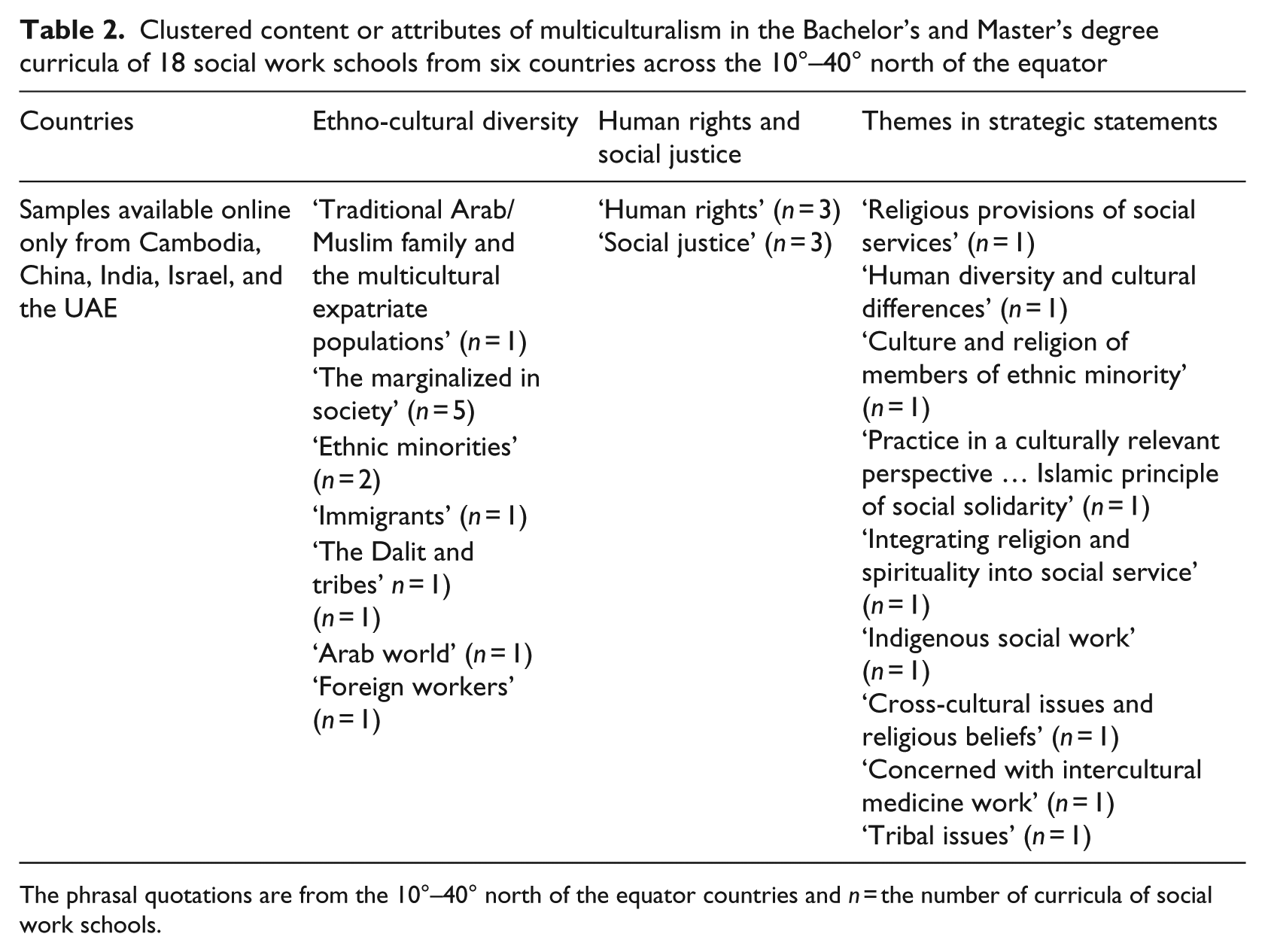
The phrasal quotations are from the 10°–40° north of the equator countries and n = the number of curricula of social work schools.
Most importantly, the schools’ curricula that are available on the Internet contain content or attributes of multiculturalism reflecting their ethno-cultural contexts with a human rights and social justice perspective. Moreover, the themes of the social work schools’ strategic statements (vision and mission) are all indications of their preoccupation with multiculturalism. In the traditional countries of immigration, the same features of multiculturalism are observed in the curricula of the social work Master’s degree (only). A total of 81 Master’s degree curricula from social work schools based in Australia, Canada, and the United States are clustered with content or attributes of multiculturalism as a result of those countries’ interfaces with global migrations. The themes in the strategic statements are also reflective of the schools’ core purposes and mission statements. The total number of curricula displaying each of the content or attributes of multiculturalism is shown in parentheses in Table 3.
Clustered content or attributes of multiculturalism in the Master’s degree curricula of 81 social work schools from the traditional countries of immigration
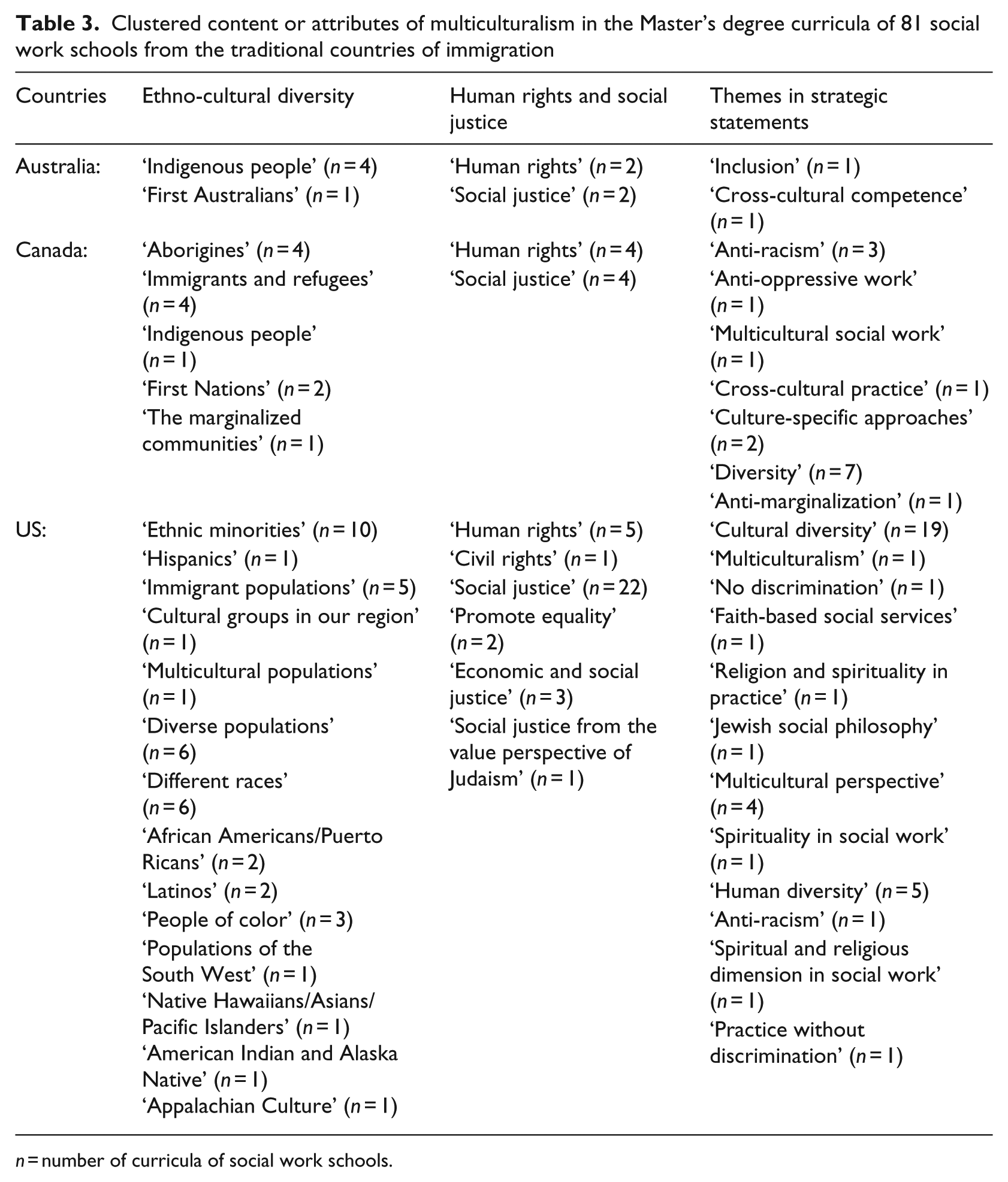
n = number of curricula of social work schools.
The relativity of ethnic focus among the samples, the similarities in human rights and social justice perspective, and the themes in their strategic statements are indicative of their preoccupation with multiculturalism, which are in tune with the primary concern of the eighth standard of the GS.
Consequently, the use of the transcendental realism orientation in the data analysis empirically highlighted the concrete content of multiculturalism in social work. The content is grouped under three headings: ethno cultural diversity (coded ‘E’) and human rights and social justice (coded ‘H’), as derived from ‘the best practices of multiculturalism’ (Kymlicka, 2007: 167), and both are connected to the third heading – themes in strategic statements (coded ‘T’), which consists of the mission, aims, and objectives of the various social work schools as reflected in the GS.
The curricular traditions of these social work schools are reflections of the prevailing social policies in the countries in which the social work schools are located (see Payne, 2001). Hence, the ‘E’, ‘H’, and ‘T’ codes symbolize aggregations (or ‘bins’ – Miles and Huberman, 1994: 18) of specific data in the study, although they can be used to generate extensive data across countries to comparatively study the ranking of multiculturalism in social work curricula. Subsequently, the emerging EHT conceptual groupings are used as aggregate indicators of multiculturalism in social work curricula, and they illuminate a new gradual sequence of approaching, interacting with, and building a relationship between social workers and people of diverse socio-cultural backgrounds. Hence, the study inductively theorizes the following: Multiculturalism in social work curricula reduces marginalization and encourages social inclusion, social justice and respect of people’s rights in ethnic diverse communities.
In addition, the study considered the EHT conceptual groupings from explicit and implicit assumption processes common to formulating theories in the behavioral sciences (Hollis, 2002; Sue et al., 1996). The assumptions are the rationales for a particular new theory and the gap that is subsequently filled. In this present case, it is used to develop a new practice model called the EHT Model. On the one hand, an explicit assumption of the EHT Model is the rationale that is obvious in the aggregated data (see Tables 2 and 3). On the other hand, an implicit assumption of the EHT Model is its uniqueness in application, as obvious in the direction of the arrow in Figure 3.

The EHT Model for social work intervention in multicultural/international contexts.
In other words, the EHT Model interweaves the gradual and sequential approaches necessary for intervention in multicultural circumstances. Ethno cultural diversity (E) symbolizes the need for social workers to acquire an in-depth understanding of their clients’ culture and traditions through formal and informal education prior to provision of services. Human rights and social justice (H) symbolize the imperative for social workers to consider the rights of their multicultural clients within a social justice framework when providing services or conducting field research on client situations – for example, as related to the principles of the casework relationship by Biestek (1961) and professional social work values as stated in IASSW and IFSW (2004). Themes in strategic statements (T) symbolize how social work practice in multicultural settings should reflect the prevailing aims, objectives, mission, vision, and goals within their social contexts as reflected in their educational curricula, which by extension are reflecting the social policy of the country or community in which the practice occurs. In this way, harmony can be brought into the diversities within the communities, as the supremacy of the prevailing social policies are entrenched irrespective of the degree of diversity.
Conclusion
The study discussed the GS debates and explored the concept and attributes of multiculturalism in social work education. Responses to the GS criticisms reveal that the document provides the profession with a unified identity and remains a flexible tool for accommodating the multicultural heritage of social work. The GS is also open to all worldviews and inclusive of all ethno-cultural groups. It does not seek homogeneity, rather it aims to ensure the welfare of all people. Thus it is geared towards increasing the repertoire of social work methods amid an avalanche of cultural heritage. However, the present study is limited, not only by the data gathering technique, the nature and scope of the data, and the negative impact of listing and delisting schools on the directory, but also by the inability to compare the cultural nuances of the regions that are the sources of the available samples. Nevertheless, empirical evidence has shown that tangible content and attributes of multiculturalism currently exist in the curricula of social work schools from both the 10°–40° north of the equator countries and the traditional countries of immigration, which are similar to the GS tenets. Hence, this study re-articulates that the GS continues to be applicable for the practices of social work education based on this study’s empirical evidences as follows:
The nine standards of the GS are aspiration statements that can be customized for local and international contexts.
This finding is supported by the multicultural patterns of social work curricula, from both the 10°–40° north of the equator countries and the traditional countries of immigration, that contain the content and attributes of multiculturalism in both local and international contexts. This finding is contrary to the widespread negative perceptions posited by the GS critics. For example, Webb (2003) dismissed the idea of global standards and international social work as spurious, and many other scholars argued that the international dimension is seemingly imperialistic (e.g. Gray and Fook, 2004; Rankopo and Osei-Hwedie, 2011; Yip, 2004). Nonetheless, the findings of the present study indicate the dynamic nature of the Global Standards; they can be relatively customized for the local context without losing their international relevance, and they can be relatively internationalized without being imperialistic.
This is also supported by the observed relative customization of issues, such as Dalit and tribes and the Arab world, in the 10°–40° north of the equator countries as well as issues of Aborigines, First Australians, First Nations, Hispanics, African Americans, Native Hawaiians/Asians/Pacific Islanders, and indigenous people. Human rights and social justice are the universal issues that permeate the curricula of social work schools from the 10°–40° north of the equator countries to the traditional countries of immigration. These findings concur with Sewpaul’s (2005) assertion that the GS consists of aspirational statements that can be customized for indigenization and localization. This opportunity created by the GS highlights Lorenz’s (2008) reference to understanding the cross-cultural relevance of method paradigms in their historical contexts, particularly in the case of social pedagogy – a widely common method in social work in some of the countries in continental Europe. This can be applied to pluralistic, secularist, or postmodern social contexts, as reflected in the analysis of data from the traditional countries of immigration.
2. The nine standards of the GS also serve as a framework for modeling social work interventions in multicultural and international settings.
This assertion is based on the observed models of curricula on immigration and refugees relating to international aspects of domestic social work. This view highlights the reality of international practice in local contexts, thereby supporting ISW as a specialization, against the critics of the GS and ISW.
In conclusion, this study has empirically supported the reality of multiculturalism and the relevance of the GS to the growing global ethno-cultural interdependence among nations by examining the content and attributes of multiculturalism in social work curricula. The study has also added to the repertoire of multicultural practice models compiled by Potocky (1997) by developing the EHT Model. This proposed model utilizes two-level analyses, which also demonstrate inclusive multicultural principles as against the idea of conflicts in multicultural social work postulated by Goldberg (2000). Thus, the study proposes a theory and the EHT Model for multicultural and international social work intervention, particularly to advocates of indigenous or culturally relative social work, as a framework for researching and evaluating the cultural nuances peculiar to their countries or regions.
Footnotes
Funding
The author(s) received no financial support for the research, authorship, and/or publication of this article.