




Abstract
Similar to other countries, the proportion of elderly citizens in Taiwan living with their children is declining, due to a reduced intention and ability to take care of elderly parents. The social life of elderly people is a dynamic continuum, in which their social support is correlated with social networks and social participation. Longitudinal data were used for latent growth curve modeling to estimate changes in social support for the subjects over time. The findings will be presented, followed by a discussion. The last part of the article will provide recommendations for service, research, and limitations of the study.
Introduction
Taiwan has undergone rapid social changes over the last few decades. It has been projected that the proportion of the elderly population will reach 14 percent in 2017 and 20 percent in 2025, and Taiwan will complete the transition from an aged society to a hyper-aged society (World Health Organization (WHO), 2015). The growth of the elderly population does not necessarily cause problems. Increasing poverty, poor health, or social isolation of the aged, however, could result in a heavy burden on society.
In Taiwan, national health insurance offers support for elderly people who are sick, and social subsidies and pensions are available for elderly people who are poor. Elderly people who are alone are a group that really requires more of our attention. Without adequate social support for them, social problems are likely to occur. Due to the decline in birth rate, there has been a drastic change in family structure of most households, and people are experiencing reduced intention and ability to take care of their elderly parents. The spatial barrier caused by household separation has an effect on intergenerational support exchange. How elderly people can avoid the predicament of being ‘old and lonely’ depends on whether they can access social support by social participation. Hence, how elderly people can access social support and what the factors are affecting social support for them are important issues.
The form and value of social support varies over time, but whether the effect of social support varies by degree of social participation or type of social network is a question yet to be answered. Most domestic studies employ the views and models of foreign studies to measure the social support system for elderly people at a single time point. Without long-term observations of the changes in social support and factors of social support among elderly people, these studies do not reach a breakthrough in finding a theoretical foundation for coping measures.
In this study we attempt to draw on a panel dataset to analyze social support for elderly people in Taiwan as well as changes in their social support over time. The secondary data of the Taiwan Longitudinal Study on Aging (TLSA) conducted by the Health Promotion Administration, Ministry of Health and Welfare, were used. This dataset captures the living conditions of elderly people around the nation. Using this national and longitudinal dataset, we will analyze the relations among social networks, social participation, and social support. Analysis results of this study can contribute to care work for middle-aged and elderly people. Findings and recommendations proposed based on the results might be helpful for the authorities concerned and for practitioners when formulating welfare policy for the elderly.
Literature review and theoretic framework
This section consists of two parts. The first explains the implications of social networks and social support, and the second discusses theories and models related to social support.
Literature review
A social network is a social structure consisting of individuals who are connected to each other, directly or indirectly, by an individual, a group, or a certain environment. It can also be viewed as a combination of power of individuals within the social structure (Berkman et al., 2000; Emirbayer and Goodwin, 1994; Huang, 2002; Lubben and Gironda, 1996). Social support refers to one’s perception of the support acquired from a social group. Social network is a more objective concept. It refers to the composition and distribution of members related to the individual. Social networks are not only the places where interpersonal ties are built, but also important resources for people to better adapt to the environment. In other words, social networks are the sources of social support for individuals.
According to Lin et al. (1986), social support has two components, namely, society and support. Lynch et al. (1998) described social support as a multidimensional and complex construct consisting of three dimensions: structure, function, and subjective perception (i.e. sufficiency and satisfaction). In the dimension of structure, social support reflects the social environment and source of support for an individual.
Caplan (1974) indicated that the functions of social support are facilitated through kin or blood connections. Despite continuous changes of family structure, informal supportive networks remain. These informal networks are built by children, spouse, relatives, friends, and neighbors. One can access support from these networks by interacting with other individuals or social groups to satisfy personal needs and better adapt to the environment (Cassel, 1974; House and Kahn, 1985; Litwak and Messeri, 1989; Thoits, 1986).
In the dimension of subjective perception, social support is defined by supportive interactions. In this dimension, subjective perception of the quality of the support is emphasized, and the quality covers whether the individual believes that he or she is cared for and loved, esteemed and valued, and belongs to a network of communication (Brown and Harris, 1978; Cobb, 1976; Kaplan et al., 1977).
In the dimension of functions, the interactive and supportive characteristics of social support are emphasized. These characteristics include the shared traits, interactions, and connections with trusted partners, as well as the resources that can be provided by the partners, including information and emotional and substantive assistance (Antonucci, 1985; Berkman et al., 2000; Brown and Harris, 1978; Cassel, 1974; Ferreir and Sherman, 2007; Kaplan et al., 1977; Norbek, 1981). Generally, social support refers to the process and outcome of acquiring assistance from others by taking advantage of social ties and networks.
Instrumental support belongs to the category of resources that are directly helpful and easily accessible. It refers to providing services or instruments to help individuals solve problems in life. For middle-aged and elderly people, this kind of social support is even more indispensable (Jacobson, 1986; Minkler, 1985).
Social support is viewed as an interactive exchange of resources between the provider and the receiver. It is a kind of exchange involving multiple individuals and resources. Social exchange can also be viewed as an individual’s interaction with the environment or others. It is the result of objective participation in social activities and subjective perception of the quality of interactions in the activities. Individuals express their feelings, support, perceptions, or views after receiving support or resources from others and provide substantive or symbolic assistance to those in need of care.
Theoretical framework
Based on Ecological Systems Theory, researchers conceptualized a social support model where individuals build communication channels through social networks and acquire social support by social participation. The relationship of these dimensions is dynamic, suggesting elderly people are both the providers of social support and the receivers of social support (Antonucci and Akiyama, 1987).
Ecological Systems Theory
The Ecological Systems Theory proposes that individuals achieve adaptation through transitions between environmental systems. The concepts of ecological transition, reciprocal activity, and hierarchical and nested structures constituting the environment explain that development of human behavior is a continuous, reciprocal, and diachronic process of interactions between the individual and immediate settings. Although environmental systems are constantly changing, individuals are self-motivated to cope with changes in the environmental systems (Bronfenbrenner, 1979).
Continuity theory
Social Continuity Theory is more individual-oriented, meaning that elderly people’s adaptation process varies by individual and background. It suggests that the development of an individual consists of many continuous stages that are closely connected one after another.
Continued participation in learning activities is a key to living a vigorous late life. Participation in these activities can bring elderly people a feeling of continuity and integrity (Postle et al., 2005; Verdonschot et al., 2009).
Source-by-context model
Middle-aged and elderly people determine how they should seek support from relatives, friends, or neighbors based on needs. No matter the priority of the tasks to perform, they tend to establish a dynamic hierarchy of support in mind. This hierarchy is the source-by-context model which stresses that social support is dominated by three components, namely, social relations, social support, and social networks, and resources in the context come from social networks. There are four common models of support systems for the elderly: (1) Additive Model – all of the supporting elements are randomly selected together to shoulder the additional tasks of supporting the elderly; (2) Asymmetrical Model – one element supports all of the tasks, and other elements do not apply; (3) Task-Specific Model – emphasizes the tasks put forward and matches with the nature and the characteristics of the various supported elements; and (4) Hierarchical Compensatory Model – the supporting feature for elderly recipients is based on the importance of judgment rather than the importance of tasks.
Among these four models, only the hierarchical compensatory model suggests that support is offered based on subjective judgment of the importance of the provider for the elderly rather than the task. In elderly people’s value system, relatives are deemed the most suitable providers of support second to important others, and organizations are at the bottom of the list. This model also considers the properties of the support provider and the type of assistance that can be provided. It suggests that elderly people seek assistance from other groups only when the favored provider of support is missing. None of the other three models take into account structural differences of groups or the differences in the type of assistance that these groups can provide. Therefore, the hierarchical compensatory model is theoretically and experientially more suited for use as a framework for studying social support for the elderly (Dono et al., 1979; House and Kahn, 1985; Litwak, 1985).
Convoy model of social support
The convoy model of social support, introduced by Kahn and Antonucci (1980), is a lifespan developmental model of social networks and social support based on role and attachment theories. It suggests that each person is moving through life surrounded by a ‘convoy’, a set of people to whom he or she is related by giving or receiving social support, and the convoy will help the person better cope with challenges and stress in later life.
The concentric circle structure of the convoy model with elderly people at the center suggests that elderly people may not maintain their relations with others when there is any change in their role. For instance, their support relation with work colleagues will be different or even vanish after they retire from work.
To sum up, the framework (Figures 1 and 2) of this study is based on Ecological Systems Theory, Activity Theory, and Social Continuity Theory. We will integrate the theory of social support measurement (House and Kahn, 1985), source-by-context, social network hierarchy (Lin et al., 1999), and convoy model of social support (Kahn and Antonucci, 1980) to examine whether social support stems from social networks and whether both giving and receiving between people are accomplished in social networks. We contend that for elderly people, social participation increases social interactions, which in turn can lead to more social support.
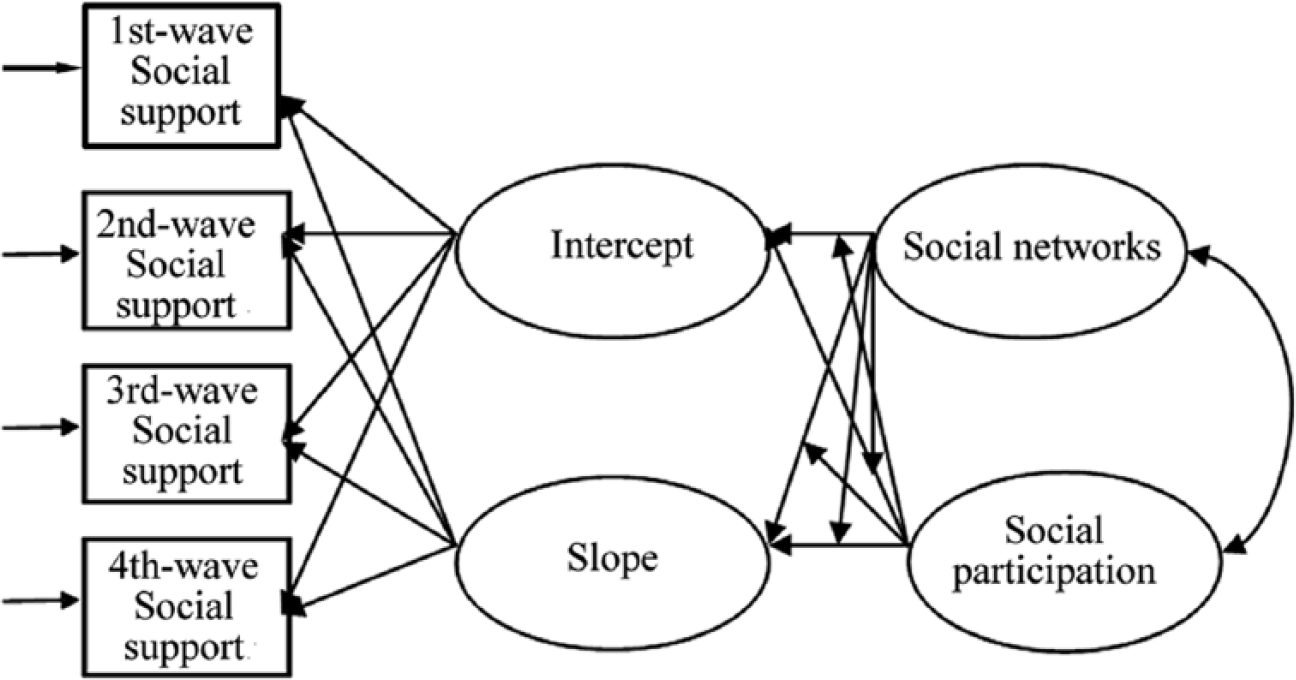
The latent growth model of social support for middle-aged and elderly people.

The causal relationship in the latent growth model.
Methodology
This study was designed to be a longitudinal study using secondary data from the TLSA maintained by the Health Promotion Administration, Ministry of Health and Welfare. The TLSA is a longitudinal study of middle-aged and elderly people in Taiwan. The Health Promotion Administration collected data from the same cohort six times in total during 1989–2007. However, we drew on a 10-year panel dataset to investigate the research issue. This panel study of longitudinal design ensures that causes come before effects, allowing us to investigate the effect of social network on social support at different points of time and capture the changes in social support over time. It should be noted that a longitudinal study of middle-aged and elderly people has to deal with changes in the cohort over time, as some elderly people may lose their ability to answer questions, move to different nursing institutions, or die during the survey period.
The subjects were selected from people over 60 years of age who had registered their residence in any of the 331 cities/counties/towns of Taiwan at the end of 1988. Based on the probability proportional to size (PPS) method, a total of 4412 people over 60 years of age were selected. The sampling procedure was as follows: we first selected 56 cities/counties/towns and then selected a representative neighborhood from each of these administrative regions. Finally, from each neighborhood we further selected two people over 60 years of age to be the survey subjects. The average age of the sample increased year by year. To conduct a double cohort study, we followed the same PPS method to select two additional samples for the years 1996 and 2003.
After excluding subjects who had passed away, gone missing, or failed to complete all the surveys during this 10-year period, we obtained a final sample consisting of 2756 subjects (Table 1).
Demographic distributions (N = 2756).

Mean ± standard deviation
Categories non-related to the cohort.
We used SPSS 21.0 and AMOS 8.0 to analyze the data. Longitudinal studies have relied on repeated-measures multivariate analyses of variance and linear trend analyses. Because these statistical analyses are based on observed variables, they confound true-construct components and measurement-error components of the intraindividual change (Bollen and Curran, 2006; Chiu, 2011; Duncan et al., 2006). Studies have shown that latent growth model (LGM) is a paradigm of application of structural equation modeling in longitudinal study. It is derived from structural equation models and mainly used to analyze panel data and stability of and changes in research variables. It deals with mainly latent variables and assumes a bivariate normal distribution of two latent variables that, respectively, stand for intercept and slope (Huang and Wen, 2011; Yang et al., 2004).
We used LGM for data analysis mainly because it could directly process the causal relationships between time and other variables and allow us to observe changes in middle-aged and elderly people over multiple time points. The main benefit of using LGM is that it can estimate growth trajectory and trends among the research subjects and test the effects of time (Figures 1 and 2).
Results
Descriptive statistics
Changes in social networks, social participation, and social support among the middle-aged and elderly people
We employed Baron and Kenny’s (1986) method to estimate the structural relationship of social networks (predictor variable), social participation (mediator variable), and social support (outcome variable).
According to the procedure for testing mediation, we first examined whether the effect of the predictor on the outcome variable is statistically significant. The effect of the social network growth trajectory on the social support growth trajectory is as shown in Figure 3 and Table 2 (Model 1). Findings suggest that the better the initial status of social networks, the better the initial status of social support; a positive growth of social networks will lead to a positive growth of social support; and the growth rate of social support is not affected by the initial status of social networks.
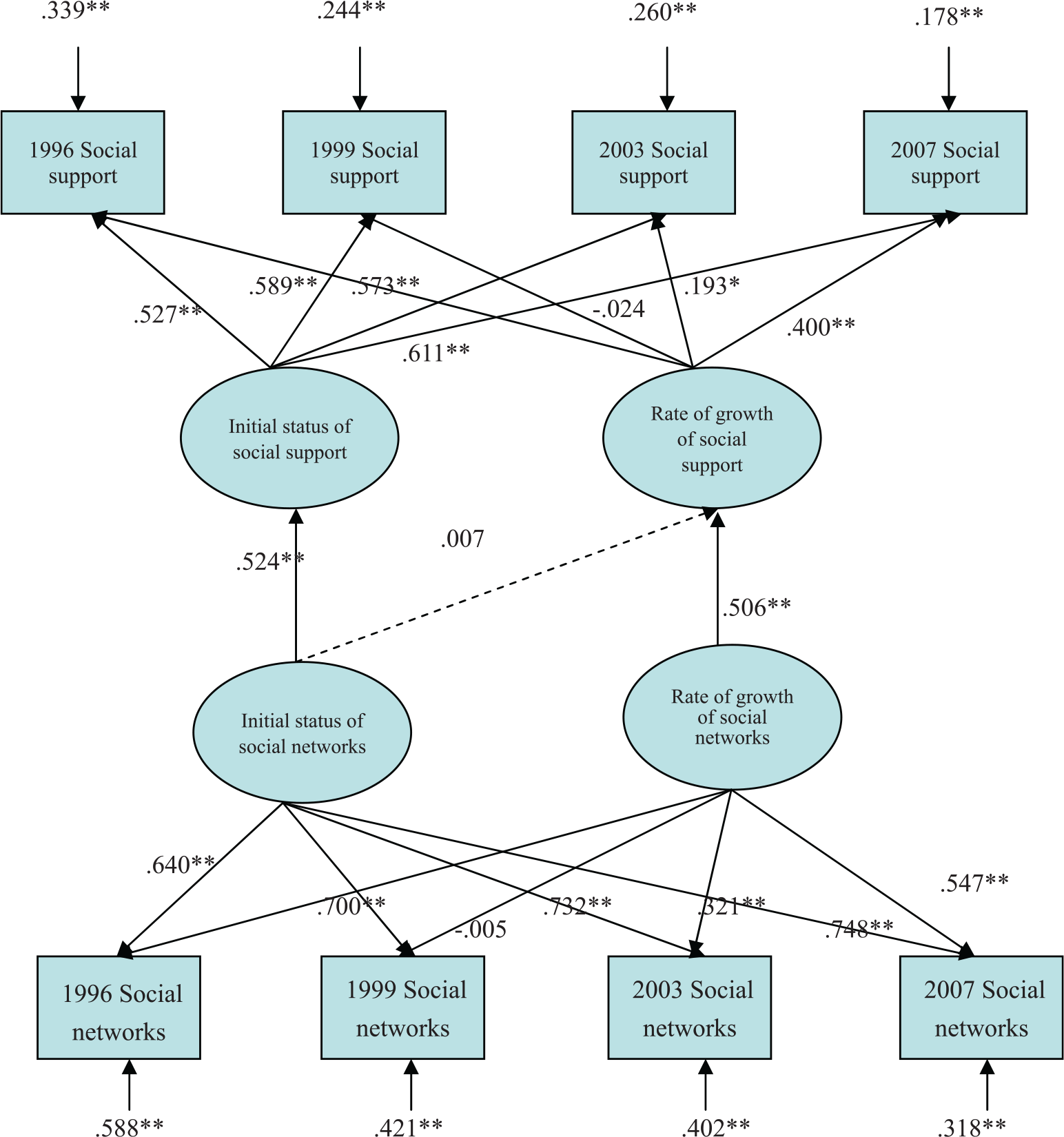
Estimation of the effect of social network on the growth of social support.
Summary of the effect of social participation as a mediator variable.
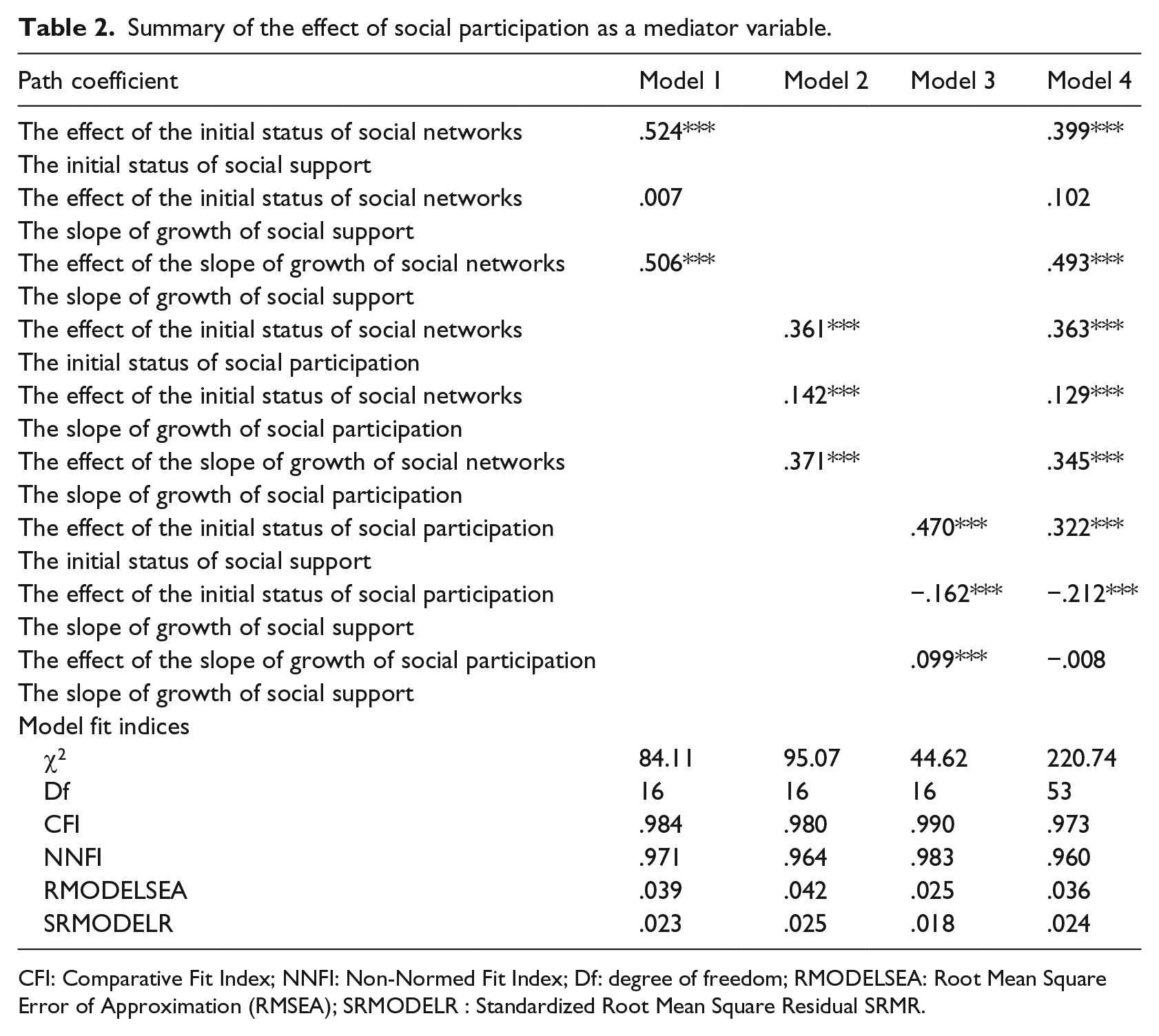
CFI: Comparative Fit Index; NNFI: Non-Normed Fit Index; Df: degree of freedom; RMODELSEA: Root Mean Square Error of Approximation (RMSEA); SRMODELR : Standardized Root Mean Square Residual SRMR.
The second step is to test whether the effect of the predictor on the mediator is significant. The estimation of the effect of the growth trajectory of social networks on the growth trajectory of social participation is as shown in Figure 4 and Table 2 (Model 2). The initial status of social networks was directly and positively related to the initial status of social participation, the initial status of social networks was directly and positively related to the growth rate of social participation, and the growth rate of social networks was also directly and positively related to the growth rate of social participation. In other words, the better the initial status of social networks, the better the initial status of social participation; a better initial status of social networks can lead to a higher growth rate of social participation; and the growth rate of social participation is positively affected by the growth rate of social networks.
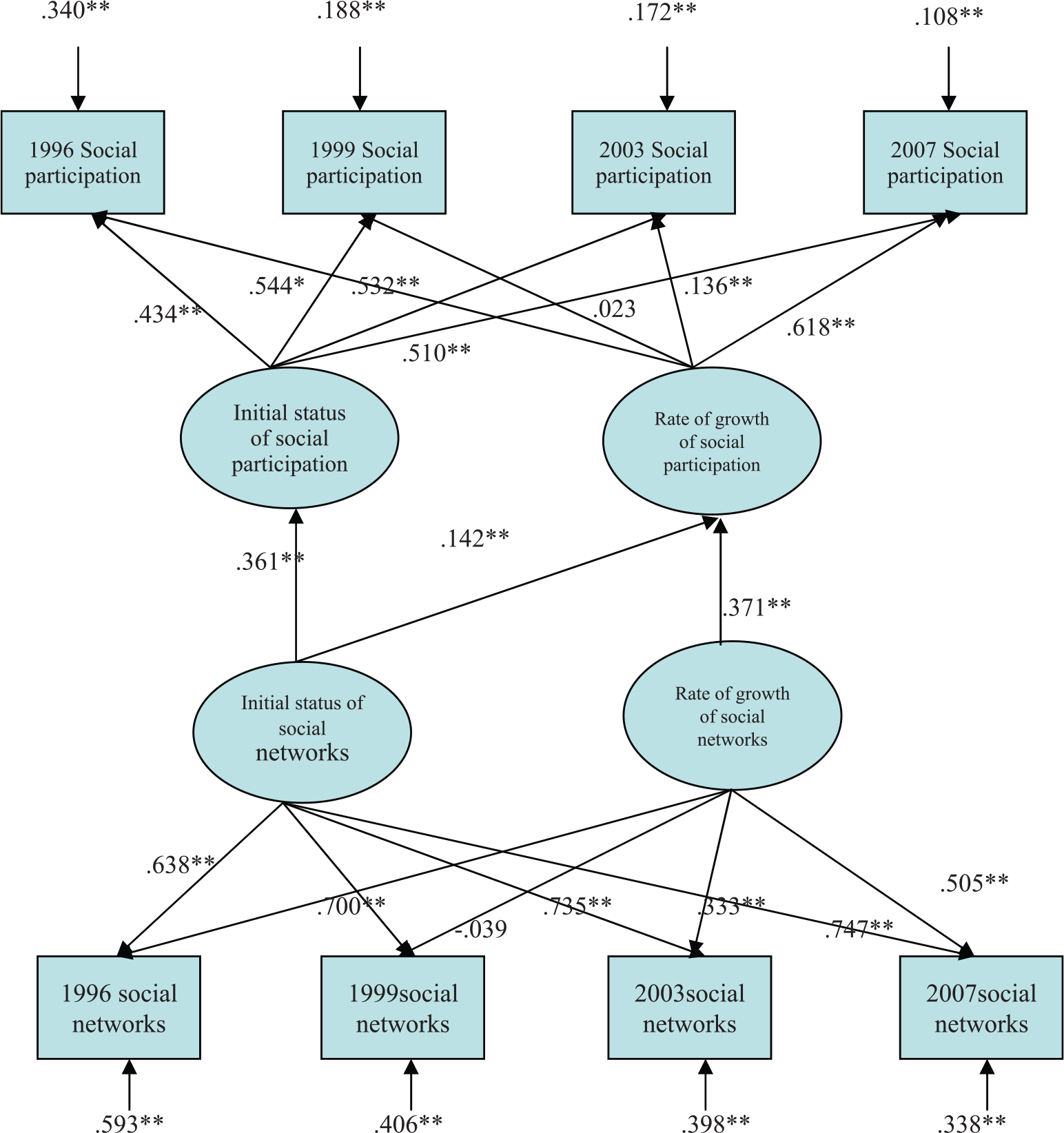
Estimation of the effect of social network on the growth of social participation.
In the third step, we examined whether the effect of the mediator on the outcome variable is significant. In this test we excluded the predictor (social networks). The result is as shown in Figure 5 and Table 2 (Model 3). The initial status of social participation was positively related to the initial status of social support; the initial status of social participation was negatively related to the growth rate of social support; and the growth rate of social participation was positively related to the growth rate of social support. It can be summarized that the better the initial status of social participation, the better the initial status of social support; a better initial status of social participation will lead to a lower growth rate of social support; and a higher growth rate of social participation can lead to a higher growth rate of social support.

Estimation of the effect of social participation on the growth of social support.
In the final step, as shown in Figure 6, we included the mediator (social participation) and predictor (social networks) in the test to examine whether the relation between the predictor and the mediator and the relation between the mediator and outcome variable are all significant. These findings confirm partial mediation of social participation in the relationship between social networks and social support.

Estimation of the effect of social participation as a mediator variable in the latent growth model.
Discussion
The analysis of the trend in the growth of social networks among middle-aged and elderly citizens in Taiwan revealed a nonlinear curve, supporting the findings of previous research on social networks of middle-aged and elderly people. The analysis of variances in the trajectory of social networks showed that the variances in the initial status and the growth rate of social networks were significant, indicating the presence of individual differences in the growth of social networks. This shows how social networks are linked not only to the social interaction of the elderly but also to the density and distribution of the network itself so that each stage of performance is different, thereby presenting a nonlinear growth curve.
In this study, the measure of social networks tells only the accessibility of social networks for middle-aged and elderly people, and one with social networks may not necessarily gain social support.
For instance, Huang (2012) found from both a longitudinal study and a cross-sectional study that the social networks of middle-aged and elderly people are narrowing and maintained selectively. They would gradually exit more distant networks and retain only close ones. Due to the fact that the elderly population increases at a faster rate than the newborn population, elderly people have fewer and fewer family networks. Besides, many people are unable to live with their parents due to work or schooling, causing a decline in the social networks of middle-aged and elderly people.
From our study, middle-aged or elderly people who have more social networks in the beginning will have a slower decline in their social networks; those who have fewer social networks in the beginning will find it difficult to maintain close social networks and suffer a faster decline in their social networks. Miller (1988) pointed out that social networks and social adaptation are closely related. Both Lin (2006) and Berkman et al. (2000) suggested that social networks and social support are determinants of successful aging. Social networks offer social support, social influence, and opportunities (Berkman et al., 2000; Seeman, 2000; Su, 2013). Studies have shown that people who are isolated from social networks tend to have a higher mortality rate. Supportive relations encourage healthy behavior, and social networks can buffer the decline in health and adaptation (Fratiglioni et al., 2004). It has been empirically found that poor social networks have an impact on the mental health of elderly people and will result in higher chances of depression (Fiori et al., 2006) and self-mutilation (Dennis et al., 2005). Besides, the number and size of social networks, the number of conflicts in the networks or the proportion of genders in the networks are also related to the mental health of middle-aged and elderly people (Edward and Patrick, 2004). The density of social networks and health condition are related to self-rated well-being (Fischer and Beresford, 2014; Szapocznik, 2011; Temkin-Greener et al., 2004).
In this study, we found that social participation of middle-aged and elderly people in Taiwan was on an upward curve, suggesting a gradual increase in social participation among them. Besides, there were individual differences in the growth trajectory of social participation. Social participation was significantly affected by some invariables, including place of ancestry and education degree. Among the variables, marital status was not related to social participation, and physical functions and mental health were found to have an effect on social participation. It has been documented that active social participation helps maintain the life quality of elderly people (Hsieh et al., 2013; Yu and Tseng, 2011). With the improvement in medical quality and education, people in young-old age tend to have better health conditions and are still very motivated to participate in social activities (Donnelly and Hinterlong, 2009). In addition, according to Lu and Chen (2002), people with higher education or better health conditions will spend their free time on social activities to divert the attention of others to their role change. Hence, health conditions and education degree are positively related to social participation among middle-aged and elderly people.
Middle-aged and elderly people who have more social participation in early years of life tend to show a slower growth in their social participation; those with less social participation in the beginning tend to have a faster growth in their social participation. A plausible explanation for this finding is that most people in adulthood are busy with their own business, and they are unable to participate in more social activities or build their social status through social participation until they reach an older age where they have more free time (Tsai et al., 2013; Turner, 1992).
It is documented that relational networks are the primary source of social support (Gunng, 2013; Knodel and Saengtienchai, 2007). Social participation facilitates development of social networks and diverse types of social support. However, we found that the social support for elderly citizens was affected by marital status, place of ancestry, and region of residence. Jiang et al. (2005) pointed out that due to the decline in physical functions or financial ability, middle-aged and elderly people are unable to have fair interactions with others as they did when they were young. As a result, they will obtain less social support. Shih (2004) also mentioned that family is the primary source of social support for elderly people, but with the change in social structure in recent years and the increasing number of young people moving out of their parents’ house for a job, elderly people are having less social support. Hence, building friendships in the neighborhood becomes an alternative way for them to gain social support (Dekker, 2007).
We found that the initial value of social support had a negative effect on the future growth of social support. The decline in social support for middle-aged and elderly is slower for those who can obtain more social support in early years of life; the decline is faster for those who can obtain less social support in early years of life. The results reveal a nonlinear and gradual decline in the social support for middle-aged and elderly citizens in Taiwan. This finding is generally consistent with findings of previous studies that showed the change of the original social role and shift of power would affect the social network of elderly people (Eliopoulos, 2005) and elderly people’s decreased social interactions would lead to a reduced number of sources of social support (Wadensten, 2006).
In the test for mediation, results suggested that social participation played a mediating role that helped relay the effect of the growth of social networks on social support. Social networks help middle-aged and elderly people develop necessary connections in life and offer positive social support to them. Through social participation, middle-aged and elderly people can also receive needed support and assistance to increase their life independence (Horowitz and Vanner, 2010; Wang and Yang, 2014).
Chen and Lin (2014) and Chou et al. (1998) have mentioned that social networks offer resources but do not guarantee that every individual can gain satisfactory support from the resources. We found social participation should occur as early as possible because network development is related to relationship involvement and development of a social network takes time (Nahapiet and Ghoshal, 1998). Moreover, individual intention to build relationships with others is also essential for continued social participation. Reduced social participation may lead to a loss of certain aspects of social support (Brown et al., 2004). Due to age, retirement, or decline in physical functions, elderly people may find it increasingly difficult to engage in new social activities.
Our results reveal a nonlinear and gradual increase in social participation among middle-aged and elderly citizens in Taiwan. Social networks serve as a channel through which social support offers and accepts flowing latent resources. Social participation does not play a powerful mediator role in the relationship between social networks and social support. This highlights the importance of the quality of networks created through interpersonal interactions. Only social networks of better quality can reinforce and facilitate formation of supportive relationships (Dekker, 2007).
Social networks and social participation were important variables affecting the growth of social support, and social participation also partially mediated the relationship between social networks and social support. According to Li and Yu (2014), Postle et al. (2005), Szapocznik (2011), Taso et al. (2014), and Verdonschot et al. (2009), continuous participation in learning activities in the society is a key to living a vigorous and more fulfilled life in late adulthood. It was confirmed that changes in social networks were positively related to changes in social support to the level of significance. This finding supports Social Continuity Theory and the social convoy model which indicates that one’s past relations and reciprocal exchanges in the network affect the persistence of social support for him or her (i.e. the supportive functions of social networks) but does not influence his or her expansion of social support. The results show that social networks positively affected not only social participation but also future variances in social participation. This finding is consistent with the conclusion of Norton and Beurskens (2014) and Lee (2010) that activity participation facilitates formation of social networks and also conforms to the view of Social Activity Theory.
In this study, we found that social network and social participation had a positive effect on social support, but the effect decreased over time. It should be noted that the growth of social networks was in a downward trend. Despite individual differences, elderly people’s initial status of social networks was critical to the rate of decline in social networks. This finding echoes the social disengagement theory and the ecological systems view, both of which suggest that decreased exchange with the environment has an effect on the adaptation to the environment.
Conclusion and recommendations
In this study, we confirm that social networks and social participation have an effect on social support and change over time. Therefore, we suggest middle-aged and elderly people increase their degree of social participation, improve social networks with family and non-family members, and participate in all kinds of religious, social, and leisure activities.
Civil organizations can hold more family activities to encourage elderly citizens’ participation in leisure activities with their friends and relatives. In order to ensure continued participation, civil organizations can set up local clubs in the neighborhoods of middle-aged and elderly people. Through these clubs, middle-aged and elderly people are allowed to have more interactions with others and further develop and strengthen supportive networks. By strengthening formal and informal ties with others, they can build an integrated social network and gain various forms of social support from the network (Knodel and Saengtienchai, 2007).
There may be fewer conflicts between different age groups if people have access to knowledge of aging as early as possible. A better understanding of aging can be promoted through school education and in the society to increase interactions between elderly people and their grandchildren. We should build a social environment that is more friendly to middle-aged and elderly people by integrating school education, family, and organizations and providing more opportunities for people to interact with and care for elderly citizens.
The social network made up by family members is critical to social participation of and social support for middle-aged and elderly people. Family members and caregivers should encourage their parents to participate in various community activities while their physical functions are still good and be more active in keeping in touch with friends and relatives as they get older.
Future research
As social participation can be broken down into several dimensions, the effect of each dimension on social networks and growth of social support can be examined. Besides, data can be divided by gender into two subgroups. The multi-group latent growth modeling can be performed to examine whether the effect of social participation on social networks and social support differs between genders. Likewise, middle-aged and elderly people can be further classified by age into one middle-aged group and one old-age group to examine whether social support differs between the two groups.
Limitations
This panel study was based on a longitudinal design. In panel studies, sample loss (including death of some participants) is inevitable, and selection bias might occur without addition of new samples. In this study, we used data extracted from the database of Mental, Physical, and Social Conditions of Mid-age and Elderly Citizens in Taiwan. The data are secondary data, and the questionnaire items are limited. Hence, internal validity might be affected. For instance, the size of social network and intensity of ties were measured by number of cohabitants and frequency of contacting, respectively. The quality and content of social networks were therefore neglected. Besides, although the questionnaire was designed to be answered by the subjects in person, a few of them asked someone else to answer the questions for them due to personal or health reasons or showed recall bias in their response to questions about certain experiences of the past year.
Footnotes
Funding
The author(s) received no financial support for the research, authorship, and/or publication of this article.