




Abstract
The global financial crisis that spread from the United States to Europe severely impacted Greece. This is a study of quality of life (QoL), anxiety, depression, and stress in Greece following the austerity measures imposed after the crisis. A convenience sample of 901 adults completed (1) a brief survey form, (2) the Multicultural Quality of Life Index (MQLI), and (3) the Depression Anxiety Stress Scales (DASS). Results indicated higher DASS scores in comparison to other normative populations. Overall, QoL in Greece is lower for women, those who are single, the unemployed, and those with lower incomes. Implications for social work practice and the profession are discussed.
Introduction
It has been well documented that differences and especially drastic changes in socio-economic conditions and the environment can lead to health inequities that include mental health disorders (De Vogli, 2014; Marmot and Allen, 2014). Thus, health inequities are understood to be socially produced and constructed as they are created by unfair power and resource distribution (Marmot and Allen, 2014; Marmot et al., 2013; Pike et al., 2013). Mental health disorders, such as depression, anxiety, and stress, have been found to be associated with socioeconomic factors, such as unemployment, low level of education, and poverty as well as – along with being female – being single and having a lower quality of life (QoL) (Economou et al., 2013; Madianos et al., 2014; Marmot et al., 2013; Mylona et al., 2014; Skapinakis et al., 2013). Thus, this study aims to explore QoL of life, anxiety, depression, and stress among Greek adults in order to offer data that will contribute to an understanding of the impact of the austerity measures in Greece.
Unemployment in particular has been consistently seen as a high risk factor for mental health disorders, mainly as a result of a lack of financial security, too much unstructured time, and limited social interactions. Similarly, depression and anxiety disorders have been found to significantly impact all aspects of QoL from general well-being to the increased risk of other health disorders (Panayiotou and Karekla, 2013; Pike et al., 2013). These relationships are of great importance as they affect the individual, his or her surroundings, and health-care expenditure (Choi et al., 2014). Following the 2009 economic crisis, QoL in Greece has been negatively affected along with health and mental health, and this is only expected to worsen (Drydakis, 2015).
However, the relationship between QoL and depression, anxiety, and stress in the wake of the austerity measures still has not been widely explored in Greece. There is a call for such research (Skapinakis et al., 2013). The enhancement of QoL is a priority of social work. In addition, these relationships are of great importance as they affect the individual, his or her surroundings, and health expenditure, all of which fall into the domain of social work practice. Due to the magnitude of the crisis, this article will briefly discuss the origins of this crisis and the effects on Greece.
Literature review
A neoliberal crisis
In the last 30 years, several economies adopted capitalist models that focused on privatization and the free market. This so-called neoliberal approach significantly reduced the role of the state both as welfare agent and market regulator. The role of the state came to be understood more as an institutional framework to facilitate free market and trade (Harvey, 2006). Concepts of individual accountability, success, self-reliance, and competiveness dominated the discourse as ideals. These ideals were presented as ways that would eventually eliminate income inequalities and poverty (Harvey, 2006; Spolander et al., 2014; Yan et al., 2015). The interests of the rich were promoted as the interests of the poor. If the rich were confronted with less taxation, more cash flow would trickle down to the poor (Varoufakis, 2011). However, this ‘trickle down’ neoliberal approach not only failed to decrease income inequalities, but, on the contrary, widened such gaps and further allocated resources to the wealthy minority (De Vogli, 2014). As Harvey (2006) argues, it negatively affected all structures: The creation of this neoliberal system has obviously entailed much destruction, not only of private or institutional frameworks and powers (such as the supposed prior state sovereignty over political-economic affairs) but also of divisions of labor, social relations, welfare provisions, technological mixes, ways of life, attachments to the land, habits of the heart, ways of thought, and so on. (pp. 145–6)
As a result of the neoliberal deregulated investing of banks, large institutions, and wealthy individuals, a huge economic crisis exploded in 2008 in the heart of capitalism, the United States, and spread across the globe (De Vogli, 2014; Fung, 2014; Karanikolos et al., 2013). Indicatively, in that year, the debt of the United States accounted for 350 percent of its Gross Domestic Product (GDP), its housing market crashed, and its unemployment rate increased by 5 percent (Varoufakis, 2011). The limited underfunded welfare state was quickly compromised, while the government responded by further shrinking of public expenditures and focusing on bank bailouts (De Vogli, 2014).
The crisis rapidly spread and came to be one of the worst crises to also affect the European Union (EU). In 2009, all European countries, apart from Poland, saw their GDP drop an average of 4.5 percent (Karanikolos et al., 2013). In the first 3 years over 10 million people are estimated to have lost their jobs (De Vogli, 2014). The consequences were severe and widespread. Unemployment, income inequalities, health-care costs, and mental health issues sharply increased, while the social matrix was dismantled (De Vogli, 2014; Karanikolos et al., 2013).
The case of Greece and the rise of mental health issues
The European crisis was first observed in Southern Europe, particularly in Greece. In 2008, Greece was considered the 29th largest economy in the world (Nation Master, 2015). Soon, however, this crisis brought the country close to bankruptcy. By 2014, Greece had dropped to the 45th largest economy (World Bank, 2014). Interestingly, this crisis was widely publicized to have been created by corruptive Greek government practices alone, coupled with the availability of a generous welfare state (Pentaraki, 2013). As a result, in 2010, the EU, along with the International Monetary Fund (IMF), introduced radical neoliberal austerity measures in exchange for bailout loans. Unlike Iceland that chose the welfare of its citizens, the Greek government chose the welfare of the banks (Marmot et al., 2013). No responsibility was assigned for the capitalist greed to the ‘Global Minotaur’, as Varoufakis (2011) calls it, and Greeks were to be punished. These austerity measures included drastic salary and pension decreases, health-care cuts, and tax increases on the most vulnerable. Despite these bailout loans and austerity measures, the recession continued to grow, and Greece reached a deep humanitarian crisis (Ifanti et al., 2013; Ioakimidis and Teloni, 2013; Matsaganis, 2012; Rachiotis et al., 2014). These draconian measures have been described as having a cataclysmic impact on Greece, not only causing immense human suffering but also attacking the country’s democracy (Ioakimidis and Teloni, 2013; Stiglitz, 2015).
Due to the austerity measures, Greece was confronted with the highest rates of unemployment in the EU (Drydakis, 2015). By 2014, unemployment rates had skyrocketed from 7.2 percent in 2008 (Kondilis et al., 2013) to 49.5 percent for young adults and 25.6 for the overall population (Eurostat, 2015). Average salaries plummeted 40–50 percent, along with significant cuts in health care and welfare services (Fouskas, 2013). During this time, approximately 3 million Greeks fell into poverty, with incomes below 60 percent of the national median (Kondilis et al., 2013). Meanwhile, 14 percent lost the economic power to purchase basic necessities, including food (Matsaganis, 2014).
Poor health outcomes in Greece were especially exacerbated by the inequitable distribution of resources and contraction of services brought about by the austerity measures that were imposed. Health-care spending was cut by an estimated 26–40 percent, triggering shortages in medical equipment and staff (Kentikelenis et al., 2014; Rachiotis et al., 2014). As a result, access to health care became prohibitive for many Greeks. Cancer patients who could not afford therapies became a cruel reality. Currently, a large number of people receive services by social clinics staffed by volunteers (Kentikelenis et al., 2014). Criteria for welfare benefits became tighter, depriving the majority of people with physical or mental disabilities of any support (Ioakimidis and Teloni, 2013). Mental health spending was reduced by 20 percent between 2010 and 2011, followed by an additional 55 percent cut in 2012, causing a drastic worsening of the quality of and accessibility to mental health care, even as suicide, depression, homicide, and drug abuse continued to rise (Anagnostopoulos and Soumaki, 2013; Economou et al., 2013; Giotakos et al., 2011, 2012; Kentikelenis et al., 2014; Kondilis et al., 2013; Madianos et al., 2011). While Greece has historically had the lowest suicide rates in the world (Madianos et al., 2014), rates in the 3 years following the economic crisis are estimated to have increased by 27.2 percent (Kontaxakis et al., 2013), and 40 percent between 2010 and 2011 alone (Kentikelenis et al., 2014). This rapid increase has been correlated with unemployment (Drydakis, 2015; Fountoulakis et al., 2015). Depression rates have also sharply increased. In 2008 and 2011, two cross-sectional studies (Economou et al., 2013) assessed major depression in Greece and reported that depression rates alone had increased from 3.3 percent in 2008 to 8.2 percent in 2011. Interestingly, the studies showed statistically significant increases from 2008 to 2011 for most sociodemographic characteristics, including gender, most age groups, relationship status, and employment status, across educational levels, and place of residence (Economou et al., 2013). This study measured major depression as diagnosed in the Diagnostic and Statistical Manual of Mental Disorders, Fourth Edition (DSM-IV) and therefore could not capture depressive and related affective states that may be pervasive due to this crisis. The authors noted these rates to be underestimated. Drydakis (2015) also concluded that self-reported physical health and mental health have been affected by unemployment for Greeks, with women being disproportionately affected. Using the Depression Anxiety Stress Scales (DASS), a study of 941 Greeks found that 73 percent of the participants reported normal/mild anxiety while 9.4 percent reported severe and 3.3 percent extremely severe anxiety (Andreou et al., 2011). Stress and anxiety are emotional states associated with depression, and one could assume that they have significantly increased due to this crisis. There is limited data on stress and anxiety in the general population even though anxiety and stress have been directly related to a significantly poorer QoL (Panayiotou and Karekla, 2013).
Quality of Life
Although a complicated concept to define (Somarriba Arechavala et al., 2015), QoL is a concept that has been widely used in health care. In recent years, its use has been expanded to include the objective and subjective well-being of the general population. Objective well-being usually refers to objective life conditions, such as housing. Conversely, subjective well-being can refer to satisfaction with one’s life (Maditinos et al., 2014). Somarriba Arechavala et al. (2015) defines QoL as a ‘result of complex interactions of a set of objective and subjective factors: objective factors refer to external conditions of an economic, socio-political, environmental, and cultural nature, while subjective factors refer to individuals’ perceptions of their own life and satisfaction’ (as cited on p. 325). Greece, Latvia, Hungary and Lithuania are among the countries that have seen the most drastic negative changes in QoL (Somarriba Arechavala et al., 2015).
QoL of citizens is directly associated with socioeconomic status. The massive economic crisis in Greece significantly affected people’s lives. In a recent study that investigated QoL in Greece, income, level of education, cohabitation, and parenthood had a significant impact on QoL while unemployed participants were affected the most (Mechili et al., 2015).
The Organisation for Economic Co-operation and Development (OECD) has provided the most extensive quality of data in Greece. The OECD reports on housing, income, jobs, community, education, environment, civic engagement, health, life satisfaction, safety, and work balance. Not surprisingly, Greek people reported less satisfaction with their lives and scored 4.8 on a scale of 1–10. As the average score is 6.6, Greeks reported one of the lowest scores (OECD, 2015). More specifically, apart from their income, they experienced very low job security, although they reported having a strong family and friend network (OECD, 2015).
Methods
Although there are some data available on QoL, depression, anxiety, and stress, no study has investigated these variables together following the economic crisis that continues to escalate. The purpose of this research was to explore QoL, anxiety, depression, and stress among Greek adults in order to offer data that will contribute to an understanding of the impact of the austerity measures in Greece. Research assumptions put forward were as follows: (1) income will have an effect on QoL, anxiety, stress, and depression; (2) employment status will have an effect on QoL, anxiety, stress, and depression; (3) QoL, anxiety, stress, and depression scores will differ by gender; and (4) marital status will have an effect on QoL, anxiety, stress, and depression.
Participant sample
Over 1000 adults in Greece participated (n = 1064). However, only 901 surveys were used, and the rest were not included because they were incomplete. Of those surveys, 472 were collected in person and 429 online through SurveyMonkey. Participants could only complete the survey once.
Procedures
Following approval by Springfield College’s Institutional Review Board, data were collected in two venues by a community sample. First, the research team (this researcher and two trained research assistants) distributed self-administered surveys to a convenient sample of adults in a central location of a major Greek city. At the same time, those same self-administered surveys were posted on SurveyMonkey. Participants were invited to respond by email and social media. The link to the study was emailed and posted on Facebook and was shared with the team’s contacts. Those contacts were asked to share the link with their contacts. Three web sites, a Greek newspaper that targets readers over 30 and two departments of graduate education of social studies also offered to share the link. A similar process was followed and was repeated three times. Participants could only access the link once, therefore were not able to complete the survey twice. In both venues participants were assured of anonymity.
Data collection lasted 6 months in 2013 and 2014. To take part in the study, participants had to be 18 years or older and have been a citizen of Greece for at least 5 years. Participants provided informed consent after they had reviewed the study’s purpose, the risks/benefits of participation, and the assurance of confidentiality. Participants then completed (1) a brief survey form to collect information on age, education, gender, marital, employment and financial status; (2) the Multicultural Quality of Life Index (MQLI) to assess QoL; and (3) the DASS to assess emotional states associated with anxiety, depression, and stress.
Research tools
Multicultural Quality of Life Index
This is a 10-item culturally informed self-report measure that assesses people’s subjective satisfaction of 10 dimensions of life: physical well-being, psychological/emotional well-being, self care and independent functioning, occupational functioning, interpersonal functioning, social emotional support, community and services support, personal fulfillment, spiritual fulfillment, and overall QoL (Álvarez et al., 2010; Mezzich et al., 2011). The instrument takes approximately 3 minutes to complete and demonstrates excellent test–retest reliability (r = .87) and internal consistency of Cronbach’s α = .92 (Mezzich et al., 2011). The MQLI has been successfully validated in several languages, for example Korean (Yoon et al., 2008). The MQLI was translated and validated in Greek and indicated a high level of internal consistency, as determined by a Cronbach’s alpha of .903.
Depression Anxiety Stress Scales
This 42-item self-report measure provides separate scores for emotional states associated with depression, anxiety, and stress. Each subscale has 14 items. The DASS takes approximately 10 minutes to complete and demonstrates good test–retest reliability and adequate construct validity (Baykan et al., 2012; Lovibond and Lovibond, 1995). The DASS has been translated and validated in Greek with a total scale coefficient alpha of .968; subscale coefficient alphas were also high (αdepression = .941; αanxiety = .906; αstress = .942) (Lyrakos et al., 2011).
Statistical methods and analysis
Data were analyzed using the Statistical Package for the Social Sciences (SPSS), Version 23.3. Data were checked for anomalies and cleaned. Bivariate correlations were used to explore statistically significant relationships among the QoL and the severity of anxiety, depression, and stress along with demographic characteristics and measures on a continuous scale. Next, independent sample t tests and one-way analyses of variance (ANOVAs) were used to further investigate those relationships. When homogeneity of variances was violated, as assessed by Levene’s Test of Homogeneity of Variance, results were analyzed by the Welch ANOVA or the Mann–Whitney U test.
Results
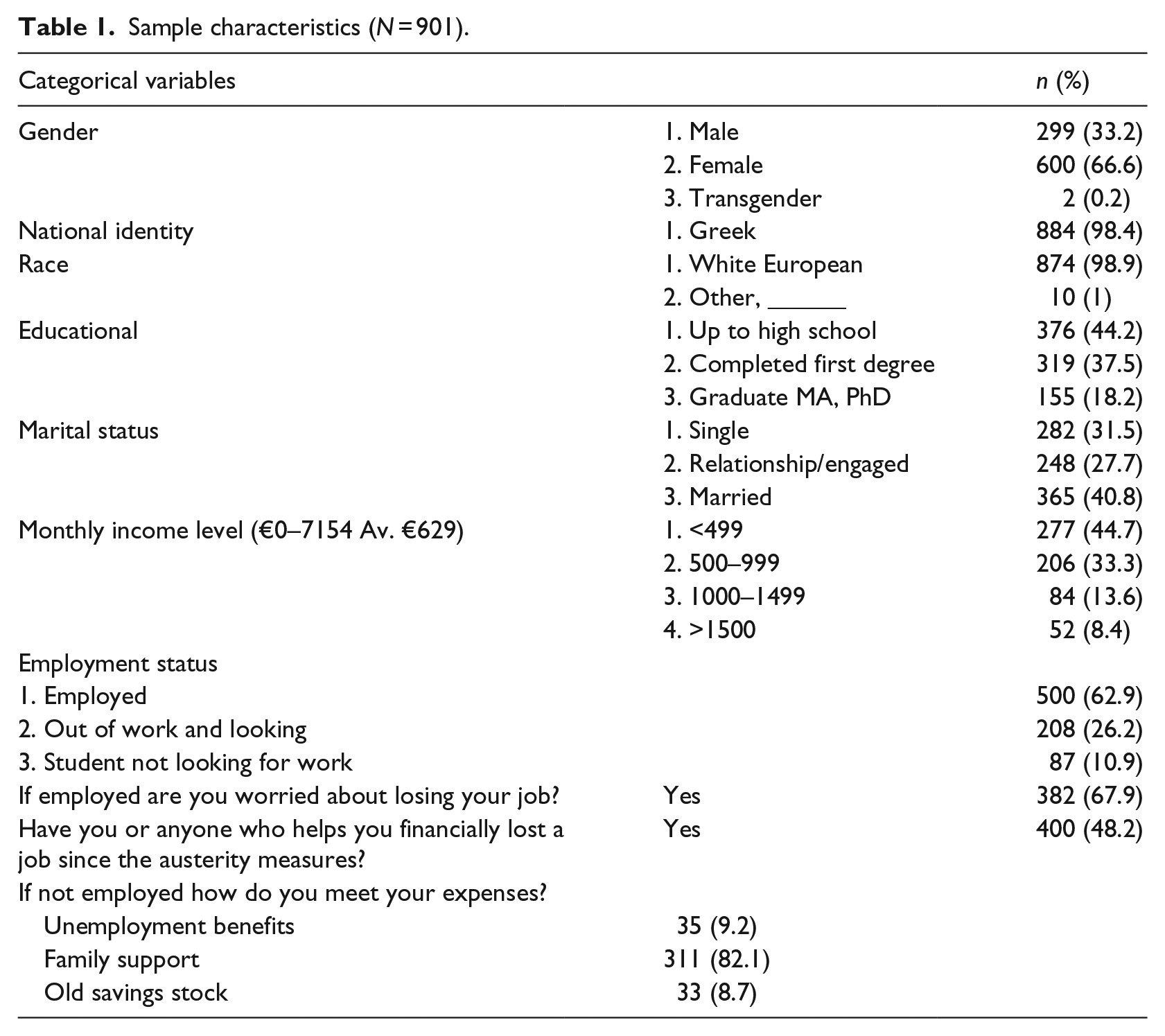
The majority of the participants were women (66.6%), and the mean age was 37.2, standard deviation (SD) = 12.9. The sample was predominantly of Greek nationality (98.4%) and identified as White (98.9%). More than half (56.3%) had either an undergraduate or graduate education. Monthly income reported ranged from 0 to €7154, with an average of €629 (US$710). Less than one-third of the sample (31%) had full-time employment, and 70 percent were worried that they may lose their employment. Of those who were not employed, 82 percent received financial support from their families. More than half (58%) of all participants reported living in housing provided by their parents. Table 1 presents demographic information along with questions that pertained to employment and income since the crisis.
Sample characteristics (N = 901).
On a scale from 1 to 10, the average MQLI index was m = 6.52 (SD = 1.7). Community and services support received the lowest ranking (m = 4.04), while personal networks of emotional support ranked highest (m = 7.98).
MQLI-Gr scores.
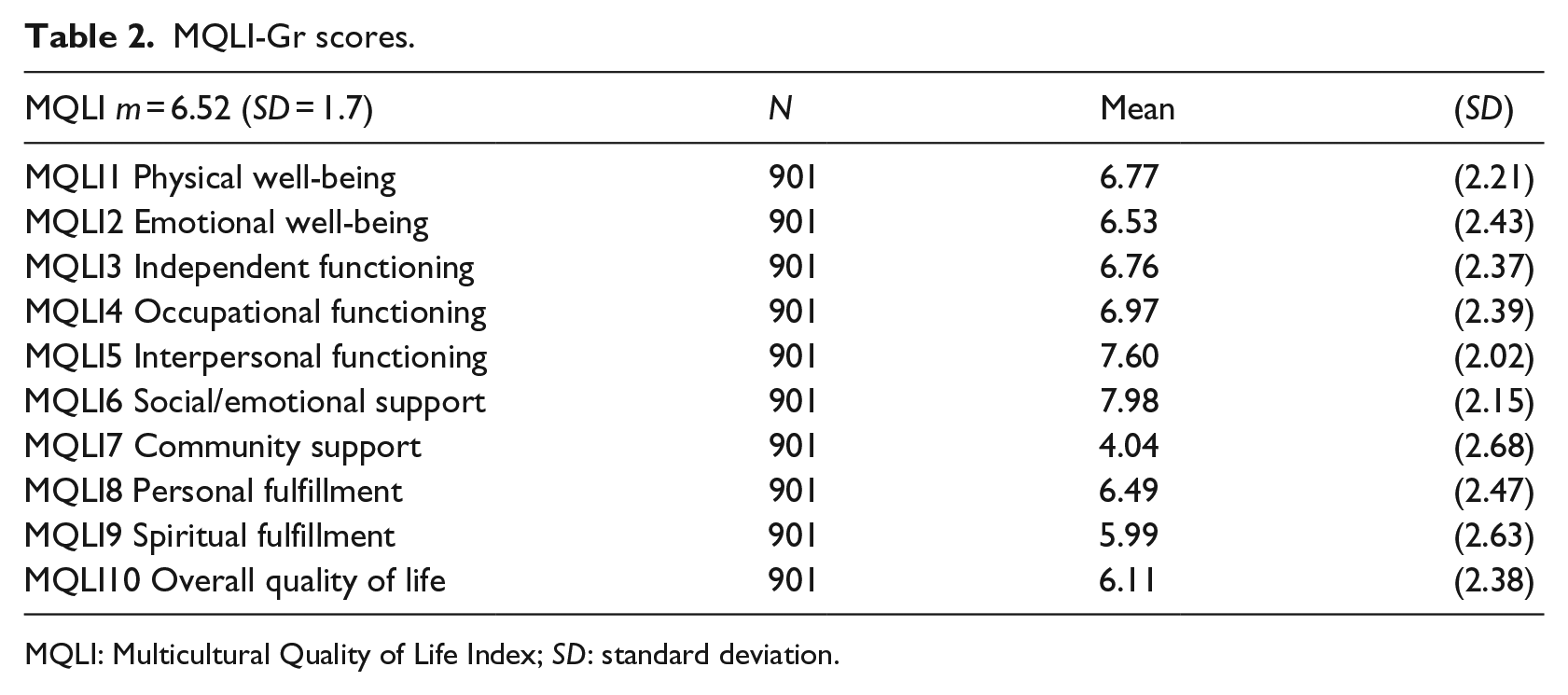
MQLI: Multicultural Quality of Life Index; SD: standard deviation.
DASS scores.
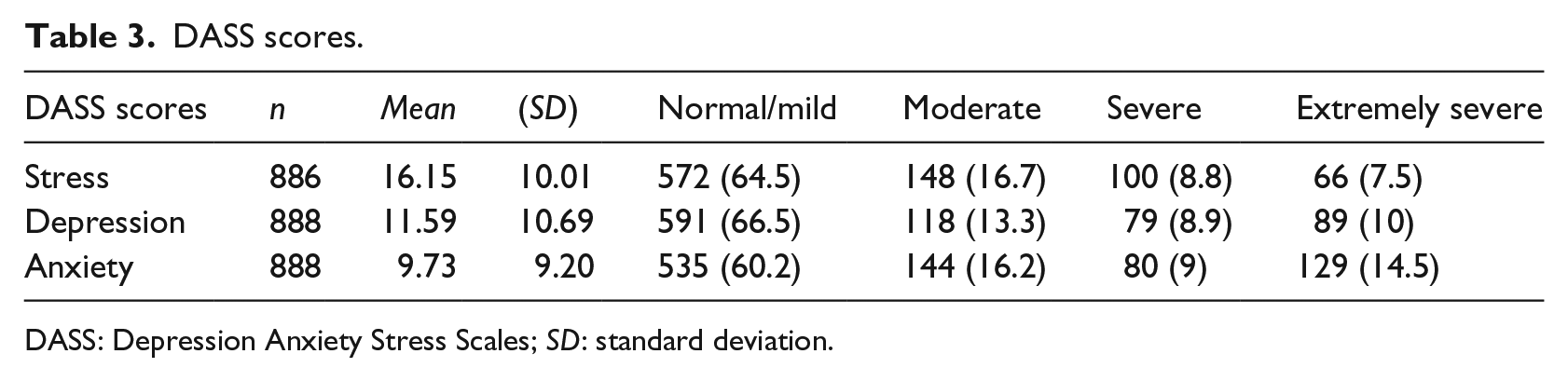
DASS: Depression Anxiety Stress Scales; SD: standard deviation.
Pearson’s correlation tests revealed significant one-tailed associations. MQLI was negatively associated with stress (r = −515, p < .001), depression (r = −617, p < .001), and anxiety (r = −509, p < .001), indicating that Greek adults were more likely to report a lower QoL if they reported high stress, depression, or anxiety. While education was not associated with anxiety, stress, or depression (p > .05), it was positively associated with QoL (r = −.94, p < .001), indicating that Greek adults who had lower levels of education were more likely to also have a lower QoL. Pearson’s correlation tests for income, depression, anxiety, stress, and QoL revealed significant one-tailed associations. Income was negatively associated with stress (r = −.92, p < .05), depression (r = −.148, p < .001), and anxiety (r = −.089, p < .05), indicating that Greek adults who had lower incomes were likely to also have more stress, depression, and anxiety. Interestingly, age was not associated with QoL, anxiety, or stress.
Income, employment, marital status, gender, and QoL
ANOVA and t tests were run to determine mean differences in scores in MQLI, depression, anxiety, and stress in relation to income, employment, marital status, and gender.
Range of income was divided into four groups: <€499; €500–€999; €1000–€1499, and >€1500. QoL, depression, anxiety, and stress scores were statistically significantly different among the income groups. Games–Howell post-hoc analysis revealed that the mean increase in stress S (M = 12.6, M = 17), depression D (M = 7.1, M = 12.8), and anxiety A (M = 6.4, M = 10.37) from the third highest income group (€1000–€1499) to the lowest income group (<€499) was statistically significant. QoL mean increase from the lowest (M = 6.4) to the third highest group (M = 7.03) was also statistically significant.
Employment status was defined as ‘Employed’, ‘Unemployed, searching for work’, and ‘Student/not looking for a job’. MQLI scores were significantly different among the various employment status groups. Tukey post-hoc analysis revealed a significant mean increase in QoL between those who reported that they were ‘Unemployed, searching’ (M = 6.06) and those who were ‘Employed’ (M = 6.77).
Anxiety and depression scores were also statistically significantly different among the various employment status groups. For anxiety, Tukey post-hoc analysis revealed a significant increase in means from ‘Employed’ (M = 8.85) to ‘Unemployed, searching’ (M = 10.22). For depression, Games–Howell post-hoc analysis revealed that the mean increase from ‘Employed’ (M = 10.32) to ‘Unemployed, searching’ (M = 14.5) was significant. These results indicated that unemployed people had a lower QoL and were more at risk for depression and anxiety. Stress scores were not significantly different among the various employment status groups.
Marital status was defined as single, married, or in a relationship. MQLI scores were significantly lower for single individuals (M = 6.2) compared to married individuals (M = 6.7). For depression, Games–Howell post-hoc analyses revealed that scores were significantly higher for single individuals (M = 13.44) as compared to married individuals (M = 10.06). Neither stress nor anxiety scores were significantly different among the various marital status groups.
Independent t-tests were run to determine differences in MQLI, anxiety, stress, and depression scores between males and females. All scores were statistically different as women scored significantly higher than men in depression, anxiety, and stress, and lower in QoL. These results indicate that adult men have a significantly higher QoL as compared to women, while women have significantly higher levels of stress, anxiety, and depression. Table 4 presents the results from the ANOVA and t tests for income, employment, marital status, and gender.
ANOVA and t tests.
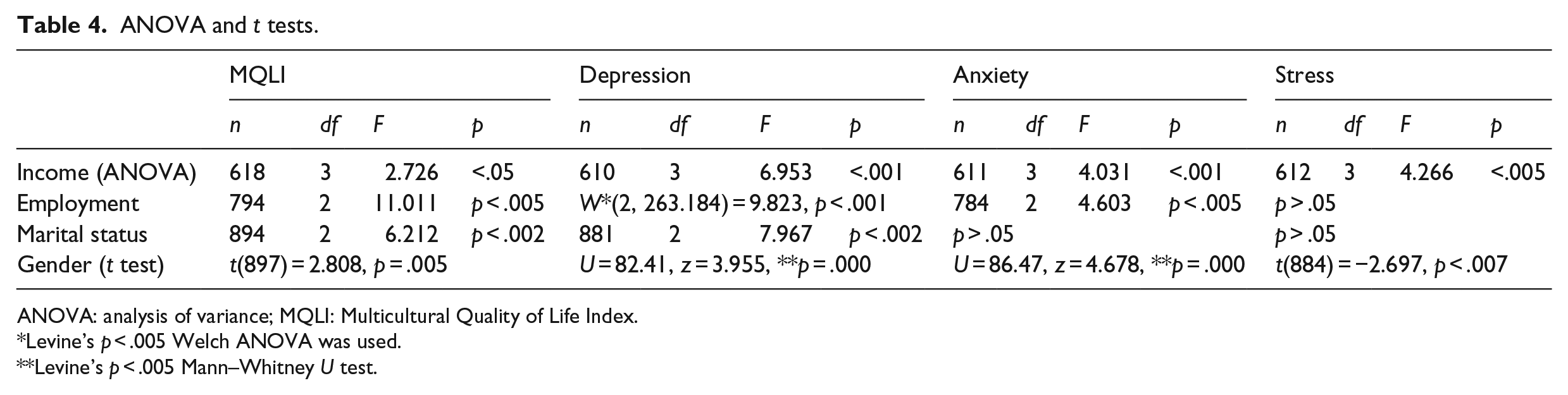
ANOVA: analysis of variance; MQLI: Multicultural Quality of Life Index.
Levine’s p < .005 Welch ANOVA was used.
Levine’s p < .005 Mann–Whitney U test.
Discussion
The economic crisis has resulted in excessive poverty, unemployment, and insecurity in Greece. Such socioeconomic turmoil and instability has increased mental health issues, particularly stress-related disorders (Kentikelenis et al., 2014). This study has attempted to contribute to an understanding of the impact of the crisis by offering exploratory data on QoL, depression, anxiety, and stress in Greece. In terms of QoL, there is no comparative data from the Greek population using the MQLI. However, this sample scored lower in QoL (m = 6.5) than other normative populations where MQLI was reported to be m = 8.4 (Mezzich et al., 2011). As noted in other studies using different instrumentation (OECD, 2013; 2015), Greece reports one of the lowest rates for QoL. Not surprisingly, and similar to OECD results, the biggest frustration in this study emerged when participants were asked to rate community services who gave them the lowest ratings. In contrast, they reported high satisfaction with the availability of personal networks of people who could be trusted and who could offer emotional support. This finding is consistent with OECD findings and other research that shows that people in Greece rely heavily on their family and friends, establishing an informal support network known as the Southern European Welfare System (OECD, 2013, 2015; Panayiotopoulos et al., 2013).
Not surprisingly, DASS scores indicated high levels of stress, depression, and anxiety for the participants, levels that are higher when compared with other normative populations (Lovibond and Lovibond, 1995). Compared to Andreou et al. (2011) who reported anxiety in a normative sample in Greece, rates for severe anxiety seemed to have tripled in the current study. Economou et al. (2013) have documented that depression rates may have tripled since the crisis. This study may also indicate that rates of depression are increasing due to the severe effects of the economic crisis.
Higher income was negatively associated with stress, anxiety, and depression, and positively with QoL, indicating that Greek adults with lower incomes had higher scores in depression, anxiety, and stress, and a lower QoL. It seemed that those earning less than €500 were the most affected. Unemployed individuals seeking employment scored significantly lower on QoL and higher on depression and anxiety. However, stress levels did not differ, indicating that a stress response may be pervasive to all groups.
As discussed earlier, the austerity measures implemented in Greece targeted wages and pensions while they increased taxation. Unfortunately, income dropped precipitously in Greece and continues to plummet. The income reduction or loss of income as well as increased taxation, coupled with the reduced availability of the former universal health-care system, has added to the difficulties (Ifanti et al., 2013; Kentikelenis et al., 2014). Understandably, such drastic socioeconomic changes will have an impact on people’s mental health (Drydakis, 2015; Ifanti et al., 2013).
Substantial gender differences emerged for all variables, indicating that women in Greece are more stressed, anxious, and depressed than males and have a lower QoL. This is consistent with prior research (Allen et al., 2014; Drydakis, 2015; Skapinakis et al., 2013) and may reflect the effects of a male-dominated society where more is expected from women both inside and outside of the home. Interestingly, Greece has the highest unemployment rates for women in the EU (Anastasiou et al., 2015). This finding reflects the need for more gender-sensitive mental health interventions and policies (Bergin et al., 2013).
Additionally, in this study single individuals were more likely to report more severe depression and a lower QoL (Economou et al., 2013). This finding strongly suggests that being in a relationship and having solid family ties is a protective factor against depression. However, it was interesting that there were no differences in anxiety and stress scores between married and single people in Greece, indicating that at this point the economic stress is all-pervading.
In 2015 living conditions rapidly deteriorated in Greece. The newly elected government of Syriza sought to renegotiate the loans and austerity measures with the IMF, European creditors, and the European Central Bank in order to secure more viable terms. Due to the failed negotiations, the European Central Bank stopped its emergency funding to Greece, resulting in the banks shutting down, while Capital Control was enforced. This instantly created panic and chaos, as Greeks had limited access to their savings, restricted to €60 a day (CNN (Cable News Network), 2015). New and harsher austerity measures were introduced in order to secure more bailout money; the result was a further demolition of the welfare state and deterioration of QoL for Greek citizens. This study pertains to data collected prior to the massive 2015 Capital Control crisis. Since then, one can only assume that QoL has worsened along with depression, stress, and anxiety may have increased.
Implications for social work
Although it is still early to fully assess the effects of the economic crisis in Greece, data from this study suggest that it and the subsequent measures have resulted in the pervasive deterioration of the mental health of Greek adults. The crisis in Greece is directly relevant to social workers and has obvious implications for the social work profession. Social workers play a central role in identifying and responding to this humanitarian crisis that includes unprecedented challenges, growing disparities, and escalating mental health issues. Social workers and other mental health professionals should be attuned to the effects of the economic crisis, such as increased stress, anxiety, and especially depression. Such awareness may help predict public health crises, as these disorders are major risk factors for a variety of health issues. In addition, this awareness will help social workers respond to a further increase in suicides.
However, the impact of this crisis on social work is not simply an issue of increased cases or responsibilities. The austerity measures have had a direct impact on social work itself as they have been enforcing a capitalist agenda and pushing the state to decrease its role as a welfare provider. As a result, the work of social workers has become more complicated as state-funded welfare services have been reduced, eliminated, or forced to operate with minimum resources. For example, mental health agencies have been confronted with a 120-percent increase in service users seeking treatment (Kentikelenis et al., 2014). As a result conditions have deteriorated for service users and social workers. Many social workers have lost their jobs or moved to short-term employment, facing overwhelming economic uncertainties (Ioakimidis et al., 2014; Pentaraki, 2013, 2015). Facing similar issues to those of their clients, social workers also have become a group at risk for poverty, mental health issues, and social exclusion (Ioakimidis and Teloni, 2013; Pentaraki, 2013). In addition to these restraints and challenges, one cannot ignore that social work was further attacked when it was eliminated as a subject of study in one of the four universities in Greece. All of the above have raised concerns about the future existence of the profession.
In the context of this catastrophic crisis, social workers were also charged with the task of responding politically to the forces of a destructive neoliberal agenda, the violation of human rights, and an attack on democracy. The increasing establishment of a state that favors and serves more as a free market and less as a welfare agent creates a direct conflict with social work. Social work, which has traditionally been about interconnectedness, interdependence, and strong relationships, has now been invited to enter an era of commodification where individual well-being is favored (Spolander et al., 2014) and measured in terms of productivity. Singh and Cowden (2014) poignantly comment on the pervasiveness of this establishment: Increasingly human need and misery is either being commodified through the expansion of capitalist markets into arenas such as education, health, welfare and policing, and as well issues of welfare are being redefined in terms of individual and group failings or pathology, leading ultimately to a reconstructed discourse of eugenics. (p. 11)
Social work may be forced to face further privatization and funding cutbacks in a similar way to that in the United States, where social work in health care is increasingly driven by corporate managed care that has resulted in higher productivity demands and a decrease in the quality of services (Motenko et al., 1995). The seeds of competitiveness for the few job openings are already negatively affecting social work practice (Pentaraki, 2015).
This crisis has already produced a philosophical and conceptual repositioning of the social work profession of a more political radical transformative nature (Ioakimidis and Teloni, 2013; Ioakimidis et al., 2014). Social workers have been trying to resist this austerity agenda. They have actively been involved in assisting their communities by organizing solidarity grass-roots initiatives throughout the country that support their service users. A call for action and solidarity to the Greek people in this humanitarian crisis by the European Association of Schools of Social Work embodies this exemplary radical transformation of European and Greek social work: We, the participant at the conference of the European Association of Schools of Social Work (EASSW) gathered in Milan have listened to the research that has identified the appalling conditions under which the Greek people live. This is unacceptable in a continent that contains among the most wealthy individuals and corporations in the world. As social work educators we urge the heads of the States of the European Union to show solidarity with the Greek people on the part of the peoples of Europe to prevent a humanitarian crisis from occurring in one of the richest parts of the world. This situation is likely to occur in other countries being subjected to austerity programmes throughout the world and we urge the European heads of States to show solidarity with them also. (EASSW, 2015)
The global minotaur has been critically wounded’ (Varoufakis, 2011: 21); however, it continues to devour economies and further advance the interests of the wealthy. Social work is a modern Theseus and more than ever should be protected and funds should be allocated accordingly. This task is very important in order to prevent further poverty, further deterioration of health, and further violation of human rights.
Implications for policy
The global economic crisis brought to sharp attention that deregulation and the free market do not agree with principles of welfare for all citizens. So far, governmental policies in Greece have focused on bailout programs and austerity measures. These policies have failed, and they have worsened the living conditions for Greek citizens as well as increased both physical and mental health issues. It is time that Europe and Greece invested in more socialist programs that protect the welfare of citizens. High taxation of the wealthy, market regulation, protection of employment, housing, universal health care, and free education are some parameters that will strengthen Europe and Greece and stop the negative impact of the austerity measures brought on in response to the financial crisis in Greece.
Limitations
This study has several limitations. First, the sample is not representative of the Greek population in its entirety. A part of the study was conducted online, and it may not have accessed all the populations who had been severely affected by the crisis. In particular, it would be interesting to see results from rural areas. The sample was also overrepresented by women, while other populations, such as undocumented immigrants, were not represented at all.
Second, research on QoL among the general population is minimal in Greece, and the MQLI has not been used in other studies in Greece. It would have been interesting if comparative data were available.
Finally, due to the recent rapid changes in 2015, it can be assumed that QoL may have been seriously affected along with mental health disorders, and ongoing research is needed.
Footnotes
Declaration of conflicting interests
The author(s) declared no potential conflicts of interest with respect to the research, authorship, and/or publication of this article.
Funding
The author(s) received no financial support for the research, authorship, and/or publication of this article.