




Abstract
Social work in the Netherlands is attracting an increasing number of Turkish and Moroccan Dutch professionals, mostly second-generation migrant women from a Muslim background. Inspired by Amartya Sen’s capability approach, this article presents the findings of a qualitative content analysis of 40 interviews with professionals by peers from the same background. The question is, what kind of professionals do these newly started social workers desire to be and what hindrances do they encounter? The professionals challenge the dominance of Western beliefs and values. This becomes tangible in their desires and constraints and especially in the process of choice.
Introduction
Social work in the Netherlands is attracting an increasing number of Turkish and Moroccan Dutch female professionals. These are migrant daughters ‘who did not migrate personally and are already positioned differently in Dutch society, by virtue of having grown up in the Netherlands’ (Eijberts, 2013). This article covers the third phase of a PhD research that began in 2013, exploring how Turkish and Moroccan Dutch female professionals connect to the social work profession in the Netherlands. We wanted to study how these young professionals combine their Muslim, gender, ethnic and professional identities and how they deal with being members of multiple social groups simultaneously (Hendriks et al., 2015a).
In this article the authors present the findings of a qualitative content analysis of the data of 40 interviews, inspired by Amartya Sen’s capability approach. This approach can be identified as ‘a framework of thought, a mode of thinking about normative issues’ (Robeyns, 2013). The application of the capability approach to social work is relatively new (Stoesz and Karger, 2012). It can, however, provide social workers with a framework ‘that can be used as a theory of action, as a normative framework that legitimises social actions and as an evaluative instrument for social policies and arrangements’ (Den Braber, 2013: 74). We, the authors, assumed that in this case, the concept of ‘capabilities’ could be helpful to obtain a more profound understanding of the data, especially because of the special attention given in the capability approach to disadvantaged groups to quality of life, freedoms and inclusion. Moroccan and Turkish Dutch women belong to the most stigmatised ethnic groups in Dutch society, based on the intersection of their religion, ethnicity and culture (Kloek et al., 2013; Van Laer and Janssens, 2011, 2014). According to Robeyns (2013), the key theoretical characteristic of the capability approach is a deep acknowledgement of human diversity. Or, in Sen’s (2006) words, ‘the allowance of diversity can be important for cultural freedom’ and ‘a demand for uniformity is a denial of the freedom of choice’ (p. 115). The question we set out to answer in this article is what kind of professionals do these newly started social workers desire to be and what hindrances do they encounter.
This article consists of six sections. After the introduction, the section ‘The capability approach’ addresses the theory of the ‘capability approach’. The section ‘Methodology’ describes the methodology, and in the section ‘Desires and constraints’, the findings are presented, related to ‘desires and constraints’. In the section ‘having choice’, authors add their perspective to the data on the process of choice, and finally the conclusions are presented.
The capability approach
Capability involves two main elements: ability and opportunity. Well-being and development should be evaluated in terms of capabilities to function, that is, on persons’ effective opportunity to undertake the actions and activities that they want to engage in, that will enable them to be what they want to be (Sen, 1993). For this research, the evaluation of the state of well-being of Turkish and Moroccan Dutch professionals meant that we sought to acknowledge and listen to their voices by involving them as participative researchers. We addressed the importance of ‘having voice’ as a condition for participation in the second phase of this study (Hendriks et al., 2015b). In this follow-up we want to add ‘having choice’.
The question of who these professionals desire to be is closely connected to the freedom they actually have ‘to choose between different styles and ways of living’ (Sen, 2009: 227). It expresses what is valued most, and for Turkish and Moroccan Dutch professionals who identify themselves as Muslims, this immediately brings to mind the often-assumed gap between Western and non-Western values. Sen (2006) criticises this civilizational or religious partitioning of the world as a reductionist view. However, Islam and other faith-based practices do recognise the centrality of spiritual well-being or non-material values in some people’s lives, which are sometimes ignored by approaches with a predominant emphasis on material well-being (Syed, 2007).
In the concept of ‘capabilities’, Sen (2006) emphasises ‘the process of choice and opportunities, especially the ability to choose, including the opportunity to pursue parts of the ancestral cultural preferences if so desired’ (p. 238).
Migration creates new identities, not only for those who move but also for their children. Capabilities are, however, primarily seen as ‘attributes of people, not of collectivities, such as communities’ (Sen, 2009: 244). With respect to the professionals in this study, engaged in identity work by combining multiple identities, Sen points to the crucial importance of the recognition of multiple identities. He argues that individuals should be free ‘to decide on their respective loyalties to different groups and must have the freedom to decide on how to see himself or herself’ (p. 247).
We need to distinguish between the achieved functionings and capabilities, or in other words, the realised and the effectively possible. Measuring capabilities (or freedoms), including all opportunities that people had but chose not to take, is much more difficult (Robeyns, 2003). It implies that we need to include and evaluate the process of choice. This, however, remains a ‘constrained choice’ (often a group constraint), as Robeyns (2003) argues, for choices are ‘profoundly molded by our family, tribal, religious, community or cultural background’. The question is ‘to what extent do people genuinely have access to all capabilities in their capability set, and whether or not they are punished by members of their family or community for making certain life-style choices’ (Robeyns, 2003: 15). Constraints on choice are not necessarily negative, such as traditions, but need to be scrutinised because of the possible negative impact on one’s functioning. Individuals can choose between or differently weigh the various elements of identity and heritage that are open to them. However, the individuals here are choosing identity, not capabilities. Significantly, choice is essential for accountability. Sen (1992) emphasises that people must not be seen simply as passive recipients of social patterning, but rather as active agents of their own well-being. Freedom and freedom of choice have, at their heart, the human agency to bring about change based on one’s own values and objectives. His concept of ‘agency’ is defined as ‘the realization of goals and values she has reasons to pursue, whether or not they are connected with her own well-being’ (p. 56). Concerning the real choices that women have, Sen refers to the notion of ‘adaptation’. It is described as a phenomenon that deals with the possibility that a chronic underdog may become so used to her deprivation and so hopeless about it, that she may have an illusion of ‘normality’ about her state of deprivation and she may also respond by cutting down her desires and by learning to take some pleasure in very small mercies (Sen, 2006).
This is exactly what the stereotypes imposed on Muslim women are about. They are portrayed in public debates as being oppressed, as victims, while they themselves claim that Islam is a matter of value and choice. Adaptation is, however, difficult to judge and can be deployed and interpreted in numerous ways.
In terms of the capability approach, the key question of this article can be reframed differently. What are the professionals, involved in this research, effectively able to do and to be (beings and doings), to live the life they desire, and what obstacles need to be removed to allow them more freedom?
Methodology
The first phase of this research, an explorative study, resulted in a larger participative qualitative inquiry in 2014 (phase 2) in which the professionals themselves were actively involved as co-researchers, carrying out and analysing 40 interviews with peers from the same background. The interviewees were recruited among final year students (20) in social work and newly started professionals (20) in social work practice. We wanted ‘to explore if and how these newly started professionals resolve their identity tensions and find positive sources of identification in social work’ (Hendriks et al., 2015b). The focus in phase 2 was on the peer co-researchers themselves and their interpretation and analysis of the data from the interviews. As a result of the rich data, we decided to focus in phase 3 on a secondary analysis, from the theoretical perspective as described above.
The eight co-researchers involved in this research were all final year students in social work at a university of applied sciences. In the 4 months of research, they were trained and prepared to carry out the interviews and to analyse and interpret the data themselves, under supervision of a research coordinator. Their interviews were semi-structured around issues derived from earlier explorative research, ‘areas in which processes of boundary work were revealed by the interviewees: in gender, faith, professionalism, belonging and discrimination’ (Hendriks et al., 2015b). Boundary work here refers to strategies used by the interviewees to cultivate differences between groups, that is, processes of inclusion and exclusion (Bartkowski and Read, 2003) – in particular, in how to position themselves in both the personal and the professional world.
In regular meetings and in two different teams, they discussed and reflected on the 40 semi-structured interviews. In the second phase of the research, the co-researchers’ own reflections were considered most important. After graduation, they left the university, and we, the authors, decided to do a secondary analysis (with the co-researchers’ consent) of the available transcripts of the interviews. We wanted to have a closer look at the dialogues ‘among each other’, between the co-researchers and their peer interviewees.
Thus, in this third phase, we added an outsider perspective to the interpretation of the data, inspired by the capability approach. We opted in favour of a ‘qualitative content analysis’ (Elliot, 2005; Lieblich et al., 1998; Riessman, 2005) to examine the transcribed interviews on common experiences of the interviewees. This involved a deductive approach, with a focus on ‘what’ was said regarding the two key elements of our question, namely, desires and constraints. However, no direct questions about these elements were asked in the interviews.
By reading and re-reading the interviews, we tried to identify common patterns and themes concerning how the interviewees construct their self and answer the question of who they desire to be. Consequently, we had to check whether our interpretation of the data significantly differed from the interpretation by the peer co-researchers. In the narratives of the interviewees, ‘desires’ are expressed in terms of ideals, ambitions and values, while obstacles are mentioned mainly implicitly. We were able to identify the main categories related to ‘desires’, in line with the interpretations of the peer co-researchers, but ‘constraints’ proved more complex to categorise. The interviewees seldom expressed themselves in terms of blockades, obstacles or other ‘negative’ terms such as discrimination. We identified constraints in indirect expressions, and this put us at a continuous risk of biases in interpretation. We tried to neutralise this by going back to the interpretations of the peer co-researchers.
Limitations and challenges
Already in the second phase we found that the data of the interviews were biased by a strong desire of the co-researchers to be positive, to resist the negative stereotypes of Muslims under pressure in Western societies and a certain reluctance to address negative themes like discrimination (Hendriks et al., 2015b). This increased the difficulty of identifying ‘constraints’ or hindrances. The relationship between the female co-researchers and their peer interviewees, with a shared background, most probably affected the narratives because the co-researchers were eager to find recognition. Another possible bias is that research, done by Kappelhof (2015) on surveying ethnic minorities in the Netherlands, shows that interviewees’ attitudes can be affected by the gender (and ethnic) match interaction with peer interviewers, especially with regard to gender roles and family ties.
Research among second-generation professionals confirms a reluctance to label experiences in terms of discrimination to avoid victimisation (Waldring et al., 2015). There are, however, strong indications that discrimination occurs in the Dutch labour market, especially against Muslims, and that the reluctance to address discrimination in organisations remains (CBS, 2012; Ghorashi & Ponzoni, 2014; Kloek et al., 2013). In its report on the Netherlands, the United Nations (UN) raises concerns about the prevalence of racist discourse in the media and on the Internet, the sharp increase in discrimination (against Jewish and Muslim communities) and the high unemployment rate among young female members of ethnic minority groups (CERD, 2015).
The most important dilemma in the screening of the interviews was how to identify a quote from an interviewee as a constraint, when the person herself did not name it as such. One of the interviewees says, Actually I preferred to do rehabilitation work with delinquents but my mother and my brother disapproved of that because according to them it is ‘betrayal work’, so I chose something else, it didn’t bother me …
Should this be identified as a hindrance because it restricted her freedom of choice, although she says it didn’t bother her? This opens the door to a certain paternalism, in the sense of knowing better what ‘really’ bothers them. We needed to resist these kinds of paternalistic interpretations as researchers and had to be aware that our values and social embedding would doubtlessly influence our findings. We, the researchers, also felt tempted to look at what was not said or ‘strikingly’ absent. Only a few examples were given of resistance against authorities, conflicts with parents or colleagues, or in another context of having the option to stay single or to stay childless. These examples reveal the fragility of interpretation by the researchers, influenced by their own personal backgrounds. If conflicts are absent, is that a restriction of their freedom of choice or did they find different ways to emancipate, or maybe both? ‘Adaptation’ or forms of repressing one’s desires are difficult to ascertain. The interviewees gave no indication of being put under pressure or being threatened with punishment or violence if they were to make choices that did not accord with the rules. This might be influenced by the close connection between the interviewers and their peer interviewees, in which, also according to the interviewers, there was less room to address taboos like sexuality, abuse or violence.
Freedom of choice itself is open to different interpretations and the decision was made to include this dilemma in our reflection on the findings, especially because freedom of choice is so strongly contested (by outsiders) with regard to the combination of gender inequality and Islam.
Desires and constraints
The findings reveal a close interconnectedness of desires and constraints in almost all statements of the interviewees, reflecting the context at large in which their statements are constructed. ‘Constraints are interwoven with a person’s own history and thus with her personality, emotions, values, desires and preferences’ (Robeyns, 2003). A Moroccan Dutch interviewee says, Islamic rules have priority over Moroccan culture. Moroccan culture can be really selfish. In the first place Islam tells me to take care of others …
The interviewees predominantly desire to believe, to follow the rules of Islam. This was expressed in nearly all interviews, in different ways. They desire to be a good Muslim. They explicitly point at one dominant obstacle within this desire and that is ‘culture’. This pertains to Turkish and Moroccan culture, as well as to Dutch culture. Culture as a constraint seems almost inseparably connected with their most frequently mentioned desire and inspiration, namely their faith, expressed in many different ways such as following the rules of Islam, being a good Muslim or a member of the Muslim community. They also refer to ‘tradition’ as another constraint, and this is mainly connected to gender equality. A Turkish Dutch interviewee expressed her irritation: What really irritates me, is that Turkish cultural aspects have become part of religion, like macho Arab male culture and to me that’s really painful because the prophet tried to do everything to get rid of this male dominance and prejudice. That’s why people think that our men dominate us. Culture is the cause of prejudice …
According to the interviewees, culture interferes with Islam. The interconnectedness of the most dominant desires and constraints, as found by analysing the interviews, is reflected in Scheme 1:
Desires and Constraints.
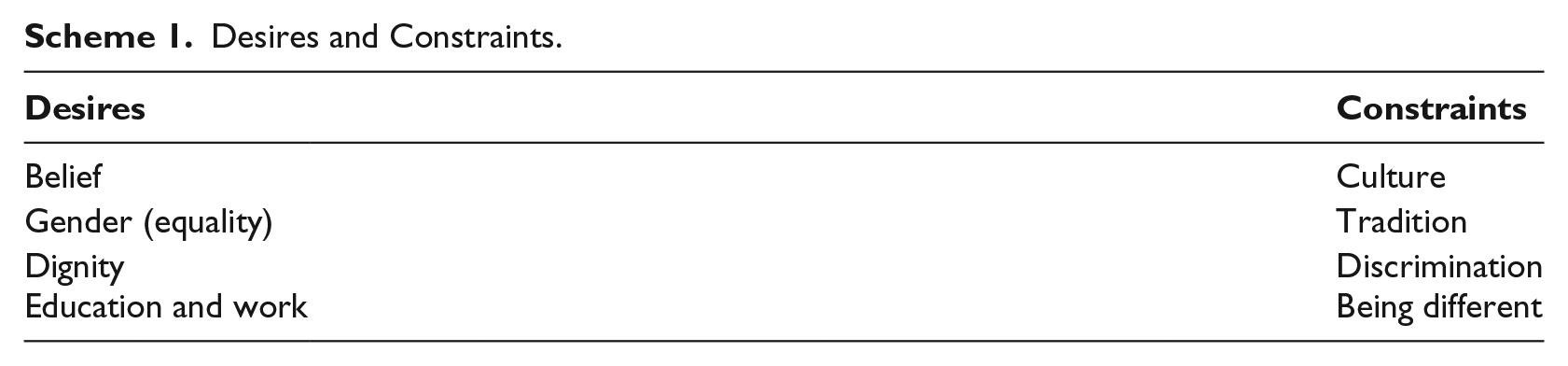
Most of the constraints (on the right) are not exclusively linked to the specific desires (on the left) but are mentioned in combinations. However, the interviewees predominantly link belief (+) and culture (−), and gender (+) and tradition (−). Discrimination and being different were mentioned in different combinations.
A summary of the findings is presented next on the basis of the main categories.
Belief and culture
According to the interviewees, their desire to believe, their faith, is the most important of all categories. Faith is connected to strength, to their desire for a positive identity and to pride. For them, Islam propagates tolerant values, such as the importance of being non-judgmental and showing respect: Even if he (a client) were the worst person on earth, I am not allowed to judge him. Who knows, what if he manages to improve his life? He might even catch up with me […] in being good and then I am the bad one … Oh no, we may never judge, that is God’s task. I might end up in the same miserable situation, we are all humans, you never know.
It is also related to a resistance against the stigmatisation of Muslims in the media. Culture is considered to be the main cause of gender inequality, forced marriages, domestic violence and the suppression of women in general. With regard to Dutch culture, the interviewees mention individualism and the dominance of material well-being as the strongest obstacles. Combining membership of the Muslim community and being Dutch is not easy for them.
No part of their faith is identified as a blockade. Two choices are explicitly emphasised: first, that women personally choose to wear a headscarf and, second, that they have the freedom to choose their own marriage partner. This partner should be a Muslim, though. Fate, karma or destiny are mentioned regularly but are not considered as obstacles and go well together with their desire to develop themselves through education or emancipation.
Following the rules of Islam has priority and it governs all aspects of their life, as well as their work.
Gender (equality) and tradition
Tackling inequality and disadvantage, or overcoming obstacles, is mainly mentioned in regard to gender issues. The interviewees lay claim to having the same opportunities and resources as the men in their communities, for themselves and their children. They challenge the privileged position of men and question how their faith can legitimise gender inequality, and present this as their cultural heritage. They mention their desire to emancipate in terms of learning to stand up for themselves, to develop, to become strong, to learn how to convince their male partner through arguments, by raising their sons and daughters equally, to work and have the right to privacy and hobbies. According to the interviewees, claiming gender equality does not conflict with their faith. One of the constraints mentioned is that it might lead to uncertainty and confusion among their male counterparts.
Although tradition is rejected, ideas about marrying young, becoming pregnant while young and being loyal to parents are considered most important. The interviewees express a sense of responsibility for their parents, feeling obliged as females to care for them, and some feel overloaded and stressed. They want to honour their parents. One important constraint is the protectiveness of parents and especially their fathers and brothers towards women. One of the interviewees is a bit more sceptical about the changing role of women in her community: Emancipation, that is how they call it in the west, but when you really listen to these women, then you will hear that they cannot cope anymore. The children are the ones who suffer. The children are neglected because they hang out all day on the streets. Women have to combine different jobs, often underpaid cleaning jobs, and when their children come home from school they are not there. They are exhausted when the children come home and feel that they are unable to give attention to them. I don’t know how to address this. People say that we are doing well, that we are becoming emancipated and don’t cause problems like our men and boys. But we need to worry more about the women …
Dignity and discrimination
Their desire to be proud of who they are is related to a sense of belonging to different communities and wishing to be treated with respect and dignity. Within this category different expressions were used, such as respect, recognition, pride, equality and dignity. We, the authors, decided to label this category as ‘dignity’. The interviewees desire equality as Muslims and as women. They consider inequality to be a violation of human dignity. The interviewees mention pride and the desire for a positive identity in relation to the stigmatisation and ‘victimisation’ of Muslims, especially in the media. The interviews show a profound distrust of the reports on Muslims in the media. In this context, news and information on the Israeli–Palestinian conflict is mentioned specifically.
Although a certain reluctance to address negative issues was mentioned before, examples of discrimination in the workplace were described more frequently here than in the first phases of this research. This could be due to the fact that the interviews were performed by peer interviewers and they may have felt more at ease in addressing discrimination, but also to the growing awareness of the co-researchers on discrimination during the research process. One of the interviewees is an exception when she criticises other Moroccan and Turkish Dutch: We (Turkish and Moroccans) do not know self-criticism, we talk behind each other’s backs, and we cannot be open with each other …
The interviewees also mention the superiority of ‘the Dutch’, who claim to be tolerant. In their criticism of the media, they express their concerns about the freedom of speech that, according to the interviewees, is mainly applied to the majority Dutch and not to them as Muslims. This double standard is felt as an affront to their dignity. The freedom of speech in the Netherlands is ‘loudly’ embraced by groups of ethnocentric people and within new right-wing parties. The interviewees describe feeling neglected, selectively informed and disadvantaged by the media, which contributes to their stigmatisation as Muslims. They say that the media focus on ‘Islamic terrorism’, radicalisation of young people and other negative phenomena and give examples of Dutch politicians stirring up hatred against Muslims. Many of them only trust their own networks and news sites.
An example of discrimination in the workplace is as follows: As I told you before, in this organisation the majority of the workers are Dutch and I noticed that I did not belong to the team. That is difficult to explain. Let me give an example – oh yes, I had a meeting with my manager and she was giving me feedback and at a certain point she said: ‘You should know that if you wear a headscarf you will have less chance of finding a job’. I had no idea why she brought this up and even though she said that it didn’t bother her, why mention it? I am convinced there is discrimination, but I am not the type to play the victim … no!
Education and work and being different
The interviewees want to study, develop and work and to combine this with family roles. The interviews show that the fields of education and (social) work represent the areas where they feel most confronted with the ‘outside world’. Work and education are pre-eminently the areas where multiple identities are negotiated and boundary work has to be done. Here one has to deal with heterogeneity. Here they have to juggle different roles. The constraints described under ‘dignity’ require finding creative solutions to combine Muslim, gender, ethnic and professional identities. Some young professionals even choose to combine work and family roles with voluntary work. Voluntary work and their choice for social work are strongly inspired by Islam. They are not primarily concerned with how to relate to the social work profession and do not formulate any explicit desires in this regard; instead, other concerns are far more important. The main constraints we identified concern being different in a predominantly ‘white’ environment. The interviewees refer to dealing with difference, to be seen as ‘only Moroccan or Turkish’ and to be treated differently as a visible minority: I am visible as a Muslim, can be recognised as Muslim and want to work as a social worker with clients, but they feel that I represent being suppressed as a woman, who is not free. They feel uncomfortable with me and question how I will be able to help other people, needing help myself. They feel that I cannot be representative as a social worker …
Being a visible minority, standing out, being different and being seen in the first place as Muslim are different ways in which being different is expressed. The interviewees avoid attracting (negative) attention to being different because it makes them feel more vulnerable. They also choose to be visible and to be heard and above all to be proud, however. Especially at work and in the media, they feel confronted with discrimination. The accusation of being suppressed as Muslim women is rejected as undermining their individual agency and dignity. They do not leave religion at the door when entering the workplace and carefully start to question subtle discrimination and the internal norms of social work organisations. In a few interviews, the interviewees refer to education as obligatory for all women and men in Islam. They also point to their experiences as migrant daughters, when they already had to support their parents at a young age by interpreting documents or by acting as mediator. Some describe themselves as ‘professional experts of experience’, referring to their own experiences of growing up in a poor neighbourhood or feeling marginalised as a Muslim. The professional field of social work connects well to their desire to be educated and emancipated, but one of the constraints here is how to incorporate their faith with their work. Especially with regard to ethical dilemmas, such as abortion and euthanasia, they question the so-called ‘expectation of neutrality’ as a professional. They seem to feel that others expect them to keep their faith out of their work and that they have to emphasise that they do not want to impose their faith on others.
Having choice
Inspired by the theory of Sen, in this section the researchers reflect on freedom and the freedom of choice by adding their perspective to the data. In evaluating the process of choice, different normative dimensions of choice are revealed, and this confirms the importance of making culture explicit in thinking and practice: My whole life I wanted to be a police woman, but the uniform and the profession didn’t feel in keeping with being a Muslim.
The above is a quote from a Turkish Dutch student who explains her choice for social work. This example, one of many, raises questions from the perspective of having choice. She deemed this to be less important and chose to become a social worker. Choice is always an encultured choice, made within particular constraints (Sen, 2006). Capability should take into account the options the professionals have and also the extent of choice. The extent of choice is, however, difficult to assess and open to different interpretations. Freedom of choice is never absolute. One of the interviewees mentions, My father would never accept if I made the choice not to fast during Ramadan, but my parents would never force me to pray or to wear a headscarf. That is a choice we have to make for ourselves. They tell me that I have to abide by the rules until a certain age, after that I am free to make my own choices …
This quote shows many dimensions of choice. Having choice can be challenged and questioned from different perspectives.
Free choice
The interviewees explicitly mention free choice with regard to wearing a headscarf and to the choice of a partner, although the partner should be a Muslim. Islam is at the core of everyday life, and this makes issues of choice rather complex. The interviewees do not restrict their faith to the private domain. They choose to be visible as Muslims. Islam offers them a perspective concerned with spiritual well-being in a secular environment that is mainly focused on material well-being. Loyalty to their parents is important and not considered a limitation of choice. The wish to honour their parents, who migrated to give their children a better future, puts pressure on them to make a career, to be successful. The interviewees refuse to be seen as ‘victims of limited choice’, however. They resist being seen as ‘suppressed’. It is obvious to them that no one wants to see herself as a victim. This was specifically mentioned a few times, related to discrimination by the majority Dutch population. One of the interviewees indicates, Seeing yourself as a victim is like giving them [the majority Dutch] the message that they are right.
With regard to their own communities, being ‘a victim’ could be considered as blaming or even accusing others, like their parents or other Muslims. An exception in this context is their rejection of the overprotectiveness of fathers and brothers (as the ‘policemen’ of their family). This is an example of their desire and choice to emancipate, within certain boundaries but with conflicts at the edges.
Freedom and the need to belong
Choice and limitation of choice, as expressed by the interviewees, are often related to the need to belong. The desire to have a place where they feel at home, a place to live among members of their own family and culture, can be identified implicitly in many responses that cite the importance of family, the Muslim community and a desire for recognition and pride. These examples show that although limitations in choice are experienced, they ‘don’t bother’. As all people do, some freedom is given up in exchange for a sense of belonging. A choice for compromise can be considered a real choice. A sense of belonging to their families and communities is a resource, and only in a few examples, for instance regarding the negative impact of social control, is it perceived as a restriction of their freedom. Mahmood (2005) argues that in order to recognise agency of (Muslim) women, a different conception of freedom is needed – freedom as a practice of belonging or freedom that can be found in connections.
Individual choice
A certain homogeneity or uniformity is visible in the desires and constraints of the interviewees. This may reflect the importance of the community or group-dependent constraints. Individual choice, autonomy and diversity in society with multiple loyalties to different groups seem to be elements of individualist cultures. The countries of origin of the interviewees’ parents can be considered collectivist societies. Although we need to be critical of a reductionist view of what is Western and what is not, we may wonder whether Western paradigms, such as individualism, rationalism and objectivity, are appropriate to meeting the needs of diverse groups.
Harmony
Social harmony is central to the interviewees’ relationship with their communities, whether of a cultural or religious nature. The option of being different as an individual can only be identified in a few of the interviewees’ narratives. More implicitly than explicitly, they express having less freedom not to take care of dependents or not to marry, but to stay single. They only refer to homosexuality when talking about service users, never in regard to themselves. A different sexual identity, to be a single mother or to stay childless, do not seem to be options. In their desire for gender equality, the interviewees do not seek an open conflict by resisting norms. Emancipation is combined with tradition and customs, such as marrying and having children at a young age.
Agency
Agency, as defined by Sen, refers to making a difference, in acting otherwise or alternatively and in emphasising that people can be considered active agents of their own well-being. The professionals involved in this research identify with Islam and advocate a dynamic, liberal and tolerant view of Islam, which seeks to recognise and afford agency to individuals. They resist a strong patriarchal and gender discriminatory position and choose a more egalitarian perspective. They combine being a carer and a breadwinner. According to the interviewees, their sense of agency and dignity is undermined by experiences of discrimination.
The process of choice
Constraints can be imposed by others. The freedom to choose implies that we can be held responsible for what we do, for our chosen actions. Sen (2009: 228) emphasises the importance of the process of choice and opportunities. This also means that the social construction and constraints on choice need to be scrutinised in order to avoid blaming individuals and holding them responsible for choice, without having the possibility to make a genuine choice. In the context of this research it would be very interesting to further investigate the interviewees’ constraints on choice, such as culture and tradition. Culture and tradition represent heterogeneity and dissension for the interviewees. The interviewees consider Islam as their dominant and constraint-free identity. None of the interviewees hints at specific hindrances or obstacles within Islam. They see culture and tradition, however, as interfering with their faith. This might reduce their options in identifying diversity within their faith as individuals, but also offers freedom for their most important desire, which is their faith. In general, a neglect of our embedment in culture and tradition may lead to a lack of cultural or historical awareness and have an impact on our choices, such as how we choose and see our identities.
Conclusions
The question we sought to answer in this article concerned the kind of professionals that these newly started social workers desire to be and what hindrances they encounter. Being a professional and questioning what kind of professional they desire to be is not their own main concern, however. The professional context represents, in the first place, the area where multiple identities are negotiated. The peer interviewers were driven by their desire for recognition. This resulted in narratives that are less connected to the professional context than we had hoped for. The desires and constraints of the interviewees nonetheless reflect their main concerns as young women, creating room for agency, especially in gender equality, but without compromising their faith. This will certainly impact their professional development. For the Turkish and Moroccan Dutch professionals in this study, the profession seems to serve as a context to realise their ideals and desires. They want to be good Muslims, also in their profession. The social work profession offers them room to be both a good professional and a good Muslim at the same time. In their desires, the professionals give the impression of embracing the humanitarian values of the social work profession, interpreted from the perspective of Islam and by that at the same time, challenging the overt dominance of Western beliefs and values.
We sought a more profound understanding of the data, and this has resulted in a deeper comprehension of what boundary work and negotiating multiple identities is really about, in a context where ‘having choice’ is continuously questioned by others and disempowers the professionals. Boundaries can thus also act to preserve structural inequalities (Vasta, 2007). In different publications on second-generation professionals and subtle discrimination in the workplace, authors refer to the importance of agency and the concept of micro-emancipation (Waldring et al., 2015; Zanoni and Janssens, 2007). The Turkish and Moroccan Dutch professionals are starting to question subtle discrimination at work, and this awareness contributes to forms of ‘micro-emancipation’. It can be seen as a subtle response, especially in relation to their employers, supervisors and other authorities.
The capability approach as a framework for thought, as applied in this study, contributes to a better understanding of the professionals’ process of choice in the construction of their identities. However, the studies on discrimination raise questions as to whether the capability approach is sufficiently critical of social power and suppression. This concern is addressed by different authors (Hill, 2003; Koggel, 2003; Robeyns, 2003). According to Sen, in matters of choice, it is essential that constraints on choice are scrutinised closely. ‘The capability approach itself does not analyse the institutions that produce and reproduce power, and that as such have great impact on people’s opportunities, and social inequalities’ (Robeyns, 2003: 48). Another question concerns the so-called ‘notion of the good life’. Sen explicitly refuses to defend a predetermined list of capabilities, or moral entitlements, as endorsed by Nussbaum (2000, 2006), and this may open the door to moral relativism. Yet for both scholars, a focus on capabilities means that they aim at a range of possible ways of life from which each person can choose. The question is how to relate to more universal humanitarian values in matters of professional ethics, as in social work. The assumption of universality and ‘one best way’ has hindered efforts to attend effectively to issues of diversity (Gray et al., 2008). Social work itself can be considered a cultural construction, and we can question what is really universal in social work. Working with migrants and refugees in social work practice and education in a Western context challenges the dominance of Western beliefs and values. This becomes tangible in the different dimensions of choice.
Footnotes
Funding
The author(s) received no financial support for the research, authorship and/or publication of this article.