



Abstract
To effectively prepare students for practice, macro social work educators need to keep pace with employers’ demands. This article reports findings from a survey of social work educators (n = 52) and macro practitioners (n = 184) in Texas to assess congruence in competencies perceived as necessary for macro practice. Findings reveal that both groups prioritize competencies related to interpersonal dynamics and leadership, program management, and community practice, and view financial management and public relations as least important. However, findings identify differences in practice competencies (e.g. policy practice, organizational management, and development), suggesting a need to better align educational and professional priorities.
Introduction
As the social work profession seeks to prepare students for macro practice careers, social work educators need to effectively keep pace with current macro practice trends, integrating into coursework the knowledge and skill sets deemed essential by current practitioners and prospective employers (Perlmutter, 2006). Shifts away from macro education in social work raise questions about the extent to which educators have been able to effectively prepare students for the needs of the macro job marketplace, particularly regarding management in social service agencies (e.g. Patti, 2003; Wuenschel, 2006).
This article argues that social work remains the best suited profession to prepare graduates to assume critical roles in human service organizations, community-based organizations, and social welfare policy settings. To prepare students for community and organizational practice and leadership, mutually supportive relationships are needed between educators and practitioners with common goals grounded in values and principles of social work. These relationships can be mutually beneficial, as effectively trained graduates secure practice and leadership positions in human service organizations.
A fundamental issue underlying this exploratory study is whether social work education (i.e. educators) is adequately aligned with current social work practice (i.e. practitioners) regarding the requisite knowledge and skills necessary for graduates to succeed as macro practitioners and, ultimately, assume macro practice leadership positions. To inform these discussions, the authors sought to address the following research question: What similarities and differences exist between macro social work practitioners and educators in regards to what both perceive as the most important areas of competency for social workers engaged in macro practice? A better understanding of the similarities – and arguably more importantly, the differences – in what is being taught in school versus what is being applied in macro practice is an important first step to ensuring that the next generation of macro social workers are equipped and prepared to succeed in the changing macro practice landscape.
Literature review
Serious questions surround the extent to which graduate social work training adequately prepares social workers for macro practice, such as advanced administrative and management practice (Deal et al., 2007; Mor Barak et al., 2004). There is widespread consensus that positions in human service administration and management, historically occupied by social workers, are in competition with other disciplines that have increasingly filled these positions (Patti, 2003; Perlmutter, 2006; Wilson and Lau, 2011; Wuenschel, 2006). For social work graduates to effectively compete with these other disciplines, some have argued that the competencies that are emphasized in academic settings must be consistent with those needed in practice (Gamble, 2011; Rothman and Mizrahi, 2014).
Scholars such as Austin (2000), Patti (2000), and Brown (2008) have noted that the traditional social work path to a supervisory or administrative position has been through direct service. Based on this history, substantial numbers of social workers will ultimately rise to positions in management and administration through direct service (Brown, 2008; Wilson and Lau, 2011). In addition, macro students often aspire to high levels of leadership, where they are competing with those with Master of Business Administration (MBA) and Master of Public Administration (MPA) degrees, and other professions that received targeted training in management and leadership (Nesoff, 2007).
However, research suggests that nonprofit executives do not believe that social workers possess the necessary upper-level management skills (Patti, 2003); instead, executives report preferring MBAs and MPAs over Master of Social Work (MSW) graduates (Hoefer, 2003). A study of 14 Chief Executive Officers (CEOs)/Directors finds that practitioners seek to hire graduates with advanced analytic, technical, and verbal communications skills (Perlmutter, 2006). Specific skills mentioned include fundraising, marketing, planning, branding, and alliance building. The ability to employ performance management tools and tactics such as strategic planning and proficiency with developing, combining, or reducing programs in response to financial uncertainty has been identified as an important nonprofit management skill (Mosley et al., 2012).
A series of efforts has taken place over the last two decades to identify essential competencies, defined here as knowledge and skills, for professional macro practice. For example, Martin et al. (1999) asked practicing social work managers who had graduated from the administration concentration in one graduate social work program to rate the importance of 37 managerial skills in practice. Martin et al. found that macro competencies fell into two main domains: technical and interpersonal skills. Interestingly, social work managers were found to ascribe greater importance to interpersonal skills than to technical skills. Thompson et al. (1999) instead compared the perspectives of managers and direct practitioners in terms of relevant administrative competencies. Both groups were asked to rank their frequency of engagement in 35 competencies. A factor analysis yielded 12 distinct domains of management practice, with significant differences between managers and direct practitioners in only two areas, identified as ‘aligning’ and ‘communicating’. While these findings highlight the importance of leadership and communication competencies, they also underscore similarities in practice between macro social workers and direct practitioners, and suggest the need to integrate macro competency throughout the social work curriculum to prepare all social workers for future human services management responsibilities.
In addition, several US-based macro practice organizations have sought to identify essential competencies to prepare students for management practice. For example, the National Network of Social Work Managers (NNSWM) has identified and revised a set of core competencies (Hassan et al., 2013). The 14 major competencies identified by NNSWM and corresponding performance indicators are categorized within four domains: leadership, resource management, strategic management, and community collaboration. These competencies include interpersonal and technical skills. The Association of Community Organization and Social Administration (ACOSA) engaged in an initiative to ‘focus the understanding and definitions of goals and competencies for macro social work’ (Gamble, 2011: 382). While NNSWM focused primarily on management competencies, ACOSA’s purview is broader, incorporating competencies related to community organizing. In developing two lists of competencies for macro practice, ACOSA first focused on 10 domains of macro social work practice, five related to social administration and five related to community organization. These lists, though not identified specifically, reflected the nine categories of competency in the Council on Social Work Education’s (CSWE) 2015 Educational Policy and Accreditation Standards (EPAS). The Special Commission to Advance Macro Practice and other leading macro organizations are now embarking on a project with CSWE to develop the first national Specialized Practice Curricular Guide for Macro Social Work Practice.
While many of the NNSWM and ACOSA competencies are technical (e.g. budget and finance, human resources, and technology) and relational in nature, research has continued to focus on the domain of interpersonal skills identified by Martin et al. (1999). Through their study of macro practice field instructors, Regehr et al. (2012) identified two distinct dimensions of macro competencies essential for student learning in macro practice: meta and procedural competencies. Meta competencies focus on personal and interpersonal skills and qualities, including ‘self-awareness, compassion, motivation, and commitment to social justice’ (p. 307). Procedural competencies focus on technical and professional communication skills such as ‘project management, presentation skills, and ability to articulate and implement steps to attain goals’ (p. 307). Regehr et al.’s study underscores the importance of strengthening students’ capacity to meet specific technical competencies and supporting them in developing the broader personal and interpersonal qualities that provide a framework in which procedural competencies can be performed. In similar fashion, Knee and Folsom (2012) identified four core interpersonal skills critical to macro practice: communication, problem solving, empowering others, and self-awareness. Knee and Folsom argued that social work programs often emphasize these interpersonal skills in the context of direct practice; as a consequence, macro social work students and professionals may find themselves unprepared to transfer critical interpersonal skills into macro practice contexts.
The CSWE’s 2015 EPAS continue to incorporate macro practice within nine broad areas of competency. In doing so, specific guidance should be provided regarding the technical and interpersonal knowledge, skills, and practice behaviors that macro education should incorporate. According to the EPAS, social work education programs should provide a curriculum and instruction that prepares students to demonstrate ethical and professional behavior; engage diversity and difference in practice; advance human rights and social, economic, and environmental justice; and engage in practice-informed research and research-informed practice. Students should also engage in, assess, intervene, and evaluate policy and practice with individuals, families, groups, organizations, and communities. As noted in the standards, The Specialized Practice augments and extends social work knowledge, values, and skills to engage, assess, intervene, and evaluate within an area of specialization … Programs identify the specialized knowledge, values, skills, cognitive and affective processes, and behaviors that extend and enhance the nine Social Work Competencies and prepare students for practice in the area of specialization. (CSWE, 2015: 12)
The advanced Specialized Practice curriculum builds on a Generalist Practice curriculum and is determined by each respective program and its faculty allowing for diverse areas specializations.
This study seeks to contribute to the literature and curriculum development by addressing two primary research gaps. First, while the literature speaks to core practice competencies, the gaps between practitioners’ and educators’ perceptions of competencies education have not been explored. Social work educators have the main responsibility of preparing the next generation of social workers, but many have left practice to enter academia. Practitioners are currently engaged in and can be assumed to have firsthand knowledge as to the skills, knowledge, or competencies needed to succeed in macro practice settings. Therefore, an increased understanding of practitioners’ (some of whom may be in leadership or management positions, i.e. employers of macro social workers) views of which skills are essential for practice, and how these perceptions differ from those of the educators teaching our next generation of MSWs, can help us better prepare students for macro social work practice.
Second, research on practice competencies has focused primarily on nonprofit executives, field instructors, alumni, students, and macro-oriented organizations (Gamble, 2011; Hassan et al., 2013; Hoefer, 2003; Martin et al., 1999; Patti, 2003; Perlmutter, 2006; Rothman and Mizrahi, 2014). Studies are conducted with mutually exclusive sample groups, thereby limiting implications for current and future practice. Noticeably absent is research comparing faculty perceptions regarding competencies for macro practice with practitioner’s perceptions regarding competencies for practice in human service organizations. Discerning differences and similarities in perceived competencies will provide further insight into pathways for enhanced student training and alignment with macro practitioners.
Methods
Using a cross-sectional survey, we sought to compare the perceptions of macro social work practitioners and educators across Texas in 2012. This study was approved by the University of Houston Institutional Review Board Committee for the Protection of Human Subjects. Social work faculty and practitioners were targeted for this study in order to identify what respondents identified as essential competencies for professional macro practice. Using the SurveyMonkey tool, links to separate practitioner and educator online surveys were emailed to each respective sample, followed by at least two reminder emails.
Sample
To recruit faculty, we reviewed the websites of each Master’s-level social work program in the state of Texas. Based on their online profiles, we identified all faculty who were engaged in macro-oriented research, teaching, or practice. For the practitioner sample, we worked with the Texas Chapter of the National Association of Social Workers (NASW-TX), which agreed to assist us in recruiting our sample from among its approximately 5700 members.
This recruitment strategy yielded a final study sample of 52 educators and 184 practitioners engaged in macro practice or scholarship in Texas. Common to online surveys (Nulty, 2008), the response rate was low, 21.1 percent of faculty and 20.4 percent of practitioners who received a survey invitation. However, although our focus was on macro social work practitioners, we were not able to distinguish between macro and direct practitioners before contacting potential respondents; therefore, the survey was sent out to social workers regardless of their practice setting, further limiting the response rate. Of the 59 educators who initially responded to our online survey, we excluded faculty who did not teach, have practice experience, or conduct research on macro social work from this analysis. Likewise, 454 practitioners initially responded to the survey. An inclusion question queried, ‘In any employment sector, do you engage in management, policy, community practice, or related macro social work activities at least half of the time in your current position?’ Any practitioners who responded ‘No’ to this question were excluded from this analysis. We chose this cutoff because we were most interested in the perspectives of practitioners whose primary responsibilities are macro-oriented.
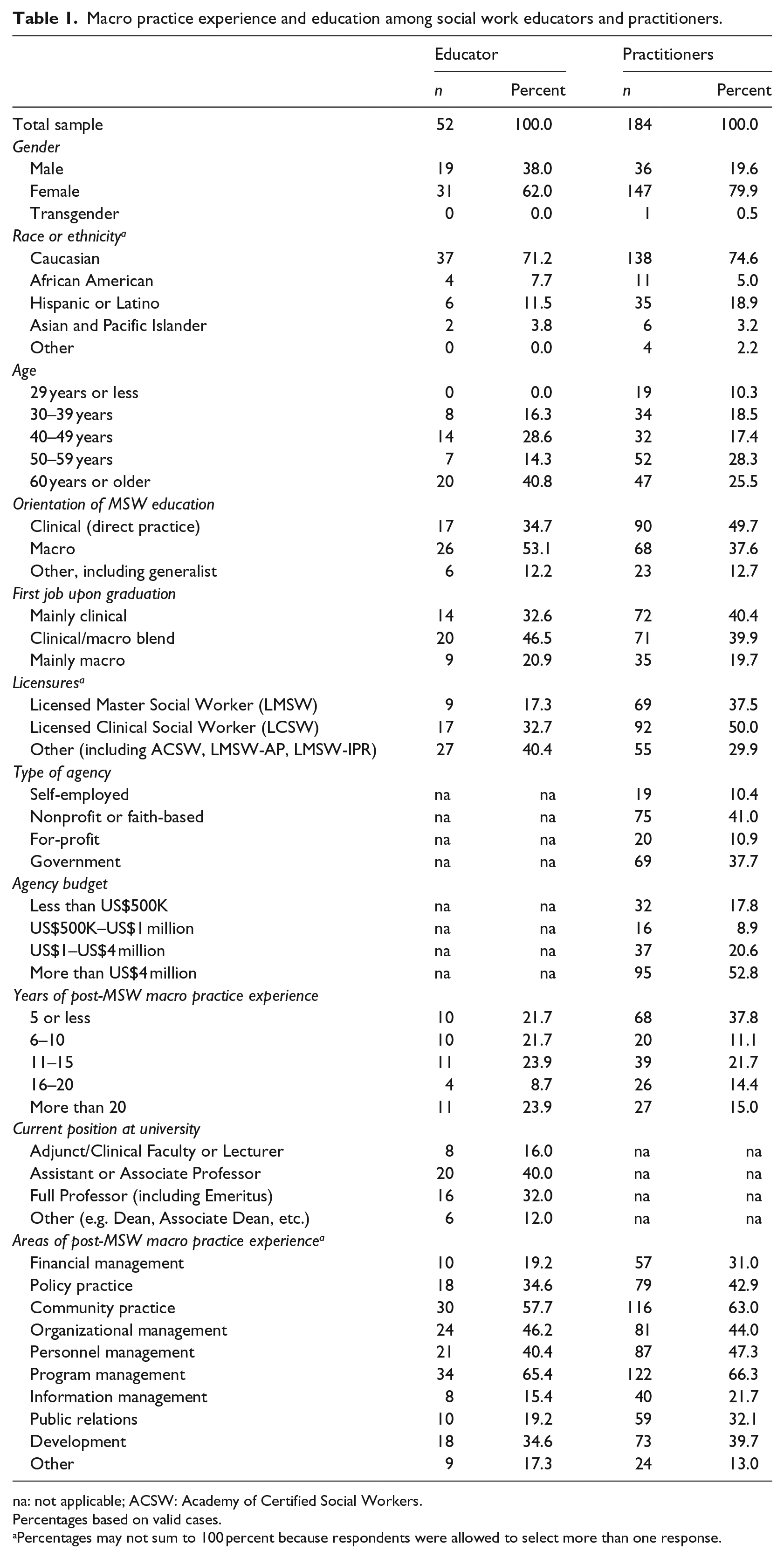
The educator sample includes faculty across academic ranks: 16 percent were adjuncts or clinical faculty, 40 percent assistant or associate professors, and 32 percent full professors. Educators represented programs with fewer than 250 MSW students (55.1%) and more than 250 (44.9%). The majority of faculty reported a macro-oriented MSW education (53.1%); the remainder were clinically trained (34.7%) or were trained in some other manner such as a generalist education (12.2%). Among these educators, half reported primarily teaching macro practice courses.
Substantial diversity is also reflected in the practitioner sample. The plurality of practitioners work in nonprofit or faith-based settings (41.0%), with the remainder in government (37.7%), for-profit (10.9%), or self-employed (10.4%), as shown in Table 1. Over half of the sample worked in large agencies with budgets over US$4 million (52.8%). In contrast to the faculty sample, the largest group of practitioners was clinically trained (49.7%). The remainder received a macro education (37.5%) or was trained in some other manner (12.7%). Table 1 summarizes additional sociodemographic and practice-related characteristics of the sample.
Macro practice experience and education among social work educators and practitioners.
na: not applicable; ACSW: Academy of Certified Social Workers.
Percentages based on valid cases.
Percentages may not sum to 100 percent because respondents were allowed to select more than one response.
Interestingly, only about one-fifth of educators started in a mainly macro position (20.5%); most faculty began either in a clinical position (32.6%) or in a position that blended macro and clinical responsibilities (46.5%). A similar 19.7 percent of practitioners started out in mainly macro positions, while most practitioners began in a clinical (40.4%) or blended position (39.9%). Across both groups, the most common areas of post-MSW macro practice experience were Program Management (PROG) and Community Practice. Also common for both practitioners and educators in this sample was experience in Organizational and Personnel Management.
Measures
While small differences existed between the practitioner and faculty surveys, both versions included items asking participants to rate the importance of specific macro practice competencies. The surveys also collected respondents’ basic demographic characteristics (gender, race/ethnicity, age), employment experience (current position, years of experience, type and extent of macro social work experience, type and size of agency or institution, courses taught if applicable), and educational experience (degrees and licensing, other certifications, social work concentration). The surveys included additional items such as respondents’ perceptions of the minimal level of preparation needed by graduates in different competency areas and several open-ended questions; these items are not included in the analyses discussed here.
Macro social work competencies
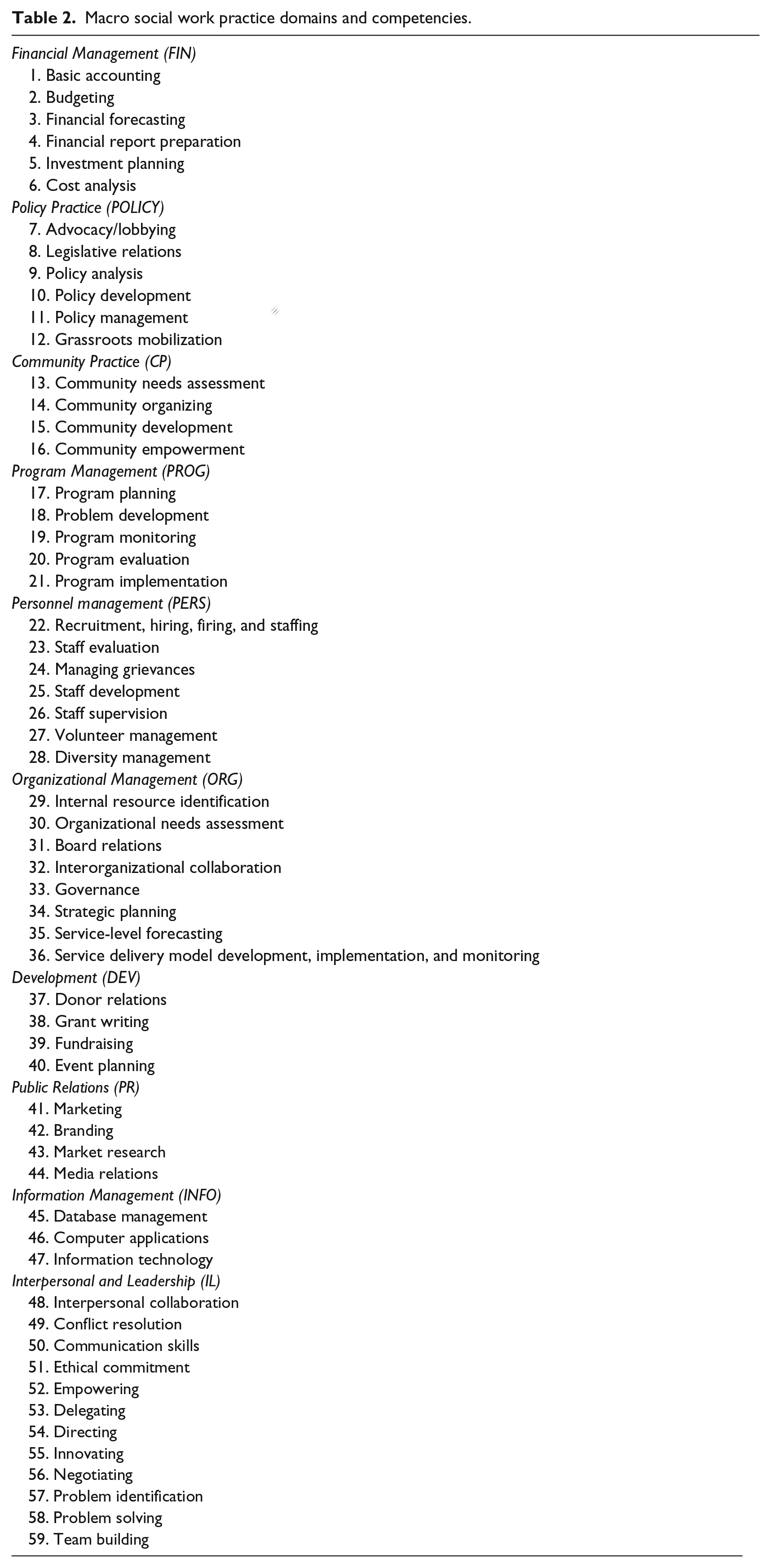
The main survey section included a series of items asking participants to rate the importance of 59 individual macro social work competencies. Based on the prior attempts to identify and categorize macro social work competencies identified in our comprehensive literature review (CSWE, 2008; Gamble, 2011; Hassan et al., 2013; Martin et al., 1999; Mor Barak et al., 2004; Thompson et al., 1999), we compiled a preliminary list of macro-specific areas of competency focused on knowledge, skills, and values. The project team, including three macro social work faculty members and a macro-trained doctoral student, then engaged in an iterative process to derive a final list consisting of the 59 central areas of macro social work competency we believed most reflect the breadth of macro practice competencies for organizational, community, and policy practice, listed in Table 2. In an iterative process, these competencies were discussed and categorized by the team into 10 major domains based on the literature previously discussed as well as the team’s knowledge of macro practice arenas. For example, the Organizational Management (ORG) domain was distinguished from the PROG domain based on distinctions between organizational-level and program-level competencies. Financial Management (FIN), which focuses on competencies related to managing an organization’s finances, was distinguished from Development (DEV), which focuses on competencies related to bringing external sources of funds into an organization. Within each domain category, respondents were asked to rate the importance of each competency for macro social work. The following response options were provided: ‘not important’, ‘somewhat unimportant’, ‘neither important nor unimportant’, ‘somewhat important’, and ‘very important’, with a not applicable option. One limitation is that grouping certain competencies together may have influenced respondents’ perceptions of their importance. We interpret findings in light of these categorizations; it is possible that practitioners might have grouped these domains differently than our team of educators did.
Macro social work practice domains and competencies.
Analysis
Descriptive statistics were used to identify how important practitioners and educators rated each area of competency. In addition to calculating mean and standard deviation scores for each individual competency, we calculated mean domain scores based on the means reported for all items within the domain. We then examined which competencies and domains were rated as most and least important by each group. Independent sample t-tests were conducted in order to assess for statistically significant differences between how the educators and practitioners rated the importance of the areas of competency under study.
Results
Individual competencies
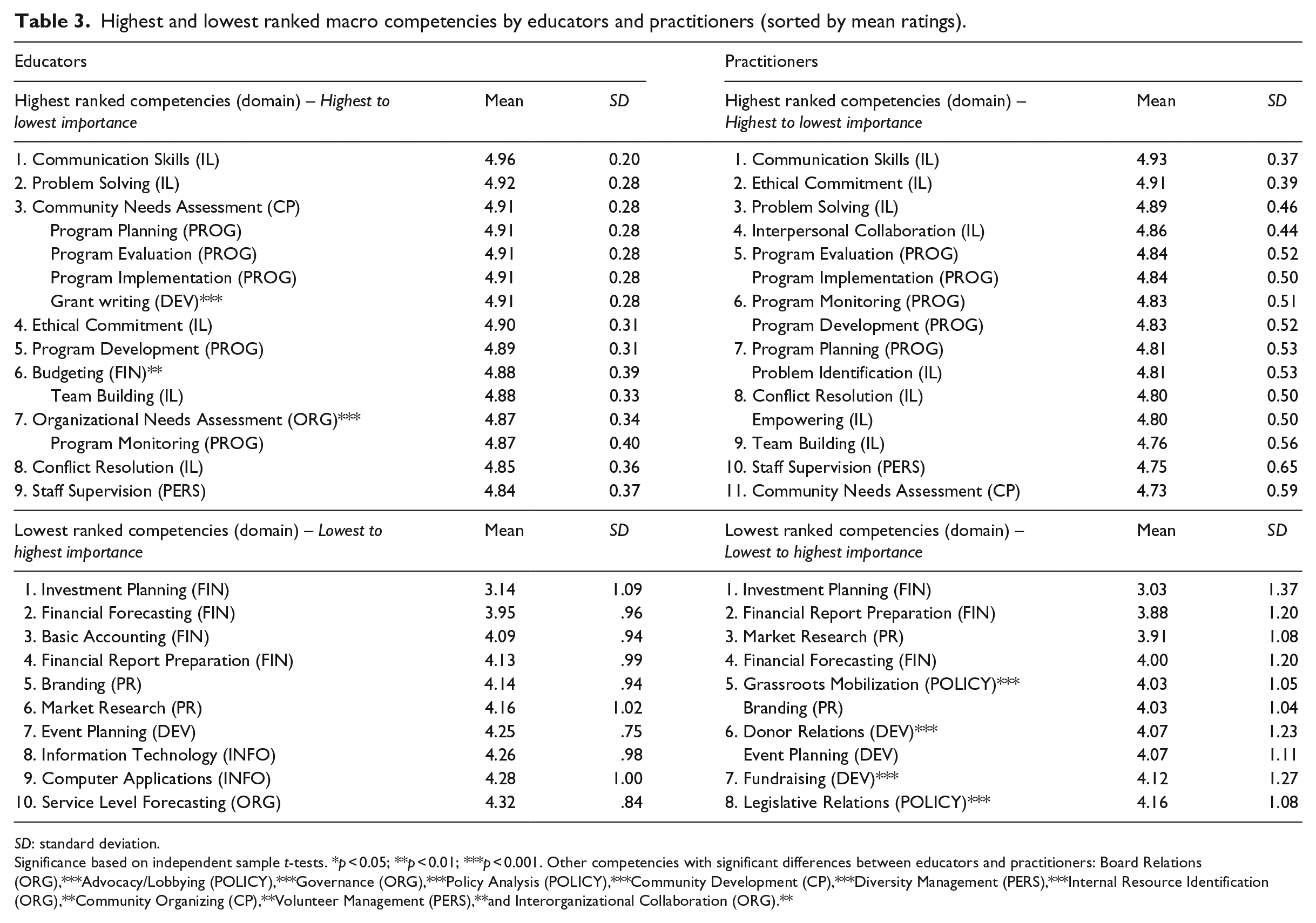
The mean importance ratings for educators and practitioners on each of the 59 individual macro practice competencies were ranked. The highest and lowest rated competencies for each sample are summarized in Table 3. Full results are available upon request.
Highest and lowest ranked macro competencies by educators and practitioners (sorted by mean ratings).
SD: standard deviation.
Significance based on independent sample t-tests. *p < 0.05; **p < 0.01; ***p < 0.001. Other competencies with significant differences between educators and practitioners: Board Relations (ORG),***Advocacy/Lobbying (POLICY),***Governance (ORG),***Policy Analysis (POLICY),***Community Development (CP),***Diversity Management (PERS),***Internal Resource Identification (ORG),**Community Organizing (CP),**Volunteer Management (PERS),**and Interorganizational Collaboration (ORG).**
Communication skills emerged as most important for both educators (M = 4.96, standard deviation (SD) = .20) and practitioners (mean (M) = 4.93, SD = .37). Practitioners also identified ethical commitment, problem solving, and interpersonal collaboration as among their top four most important competencies. Educators similarly prioritized problem solving and ethical commitment; in addition, community needs assessment, program planning, program evaluation, program implementation, and grant writing tied at the third highest importance ranking for educators.
Among the 15 competencies each group identified as most important for macro social work were those categorized within the domain of Interpersonal and Leadership (IL) skills. Of the 12 queried competencies in this domain, practitioners rated eight as among the most important, while educators assigned high importance ratings to five IL competencies. The three competencies practitioners prioritized that were not similarly rated in the top 15 by educators are interpersonal collaboration, problem identification, and empowering.
Competencies related to PROG rate among the most important for both educators and practitioners were program planning, evaluation, implementation, development, and monitoring. For practitioners, only two of the competencies rated as most important fell outside of the IL or PROG domains: staff supervision and community needs assessment. Both of these were rated as among the most important competencies by educators as well. Three other competency areas emerged as highly important for educators: technically oriented skills related to grant writing, budgeting, and organizational needs assessment.
For both educators (M = 3.14, SD = 1.09) and practitioners (M = 3.03, SD = 1.37), investment planning rated as the least important of the 59 queried competencies. All of the competencies rated as least important by educators fell within the FIN domain, including financial report preparation, financial forecasting, and basic accounting. Practitioners similarly placed lower priority on financial report preparation and financial forecasting. Educators assigned comparatively low importance ratings to all four of the queried competencies in the FIN domain, while practitioners did so with three.
Competencies related to DEV were rated as less important than other skill areas; this was particularly the case among the practitioners. Of the four competencies within the DEV domain, practitioners identified three as among the least important: donor relations, event planning, and fundraising. Only event planning was rated in the bottom 10 for educators. Comparatively low importance was given to two of the four competencies related to public relations – market research and branding – by both groups.
Analyses of the competencies rated as least important by the two groups yielded two major differences. For educators, but not practitioners, two of the three competencies related to Information Management (INFO) – computer applications and information technology – rated among the 10 least important skills. For practitioners, but not educators, two of the six competencies related to Policy Practice (POLICY) rated among the 10 least important areas for macro practice: legislative relations and grassroots mobilization.
Independent sample t-tests were used to assess differences in how educators and practitioners rated the importance of specific competencies (Table 3). For all competencies in which significant differences exist between the two groups, educators reported a higher importance rating than did practitioners. Statistical differences are most common in regards to development-related competencies. Educators assigned a statistically greater importance to three of the four DEV competencies: fundraising, grant writing, and donor relations. Similarly, educators rated six of the eight ORG competencies as more important for macro social work practice than did practitioners: board relations, governance, organizational needs assessment, internal resource identification, strategic planning, and inter-organizational collaboration. Educators too viewed policy practice competencies as more important than practitioners; this was the case for four of the six POLICY competencies: advocacy/lobbying, legislative relations, policy analysis, and grassroots mobilization.
Analyses of the competencies rated as least important by the two groups yielded two major differences. For educators, but not practitioners, two of the three competencies related to INFO – computer applications and information technology – rated among the 10 least important skills. For practitioners, but not educators, two of the six competencies related to POLICY rated among the 10 least important areas for macro practice: legislative relations and grassroots mobilization.
Practice domains
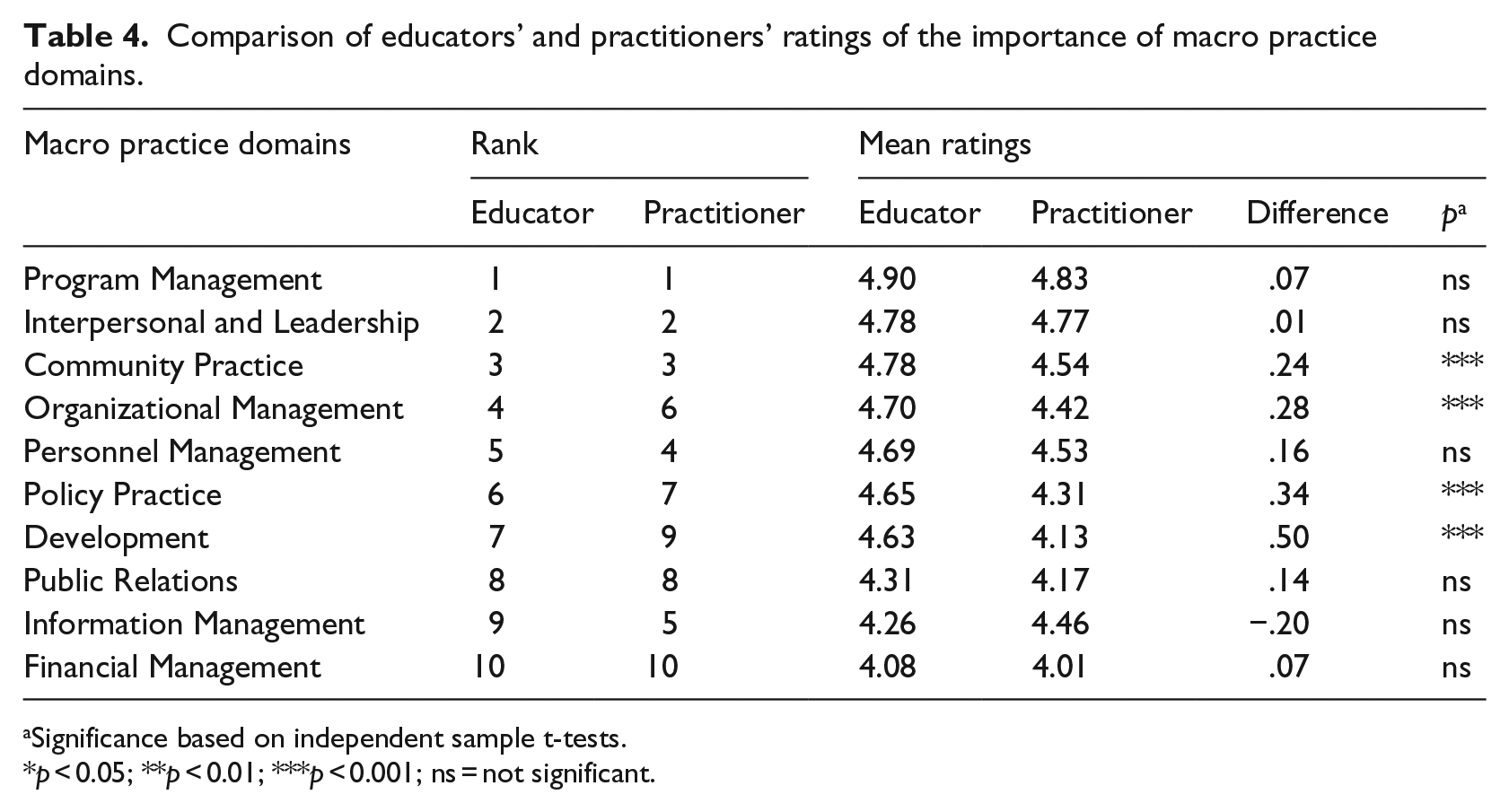
We also examined whether differences exist in how educators and practitioners perceived the relative importance of the broad domains of macro practice under study. Consistent with the individual competency analyses, educators and practitioners both rated Program Management and Interpersonal and Leadership as the most important macro practice domains, as shown in Table 4 and illustrated graphically in Figure 1. Despite only one community practice competency appearing in the lists of educators’ and practitioners’ top 15 competencies, community practice emerged as the third most important macro practice domain for both groups.
Comparison of educators’ and practitioners’ ratings of the importance of macro practice domains.
Significance based on independent sample t-tests.
p < 0.05; **p < 0.01; ***p < 0.001; ns = not significant.
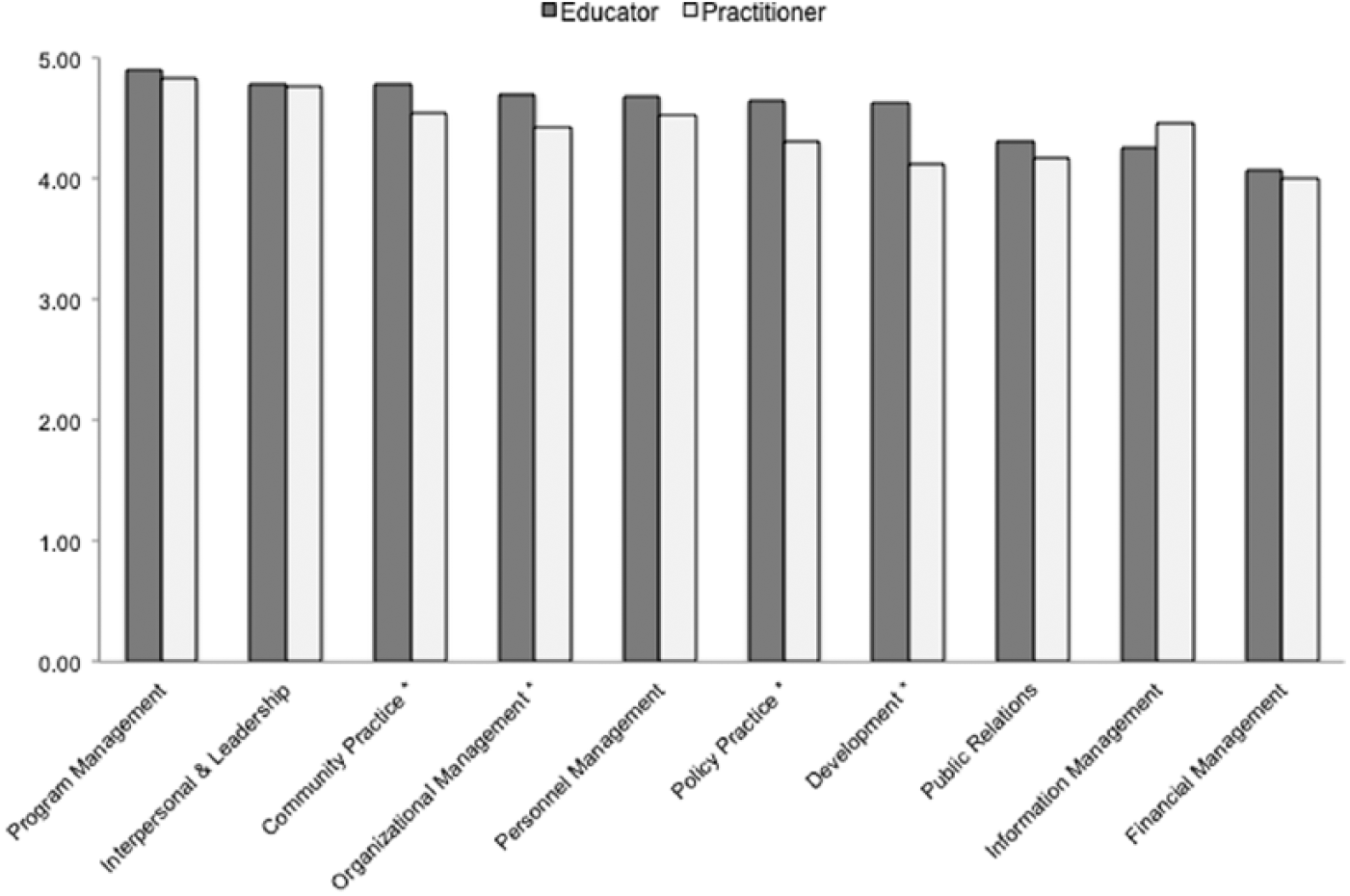
Educator and practitioner mean ratings of macro practice domains.
Educators and practitioners agreed on the least important domain for macro social work: Financial Management. Also rated comparatively less important for both groups were the domains of Public Relations and Development. Interestingly, while educators rated Information Management ninth out of 10 in importance, practitioners rated it as the fifth most important domain.
Despite the noticeable difference in rankings of Information Management between the two groups, no significant differences in mean importance ratings were identified. Statistically significant differences in mean importance ratings were identified for four domains: Community Practice, Organizational Management, Policy Practice, and Development. In all four cases, educators rated the domain as more important than did practitioners.
Discussion
Macro practice has long been an essential part of the social work profession, reflecting a commitment to alleviate social problems by modifying aspects of the organizational, community, and societal context (Long et al., 2006). Yet the profession faces a changing macro landscape with increased competition from other disciplines (Hoefer, 2003; Mirabella and Wish, 2000; Rosenberg, 2012). Along with other macro social work scholars (e.g. Rothman, 2012), the authors believe that social work must continue to prepare graduates for organizational, community, and policy practice, and most importantly, leadership. The goal of this study was to improve our understanding of which competencies macro practitioners – and potential macro employers – rate as important, and how educators’ views may differ.
In many ways, social work educators and practitioners see eye-to-eye in terms of competencies needed for macro practice. Our findings suggest that educators and practitioners agree that communication skills, ethical commitment, and problem solving are the most important competencies for macro social work practice. Both groups rate Program Management, Interpersonal and Leadership skills, and Community Practice as the most important domains of macro practice competency. Educators and practitioners also agree that among the least important macro competencies are investment planning, financial report preparation, financial forecasting, branding, market research, and event planning, with Financial Management and Public Relations the least important competency domains. These areas of agreement highlight the need for macro curricula to emphasize skills related to the entire process of organizational leadership. Students may benefit from more attention in both generalist and advanced macro curricula to teaching that the interpersonal skills they learn for direct practice – for example, communication, ethical commitment, problem solving, and interpersonal collaboration – are equally applicable in both direct practice and macro contexts.
The findings highlight a distinction between technical and interpersonal competencies. Over half of the top-rated competencies by practitioners were in the Interpersonal and Leadership domain. The remaining highest rated competencies were in the Program Management domain. This suggests that practitioners deem both interpersonal and leadership and Program Management skills central to macro practice. While educators prioritized similar competencies within the Interpersonal and Leadership and Program Management domains, alongside these competencies they also emphasized the importance of technical skills such as grant writing, budgeting, and organization and community needs assessments. Future research can explore why educators may be more likely to prioritize a broader set of technical skills while practitioners are less inclined to emphasize technical skills, particularly financial competencies. One possibility is that practitioners have observed through experience that interpersonal and leadership skills are harder to develop on the job than technical skills, while educators may prioritize areas in which competency development is more clearly quantifiable, such as program planning, design, and evaluation.
Differences in priorities for practice may contribute to distinctions that commonly exist between classroom theory and models in practice arenas. For example, while educators in this study viewed Information Management as one of the least important macro practice domains, practitioners may be more likely to see a need for students to be trained to collect and manage data for program monitoring and outcome evaluation. Likewise, the comparatively low practitioner importance rankings for specific Policy Practice and Development skills contrast with the common attention in macro social work coursework to policy analysis and advocacy and, in some cases, to fundraising. It is possible that macro social workers practicing in smaller, less complex organizations may place importance on a wider variety of competencies than those in larger agencies where job responsibilities may be more discrete. Similarly, social workers in nonprofit contexts may prioritize a different set of competencies than those in government contexts. To further understand these differences, future analyses might benefit from attention to factors such as organization size, type, and geography that may influence the type of competencies prioritized by practitioners.
The analyses found high ratings across a wide array of macro practice domains. Competencies are highly centered on more generalist functions such as interpersonal relational behaviors, communication, and decision making, and less on executive skills associated with CEO functions. The findings support the view that social work education must move beyond mid-level generalist macro skills and leadership development (e.g. problem solving and interpersonal communication). Instead, in today’s ‘business-oriented climate’, our results suggest that social work graduates need advanced analytic, technical, financial executive, leadership and verbal communication, and executive leadership skills in order to succeed in nonprofit human service organizations (Perlmutter, 2006). For example, the ability to employ performance management tools and tactics such as strategic planning, and proficiency with developing, combining, or reducing programs in response to financial uncertainty have been identified as important nonprofit management skills (Mosley et al., 2012).
Across both groups, only four individual competencies received a mean importance rating of less than 4.0 on a 5-point scale. Clearly, both educators and practitioners view a wide array of organizational, community, and policy competence as at least somewhat important. Where significant differences exist between practitioners and educators, the educators’ ratings were, on average, higher than those of the practitioners, suggesting perhaps that educators prioritize a broader array of skills for macro practice. Yet even here, the differences between the two groups are no larger than 0.50 points. If all of these domains of macro skills are perceived as important, educators may be forced to sacrifice depth for breadth to address so many divergent competencies within a tight macro concentration curriculum, often limited to 1 year. These findings suggest that there is a general level of expected competence, rather than specialized competence in any concrete macro practice area, which presents a significant challenge for the development of social work curricula. While community practice and policy analysis are noted as important, future research should explore best practice models to strengthen curricular offerings in what have become largely secondary areas of macro practice in many social work programs (Rothman, 2012).
Educators must ensure that social work graduates receive content consistent with CSWE-EPAS, with the advanced specialized values, knowledge, and skills necessary in order to be well prepared to engage in the broad range of macro practice settings. Yet advanced macro curricula may struggle to address this array of advanced knowledge and skills in a sufficiently in-depth manner. These findings are consistent with earlier studies that indicate that macro curricula emphasize interpersonal and leadership skills, such as communication, problem solving, conflict resolution, advocacy, empowerment, and program development skills. In addition, ethical commitment emerged as an important competency for practitioners (as well as educators), which suggests that in the end, a commitment to the social work code of ethics and values, such as social justice and client self-determination/empowerment, is still critical.
Coursework devoted to the many facets of program management – including developing, planning, implementing, monitoring, and evaluating programs – should continue to be a top priority for educators in macro concentrations. However, beyond program management, advanced coursework and training emphasizing Administration and Nonprofit Management, Finance, Development, Human Resources, and Executive Leadership is warranted. Our findings support the view that macro practice competencies must move beyond mid-level macro skills emphasizing such areas as interpersonal communication and program planning and development, toward more advanced analytic, technical, executive, and verbal communication skills required to lead nonprofit human service organizations (Mosley et al., 2012; Perlmutter, 2006).
Moreover, our findings beg the question, how do social work programs better prepare their macro social work graduates to be successful macro practitioners in an ever-changing and increasingly more competitive field? While the educators and practitioners in our sample agree that what is most needed in macro practice are strong interpersonal and leadership skills and program management skills, other professions, such as MBAs, MPAs, and so on, emphasize training in business administration, financial management, and marketing (Mirabella and Wish, 2000; Nesoff, 2007; Rosenberg, 2012). For example, Mirabella and Wish (2000) have found that social work curricula tend to place limited emphasis on the tasks identified as Inside and Outside Functions – which are often viewed as critical by nonprofit boards, but perceived as only minimally important by social work educators and practitioners (Young, 1987). Similar to Wilson and Lau’s (2011) distinction between internal and external relations, Inside Functions include financial management, internal management skills, public relations, human resources management, and information technology. Outside Functions include philanthropy, advocacy, public policy, community organizing, fundraising, marketing, and public relations.
Finally, these findings may be less reflective of what competencies are necessary to prepare students for macro practice. Instead, they may be more reflective of the CSWE-EPAS core competencies and practice behaviors or the tasks social work practitioners and educators prefer to practice or teach. In our sample, both educators and practitioners are most commonly engaged in program management, interpersonal and leadership development, and community practice, compared to information management, public relations, and financial management. Practitioners’ responses may reflect the demands of the mid-level management positions common among today’s macro social work practitioners (Hoefer, 2003), rather than of the leadership cadre we aspire to see our graduates in. This may reinforce a situation in which social workers are well prepared to serve as program managers, planners, and community developers, but are not perceived by nonprofit boards as capable of assuming executive leadership.
This study had several potential limitations. First, the sample is focused on social workers and faculty in the state of Texas, and therefore the reader should be cautious in generalizing these results to social workers or faculty in other states or countries. Second, the small sample size and relatively low response rates, although common for online surveys, may limit the representativeness of the sample. Third, while the organization of competencies into domains reflects both the literature and the practice experience of the authors, a somewhat different approach to categorizing competencies into domains may have resulted in different findings. Research should continue to examine the appropriateness of the competency categorization used here. Fourth, due to the cross-sectional nature of the data, the analysis only looks at correlations and not causal relationships. Fifth, because our survey did not ask respondents to self-identify as administrative executives or upper-, mid-, or entry-level managers, we cannot discern the difference in responses by sub-categories. Finally, the tight range of importance scores may raise questions about whether the 5-point response scale allowed for sufficient variability and the degree to which these overwhelmingly positive scores reflect a social desirability bias. If, in fact, almost all of the queried competencies are perceived by both educators and practitioners as important, this raises serious questions about the degree to which education can be sufficiently focused and graduates sufficiently prepared.
Future research can examine whether similar patterns emerge with a larger sample more representative of the broader macro social work context in the United States, as well as internationally. A larger sample can allow for more thorough attention to the impact, if any, that geographical differences and organizational size or focus have on competency prioritization. Furthermore, research should examine distinctions between the competencies expected of entry- and mid-level managers and executives in human service organizations. This can help assess whether educators and practitioners in this sample are short-changing social work by deeming financial management skills and other key management functions to be comparatively unimportant, or if we are perhaps misreading why other professions are being hired into executive positions. Such research can help assess whether business-related competencies such as financial management will enhance student career competitiveness or whether this content should remain peripheral in social work education.
Conclusion
Macro practice is a crucial part of the social work profession, essential for carrying out our ethical obligation to elicit social change on the part of vulnerable populations. To effectively impact the environmental context – organizations, communities, and societal structures – social workers are engaged in a broad range of macro practice settings. A significant challenge for social work education is how to adequately prepare our graduates for the various competencies that a macro social work practitioner will need in order to be successful in an increasingly more competitive field. In many ways, these findings show that social work educators are in line with the demands of macro practice in the field; yet important distinctions remain between educators and practitioners, with implications for how we prepare students for macro practice. In an effort to provide an all-encompassing generalist macro education that prepares students to practice in organizational, community, and policy settings, social work educators need to examine whether we are sacrificing depth for breadth. Social work educators and practitioners must enhance their commitment to prepare and mentor students for community and organizational practice, while continuing to uniquely distinguish ourselves from other disciplines.
Footnotes
Acknowledgements
The authors extend their sincere gratitude to Ashleigh Scinta for her research contribution to this study in the formative stages of development.
Funding
The author(s) received no financial support for the research, authorship, and/or publication of this article.