




Abstract
This study examines the myth of whether China’s public assistance scheme is creating welfare dependency. It first analyses the benefit levels of the Urban Minimum Living Standard Guarantee (UMLSG) according to the international poverty measurements. Then it employs in-depth interviews to reveal the life experiences of 15 UMLSG beneficiaries and the views of 8 welfare officials in Guangzhou city. It concludes that the UMLSG assistance is actually too low to reduce the work motivation of beneficiaries. Instead, supplementary welfare associated with the UMLSG contributes to the staying of beneficiaries, to facilitate access to basic housing, health and educational services.
Keywords
Introduction
The Chinese Government established its first national public assistance scheme – the Urban Minimum Living Standard Guarantee (UMLSG) – in 1997, following its economic reforms in the late 1970s. This scheme is especially important to tackle the economic hardship of laid-off workers, which was caused by a large-scale reform of state-owned enterprises (Zhang, 2012). According to the State Council (1997), the function of the UMLSG is to maintain social stability and facilitate the economic reform. Accordingly, poor families can apply for the UMLSG if their incomes are below an official poverty threshold in their regions. After seeing the success of the UMLSG, the Chinese Government introduced the Rural Minimum Living Standard Guarantee in 2007 in order to address the financial needs of those peasants living in rural poverty.
However, there are increasing concerns surrounding welfare dependency, which have been assumed to be caused by the ‘generous’ UMLSG assistance. Regarding media reports, Zhou (2012) conducted a content analysis on newspaper articles published in the most authoritative publication of the Ministry of Civil Affairs (MCA) from 1998 to 2011. She found that 63 percent of the themes of the articles were about ‘tightening means testing and increasing home visits’ and 23 percent were about ‘tackling welfare dependency and work disincentives’. For example, the following commentary portrayed UMLSG beneficiaries as ‘lazy people’:
The ‘golden content’ of the UMLSG welfare is so high that it will create beneficiaries who find it ‘hard to quit’ or will even ‘raise lazy people’. Some beneficiaries are reluctant to quit the UMLSG even after their incomes increase and their situations improve. A minority of beneficiaries are normal in health and intelligence, but they are keen to ‘lie down and eat’ the UMLSG welfare. [They] refuse to ‘stand on their own two feet’ but depend on the UMLSG benefits and additional welfare. (Global Times, 2013)
Chinese policy makers are also concerned about welfare dependency and have attempted to use welfare-to-work measures to drive welfare claimants to the labour market (Ngok et al., 2011). For example, Guangzhou city has required able-bodied beneficiaries to perform unpaid community services for 3.5 days a week since 2005, including picking up rubbish in streets, neighbourhood patrols and directing traffic on the roads. The benefits of the UMLSG recipients will be terminated if they fail to perform these duties twice a month.
The fears of the public and policy makers are further supported by a number of academic studies, which reported that the payments for UMLSG recipients are too generous. Using indicators of the US Department of Health and Human Services, Liu and Lin (2015) defined ‘welfare dependency’ as the level of UMLSG benefits, which is more than 50 percent of the total household income. Based on data gathered in 10 provinces in 2012, including 3829 UMLSG households, they found that 43 percent of the UMLSG households met the definition of ‘welfare dependency’. By comparison, this dependency rate was only 5.2 percent in the United States in 2011. As for long-term dependency, the definition by the US Department of Health and Human Services (2014) is a welfare claimant who is on benefit for more than 20 months. Liu and Lin’s (2015) study showed that 96 percent of the Chinese households living on the UMLSG had never left the institution and 85 percent had been claiming the benefits for more than 2 years. Other studies reported a low work motivation among the UMLSG claimants. Han and Guo (2012) examined 1209 UMLSG beneficiaries in six cities in 2007. For recipients with work capacity, the level of benefit was one of the significant factors predicting their possibility to find jobs. For every increase of 100 yuan of benefit, this would decrease their possibility of getting jobs by 4 percent. In short, the mass media’s portrayal and some academic studies have generated an impression that public assistance beneficiaries can rely on ‘generous’ benefits to live a relatively ‘comfortable’ life.
On the other hand, some argue that the levels of UMLSG are actually too low to provide poor recipients with a decent living, not to mention to reduce their work motivation. The ratio of the average UMLSG thresholds to per capita consumption in urban areas significantly declined during 1999–2007 and they only returned to 22 percent in 2009 (Gao and Zhai, 2012). Also in a declining trend, the level of the UMLSG thresholds was only 16 percent of the mean disposable income in urban China in 2010, while the same indicator in Sweden was 35 percent (Gustafsson and Gang, 2013).
The aim of this study is to contribute to the above debate on whether the UMLSG has created welfare dependency in China. The first section of this article will review the explanations on welfare dependency, which will also be used to analyse the case of China. Then the next section will elaborate the intentions of the Chinese authoritarian state on the ‘minimum living standard’. After that, the scope of the ‘minimum living standard’ will be assessed in two ways: one is to compare the UMLSG thresholds in 1999–2014 to the World Bank’s (WB) absolute standards and the ‘cost of basic needs’ (CBN) standards, while the other is to use the life experiences of UMLSG beneficiaries in Guangzhou to illustrate the levels of assistance and explain why it is difficult for poor people to leave the public assistance scheme. Finally, this article will argue that due to the inability of the beneficiaries to purchase health, housing and education services, supplementary benefits attached to the status of UMLSG claimants are the main cause contributing to the dependency of poor people.
Explaining welfare dependency
Welfare dependency has been widely debated in many Western countries. There are two conflicting approaches explaining its causes, including ‘advocates who support cultural/behavioral arguments and those who support structural/economic arguments’ (Jordan, 2004: 18). Behavioural and cultural explanations argue that individual problems, family and neighbourhood culture, and rational choice lead poor people to live on public benefits. This perspective was especially popular in the US during the 1960s–1980s. George Gilder’s (1981) Wealth and Poverty and Charles Murray’s (1984) Losing Ground: American Social Policy 1950–1980 were regarded as ‘Reaganite Bibles’ (White, 2001: 224). According to Murray (1984), family breakdowns and lack of work were caused by the US’ attractive welfare system, which ‘feeds the growth of the underclass, by making it too easy for lone mothers to rear children, and removing the pressure on single mothers to marry’. The culture of the underclass, which rejected the family and work ethics of the mainstream society, was a ‘disease’ that was spread by people and contaminated the life of entire neighbourhoods (Murray, 1984). Murray further suggested that poor people were rational actors, who chose to live a comfortable welfare life but refused to work (Jordan, 2004). Similarly, Gilder (1981) criticised that welfare benefits had weakened family duties, caused family breakdowns and increased dependency: The moral hazards of the current programs are clear. Unemployment compensation promotes unemployment. Aid for Families with Dependent Children (AFDC) makes more families dependent and fatherless. Disability insurance in all its multiple forms encourages the promotion of small ills into temporary disabilities and partial disabilities into total and permanent ones. Social security payments may discourage concern for the aged and dissolve the links between generations. (p. 127)
Thus, he proposed a reduction in state benefits in order to tackle the negative consequences of the welfare system.
It seems that there is a resurgence of the above ideas in both the US and the UK in recent years. Barnichon and Figura (2016) stated that changes in welfare and social insurance in the 1990s had lowered the desire to work by 50 percent. The anti-poverty reforms introduced by the Democrats were criticised for reducing work motivation ‘since people implicitly calculate the costs and benefits of productive behavior’ (Mitchell, 2015). Therefore, any welfare improvements are undesirable as they will adversely affect employment. As Mulligan put it, ‘The more you help low-income people, the more low-income people you’ll have. The more you help unemployed people, the more unemployed people you’ll have’ (quoted in Mitchell, 2015).
In order to tackle welfare dependency and enhance the work motivation of public assistance recipients, access to benefits has been made conditional over the past two decades. Social policy debates have ‘shifted from the causes of poverty to the details of work requirements’ (Brezina, 2008: 26), such as job search activities, relevant training courses, work placements and unpaid community work.
In the UK, comprehensive workfare measures have been implemented since the New Labour Government in 1997. The UK’s Coalition Government pointed out that more than ‘one in four working-age adults in the UK do not work’ and as many as 2.6 million of the population spent ‘at least half of the last 10 years on some form of out-of-work benefit’ (Department for Work & Pensions (DWP), 2010: 9). Thus, its benefit reforms are aimed at ‘increasing work incentives and reducing the extent and costs of welfare dependency’ (DWP, 2010: 3). Accordingly, it implemented more stringent workfare policies by requiring lone parents to seek work if their youngest child was at least 5 years old. Disabled people were also required to pass a stricter assessment test in order to obtain higher benefits. According to Slater (2012), new workfare measures were an ‘expansion of the punitive elements of the state in respect of those living at the bottom of the class structure’ (p. 958) and regarded ‘family breakdown as the principal root of all poverty in Britain’ (p. 962). The UK Government’s workfare policy has diverted the public’s attention away from some structural factors that ‘produce and reproduce poverty’ (Hancock and Mooney, 2013: 59).
On the other hand, some argue that poverty is caused by economic and ‘several interrelated institutional environments’ based on gender, class or race (Jordan, 2004: 22). According to a study, the two main causes of poverty were ‘family composition changes’ (e.g. death and divorce) and ‘labour market events’ (e.g. job loss) (Corcoran et al., 1985: 532). In recent years, in-work poverty is an important explanation of contemporary poverty because low wages means that ‘employment is no longer a guaranteed passport away from poverty’ (Shildrick and Rucell, 2015: 5). In short, the welfare dependency of poor people needs to be analysed in the context of the economic problems of capitalism and some social changes that are beyond a person’s control.
Welfare reforms over the past three decades in Western societies aim to address concerns over the welfare trap. The welfare trap theory assumes that taxation policies and welfare benefits can keep claimants in the social security system because ‘the withdrawal of means tested benefits that comes with entering low-paid work causes there to be no significant increase in total income’ (Business Inside UK, 2017). It seems that the welfare trap can be explained by either personal choice or poor people’s constraints in a market economy. Some might argue that welfare beneficiaries will calculate the benefits of living on public assistance and refuse to take up jobs. On the other hand, some might suggest that low wages and expensive housing, medical treatments and education force welfare recipients to maintain their status as public assistance claimants in order to gain access to basic necessities that are essential to human well-being.
Against the above debates on poverty and the welfare trap, the following sections will first examine the level of UMLSG to see whether it is too attractive to create welfare dependency, as suggested by liberal economic followers such as Murray (1984) and Gilder (1981). Then qualitative data from a research study in Guangzhou city will be used to further explore whether the welfare trap plays a role in contributing to the welfare dependency of Ministry of Civil Affairs (MCA) beneficiaries, who had to rely on their public assistance status in order to access basic social services.
The level of ‘minimum living standard’: From official concept to international standards
Since free market followers argue that welfare dependency is an outcome of generous public assistance benefits, this section will examine whether the level of China’s UMLSG is too high to reduce claimants’ work motivation. The discussion will start from the Chinese Government’s interpretation of the concept of ‘minimum living standard’. Then the level of the UMLSG will be examined by two international poverty measurements – WB and CBN standards.
After the economic reform was initiated in 1978, China was compelled to substitute danwei, or workplace-based welfare, with an overarching social security system. High-ranking leaders, however, have been extremely cautious about the standards of this social security system. As early as 1980, Deng Xiao-ping rejected the idea of a ‘welfare state’ in China because in his belief, ‘development of production’ should be prioritised over ‘improving people’s living standards’ by state welfare: We are fundamentally poor and weak, with under-development of education, science and culture. We oppose the argument for creating a welfare state in China because it is impossible. We can only improve our living standards gradually on the basis of developing production. It is wrong to develop production without raising people’s living standards, but it is also wrong – in fact impossible – to improve people’s living standards without developing production.
This rationale about the social security system deeply influenced the development of the UMLSG. Since its establishment, the authorities have been alert to the possibility of welfare dependency produced by high standards of the UMLSG. As pointed out by the former Premier Rong-ji Zhu (2002), The key is to confirm the UMLSG thresholds and the benefits of recipients at a reasonable level. A high level would not only lead to the over-burdening of the state but also produce a system for ‘raising lazy people’, which would undermine the possibility of employment.
According to Duoji (2001: 87), a former government minister who was responsible for establishing the UMLSG, the guidance for setting the UMLSG thresholds should stick to the principle of ‘moving up from low levels’. This means that ‘levels of the UMLSG should be lower than incomes from work in order to prevent the problem of raising lazy people through the UMLSG’ (Duoji, 2001: 85). He worried that ‘Otherwise, those people with the ability to work would not fulfil their obligations but only settle for an easy life’ (Duoji, 2001: 86).
These overwhelming concerns about welfare dependency led to an extreme interpretation of ‘minimum living standard’. Duoji (1997) defined this ‘minimum’ level as the ‘minimum needs of the poor population for avoiding hunger and cold’ (p. 253), while Zhu (2000) perceived it as the ‘basic survival conditions for poverty-stricken families’.
It is clear from the above analysis of state discourses that the rationale behind the ‘minimum living standard’ of the UMLSG resulted from the state strategy of prioritising economic development and preventing welfare dependency. The next section will further reveal the ‘minimum’ extent of UMLSG thresholds, using quantitative evidence.
Comparison with the WB standards
Since the UMLSG thresholds are set up by local authorities, there is no single poverty line across urban China. The MCA averages local UMLSG thresholds and publishes a national figure every year, which is illustrated in Figure 1 (National Bureau of Statistics, various years). Although these average national figures cannot show the variations in different localities, they give us a national picture about the living standard of the UMLSG beneficiaries. Moreover, the national figures can be compared with other poverty lines to show the living conditions of poor people in China. In the following analysis, the average of UMLSG thresholds will be compared with those of the WB and the CBN standards.
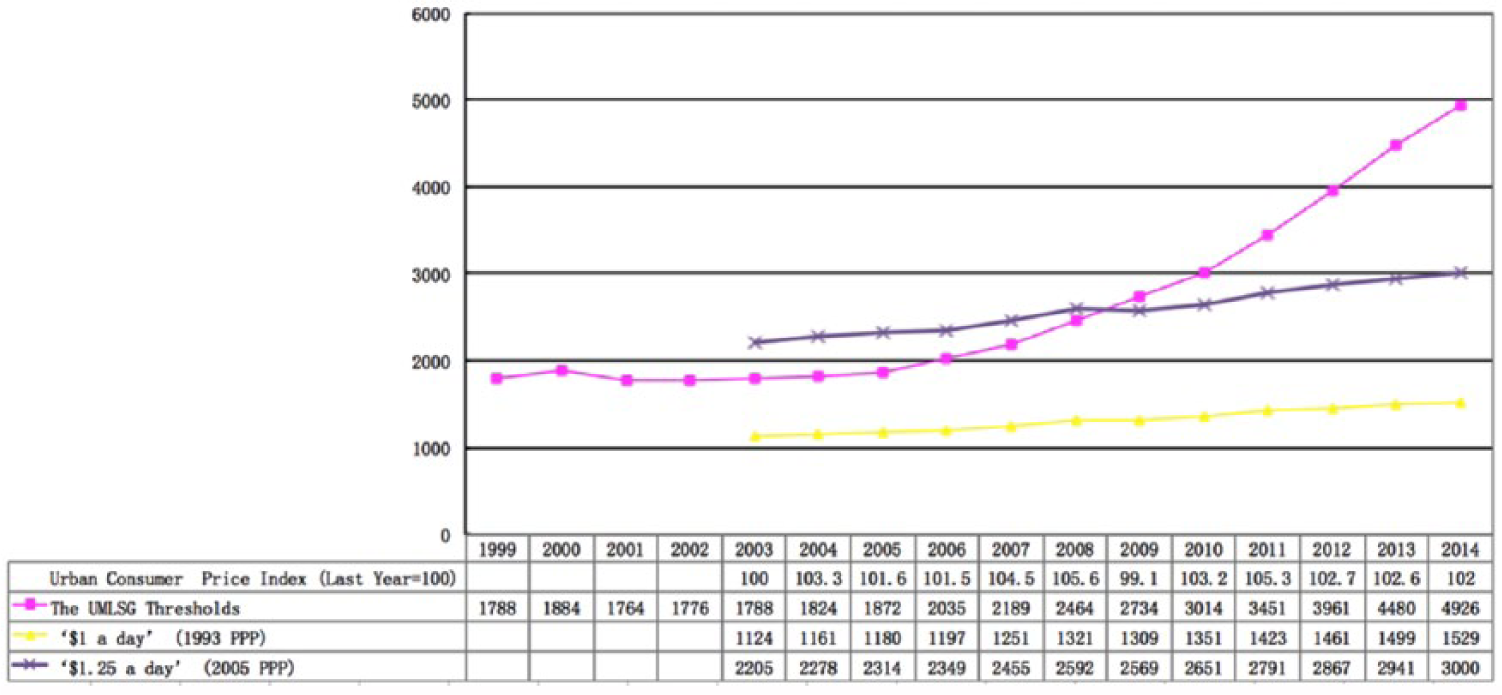
Comparison of the UMLSG thresholds to the WB standards.
The first comparison is drawn from the WB’s absolute standards of ‘$1.08 a day’ (1993 Power Purchasing Parities [PPP]) and ‘$1.25 a day’ (2005 PPP), which were calculated based on the aggregation of the poverty lines in the poorest countries in the world (Ravallion et al., 1991, Ravallion etal., 2008). Since 2008, the absolute standard of ‘$1.08 a day’ (1993 PPP) has been equivalent to the poverty line which the Chinese authorities have used to calculate rural poverty. However, this universal poverty line for rural areas is not adopted in urban areas, based on the assumption by the authorities that people living in cities should have a higher living standard than the global absolute standard. Figure 1 seems to support this assumption because the UMLSG thresholds have far exceeded the level of ‘$1.08 a day’ (1993 PPP) ever since its institution in 1999.
However, the global absolute standard would be comparable to the UMLSG thresholds if the updated standard of $1.25 a day (2005 PPP) were included in the analysis. In fact, it was not until 2009 that the UMLSG threshold (2734 yuan) became higher than the global absolute standard. Even by 2014, the level of the UMLSG threshold, at 4926 yuan, was only 1.64 times as much as the ‘$1.25 a day’ standard (3000 yuan).
In short, the ‘minimum living standard’ of the UMLSG (especially in the first 10 years of its development) was probably no more than the same level of the poorest countries in the world. In terms of China’s economic power, it is quite unreasonable to place China in the poorest group of 15 countries from which the WB derived the ‘$1.25 a day’ standard (Ravallion et al., 2008). For example, in 2009 the per capita gross domestic product of China (current prices) ranked 98 of 183 countries, while Chad and Tajikistan – 2 of the 15 poorest countries which came close to China in per capita gross domestic product – ranked 150 and 151 in the table (International Monetary Fund, 2010).
Comparison with the CBN standards
The other indicator for comparison refers to the poverty lines produced by the CBN method. These poverty lines consist of food costs (which are calculated by the nutrition requirement and its price index) and non-food costs (which usually generate two bounds). The lower bound refers to the non-food costs spent by those families whose whole expenditure is equal to the food poverty line, while the upper bound is about the non-food expenses spent by those families whose food expenditure is equal to the food poverty line (Ravallion, 1998).
As shown in Figure 2, all the UMLSG thresholds were higher than Ravallion and Chen’s (2007) predictions in various years. In 2006, they started to rise above the thresholds of Wang (2002), Yao (2004) (lower bound), Khan and Riskin (2001) (lower bound) and Meng et al. (2005) (lower bound), all of which once shared similar levels with each other. In 2009, the UMLSG threshold reached the levels of another group aggregated by the thresholds of Hussain (2003), Yao (2004) (upper bound) and Meng et al. (2005) (upper bound). Finally, the UMLSG threshold caught up with Khan and Riskin (2001) (upper bound in 2010) and it marginally exceeded the threshold of Wang (2006) in 2012, both of which were the highest standards among the poverty lines used for reference.

Comparison of the UMLSG thresholds with the CBN standards.
Since the UMLSG thresholds in 1999–2012 shared similar levels with the poverty lines produced by the CBN method, the ‘minimum’ extent of UMLSG thresholds can be indicated by the characteristics of these CBN standards. The first attribute of the ‘minimum living standard’ of UMLSG thresholds relates to the extremely low amount of nutritional intake. The illustrated poverty lines based on the CBN method all adopted an amount of 2100 kcal/day for calculating food costs. According to the Food Agriculture Organization et al. (2004), this amount can only support a 12-year-old boy or a 15-year-old girl for light physical activity. Moreover, this amount of nutrition intake indicates that the living conditions of UMLSG beneficiaries are even worse than those of the prisoners in China, whose nutritional intake was set at 3343 kcal/day (Wang, 1998).
Second, the levels of UMLSG thresholds seriously lag behind the average living standard in terms of food costs. The CBN method requires the use of a price index to multiply the nutritional intake and thus estimate food costs. The illustrated studies usually adopted the price indexes of the lowest income group, such as the poorest 15–25 percent for Ravallion and Chen (2007) or the poorest 20 percent for Meng et al. (2005) and Hussain (2003). By contrast, it was the average price index that was employed by Orshansky’s (1965) pioneering study of estimating poverty in the US, which was based on the rationale that food consumption of poor people should be measured in accordance with a normal standard.
Third, the UMLSG thresholds severely underestimate the actual non-food costs of beneficiaries. Engel’s coefficient represents the proportion of food costs within the whole expenditure. During 1999–2006, the identical levels of the UMLSG thresholds in Yao (2004) (lower bound), Meng et al. (2005) (lower bound), Khan and Riskin (2001) (lower bound) and Wang (2002) indicated that they should have shared the same Engel’s coefficients, which were 75, 55 or 74 percent. During 2009–2010, Engel’s coefficients of the UMLSG thresholds could have been lower because the figures from Khan and Riskin (2001) (upper bound) and Yao (2004) (upper bound) were 55 and 61 percent. In 2012, the UMLSG threshold caught up with Wang’s (2006) standard, for which Engel’s coefficient was 54 percent, the lowest figure among the poverty lines used for reference.
Ironically, the official statistics recorded that the poorest 5 percent of urban residents (approximately the proportion of the UMLSG beneficiaries in the urban population) had spent less than these proportions of their budget on food. Their Engel’s coefficients dropped slightly from 52.73 to 46.79 percent during 1999–2012 (National Bureau of Statistics, various years), which were much lower than the estimates of 54–75 percent derived from the CBN studies as illustrated. This suggests that the UMLSG beneficiaries had probably been squeezing the expenditure on food in order to cover non-food costs.
Qualitative data on the level of UMLSG
The findings from the two international measurements have demonstrated that the level of UMLSG was actually very low, which only offered a minimal amount of support for poor people. Based on the interview data from welfare officers and UMLSG recipients, this section will explore the life experiences of those who were living on public assistance and analyse why they could not leave the benefit system.
The research site of this study was in Guangzhou and the fieldwork was conducted from June to September 2010 when the monthly UMLSG was 410 yuan, the third highest level in the 36 central cities in China. This means that the life experiences of struggling for subsistence at the relatively higher standard of threshold for Guangzhou are very likely to be found in other cities with much lower thresholds. There were three categories of respondents, including 15 UMLSG recipients, 2 former recipients and 8 welfare workers. Among the welfare workers, 5 were from street offices (SOs) and 3 from residents’ committees (RCs). In China, SOs are the lowest level government agency that are responsible for administrating UMLSG applications. RCs are semi-official neighbourhood organisations, which have long been treated as the government’s foot-soldier, helping various government agencies to provide a wide range of public services such as community health education, neighbourhood safety, national birth control and, over the past 20 years, assisting UMLSG applications before sending all relevant materials to the SOs. The workers of the RCs are also expected to visits UMLSG applicants to investigate their applications.
In China, welfare claimants are wary of the authorities and are unlikely to openly express their views on the UMLSG for fear of upsetting government officials. In order to reduce the resistance of the respondents and also gather data that could truly illustrate the actual experiences of poor people, this study adopted a ‘snowball’ approach: respondents were therefore recruited through one of the author’s private connections as well as referred by some of the respondents. All stakeholders, including five workers from RCs and three workers from SOs, were referred to this study by the author’s former colleague who had close contacts with government officials.
In-depth interview was adopted to gather concrete information on the living conditions of welfare recipients and the views of the stakeholders on why some poor people had to rely on the UMLSG. NVivo 8.0 was used for coding the texts and categorising the themes such as ‘living conditions’, ‘UMLSG assistance’, ‘impressions of beneficiaries’ and ‘leaving the UMLSG’. All the participants are anonymised in the following reports.
When asked about the adequacy of benefits, the welfare officers admitted that the UMLSG threshold was far from sufficient for subsistence: ‘410 yuan [the UMLSG threshold in 2010] is definitely not enough!’ (Ms Fan, Mr Shen, Ms Mo and Mr Gan). Beneficiaries living on the UMLSG ‘must find every means to survive’ (Ms Pan), such as searching for the lowest prices, buying the minimal amount of food or slowing down consumption.
Four claimants had tried different means to reduce food bills, such as buying cheap food in another area, getting reduced products just before the closing of stores and cooking several meals at the same time. Three examples are as follows: Vegetables are usually sold at 3.5 yuan/500 grams. I can only afford an amount worth 1 yuan. And I have to cook them separately for several days. (Ms Shu) In order to save fuel, I cook lunch and supper at the same time. My tip for saving on food is to buy a whole chicken and cut it into small pieces. By doing this, I can eat the chicken for a month. (Ms Zhou) I cook two meals at a time and I will finish the leftovers the next morning. In order to save more money on meals, I ride a bicycle to a market in another district, which takes me 1.5 hours. (Mr Zhao)
The UMLSG claimants also found it difficult to pay their utility bills. Some of them even refrained from using basic household appliances such as the microwave, air conditioner and electric shower. The following two respondents described how they reduced electricity consumption in their daily life: You may notice that there is a television and an air conditioner in the apartment. My friend gave them to me. But I never turn them on because the electricity bill will be too high for me. (Ms Xian) I just use the cold water for a shower, while my wife and child boil a small pot of hot water. My mother-in-law gave this microwave to us, but we never use it as the electricity will cost too much. (Mr Zhao)
The life experiences of beneficiaries further demonstrate how deprived they were of social participation. It is very common for beneficiaries to ‘seldom go out for shopping and have dinner at a restaurant’ (Mr Li) or ‘never have any social engagements’ (Mr Wang). For example, Mr Chen was interested in painting and once considered becoming an apprentice painter. However, he had no choice but to give up this career plan because of financial reasons: I like going out with my ‘painter’ friend to draw pictures, but I can’t afford any extra costs on brushes and papers, not to mention tuition fees. More importantly, what will other people think when they know an UMLSG beneficiary is just making friends and learning painting!
In short, the ‘minimum living standard’ of UMLSG thresholds had excluded beneficiaries from the mainstream society in terms of food consumption and social life. Living in a life of social deprivation, one respondent hoped that he could ‘return to mainstream society’ (Mr Li).
‘Trapped’ in the UMLSG
The quantitative and qualitative data presented in previous sections have demonstrated that financial support for UMLSG recipients is too low to cultivate a dependency culture. This leads to the question of why some studies had detected the long-term dependency of beneficiaries (Han and Guo, 2012; Liu and Lin, 2015). The supplementary welfare provided for the UMLSG beneficiaries, especially health, housing and education services, may explain this phenomenon. With the radical commodification of social services over the past two decades, a lot of people are unable to access basic necessities. It was reported that 23.3 percent of respondents in cities in 2008 did not see a doctor when they were sick for the first 2 weeks because of financial reasons, while 23.2 percent received no treatment at all. Similarly, 67.5 percent of people who should have been hospitalised did not make it, while 52.4 percent of patients discharged themselves from hospital since they could not afford the medical costs (Ministry of Health, 2009).
Regarding housing affordability, the ratio of housing price to income is usually used as an indicator. The estimation by Shen (2012) was 9.1 in 2009 in China, much higher than the figures in the United States (2.9), United Kingdom (5.1) and Australia (6.8). According to Yao et al. (2014), this ratio for Guangdong province (where Guangzhou is the capital city) was 10.1 in 2008, which was significantly higher than the nationwide figure of 7.5. In Shanghai, this ratio was 16.4 for the income group in the bottom 10 percent, nearly twice as much for the median income group (Chen et al., 2010).
It should be stressed that many people claimed for UMLSG because of health reasons. After studying 6835 households in 77 cities in 2003, Gustafsson and Deng (2011) found that a household head’s poor health was one of the main reasons contributing to UMLSG applications. Meanwhile, Chen et al. (2006) compared the living conditions of the UMLSG families and other families in a sample of 76,000 households in the 35 largest cities in 2003–2004 and reported that UMLSG beneficiaries lived in either smaller dwellings or rental housing. The UMLSG families more likely had members who were students, disabled or chronically ill patients.
Compared with other families, local income households, including UMLSG families, spent more on medical costs. Except in the periods of 1999–2001 and 2003–2004, the proportion of medical costs for the poorest 5 percent of residents in cities was higher than the average figures. This problem was even more serious in housing as the poorest 5 percent spent more on housing than the average figures during 1999–2012 (see Figures 3 and 4).
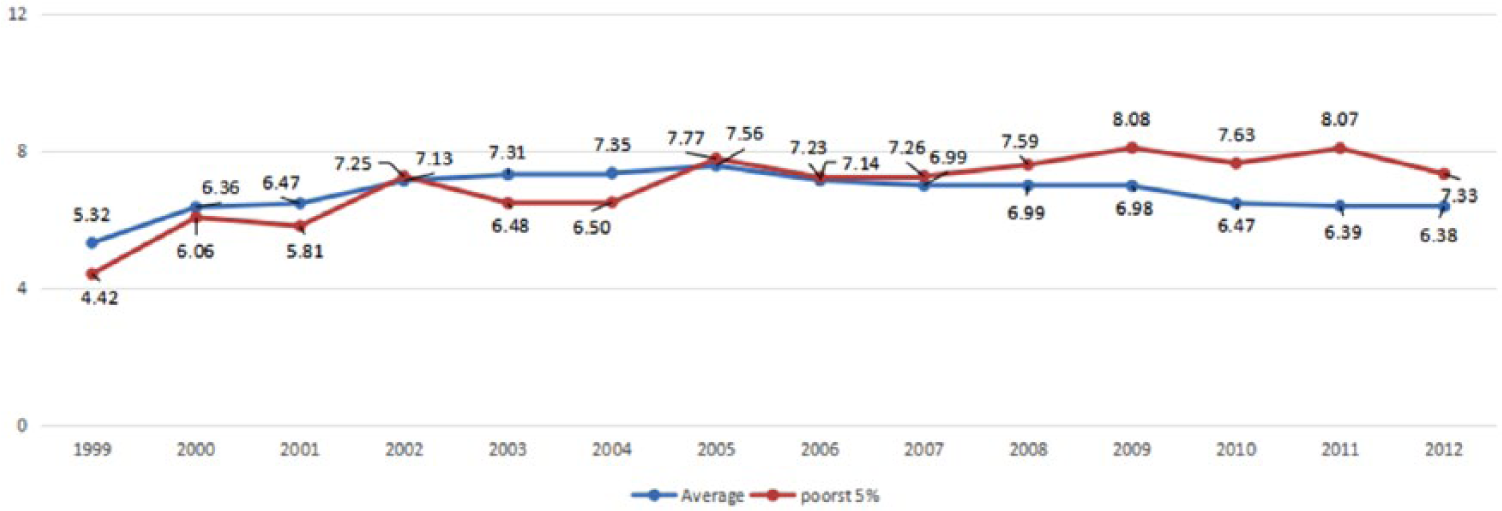
Proportion of medical costs in the expenditure for the poorest 5 percent in cities (%).
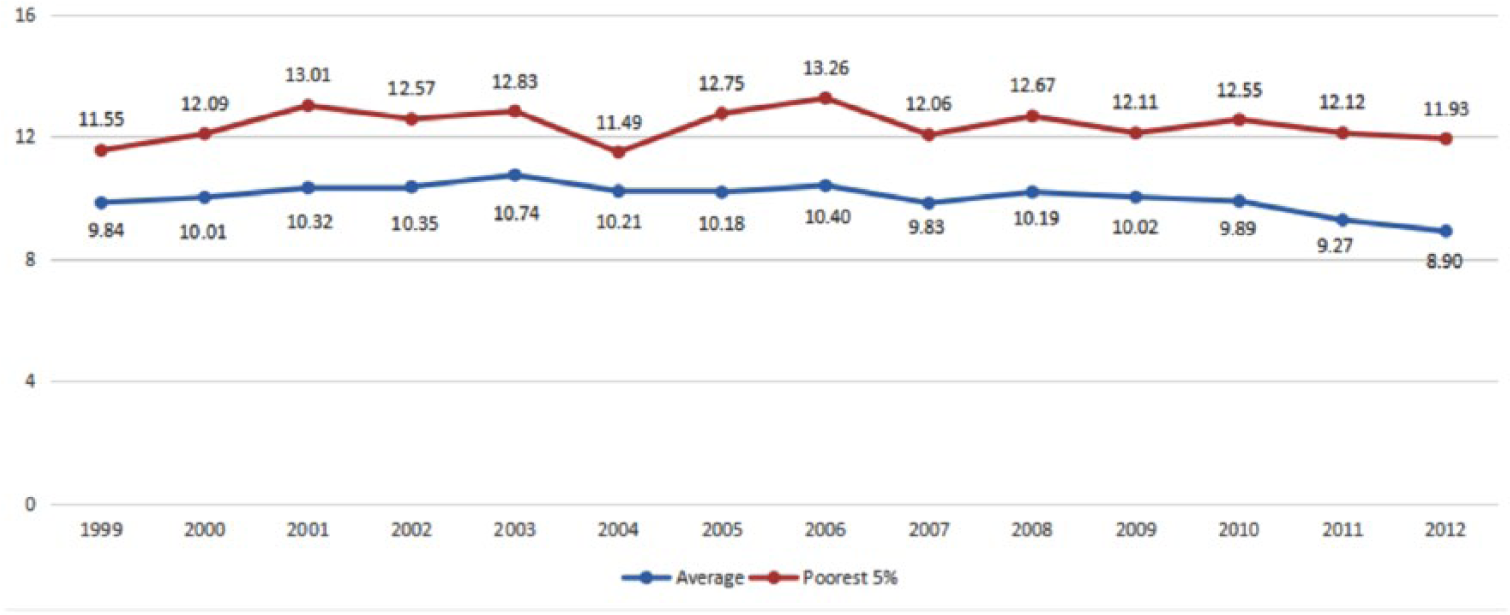
Proportions of housing costs for the poorest 5 percent in cities (%).
In order to reduce the welfare burden of poor people, local governments set up various types of schemes to address their medical, housing and education needs. UMLSG beneficiaries are the largest welfare group which can access these services. For example, UMLSG beneficiaries in Guangzhou can be reimbursed most of the expenses on hospitalisation or some special out-patient services. Beneficiaries also can apply for low-rent apartments which only charge 1 yuan/m2. As for education, their children can be exempted from all fees related to compulsory education and can also receive subsidies and student loans in higher education. The UMLSG beneficiaries in our study emphasised that these supplementary benefits were not adequate for them to solve their basic needs: We only need to pay one yuan/square metre for our current apartment. We could not find such a cheap apartment if we left the UMLSG. (Ms Zhuo) As long as we are recognised as beneficiaries, we can live in this low-rent apartment. This apartment is what I want. I will feel that my life is better than before if we can live here forever. (Mr Zhao) Due to the situation of my daughter with cerebral palsy, I think I have to rely on the UMLSG for my whole life. She needs regular medical support. Besides, I hope I can succeed in applying for a low-rent apartment very soon, so that I don’t need to pay the high rent now. (Ms Zhao)
Ironically, welfare measures aiming at solving the basic needs of UMLSG beneficiaries have strengthened their image as ‘lazy people’ in the eyes of street-level welfare bureaucrats. Mr Gan, an officer of a RC, was disappointed with the ‘greedy’ beneficiaries who would ‘try every means to pursue the UMLSG welfare’: Other than benefits, medical aid and low-rent apartments are becoming more and more important. People are greedy. They think that they have ‘rights’ to these provisions. Instead of self-reliance, they will try every means to pursue the UMLSG welfare that the government is currently providing for them.
On the other hand, the reluctance of the beneficiaries to leave UMLSG can be explained by their difficulties in purchasing basic welfare provisions in the market. This was illustrated by the negative experiences of Ms Xian and Ms Zhang following their leaving of the UMLSG. Having been claiming the UMLSG for more than 7 years, Ms Xian’s family finally escaped from the UMLSG in early 2010 because she and her husband started to receive pensions of about 2000 yuan per month. She also returned to her original position as an hourly paid cleaner after retirement that gave her an extra 600 yuan per month. Although saying that ‘life is apparently better now’, she was very worried about future accommodation: I wish I had understood the policy better before leaving the UMLSG. We sincerely hope that the state can go on helping us. Otherwise, our situation will not become better even though we seem to have more income than before. The rent in the same area is at least 40 yuan per square metre!
Similarly, Ms Zhang’s family managed to leave the UMLSG because her husband started to claim his pension with about 2000 yuan per month. She also worked as a part-time domestic helper with a monthly income of 800 yuan. However, she was regretting their ‘honest’ decision to leave the UMLSG: Even with my husband’s pension, I am still feeling stressed about his medical bills. Now we can’t claim reimbursement for all the costs as we did before. We also need to raise money for my daughter’s tuition fee. This apartment is the same size as the previous low-rent apartment, but the price is tripled to 1500 yuan a month. We have been so honest in leaving the UMLSG once our incomes increased. But we may be as poor as before if all these expenses are considered. This means that we actually never get out of poverty.
By contrast, Mr Chen explicitly stated his unwillingness to leave the UMLSG. Mr Chen was blind in one eye and both of his children were in high school. The only source of income came from his wife, who worked as a casual domestic worker for 800 yuan per month. As he explained, The subsidy from the UMLSG doesn’t matter. What matters is this low-rent apartment, reimbursement for the treatment to my eye and financial support for the university tuition fees for my children. I know some people will call us ‘lazy people’, but how can we manage these expenses if we are only earning 800 yuan/month in the market?
The above cases have clearly demonstrated that poor income families in China are kept in the public assistance scheme because of their difficulties in affording housing, medical care and education in the open market. It is only through their UMLSG claimant status that the basic welfare needs can be met.
Conclusion
This study examines whether China’s public assistance is too attractive to create welfare dependency and analyses the nature of the welfare trap in its public assistance system. The findings from the international measurements on assistance level have confirmed that China’s UMLSG assistance thresholds can hardly motivate beneficiaries to ‘depend’ on its public assistance system. Subordinate to the Chinese Government’s priorities on economic development, the UMLSG thresholds have been made only the minimal level. As a top official put it, this means the ‘minimum needs of the poor population for avoiding hunger and cold’ (Duoji, 1997: 253) or ‘basic survival conditions for poverty-stricken families’ (Zhu, 2000). Compared to the WB standard of ‘$1.25 a day’, the ‘minimum living standard’ of UMLSG thresholds during 1999–2009 was only equivalent to the poverty lines of the poorest countries in the world. Also compared to the CBN method, the UMLSG thresholds from 1999 to 2012 showed that the assistance levels could only allow beneficiaries to live on the cheapest food, while the non-food costs were not properly included.
However, the analysis of the subjective experiences of beneficiaries reported in this study shows that their reluctance to leave the UMLSG was associated with supplement benefits that allow them to access basic housing, medical and education services. Paradoxically, this finding echoes previous studies that reported the existence of ‘welfare dependency’ in China (Han and Guo, 2012; Liu and Lin, 2015). In short, the dependency of UMLSG claimants is an outcome of the marketisation of social services in terms of housing, medical treatment and education following China’s economic reforms since the late 1970s. Therefore the introduction of welfare-to-work measures in recent years can hardly address the ‘welfare dependency’ of UMLSG beneficiaries if wages are too low to pay for basic welfare services. It is only through effective state interventions to reduce the costs of housing, health and education that the cause of dependency in China can be fundamentally tackled.
Footnotes
Funding
The author(s) received no financial support for the research, authorship and/or publication of this article.