




Abstract
Recently, humans have negatively altered ecosystems more rapidly and extensively than in any other time in human history, contributing to gains in well-being and economic development for some, while threatening the security of most, particularly oppressed populations. We comprehensively reviewed recent social work literature (2010–2015) to examine gaps in environmental sustainability themes relevant to social work practice. Peer-reviewed manuscripts, dissertations/theses and white papers were examined. A total of 71 papers (less than 1% of social work literature) met inclusion criteria. Although our call is to protect human health and well-being, recent literature does not account for sustainability even with evidence that environmental issues directly impact clients, hindering practice efficacy.
Introduction
Humans have negatively altered global ecosystems more rapidly and more dramatically over the last 50 years than in any comparable time period (World Wildlife Fund [WWF], 2014, 2016). Humans cannot survive without a healthy planet. Earth’s ecosystems and the services they provide allow for human life through the provision of clean air and water, food, medicines, disease management, building materials, fuel, climate regulation, storm buffering, security and shelter, spiritual fulfilment and more. Yet humanity’s current natural resource consumption and carbon emissions combined exceed Earth’s (land and sea) production and carbon absorption capacity by 50 percent (WWF, 2014), meaning Earth will be unable to sustain the burgeoning human population without intervention. These unsustainable demands have led to substantial gains in well-being and economic development for some, but at the cost of health, well-being and security for most humans, particularly already marginalised and oppressed populations, making this a pressing social work concern. However, many social work professionals have not been exposed to the prevalence and severity of these environmental issues and the direct negative impacts on their clients, policies and interventions.
Scientists have long known that excessively taxing Earth’s natural resources and processes could lead to devastating consequences, including abrupt and irreparable environmental change (Meadows et al., 1972). In an effort to define parameters within which humans can develop sustainable societies, contemporary scientists have suggested nine planetary boundaries, or guidelines, for utilising each Earth system that minimises the risk of causing irreversible changes (Rockström et al., 2009; Steffen et al., 2015). These systems include climate change, biodiversity loss, nitrogen and phosphorus use, freshwater use, land use change, ocean acidification, stratospheric ozone depletion, atmospheric aerosol pollution and chemical pollution; three boundaries that we have already violated are climate change, biodiversity loss and nitrogen cycle disruption (Rockström et al., 2009; Steffen et al., 2015). Rather than strict tipping points that would flip a physical system into an alternate state, these boundaries are based on an evolving understanding of Earth’s functioning and resilience; as such, they exist on a risk continuum where the farther these boundaries are transgressed, the higher the risk humans run of destabilising Earth’s processes and eroding both human and Earth’s resilience (Steffen et al., 2015). While Earth could rebound from such destabilisation, the resulting changes to Earth’s environment would be so drastically different that human life likely could not (Steffen et al., 2015).
Environmental changes are so pervasive and severe that scientists have suggested humans are already causing the Earth to exit the current geological epoch, the Holocene – which has existed for over 10,000 years and made the development of human civilisations possible – into the Anthropocene, a term under review by the International Commission on Stratigraphy to become a formal geological time period (Lewis and Maslin, 2015; Steffen et al., 2007, 2011). The Anthropocene is defined as a period when human activity has overtaken vast parts of Earth’s natural cycles, and in ways that threaten humanity’s future (Lewis and Maslin, 2015).
The period 1800–1850 marks industrialisation’s and the Anthropocene epoch’s approximate onset, as industrial societies rapidly expanded their fossil fuel use (Steffen et al., 2007). Fossil fuels provided humans with abundant energy for developing new technologies (e.g. steam engines), eliminating previous energy supply constraints and altering and intensifying resource use for medicine and agriculture. Consequently, between 1800 and 2000, energy use grew approximately 40-fold, the global economy approximately 50-fold and human population more than 6-fold (Steffen et al., 2007). Since World War II, the human population has continued to grow almost exponentially, doubling in 50 years, reaching more than 6 billion at the end of the 20th century and increasing to 7.6 billion as of this writing, with the last billion added in just the past 12 years (United Nations, Department of Economic and Social Affairs, Population Division, 2017). Human activity has also rapidly increased, with the number of motor vehicles jumping from 40 million in 1945 to 700 million in 1996 and petroleum consumption growing 3.5 times since 1960 (Steffen et al., 2007). This alarming growth in population and consumption was occurring concurrently with early scientific recognition and documentation of the extent that human activities were affecting Earth’s functioning (Steffen et al., 2007, 2011).
Impacts of climate change, including rising temperatures, shifting seasons, sea-level rise and increasing droughts and floods, threaten people’s abilities to meet basic needs (Raworth, 2012). Already, 1000 children die daily from climate change-related starvation and disease (Salomon, 2016). Furthermore, rising carbon dioxide levels contribute to the acceleration of environmental change and weather anomalies (Raworth, 2012). Experiencing extreme weather events not only poses serious physical threats, but can also have severe psychological consequences by increasing individuals’ overall stress, making increases in substance abuse, anxiety, depression and suicide more likely (Clayton et al., 2014). Severe disasters like floods and storms can also have damaging effects on individuals, families and communities by making people susceptible to post-traumatic stress disorder, significantly affecting children’s learning and development, and even increasing physical aggression within the home (Clayton et al., 2014).
Excessive human consumption has depleted biodiversity levels below a safe threshold (Newbold et al., 2016), violating another planetary boundary and initiating the onset of the sixth mass extinction (Ceballos et al., 2015). Biodiversity loss has become so severe – occurring at a rate at least 114 times what is natural (Ceballos et al., 2015) – that the current extinction rate is comparable to the last global mass-extinction event, commonly remembered as the dinosaurs’ extinction (Sodhi and Ehrlich, 2010). Specifically, between 1970 and 2010 the size of cataloged vertebrate populations decreased by 52 percent (WWF, 2014). During the same time period, freshwater species declined by 76 percent, followed by marine and terrestrial species each declining by 39 percent (WWF, 2014). The current loss rate is unsustainable, and depleting ecosystem resilience threatens human security and creates deleterious economic repercussions (Rockström et al., 2009). For example, 15 percent of animal protein in human diets comes from marine ecosystems, and fisheries support 660 million jobs globally; without abating threats to oceans, predicted economic losses are US$428bn by 2050 (WWF, 2014). Another ecosystem service humans need for survival is bee pollination. Bees are the most economically important pollinator in the world, as the value of US crops pollinated by bees in 2009 was estimated at US$15.2bn (Calderone, 2012). Globally, bees pollinate 71 of the 100 crops that provide 90 percent of the world’s food (United Nations Environment Programme [UNEP], 2010).
In 2003, Mascia et al. put out a call to action to all social sciences to collaborate with natural sciences in conservation initiatives, for Earth’s and humanity’s preservation. As a practice-based profession with adept skills in advocating for human health and well-being and organising and empowering communities, no social science profession is better poised to help protect a future for humanity than social work.
Methods
We performed a comprehensive review of recent social work literature (published 2010–2015) to uncover existing gaps in sustainable development themes relevant for social work practice. The review was completed according to a fixed and systematic plan established a priori and based on the Campbell Collaboration Resource Center methodology and in consultation with a university research librarian. Databases, explored one-by-one, were Social Services Abstracts, PsycINFO, Social Sciences Citation Index (Web of Science), Sociological Abstracts, Academic Search Complete, ProQuest Central, EBSCOhost, Dissertations and Theses, and Google Scholar. Peer-reviewed articles (including editorials), social work reports, white papers and dissertations and theses about the theories and practice of sustainable development-related work in social work practice and research in English were examined. Keywords used were social work research, social work, sustainable development, natural environment, environmental sustainability, green social work, environmental social work, conservation social work and indigenous social work.
The search terms were grouped into 10 categories: social work research AND sustainable development, social work research AND natural environment, social work research AND environmental sustainability, social work AND sustainable development, social work AND natural environment, social work AND environmental sustainability, green social work, environmental social work, conservation social work, and indigenous social work AND sustainable development. For each search yield, titles and highlighted search terms were first read to ascertain possible relevance. For pertinent titles and search terms and those that were published in a social work or social welfare journal, abstracts were read for appropriateness to our search. Most of the 1690 articles yielded were found to be irrelevant after abstract review; for example, ‘sustainable development’ often meant sustainable development of an organisation (e.g. economically, human resources, ethically). Our criteria were that works needed to (a) integrate human needs for the natural environment or needs for the natural environment’s protection into social work research, or (b) recognise the natural environment’s importance to human health and development. Works regarding nature’s therapeutic benefits and/or of animals were not included as those were not germane to our concerns. However, if for example a community organic garden effort was conducted or evaluated by a social work or social welfare practitioner/researcher and found to also have mental health benefits to the community, those works were included. This same process was utilised for each separate database, and relevant articles were recorded in a research notebook by the first author and later reviewed by the second author. The first and second authors conducted the review independently. To address inter-rater reliability, the second author’s findings were compared to the first author’s, which resulted in the inclusion of an additional 11 papers; the first and second authors reached aggregate consensus.
The general database search yielded 60 relevant publications. We further investigated the references cited in the original 60 papers for additional citations not covered in the database search. We elected to include this step out of concern that refereed journals requiring keyword selection from a pre-existing keyword database may not yet have keywords congruent with environmental social work, thus hindering indexing which would have influenced the search criteria’s yield. This method produced an additional 11 relevant publications that were not included in the original search, yet highly relevant to the literature review. These 11 publications were included in the screened-in publications. After completing all steps of the review, 71 papers were included in the analysis. The full list of screened-in peer-reviewed manuscripts (including editorials), dissertations, theses and white papers can be found in Appendix 1.
Study quality was not assessed, as that was not the review’s intent. The objective was to analyse social work research to gain an understanding of whether and how social work researchers were thinking about and/or addressing sustainable development. Study characterisation denoted eight categories: empirical, theoretical, pedagogical application, literature review, editorial/call to action, white paper, thesis and dissertation.
Results
As a quantitative framework, 2,014,451 (ProQuest) social work publications were produced from 2010 through 2015. Our review screened-in 71 applicable publications, representing 0.00004 percent of social work research published from 2010 to 2015. Of these, 17 (24%) works were dissertations/theses and white papers and 54 (76%) were published in peer-reviewed journals (including editorials). Combined, special issues of International Journal of Social Welfare in 2012 and Australian Social Work in 2013 produced 18 (33.3%) of the screened-in peer-reviewed articles. Four journals published 29 of the 54 (53.7%) articles: International Journal of Social Welfare, Australian Social Work, Social Work Education and Social Work Research. Scholars J. H. Williams, J. Drolet, J. McKinnon, C. A. Faver, J. L. Willett, M. Gray and J. Coates authored 19 (26.8%) of the total products and 18 (33.3%) of the peer-reviewed articles. Table 1 presents screened-in publication findings’ characterisation.
Screened-in products’ classification.

Total number of theses includes one Bachelor’s thesis.
Total number of theses includes one product completed by a student outside of the United States or Canada.
Total number of dissertations includes one product completed by a student outside of the United States or Canada.
Empirical studies most frequently used qualitative methodologies (n = 8 [44.5%]), followed by quantitative and community-based participatory action research methodologies that were equally represented with four (22.2%) articles each. Mixed-methods research was used in two (11.1%) articles. Only one product (Walke, 2015) included intervention research. Of the 18 theoretical articles published in peer-reviewed journals, six (33.3%) were specific to social work education. The three products classified as pedagogical application differed from these six articles, as they moved beyond conceptual modelling to present case studies evaluating specific teaching techniques or curriculum content previously used in a classroom setting.
We also analysed trends over the 5-year period. Figure 1 demonstrates that journal publications are on the rise, while dissertations, theses and white papers show a steady upward trend.
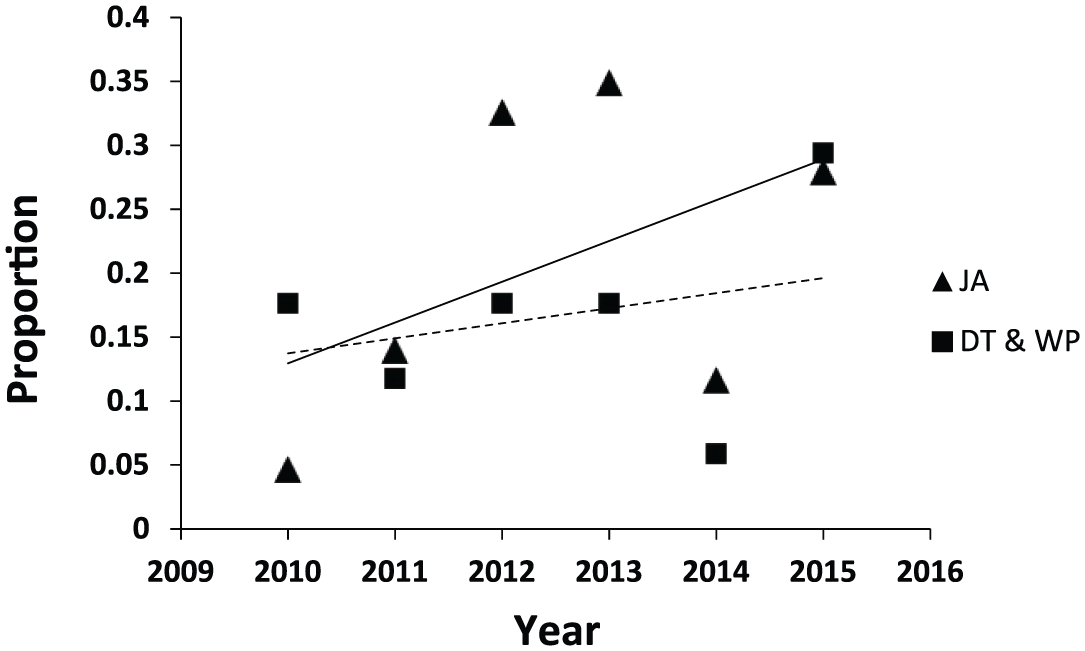
The proportion of total relevant products published in the years 2010–2015, grouped by journal articles (JA) and dissertations, theses and white papers (DT and WP).
It is important to note that at least two significant social work texts within this theme were produced during the time frame investigated: Lena Dominelli’s (2012) Green Social Work: From Environmental Crisis to Environmental Justice and Mel Gray, John Coates and Tiani Hetherington’s (2012) Environmental Social Work.
Discussion
Earth’s continued sustainability for humans can no longer be taken for granted (Millennium Ecosystem Assessment, 2005; Rockström et al., 2009; Steffen et al., 2015). Environmental changes due to unchecked human population growth and overconsumption now threaten human survival, with the poorest and most vulnerable on Earth impacted most significantly despite causing the least damage themselves (Raworth, 2012), making this a pressing social justice issue facing social work practitioners (Tedeschi et al., 2013).
While the review was limited by the inclusion of only English papers, findings led to the conclusion that recent social work research and academic literature do not adequately account for environmental degradation and sustainability issues, even when they are directly linked to human and social development. Despite evidence that many environmental problems are intrinsically linked with social justice issues aligned with social work’s mission (e.g. food security, protecting environmentally induced migrants or environmental racism) (Dominelli, 2012; Schmitz et al., 2012), the lack of intervention studies in the review’s findings indicate social work is failing to make a substantial contribution to mitigating environmental degradation’s growing threat to human health, well-being and survival. The finding that environmental degradation and sustainability account for less than 1 percent of all social work research suggests that these issues and themes are not prioritised. If the products from the two special issues are removed from the data count, 36 peer-reviewed publications in a 6-year time span remain. Publication biases, funding barriers, institutionally perpetuated disciplinary boundaries and low value attributed to interdisciplinary research in tenure systems have been cited as impediments to interdisciplinary environmental research by both natural and social scientists (Roy et al., 2013), and have also likely hindered prioritisation of these themes in social work research and influenced these findings.
In a 2013 survey, 83 percent of 179 natural and social scientists conducting research at the human–environment interface reported frequent or occasional trouble publishing manuscripts since the interdisciplinary research did not adhere to preferred methodological and theoretical approaches or traditional journal guidelines, frameworks and interests, which were often perceived as disciplinary (Roy et al., 2013). Although influenced by the presence of two special issues, the finding that more than 50 percent of screened-in peer-reviewed articles were published in only four journals may be evidence of a publishing bias or challenge in regards to human–environment research rooted in social work. As such, the low number of empirical studies (18 in 6 years) may also be representative of a publishing bias, and not an accurate reflection of the amount of environmental research conducted by social workers.
The documented schism between ‘evidence-based practice’ and ‘practice-based research’ in social work (Anastas, 2015) is also a reminder that the lack of environmental social work research may not be reflective of the extent that sustainable development and environmental degradation themes are incorporated into practice and unpublished or unevaluated interventions. Indeed, globally numerous social service organisations and grassroots organisations employing social work strategies are working at the interface of environmental challenges and social injustices, and thus impacting both social and sustainable development (e.g. India’s Navdanya, Kenya’s Green Belt Movement, Cambodia’s 3S Rivers Protection Network). While they may not disseminate their work through traditional academic (e.g. peer-reviewed literature) and development (e.g. white papers and technical reports) channels, these organisations present potential opportunities for collaborations with social work researchers who have the abilities to amplify these organisations’ voices by assisting in the dissemination of their findings to newer and broader audiences.
Approximately 20 percent of all screened-in products – and 25 percent of peer-reviewed products specifically – are editorials or calls to action. While these articles often cite clear and cogent evidence of the changing environment’s effects on, and relevance to, social work practice, and explicitly link social work to the environmental sciences, the evidence suggests that they are not being heeded. Several factors are likely perpetuating this inaction. Social workers are not the only population difficult to motivate in regards to environmental action. The enormity of problems and challenges often creates a paralysis or apathy that leads to inaction (Clayton et al., 2014; Moser, 2007), which in research and academia is likely exacerbated by the aforementioned institutional barriers, publication biases and other challenges to interdisciplinary research. This paralysis and apathy could be further complicated in social work, a profession that is already frequently overtaxed, and whose breadth of social injustices pertinent to its mission is continually expanding.
Regardless of root causes, these persistent gaps remain problematic. Without using research to explore the intricate links between environmental degradation and social justice, the social work profession will fail to build an evidence base grounded in the profession’s values or to inform practice with the marginalised and vulnerable communities social workers serve, who will be impacted most severely by environmental change. These literature gaps will also continue to perpetuate knowledge gaps in social work curricula and practice, creating a reliance on other disciplines to create the knowledge base that will be needed for future social work practitioners (Brekke, 2012). It can be said with certainty that global environmental problems are exponentially worsening (Steffen et al., 2015), and that social workers will be unable to ignore these problems when utilising complex systems approaches in their practice. Therefore, the evidence-based knowledge they will seek to inform their advocacy and interventions with clients should be rooted in social work values and derived from the social work profession itself.
Because environmental change shares a complex association with social justice, other professions will potentially begin to implement traditionally social work services and interventions, without the unique social work training that is rooted in cultural competence towards marginalised and oppressed populations. Proctor (2010) offers historical cautionary tales about specific social work sectors (e.g. case management and disaster response) where other professions usurped social work ‘turf’ due to a lack of social work research presence. The results included diminished credibility of the social work profession, its training, proffered services and outcomes as well as undue risk to vulnerable populations.
The review also yielded positive findings in contemplating how the field moves forward and further engages in environmental and sustainability challenges. First, differing methodological approaches are cited as a barrier to interdisciplinary environmental research (Roy et al., 2013). Although only 18 empirical journal articles were included in this review’s final data set, they represented a breadth of research methodologies. Qualitative methods constituted the most frequently cited approach, despite the natural and environmental sciences’ reliance on quantitative frameworks (Roy et al., 2013), demonstrating that some barriers are penetrable. The 18 theoretical journal articles also synthesised diverse theories, integrating traditional social work theories with ecological and environmental theories to form robust interdisciplinary conceptual models. While still limited in number, these conceptual and theoretical models should provide the foundations for intervention studies and further empirical research.
Although J. H. Williams, J. Drolet, J. McKinnon, C. A. Faver, J. L. Willett, M. Gray and J. Coates authored 33 percent of the peer-reviewed articles, their credentials range from a Dean Emeritus (J. H. Williams) to the author of a doctoral dissertation completed in 2015 (J. L. Willett). Student theses and dissertations account for 18.3 percent of all screened-in products, suggesting that the next generation of social work scholars are interested in moving the field forward, and integrating these concepts into their own scholarship. To continue this progress, social work faculty who serve as mentors and advisors need to support these students with receptivity to their pioneering ideas and a willingness to embrace an interdisciplinary approach to mentorship. Building collaborative teams within the field, and across disciplines, is essential.
Social work researchers interested in the human–environment interface also appear to be making progress within the field of social work as the American Academy of Social Work and Social Welfare (AASWSW) acknowledged the field’s response to global environmental change as one of the 12 grand challenges for social work (AASWSW, 2016; Kemp and Palinkas, 2015). Raising awareness and recognition of the linkages is not enough, though. Future calls to action and theoretical frameworks need to be more effective at stimulating empirical research, and one strategy may be to include specific future directions for research, as well as resources and strategies for overcoming previously noted interdisciplinary research barriers. Global environmental change is the most dangerous crisis facing humanity, and it is critical that much needed social work practitioners are prepared and equipped to intervene in environmental challenges and that social work researchers have clear paths to disseminate their interdisciplinary research. There is also an urgent need for social work intervention research to stimulate change at the macro, mezzo and micro levels through behaviour change, policy and advocacy – ensuring a sustainable and equitable usage of Earth’s resources.
Global environmental change is a grand challenge for all professions, including social work, in the 21st century. Ultimately, the findings of this review demonstrate the need for greater recognition of this challenge in social work research.
Footnotes
Appendix 1
Declaration of conflicting interests
The author(s) declared no potential conflicts of interest with respect to the research, authorship and/or publication of this article.
Funding
The author(s) received no financial support for the research, authorship and/or publication of this article.
