



Abstract
This study analyzes the opinions of foster families and social workers regarding the benefits and problems associated with contact visits. Data were gathered through two focus groups, comprising social workers and foster carers, respectively. Both groups agreed that visits were useful for maintaining foster children’s attachment to their birth family, for enhancing their psychological wellbeing and for helping them to understand the real situation of their birth family. Regarding difficulties, the two groups highlighted problems of coordination between social workers and foster families, as well as a lack of support and preparation for foster carers, children, and birth families.
Introduction
The benefits and potential drawbacks of contact visits for children in family foster care have been the subject of much debate and controversy in recent decades (Quinton et al., 1997, 1999; Ryburn, 1999). There remains, however, a need for continued research that can provide fresh evidence and compare it with existing findings. It is generally agreed that contact visits with the birth family are important both for the foster child’s wellbeing and for ensuring that the foster placement is successful. In this respect, the views and opinions of those involved can provide useful information regarding how such visits may be improved.
Official data for the Spanish region of Andalusia indicate that there are currently 2720 children in family foster care (2259 in permanent care and 461 under temporary placement), of whom approximately a third have contact visits with their birth family. Given the important role that this contact may play, this study established two focus groups in order to gather and analyze the views of foster families and social workers about contact visits between foster children and their birth family. In both groups the discussion was focused on three key questions (topics): (1) participants’ opinions about the benefits and utility of contact visits, (2) the difficulties or drawbacks associated with contact visits, and (3) their suggestions for improving them. Our goal was to identify the aspects that, according to participants in the two groups, were most relevant in relation to improving the quality of visits. More specifically, we were interested to see whether aspects highlighted in the literature, such as the preparatory training offered to families and children, the monitoring of visits, and collaboration between foster and birth families, were regarded as important by foster families and social workers.
Literature review
Numerous studies have shown that contact between foster children and their birth parents can play an important role in improving the child’s wellbeing. Among the benefits of contact it is argued that maintaining attachment relationships with the biological family can help the child to adapt to life with the foster family (Biehal, 2014; Dozier et al., 2002; Ironside, 2012; Juffer et al., 2014). When foster children are unable to reconcile feelings of loyalty and affection toward both their birth and foster families, a conflict of loyalty can arise and may potentially produce considerable anxiety in the child (Metha et al., 2013). Contact visits between foster children and their biological parents can help to stimulate a secure attachment relationship and to reduce or prevent a conflict of loyalty, and thus they are regarded as very important for the child’s wellbeing (McWey et al., 2010).
Another advantage of contact visits that is widely recognized by researchers is that they can contribute to foster children’s sense of identity and understanding of their personal and family history, thus avoiding idealization of the biological family. Contact prevents children from fantasizing about and forming an overly idealistic picture of their birth parents (Hess, 1987), and can help to preserve family relationships (Sanchirico and Jablonka, 2000). Visits have also been associated with a greater likelihood of a return home, since they help the child maintain an expectation of reunification with the birth family, increasing the stability of the foster placement and promoting better mental health in the child (Cleaver, 2000; McWey and Mullis, 2004; Oyserman and Benbenishty, 1992; Schofield and Beek, 2009; Sinclair, 2005; Testa and Slack, 2002).
Despite these advantages of contact visits, researchers acknowledge that they are not always positive for the foster child. Salas, Fuentes, Bernedo, and García-Martín (2016) found that many visits are not very satisfactory in terms of quality, as a high proportion of them were rated as involving poor or very poor parent–child interaction. In order that visits are genuinely of benefit to the child and do not produce anxiety, some authors strongly recommend that decisions about contact be made on a case-by-case basis (Prasad, 2011; Sen and Broadhurst, 2011; Taplin, 2005), that visits are carefully planned by social workers, and that all those involved are given the support they need (Moyers et al., 2006).
Various studies (e.g. Broady et al., 2010; Jiménez and Palacios, 2009) have examined the views of foster families regarding the input of social workers into the fostering process. The main complaints concern an insufficient number of social workers to monitor placements; a lack of sensitivity, support, and involvement on the part of social workers; too little information about the child’s background; insufficient psychological support of families and children; bureaucracy and delays in completing administrative and legal procedures; and a lack of financial support. Similarly, other studies have found that foster carers have a negative view of social workers when they find it hard to contact them, when their queries go unanswered (Sinclair et al., 2004), when collaboration is lacking, and when they feel their role as carers is undervalued (Buehler et al., 2006; MacGregor et al., 2006).
By contrast, foster carers have a positive view of social workers and feel supported by them when they receive regular visits; they feel listened to and respected; when their queries and requests are adequately dealt with (Sinclair et al., 2004); when they receive emotional support; when they are included in the decision-making process about the foster child’s future; when they are made to feel part of the team; when they can turn to the social workers at times of crisis; and when there is good communication and a relationship of trust between them and social workers (Buehler et al., 2006; MacGregor et al., 2006).
The preparatory training and support that is offered to foster families regarding how to deal with contact visits has become a central issue in relation to the success of foster placements (Farmer et al., 2004; Murray et al., 2011; Price et al., 2008; Triseliotis et al., 2000). MacGregor et al. (2006) found that most foster carers requested more realistic and specialist training that was geared toward the particular needs of foster children. In a similar vein, Haight et al. (2002) noted how many foster mothers emphasized the importance of preparing children before visits and supporting them afterwards. Other studies (Sanchirico and Jablonka, 2000; Sellick and Howell, 2003; Whenan et al., 2009) likewise indicate that those foster carers who feel they have received adequate preparation report greater wellbeing, satisfaction with the foster placement, and a willingness to collaborate with contact visits involving the child’s biological parents.
The planning of contact visits and the preparatory training offered to foster families must be consistent with the terms of the fostering arrangement and be done with the child’s future in mind (Schofield et al., 2000). Schofield et al. (2000) found that when the views of foster carers were taken into account they engaged more with contact visits and felt more secure in their relationship to the child, making it easier to integrate visits into the everyday life of the foster family. Ongoing support and preparation on the part of social workers led to higher levels of satisfaction among foster carers, which in turn proved beneficial for the contact between child and birth parents. Simms and Bolden (1991) also found that good planning of the contact visits, taking into account the foster family, the child, and the birth parents, enabled better relationships between the foster and biological parents.
Other studies (Haugaard and Hazan, 2002; Sellick and Howell, 2003) have highlighted that the collaboration of foster carers plays an important role in the success of contact visits. For example, Sanchirico and Jablonka (2000) found that the frequency of visits increased when foster families were offered preparatory training and support in order to improve their relationship with the biological parents. Research has shown that the frequency of visits and the quality of the parent–child interaction during contact are factors that have a direct effect on the child’s wellbeing and affective ties with relatives, as well as an indirect effect on his or her adaptation to the foster family (Haight et al., 2001, 2005; Leathers, 2003; McWey and Mullis, 2004; McWey et al., 2010).
The study by Triseliotis et al. (2000) found that although the majority of foster families were very willing to collaborate with the biological parents and with social workers, and recognized the importance of contact visits, they often had negative views about the impact that these visits had on the child. Furthermore, many foster families felt ill-prepared for the contact with birth parents and for managing the stress that it produced in them. These authors also found that financial remuneration, training, and support from social workers increased the willingness of foster carers to maintain contact with birth families. In this context, Sinclair (2005) also stressed that it was important for social workers to encourage birth parents to talk about the child with foster carers, and for foster carers and social workers to share information about contact. These issues need to be covered in the training of carers as well as of social workers. Those carers who have had training about contact tend to have better relationships with the foster child and his or her birth parents, and are more likely to be actively involved in contact arrangements (Farmer et al., 2004). The study by Neil and colleagues (2003) found that sensitivity, empathy with the child’s feelings, and acceptance of visits on the part of foster families all helped to maintain contact with the biological parents and to promote in the child a sense of belonging to both families. Oyserman and Benbenishty (1992) similarly found that when the relationship between the birth and foster families was hostile and critical, fewer visits and fewer telephone contacts took place between the child and his or her biological parents, whereas visits were favored by a climate of mutual acceptance and participation.
In the opinion of Selwyn (2004), contact between foster children and their birth family provides a setting in which all the child’s relationships can potentially be worked on. In this respect, the role of social workers should be to assess, in depth, each specific situation related to contact visits, and once it is decided that such visits are appropriate and will be of benefit to the child, to ensure that they are conducted in a safe way, with all those involved being given the support they need. Achieving this requires social workers who are experienced, skilled, and able to dedicate the considerable amount of time involved.
One conclusion to be drawn from the literature reviewed here is that although the importance and potential benefits of contact visits are widely accepted by social workers and carers (Sinclair, 2005), more needs to be understood about the difficulties that can undermine the success of visits and how they might be resolved. With this in mind, the present study uses a focus group approach to gather the opinions of foster carers and social workers responsible for supervising contact visits. The analysis considers their views regarding the benefits and problems associated with visits, as well as their proposals for how they may be improved.
Method
Given that the purpose of the study was to gather and analyze views and opinions about contact visits, we opted to use qualitative methodology and to establish two focus groups: foster carers and social workers. Our premise was that the conversations and debates in each group would enable shared concerns and ideas for improving such visits to emerge.
Participants
Two focus groups were formed, one involving social workers with responsibility for managing contact visits and another comprising foster carers.
The criterion for creating the focus group of social workers was that they had a minimum of 4 years’ experience of managing family foster placements involving contact visits. The eight social workers (five women and three men) who participated in this focus group were employed by four fostering agencies in Andalusia (southern Spain), all of which are overseen by the regional Child Protective Service (CPS). The mean age of these social workers was 35 years (range 27–45).
The criterion for inclusion in the focus group of foster families was that they were members of the Association of Foster Families in Andalusia and had at least 4 years’ experience of offering foster placements. This focus group comprised members of nine foster families (one per family, eight women and one man). Six families had previously fostered a number of children, while for the remaining three the current placement was their first experience of fostering. At the time of the study two families were fostering one child, while the remainder had two or three children in their care. Of the 16 children being cared for by the 9 families, 7 placements were permanent and 9 temporary. The mean age of foster carers was 43 years (range 38–51), and the children ranged in age between 1 and 16 years.
Procedure
The first step involved contacting the CPS, the fostering agencies, and the Association of Foster Families in Andalusia in order to obtain authorization for the study and to inform them of the study objectives. In Spain, the CPS is the public body with overall responsibility for foster care, and it oversees and coordinates the work of all the fostering agencies that manage contact visits. The Head of our university’s Research Group on Family Fostering signed an agreement with each participant that ensured confidentiality, anonymity, and the storage and subsequent deletion of all the recordings made. The eight social workers and nine foster family representatives all gave their consent both to participate in the focus groups and for these discussions to be recorded. The study was approved by the Ethics Committee of the institution to which our research group is affiliated.
Each of the focus group discussions lasted 2 hours and took place at the University of X. In terms of group dynamics, each focus group was moderated by the Head of the Research Group on Family Fostering, who was responsible for introducing the key questions (topics) of interest. After introducing the first topic, the moderator’s role was to manage turn-taking by participants. When no new perspectives or information on a given topic were offered, the moderator introduced the next topic for discussion.
Data analysis
Transcriptions of the two focus groups gave rise to primary documents for the hermeneutic unit under study. These were examined using an inductive method and ATLAS.ti v7.0 software (Scientific Software Development GmbH, 2014) to identify themes among participants’ responses. No conceptual categories for coding were established a priori (Charmaz, 2006). The four researchers involved in the study worked individually when coding the transcripts with respect to the three key questions (topics): (1) participants’ opinions about the benefits and utility of contact visits, (2) the difficulties or drawbacks associated with contact visits, and (3) their suggestions for improving them. The codes assigned took the form of a descriptive key phrase that captured the main ideas expressed by participants’ raw comments. After this individual coding of transcripts, each researcher compared the codes previously assigned, and in several face-to-face meetings the four of them reached a consensus regarding the code list. Based on the similarity of content the resulting codes were categorized into major themes, each of which contained subthemes.
A report based on these themes was then drawn up and sent to all participants so that they could confirm the accuracy of its content or suggest any corrections they believed were necessary. All the participants stated that the report was a faithful record of their contributions to the corresponding focus group.
Results
Opinions from the focus groups regarding the benefits and utility of contact visits
The focus group of social workers indicated that visits were important for a number of reasons: they allow foster children to maintain contact and attachment relationships with their biological family; they contribute to children’s sense of identity and their understanding of why they were fostered, thus enabling them to see the reality of their biological family and preventing an idealized view from developing; and they reduce uncertainty and distress in children (Table 1).
The codes used and examples of statements made in the focus group of social workers regarding the value of contact visits.
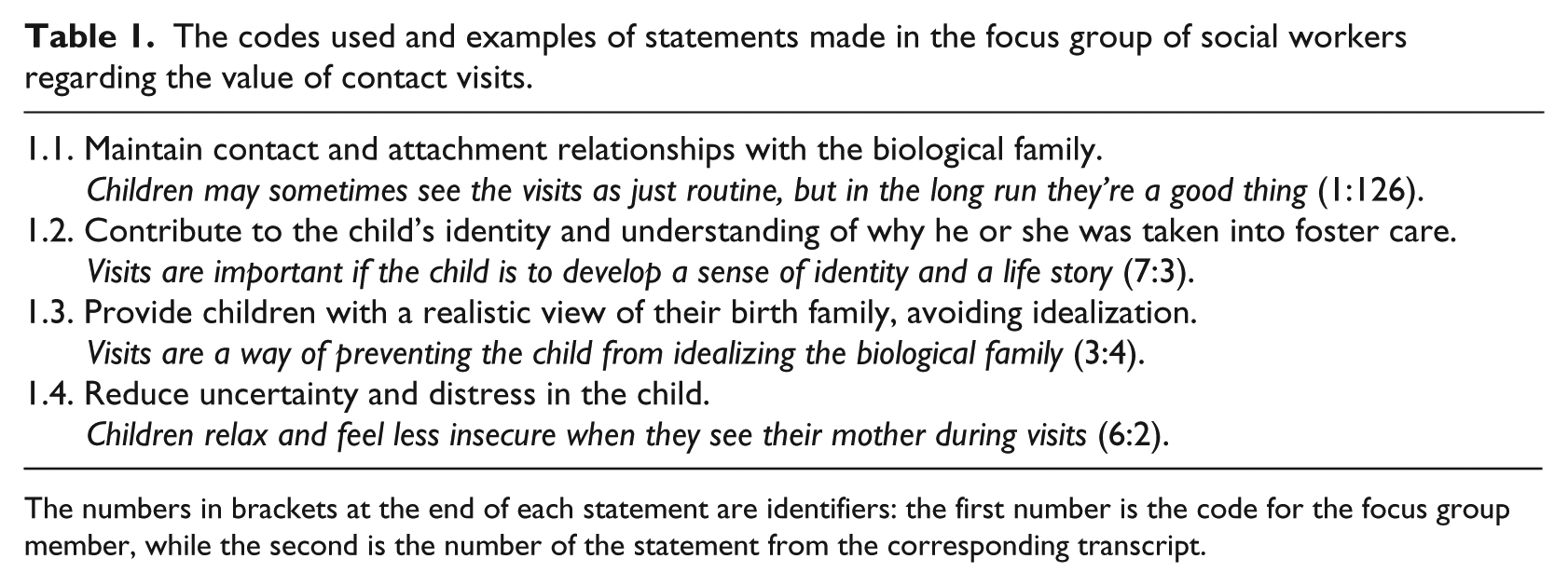
The numbers in brackets at the end of each statement are identifiers: the first number is the code for the focus group member, while the second is the number of the statement from the corresponding transcript.
The themes that arose in the focus group involving foster carers are shown in Table 2. The two most common themes referred to the idea that visits allowed children to maintain contact and attachment relationships with their biological family (mentioned on nine occasions), and that they enabled children to have a more realistic view of their birth family (four mentions).
The codes used and examples of statements made in the focus group of foster carers regarding the value of contact visits.
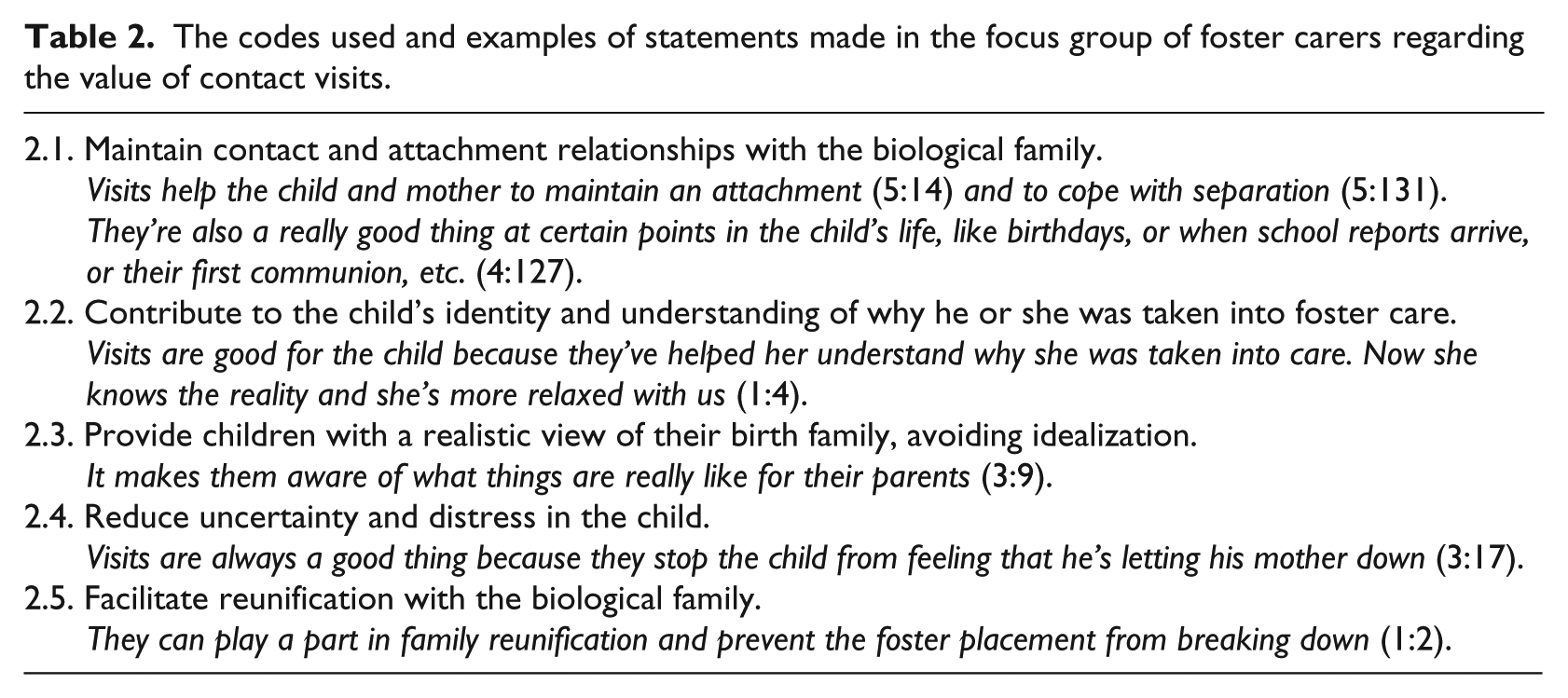
Taken together, the comments made by social workers and foster carers suggest that one of the basic functions of contact visits is to enable children to maintain an attachment with their birth family. In addition, the positive experience of the new bond that is established with foster carers can help children to feel more secure in their relationship with their biological parents. Contact visits also help children to understand more about their family history and promote a sense of identity, both of which are important for the child’s wellbeing and the success of the foster placement.
Difficulties related to visits that were raised in the focus groups
The difficulties identified by social workers in relation to visits are shown in Table 3. The most common problems involved complaints about the CPS (mentioned on 12 occasions), the lack of coordination between social workers and the CPS (9 mentions), and the birth family giving the foster child inappropriate messages (5 mentions).
The codes used and examples of statements made in the focus group of social workers regarding difficulties related to contact visits.

The difficulties identified by foster carers in relation to visits are shown in Table 4. The most common problems concerned being seen in a negative light by the birth family (mentioned on 9 occasions), the distress, anxiety, and conflict of loyalty that visits can produce in the child (7 mentions), and complaints about the CPS (5 mentions).
The codes used and examples of statements made in the focus group of foster carers regarding difficulties related to contact visits.
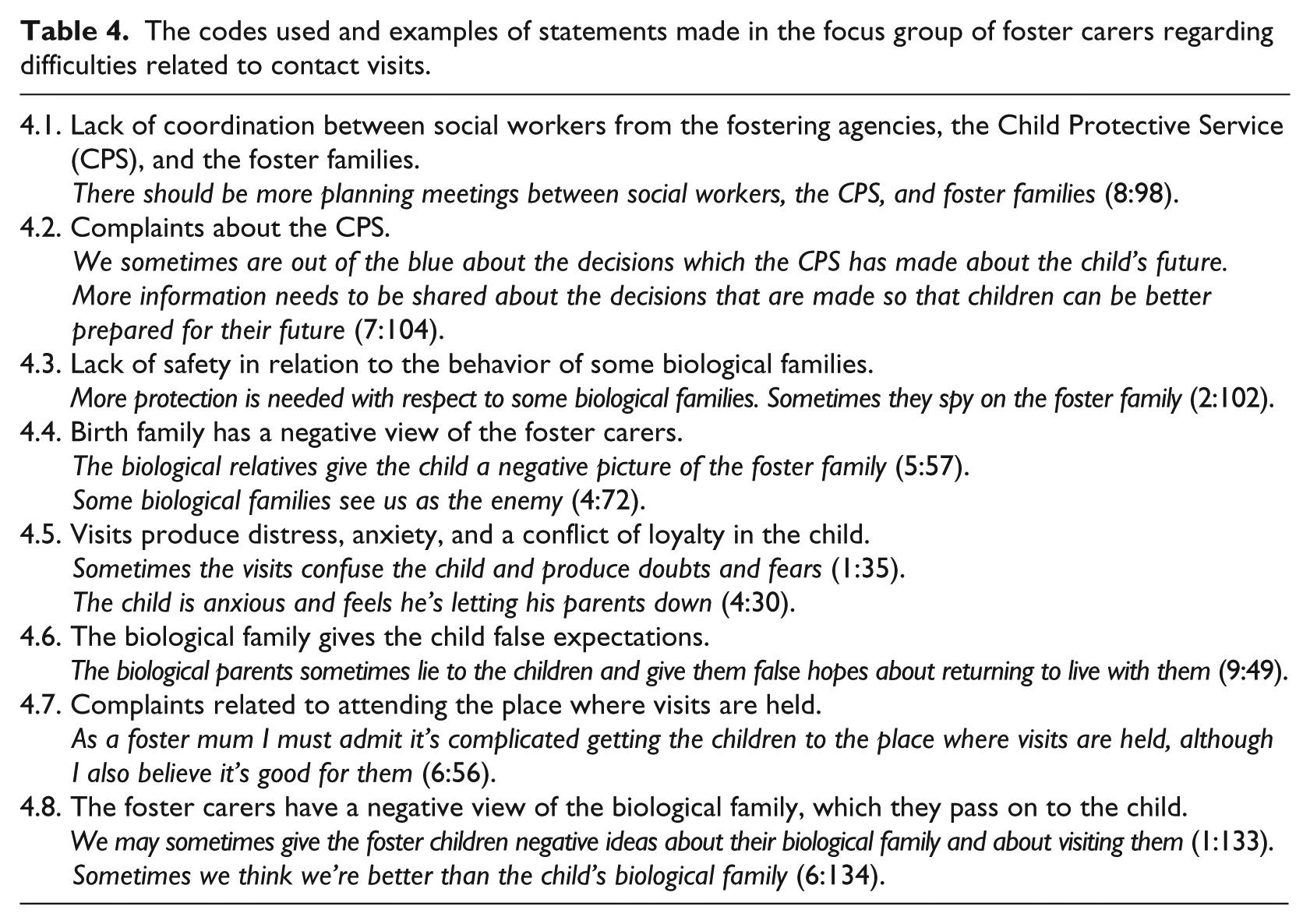
The comments made both by social workers and foster carers about birth families suggest that they have only a limited understanding of the latter’s reality. They also highlighted a lack of collaboration between foster and birth families, which can lead to fears and mistrust on both sides. Other difficulties such as the conflict of loyalty and anxiety which foster children can experience may also be linked to the poor communication between the two families.
Social workers put forward a number of proposals for improving contact visits (Table 5). The main ones were providing birth families with more information, preparation, and support (mentioned on 20 occasions) and the need to establish both an agreed protocol governing visits (12 mentions) and a clear criteria for when they should be suspended (7 mentions).
The codes used and examples of statements made in the focus group of social workers regarding ways of improving contact visits.

The main proposals put forward by foster carers for improving contact visits (Table 6) concerned their need for more information, preparatory training and support (mentioned on 13 occasions), the importance of a collaborative relationship between the birth family and foster carers (11 mentions), the need for greater preparation of foster children (10 mentions), the need to provide birth families with more information, preparation and support (9 mentions), and adapting visits to the specific needs of each child (7 mentions).
The codes used and examples of statements made in the focus group of foster carers regarding ways of improving contact visits.

Given that contact visits are regarded as a key component of a successful foster placement, it is striking that so many aspects were mentioned as requiring improvement. Many of these had to do with the organization of visits (frequency, duration, meeting place, etc.) and the resources, both human and material, that are made available. The results obtained highlight the need to explore ways of improving the whole process of contact visits (preparation and prior planning, procedures, flexible scheduling, etc.) so as to ensure that they respond adequately to the needs of foster children and both the families involved.
Discussion
Although other authors have previously highlighted the benefits and drawbacks of contact visits for children in family foster care, this study adds to this literature through the use of two focus groups in which participants offered many and varied opinions about the potential value of contact visits, the problems that were sometimes faced, and ways in which such visits might be improved.
With respect to the value of visits, the first point to note concerns the level of agreement between social workers and foster carers. As reported in previous studies on this issue (Biehal, 2014; Dozier et al., 2002; Ironside, 2012; Juffer et al., 2014), both groups felt that visits helped children to maintain attachment relationships with their biological family and contributed to their sense of identity and understanding of their personal and family history. This consensus among social workers and foster carers underlines the importance of the emotional bond between children and their parents, especially in the case of foster children, who rely on it to maintain their sense of identity.
Foster children often fantasize about and form an idealized view of their birth parents, and in this respect another advantage of visits is that they put children in touch with the reality of their biological family (Hess, 1987; Sanchirico and Jablonka, 2000). It should be remembered that the birth parents remain the primary figures of reference for the child, and it is therefore important to maintain this special bond. As in the study by Metha et al. (2013), our participants stated that contact could reduce foster children’s anxiety and uncertainty about their biological parents, and also limit the distress they experience as a result of being separated from them. This supports our view that visits provide an opportunity for children to learn more about their birth family and to understand the reasons why they were taken into care.
The focus group of foster carers considered that visits were particularly important with respect to the goal of family reunification. Various studies have associated contact with a greater likelihood of a child returning home, it being a way of keeping alive the child’s expectations in this regard (Cleaver, 2000; McWey and Mullis, 2004; Oyserman and Benbenishty, 1992; Schofield and Beek, 2009; Sinclair, 2005; Testa and Slack, 2002).
One of the themes that emerged in both focus groups was the lack of coordination between social workers, the CPS, and foster families. A related theme involved various complaints about the CPS, for instance that it failed to share information about the decisions it made regarding a child’s future or that it gave foster carers too little time to prepare a child for a planned change to the fostering arrangement, including saying goodbye when a child left their care. The importance of keeping foster carers informed and taking their views into account when making decisions about a child’s future has been highlighted by previous studies (Buehler et al., 2006; MacGregor et al., 2006). What the present study adds in this regard is that it sought the opinions of both social workers and foster families regarding the practice and procedures of the CPS.
Participants in both focus groups drew attention to the need for more protection and safety measures in relation to possible violent behavior on the part of biological families. Similarly, both social workers and foster families considered that biological parents sometimes had a negative view of the foster carers which they then passed on to the child. The experience of some foster carers was that the biological family gave children false expectations and inappropriate messages regarding their actual situation and the real chances of being able to return home. These negative views may be partly due to the fact that in Spain there tends to be limited contact and collaboration between the two families, a situation that hampers mutual understanding and encourages mistrust and judgmental opinions. As Metha et al. (2013) point out, it is important that birth parents and foster carers cooperate in helping the child to reconcile feelings of loyalty and affection toward both families, as otherwise the child may experience a conflict of loyalty.
Other complaints raised by foster carers included insufficient monitoring of visits due to a shortage of social workers; the lack of support and preparation given to foster families, children, and birth families regarding contact visits; a lack of financial help; and not being given enough information about the foster child’s background. These problems are similar to those reported in previous studies of foster families (Broady et al., 2010; Jiménez and Palacios, 2009; Triseliotis et al., 2000).
In addition to the benefits and problems associated with contact visits, participants in the two focus groups were also asked to suggest ways in which such visits might be improved. The main proposals put forward by foster carers and social workers concerned the need to provide more information, preparation, and support, not only to foster carers but also to birth families and the children themselves. These findings are consistent with other studies (Haight et al., 2002; MacGregor et al., 2006; Moyers et al., 2006) and highlight the need to develop and implement strategies that would improve the whole process and quality of contact visits. A key element in this respect would be increased funding and human resources for child protection services so as to provide all those involved in family foster care with better preparation, training, and support.
In this same context, another point made by both social workers and foster families concerned the need for an agreed protocol governing visits. For example, foster carers felt that rules should be established regarding the use of new technologies in contact between children and their birth families. For their part, social workers stressed the importance of monitoring visits and of establishing clear criteria for suspending visits.
Contact visits are part of a complex system of family relationships in which the foster child is immersed and therefore it is essential that all those involved work together in order to ensure the child’s wellbeing. In this respect, both social workers and foster families pointed out that the success of visits depended on a collaborative relationship between the birth family and foster carers. Other studies (Sanchirico and Jablonka, 2000; Sellick and Howell, 2003; Whenan et al., 2009) have previously found that those foster carers who feel they have received adequate training are more willing to collaborate with contact visits involving the child’s biological parents. For their part, Schofield et al. (2000) and Simms and Bolden (1991) concluded that the adequate preparation of foster carers and the careful planning of contact made it easier to integrate visits into the everyday life of the foster family, which in turn improved the contact between foster child and birth parents. The results of the present study support these findings regarding the importance of collaboration between families and the role of planning, preparation, and support in relation to the success of contact visits. Furthermore, they highlight the need in our country for specific programs to promote social skills, communication, and an appreciation of the importance of life story and emotional bonds among all those involved in foster care.
Another conclusion reached in both our focus groups was that contact visits should be adapted to the specific needs of each child, reflecting the view of those authors who recommend that decisions about contact be made on a case-by case basis (Prasad, 2011; Sen and Broadhurst, 2011; Taplin, 2005).
It should also be noted that foster carers made a number of other suggestions regarding how contact might be improved. These included taking the child’s wishes into account when setting up visits, improving the place where visits are held, having a more flexible approach to the type of contact (i.e. not just face-to-face meetings), and reviewing and adapting the frequency and duration of visits to the circumstances of each case. In our experience the majority of locations used for contact visits in Spain are not fit for purpose (e.g. small rooms, lack of age-appropriate educational or play resources, and the presence of various families in the same meeting place). We also agree about the need to take the child’s wishes into account when planning visits, since they tend to be systematically ignored. Finally, various studies (Haight et al., 2001, 2005; Leathers, 2003; McWey and Mullis, 2004; McWey et al., 2010) have found that the frequency of visits and the quality of the parent–child interaction during contact are factors that influence the child’s wellbeing and affective ties with relatives, as well as his or her adaptation to the foster family. This supports the view expressed by foster carers regarding the importance of these factors for improving the quality of visits.
In sum, the use of focus groups has enabled us to gather numerous and varied opinions from social workers and foster families regarding contact visits. This kind of analysis is important, since both parties can provide valuable insights into the needs of foster children. The findings also have practical significance as both groups made a series of specific suggestions about how visits might be improved. Based on these suggestions, which we regard as recommendations for good practice, our group is in the process of developing a specific program aimed at providing both foster carers and birth families with adequate training and preparation in relation to contact visits. The program focuses on social and communication skills, emotional relationships, and the importance of life story, among other aspects, and seeks to improve the quality of visits by enhancing the competences of both families. A further goal is to encourage cooperation and understanding between the two families so as to reduce the likelihood of judgmental opinions and accusations of blame (e.g. by sharing information and creating spaces in which children can play with both families present, such as during a birthday party or after-school activities). We believe that such an approach will help considerably to challenge the negative views that foster carers often have of birth families, whose life context is invariably complex and characterized by a wide range of different social and financial situations. Likewise, this kind of preparation provides an opportunity to tackle the mistrust and accusatory views that birth families often hold with regard to foster carers and social workers, whom they see as responsible for taking their child away.
Limitations
This study does have certain limitations, primarily that the social workers were recruited solely through four fostering agencies in the region of Andalusia. A related limitation concerns the small number of focus groups, whose views may not reflect the opinions of other social workers and other foster families.
The analysis could also be enriched by seeking the views of birth families and of foster children themselves. The broader picture thus obtained would enable a better understanding of the complex set of relationships involved in contact visits. For this study it was not possible to conduct a focus group with the biological families as many of them lived some distance from the city where the contact visits took place, thus making it impossible to coordinate a meeting on the same day. As a result, we carried out a subsequent study in which the birth families were interviewed individually (García-Martín, Fuentes, Bernedo, and Salas, 2018). Regarding the opinions of foster children, our research group is currently undertaking a study looking at ways of improving visits, in which the views of children are taken into account.
Footnotes
Ethics
This research was approved by the Research Committee of the Psychology Centre (University of Malaga). In addition, the foster care families and social workers expressed their agreement to participate in this study.
Funding
This study is part of a Project (I+D) financed by the Government of Spain (EDU2016-77094-P).
