




Abstract
This research compares job stressors’ frequency and interpersonal conflict resolution strategies between social workers and employees from other local institutions in Novi Sad, Serbia. The occurrence of individual stressors was found to be more frequent for social workers than employees from other institutions. Social workers experience significantly higher levels of job pressure, lack of support, and general job stress than the others. It was also found that social workers tend to use integrating and compromising conflict resolution strategies more frequently than employees from other local institutions, showing a good level of care for the self, as well as maintaining a balance between the two sides involved in the interpersonal conflict.
Introduction
Systematic reviews of stress among social workers show that they typically encounter more stressors and experience relatively high levels of stress reactions when compared with normative populations (Coyle et al., 2005). Although there is evidence that social workers may experience higher levels of stress and resulting burnout than comparable occupational groups, the quantity and quality of empirical research of this problem is still weak, mostly supported only by anecdotal evidence, and without enough comparison with other occupational groups (Lloyd et al., 2002). While there are numerous studies that deal with stress reactions and job satisfaction within this population, less studies observe the working conditions and stress factors directly. It was found that social workers do experience high levels of stress, with the most frequent stressors being identified as role ambiguity (Balloch et al., 1998), planning and reaching targets (Collings and Murray, 1996), and not feeling valued by their employers and wider society (Huxley et al., 2005). Workload and organizational policy are identified as dominant stressors in Hong Kong (Vyas and Luk, 2010). Organizational structural aspects, organizational resources, and management are found to place formidable limitations on this profession in Saudi Arabia (Albrithen and Yalli, 2012). An extensive workload and role conflicts are the most frequent stressors for social workers in the Nordic countries, especially for those working within the public sector (Blomberg et al., 2015). Working conditions have now deteriorated even more than before, in that social workers have too much to do, are often obliged to work overtime, are influenced by urgent situations with less opportunity to influence their work, and are found to spend less time in direct contact with their clients than they believe is appropriate (Tham, 2017a). Although highly relevant, these studies did not compare social workers with employees from other professions.
During their work, social workers experience many interpersonal conflicts, both from communicating with their clients in complex situations, and from communicating with other services, management, and agencies. There is evidence that social workers’ stress is more dependent on their interpersonal relations with colleagues and clients than on intrinsic working conditions (Pines and Kafry, 1978); social workers’ relationships with other people were found to be a significant stressor (Bennett et al., 1993). Therefore, it is beneficial to observe interpersonal conflicts in the context of job stress (JS), where Barki and Hartwick’s (2004) definition of interpersonal conflict as ‘a dynamic process that occurs between interdependent parties as they experience negative emotional reactions to perceived disagreements and interference with the attainment of their goals’ was used (p. 234). Interestingly, searches for empirical studies related to social workers’ interpersonal conflict strategies, conflict management, and similar terms related to interpersonal conflicts as defined by Barki and Hartwick (2004) yield zero results. 1
During stress and conflict management strategy workshops held for social workers in Serbia, it was noticed that social workers not only reported higher stressor exposure, but also displayed more skill when managing interpersonal conflicts than displayed by employees from other public institutions engaged in similar workshops. Here, there can be several possible explanations for this observation. Social workers often have a formal education background that empowers them to manage interpersonal conflicts. They also participate more frequently in informal education activities, such as workshops and soft-skill trainings, and direct transfer of knowledge from their colleagues. Finally, based on their education and job choice, most of them are probably intrinsically very interested in helping other people, making them more motivated to resolve interpersonal conflicts constructively.
This research aims to validate these insights with a quantitative approach by answering the following research questions relative to the research sample: (1) What are the most frequent sources of JS experienced by social workers? (2) Are there different JS factors for social workers than there are for employees of other local government institutions? (3) What are the dominant interpersonal conflict resolution styles utilized by social workers? (4) Are there differences in conflict resolution strategies used by social workers than by employees of other local government institutions?
Data collection and methodology
The data were collected during workshops on stress and conflict management in local government institutions in Novi Sad, Serbia. Although workshops were also held in other municipalities, it was decided to observe only employees from one city to control relevant variables as much as possible. Since different Serbian municipalities have different approaches to service organization, it is possible for external variables (such as differences in remuneration, different bureaucratic rules, responsibilities, and different organizational climates) to interfere with types of job-related stress factors. The Center for Social Work of Novi Sad also had by far the largest number of employees as participants in the workshops from one institution.
The first sample of 60 social workers came from five units of the Center for Social Work of Novi Sad. Participants’ ages ranged from 28 to 62 years old, the mean average being 43.49 years old; 80 percent had a high school or university diploma; and 91 percent were female. The second sample consisted of 883 local government workers from other institutions such as medical centers, employment offices, and primary and secondary schools. Here, participants’ ages ranged from 21 to 64 years, the mean average being 45.11 years old; 53.1 percent had a high school or university diploma; and 44 percent were female.
At the start of each workshop, with each group containing 15 participants, respondents completed an anonymous survey that required them to reflect on relevant aspects of their work. This survey consisted of several demographic questions, and the two following instruments.
The Job Stress Survey (JSS) calculates the overall level of work stress based on the combined severity and frequency of 30 stressor effects (Vagg and Spielberger, 1998). It provides measurements of total occupational stress associated within a work context, and three sub-scales: the nature of the job itself (job pressure [JP]), lack of support from co-workers, or the policies and procedures of the organization (lack of organizational support [LS]), and general stressors from the working environment (JS). It also allows the comparison of individual stressor frequencies. The original JSS was modified according to frequent psychometric recommendations by replacing the 0–9 scale with a more reliable 1–5 Likert-type scale. Also, severity measurements were eliminated for brevity during the workshops. Thus, the JSS consisted of 30 items where respondents could indicate how often each event had occurred during the preceding 6 months.
The Rahim Organizational Conflict Inventory (ROCI-II) measures five styles of handling interpersonal conflict, based on two dimensions: concern for self and concern for others (Rahim, 1983). Therefore, the ROCI-II gives results in measurements of the following styles: integrating (high concern for others and high concern for self), obliging (high concern for others and low concern for self), dominating (low concern for others and high concern for self), avoiding (low concerns for both others and for self), and compromising (concern for others and concern for self are both at mid-point). Here, the original instrument was shortened from 28 to 20 items to allow the same number of items for each method (four), which did not result in any significant change in psychometric properties. The respondents were asked how they typically react when faced with interpersonal conflicts with co-workers and clients, and they indicated the frequency of their responses on a 1–5 Likert-type scale.
Results
When mean averages of individual stressor frequencies among social workers were examined, there was a clear distinction between two groups of stressors. There were seven stressors that scored mean averages between 3.86 and 3.2 (presented in Table 1), while all the other stressors scored mean averages of 2.93 or lower. Out of these most frequent stressors, only Item 8 was from the LS sub-scale, while the rest were either from the JP sub-scale (Items 16, 23, 25, and 26) or were defined as general stressors (Items 15 and 19).
Most frequent individual stressors in the two sub-samples.

Looking at the sub-scales presented in Figure 1, it can be concluded that stressors related to JP were only slightly more frequent than stressors related to lack of support or the working environment.
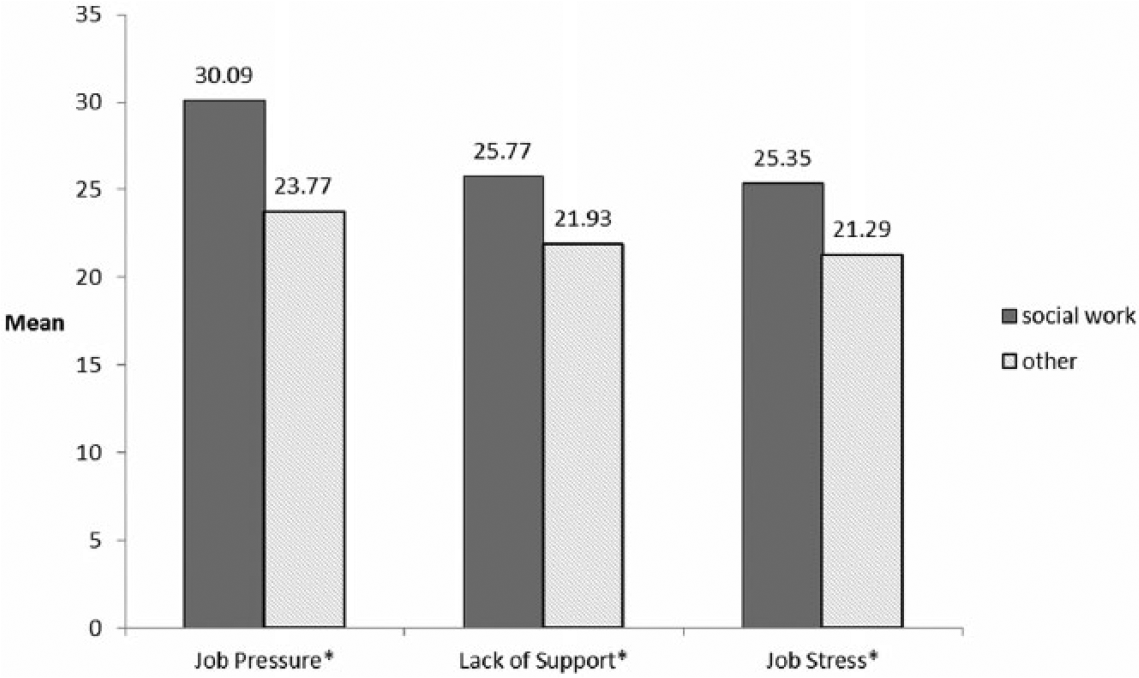
Means of the JSS sub-scales compared between the two samples; significant differences are marked with an asterisk.
Employees from the second sample identified, quite surprisingly, the first six frequent stressors in a very similar manner, but the mean averages of the highest-ranking stressors were obviously lower than those from the social workers, as presented in Table 1.
Because the total occupational stress index and all three sub-scales measured by the JSS were not normally distributed, a nonparametric Independent Samples Mann–Whitney U Test was used to examine the differences between the two samples. Social workers scored significantly higher scores than the employees from other institutions in the total score (mean [M] = 81.28, standard deviation [SD] = 14.13 versus M = 67.32, SD = 18.67; Sig.= .000). They also had significantly higher scores on all three sub-scales, as presented in Figure 1.
The most dominant interpersonal conflict resolution style of the social workers was by far the integrating style (M = 17.26, SD = 1.98), followed by the compromising style (M = 15.34, SD = 2.07), the obliging style (M = 12.52, SD = 2.46), the dominating style (M = 12.18, SD = 2.19), and the avoiding style (M = 11.69, SD = 2.95).
When comparing the two samples, the Mann–Whitney U Test was used again, because most of the variables were not normally distributed and did not have similar variances. Here, social workers expressed significantly higher usage of the integrating style (Sig.= .000) and the compromising style (Sig.= .008). Employees from other institutions expressed significantly higher usage of the obliging style (Sig.= .048) and the avoiding style (Sig.= .003). Usage of the dominating style was not statistically different between the two samples (Sig.= .776), as shown in Figure 2.
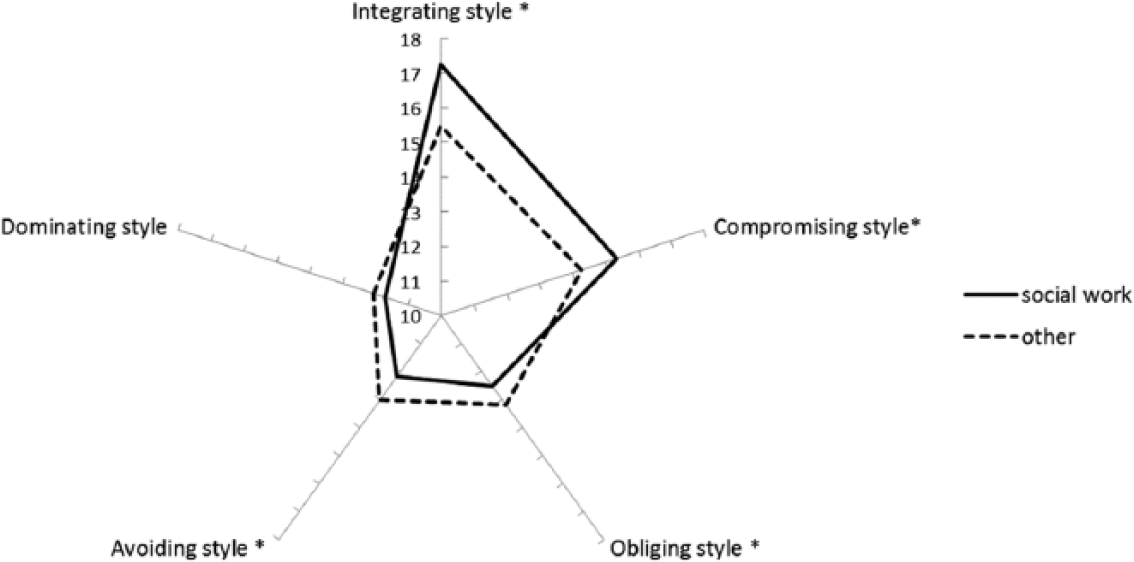
Mean averages of conflict resolution styles in two samples; significant differences are marked with an asterisk.
Since there is evidence that social workers’ attitudes toward clients within the welfare system are to some extent related to their level of JS (Blomberg et al., 2015), it was interesting to explore any potential connection between both phenomena. However, although significant, the correlation coefficients (Spearman’s Rho) between stressor frequencies and conflict resolution usage were lower than .30.
Discussion and conclusion
Previous literature suggests that social workers are exposed to various job-related stressors to a large extent. Worldwide, some of the pressures facing social workers are even more common today than in previous decades, since the complexity and size of caseloads have increased, while the global recession in 2008 significantly led to further efforts to reduce social spending (Van Heugten, 2011: 32), which is especially apparent in low-income areas (Tham, 2017b). This study shows that social workers in Novi Sad are mostly faced with stressors related to the nature of the job (JP sub-scale), although lack of organizational support and general stressors are also present. In Serbia, public institutions are frequently under-funded and under-staffed, which adds two major stressors (numbers 1 and 4 presented in Table 1) to the ones most frequently identified in studies from other countries.
This study also showed that social workers from the sample have a similar structure of stress factors to employees from other institutions that are managed by the same local government. Although the Center for Social Work and other local institutions in Novi Sad have separate management, a similar organizational culture – probably enforced by the city government – is probably responsible for this phenomenon. However, social workers indicate that they encounter stressors more frequently than the others, which confirms previous qualitative studies. Similar organizational culture, funding and procedures enforced by the city government could imply that the responsibility to reduce stress within social services cannot be put solely on management of the individual institution; rather, joint efforts should be made by the institution’s management and city government to reduce social workers’ stress. This is especially apparent when one realizes that individual stressors ranked 1 and 4 are the only ones that ranked high in both samples from the ‘general stressors’ group.
When it comes to interpersonal conflict resolution, social workers from Novi Sad show that they tend to use styles that require high or mid-point concern for both others and self. The integrating and compromising styles both insist that subjects require a good level of care for the self, which indicates good coping strategies. Also, both styles require maintaining a balance between the two sides involved in the conflict, which is beneficial in social work. Although when compared to employees of other institutions the profiles look similar, social workers show higher usage of the integrating and compromising styles, and lower usage of the obliging and avoiding styles than the others. Therefore, social workers are found to be more competent to resolve interpersonal conflicts constructively and with the highest benefits for both sides, which is highly beneficial for the Center’s clients. As mentioned in the introduction section, these differences are probably as a result of the educational background that the social workers have: they are taught to approach individuals, and to think about how their problems should be solved. During their work, social workers probably engage in more workshops and trainings that empower them to deal with interpersonal conflicts, but also to take care of both others and self. Finally, choosing social work as a profession probably implicates personality traits and motives that are in favor of constructive and balanced conflict management.
In conclusion, this article aimed to add to existing literature by presenting research that was both quantitative and comparative, and conducted in a developing country. Social workers are shown to have relatively high exposure to work-related stressors, and higher than employees in other institutions with the same ownership structure. On the other hand, social workers show more skills in managing interpersonal conflicts, which is not surprising, considering the nature of their work and their educational backgrounds.
Based on these findings, social work center managers in Serbia should organize procedures and work in a way that minimizes interruptions, deadlines, and excessive paperwork. To alleviate much of this, managers should consider hiring more staff. If there is no possibility to increase social workers’ earnings, and they experience lack of recognition for their work, other strategies should be employed to compensate for their work. The factors related to the JP and lack of support sub-scales are mostly the responsibility of the Center’s management, while the factors related to the JS sub-scale should be tackled together with the local government, in order to decrease stress experienced by the social workers. In addition, the Center should organize stress-relieving activities that could help the employees work through the stress that cannot be eliminated. Currently, there are no such organized and recurring activities at this Center, but other research suggests that there are significant benefits in implementation of these interventions (Brinkborg et al., 2011). Conflict management skills are found to be adequate, both in terms of the most dominantly used ones and in comparison with employees from other institutions, so currently the Center’s employees do not need urgent interventions in this topic – more time should be used to remedy the effects of stress.
This research has some limitations that should be mentioned. While pursuing higher validity of the research through controlling external factors, the sample of social workers was constricted to only one municipality, which may limit generalization of the findings. Discrepancy between the two samples regarding the gender of the employees is quite high, and future research should balance this. Finally, both samples were from institutions that are owned and managed by local governments, while social workers from other institutions and non-governmental organizations were not observed.
Footnotes
Funding
The author(s) received no financial support for the research, authorship, and/or publication of this article.
