



Abstract
Social work is observing an increasing awareness of geographical inequity in knowledge creation and dissemination, an interest in research by scholars from the global South, and debates about the extent to which the multiple contexts of social work are recognised. This article extends understandings of these research dynamics through reviewing recent articles authored in the global South and published in the 10 largest social work journals, subjecting them to analysis across institutional affiliation, author order and research type. Findings highlight an absence of knowledge from the global South, identifying major gaps in social work theorising, research and knowledge.
Keywords
Introduction
The global dynamics of social work theory and research is of increasing importance, highlighted by the growing awareness of geographical inequity in engagement with knowledge, and growing interest in the contributions of scholars in the global South (Lombe et al., 2013; Pawar, 2015). Both Connell (2007a) and Behdad (2005) argue that research and theory emanating from the global South have as much intellectual power and political relevance as those from the global North, yet this knowledge is currently obscured by the hegemonic ‘global North’ and the dominated ‘global South’. Connell’s (2007b, 2014) work stresses these problematic global dynamics of knowledge production, highlighting a power imbalance in the social sciences, which are dominated by the perspectives of men, capitalists, the educated and wealthy who are geographically located in the global North. Social work’s knowledge base is dominated by Anglo-American values, perspectives and epistemologies, which largely ignore the contextual realities of the global South, within a system of Northern paradigms that define and validate social work knowledge (Mathebane and Sekudu, 2017).
In response, we first discuss contemporary social work research dynamics, as well as barriers to publishing from the global South, and relate these to current debates about international social work. We then investigate social work research and dissemination from the global South by exploring the characteristics of global South scholarship in social work’s 10 largest journals (by total publications), which are all published in English, over a 5-year period, from 2012 to 2016. We provide insights into the geographical landscape of social work publishing and reveal the geographical diversity of social work scholarship, highlighting the extent to which this knowledge is obscured or missing in major social work scholarship. This work adds to emerging discourses around representations of knowledge in published social work research, and defines the absence of social work ‘voices’ from the global South. This represents an original, yet initial, effort to review the geographical characteristics of contemporary social work publications.
International dynamics of knowledge production
The term ‘Southern theory’ directly refers to knowledge emanating from the ‘global South’ or ‘periphery’ (Connell, 2007a). While not entirely geographically accurate, these terms refer to countries outside of the powerful and privileged countries that are mostly located in the ‘global North’, otherwise known as the ‘metropole’ (the parent state of a colony), largely located in the Northern hemisphere in Europe and North America (Epstein and Morrell, 2012). The global South refers to countries or peoples that have histories of colonialism and experience geopolitical marginalisation, that are largely, but not always, located in the Southern hemisphere (Epstein and Morrell, 2012). It is also understood to include Indigenous communities and knowledge systems embedded in the global North that frequently sit outside of Western moralities, belief systems and epistemologies (Holcombe, 2009). Connell (2017) highlights that the vast wealth of theoretical and methodological knowledge that originates from the global South is mostly ignored in mainstream economies of knowledge, including marginalised Indigenous voices. Connell’s work suggests a ‘southern turn’ across the social sciences towards theories that acknowledge their situated and contextualised time and space, and the problematic nature of universalising theories (Watson, 2016).
Connell (2007b, 2014) argues that the social research process is infused with a power dynamic that elevates ‘metropole’ and ‘Eurocentric’ knowledge of the ‘global North’, while marginalising perspectives from the ‘global South’. The social research process also highlights the ways in which important social theory from the global South is obscured in the global production of knowledge, despite its strong intellectual relevance. The academic hegemony of the global North is underpinned by universities, government and corporations in which outside knowledge is different and of less value (Connell, 2014), assuming universality by failing to acknowledge or address the geopolitical and historical nature of theory and research (Connell, 2007a).
Contemporary universities are now embedded in the institutional infrastructure of neoliberal states and managed within a global economy of knowledge (Boden and Epstein, 2006; Connell, 2014; Watson, 2016). The globalisation of universities – or as put by Altbach (2004), the ‘McDonaldisation of universities’ – has seen a global world of higher education that is vastly unequal due to the location of highly successful research outputs in large and wealthy countries in the global North. Knowledge produced by universities is required to fit institutional and national research agendas of economic utility, typically involving competitive research funding, university rankings and articles published in journals that achieve high citations (Boden and Epstein, 2006; Watson, 2016). Pressure to publish further legitimises research in the global North (Keim, 2011), while frequently the global periphery exports data and imports applied science, maintaining the centre of theory and methodology in the global North (Connell, 2014). Article production is dominated by the global North, despite significant development throughout the global South, particularly in Asia and Latin America (Estrada, 2017), amounting to an international division of scientific labour, where academics in the global South hold marginalised positions in international knowledge production (Estrada, 2017; Mathebane and Sekudu, 2017). If this dynamic continues, knowledge will continue to be interpreted through Northern theories, and perpetuate current knowledge bias (Thomas, 2018).
Barriers to publishing from the global South
Despite the incredible internationalisation of academic publications, researchers in the global South face many barriers to publishing their research. Major publications are mostly located in the geopolitical and economic areas of North America and Western Europe (Larson, 2017), leaving researchers in the global South obscured from Northern research conventions, such as the use of English in publications, a focus on empirical knowledge and Northern epistemologies (Larson, 2017; Thomas, 2018). The dominance of English language social work publications obscures valid and important non-English publications, and can impede researchers working in non-English settings. Furthermore, countries and institutions in the global South typically lack long histories of scholarly production that are recognised by the global North, as well as lacking basic access to Internet connectivity and subsequent access to international research databases, research software and training (Butterfield and Abye, 2012; Larson, 2017; Thomas, 2018).
Social work knowledge and alternative voices in the global South
The field of social work is subject to these global knowledge dynamics that are occurring within a global knowledge explosion (Kreisberg and Marsh, 2016). Those who have the resources to produce social work literature are better able to disseminate and promote their theoretical views and methodological approaches (Ranta-Tyrkko, 2011). This has added implications in the field of social work, as it is both an academic field within the social sciences and a profession practised internationally that should draw on research to effectively engage with people and communities in diverse contexts and settings. As a result, social work, in a range of global and local settings, is increasing in prominence outside of the global North, particularly in the Asia-Pacific region, where researchers, educators and practitioners are working in a variety of unique and important social work settings (Pawar, 2015).
Globalisation and colonisation
As Gray et al. (2008) detail, social work is a modernist Western invention that has a long history of exporting Western forms of knowledge into varied settings, with the profession practised in over 144 countries (Weiss-Gal and Welbourne, 2008) and in areas of significant socio-economic, political, religious and cultural diversity (Golightley and Holloway, 2017; Schmid and Patel, 2016). In this way, the ‘global’ interacts with the ‘local’, producing hybrid cultural practices and products relating to social work, whereby Western models of social work practice are often modified and indigenised (Harrison and Melville, 2009: 15).
Despite this diversity, social work has sought universalism via global qualifying standards for practice and the utilisation of international definitions of social work that transcend national boundaries and focus on the shared aims and activities of social work (Gray and Fook, 2004). These unifying values and principles include social justice, human rights, collective responsibilities and empowerment (Gray and Fook, 2004; International Federation of Social Workers [IFSW], 2017; Weiss, 2005). Commonalities in the practices of international social work often include shared ethical arrangements, relating to human rights and social justice in its various forms, and the dignity of individuals (Schmid and Patel, 2016). However, there are questions over the universal applicability of social work values and principles (Gray and Fook, 2004). Social work approaches vary across its priorities and the social issues and groups it focuses on, as well as professional characteristics and fields of practice, which can vary across North–South contexts (Schmid and Patel, 2016). The notion that there is a unifying set of social work practices reduces the importance of local contexts on social work practice (Gray et al., 2008). Critics point to assumptions of a ‘monolithic body of Western social work knowledge’ (Harrison and Melville, 2009: 21) and debate the purpose of a universal social work in which there is only one set of knowledge, skills and values that can be applied in all cultures and contexts (Askeland and Payne, 2006).
Calls to ‘indigenise’ social work focus on challenging universal knowledge and the cultural hegemony that abounds in social work (Gray, 2005) and on advocating and making available multiple voices and ways of knowing (Gray, 2005). Askeland and Payne (2006) suggest that a less hegemonic approach involves accepting and promoting distinct local social work traditions. Local and contextualised knowledge plays a crucial role in promoting well-being, and can challenge dominant paradigms and discourses, and be highly relevant to practice contexts, both outside and within the global North. Crucially, promoting Indigenous and post-colonial knowledge and theorising in social work is extremely important, especially research and theory that draws attention to colonial pasts and their legacies in contemporary social work practice (Ranta-Tyrkko, 2011). A core component of this work is detailing approaches to working with Indigenous peoples, challenging dominant paradigms and strengthening local identities and discourses in social work settings (Ranta-Tyrkko, 2011).
Social work has been slow to adopt local knowledge, traditional forms of assistance and non-Western and Indigenous worldviews (Gray et al., 2008). Furthermore, the contributions of researchers and professionals from the global South to social work academic publications and other forms of knowledge dissemination are limited (Pawar, 2015). Pawar (2015) advises that the adaptation, ingenuity and knowledge creations of social practices in global South settings are rarely disseminated, and that research dissemination faces large barriers, often to do with resources and knowledge of publishing. This is problematic because, as Connell (2007a) argues, research and theorising that do not recognise the different realities between the global North and South risk privileging parts of the world over others and promoting a false idea of universality. In addition, academics in the global South provide immense value in providing and facilitating authentic representations of the local contexts in which they are embedded, generating local solutions to local problems (Larson, 2017; Thomas, 2018).
This article now explores these knowledge and dissemination dynamics, and in doing so draws attention to social work research emanating from the global South. It answers the research questions ‘To what extent are voices from the global South being heard in major social work publications?’ and (2) ‘What are the characteristics of research from the global South in major social work publications?’.
Method
In order to answer the research questions of this review, a search and review of articles (2012–2016) authored in the global South in the 10 largest social work journals, determined by the total number of article outputs, was undertaken. This review joins similar work that explores trends and characteristics in knowledge generation in social work (Howard and Garland, 2015; Kreisberg and Marsh, 2016; Ligon et al., 2012; Perron et al., 2016) and adds to Lombe et al. (2013) and Pawar’s (2015) work in drawing attention to social work research collaboration with the global South.
The search technique employed for this review, assessment and inclusion of articles is based on predetermined and therefore replicable criteria (Pickering and Byrne, 2014), an approach that has been deployed successfully in recent social work scholarship (Parsell et al., 2016), and with similar methods used to investigate knowledge production in the field of social work (Kreisberg and Marsh, 2016). The benefit of this approach is that it can reveal research gaps as well as the broader characteristics of the literature under examination (Littell, 2008).
Journals subject to review
A search was conducted of the top 10 largest journals in the field of social work by volume, all in the global North. This was determined in research by Perron et al. (2016), who identify the contemporary population of international social work journals and detail the scale of their contributions. These journals were selected for inclusion by drawing on Perron et al.’s (2016) comprehensive list of social work disciplinary journals. Perron et al. (2016) provide a definitive list of social work journals over a 25-year period, and rank them by the total number of articles published. The top 10 journals were chosen for our analysis because they represent the largest contributions to social work scholarship, an indicator of impact, and the list provides an objective and replicable choice of journals. Impact factor, the yearly average number of citations per article, is a less important indicator of impact, given the diverse readership, both academic and professional, of most social work publications.
These journals are as follows:
Families in Society (USA)
Social Work (USA)
British Journal of Social Work (UK)
Journal of Gerontological Social Work (USA)
Research on Social Work Practice (USA)
Social Work in Health Care (USA)
International Social Work (USA)
Health and Social Work (USA)
Journal of Social Work Education (UK)
Journal of Sociology and Social Welfare (US)
Inclusion criteria
The inclusion criteria were based on the following parameters:
in keeping with Connell’s (2007a) interpretation of knowledge from the global South, having at least one author from the global South, as indicated by their institutional or organisational affiliation, and/or research that investigates Indigenous issues, communities or subjects, regardless of author location;
publication between 2012 and 2016;
an original and full-length research article, for example not a ‘commentary’, ‘editorial’, ‘viewpoint’, ‘book review’, ‘letter’, ‘practice update or perspective’.
Country inclusion criteria
The countries that make up the global South are contested and largely undefined. In the absence of an authoritative list of countries that make up the global South, and to take a replicable approach, we utilised the 2016 United Nations Human Development Index (HDI). The HDI has previously been utilised in conjunction with global South research (Odeh, 2010), and is an objective way to classify nations into North and South categories (Hollington, et al., 2015). The HDI incorporates indicators of Gross National Income (GNI) per capita, as well as measures of life expectancy and education (United Nations Development Programme [UNDP], 2017a), and then places countries into four tiers: ‘very high human development’, ‘high human development’, ‘medium human development’ and ‘low human development’ (UNDP, 2017b).
For the purposes of this review we excluded countries placed in the ‘very high human development’ tier, considering them as comprising the global North. Any institutional or organisational affiliation in the articles to a country outside of this tier was then included. It is important to note that the UN’s HDI lists Hong Kong as a special administrative region of China and as a member of the ‘very high human development tier’, and was considered outside of the global South for our purposes. Taiwan is not listed by the UN HDI; however, we included it as a separate entity outside of the global North.
Search process and outcome
The 10 journals were searched manually because the location of the author is not a variable that is possible to search electronically. This involved scanning the abstract and author affiliations of all articles published by each journal between 2012 and 2016. This process identified a total of 139 articles. Articles were excluded if they were not full-length articles, outside of the year range or the author affiliation was not provided.

Search Process.
Limitations
There are some important limitations to this review. It is important to acknowledge the vast scholarly works in social work outside of the journals under focus in this article, in publications not subject to analysis such as books, edited books, grey literature and, significantly, in non-English speaking settings, the volume of which is difficult to ascertain. Exploring these outputs is an important next step in defining social work knowledge beyond major social work publications situated in the global North. In addition, categorising research into global South and North risks obscuring the diversity and variation of social work research and theorising across both contexts. The journals selected for our sample merely represent a snapshot of recent social work research in both the global North and South.
Another limitation is that while the search criteria utilises the 2016 UN HDI, some countries may have moved in or out of the very high human development tier since or may do so in the future, and thus are not captured by this review. Also, as the search criteria relied upon authors’ university or organisational affiliations at the time of publishing to determine the origin of the research, it is likely to have missed authors from the global South who publish from a university or institution in the global North.
Furthermore, we acknowledge that we as authors, from a well-resourced university in the global North, are embedded in Northern systems of thought and knowledge production. We are participating in the unequal knowledge dynamics that are the focus of this article. However, through this article we are also contributing to deconstructing the North–South divide in social work research, motivated by the rapid internationalisation of social work education and research we are witnessing, as well as the disconnect between social work knowledge and the varied contexts in which it is utilised. The field of social work needs truly international research to meet its objectives of social justice, dignity and empowerment (IFSW, 2017), and to tackle pressing international social problems such as inequality, poverty and human rights.
Analysis
Articles were uploaded into Endnote and NVivo programs. Analysis focused on author affiliation, author order and research type. Author affiliations were located in the text and tabulated, while the categories of research types were located and coded using NVivo.
The categorisation of the articles into seven research types draws on methods utilised by Kreisberg and Marsh (2016). The categories of research type include research, information or evidence about the following: (1) ‘Social problem or clinical diagnosis’, (2) ‘Social work practice’, (3) ‘population group’, (4) ‘social work ethics’, (5) ‘social work profession’, (6) ‘theoretical perspective’ or (7) ‘research methodology’.
For the purposes of this research, these categories have been altered in two minor ways. Research relating to social work education has been included in category (5) ‘social work profession’. In addition, the term ‘effectiveness’ has been removed from category 2 ‘social work practice’. This is because while several articles described social work practice in detail, they did not necessarily formally review the effectiveness of practice. This category now reflects articles that reviewed, described or tested social work practice, programmes, policy or treatments.
Findings
The search process found 139 applicable articles out of a total of 2538. Relevant papers were divided across three domains: articles published with an author with a global South affiliation (n = 110); articles with an Indigenous focus and authored in the global North (n = 24); and articles authored in the global South with an Indigenous focus (n = 5). Articles with authors with global South affiliations make up the majority of articles.
Authorship characteristics
Distribution of authorship across the journals under analysis
Figure 2 details the spread of articles across the 10 journals searched. It includes the articles from all three categories referred to above: global South authorship, Indigenous focus, and global South and Indigenous focus. It reveals International Social Work as a significant contributor of global South social work scholarship, publishing 74 articles, making up 53 percent of the total (n = 139). It also highlights the limited contributions of the other journals, which have published few articles by authors with global South affiliations or with an Indigenous focus. Articles from the global South account for just 5.48 percent of the total number of publications (n = 2538) in the 10 journals subject to analysis. These results validate the geographical inequity of social work research, and the hegemonic status of social work research emanating from the global North.

Total publications compared with publications from the global South 2012–2016.
It is important to note that across the past 5 years global South scholarship has increased, with the contributions in 2015 doubling the number from the previous year. Of the 139 articles over the past 5 years, 2015 and 2016 make up 58 percent of the total scholarship, signifying an upward trend in the volume of global South literature. This may reflect growth in publishing more generally, as well as the expansion of the social work profession internationally, increasing use of English and the growing internationalisation of universities in countries such as China.
Author location
The author locations provide insights into the geographical spread of social work research. Of the 139 articles, 190 authors had affiliations to countries in the global South, while 125 authors had affiliations to the global North. Where authors declared multiple affiliations, the global South affiliation was recorded over the global North affiliation, and if multiple affiliations were in the global South, the first affiliation was recorded. Authors from the global South hold prominent positions among the articles reviewed, with 24.3 percent (n = 28) of articles authored by a sole author with an affiliation to the global South, while the majority (69.96%, n = 77) of articles had a first author with an affiliation to the global South. This is significant given that typically first authors have more control of the research design and process, and here it is an indicator of the capacity of researchers from the global South. In addition, 48.7 percent (n = 56) of articles were authored only by authors with global South affiliations, while the remaining 59 articles had a combination of global North and South affiliations, indicating the significant levels of shared authorship between the global South and the global North.
Analysis of author location reveals the geographical spread of social work scholarship in the global South. Detailed in Table 1, affiliations to the global South were spread across 32 countries. Of all the authors with an affiliation to an institution or organisation in the global South, China (n = 40) and South Africa (n = 39) were most represented, together representing 42 percent of authorship. India (n = 19) and Taiwan (n = 16) were also significant contributors.
Author affiliations in the global South.
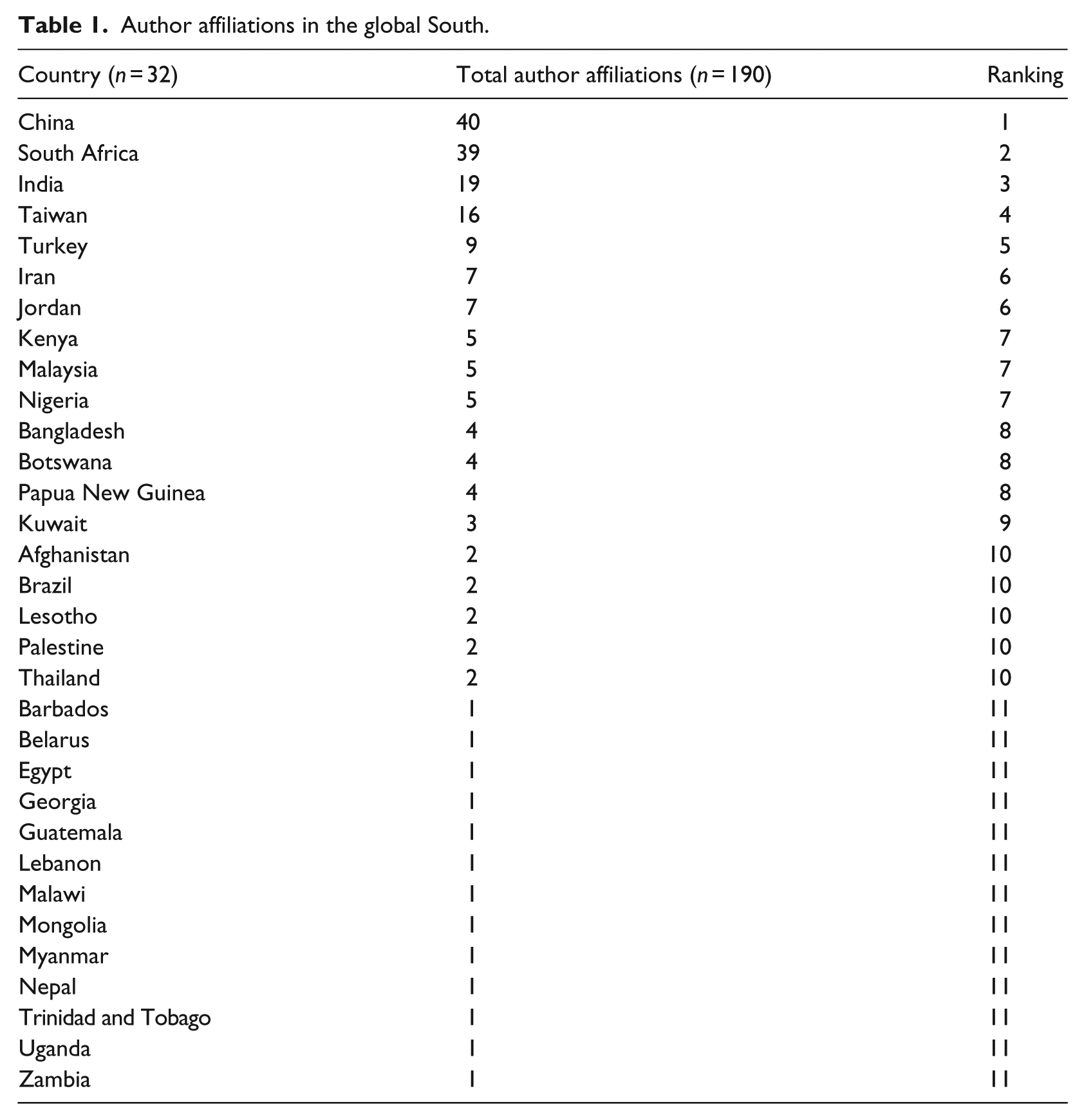
Next, we present the author affiliations for authors in the global North who are publishing in collaboration with authors in the global South. Outlined in Table 2, of the authors with affiliations to an institution or organisation in the global North, the United States dominated authorship, making up 45 percent (n = 56) of the authors. The United Kingdom (n = 14), Australia (n = 12) and Hong Kong (n = 12) made up the next three largest contributors. This outlines the extent of collaboration between authors in the United States and the global South, and reflects the locations of the most substantial North–South article collaboration amongst the scholarship under analysis, as well as the location of the journals in the sample. This indicates the location of researchers with the most capacity to collaborate with researchers in the global South.
Author affiliations in the global North.

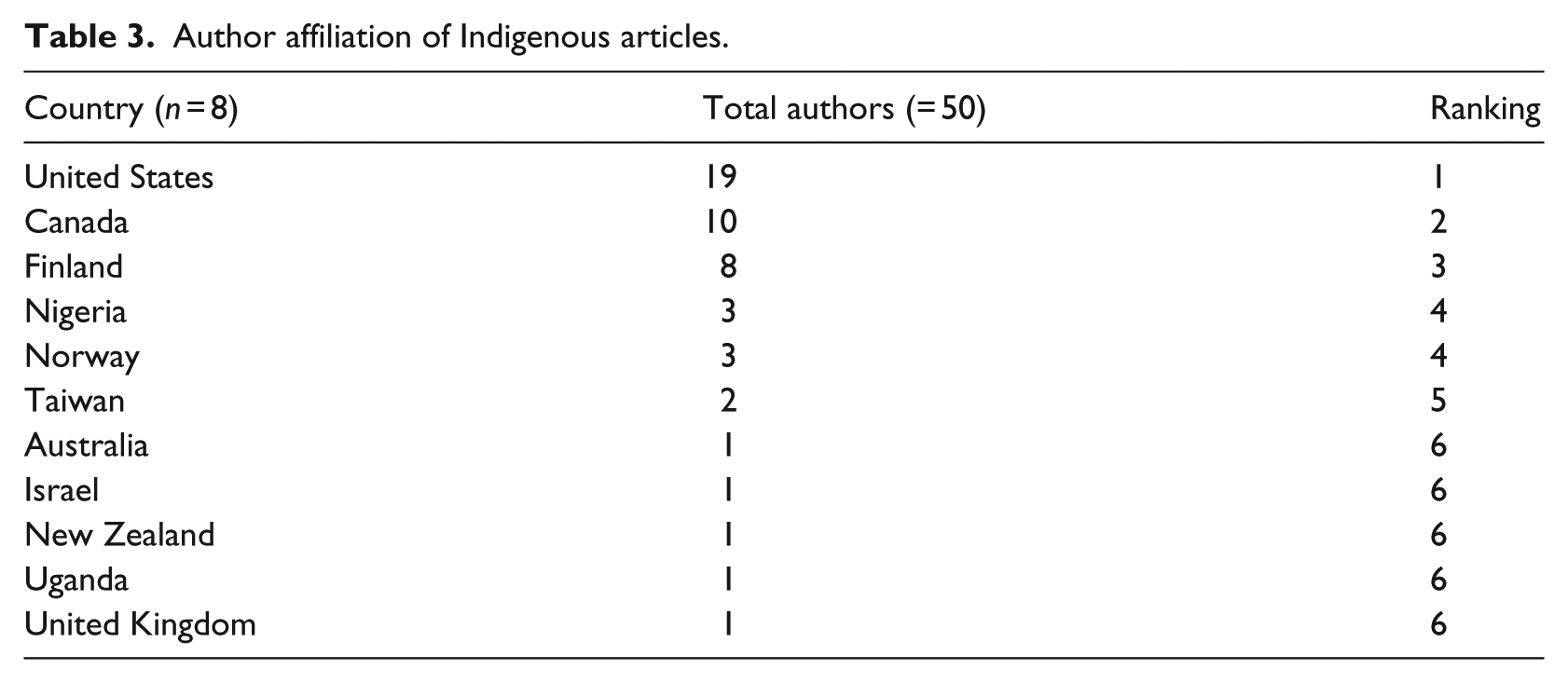
Table 3 details the articles with an Indigenous focus, showing that most were authored by academics in the United States and Canada, followed by a small spread of other countries, representing differing levels of engagement in this area. The majority of publishing on Indigenous subjects by authors in the global North take a domestic focus, for example Henriksen (2016) examines the development of professional social work in Sámi areas in Norway, while Brown et al. (2012) explore staff perspectives on working in aboriginal family services organisations. The low number of authors focusing on Indigenous subjects in the global South is of note (n = 6), representing limited research engagement in this area by the sample. Table 4 outlines the affiliations of authors of articles with no global North author affiliation, who publish independently of the global North. This outlines the country affiliations of authors from the global South who have not collaborated with academics in the global North to publish, and accordingly shows the location of the most established and independent social work scholars in the global South. South Africa, China and Taiwan make up the top three countries. It also details the number and varied locations of authors in the global South who are publishing independently of the global North. These locations represent the largest communities of social work researchers in the global South.
Author affiliation of Indigenous articles.
Author affiliation of articles with no author from the global North.

Analysis of research type and content
The following section provides an analysis of the characteristics of the articles utilising the adapted Kreisberg and Marsh (2016) categories. These categories outline the type of research being conducted by authors from the global South and detail the most prominent areas of research in the global South, as well as the research types that are under-researched. Analysis, detailed in Figure 3, finds that the most common research types were ‘social work practice’, ‘information about a population group’ and ‘social work profession’. Articles investigating ‘social problems’, ‘social work ethics’, ‘methodology’ and ‘theory’ were least represented.
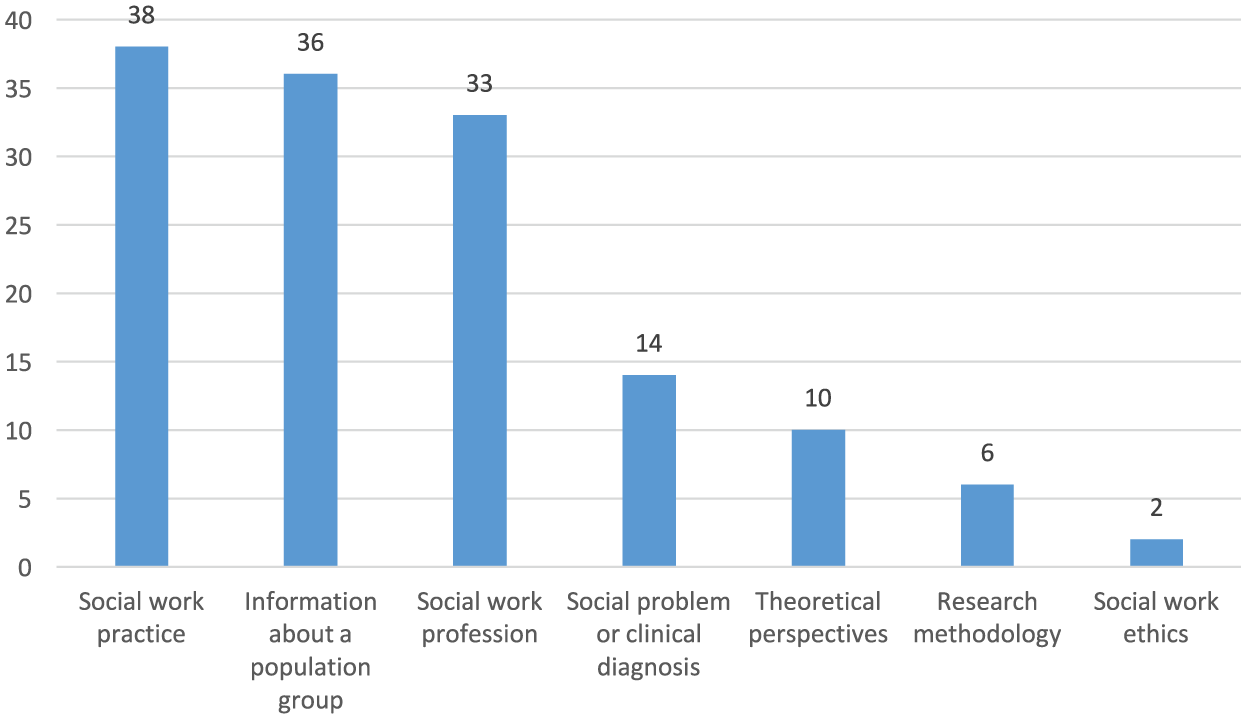
Global South articles categorised by research type.
This differs from research conducted in the global North. Kreisberg and Marsh’s (2016) study of highly cited social work literature from the United States and Europe found that in Europe 48 percent of articles focused on the ‘profession’ and 19 percent focused on ‘theory’, while in the United States 35 percent focused on ‘population’, followed by 19 percent on ‘effectiveness’. The extent to which this reflects the differing social work practice focus in the global North is unable to be addressed in this article, but is an area for future examination.
The most frequent type of research in this sample investigated ‘social work practice’. This is understandable given the diverse and unique practice settings of the global South, many of which are in a developmental stage seeking to define social work, and utilise the ability of research to improve practice. Some examples of these include an adaptation of a family group conferencing model in Guatemala (Roby et al., 2014), and an investigation of the role of self-help groups in post-tsunami rehabilitation (Larson et al., 2015). Information about specific population groups was also prominent in the sample, most likely a response to the varied, distinctive and under-researched population groups in the global South. This is demonstrated by Melvin and Uzoma (2012), who investigate adolescent mothers’ subjective well-being in a Yoruba community in Nigeria, as well as by Hossen and Westhues (2012), who explore the utilisation of both traditional and modern healthcare services by older women in rural Bangladesh.
Research investigating the social work profession is also well represented in the sample. Much of this research concentrates on educational activities, including developing social work education in countries such as Myanmar (Costello and Aung, 2015), and educational techniques (Rowan et al., 2012). The sample also has examples of research that investigates the state of the profession, such as the politicisation of social work in China (Leung et al., 2012).
The other research categories of ‘social problems’, ‘research methodology’ and ‘social work ethics’ are less represented in the sample, indicating potential barriers to conducting and publishing these types of research. Examples of social problem research include female genital mutilation (Jungari, 2015) and substance abuse (Momper et al., 2012), and instances of theoretical perspective articles include introducing conceptual frameworks utilising an Islamic perspective, and social work in relation to post-modern theory (Montaño, 2012). This analysis also highlights the extent to which social work ethics and research methodology are severely under-studied in the global South.
Discussion
The results reveal a range of findings on the global dimensions of social work knowledge production. Social work research is underway in diverse contexts all around the world, yet in this sample of major social work journals the volume of global South authorship is low (5.48%), indicating a range of barriers for authors from the global South to contribute to social work knowledge and dissemination. This is despite the benefits of international research collaboration and dissemination, which include higher impact outputs, innovative research outcomes as well as greater capacity to respond to complex international issues (Lombe et al., 2013).
The limited extent of global South authorship may be, in part, explained by the publication practices of the selected journals. Some explanation of these practices can be found in their stated aims and objectives. International Social Work declares an interest in international submissions and cross-national research (International Social Work, 2018), which is reflected in the geographical location of authors and the content of articles. However, Social Work, based in the United States, a journal with low global South content, seeks to improve practice and advance knowledge, but does not declare international objectives and is associated with the domestic professional body, the National Association of Social Workers (Social Work, 2018). In addition, Families in Society directly references the role of the journal in ‘working to benefit America’s families and their neighbourhoods’, indicating a strong domestic focus (Families in Society, 2018).
It is apparent that the field of social work is currently not doing enough to encourage or facilitate diverse scholarship for their readers, nor promoting the ‘voice’ of social work researchers outside of the global North. An important piece of future research will be to investigate these barriers to publishing, which may include the resources of global South institutions, English language barriers, publishing practices that privilege the global North or differing expectations of ethical practices outside of Western contexts of research.
There is a diversity of research from the global South, indicating strong social work research engagement with multiple social work contexts and fields of practice, as well as the utility of the field of social work in engaging social issues in various settings. However, to understand and engage with the global dynamics of social work knowledge production and dissemination, it is necessary for more investigation of social work research outputs in the global South beyond major academic journals. It is also worth highlighting the dominance of authors from the United States and the United Kingdom in collaborating with the global South, making up 56 percent of North–South collaborations, and whose research industries clearly dwarf those of other nations. That the journals subjected to analysis are based in the United States and the United Kingdom is most likely an additional advantage to researchers from these countries.
Despite the barriers to publishing in the global North from the South, we found that North–South collaboration is not essential in order for social work scholars to publish. This is evidenced by the 24.3 percent of sole authors publishing without collaborating with global North researchers. Furthermore, in South–North collaborations authors from the global South frequently hold prominent positions of authorship, with 69.96 percent of articles with a global South first author and 48.7 percent of articles authored only by scholars from the global South. This indicates that authors in the global South frequently publish independently of colleagues from the global North. This is particularly the case for authors in South Africa, China, Taiwan and India, who consistently publish without collaborators from the global North, and represent major future contributors to social work knowledge. We suggest that locations with greater cultural and linguistic alignment to the global North are better able to publish in Northern journals.
There is a risk that greater North to South research connections may strengthen Northern research and publishing dominance. However, stronger interest in subjects and authors from the global South by Northern journals may also increase interest in and scholarship on the global South, and in doing so, enhance the interest and validity in Southern research and theorising. Increasing Northern support for journals based in the global South can also provide more opportunities for research that falls outside of Northern paradigms. In addition, researchers who increase their engagement with the global South, as well as North–South research interactions, can assist in transforming social work research into a more globally representative field of practice and research.
This review has offered only an initial snapshot of social work literature from the global South, albeit in established and high-performing social work journals based in the global North. While a different sample of social work journals many provide potentially different results, this provides some insights into the dynamics of social work scholarship, and highlights the privileging of voices of only a proportion of the world. Research and theorising that does not recognise the different realities between the global North and South risk a false sense of universality and privileging the voices of only a proportion of the world (Connell, 2007a).
Conclusion
This article extends understandings of geographical inequity in knowledge creation and dissemination in the field of social work, highlighting the absence of research from the global South in major social work journals. The findings reveal that major social work journals are publishing minimal research by scholars in the global South, publishing even less Indigenous research, and are highly focused on domestic contexts, leaving major gaps in social work theorising, research and knowledge. It also details that research into methodology and ethics are major research gaps in Southern social work scholarship. This brings into focus the problematic historical and contemporary marginalisation of research voices from the global South. Social work, despite its incredible global reach as an academic field and profession, risks privileging knowledge from some parts of the world over others, and in doing so, promoting a false idea of universality and research that is not intellectually relevant or responsive to the people and contexts of all settings of social work practice.
Yet despite major barriers to publishing, we find that there are areas of significant and independent social work scholarship in the global South, a high level of geographical variation, evidence of high levels of South–North collaboration and increasing numbers of articles from the global South, all indicators that Southern social work scholarship is emerging. This scholarship has the potential to solve major social work issues and should be embraced by the North, because academics in the global South provide immense value in providing and facilitating authentic representations of the local contexts in which they are embedded, and are able to generate local solutions to local problems (Thomas, 2018).
Moving beyond the geographic and linguistic barriers to researchers in the South can help to create a more globally representative body of knowledge and improve representations of knowledge. This can occur through mutually beneficial partnerships between the global South and North, and the translation of skills and knowledge that this may engender. Exploring knowledge production and outputs in the diverse settings of the global South is an important next step in defining social work knowledge beyond major social work publications situated in the global North, particularly those in non-English formats. Knowledge production and dissemination that elevate and empower the voices of those outside the global North will contribute to a truly globalised knowledge base, and assist in achieving policy and practice solutions as the heart of international social work objectives.
Footnotes
Funding
This research was supported by an Australian Government Research Training Program (RTP) Scholarship.
