




Abstract
Family violence significantly impacts upon Aboriginal women and children globally. Despite this fact, there is a scarcity of published knowledge regarding the nature and efficacy of Aboriginal programmes for men who use violence against women. This article reports the findings from interviews with 15 facilitators of Australian Aboriginal men’s healing, fathering and family violence programmes. From these interviews, we have developed a conceptual model of working with Aboriginal men. It accommodates the collective, generational and individual trauma of both perpetrator and victim, while privileging gendered accountability for violence as a central tenet to the work.
Keywords
Introduction
The scourge of violence is increasingly evident in the lives of Aboriginal 1 women and children globally (World Health Organization [WHO], 2018). A growing body of literature identifies the impact and magnitude of such violence perpetrated against Aboriginal women and children (Bopp et al., 2003; Koziol-McLain et al., 2007; Lawrence, 2006), acknowledging that not all perpetrators of violence against Aboriginal women are Aboriginal men. In Australia, violence against women is recognised as a public health issue conceptualised through a framework of prevalence, social determinants and interventions with a view to prevention (Australian Government, 2011). As a tertiary prevention strategy, men’s behaviour-change programmes (MBCPs) and other group programmes focusing on men’s violence have a recognised, if not controversial, role in addressing violence against women (Day et al., 2009). However, the relevance of such predominantly Western, gendered interventions to the Australian Aboriginal context is contested when family violence is recognised as a complex social issue grounded in historic and structural oppression (Cripps, 2007).
The family violence discourse in Australian Aboriginal communities is often polarised and framed as gendered versus healing interventions; our argument is that both are required for men and for women. As we have discussed previously in (Gallant et al., 2017), the literature clearly establishes that Aboriginal men’s violence against women needs to be located in the context of ongoing colonisation and intergenerational trauma, while privileging and centrally placing women’s experiences at the forefront of the approach (Cunneen, 2002; Gregory, 2008; Zellerer, 2003).
This article extends on our previous work to present the findings of interviews with the facilitators of 15 Aboriginal men’s healing/fathering/family violence programmes across Australia. It provides a culturally framed, multi-theoretical conceptual model derived from a synthesis of these interviews in the discussion with the aim of offering an informed practice framework that can contribute to Aboriginal women’s and children’s safety. The research sought to explore the nature of Aboriginal-specific family violence, fathering and healing programmes, and examined programme structures to seek answers to the following research question: How do Aboriginal-specific family violence, fathering and healing programmes address the issues of fathering in the context of family violence?
Literature review
The efficacy of MBCPs, or perpetrator programmes for men who use violence, was contested and questions arose about the following: the length of programmes, the significant attrition rates, voluntary versus mandated referrals, and which men will benefit from attendance at a programme (Day et al., 2009; Gondolf, 2002). The paucity of evidence of the effectiveness of mainstream programmes reflects the complexity and melee of ideologies regarding programmes and their approaches. Similarly, there is a scarcity of literature regarding the nature and efficacy of Aboriginal-specific programmes aimed at addressing men’s violence against women.
These gaps in the service system response are matched by the problem of the over-representation of Aboriginal men in the criminal justice system. The Royal Commission into Aboriginal deaths in custody (Australian Human Rights Commission Commission, 1997) drew attention to the significant issues associated with the disproportionate imprisonment of Aboriginal men. Advocates continue to decry the lack of action on the recommendations and findings. Taken together, the space to innovate and explore approaches customised to the needs of Aboriginal men is urgent and open for development.
Within the available literature on individual programmes, there is consistency in the perceived programme elements required to appropriately engage Aboriginal men to address their use of violence. These elements include community ownership of programmes, a focus on men’s healing, the need for holistic approaches, and fulfilling the cultural needs of participants to facilitate healing (Gallant et al., 2017). In some programmes, there is also acknowledgement of the value of addressing men’s and women’s business separately and confidentially. The emphasis on healing as a framework for working with Aboriginal men who use violence is evident (Adams et al., 2017; Cunneen, 2002; Kowanko et al., 2009; Tsey et al., 2002). Less visible is the acknowledgement of the gendered nature of most violence experienced by Aboriginal women in Australia (Braybrook, 2015; Cunneen, 2002; Franks, 2000; Tsey et al., 2002; Zellerer, 2003) and how this is theoretically framed to inform practice with Aboriginal men who use violence against women.
Prince et al. (2015) have identified place-based, community ownership of programmes as critical indicators for successful programmes, which supports both the heterogeneity of Aboriginal knowledges and the self-determination required to facilitate change. More broadly, Arney and Westby (2012), Kirmayer et al. (2003) and Shea et al. (2010) discussed healing and healing methods as fundamental to the work that Aboriginal people undertake to address the impacts of colonisation. Cunneen (2002), Franks (2000) and Zellere (2003) argued that in the context of family violence programmes, men need to be held accountable for their current violence, while acknowledging the trauma of colonisation. The literature on family violence prevention programmes also points to the need for holistic approaches that consider all aspects of an individual’s life stage, socio-economic status, and mental, physical, emotional and spiritual health (Franks, 2000; Kiyoshk, 2003; Kowanko et al., 2009) in parallel with addressing men’s family violence in a culturally responsive way. The multiplicity of factors which require consideration points to the disengagement from mainstream MBCPs by many Aboriginal men who use violence and the necessity to develop culturally responsive programmes.
The World Health Organization (WHO)’s (2018) Violence Prevention Alliance constructs the risk factors of violence through an ecological framework that acknowledges the intersecting, multi-layered nature of family violence. It recognises the complex interplay between individual, relationship, community and societal factors, with no single factor explaining why some people or groups are at higher risk of interpersonal violence (WHO, 2018). The framework posits that the interaction between levels is as important as a factor within a single level (WHO, 2018). Heise (1998: 285) described the ecological model as one that situates violence against women in the ‘complexity of real life’ without minimising men’s accountability or discounting gendered social constructions. The intersectional dimensions of gender, race or culture and class also play out across the spectrum of the ecological framework and offer an important frame within which to understand the complexities of family violence. The clarity about how to translate this into practice within Aboriginal family violence programmes is yet to be well articulated, with healing in the context of race or culture often privileged, leaving gender marginalised (Lucashenko, 1996; Price et al., 2016).
Though still in its infancy, the literature available on historical trauma suggests it may play a significant role in understanding and addressing the persistent health and social issues faced by Aboriginal populations globally (Atkinson, 2013; Brave Heart et al., 2011; Gone, 2013; Kirmayer et al., 2014; Sotero, 2006). Brave Heart et al. (2011) defined historical trauma as ‘cumulative emotional and psychological wounding across generations, including the lifespan, which emanates from massive group trauma’ (p. 283). As a distal determinant, historical trauma sits distinctly in the ecological framework as a societal factor, but is hampered by what Sotero (2006) described as a ‘preoccupation with proximate risk factors and a focus on the health of individuals rather than of particular populations’ (p. 93).
Historical trauma provides the precursor to much individual and childhood trauma. Aboriginal children have a greater risk of experiencing trauma, and family violence contributes significantly to this trauma (Commission for Children and Young People, 2016; Tilbury, 2009). As a precursor to violence in adulthood (Gil-González et al., 2007; Heise, 1998), childhood exposure to violence sets communities up for a cycle that is difficult to break. Integrated trauma responses and supports for communities when addressing family violence are the key components for shifting the intergenerational patterns of violence and apply to all aspects of family violence work, including working with men in group settings (Atkinson, 2013).
There are many theoretical approaches to understanding the complexities of family violence and programme practice frameworks which are applicable to Aboriginal men’s family violence/fathering/healing programmes. The way in which these programmes can then seek evidence-based standards and structures, which can demonstrate efficacy in addressing violence and establishing safety for Aboriginal women and children, remains a work in progress that needs ongoing negotiation and agreements with programmes, participants and facilitators.
Research design
The research design considers an Aboriginal worldview as the precursor to the qualitative methodology used for the research context.
Aboriginal worldview
In Martin and Mirraboopa (2003), Martin discusses the research she undertakes ‘from the strength and position of being Aboriginal’ (p. 205). Fundamentally framed by her Aboriginal worldview, it is from this standpoint that her research tells stories of new knowledge that is grown from the principles of Aboriginal relationality. This research was led by Aboriginal researchers operating within a mainstream academic environment. We have been cognisant of our worldviews (and those of the participants of this work) guiding the process of this work. The social and cultural engagement of local Aboriginal community leaders in the family violence space was foundational and conducted through a project steering committee. We aimed to privilege the voices of the Aboriginal facilitators interviewed and maintain the authenticity of their views by including their comments throughout this article.
Data collection: Listening to community and hearing stories
Qualitative methodology using semi-structured interviews (Thomas and Harden, 2008) informed the research approach. Data were collected from 15 programme facilitators who were running Australian Aboriginal men’s programmes that addressed men’s use of violence. Programmes were identified in an initial online search, which was then supplemented by community consultations and through conversation with the project’s Aboriginal-led steering committee. Initially, 53 programmes were identified. To determine programme eligibility for the study, three questions were asked of facilitators: (1) Does the programme specifically target Aboriginal men? (2) Is the programme based around group work? (3) Does the programme contain specific content elements that discuss family violence and men’s use of violence against women? A programme was deemed eligible to participate if a facilitator answered in the affirmative to all three questions. From the initial list of 53 programmes, we were unable to contact 15 of the programmes and a further 11 organisations stated that their programme had ceased to operate, primarily due to a lack of funding. A further seven programmes were deemed ineligible to participate in the research based on the stated eligibility criteria.
In total, 20 programmes were considered eligible to participate and subsequently 15 facilitators agreed to take part in the study. Of these facilitators who participated, six were involved in a family violence-specific programme, five facilitated a fathering programme and four facilitated a healing programme. Programmes were located across Australia.
Interviews were conducted either in person or over the phone and lasted an average of 70 minutes. Semi-structured interviews were used to understand the function of each programme, how the programmes were designed to address issues of fathering and violence, and finally how programmes engaged with both gendered and healing frames. It was not the intention of the research to evaluate the adequacy of the manuals or standards of practice that were being used in the programmes. Ethical clearance was provided by the host university ethics committee ID 1544978.1, and ethical accountability was guided by the project steering committee.
Data analysis: Understanding the message
All interviews were digitally recorded and then transcribed. A thematic analysis was employed to uncover key themes drawn from the interview transcripts (Patton, 2002; Thomas and Harden, 2008). NVivo 10 was used to manage the data and establish the primary coding prior to deriving the secondary themes. Primary coding was undertaken by one researcher, while two researchers created the interrelated reliability for the secondary themes relevant to the research question (Thomas and Harden, 2008). The ideas, themes and conceptualisation were validated through meetings with the steering committee.
Limitations
It is the authors’ view that this study may not have exhaustively identified every programme within Australia that is working with Aboriginal men in a group setting and addressing issues of family violence. This limitation was due to all programmes not being identifiable via the Internet, or were not known to our steering committee or other facilitators who were interviewed. In Australia, many pilot programmes are funded but not provided with sustainable resources to continue. It is difficult in short time frames to capture these programmes.
Findings
Reported within this section of the article are the findings from the interviews with programme facilitators or managers of Aboriginal-specific programmes who work with men on issues of family violence, outlining the complexities and the nature of the work. Data analysis revealed several key themes in the way programmes addressed family violence: men’s violence and its impact, trauma and healing, challenging violent behaviour and accountability, and culturally framed and safe practices. Each of the themes are briefly discussed below.
Men’s violence and its impact
The majority of the fathering and healing programmes spoke broadly about the cycle of violence that men are caught up in: A lot of the dads we’re working with were just repeating, and they were repeating it to such a point they don’t even realise that they were repeating it, until one day they’re like, hey. (Fathering facilitator 4)
All the programme facilitators explored with men their understandings of family violence, what it is and the many types of abuse that constitute it. ‘We do a session in types of abuses and I cover Elder abuse and I cover physical abuse, psychological abuse, cyber abuse. It comes in many forms’ (Family violence facilitator 1). All of the programme facilitators spoke about how they engaged men on the impacts of their use of violence. These discussions drew from both children and women’s experiences. Every participant spoke about using discussions about fatherhood and children as a source of engagement through which to discuss the impact and use of violence: The stuff that we do around fathering can often be a hook, and I’ve heard people say, Oh you know you can’t use the children for men – you know who use violence. I disagree, I think that if that’s a hook for them to change then that’s a good thing and why wouldn’t we? (Family violence facilitator 3)
Many of the programme facilitators reflected that men were generally not aware of the impacts of their violence on their children. This was particularly evident because men would often state that their children were not the receivers of the violent behaviour or they were not present in the space the violence took place. It was argued that bringing the experience of children into programmes was an important element in building men’s sense of empathy towards their children: With the dads, we need to focus more on how the children are feeling and what they’re seeing when Dad is angry. We need to focus more on letting dads know that with their loud noise and rowing and arguments and so forth and violence … how it affects their children. They think because they’re doing it in the backyard, that it’s not affecting their children because they can’t see them. But they can hear him. (Fathering facilitator 3)
Furthermore, most of the facilitators got men to reflect on their time as children, many of whom had experienced violence in their family home: Often it’s about inviting them to just imagine what that might have felt like. That’s fairly shaming for some blokes because they get it, because immediately they’re plugged into how they felt when they were a little tacker and all hell was breaking loose, you know. (Fathering facilitator 2)
Some of the family violence programme facilitators commented that men were more likely to connect with the idea of how their violence impacts upon their children than how it impacts on a partner: That’s the actual key to it, is that men don’t want their kids really going through what they’ve gone through and the biggest motivation for change is not the love of their life, it’s actually their kids. (Family violence facilitator 4)
Trauma and healing
All of the participants spoke in detail about the inherent loss and trauma experienced by Australian Aboriginal people and how these issues have added to the complexity of dealing with family violence in an Aboriginal context, ‘We’re dealing with a very vulnerable … highly distressed, traumatised group of people. The daily challenges are constant and it never stops for them’ (Fathering facilitator 1).
Participants argued that the root cause of much of the loss and trauma experienced by Australian Aboriginal people was a result of the ongoing impact of colonisation: We didn’t dig this hole. It was dug for us 200 years ago and we’re slowly trying to get our way out of this hole and finding that road back to self-respect and respect in our community and most importantly, being that role model within our family and with our children. (Fathering facilitator 3)
A majority of the interviewees stated how important it was to dispel the myth that family violence was traditionally a part of everyday Aboriginal community life: It’s not our way. It never was our way. We’ve inherited this with our loss of our tradition, loss of our laws, we’ve lost that ability to deal with family violence. So to me family violence is something that we’ve inherited and family violence is something that we have to work and develop strategies to work better with. (Family violence facilitator 1)
It was perceived that historical trauma, as a result of colonisation, has had an impact upon Australian Aboriginal men’s contemporary understanding of what a man’s role is within the community. Participants argued that the loss of men’s identity has led to a greater number of men being angry, an anger contextualised within cumulative, unresolved trauma.
In responding to trauma, participants also stated that it was essential to balance the need to challenge men’s use of violence, while also making sure that they were not just shaming men in the process: I want them to feel like there’s opportunities for change, that they can get some different strategies or some different ideas … without walking away feeling just so awful about themselves that they’ll never come back … If we’re going to shame them, they’re not going to come back. (Family violence facilitator 3)
Furthermore, the facilitators noted men’s emotional safety was a critical element in the work they do with men: If you are in a conversation with some blokes who are talking about this in a way where you can see that they’re actually empathising and feeling guilt and feeling shame you really have to do a lot of support so that they don’t just, in their feeling bad and their shame, don’t self-medicate … Or because they’re feeling crappy go and get into a fight. (Fathering facilitator 4)
Balanced with men’s emotional needs, programme facilitators also reiterated the significance of not letting men’s behaviour go unchallenged while trying to emotionally hold men: ‘So we try to come from a place of support and non-judgement, but definitely not letting people off the hook or anything either’ (Healing facilitator 1).
Another key component in the concept of holding men was connected to the need to keep men engaged over their journey towards sustained behaviour change: It’s not smooth sailing. It’s definitely not smooth sailing and you’re probably going to have your little relapses too. But the journey, the road continues. It’s always open and as workers, we need to keep that in mind. (Fathering facilitator 3).
Discussed by all the participants was the need to work with men to address both their violent behaviour and the numerous traumatic and interrelated issues that they could be experiencing: The programmes do need to incorporate a variety of things because what the program needs to bring out in somebody is help them identify what underlying issues led them to be violent. You need to cover relationships, you do need to cover stress, you do need to cover anger management, you do need to cover alcohol and drugs. You need to cover morals and ethics. (Family violence facilitator 2)
A majority of the facilitators connected men’s substance abuse and lived trauma as a significant contributing factor to their use of violence: ‘A lot of the issues around past trauma in their lives, post-generation trauma, anger, drugs and alcohol. There was all these issues that were part of their life’ (Fathering facilitator 3). Several of the family violence facilitators stated that intense case management was important to their work beyond just programme facilitation.
Challenging violent behaviour and accountability
The importance of challenging violent behaviour and reinforcing accountability for violence against women and children was a consistent theme emerging from the data.
A majority of the family violence programme facilitators discussed the importance of being conscious of some men’s attempts to use colluding tactics with facilitators or other participants to justify or minimise the impact of their violent behaviour: They’ll often wink to me or they’ll give me a quick nudge … It’s you know what I mean brother. We all do it, brother. I think no, no, no hang on a sec. You need to step back now … if you don’t challenge that you’re colluding with it and he’ll leave the room and go home that night and he’ll perpetrate family violence again and again and again. (Family violence facilitator 1) You’re not willing to take responsibility; you hear that in their language. Blame, blame, blame. Well you’ve – if we didn’t get invaded, if we weren’t colonised then – and if my traditional role – all that sort of stuff, but then we question [that]. (Fathering facilitator 4)
This was further elaborated by the following: It has to be established quite early that for us as Aboriginal men that we don’t use culture as an excuse for abuse … This is sometimes when men in my group they get stuck in that warrior mode and they blame colonisation for their impacts on their violence towards their children and their partner. They’ll use that as an excuse. (Family violence facilitator 1)
Interestingly, unlike the family violence facilitators, none of the facilitators from the fathering or healing programmes identified this issue of collusion.
Participants identified that a key element in reinforcing accountability for violent behaviour was to bring women’s experiences and voice into the programmes. This was done in various ways including using female programme facilitators, doing partner contact work, through programme activities focused on women’s views and having women review programme content. ‘Aboriginal men need to hear from an Aboriginal woman that it’s not okay; that violence in any form is not okay’ (Family violence facilitator 2).
Many of the family violence programmes conducted a form of partner contact to bring women’s experiences into the programme: So they contact their partners and we let them know that they’ll be doing the program and because these communities are small and they all know who we are and what we’re doing there so there’s no – the partners are really happy that we’re there to be honest. (Family violence facilitator 4)
Many of the family violence facilitators also used partner contact to feed information back to partners and ex-partners: In terms of the mandated program, we’ve been able to catch men out who’ve said that they’re coming to the program to their partners and then we’ve spoken to the (organisation name deleted) and said he hasn’t been at the program for three weeks. (Family violence facilitator 6)
Where family violence programmes did not have a partner contact worker, it was stated that this was only due to a lack of available funds to do the work. None of the fathering or healing programmes had partner contact work. Some of the fathering programmes stated that some of the men’s partners wanted to attend sessions: The yarning sessions will often involve women as well. Because although it’s for men they will sometimes bring their partners along and occasionally a partner will demand to be involved. (Fathering facilitator 2)
Several of the family violence programme facilitators utilised women’s voices in programmes through a particular activity: ‘… another thing we do in here as well … which is called “walking in her shoes”’. (Family violence facilitator 5)
Culturally framed and safe practices
The importance of a culturally framed and safe programme when working with Aboriginal men was strongly identified. The majority of interviewees considered that they worked with men in a very different way from mainstream men’s group programmes. Many of the participants stated that the embedding of basic culturally appropriate practices assisted them to build cultural safety and engagement with the men in their groups: Whenever we start a men’s group we always acknowledge that the country we’re standing on today is Aboriginal land. Always was and always will be … if we put that across to the men it relaxes them and makes them feel good … it starts off that cultural connection that we identify with who we are. (Family violence facilitator 1)
The discussion on culturally appropriate practice was considered a fundamental element required for the success of engaging men in programme content: ‘The men wouldn’t come if it wasn’t culturally appropriate, and I think that’s true’ (Family violence facilitator 3).
Utilising culturally responsive practice was also perceived to be important to instil positive cultural norms when addressing issues of family violence: Currently they think that violence is a part of the culture. But then once we start talking to them about, you know, no, it’s not actually a part of Aboriginal culture, it’s something that’s become a normal part of Aboriginal cultural and it has to stop. (Family violence facilitator 2)
Building men’s understanding of their culture was also a tool used by facilitators to explore men’s thoughts on identity and their perceived roles in contemporary society: That’s where the cultural knowledge part comes into it. Cultural contact, you know you build the strength base of their cultural knowledge. The stronger they feel as a black man, the stronger they’ll feel as a black dad. An Aboriginal dad. (Fathering facilitator 4)
It was argued by many of the research participants that programmes that were not culturally appropriate created an unsafe environment for Aboriginal men: Once again it creates that scene of the overseer, passing judgement on me. They don’t walk in my life, they don’t fully understand what me or my people have been through. They might have an understanding but they don’t fully understand. (Fathering facilitator 4)
Discussion
The four key themes that emerged from the data illustrate the complexities Aboriginal communities face when developing family violence services. The issue of using a trauma-informed approach to facilitate a focus on challenge and accountability clearly requires skilled facilitation, particularly in the context of intergenerational trauma and its relationship with current lived experience (Atkinson, 2013). Mainstream men’s violence services have traditionally adopted a feminist approach of power and control, which has focused strongly on reinforcing accountability for violent behaviour. Critiques of this approach have questioned its suitability to account for historical and ecological understandings of family violence, in particular across cultural contexts (Atkinson, 2013; Healing Foundation, 2017). Other writers have argued for the importance of structural frameworks, community accountability and the role of intersectional feminism towards supporting women’s voice and agency (Sokoloff and Dupont, 2005). These debates highlight the tensions that exist when trying to find responses that are holistic and also support principles of gendered accountability in the context of violence against women.
It is interesting to note that the fathering and healing programmes did not use power and control mechanisms to explore mens’ understandings of violence, preferring to take an approach that included attention to trauma, healing and cultural identity. These services sought alternative ways of reinforcing accountability, for example finding ways to bring women’s experiences and voices more strongly into the programme. Aboriginal women’s and children’s experiences of family violence are wholly the reason for men’s family violence programmes or violence-related content in other men’s programmes. Framing this as the central tenet within any practice model in family violence work is essential to the accountability asked of Aboriginal men who are violent towards women (Author).
The narrative about family violence in Aboriginal communities shifts between the dimensions of race/culture and gender, and to a lesser extent class, is often caught in an ‘either/or’ conflictual discourse (Cripps and Adams, 2014). The importance of creating culturally responsive, trauma-integrated Aboriginal men’s violence programmes was identified very strongly in this research and for most programmes centrally situated within the practice models used. The gendered theoretical approaches were also present, but were significantly more discrete and generally not privileged within the structure of the programme. The approach towards engaging and privileging a gender-based programme theory mostly rested upon poorly developed notions of men’s and women’s (family violence) business which may cover rather than address transparently the violence both perpetrated and experienced. All programmes used men’s cultural safety as a frame to engage, hold and support men, but only a few identified this as the process towards engaging fully in the work around gendered accountability and the impact of men’s violence against women and children.
As has been widely supported in the literature, many Aboriginal communities desire holistic approaches to tackling family violence. It has been argued that a holistic approach should take in all aspects of an individual’s mental, physical, emotional and spiritual health (Gregory, 2008; Kiyoshk, 2003; Kowanko et al., 2009; Tsey et al., 2002). The findings from this study showed that all participants valued this approach, and it was central to the way they work with Aboriginal men. The findings also showed that attention to the wide range of issues in men’s lives needed to be addressed, alongside creating culturally safe practices.
Practice implications
The findings of this research and the supporting literature discussed earlier provide a rich source of knowledge that can be used to strengthen services and practices for Aboriginal men who are violent towards their partners. Building informed practice frameworks that respond to particular fields of practice is increasingly seen as an important way of translating research into practice (Kaur and Atkin, 2018). Influenced by this work, we now discuss the implications of the central themes of this research for practice through the development of a culturally framed group programme for Aboriginal men who use violence against women. We preface this discussion to reiterate that our focus has been on men’s violence programmes only. This focus precludes the model encompassing all aspects of family violence work. Rather, the premise of the model rests upon the need for aligned programmes for women and children, individual case management and a broader research and policy plan that builds understanding of what programmes and policies work most effectively to achieve Aboriginal women’s and children’s safety.
The Yarra Model 2 (see Figure 1) uses a river metaphor to identify an Aboriginal men’s family violence programme approach that privileges gendered accountability as the primary group practice element and that uses healing, intersectionality and culture as foundational practice elements towards safety for women and children. The model is holistic and provides avenues for addressing socio-economic, political and psychological aspects of the men’s journey. The model depicts a flowing river with fish (representing the journey of Aboriginal men accessing programmes) swimming along with the flow of the water. Some take the journey in one direction, making changes in their lives as they engage with a programme (and other supporting mechanisms); others may need to turn back to repeat a programme or to take a different path, moving with the ebb and flow of the current to perhaps spend more time on trauma and healing or address other complexities in their lives such as substance use or housing issues. While a complete cessation of violence is the aim, it is not the only measure of success. Acknowledging the steps along the way is also important. The safety of women and children, however, is dependent upon the privileging of an approach that recognises the gendered nature of family violence in Aboriginal communities. Women’s and children’s safety sits within the woven basket of gendered accountability and guides the journey through the flow of the river.
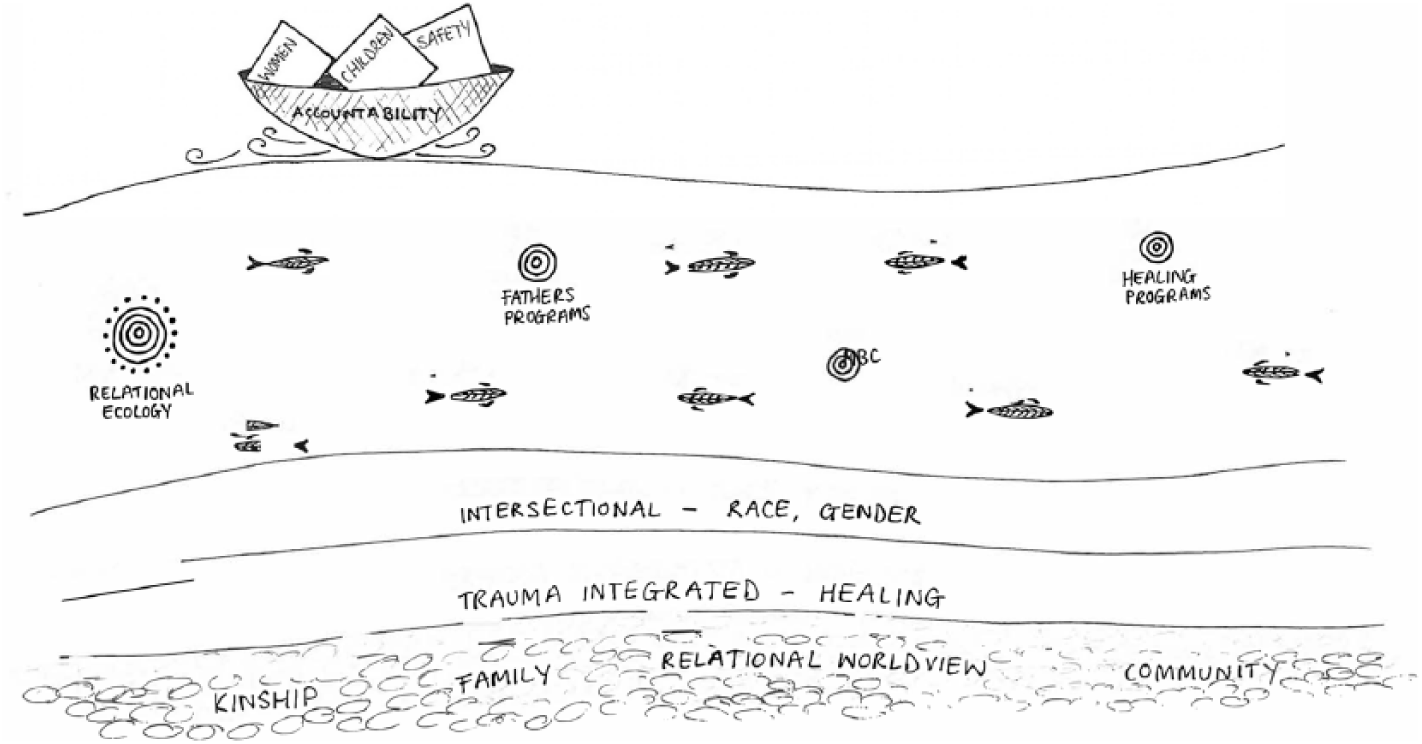
The Yarra Model.
Within the model, the journey of men begins at a set of nested circles, which represent the ecologically framed understandings of men’s stories and experiences – lifespan, generations and layered social contexts. Understanding the risk factors at each level of the relational ecology of someone (individual, relationship, community and society) and how they influence one another is critical in determining family violence prevention strategies (WHO, 2018). Furthermore, the nested circles at the journey’s beginning point to both the experiences of childhood exposure to violence for many Aboriginal men (Tilbury, 2009) and their position of privilege as men in society. The deep river themes of intersectionality and trauma healing, as foundational layers of meaning in work with Aboriginal men who are violent, are engaged at this initial point of the journey and must be present throughout.
While we acknowledge that family violence programmes have their limitations, the ecological framework offers an approach that enables work with Aboriginal men to be multi-layered and non-linear. Such a way of working with men who use violence demands a holistic community and family approach that positions the programme within a broader community strategy that also provides supports for families, women and children. The model’s approach to the safety of women and children uses gendered accountability as the central and primary focus of the programme structure, which provides for both depth and flexibility in addressing measures of success.
As an integrated model, the Yarra Model also allows for healing. Locating the contemporary violence in Aboriginal communities within the ongoing trauma of colonisation, much of which is unresolved, helps to frame the secondary exposure to trauma and the consequential inter-generational trauma experienced by many Aboriginal families (Atkinson, 2013; Brave Heart et al., 2011). The model places trauma healing and intersectionality as two distinct but inseparable layers deep within the river’s current to carry Aboriginal men on their journey. The intersecting systems of Aboriginal men’s oppression, the composition of which will differ from that of Aboriginal women, highlight the need for intersectional identities to be considered in prevention and early intervention strategies (Butler, 2013).
Conclusion
Working to eliminate violence against women and children in Aboriginal communities in Australia is a complex, multi-layered endeavour. Our aim through this research was to consider how Aboriginal men’s family violence (and fathering and healing) programmes address the issues of fathering in the context of family violence. By examining programme structures, we found that most programmes privileged a culturally framed and healing-focused practice framework rather than a gender-based programme theory. This appeared to be supported by much of the literature. The Yarra Model provides a practice framework for Aboriginal men’s programme work derived from Aboriginal facilitators and the literature and validated through the project’s Aboriginal steering committee. Drawing from multiple theories and understandings of family violence in Aboriginal communities, and attempting to consolidate the complexities of group programme work within family violence, the model offers a practice frame with which to privilege women and children’s safety through programme work with Aboriginal men.
Footnotes
Funding
The author(s) received financial support from the Australian Research Council to conduct the research.
