




Abstract
This article examines the tension between the rhetoric of children’s rights and the realities of residential care for children in Taiwan. After reviewing Chinese and English literature, we present an empirical study of children’s experiences of life in residential care, drawing on participant observation, participatory arts-based activities and semi-structured interviews with 50 children in two homes. Breaking new ground, we reveal children’s accounts of happiness and unhappiness with institutional living, their strategies for developing resilience, and their understanding and experiences of children’s rights. We discuss the implications of these findings for social work policy, practice and research.
Keywords
Introduction and background
Despite its geopolitical position being outside the family of the United Nations (UN), Taiwan has adopted the United Nations Convention on the Rights of the Child (UNCRC), informed by Western emphasis on individual rights, in a cultural context deeply influenced by Confucianism in which family harmony and filial piety are valued over individual interests (Lu, 2001). While processes of democratisation and globalisation have influenced thinking about social justice and human rights in Taiwan, the broad cultural heritage endures, and filial piety, while changing in nature, is still strongly evident (Yen et al., 2013).
Alternative care for children in need of protection
Strong family hierarchies and roles have, historically, meant that residential care has been provided only for orphaned children or those whose parents had broken strict social or moral codes (Lin, 2006). But the emergence of ‘new’ social problems – rising rates of divorce, lone parenthood, alcohol and drug addiction and incarceration – has been associated with various forms of child maltreatment (Chen et al., 2016). This has led to the development of a series of child protection policies through a process of ‘policy assemblage’ (McCann and Ward, 2013), borrowing from Western models of child protection, particularly those of the USA (Lin, 2017). These have included the introduction of mandatory reporting of abuse and neglect, a formal notification system, interventions with families whose children are experiencing maltreatment, and preventive services for families where there is a considered risk of child abuse (Peng, 2011). The result has been an increase in notifications of child abuse and neglect (Chen et al., 2016; Lin, 2017) and increasing numbers of children protected under the provisions of the Child and Youth Welfare Act 2003 and the subsequent Protection of Children and Youths Welfare and Rights Act 2012.
These developments have been paralleled by increasing demand for alternative living arrangements when birth families cannot be supported by other means to care safely for their children (Lin, 2017), situations arising typically as a result of poor parenting skills, parental separation, substance addiction or incarceration. With strong cultural value placed on blood relationships, the successful integration of ‘outsiders’ into family systems, either by fostering or adoption, is rare (Yang et al., 2000). In addition, despite the apparent success of large non-governmental organisations, such as the Taiwan Fund for Children and Families, in recruiting foster families, establishing this form of alternative care has faced challenges beyond its use as a short-term measure. A 2005 report by the Child Welfare League Foundation highlighted an increasing problem of foster parents relinquishing the care of their foster children.
The increasing use of residential care, which developed initially after World War II to support orphaned, abandoned and disabled children, can be seen as a symptom of both family breakdown and as a reflection of the challenges encountered in establishing alternative family care as Taiwan has faced the arguably incongruous discourses of individual rights versus long-held traditions underpinned by values of family harmony and filial piety. Concerns about the increasing use of residential care led to a national study of care homes (Wang, 2005), which found physical standards to be largely acceptable but that staff were poorly qualified or trained and paid insufficient attention to relational aspects of care, connections with birth families or long-term care planning. Lack of detailed guidance for care providers presented a challenge in developing practices that reflected and respected both cultural norms and children’s rights. Other research on residential childcare in Taiwan has involved data collection largely from staff (Chang, 2004; He, 2004; Huang, 2002; Wu, 1999; Yu, 2003). Exceptions are Lin (2000) and (Lo, 2003), who interviewed six and two child residents respectively, though their focus was not on the children’s own experiences of residential care.
Children’s rights in context
While stressing the importance of diverse traditions and cultural values informing the harmonious development of children, the UNCRC does not address the ways in which cultural values can constrain thinking about children’s rights. Yet critical analyses of the UNCRC have highlighted ways in which children are easily denied their rights of expression and participation in decision-making about matters that affect their lives (Freeman, 2000), including decisions to live in residential care settings (Franklin, 2004). Further, Van Bueren (1998) has long argued that researchers must develop innovative approaches to encourage children to express themselves. In the Taiwanese context, the tension between family harmony and children’s rights suggests that children are likely to require support to speak out, and to feel safe in doing so (International Federation of Social Workers [IFSW], 2002).
There are still those who argue that the Confucian belief in strict authority and submission to parental will, whether due to trust or fear, contributes to family harmony and happiness (Lu, 2001). But Law and Lee (2014) argue the value of the UNCRC in questioning long-held and easily reproduced power structures. In this way the present study disturbs thinking about children’s rights, in order to inform policy and practice in residential care settings.
Theoretical framework
Drawing on culturally relevant theoretical concepts of happiness and resilience, and the more recently adopted notion of children’s rights, this study sought to explore children’s experiences of life in residential care, their sources of happiness and unhappiness, and their strategies for developing resilience in the face of adversity. It also sought to develop knowledge of children’s own understandings and experiences of their rights in residential care. As Huang (2002) has argued, children’s happiness is associated with the enjoyment of rights, and where children do not enjoy their rights, they require strength to adapt to adverse circumstances. The relationship between these concepts is shown in Figure 1.
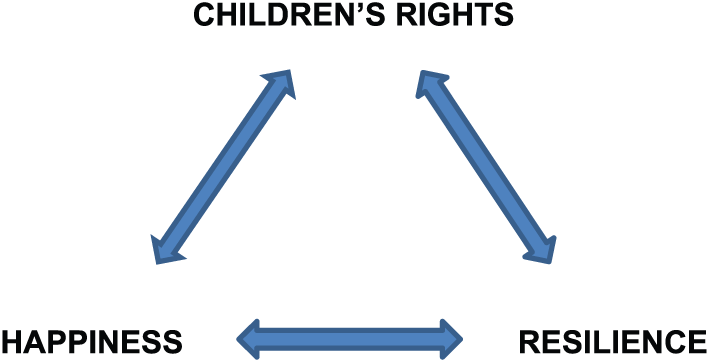
Relationship between children’s rights, happiness and resilience.
While the notion of children’s rights sits uneasily in Confucian cultures, the concept of happiness is ubiquitous in Taiwanese culture. Approximating with subjective well-being and life satisfaction, happiness is intertwined with the notion of harmony (Lu, 2001), emphasising interpersonal satisfaction in contrast to Western emphasis on intrapersonal satisfaction (Lu et al., 2001). As Diener et al. (2003) explain, in East Asian cultures adherence to social norms and perceived acceptance by parents and friends are as important as emotions in contributing to life satisfaction, heightening the value of understanding children’s experiences of residential care from their own perspectives.
Acknowledging cultural variations across the world, Ungar (2008: 225) defines resilience in the face of adversity as ‘the capacity of individuals to navigate their way to health-sustaining resources, including opportunities to experience feelings of well-being, and a condition of the individual’s family, community and culture to provide these health resources and experiences in culturally meaningful ways’. Masten (2001) maintains that childhood resilience is remarkably common, but can be threatened by anything that compromises children’s protective systems. Research in the United Kingdom has identified the importance of education, talents and interests, a secure base, positive values, social competencies and friendships, as being important for resilience development among vulnerable children (Daniel and Wassell, 2002), along with the roles of both children and staff in developing resilience in residential settings (Houston, 2010). Resilience research in Confucian cultures is less well developed and has focused principally on families (Lee, 1998), demonstrating the important role of positive family relationships for developing psychological resilience. Exceptions are Zhang and Jiang’s (2012) study of secondary school pupils in mainland China, indicating the increasing importance of relationships with peers and teachers for dealing with stress during adolescence; and in Taiwan, Huang’s (2002) study of residential care found an association between happiness and enjoyment of rights and a need for resilience where rights were denied. Huang’s findings were, however, generated from adult carers’ perspectives rather than from the children themselves.
Research aims and questions
This study aimed to begin to fill the gap in understanding of children’s own perspectives of life in residential care in Taiwan, their coping mechanisms, and their understandings and experiences of children’s rights – perspectives that cannot be accessed through accounts of adults (Prout, 2002). The empirical study was underpinned by two broad research questions designed to illuminate the theoretical concepts under consideration: (1) What are children’s experiences of life in children’s homes?; (2) What are children’s understandings and perceptions of their own rights in the context of the children’s homes?
Research design and process
An institutional ethnographic approach (Smith, 2005) was adopted as the most appropriate way of addressing the research questions. Institutional ethnography uses everyday experience as a lens to examine social relations and social institutions, beginning with concerns that are situated in the relationships between people and an institutional order (Smith, 2005: 32). It recognises the authority of those informing the researcher and, as Prout (2002: 68) explains, including children as participants has revealed many novel aspects of the situations, settings and issues they are asked about.
The study was carried out in two contrasting care homes in the same city: Home A run by a non-governmental organisation with 29 resident girls and boys, and government-run Home B with 150 resident girls and boys. The choice of the two homes was informed by the possibility that differences in management and scale might influence children’s experiences. While non-governmental homes far outnumber government-run homes, 1 they cater to significantly smaller numbers of children as was the case in this study.
A three-stage process was adopted to address the research questions. A period of participant observation in each home allowed the children to familiarise themselves with the researcher before participating directly in data collection activities, and aided their understanding of their daily routines and activities. This also served to inform the design of appropriate group activities in the second stage, when arts-based group activities were used to explore children’s experiences related to ‘happiness’ and their rights in the homes. The final stage of data collection involved individual semi-structured interviews with children.
Access to the homes was aided by the managers’ interest in demonstrating engagement with children’s rights, by the lead author’s earlier involvement as a student-volunteer in Home A and the support of the manager of Home A in accessing Home B. Cooperation, from managers and children alike, was also encouraged by careful attention to ethical considerations. Without formal systems for ethical approval of research in Taiwan, this study was granted ethical approval by Durham University. This required the demonstration of robust arrangements for institutional permissions, children’s informed consent and voluntary participation, assurances of anonymity and confidentiality, arrangements for the mitigation of possible harm, and the right to withdraw from the research without fear of repercussions, ensuring that children could feel safe in speaking out (IFSW, 2002).
Following the period of participant observation, individual children were recruited to the study by invitation. In Home A, it was possible to explain the purposes and terms of the research to all 29 children in a face-to-face meeting, and all expressed eagerness to participate. In Home B, the large number of resident children prevented this personal approach, and posters were displayed to explain the research and invite participation. The resulting sample was restricted to 21 as the research activities were not permitted to impinge on strict institutional timetables. However, as can be seen in Table 1, samples from both homes included children aged 7–17 years (and one 18-year-old) and sufficient numbers of girls and boys at both homes to avoid any sense of gender bias.
Sample details.
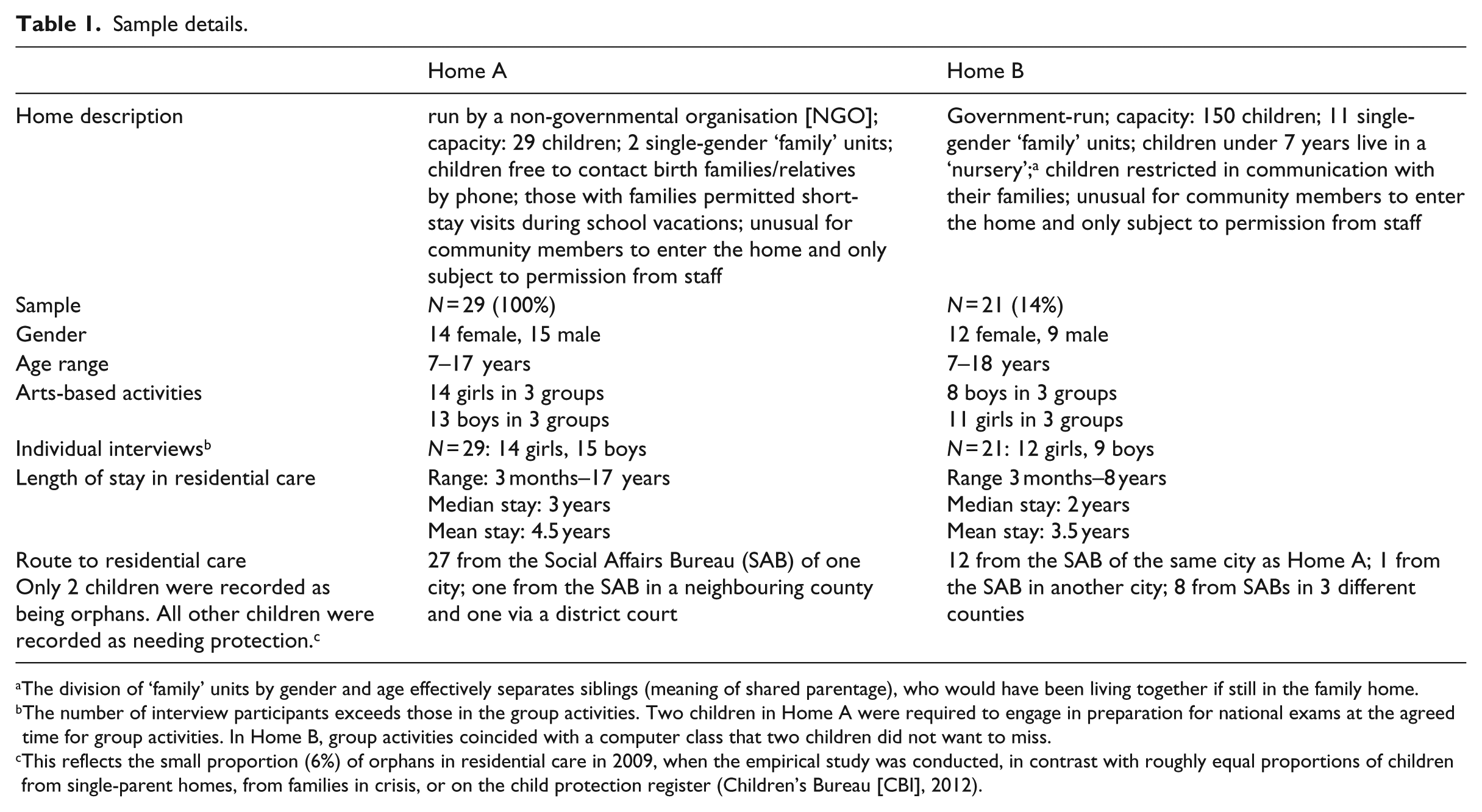
The division of ‘family’ units by gender and age effectively separates siblings (meaning of shared parentage), who would have been living together if still in the family home.
The number of interview participants exceeds those in the group activities. Two children in Home A were required to engage in preparation for national exams at the agreed time for group activities. In Home B, group activities coincided with a computer class that two children did not want to miss.
This reflects the small proportion (6%) of orphans in residential care in 2009, when the empirical study was conducted, in contrast with roughly equal proportions of children from single-parent homes, from families in crisis, or on the child protection register (Children’s Bureau [CBI], 2012).
While the arts-based group activities served to generate data on children’s experiences of happiness and their understanding of their own rights, they also served to build the children’s interest in taking part in individual interviews. This proved very successful, with all group participants keenly expressing their desire to talk about their experiences individually. The semi-structured interviews allowed for deeper exploration of children’s experiences of life in the homes and their perceptions of the reality of children’s rights.
As the focus of this study was on hearing children’s own accounts, it was important to create the conditions in which the children felt confident to trust an adult researcher with their experiences, thoughts and reflections. While some children did refer to life before admission to the home and the circumstances of their admission, care was taken to avoid direct questioning about birth families, their admission to residential care or plans for the future.
Arts-based group activities
These activities were conducted with six groups from each home, as shown in Table 2. The choice to start with arts-based activities was linked to evidence of the use of this form of communication with vulnerable children in re-establishing self-esteem, avoiding the stress that can arise from pressure to communicate verbally (Coholic et al., 2009) and in facilitating the expression of emotion for which children may lack the necessary vocabulary (Pain et al., 2007).
Composition of groups for arts-based activities.
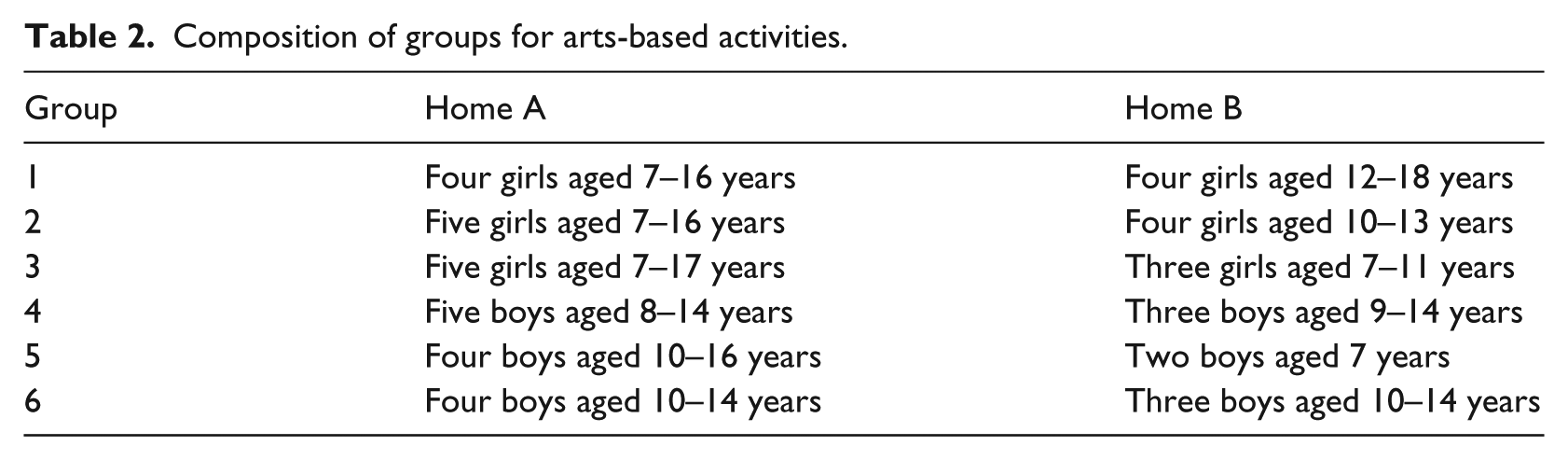
The use of single gender and – with one exception – mixed-age groups reflected the living arrangements in the homes and avoided individual children feeling isolated or exposed when presenting their artwork to the researcher and other groups of the same gender. The foci of the activities, on happiness and children’s rights respectively, were introduced in different ways. Happiness is a common concept in Taiwan, and the introduction to this first set of arts-based activities was facilitated through the use of a well-known song about happiness. The children were invited to think about the issues raised in the song and discuss with each other in groups before using poster-sized paper to draw pictures and/or write words representing their ideas of happiness in the children’s home. Without being asked, they combined representations of happiness with those of unhappiness. Despite encouragement to work as a group, each poster contained individualised contributions.
Introducing the children’s rights activity was more challenging since the concept was new to all the children, despite the display of a poster outlining children’s rights in Home A. To familiarise them sufficiently to be able to participate meaningfully, they were shown and offered a brief explanation of a Taiwanese picture book, What we should all know – Understanding the UN Convention on the Rights of the Child. Again, they were encouraged to think about their own experiences and discuss these in their small groups before moving on to produce visual representations of their ideas and experiences of ‘rights’ in the children’s home. As with the posters of happiness, those relating to children’s rights revealed both positive and negative experiences. Analysis of the posters was aided by presentation to other groups of the same gender, allowing further dialogue and facilitating understanding of the meanings children wished to convey. With the children’s permission, the presentations were audio-recorded.
This process revealed layers of views and experiences linked to happiness, unhappiness and children’s rights. In addition to the children’s own explanations of their drawings, researcher observations of images and words, their size and the use of colour was incorporated into the analysis through reflection on the links between the images produced and the children’s verbal explanations of their meaning. However, care was taken to avoid overinterpretation of images or to make claims that could not be substantiated by the drawings and/or children’s explanations of them. In this way, we have confidence that the data represent the children’s own views and experiences.
Interviews
All children participating in the arts-based activities and the four children who had wished to participate but had been unable to do so were invited to discuss their experiences in an individual interview. They all expressed eagerness to participate, and interviews were arranged according to each child’s availability and took place in counselling rooms in both homes, providing quiet, safe spaces and a choice of seating to allow each child to feel comfortable. Interviews followed reassurances about the voluntary nature of participation, the right to withdraw without any sanction, and anonymity in the use of information shared during the interviews. Permission was sought to audio-record the interviews and agreed to by all but one child, whose interview was recorded through note-taking. To provide a smooth introduction, all those who had participated in the group activities were asked how they had found the experience, before moving on to questions about experiences of life in the homes, what they enjoyed and what they did not, and how they coped with difficult experiences. They were also asked about ways in which they could relate the idea of children’s rights to their experiences of life in the homes. A further element focused on relationships with, and the role of, staff in the homes. Interviews lasted on average about 1 hour and were characterised by a flexible and open-ended approach, allowing the children freedom to tell their personal stories of life in the homes.
Interview data were analysed thematically before being combined with findings from the arts-based activities and contextual information from participant observation notes using NVivo8. This allowed for a holistic analysis consistent with institutional ethnography, focusing attention on connections between the sites and situations of everyday lives and everyday experience as a lens through which to examine social relations and social institutions (Smith, 2005: 32)
Findings
This section presents findings in relation to each of the three theoretical considerations: happiness (and unhappiness), resilience and children’s rights. In presenting the findings, the children’s voices, represented most clearly through the interviews, are deliberately given prominence. This captures the richness of their contributions and offers evidence of the value of research with children as active participants. Without making any claims regarding the representativeness of these findings, based on the contributions of 50 children from two residential homes we believe these contributions form a helpful basis from which further research can be undertaken with children in Taiwan.
Happiness and unhappiness
Principal sources of happiness centred on meeting basic needs, the availability of friendship, companionship and a sense of belonging, as well as access to leisure and learning opportunities. Sources of unhappiness were linked to a sense of confinement and common experiences of bullying linked to hierarchical power relations based on age and status.
Children’s artwork revealed stark gender differences, with girls accentuating representations of happiness with generous use of bright colours and heart symbols referring to love and happiness, while boys included more sources of unhappiness. There was also a contrast between boys in Homes A and B, the latter including swear words, sexual and faecal imagery in drawings, expressions indicating dislike of staff and ridicule of fellow residents, which were later discussed in terms of bullying behaviour. References to meeting basic needs of food, clothing and shelter emerged clearly across the sample. All but one group represented happiness as friendship, love and a sense of belonging, consistent with both Western research on childhood (Holder and Coleman, 2009) and the emphasis placed on the collective in Chinese culture (Ip, 2011). However, girls from Home A in particular experienced a place where they could develop friendships, while boys, especially those in Home B, conveyed images of confinement and a desire to escape to freedom. Both solitary and collective leisure and occupational activities were represented, and one group of boys from Home B expressed happiness explicitly through helping younger children ‘weaker than themselves’.
In individual interviews children conveyed both positive experiences of warmth, security and enjoyment and negative experiences of bullying and the expectation of bending to the will of staff. For example, 13-year-old F34 explained her sense of happiness because I have a place to live in … it’s because the children’s home has a lot of kids living here, and we have a lot of arts and music classes to attend.
M24, a 12-year-old boy, drew comparisons with his experience of foster care: I have a lot of friends to play with in the Children’s Home. While at the foster family, I only had one or two friends. When I had something difficult to deal with, maybe they could not help because we didn’t have enough hands …. Here I have bigger brothers to help me with my studies.
F38, aged 11, also found the residential home more supportive than foster care: I enjoy living here because I didn’t have many people as companions and felt bored …. Here [I have] a lot of good friends and teachers’ guidance.
F40, aged 13, compared group living with living with one’s parents, explaining about children who lived with their parents: They have a lot of friends, but those friends may not come to play with them because they have something else to do …. Here everyone has the same time schedule so we can play together.
While these examples show that residential care can represent a sense of companionship, belonging, safety and access to enjoyable activities, they must be understood in the context of the children’s own family lives. All but two children in this study were subject to formal child protection interventions, suggesting that family life for them was less than happy.
Artistic portrayals of unhappiness were elaborated in individual interviews, with experiences of bullying emerging spontaneously from one in five, particularly younger children, mirroring evidence from UK studies of residential care (Gibbs and Sinclair, 2000) and a survey of school children in Taiwan (Yen, 2010). Children from both homes referred to being bullied, witnessing bullying and engaging in bullying.
F21, aged 7 years, experienced both verbal and physical bullying by boys: They often hit me on my head. They would yell at me and then hit me. They would swear at me. I can become very unhappy.
However, she refused the offer of help to bring this behaviour to the attention of staff, fearing it may make matters worse, a response that was repeated by all children who disclosed bullying. F3, also aged 7 years, and the only child of minority ethnic status in the sample, had experienced racist bullying in the form of name calling: Sometimes they will call me ‘Heihei’.
2
They wrote ‘Heihei, you’re one year older now!’ on my birthday card … I get very upset when I hear them calling me Heihei …. I will run into my room to cry loudly and sometimes I will throw my toys; my own toys!
F30, also aged 7 years, talked of her unhappiness at being bullied by her older siblings: ‘Many people, Da Ge ge, Da Chieh chieh,
3
are mocking me and making fun of me.’ M31, aged 8, spoke of repeated physical bullying: I have not done anything but he used his catapult to shoot at me. I got scalded … because someone splashed hot water on me on purpose. Look at my face: This was scratched by someone this morning.
Asked whether the staff knew about this, he explained ‘Of course the staff know. They helped me to put some lotion on my skin’. But nothing had been done to address the bullying behaviour. This was also the case with M43, aged 7 years, who explained how his experience of physical bullying was ignored by the staff: He often hits me on my back and shoulder …. The two staff members in the unit know about this but don’t do anything.
M15, a 9-year-old boy, had actively brought his older brother’s aggressive behaviour to the attention of the staff. He explained: He will kick me to wake me up … The teacher said nothing but instead asked us to do the house cleaning immediately … It’s painful. It’s really hurting when being kicked. Teachers know about it.
But this had not stopped the behaviour.
F47, aged 11, explained that unless a situation was getting out of control, children being bullied were encouraged to accept the situation by tolerating unfairness for the sake of peace and harmony of the larger group or, in the case of siblings, among the family group. While encouragement of submission to achieve a sense of harmony is, arguably, consistent with the cultural values of Confucianism (Liao, 2001), unaddressed bullying can escalate, with consequences for both victims and bullies, as M16, aged 12, explained: It’s me who would bully others. If the kids from primary school are not behaving well and would not do what I ask them to do, I will beat them … Even teachers beat us with a cane if we do not obey what they say. If we do something wrong, she will use the bigger cane, like this thick. We have to obey the orders.
M50, aged 11, applied similar logic in justifying his bullying behaviour, reinforced by its apparent effectiveness: The boy who locked me up got beaten up by me again last time because he locked someone else’s door. I hit him here and then he got bruised. After that he would not dare to lock the door.
F44, aged 15, both a victim and witness of bullying, explained that reporting to the staff ran the risk of further bullying: ‘It’s really unfair and uncomfortable, and we have to suffer in silence.’ Without confidence in staff responsiveness, bullying had become normalised, as articulated by F48: ‘The older ones bully the younger; the younger bully the much younger ones. Teachers know about it.’
Wider concerns about bullying of children and young persons as a form of maltreatment, based on surveys of large samples of children and young persons (Chen et al., 2016; Feng et al., 2015; Yen, 2010; Yen et al., 2013), suggest that children in residential care may be at particular risk of bullying given their weaker networks of protection. The normalisation of bullying suggested by staff acceptance of the behaviour is of particular concern, and leads us into consideration of the ways in which children develop resilience to cope with adversity.
Resilience
Findings related to resilience were largely derived from the use of probing questions to explore accounts of unhappiness shared during interviews. With bullying featuring as part of the accepted order, and such a clear source of unhappiness for one in five children in this study, accounts of coping mechanisms in the face of adversity required little prompting. With institutional emphasis on achieving harmony, those who experienced bullying coped largely by recourse to their inner resources. Positive coping strategies ranged from engaging in sport, drawing, singing, exercising, playing with friends, turning to help others, or seeking support from friends or staff within the institutional family. Strategies more likely to have negative consequences included swearing and keeping adverse experiences to oneself.
M42, aged 14, played basketball when he felt unhappy, explaining ‘It helps to calm my mind’, while M31, aged 8, said ‘I’ll find something pleasant to do, like drawing, singing or doing some exercise’. F36, aged 11, had learnt that playing with friends offered a sense of belonging, allowing her to move on, while F34, aged 13, drew support from actively helping others in distress. F41, a 12-year-old girl, referred to swearing as an effective and ‘natural’ way of dealing with ‘bad moods’, but also spoke of her (single-gender) family unit in the home in helping each other to face adversity: ‘My “family” will try to make you happy when they see you are sad or upset.’ By contrast, and despite her earlier description of suffering in silence, F44, aged 15, had identified staff as a helpful resource when discussing private matters: It’s all right to talk to friends … It’s just sometimes I don’t want my personal issues to get around in public, so it’s better to talk to staff.
Aware of her own developing resilience, F44 felt strong enough to confront new challenges, a quality recognised by Gilligan (1997) who refers to resilience as that which cushion(s) a vulnerable child from the worst effects of adversity in whatever form it takes and which may help a child or young person to cope, survive and even thrive in the face of great hurt and disadvantage. (p. 12)
Ungar (2005) has argued that children who grow up in children’s homes might, in general, be expected to develop better resilience skills compared to other children of the same age and social group, but Masten (2001) argues that resilience development is easily threatened when children’s protective systems are compromised. For children in this study, their principal protective system, the family, had already been damaged if not dismantled, and not all had developed positive strategies for coping. M32, aged 10, kept negative experiences to himself, fearing loss of control if he externalised them. Referring to bullying by staff he explained, I normally do not share this experience with other people … I’m not sure what will happen when I cannot control myself.
M39, aged 9, also kept difficult personal issues to himself and struggled to work out the best way of dealing with problems: I keep everything to myself. Some girls said that when boys grow up, they might develop depression if they bear with everything. I’m not sure … Sometimes I will talk about my problems with others. I will talk about it with my good friends …. Sometimes teachers help me to deal with my problems …. They will chat with me and make me happy so that I can forget about those unhappy things.
This range of responses to adversity shows connections with Daniel and Wassell’s (2002) six domains of resilience based on research with vulnerable children in the UK. Similarities are evident, particularly in relation to reliance on friends, the use of talents, and interests and social competencies. However, two further domains, the sense of a secure base and the development of positive values, were mentioned only by three children in this study, who shared a lack of any prospect of returning to their birth families. For example, F44, aged 15, spoke of having met good and noble people in the home, who had helped her to develop healthy and constructive relationships with other community members. She had been abandoned by her parents and had come to see the home as a place of safety. F44 was unusual in this respect, and the idea of developing positive values in the homes emerged more broadly as a site of significant tension as the explicit power imbalance between adults and children and older and younger children created resentment, exacerbating specific experiences of adversity.
These findings reveal the use of both positive and negative coping strategies in the face of adversity. The relative poverty of resilience research in relation to children in institutional care in Chinese cultures has led us to draw upon Western research in interpreting the findings. However, Wang et al.’s (2014) comparison of Chinese and Western research on the social ecology of resilience points clearly to the disadvantages of being denied a positive parenting experience in Chinese culture, leading to the greater importance, but lesser likelihood, of developing positive relationships with peers and teachers, who become increasingly important as sources of support in adolescence. They also refer to Zhang’s (2011) findings that children in rural areas with absent parents benefit from communication with their parents and support from their grandparents. This offers a reminder of the institutional policies of the two homes in this study, with only one encouraging telephone contact with family, while both implemented strict policies of limiting access to outsiders. There were no references to children’s rights in accounts of dealing with unhappiness, a reminder of the children’s lack of familiarity with the concept. But it was possible to extend exploration of children’s ideas about rights in individual interviews, which is the subject of the following section.
Children’s rights
Concern with a number of rights articulated in the UNCRC emerged from the children’s artwork and in individual interviews. Principal concerns centred on rights of freedom, the right to express views and be heard and the right to privacy. Questions of equal treatment and non-discrimination also attracted attention, as did two further issues not explicit within the UNCRC: rights in relation to responsibilities and the right to be loved. These are now discussed in turn.
Freedom
Expression of freedom as a right was closely associated with understandings of happiness and focused largely on lack of freedom as a source of unhappiness. Artwork on children’s rights reflected strict regimes including enforced times for getting up, homework, housework, bed time and compulsory attendance at classes even outside the school curriculum. Acknowledging enjoyment of the right to education, there were also expressions of concern about too much formal education and a lack of freedom of choice regarding school attendance or involvement in educational activities arranged within the homes. Desire to spend more time outside the home and greater choice of activities also featured, as did freedom to express and communicate thoughts and feelings. Group B10 referred specifically to ‘freedom of space’ and ‘freedom of speech’, illustrated by two figures having a conversation: ‘Hey let me tell you this’ – ‘Of course!’, explained as the right to be heard.
Freedom was a recurring theme in individual interviews. F20, aged 10, put it simply: I just want freedom. At that time [referring to the group activities], everybody wrote down “Freedom” Rights are … freedom.
The majority of interviews conveyed a sense of lacking freedom. M2, aged 14, resented being denied access to computer games, while F9, aged 10, referred to her lack of freedom in comparison with her previous foster placement: It is more relaxed at a foster family. I had more free time. I would be free once I finished my homework. But [here] I have no free time.
M15, aged 9, who had experienced several different residential care homes, expressed a sense of spatial freedom in Home A:
In here we have a lot of space. We can run around when we’re bored … It’s not like the normal children’s homes which are small.
But he did not feel free to choose extracurricular activities: The staff said no, there is no freedom about this at all … If I said I don’t want to join … they will not listen to me.
F21, aged 7 years, combined an understanding of the rhetoric of rights with everyday reality: I know I have the rights of freedom. However, I have not enjoyed the rights here, because I have to study and am not allowed play around.
By contrast, a minority of children indicated a sense of freedom closely associated with their understanding of ‘rights’. They appreciated that they had time to play and express themselves. For example, 8-year-old M12, for whom freedom and rights were interchangeable, explained: I have the freedom to speak up. For example, I like playing table tennis. I told the residential care staff, and they told me to play at the back yard … I feel I have the freedom to play table tennis.
He also referred to participation in this research as freedom to express his views: ‘… just like we’ve had an activity group and now [interview]’.
In the same vein, M24, aged 12, referred to the freedom offered by participating in this research, which contrasted with his usual experience of feeling controlled: I can tell what’s on my mind and can tell some unhappy things. When I attended the group activity, we could discuss and share experiences together and that was the time I wanted …. At that moment, I had a freedom to express myself. Normally, the staff always control us.
This contribution leads us to consideration of the right to express views and be heard.
Expressing views and being heard
The children demonstrated different stages of knowledge and understanding of the right to express their views and to be heard. For example, 10-year-old M8 explained ‘You have rights to express your own opinions’, while 16-year-old F27 spoke thoughtfully rather than confidently: We can talk about some of our opinions. It’s a good opportunity to express myself. I think it is one of the rights, right?
The children also demonstrated mixed experiences of expressing their views and being heard positively. F34, aged 13, explained ‘I will talk to our residential care staff and they will comfort me’, and F37, aged 10, said ‘When I feel unhappy or sad, I talk to the care staff normally’. F44, aged 15, appreciated that staff would listen to her in confidence when she felt sad and help her in ‘matters of the mind’ that she did not want to share with friends. M50, who had referred earlier to his own bullying behaviour, spoke of the importance of confidentiality in feeling able to express his views. While he felt able to talk to staff, he expressed particular enjoyment of participating in this research with its promise of confidentiality: I can talk to care staff and join some art activities here. I can talk about what bothers me in the interview and no one else will know what we talked about. I like this interview.
The most striking and frequently articulated thought about the right to express views, however, related to the limited willingness or capacity of adults to hear, acknowledge and respect children’s views and emotional concerns. F20, aged 10, put it simply: ‘The care staff cannot understand us and cannot understand our thoughts.’ F1, aged 11, felt strongly that staff neither listened to her nor gave her a chance to respond to questions: The care staff here will continuously ask me all kinds of questions and I feel so vexed …. She repeated one thing from the very beginning to the very end. She is the only one speaking.
M45, aged 14, also talked powerfully about his experience of one-way communication from staff to children and being effectively silenced: Speaking up will only make living in the home worse because we have to be good and quiet … when I talk to the staff, they will say it’s none of my business … it makes me stop wanting to talk about it with them.
M15, a 9-year-old boy, referred to how hurt he felt when staff did not listen to him, and the contrasting positive experience of the arts-based group activities: [W]e draw to express what we feel and will not bury what haunts us in our hearts … I like to attend the group activities. I feel that I can express and release myself in that way.
From these mixed experiences of the right to express views and to be heard, it is clear that the children wished to express themselves and wished to be heard. While they demonstrated various strategies to cope with difficult experiences when adults would not listen to them, approaching the question of being heard from a children’s rights perspective opened a new window through which the children expressed themselves without hesitation, including matters of privacy, which is the focus of the following section.
Privacy
Lack of privacy featured frequently both in children’s artwork, which depicted intrusion into private spaces and pictures of toys and gadgets that had been confiscated, and in the interviews with half the children from each home. Examples included interference with private thoughts by banning mobile phones and limiting use of the telephone in the office, where conversations could be overheard by staff, monitoring of letters, reading notebooks stored in supposedly private spaces and confiscation of personal belongings. Privacy is associated with autonomy and control over personal boundaries (Dowty, 2008), something the children felt they were being denied as a means of control, discipline and punishment by staff. F3, aged 7 years, said, I do not have a right of privacy in here. Privacy means I can keep my own possessions from peeping by other people.
According to 8-year-old F5, I found many people read through my letters without my consent. The care staff also check my stuff sometimes, as if they are performing a daily routine.
F47, aged 11, felt particularly strongly about children’s lack of control over private spaces, despite undertakings to the contrary: The residential care staff told us that they would not mess with our belongings. However, sometimes, the care staff still go through our stuff.
An unusual, though poignant, understanding of privacy came from M42, aged 14, who also associated privacy with bodily integrity, referring to being hit: ‘No touching my stuff, no touching my body’.
The overall experience of the children in these two homes suggests that enjoyment of the right to privacy remains a continuing challenge, a concern shared by some children in relation to the notion of the right to equal treatment and non-discrimination.
Equal treatment and non-discrimination
Unequal treatment was raised in children’s artwork by a group of boys aged from 10 to 16 years, who felt the allocation of greater responsibilities to older boys, reflecting gender- and age-related hierarchies, to be unfair. This mirrors the patriarchal nature of Taiwanese society and the importance placed on age hierarchies, with specific responsibilities placed on older children and siblings with corresponding respect expected from younger children and siblings. Recognising unequal treatment in these ways is to recognise the inequality that is deeply woven into the social fabric of Taiwanese culture, and disturbing such tradition may easily be perceived as threatening by adult staff members, who are often ill-equipped to support children with the problems they are experiencing.
A different perspective, expressed by several groups, referred to unequal treatment in terms of unfair punishments, allocating blame inaccurately, for no justifiable reason, or punishing a whole group in response to individual infringements: ‘One does anything wrong, everyone gets punished for it.’ The children were acutely aware of the negative nature of institutional schemes, such as a points system to enforce discipline, focusing only on punishment for wrongdoing with no equivalent reward system for good behaviour. In addition, of particular concern was the denial of family visits as a punishment, which bears resemblance to punishment regimes in prisons.
This particular aspect of children’s rights was felt keenly by the children, and might serve as a basis for wider discussion given the cultural implications of moving towards a more equal, less discriminatory society.
Rights, responsibilities and love
Returning now to the issues that received less prominent, but recognisable, attention in group activities and interviews, the relationship between rights and responsibilities was expressed most openly by adolescents. While arguing that being able to exercise rights was linked to happiness, they also felt a sense of responsibility to promote institutional harmony. F48, aged 18, had learnt that freedom came from complying with the will of the care staff: ‘… it’s relative. If you do what the residential care staff ask, you have the relevant rights’. Similarly, F34, aged 13, had realised that freedom was coupled with responsibilities: I do what I want to do. But not everyone can do what he/she wants to do. If I want to play, I cannot play unless I have finished what I should do first. Normally I finish what I should do first.
F44, aged 15, explained in a little more detail: We have the freedom to do things we like as long as we do not break the family rules … After all we have a collective life here, unlike the normal family, so to avoid some frictions we have to set up these family rules.
In contrast, M19, aged 16, expressed frustration at not being allowed to develop his own sense of responsibility to achieve institutional goals. Referring to the strict enforcement of study time with the goal of high achievement in school, he said, I think it is right to study efficiently … but the care staff force us to study. They will ask you to study and study and study; everywhere. I arrange my own time efficiently. It is helpful to let me arrange my own time.
As Huang (2002), has argued, this reflects the tension between maintaining a system of discipline and routine that suits the staff and meeting children’s individual desires to do things on their own at their own pace. Negotiating the relationship between rights and responsibilities is widely recognised as an important aspect of children’s learning and growing (Mayall, 2002), as illustrated by the above quotes from girls, F48, F34 and F44, who had learnt the art of compromise.
Love, strongly represented in relation to the achievement of happiness, also emerged as a ‘minority’ theme in relation to children’s rights. A group of girls aged between 7 and 17 years depicted love as the need to feel cared for and a warm environment in which to grow, something Huang (2002) noted was lacking in her study of Taiwanese children’s homes. The UNCRC makes no explicit reference to the right to be loved, though this question has entered the world of philosophical debate with Liao (2006) arguing that a child’s right to be loved should be viewed as a human right based on evidence of the outcomes of lack of love, including failure to thrive, or even survive, despite meeting basic needs such as food and shelter. Counter arguments from Cowden (2011), based on the impossibility of commanding love, have invited further response from Liao (2012), who presents evidence of the importance of love in developing trust in others and the self and motivation to develop, implying that love is important for the development of resilience in the face of adversity. Only one child in this study, who had been abandoned by her parents, referred to feeling loved in the setting of her home, while some took the opportunity of being heard in the course of this research to articulate that love is what they would like, with one group expressing an aspiration to being loved as a right that should be expected.
Concluding discussion
The aim of this study was to begin to fill the gap in understanding children’s own perspectives of life in residential care in Taiwan, illuminating sources of happiness and unhappiness, coping mechanisms in the face of adversity, and understandings and experiences of children’s rights. With understanding of institutional arrangements and routines informed by participant observation, the use of arts-based group activities followed by individual interviews proved effective in tapping into the evident desire of child participants to share their experiences and to be heard.
The overall picture of children’s experiences of life in residential care demonstrates children’s acknowledgement of the homes meeting their basic survival needs, the availability of friendship, companionship and a sense of belonging, and access to learning and leisure activities. But concerns were raised about a sense of confinement with strict limitations on freedom, particularly by boys, bullying linked to culturally accepted hierarchies of age and status, not being listened to, lack of privacy, and unfair or unequal treatment. The children’s experiences of their rights demonstrated acknowledgement of the rights to education and to survival through meeting basic needs, but they raised questions about their rights to freedom to express themselves and to be heard, to privacy, and to equal treatment and non-discrimination. There were also expressions of interest in the relationship between rights and responsibilities and in the possibility of the right to be loved, issues that do not fall within the central ambit of the UNCRC.
Reflecting children’s rights to express their views and to be heard, the use of arts-based methods allowing for collective thinking, followed by interviews to tap into individual experiences, has generated new knowledge and understanding of children’s experiences of residential care in Taiwan. There were remarkable resemblances between experiences in the two homes, despite differences in scale, management and regime. This constitutes a significant step in understanding the limitations of residential care in responding effectively to emerging social problems that threaten to weaken family structures and family harmony in Taiwan.
The tension referred to in the title of this article reflects the possibilities and the challenges that Western-dominated thinking about children’s rights brings to the plight of children who cannot be cared for by their own families in Taiwan. It could be argued that privileging children’s accounts has privileged Western ideals of children’s rights. But the UNCRC offers a framework for the critical analysis of power structures inherent in systems of cultural beliefs and values (Law and Lee, 2014). And its use in this study respects the global definition of social work that emphasises the use of theories and indigenous knowledge to engage people and structures to address life challenges and enhance well-being (IFSW, 2014).
In the context of rapid social change, some have argued the durability of cultural values in Confucian societies (Yen et al., 2013) and the sense of moral crisis associated with deviation from long-accepted hierarchies (Yang and Tamney, 2011). But others claim such arguments reflect the politicisation of Confucianism that has masked its wider philosophy of humanism (Tu, 1998). Chan (2002: 304) has argued that the development of autonomy in children ‘need not be seen as forsaking Confucian ethics, but rather as an internal revision in response to new social circumstances’.
This research has demonstrated children’s enthusiasm to participate in decision-making about matters that affect their lives, suggesting that children could play a pivotal role in assisting adults to understand that children’s rights, rather than constituting a threat to long-held values, can be used to nurture the development of dialogue and mutual respect between adults and children. In this way, social work’s mission of empowerment could be understood as being driven from within rather than imposed externally (Reynaert et al., 2009)
We end by outlining the implications of this study for policy, practice and research. We argue that policymakers must address the cultural ambiguities that have surfaced in the context of globalisation and threats to family cohesion, identifying aspects of Confucian philosophy that recognise the value of respect for children and ways of honouring these. This would permit a reconsideration of children’s rights as having a positive role to play in the development of Taiwanese society rather than being seen as a threat to traditional values. A principal challenge for practice lies in supporting care staff to understand the concept of resilience and to understand the value of listening to and partaking in dialogue with children (Houston, 2010). This would provide a strong foundation for developing a respectful balance between children’s privacy and their protection, thereby addressing children’s deep sense of hurt and injustice, while nurturing the development of resilience and creating an environment in which children are more likely to feel valued and ‘loved’.
The study has also highlighted the need for further research to understand the working conditions, views and experiences of residential care staff. And given the tacit acceptance and normalisation of bullying, it seems vital that the role of residential care staff is more fully explored in order to identify recruitment practices and training needs. Further areas for research include long-term outcomes of residential care and the roles of social workers in identifying placements for, and supporting, children separated from their birth families. More nuanced insights are also needed to understand the experiences of family separation and residential care for children with diverse needs-related characteristics, including but not limited to those based on age, gender, ethnicity and disability.
Footnotes
Funding
The author(s) received no financial support for the research, authorship and/or publication of this article.