



Abstract
Illustrating the adaptation of new and creative methods in international social work education, this article will present a working model for the use of photovoice methodology as part of a daily training seminar during an international field placement for Israeli students. The article will present a protocol for the use of a photovoice-based work model, with 3 applied examples from seminars held during 3 weeks of field placement in India and Ethiopia. We will discuss the educational and pedagogic contribution of photovoice as critical reflective tool within the context of international social work education.
Keywords
Introduction
International social work (ISW) has become an accepted field of training and specialization in many academic institutions. Training in this field is implemented in various forms and through diverse models (e.g. Dominelli, 2014; Lager et al., 2010). In the education setting, ISW places emphasis on the increasingly globalized manifestations of social work practice. Drawing from the international context, the ultimate objective is the development of social work practitioners able to reflect on phenomena originating in the global world, with an understanding of the global processes that influence policy and practice beyond the local level (Lyons, 2006). This process manifests in a variety of ways. One is the internationalization of course syllabuses, to include topics such as globalization, human rights and cultural competence. Another is the creation of specific programmes incorporating short or long training visits abroad, away from the social work trainee’s primary training environment (Lager et al., 2010).
It is generally recognized that ISW gives social work students the opportunity to broaden their knowledge and professional experience, through intercultural encounters in a foreign country (Healy, 2008), and that ISW practice is defined by the values and goals of promoting equality and social justice globally (Cleak et al., 2014).
The current discourse on ISW addresses the processes of learning and transformation it presents to social work students (Cleak et al., 2014), as well as the teaching, training and accompanying methods expected to create a basis for defining the learning experience (Pawar, 2017).
Over the years, there have been several initiatives to integrate photovoice into social work education (Mulder and Dull, 2014). These initiatives were predicated on recognition of the relevance of this approach to issues of social justice and equality, and the role that it can play in the development of critical awareness among both social work students and social work clients (Peabody, 2013).
This article describes the implementation of the photovoice methodology in a training seminar for Israeli students participating in an ISW programme. The daily seminar was delivered to 2 separate groups of students over the course of a 3-week field placement abroad, 1 group in India and the other in Ethiopia. Specifically, we will present in detail our work model for integrating photovoice implementation into the seminar, demonstrating the benefits of using photovoice as a tool to reflect on the students’ learning during their field placement abroad.
Literature review
The literature review is presented in two parts. In the first part, the focus is on training in ISW. This section includes a review of studies on the various processes and training structures that ISW students engage with during their stay abroad, and on the role of the seminar that accompanies their training process. The second part of the literature review presents a brief introduction to the photovoice methodology, together with an assessment of its implementation and pedagogical contribution.
ISW training
ISW focuses on the development of knowledge, solutions and services, in response to social phenomena and problems originating around the world (Dominelli, 2014); it seeks to improve the welfare of populations deprived of their rights and living in distress, ensuring the continued relevance of local and indigenous practices while considering global trends (Healy and Link, 2012).
ISW training has taken on increased significance in recent years, in part due to the increasing influence of global processes that serve to marginalize specific groups and communities across various countries and societies (Cleak and Wilson, 2004; Lager et al., 2010; Panos et al., 2004). Consequently, international field placement (IFP) has in recent years become popular, in line with the acknowledgement of ISW as an area of social work practice which reflects and influences the identity design processes of social work students (Fox, 2017a).
Studies have shown that the training of students in ISW enables unique learning opportunities and experiences (Ranz, 2017). These studies show that social work encounters in a foreign country enable students to re-examine their attitudes, perceptions and beliefs, an experience mediated at least in part by the intercultural encounter. Taking place within a learning situation characterized by distance from home, exposure to new cultures and languages, and the overarching global processes of colonialism, the ISW training context prompts questions and ethical dilemmas (Razack, 2009). Thus, alongside the emotional experience of cultural shock, uncertainty and anxiety, there is also potential for the development of new knowledge and new perceptions (Barlow, 2007; Lough, 2009), within a professional framework supervised by an accompanying lecturer, who serves as a professional instructor and supervisor.
The literature on ISW suggests that the principal objectives of the IFP training and learning models are to promote students’ self-reported research and learning processes, to facilitate engagement in reflective groups, and to share and process the information and experiences that students accumulate during the field placement (Das and Anand, 2014). These processes are buttressed through joint seminars for students from the country of origin and the target countries, with the participation of lecturers and professionals from the social work field (Ranz, 2017).
Photovoice in social work education
The photovoice methodology was developed by Wang and Burris (1997) as a means of giving marginalized communities a platform to express their lived experience of marginality, exclusion and oppression in a group process, using the combination of image and text (Wang, 1999). Over the years, photovoice has gradually been introduced to social work practice and research. One example of recent research looked at the role played by photovoice methodology in the aftermath of a major disaster, among women affected by natural disaster in Japan (Yoshihama and Yunomae, 2018). In another example, photovoice was utilized in a group intervention programme for children of addicted parents. It was found that the use of the approach enabled participants to bridge developmental barriers in their internal world and the social-phenomenological reality of addiction (Malka et al., 2018).
Alongside this trend, there are a few examples in contemporary literature demonstrating the implementation of photovoice methodology in social work education. One example is of the deployment of photovoice as a pedagogical tool for promoting the involvement of students in social justice. Based on a 10-week course for students in a Master’s of Social Work and Health programme, Peabody (2013) found that photovoice helped to sharpen students’ critical awareness; it supported their understanding of principles of dialogue, critical awareness and empowerment, and emphasized the importance of the role of social justice. Lynch and Bengtsson (2018), who applied this methodology as part of a seminar for social work students in Sweden (Gothenburg), reported that as a critical reflective tool, photovoice helped students and lecturers promote critical dialogue, creating space for dialogue on critical topics and playing a role in the way students evolved into social workers.
Another article reported how the introduction of photovoice to first-year students on an MSW degree in the United States (Grand Valley State University) led to several positive outcomes. These included the development of students’ self-awareness; self-exploration of personal lived history, and the connection between this and the development of their perceptions and values; the enrichment and expansion of their learning styles, facilitating classroom dialogue; and re-socializing the students for the profession of social work (Mulder and Dull, 2014). The use of photovoice as a reflective tool for developing self-awareness is also reflected in another example. A photo-based assignment for first-year social work students in South Africa (Western Cape University) enabled the students to refocus on the challenges and opportunities they faced within the academic-university space, and created an opportunity for the lecturer and students to be exposed to new narratives underlying the students’ experiences (Safodien, 2018).
These examples demonstrate photovoice’s utility as an accessible tool for social work education purposes. Technological developments, including the widespread availability of mobile phones and other digital means of communication, have enabled photography to become a convenient tool for the implementation of photovoice, not only in practice and research (Catalani and Minkler, 2010; Caton, 2015) but also in teaching and in social work education. Moreover, assessments of the use of photovoice methodology in social work education suggest its suitability as an educational tool in ISW education as well. For example, it has been demonstrated that photovoice facilitates the development of critical awareness and critical reflexivity, and supports experiential learning (Pawar, 2017).
Against this background, our goal is to present a working model detailing the use of photovoice in an ISW programme at Sapir College (Israel), over a 3-week IFP in India and Ethiopia. As part of our role as facilitators of the daily training seminar, we have developed this model over the past 3 years. Our objective was to integrate the students’ training process with a new and critical reflective tool, capable of strengthening the pedagogic connection between academic learning and the students’ lived experiences.
Research method and ethical considerations
The principal focus of this article is a description of the implementation of the photovoice working model, in the context of a training seminar abroad. The following materials and examples are drawn from a wider research project assessing the photovoice research methodology (Wang and Burris, 1997) and its implementation in social work education, in the context of ISW.
Four IFPs with students from the ISW programme took place between 2016 and 2018: two groups in 2016–2017 and the other two in 2017–2018. A total of 19 students participated in the programme over the course of the 2 years, each seminar group consisting of between 4 and 6 students.
The study was approved by the Ethics Committee of the School of Social Work at Sapir College, and several necessary ethical procedures were taken: (1) the students received information about the research and its objectives; (2) each student signed an informed consent form, and waived their intellectual rights to the material prepared; (3) each student was given the opportunity to withdraw from this agreement at various stages during the research, and again 3 months after completion of the material collection stage of the study.
Context of the ISW programme
General background of the programme
The ISW training programme at Sapir College in Israel has operated since 2007. It was developed as a response to the need to train students to cope with phenomena created by globalization, such as the migration of new populations to Israel (migrant workers, refugees and asylum seekers) and the subsequent emergence of a new and complex social reality. The programme includes theoretical courses and field training, usually within services dealing with international issues. As part of their international training, students spend 3 weeks abroad (in India and Ethiopia) in order that they be exposed to a range of social realities, and to various and unique initiatives and services. The IFP also creates an opportunity to exchange knowledge and ideas between social work practitioners from Israel and the social work practice in the country which they are visiting. Students in the third year of their undergraduate social work degree (BSW) take part in the programme. It includes theoretical and practical courses, a preparatory workshop for field training abroad, and a daily training seminar while abroad under the guidance of the two authors of the present article.
The training programme in India and Ethiopia
In both countries, the training framework consists of 4 days of field training in a local organization each week, joint seminars with local social work students, a professional tour of welfare agencies and social organizations, and 2 or 3 days for a study tour aimed at informal exposure to the local environment, the host society and the ‘other’ culture.
The fieldwork within the selected organizations consists of several stages: (1) orientation with the organization’s activity, during which the students will stay and meet with the social workers and representatives of the organization, the latter serving as the gatekeeper or guide to the local experience; (2) initial entry into the field and developing familiarity with the target population; (3) identification of needs; (4) focused intervention adapted to short-term engagement, according to the needs identified and tailored to the target countries; and (5) termination.
The daily seminar during the IFP
For the duration of the IFP, the students are accompanied by a lecturer, a faculty member. Among other functions, the lecturer facilitates a daily training seminar. In total, 18 meetings take place, lasting between 2 and 3 hours, at a fixed place and time in the evening.
The photovoice working model
The working model for the implementation of photovoice operates in two main parts: orientation phase and implementation phase (Figure 1).
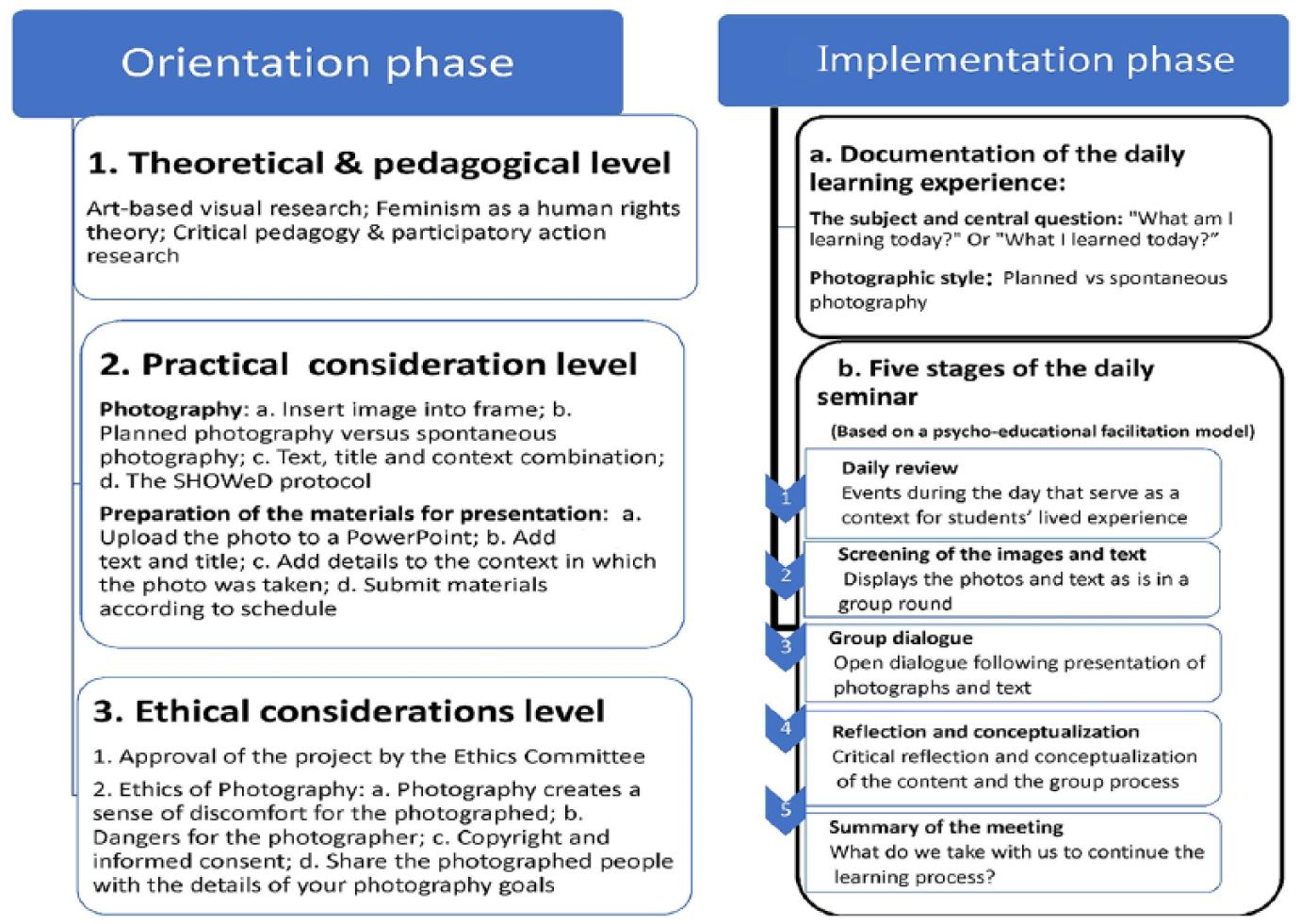
The photovoice working model.
Orientation phase
Several steps were taken to prepare the students for the use of the photovoice methodology. These were based on a working model for the implementation of the photovoice project (e.g. Palibroda et al., 2009). These activities, which took place in a preparatory workshop, included several levels of action: the theoretical-pedagogical level, the practical-technological level and the ethical level.
Theoretical and pedagogical considerations
An orientation lecture explaining the conceptual basis of photovoice was presented to the students. Regarding the art-based visual research component of photovoice, photography was presented as a critical reflective tool, with the potential to convey diverse, contradictory, symbolic and concrete ideas together (Pink, 2013). In addition, a general discussion explored the system of interpretations and meanings associated with photography through the text, and how this action creates the potential for dialogue and the distribution of ideas – both within the immediate group, and within communities of knowledge and communities of practice.
During this lecture, students were introduced to the ideas of critical research and feminist research. Specific reference was made to the paradigm of participatory action research (PAR) (Fine, 2009), and how photovoice is applied within this paradigm: to give voice to populations in exclusion; to document their knowledge and lived experience; and to derive images and text from critical issues of everyday life, with the objective of translating group work into action for change (Wang, 1999). In the pedagogical dimension, students were introduced to the connection between photovoice and critical pedagogy. Based on Paulo Freire’s approach (Peabody, 2013), we explored with the students how photovoice can help us, as citizens, to ask questions about social reality, to develop critical consciousness, to pose problems, and to identify topics for future action with the objective of bringing about social change (Freire, 2000). In addition, photovoice was presented to the students as a critical reflective alternative for documenting and developing learning processes in an ISW programme, based on experiential learning (Mezirow, 2011) and on the learning cycle (Kolb and Kolb, 2005).
Practical-technological consideration
The first author, who has applied experience in the photovoice methodology, presented the tool to the students. First, a brief background was presented, describing the evolution of photography up to the development of technology enabling documentation via smartphones. Next, several principles of planned photography were presented: (1) the determining the focus of a photograph through its insertion into the frame; (2) the difference between planned and spontaneous photography; (3) the principles of combining image and text; and (4) the principles for adapting some of the questions that emerge through the SHOWeD protocol (Wang, 1999) to the context of ISW training:
What do we See Here?
What is Really Happening?
How does this relate to Our life as part of the global world, and primarily as social workers of the future? How is this related to ISW?
What are the processes that explain this situation – at the local, intercultural and global levels?
What can we Do about it – Today, and as social workers of the future?
The protocol was adopted as a tool for organizing the conversation during the presentation of the images, to allow a degree of flexibility. In addition, students were instructed on how to prepare their materials for each session, as follows: (1) prepare a PowerPoint slide of the picture taken; (2) attach an explanatory text and title to the image; (3) specify, below the picture, when and where it was taken; and (4) send the materials to the lecturer by the scheduled date and time. The students were told that they would be expected to send the picture an hour or two before the start of the daily seminar, to ensure that the pictures could be properly prepared during the group meeting.
Ethical considerations
In accordance with the protocol of the photovoice project, the students participated in a presentation and discussion on ethics and photography (Wang, 1999). Among other things, the students and lecturers discussed the challenges inherent in photography (Palibroda et al., 2009). Issues considered included (1) how photography may cause discomfort to the person photographed; (2) potential dangers surrounding the safety and security of the photographer; (3) copyright and permission to photograph; and (4) discussing with the subjects of the photographs the purpose of the photography, and how the act of photography connects to the goals of the project.
Implementation phase
The implementation of the photovoice working model was divided into two parts:
1. Documentation of the daily learning experience: students were required to perform a day-to-day photographic assignment, on the topic ‘What am I learning today?’, or ‘What I learned today’ in accordance with the principle of reflection on action (Schön, 1987). The students had two options for fulfilling this assignment: a planned or staged photograph or spontaneous photography. With the planned photography, the students planned the content of the photograph in advance. But with the spontaneous photography option, the students chose a single photograph, from a variety taken during the day, as reflecting their daily learning experience. In addition, emphasis was placed on the importance of preparing the materials before the daily seminar meeting. Placement in a foreign country presents, as a matter of course, unanticipated barriers and technological challenges; early anticipation of these barriers (e.g. the ‘falling’ of the Internet) was required (Fox, 2017). For example, the expectation was that the students would upload the photograph file to their laptops and transfer it to the lecturer using a portable memory device.
In fact, the technical preparations for the seminar meeting enabled the effective management of the meeting, and it facilitated full participation of group members in learning processes during the seminar. The preparations also allowed the seminar lecturer to design a joint presentation, incorporating all the pictures taken during the day along with the accompanying text. In cases where there was no projector available, the presentation could be displayed directly on the laptop. It was obvious that the screening of the presentation during the meeting generated the tension and excitement appropriate for such a group activity.
2. Photovoice work model implementation in the daily seminar session: the daily seminar was based on psycho-educational group work (Furr, 2000), in which group dynamics and the composition of the group are translated into the primary task of developing the students’ professional identity. Because a psychodynamic group guidance model is less appropriate for group work based on photovoice methodology, group facilitation was conducted through a semi-structured model adapted to photovoice methodology. This operated in the form of a structured group facilitation guide operating throughout the meeting, conducted in the following order: Stage 1 – Daily review: each session starts with a detailed review of the day’s events. This stage places the group in the context of the events that would form part of the lived experience of the students. The description of events maps the more objective aspects of daily learning, including places visited by the students, unique events, meetings with the local staff, and gaps between planning and implementation, including decisions about programme changes. In this way, daily life in a foreign country is contextualized. Stage 2 – Screening of the images and text: each student presents their photovoice to the group. For the most part, the instruction is to read the text ‘as is’, questions deferred until all the students in the group had been given the opportunity to present their photovoice. In addition, the facilitator may ask participants to keep in mind, or note to themselves, the ideas, meanings and images that arise from watching the presented materials of their colleagues. Stage 3 – Group dialogue: at this stage, personal and group work regarding the photovoice takes place. In some cases, the group process is based on a photovoice of one or more of the participants, which ‘touched on’ or covered issues identified by the others in their photographs; and in some cases, the group focuses on ideas or common themes arising from the materials presented. The content and materials arising from the photovoice may prompt discussion about the encounter with social work students from the host country, or issues related to social phenomena and complex situations that students meet with, such as poverty, illness, natural disasters and trauma. With each of these possibilities, the content that arises is used to investigate and deepen the learning process. It is important to note that there is no permanent scenario of development at this stage; the facilitator asks the members of the group clarification and focus questions, to stimulate discussion about the materials and their connection to the primary task of the group – the learning experience and the development of professional identity. Stage 4 – Reflection and conceptualization: this stage is directed towards extracting the insights that can link the lived experience of the students, as reflected in the photovoice, with different forms of knowledge acquired in other courses and other fields. It is important to note that in this point in the implementation process, the lecturer should be oriented towards critical thinking, and to encouraging the integration of different types of perspectives in social work alongside accepted models such as ecosystem approaches, micro-macro integration, cultural competence, etc. Stage 5 – Summary of the meeting: this stage is anchored by the question: What do I take with me? This stage is also used to identify immediate lessons to be taken into the next training day, and towards the continued enrichment of the experience abroad.
Examples
Example # 1: Symbolic representation of power relations Title: Experience of voicelessness Voice: Today I had a complex experience, because I could not speak (I had the flu). I felt that I had no voice. On the one hand, it was convenient for me, not to be expected to speak and say my opinions; but on the other hand, a large part of my presence and who I am disappeared. I understood that an important part of the presence and essence, in the encounter as it was today, is built on the voices we bring, and this made me think of wider contexts . . . about people who are members and communities whose voices are not necessarily heard … According to the SHOWeD protocol, N. explained: See: The picture (Figure 2) shows the neck of a white woman. Happening: The focus on the neck is designed to describe a situation of voicelessness; the woman (I) was voiceless during a professional session, ostensibly because she was sick. Our: The experience of lack of voice, and the accompanying feeling of helplessness, is part of an experience that we feel here in India, as foreigners, due to our language shortcomings and lack of familiarity with local culture. Therefore, we can learn, from our physical, cultural and emotional experiences, about what groups and communities in the global world experience as part of power relations, based on gender, race, nationality and other social identities.

The photograph was taken by ‘N’ during a professional meeting at Matru Sewa Sangh Institute of Social Work (MSSISW), Nagpur, India, 12 February 2017.
In this case, the last two questions (Why and Do) were translated into a group discussion about voiceless communities around the world and how our role as social workers, translated into micro and macro interventions in these communities, is mobilized to help make their voice heard. During the discussion that developed in the seminar, one of the students related the topic to her practical training in Israel, in which she helps African women without legal status in Israel to apply for asylum. In this case, the discussion dealt with the conceptualization of intersectionality: the fact they are also women (gender identity), also African (ethnic-racial identity) and lacking status in Israel (national identity) are expressions of marginalization, oppression and power relations operating across cultures, societies and different identities.
In addition, we discussed the significance of neutrality (declining to take a stand) against the phenomena of power, and the importance of taking an opposing position. Against this background, following the seminar sessions, the students continued to investigate the subject, and to be alert to the general status of women in India.
This example illustrates how the student creatively used her own self, as well as her physical state of illness – which had deprived her of her voice in a learning situation, to create a symbolic representation of voicelessness. Through this symbolic representation, she linked her personal-physical experience to the phenomenon of the lack of voice experienced by communities and groups against the background of power relations globally. Like the process of reflection on action described by Schön (1987), the use of photovoice in this case created the opportunity for a process of critical reflection on a personal-physical experience, within the context of a learning situation.
Example # 2: From psychological discourse to discourse on social identities Title: That’s what I want to be in my country, powerful H. immigrated to Israel from Ethiopia when she was 5 years old; many years later, she returned to her homeland as a student in the ISW Program. Voice: I admire some of the women I met here in Ethiopia, because it is so difficult to be a woman in Ethiopia, in a patriarchal society, but they do not give up, and some of them attain important positions. I think that the fact that they are black women of Ethiopian origin helps me to define myself in the category of strong women. It makes me realize how much I feel in a state of constant war in Israel. I am at war over my color, my femininity, my community, my rights. Suddenly, in Ethiopia, I felt relief, as though rocks [a heavy burden] had fallen from my back. I walk down the street and the majority looks like me. The singer is my color, the person who sells shoes is my color, the prime minister is my color, and this woman from television, she also looks like me. For the first time, I feel that I’m like everyone else, that I’m no different. And that woman on TV, she looks like me too. At last I felt that I was like everyone else. H. explained: See: The picture (Figure 3) is of a poster, part of a marketing campaign supporting the empowerment of women in Ethiopia. The photograph was taken during a tour of the city. Happening: As a process of identification, the picture tells, in a sense, part of my story and of my community, as a Jewish woman whose family emigrated from Ethiopia to Israel, and my experience of diversity, of being ‘the other’. Our: We too, as social workers, draw from experiences of diversity and exclusion within different contexts. It is important to learn from this, and to be aware of the integration between social diversity, exclusion and power relations.
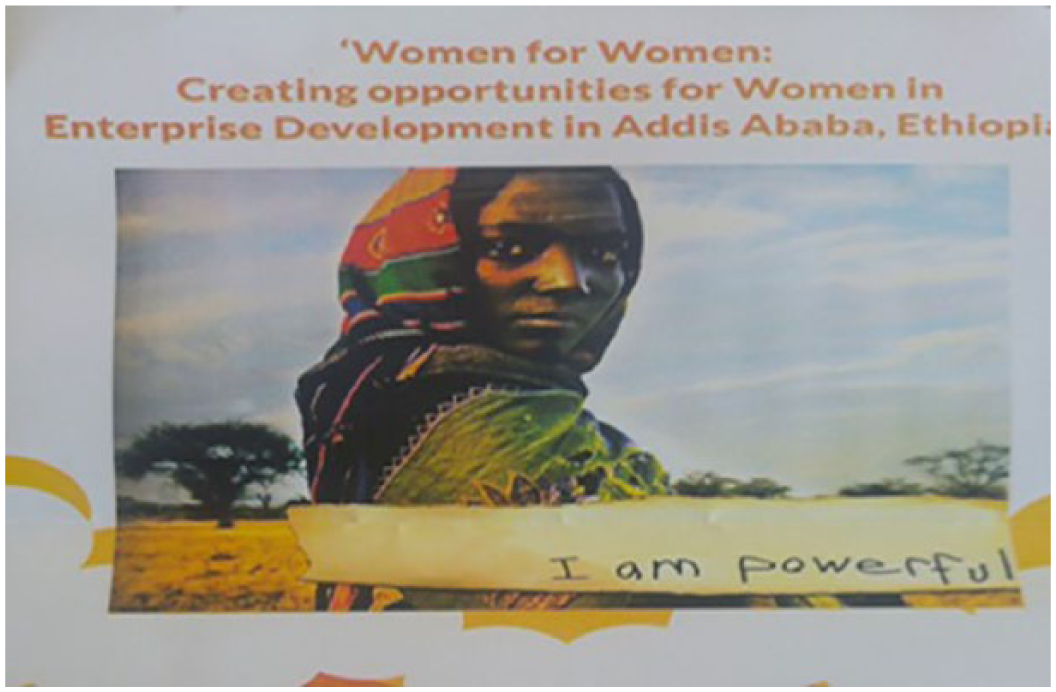
The photograph was taken by ‘H’ during a study tour on the outskirts of Addis Ababa, Ethiopia, 12 February 2017.
In this case, the two additional questions (Why and Do) led to an intimate group discussion, during which group participants were able to discuss experiences of diversity and exclusion based on their different social identities (gender, ethnicity, race, religion, status). In addition, H.’s personal collaboration was powerful; it led to rapprochement and intimacy in the group, and contributed to further learning, linking self-exposure to closeness and intimacy.
This example illustrates the transition within the group discussion, facilitated by the photovoice, from a personal-psychological discourse of pain to a discussion of social identities. H.’s photograph and explanation enabled conversation about the connection between negative experiences and social positions (ethnicity, gender, status), and about the idea that personal pain and negative feelings are not necessarily the product of individual ‘psychological problems’, but may emerge from the social structures that maintain power, and from gaps between hegemonic and marginalized communities.
Example # 3: The encounter with the other as a reflective mirror Title: Mutual aid and solidarity Voice: Here there is unity and solidarity that is simply hypnotic, and I do not think it exists in Israel. I see the children in Israel as spoiled and loud in my eyes, but here it is different. Maybe it’s an educational difference? I would like to take part in this social order, which the children learn to take part in creating. There is mutual understanding here concerning who does what; there are no complaints, and everything harmonizes harmoniously. It’s not clear to me how everything happens together, it’s like magic, and I would like to have it in my family and in Israel. The need to help each other and not just worry about yourself, that’s what I need in my country. D. explained:
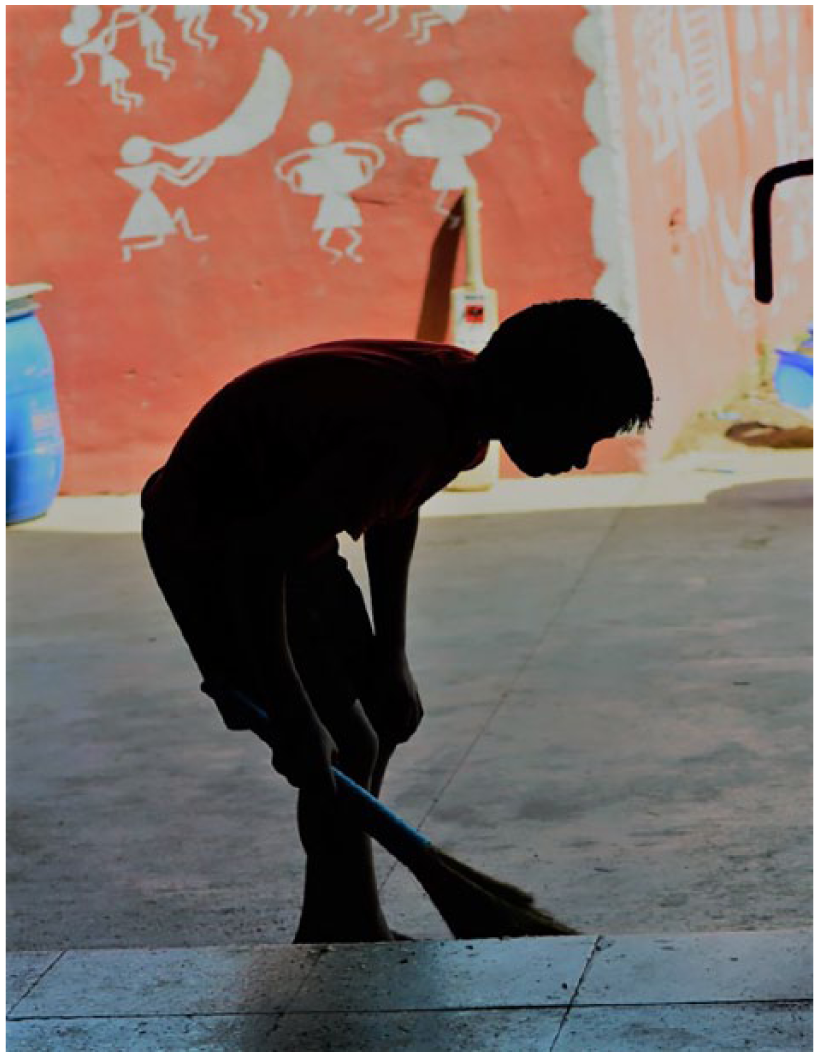
The photograph was taken by ‘D’ during her fieldwork in ICID, Nagpur, India, 17 February 2017.
In this case, D.’s photovoice led to a group discussion, which included references to the three additional questions of the SHOWeD (Our, Why and Do). The discussion dealt with the processes of privatization in Israel, and Israel’s transformation into an individualistic society against the background of the influences of Western countries and global processes. On the other hand, the discussion focused on the role of social work and the social worker in this reality, with reference to the role of community work and macro practice. In addition, as part of the learning process we discussed the ability to learn from the encounter with the ‘other’, the process through which the journey in India served as a mirror, and the ability to learn about ourselves through encountering the other, as an alternative to trying to teach others in a patronizing manner.
In this example, as part of the discussion the students gave another meaning to the phenomenon they encountered in India, that of lack of progress in industrialization and the replacement of working hands with sophisticated machines. What had previously been criticized and viewed with a certain kind of condescension now assumed new meaning in the context of the world, and a connection between the development of progress and phenomena of alienation and individualism in Western societies. The example illustrates how the use of photovoice contributed to a critical examination of the society that the students come from, and how one can learn about oneself through encounters with the ‘other’.
Difficulties and barriers
There are several difficulties and barriers which have an impact on the implementation of the photovoice model. One barrier relates to the suitability and limitations of the model regarding certain activities in the training programme. One example is the hypothetical case of a student on placement conducting a conversation or game with a child under the care of the host organization – the use of photography in such circumstances may conflict with core processes of establishing contact and building trust.
Another example relates to modes of learning, specifically those connected to emotional experiences, which are often transmitted unconsciously. In such circumstances, photovoice’s capacity to record these experiences is limited.
Cultural gaps also serve as a barrier to the effective implementation of the photovoice model. It is known that different cultures and societies ascribe different meanings, positive or negative, to the camera and the act of photography. Thus, there will be events within different intercultural encounters where the degree of adaptation of the photovoice model will be circumscribed, impossible, or may even lead to fear or tension in the local population.
Finally, it should be noted that as described, the programme includes a variety of experiences and commitments; the discipline of making time for photographic documentation is an acquired ability, one that requires a high level of skill and the reflexive ability to ‘capture the moment’. This is why students sometimes use spontaneous photographs taken during the course of the day, and through this give meaning to the learning experience.
Conclusion
This article presents a detailed description of a structured work model for the implementation and use of photovoice as a critical reflective tool in a daily training seminar abroad, supported by three examples.
The first example illustrated how photovoice expanded the students’ ability to use the personal self to create a symbolic representation of power relations – and thus to introduce themselves into group discussion and dialogue. In fact, it was the use of the self, and the introduction of the students’ lived experience, that encouraged their social empathy in social situations of exclusion and social marginality. It is clear from this point that there are many lines of debate that can be developed in order to promote the purpose of developing critical awareness. Our goal, in this article, was to demonstrate this potential.
In addition, it is important to note that these daily photographs accumulate over time into a travel diary, providing chronological documentation of the experience of each student; thus, there are moments that are preserved in this photographic journal diary that can be referred to and repeated as a continuation or extension of the learning process.
The second example illustrates the transition from a psychological discourse (usually based on the clinical aspects of social work) to an ethno-gender discourse of social identities. This example also illustrates how the use of photovoice allowed the student to bring both pain and power to the group discussion. In this way, the tool enables her to take ownership on the pain, define it as the product of social power relations and open a discussion of identities in Israeli society, a discussion which is sometimes silenced. The example also illustrates how students developed the ability to see Ethiopia and women in Ethiopia through a complex lens, through which they could see not only weakness and oppression, but also women’s power and the potential afforded by resistance.
The third example illustrates how the intercultural encounter with the other may serve as a mirror (Mizrahi et al., 2017). This means that, contrary to the common assumption that the purpose of intercultural encounter is for students to learn about the other culture, this example points to the expansion of the reflective learning process: the ability to learn from Indian culture and society, and to criticize the processes of privatization and globalization that have taken place in Israeli society.
These examples highlight the contribution of the connection between ISW and photovoice as a methodological and pedagogical tool (Mulder and Dull, 2014). Regarding ISW education, the article demonstrates that photovoice, as a tool based on critical ideas, serves the learning objectives anchored in the definition of ISW. For example, the development of reflective ability, critical awareness and learning from lived experience was extended beyond the theoretical. Therefore, it can be argued that the use of photovoice may provide a response to the demand, identified in the literature on ISW education, for more interactive and critical reflective approaches to supervision and practice teaching, in order to strengthen the professional connections between students’ experiences and academic learning (Cleak et al., 2014).
Regarding the photovoice as critical methodology, its implementation in ISW is another extension of the use to which this tool can be put, and the transition of photovoice from a research tool to a pedagogic tool (Peabody, 2013). In this case, we have demonstrated how the SHOWeD protocol was successfully adapted to the language of ISW; the potential for change and action was directed towards the students’ learning processes, with the intention of integrating them into their work with future clients.
With regard to barriers to and difficulties in the implementation of the photovoice model, it must be emphasized that the use of photovoice is directed as a means to an end, and not a goal in itself. A range of events and experiences are not recorded in the documentation of the daily learning experience; these include personal and emotional challenges, events during the day and difficulties in group dynamics. Therefore, supervisors who use the approach must create additional opportunities for expression, both personal and group, to complement the implementation of photovoice.
Footnotes
Funding
The author(s) received no financial support for the research, authorship and/or publication of this article.
