




Abstract
Adverse early experiences of adopted children tend to entail emotional deprivation, which may have impaired their attachment relationships. Using an adaptation of a projective test specifically devised to assess attachment in teenagers, the relational histories of 70 Spanish adolescent international adoptees were explored and compared to non-adopted peers. A significant association between insecure attachment and difficulties with internal representation of parental figures (birth and adoptive) appeared in young adoptees with adverse pre-placement care and late adoption. With knowledge of internal attachment’s working models, professionals can improve their understanding of the adopted adolescent and go beyond mere classification of attachment patterns.
Introduction
Attachment theory stresses the importance in the infant’s early relations of figures of reference which favor positive attachment relationships, thus providing security and protection. These relationships will be a crucial factor in well-adjusted psychological development, not only in childhood but also in adult life (Bowlby, 1969).
As Main (2000) describes, the study of attachment was developed in three main phases. In the first one, Bowlby (1951) started out by investigating the responses of children who were separated from their parents and placed in institutional care (hospitals or children’s homes) outside the family environment during the Second World War. The sequelae of these significant and often ‘traumatic’ separations included not only the emergence of anxiety and ambivalence with regard to once-loved people, but also an eventual state of detachment in which both affectionate and hostile feelings were suppressed. In a second phase of this inquiry, Ainsworth (1967; Ainsworth et al., 1978) developed the ‘strange situation’ procedure. She discovered, surprisingly, that adverse responses in meetings with parents could also appear with children of 12 months who had not suffered significant separations. This was probably due to cumulative stress resulting from limited or unpredictable maternal responses. The affective bond turns into an attachment tie when the individual seeks security and comfort in the relationship. Finally, in the third phase, the study of attachment focused on the level of representation (Main et al., 1985).
Bowlby (1969) adopted the term ‘internal working model’ from Piagetian cognitive psychology to refer to the process wherein children achieve internal representation of their emotional experiences and significant relationships with attachment figures. This notion belongs in the realm of unconscious mental structure (Steele et al., 2010). Consequently, attachment theory combines concepts from psychoanalytic theory (object relations theory) and cognitive-developmental psychology (internal working model). According to Fonagy (2004), psychoanalytic theory and attachment theory have the common feature of an interest in the psychological consequences of early deprivation, as well as emphasizing the importance of the first years of life in which they link development of the personality with social milieu.
Research on international adoption has shown that adopted children are more susceptible to difficulties in their overall development, these deriving from adverse pre-placement experiences such as institutionalization, neglect, abuse, and malnutrition (Tieman et al., 2005; Van den Dries et al., 2009; Vorria et al., 2006). Recent studies have pointed out that in the case of institutionalized children, the impact on their emotional development is associated with high rates of insecure and disorganized patterns of attachment (Lionetti et al., 2015; Zeanah and Sonuge-Barke, 2016). They have usually suffered from several disrupted attachment relationships, beginning with the loss of their birth family and followed by frequently repeated foster care placements and changes of caregivers (Van IJzendoorn et al., 2011; Steele et al., 2003). Furthermore, emphasis is placed on the consequences of separation, absence, or loss of the biological parents in the psychological adjustment of these adopted children, who repeatedly show an absence of representation of primary internal objects. (Allen et al., 2007; Brodzinsky et al., 1992; Courtney, 2016; Lanyado, 2003; Quinodoz, 1999). Nevertheless, another meta-analysis study (Juffer et al., 2011) has shown that adopted children have a considerable capacity for recovery in practically all areas of development, with the exception of physical growth and attachment (compared with their peers). In fact, little is known about their internal world, their feelings, and how they experience the complex affective situation resulting from being an adopted child (loss, affective ambivalence, having two sets of parents, etc.).
Likewise, other studies indicate the consequences for emotional development of some pre-adoption variables: age at the time of adoption, number of institutions the child lived in, timing, quality of pre-placement care, and others (Howe et al., 2001; Van den Dries et al., 2009; Vorria et al., 2003, 2015). These are seen as risk factors and they can give rise to patterns of insecure attachment and behavioral problems (Hodges et al., 2003; Howe, 2005; Selvyn et al., 2015). In general, adopted children have usually spent more or less lengthy institutionalized periods in the early years of their lives and have therefore been unable to establish positive, stable relationships. It is likely that they have not received sensitive, consistent responses to their needs from caregivers, as would be required for the formation of a secure attachment relationship (Ainsworth et al., 1978; Dozier and Rutter, 2008; Rutter et al., 2010).
Finally, we want to mention that adolescence is considered a special stage to assess attachment. New bonds are established with peers, and greater autonomy and separation from the childhood attachment figures are noted (Allen, 2008; Beyers et al., 2003). Although many studies and instruments have been developed to assess attachment behaviors in adopted children, there are less studies and tools to explore the attachment representations in adolescence. When it comes to testing this age range, it is observed that there is a gap and normally tests for adults are used.
The social work practices in our study were understood in an international context of globalization and transnational migration, which, as Palattiyil et al. (2019) stated, often continues to evolve to meet the local as well as global demands. The study’s aim was to explore the internal representation and attachment patterns of international adolescent adoptees, with over 8 to 17 years of adoptive placement, as compared to non-adopted peers living with their birth families.
The focus of our research entailed assessing the adolescent’s inner world with the aim of learning about the evolution of internal representations of attachment. The internal representations of attachment were analyzed by means of adaptation of the thematic-projective test Corman’s Patte Noire, specifically devised to assess attachment representations in adolescence in quantitative and qualitative ways (Ballús et al., 2019). In order to explore the nature of their pre-placement care experience and age at placement, the semi-structured interview and pre-placement classification were used with a view to obtaining answers to the following two questions. First, is the age at placement a factor that influences the development of attachment? Second, what factors of early adversity (pre-placement care experience) and/or pre-adoption variables (age at placement) hinder the development of secure attachment several years after adoption?
Method
Participants
The sample consisted of a group of 70 international adopted adolescents who were adopted in Spain and a control group of 77 non-adopted adolescents who lived with their birth families. Both groups, adopted and non-adopted, were from Cataluña (an autonomous community in the northeast of Spain, which represents 16% of the total national population).
The 70 international adoptees were aged from 12 to 17 years. The sample consisted of 26 boys and 44 girls with an average age of 14.36 years (SD = 2.11). The mean age at which the children were placed in their adoptive families was 2.38 years (SD = 1.78), and the mean time of institutionalization was 1.43 (SD = 1.22). They had lived with their adoptive families for an average of 9.24 years (SD = 4.42). The inclusion criteria were: (1) having been adopted for more than 4 years and (2) being aged from 12 to 17 years. The exclusion criterion was adolescents who suffer from serious mental disorders. The distribution by continents of origin and gender is as follows: Eastern Europe 18.6 percent (9 boys and 4 girls), Asia 44.3 percent (6 boys and 25 girls), South America 25.8 percent (10 boys and 8 girls), and Africa 11.4 percent (1 boy and 7 girls).
The control group consisted of 77 non-adopted adolescents, 35 boys and 42 girls and their mean age was 14.71 (SD = 2.07). This group was paired, by age, gender, and educational and socio-economic level, with the group of adopted adolescents.
The adoptive families that took part were selected through Spanish adoption associations. The sample of non-adopted adolescents in the control group came from other but more or less similar schools in the same community previously mentioned.
Procedure
This project was approved by the Ethics and Research Committee review board at the Ramon Llull University (URL) of Barcelona (Spain). Informed consent and assent were obtained from parents and young participants respectively. The anonymity of all of them was guaranteed by means of numerical codes, which they selected themselves. Data were gathered at the aforementioned university. Corman’s PN test was individually administered to the adolescents without their parents being present and in a single session lasting approximately 20 minutes. The answers were recorded in the test protocol, together with the subjects’ attitudes and reactions to the test. Meanwhile, another member of the research team interviewed the parents in another room in order to obtain information about the adoption process.
Data analysis
The statistical data analysis was carried out by means of the 22.0 version of the Statistical Package for Social Science (SPSS). Percentage and the chi-square statistic were used to analyze attachment patterns, and identification results, which were compared after the tests, were completed with both groups: adopted and non-adopted adolescents. They were also used to study differences in pre-placement classification.
Measures
Semi-structured adoptive parents interview
The semi-structured interview format was chosen because of the need for flexibility within a clinical epistemological framework so that parents could share the most meaningful aspects of their experiences, although, for the purposes of the research, information on certain specific points was also required. The interview was designed for Ballús and Pérez-Testor (2016) in order to collect data and information related to pre-placement and post-placement history. It consisted of 30 items and was organized into seven sections: pre-placement experiences, post-placement experiences, behavior, affective relationships, developmental aspects, school performance, and parent–child discussion of adoption.
Classification of pre-placement care
Howe’s (1997) Classification of Pre-placement Care was used to ascertain some factors of early adversity (pre-placement care experience and age at placement). This distinguishes between children who were adopted as babies (6 months and younger) and those who were adopted as older children. As Howe (1997) describes, the majority of babies adopted experience little adversity in the quality of their short pre-placement and sometimes go directly from the care of their biological mother to the adopters. In contrast, children adopted later usually experience adversity prior to their placement, either neglect, abuse, or rejection. In most cases, they have lived in institutions for a longer time and have experienced more changes in residence, caregivers, and friends.
In this regard, three types of adoption are taken into account, each associated with a particular kind of pre-placement care: (1) Baby adoption, in which children were adopted before the age of 6 months with a non-adverse care period before placement; (2) Good start and late adoption, in which children experienced non-adverse care for their first year of life or until the time of placement; (3) Poor start and late adoption, in which children experienced adverse care during their first year of life and/or until the time of placement, whichever was longer.
On the basis of this classification, each participant in our sample was placed into one of the three aforementioned categories.
Corman’s PN test
Corman’s PN test is a thematic-projective test consisting of storytelling through the character of the little pig Patte Noire (Corman, 1989). It could be described as a European version of the Blacky Pictures Test (Blum, 1950). The PN test is designed to elicit themes related to the child’s perceptions of the relationships between parents and children. Like other projective thematic techniques, the stories are invented by subjects and reflect their predominant unconscious concerns.
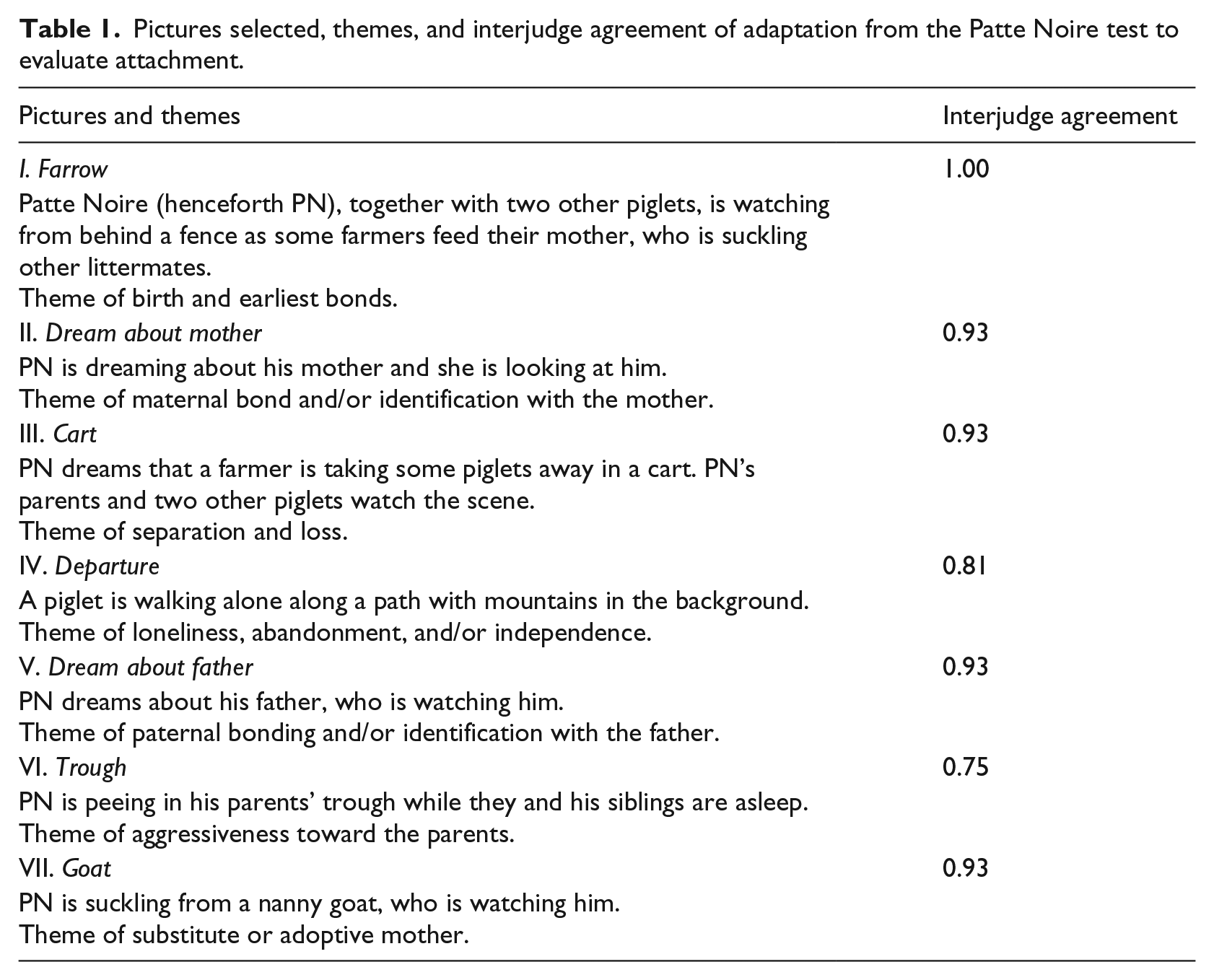
For the purposes of this study, we only selected seven sheets out of the total 17 comprising Corman’s Patte Noire Test. The selection criterion was to show pictures whose depiction of attachment relations in terms of attachment theory (Ainsworth et al., 1978; Bowlby, 1969, 1980; Corman, 1989) was clearly expressed, in order to elicit information about attachment experiences. The pictures chosen as a means of evaluating attachment were numbered in accordance with their order of presentation. The description of each picture and the themes they illustrate are shown in Table 1.
Pictures selected, themes, and interjudge agreement of adaptation from the Patte Noire test to evaluate attachment.
The test was administered in two main parts (Ballús and Pérez-Testor, 2016): (1) Stories and (2) Identifications.
Stories
We began with the frontispiece to introduce the children to the main characters of the test. The picture presents the family of the little pig Patte Noire (with a black leg), showing two other white piglets of the same size, and two adult pigs, one male and one female, the latter also with a black patch. The subject was asked to assign a gender, age, and relationship to each character. The young people tended to respond very well to the test and identified with the little pig Patte Noire. The subjects were then shown the seven selected sheets in the pre-established order, and asked to tell a story for each one using three tenses (past/present/future).
Identifications
The children were then shown the illustrations again, regardless of the story they told, and we asked them to look at them one by one and indicate the characters they preferred to identify with (different members of Patte Noire’s family, or other characters, depending on the illustration). They could also choose to identify with ‘No One’.
Two members of the research analyzed the test, without knowing the participant status (adopted or non-adopted).
Reliability and validity
Satisfactory content of validity for pictures (Table 1) and items were found, through the interjudge agreement of four experts in the field, who were familiar with the construct that was the object of the study but totally uninvolved in the research. In order to be able to define the items measuring attachment patterns in adolescents, a review of the material was carried out in accordance with the literature (Ainsworth et al., 1978; Bowlby, 1969, 1980) and previous research. Sagrario Yarnoz’s (1993) study used Corman’s PN test in order to assess children’s perceptions of the paternal and maternal images. In addition, the study by Balluerka et al. (2011) presents the CaMir-R or the short Spanish version of the Questionnaire for assessing Attachment in Adolescents of CaMir (Pierrehumbert et al., 1996), which has also been adapted for English researchers (Miljkovitch et al., 2005). Next, the exploratory factor analysis resulted in a four-factor solution, which explained 61.09 percent of the variance. Confirming reliability, Cronbach’s alpha score was between 0.51 and 0.66, with the exception of factor 4, which was lower: (1) Secure/Insecure Avoidant (0.665), (2) Insecure fearful (0.522), (3) Insecure resistant (0.514), (4) Unresolved (0.416). In the end, 10 items grouped into four factors – each with two indicators – were conserved.
Furthermore, qualitative analysis of the stories was carried out with a focus on (1) Themes and (2) Identifications.
Themes
The pictures of the PN test are designed to elicit themes related to the child’s perceptions of relationships between parents and children. The themes of the young people’s stories will therefore refer to the internal representations of their attachment experiences. Positive interactions are characterized by more positive themes (inclusion, receiving/giving protection, acknowledgment of distress, and a pleasant relationship). Conversely, the experiences of neglect or maltreatment are characterized by negative themes (abandonment, loss, rejection, and death). Positive and negative experiences pertain to secure or insecure attachment respectively, as described by theoretical constructs mentioned above and in other research, for example that using Story Stem Assessment (Hodges et al., 2003; Steele et al., 2003, 2010). For the purposes of our study – to explore the attachment patterns of adopted adolescents with over 8 to 17 years of placement – only the themes with negative contents have been taken into account.
Identifications
The assessment focused on two main identifications (Ballús and Pérez-Testor, 2016): the little pig Patte Noire and No One. Identification with Patte Noire, the protagonist who takes action, suggests that the child is able to deal with the situations depicted. By contrast, identifying with No One reveals part of the child’s defense mechanism of denial or refusal to take action. The total number of these identifications, Patte Noire and No One, was evaluated in accordance with Corman’s (1989) criteria. Quantifying the identifications allows us to ascertain the child’s ability to accept the different themes shown in the pictures. The usual average number of identifications with Patte Noire is six or seven or higher, indicating a good level of self-assurance in identifying with the situations depicted. Four or more identifications with No One suggest a dominant feeling of anxiety, which does not allow the subject to identify with the themes.
Results
The results are organized in two parts. In the first part, and in order to obtain a response to the first question pertaining to the importance of pre-placement care and age at the time of adoption for the development of attachment, we only used the sample of adopted adolescents. In the second part, and with the aim of obtaining a response to the second question, referring to factors of early adversity and/or pre-adoption variables hinder the development of secure attachment several years after their placement (8 to 17) and thus learning about the evolution of internal representations of attachment in these young adopted people. Corman’s Patte Noire test was used with the entire sample (adopted and non-adopted adolescents). Comparison was then made between the two groups: the group of adopted adolescents and the control group of non-adopted adolescents.
Classification of pre-placement care
The results of our study reveal differences between the participants. As shown in Table 2, there is a significant relationship between the pre-placement classification and the type of attachment (χ2 = 5.928; p = 0.015*). In other words, those adolescents in the first two kinds of adoption ( Baby adoptions and Good start/late adoptions), in which children experienced non-adverse care during their first year of life or up until the time of placement (no more than 1-year old), scored higher points, indicating secure attachment (60%; n = 35), than those classified under the heading of the third type of adoption ( Poor start/late adoption). This group, in which children experienced adverse care during their first year of life or up until the time of placement (beyond one-year old), shows a lower score for secure attachment (28.5%; n = 35). Good-quality early care appears to be a protective factor (Howe, 1997). Otherwise, no significant differences were found between the pre-placement classification and countries of origin (χ2 = 9.095; p = 0.334).
Classification of pre-placement care (Howe, 1997).

p < 0.05.
Corman’s Patte Noire test
This test was used to evaluate three different aspects of internal representations of attachment: (1) Attachment patterns, (2) Themes of the stories, and (3) Identifications.
Attachment patterns
The results showed that in the group of adopted adolescents (n = 70), 44.2 percent demonstrated secure attachment and 55.8 percent insecure attachment. In the non-adopted group (n = 77) the rate for secure attachment was 57.1 percent, and for insecure attachment it was 42.9 percent. In the group of adolescent adoptees, no significant differences were found between countries of origin and attachment patterns (χ2 = 3.919; p = 0.417). As for gender differences, adopted boys had significantly higher scores in insecure attachment (χ2 = 5.919; p = 0.023*) than adopted girls, but no significant differences were found in the non-adopted group (χ2 = 0.421; p = 0.648).
Themes of the stories
Results of qualitative analysis of the stories showed, in the adopted group (Table 3), significant links between the type of attachment and the presence of the themes of negative content in the stories (χ2 = 4.869, p = 0.027*). A greater presence of the themes was observed among the subjects with insecure attachment (79.4%; n = 39) than among those with secure attachment (54.8%; n = 31). By contrast, no significant differences were observed among the non-adopted group, which showed a much smaller presence of the themes of negative content in the stories in groups of both secure and insecure attachment. Only six subjects presenting insecure attachment (17.64%; n = 34) and nine with secure attachment (20%; n = 45) showed a presence of these themes.
Themes of stories and attachment patterns.
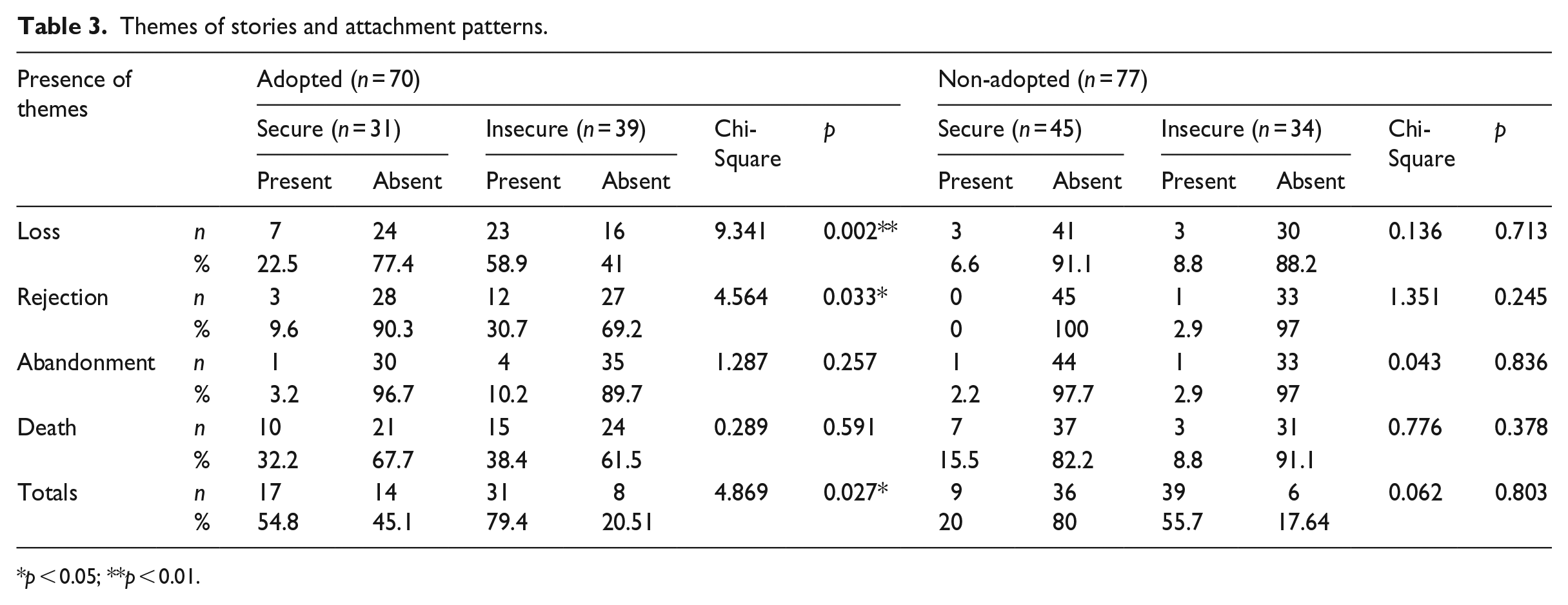
p < 0.05; **p < 0.01.
Otherwise, as shown in Table 3, we found a significant association in the group of adopted adolescents with subjects that score on insecure attachment and a presence of specific themes of negative content in the stories: Loss (χ2 = 9.341; p = 0.002**) and Rejection (χ2 = 4.564; p = 0.033*). Themes of loss appear with 23 subjects in the group of insecure attachment (58.9%; n = 39), and themes of rejection in 12 subjects (30.7%; n = 39) with insecure attachment. Once again, no significant differences between groups of secure and insecure attachment were observed in the non-adopted group. Only three subjects (8.8%; n = 34) with insecure attachment show themes of loss, and one subject (2.9%; n = 34) themes of rejection. Table 3 details the significant relations between insecure attachment and the specific themes of the stories: Loss (p = 0.002**) and Rejection (p = 0.033*).
Identifications
In the group of adopted subjects (Table 4) we found a clearly significant relationship between the type of attachment and the identifications expressed with some of the pictures. The results show that subjects with insecure attachment (n = 39) did not identify with the main character, the piglet PN, in the Departure (69.2%; p = 0.042*) and Dream of Father (64.1%; p = 0.035*) pictures and, in the case of subjects with secure attachment (n = 31), the scores were markedly lower: Departure (45.1%; p = 0.042*) and Dream of Father (38.7%; p = 0.035*). Similarly, it is observed that subjects with insecure attachment (n = 39) identified more with No One in the Goat (43.5%; p = 0.042*) and Dream of Mother (38.4%; p = 0.083) pictures than subjects with secure attachment: Goat (19.3%; p = 0.042*) and Dream of Mother (19.3%; p = 0.083). As for the scores for the non-adopted group, Table 4 shows that no significant differences appear for any of the pictures.
Frequencies of attachment patterns and identifications.
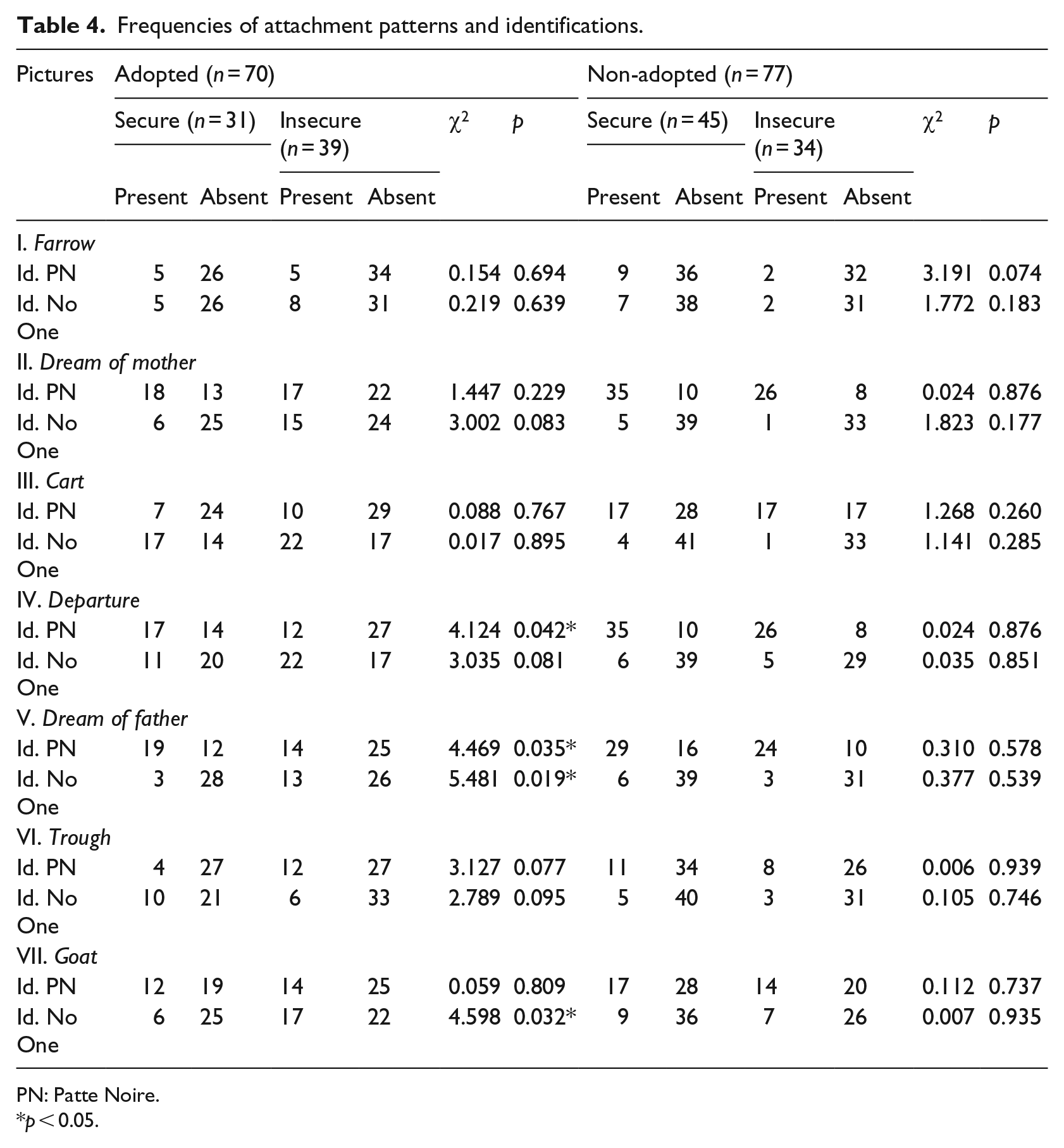
PN: Patte Noire.
p < 0.05.
Discussion
The aim of this study was to explore the internal attachment representations of adopted adolescents with more than 8 years of adoptive placement, in comparison with non-adopted peers. The first question presented in the Introduction section has been answered. Our study shows that age at the time of placement is a significant factor influencing the development of attachment, but a second factor must also be taken into account, namely the quality of pre-placement care. The results suggest that there are significant relations between the type of attachment and the classification of pre-placement care, in which two variables – age of adoption and qualities of pre-placement care – are taken into account simultaneously and not independently as happens in other research (Escobar and Santelices, 2013). It should be noted that, when analyzed separately, neither of these two variables produced significant results in our study. Accordingly, our findings also showed that these factors affect attachment development since most of the adolescents classified under the heading of the third type of adoption (Poor start/late adoption) show insecure attachment (71.4%; n = 35). Children adopted at an older age and who experienced adverse care during their first year of life or up until the time of placement are at greater risk of insecure attachment (Howe et al., 2001; Van den Dries et al., 2009; Vorria et al., 2006, 2015) and behavioral problems (Hodges et al., 2003; Howe, 2005; Selvyn et al., 2015).
The second question presented in the Introduction section was ‘What aspects of early adversity and/or pre-adoption variables hinder the development of secure attachment several years after adoption?’. This question can be answered with the outcomes of Corman’s PN test. In the first instance, analysis of attachment patterns shows that the distribution of our sample is similar to that in other studies with normative samples (Cyr et al., 2010; Van IJzendoorn et al., 1999): secure attachment 62 percent (non-adopted 57.1%, in our sample) and insecure attachment 38 percent (non-adopted 42%, in our sample). In the group of adopted subjects, the proportion was almost the reverse: secure attachment 44.2 percent and 55 percent insecure attachment. These data coincide with those obtained in other studies that suggest that, in the case of adopted children, an absence of stable caregivers/attachment figures prior to adoption generally thwarts their ability to respond sensitively and consistently in a way that is appropriate to their needs, and this impedes the formation of secure attachment (Ainsworth et al., 1978; Dozier and Rutter, 2008; Rutter et al., 2010). As for gender differences, our results coincide with those studies of Dutch adoptees (Dekker et al., 2017), which have found a higher incidence of mental health problems in male adoptees compared with their non-adopted peers.
Moreover, qualitative analysis of the stories (Themes and Identifications) has made it possible to go beyond scores for a certain kind of attachment and enquire more deeply into attachment representations. With regard to the themes of the stories, the most notable finding is that subjects with insecure attachment or, generally speaking, children who have been adopted at a later age and with adverse care during their first year of life or up until the time of placement, are the ones who show a significant presence of themes of negative content (79.4%; p = 0.027*). These results tally with those of other studies by Hodges et al. (2003), Steele et al. (2010) and Ballús and Pérez-Testor (2016). Earlier relationships affect the new relationship since the effects of internal working models of attachment developed in situations of neglect or abuse are carried over to the new placements (Hodges et al., 2003; Hopkins, 2000). The specific themes in our study, which are significantly related with insecure attachment, are Loss (58.9%; p = 0.002**) and Rejection (30.7%; p = 0.033*). The findings suggest that feelings of loss of and rejection by biological parents are still present whatever amount of time may have elapsed since placement in the new adoptive families (8 to 17 years). This would seem to result from difficulties in elaboration of mourning for the loss of a birth parent, which was a traumatic rupture (Allen et al., 2007; Brodzinsky et al., 1992; Courtney, 2016). Many children who have lost contact with key attachment figures, not through death but through neglect, abuse, or abandonment – as is the case of many of the internationally adopted children in this study, are unable to mourn this loss (Lanyado, 2003). In addition, ambivalent feelings related to being given up for adoption favor the internalization of negative attachment figures, which is difficult to modify (Brinich, 1995; Hopkins, 2000). As Juffer et al. (2011) note, attachment recovery is one of the most difficult areas of development among adopted children.
The third part of the PN test outcomes is Identifications. Among subjects with insecure attachment the results of Identifications show that most of them are not able to identify with the protagonist (PN) in those pictures in which parental figures are represented: birth figures (II. Dream of mother) and (V. Dream of father) and adoptive or foster mother (VII. Goat). It is observed that subjects with insecure attachment show significant identification with No One, or fail to identify with the main character, the piglet PN, which suggests inability to deal with the themes presented in the picture. These data suggest that a predominant theme of anxiety prevents the subject from identifying with the pictures, and functions as a defense mechanism of denial or avoidance, as has been shown by other studies (Ballús and Pérez-Testor, 2016; Steele, 2003, 2010). As the results reveal, representation of the paternal and maternal figure (birth or adoptive) continues to cause a great deal of anxiety, despite the amount of time that may have elapsed since adoption. It would seem that the subjects are unable to integrate the two parental images into their affections (Quinodoz, 1999) and will need more time and support in order to achieve this. As Priel et al. (2000) have observed, the capacity of adopted children to construct a symbolic representation of their two mothers would seem to require quite advanced elaboration of the loss of the birth mother.
Several limitations of our study should be noted. First, our results cannot be generalized and should be treated with due care as the sample is not homogeneous in terms of the countries of origin represented or the cultural backgrounds from which the subjects have come. Second, we have not taken into account the adoptive parents’ attachments, and some studies have shown that it is associated with children’s attachments patterns (Lionetti, 2014; Lionetti et al., 2015). Future research is required in order to observe the effects of these factors on the results obtained, as well as to contribute to improving social workers’ knowledge in relation to the evolution of internal representation of attachment. Third, although the number of participants was acceptable, broader samples would have strengthened the results.
In spite of these limitations, some implications of our findings are connected to professional practices in social work. Having a projective tool specifically devised to assess internal attachment representation in adolescence may allow young adoptees to express early adverse experiences, which are often unconscious and difficult to express. Furthermore, these data may help social workers better understand and support these teenagers, thus fostering professional interventions that more closely match their real needs, as well as aiding to promote their well-being.
Conclusion
The international adopted adolescents in our sample showed more prevalent representations of insecure attachment, compared to their non-adopted peers. Particularly, a higher presence of insecure attachment was found in the adopted boys than in the adopted girls; however, there were no differences based on countries of origin. In addition, the results of this study indicated that the simultaneous presence of two specific adverse pre-adoption experiences, namely poor pre-placement care and late age of adoption, appears as a risk of factor in developing insecure attachment, despite the years since placement (8 to 17). Post-adoption services with more resources for social workers and other professionals involved are required, in order to support these adolescents and their families in the difficult process of attachment recovery.
Footnotes
Acknowledgements
The authors are so grateful to the adopted youth and their parents for the participation in our research and for sharing their experiences.
Declaration of conflicting interests
The author(s) declared no potential conflicts of interest with respect to the research, authorship, and/or publication of this article.
Funding
The first author was granted the following financial support for the research, authorship, and/or publication of this article: Support from ‘Secretaria d’Universitats i Recerca del Departament d’Economia i Coneixement de la Generalitat de Catlunya’ (URL/R12/2016).
