



Abstract
Since the so-called ‘refugee crisis’ in 2015–2016, the hostile EU migration policies, the restricted access of refugees to welfare and neoliberalism have put social work in a rather difficult position. This self-funded quantitative research was carried out from June to August 2018 in Greece, addressing social workers working with refugees in various organizations, such as NGOs, public institutions and EU-funded projects. This article will present and discuss social work’s day-to-day practice with refugees and the social workers’ role as human rights defenders and claimants of social justice in the context of systematic violation of the human rights of refugees.
Introduction
Greece has been one of the main EU entrance and host countries for refugees not only during the ‘refugee crisis’ of 2015 but since the 2000s due to the wars in Iraq and Afghanistan. In spite of this, the state’s response to migration has been historically mostly reactive and repressive. The Greek welfare state was never fully developed and since the 1990s, the ‘neoliberal turn’ has progressively and systematically resulted in the privatization and degradation of public social services whereas non-governmental organizations (NGOs) and the European Union (EU) funded partnerships flourished.
The financial crisis of 2009 and the imposed austerity measures by the Greek government and Troika (International Monetary Fund, European Commission, European Central Bank) resulted in dramatic cuts in public welfare services, scarce resources, staff shortages, and exploitative working conditions, leaving professionals such as social workers overworked, facing poverty and house insecurity themselves and totally unsupported to respond to the increased social needs (Karagkounis, 2017; Pentaraki and Dionysopoulou, 2019). These conditions in social services were exacerbated with the refugee ‘crisis’ of 2015 that followed. Besides the response to this crisis by the solidarity and anti-racist movement there is also a rapid development of NGOs and a high demand of professionals, including social workers. Recent research in Greece (Teloni et al., 2020) reveals the poor working conditions and the limited support that social workers working with refugees experience, suggesting that they are ‘abandoned’ to confront the refugee crisis and people’s immediate needs. Taking into consideration this political and socio-economic context, this article explores social work’s day-to-day practice with refugees, and responses and roles during the refugee crisis. Using a critical and radical social work framework, the political role and actions of social workers in defending human rights and refugees’ needs are analysed.
Literature
More than 1,000,000 people arrived in Greece between 2015 and 2016 fleeing war and persecution. The already existing anti-migration policies were enhanced by the role of Frontex and the implications of the Turkey–EU agreement that led to arbitrary pushbacks as well as the establishment of detention centres for refugees. These policies’ implementation resulted in the systematic violation of human rights including children’s rights. More specifically, tens of thousands of refugees died in the Mediterranean Sea, while the ones that survived were detained in overcrowded camps under dire living conditions. The COVID-19 pandemic exacerbated the refugees’ situation in the past year, as the lack of basic facilities in the camps and detention centres deprives them of fundamental rights. In turn, this has had a direct and indirect impact on the social work practices in Greece, whose professionals are at the frontlines.
The limited and repressive options available for refugees, the lack of resources and a cost-led target culture are mostly a result of ‘technocratic’ social work methods, which focus on instrumentalizing the bureaucratic procedures instead of employing empowering approaches (Guhan and Liebling-Kalifani, 2011; Humphries, 2004; Jönsson, 2014; Masocha, 2014; Robinson, 2013, 2014; Wroe, 2019). Much of this method is conceptualized within the literature of social work practice concerning work with migrants. The more managerial scholarship focuses on material assistance, such as provision of food, clothes and shelter, primarily casework or counselling, bureaucratic paperwork, interagency communication, and, most degrading of all, the identification of ‘deserving’ and ‘undeserving’ vulnerable groups (Jönsson, 2014; Masocha, 2014; Masocha and Simpson, 2011; Sales, 2002). It is important to note that, regardless of their procedural underpinnings, some of the aforementioned practices may also be examples of solidarity actions. There is a difference in the way and scope of these practices or praxis, which are connected in a dialectic relationship and impact what the social workers are and what they do. In other words, ‘to act and think about what one is acting for and against, to transform and be transformed and, ultimately to realize that emancipatory change does, and will always, involve taking sides’ (Singh, 2014: 28).
Different perspectives on conceptualizing social work with refugees have been presented by Devenney (2020), who suggests an emphasis in the relational aspect of the work. Similarly, Fell and Fell (2014) discuss how a hospitality-based approach, especially in the voluntary sector, can mitigate the effect of the welfare restrictions. However, both approaches mostly focus on the professional–refugee relationship without a critical discussion on the actual options and outcomes. However, other approaches emphasize more progressive practices of social work, such as anti-racist social work, which use empowerment, advocacy, lobbying and campaigns, as well as the connection of social work with social movements (Dominelli, 2008, 2018; Ferguson, 2008; Lavalette and Ferguson, 2007; Lavalette and Penketh, 2014; Singh and Masocha, 2020; Teloni, 2011).
In Masocha’s (2014) interviews with 25 social workers in Scotland, participants described doing ‘the best they can’, struggling between being agents of control and protecting the service users. However, they considered the outcomes for refugees to be ‘just acceptable’ and far from meeting the factual needs. The bureaucratic process of implementing the repressive migratory frameworks by professionals has been interestingly defined by Yuval-Davis et al. (2019) as ‘everyday bordering’. Their conceptualization of borders implies both the physical and the ones that exist in the multi-layered practices of social agents in their day-to-day work – such as social workers among other professionals – that are involved in processes of ‘othering’ or differentiating between ‘us’ and ‘them’ in civil, political and social rights through assessments, legal entitlements and access to services. Given the fact that social work activity is by default from the outset linked with the defence of human rights and struggle for social justice, it is not surprising that a significant number of scholars and research reveal the ethical dilemmas of these bordering practices (e.g. Guhan and Liebling-Kalifani, 2011; Hayes and Humphries, 2004; Humphries, 2004; Jönsson, 2014; Masocha, 2014; Masocha and Simpson, 2011; Nouman et al., 2019; Ottosdottir and Evans, 2014; Robinson, 2013, 2014). The constant struggle with ethical dilemmas and the inevitable negative outcomes for refugees have been linked with professionals’ feelings of powerlessness and non-support (Masocha, 2014; Ottosdottir and Evans, 2014; Robinson, 2013). Despite this powerlessness, there are some hopeful examples of resistance and activism in social work literature on migration.
In order to advocate for refugee rights and resist unjust migration policies, a growing wave of social workers has used their professional associations and networks to influence legal frameworks (e.g. Ottosdottir and Evans, 2014). Others have been involved in political campaigns and social movements with community action and support (e.g. Briskman, 2020; Ferguson, 2008; Lavalette and Ferguson, 2007; Lavalette and Penketh, 2014; Marston and McDonald, 2012; Robinson, 2013; Wroe, 2019) or have even engaged in symbolic refusals and covert resistance (e.g. Marston and McDonald, 2012; Robinson and Masocha, 2017). One such example of social work activism is the Social Workers Without Borders in the United Kingdom, an initiative to support migrant families as well as resist anti-migration policies with a number of collective actions. Similarly, in the Greek context, some activist initiatives by social workers are found in their involvement with the wider anti-racist movement as well as community and solidarity actions of the Greek Social Work Action Network (SWAN; see Dedotsi et al., 2019; Ioakimidis and Teloni, 2020; Teloni, 2011, 2017; Teloni and Mantanika, 2015). While there are these several examples, they do not seem to dominate the mainstream approaches (Briskman, 2020; Fennig and Denov, 2019; Jönsson, 2014; Masocha, 2014). Three main barriers have been identified within the literature that hinder an activist approach to social work practice: organizational, professional and educational factors.
The organizational ethos and culture, where social workers are employed, may hinder social workers’ anti-oppressive practices and emphasize more individualized approaches (Forde and Lynch, 2014; Mendes, 2007; Nouman et al., 2019; Ottosdottir and Evans, 2014; Strier and Bershtling, 2016; Trappenburg et al., 2020; Weiss-Gal and Gal, 2011). It has also been suggested that these organizational barriers are less in cases of social workers who hold senior management positions or if job descriptions specifically require more macro-level activities such as policy involvement and community actions (Ezell, 2001; Gal and Weiss-Gal, 2015; Mendes, 2007). Additional key factors on social workers’ practices are the dominant professional and educational discourses, which reflect national socio-political contexts (Gal and Weiss-Gal, 2013, 2015). In these contexts, neither the mainstream practice of bureaucratic or technocratic and individualized approaches of the profession nor the clinical and therapeutic perspectives of the educations discourse with an apolitical approach provide social workers with knowledge, consciousness for structural views or collectivist practices (Bhuyan et al., 2012; Dedotsi and Young, 2019; Ferguson, 2008; Gray and Gibbons, 2007; Lavalette and Ferguson, 2007; Lavalette and Penketh, 2014; Mendes, 2007; Morley, 2008; Park et al., 2011; Strier and Bershtling, 2016).
However, in spite of a growing literature in this regard, for example, cultural competence approaches (e.g. Lum, 2003, 2010; Potocky-Tripodi, 2002), anti-oppressive practice models (e.g. Cemlyn and Briskman, 2003; Valtonen, 2001), socio-ecological theories (e.g. Fennig and Denov, 2019; Hagues et al., 2021; Miller and Rasmussen, 2016) and anti-racist social work (e.g. Dominelli, 2008, 2018; Lavalette and Penketh, 2014; Singh, 2006, 2014), research has highlighted that practitioners utilized limited theory to inform their everyday practice with refugees (Jönsson, 2014; Robinson, 2013, 2014). Instead, social workers tend to rely more on bureaucratic systems, ‘common sense’ dominant approaches and unquestioned legal and organizational approaches (Gray et al., 2012; McDonald et al., 2008; Muurinen and Kääriäinen, 2020; Sheppard and Ryan, 2003). To this end, this research scope intends to explore the social workers’ day-to-day response and the role of social work through its action.
Research methodology
Aims of the study
Our research intended to explore and describe social work practice with refugees during the refugee crisis, using a quantitative methodology through questionnaires. Specifically, the research aims were to examine the following: (1) social workers’ role and practice with refugees including theoretical approaches, concepts and methods that social workers apply in their day-to-day practice and (2) the connection of the social work agenda with social justice, human rights and the anti-racist movement.
Sampling strategy and research ethics
Our research population were professional or social workers in NGOs and projects. Given the complex involvement of various sectors and services (i.e. third sector, semi-private and public sector as well as international services), with some of them carrying out short-term projects (3 months) and the majority of these services not being officially registered at the time, we cross-checked lists of services retrieved from a variety of sources: NGOs referred to in the official website of the Ministry of Migration Policy (https://mko.ypes.gr/home_in_mitroo_report, accessed 17 November 2017) and website information on well-known organizations or NGOs such as the United Nations (UN) (https://tinyurl.com/uep95ur4, accessed 15 November 2017) and the Greek Council for Refugees (https://www.gcr.gr/index.php/el/action/gcr-projects, accessed 17 November 2017); as well as lists in relevant websites (https://www.refugee.info/greece/search?q=SERVICES, accessed 17 November 2017) and lists of local–regional services held by known colleagues who work with refugees.
We adopted the snowball sampling method (Hendricks and Blanken, 1992; Robson, 2003), as there was a lack of official registration data of social workers and social services (Dedotsi et al., 2016; Papadaki, 2005).
A self-completed anonymous questionnaire was available online through Survey Monkey between June and September 2018 containing 52 questions. The questions were closed (Yes/No, multiple choice, demographic questions, ranking, Likert-type scale). In only four questions, there was an open-ended option through the choice of ‘Other’ by the respondents. The questionnaire was designed by the researchers and piloted with eight professionals prior to the collection of data, whose feedback contributed to its final structure.
The professionals who participated had first to consent and give permission for the use of their data. In order to fully guarantee their anonymity, the questionnaire webpage had no IP tracking control mechanism, no private ‘cookies’ and required no signing up or registration for the process.
Statistical methods and analysis
Out of 158 responses, 21 were incomplete and were thus excluded. The 137 complete responses were analysed and the statistical significance was evaluated in R version 3.4.3. We employed hypergeometric or chi-square test and the statistical threshold was set at a p-value of 0.05.
Findings
Social workers’ practice with the refugees
As it concerns the day-to-day practice the most frequent responses by the social workers (up to three options available) was referrals to other services, bureaucratic work, informing refugees of rights and benefits as well as empowerment (results are presented in Figure 1).
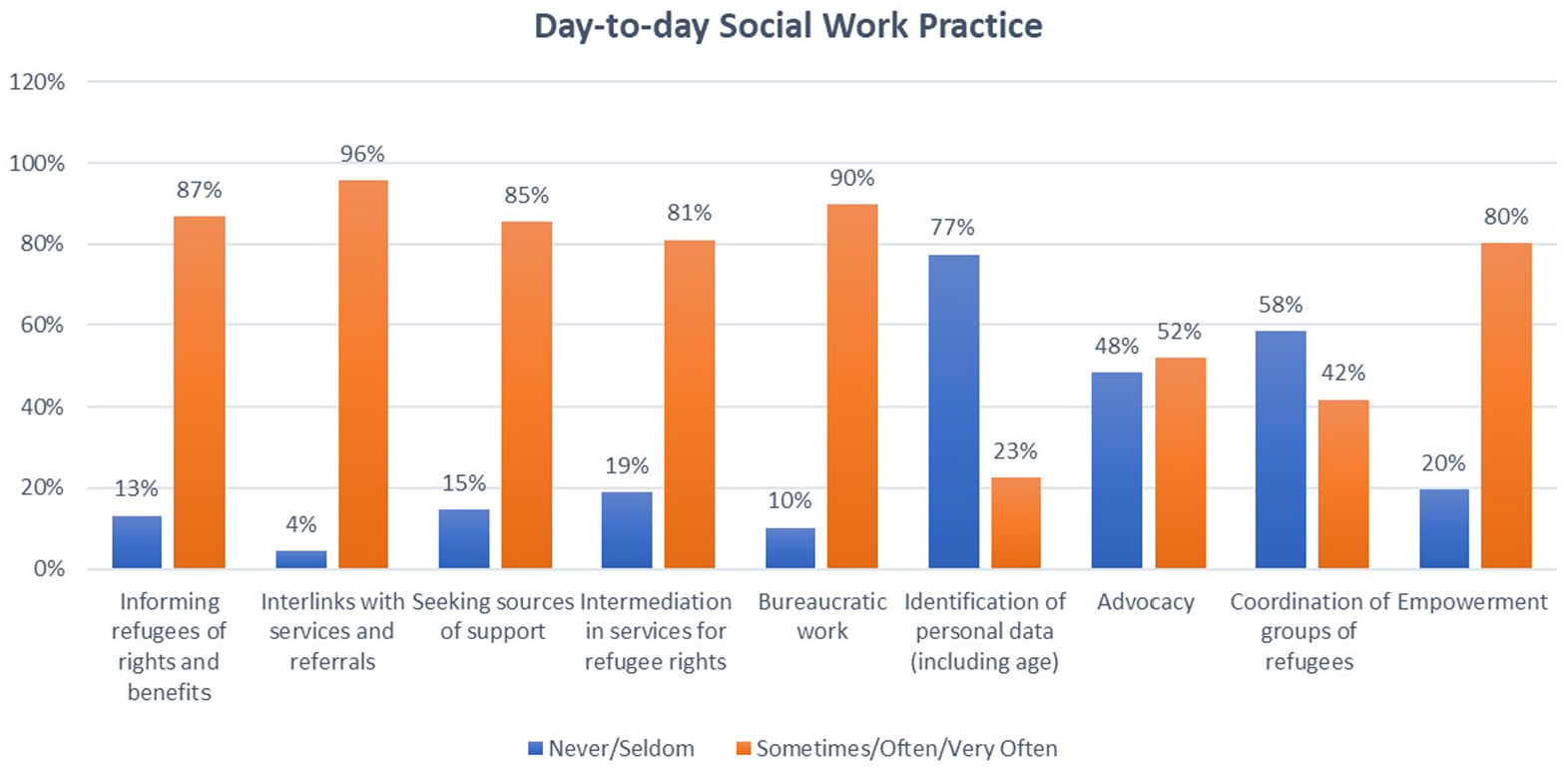
Most frequent activities of social workers’ everyday practice concern: referrals to other services, bureaucratic work, informing refugees of rights and benefits and empowerment (the research was conducted between June and September 2018 with social workers working with refugees in Greece – 52 questions, self-completed anonymous online survey).
When social workers were asked about users’ involvement in the decision-making process, the majority responded ‘not at all or a little’ (73%), while ‘enough’ and ‘much and too much’ were less frequent answers, 15 percent and 8 percent, respectively. When we cross-checked this question with the social work methodology, we observed that social workers’ perception about the users’ involvement in the decision-making process is correlated with the groupwork. This may imply that – from the social workers’ perspective – in the cases in which social workers worked with refugees’ groups, the latter were more likely to get involved in the decision-making.
In regard to how social workers perceive their role (up to three options), 83 percent of the respondents perceived their role as ‘Supportive’, while 62 percent as ‘Empowering’, 40 percent as ‘Organizer’ and 36 percent as ’Bureaucratic’ (Figure 2).

Social workers mainly describe their role as: supportive, empowering, organizational and bureaucratic (the research conducted between June and September 2018 with social workers working with refugees in Greece – 52 questions, self-completed anonymous online survey).
The vast majority of the social workers (58%) do not follow a specific theoretical approach, while 8 percent chose N/A. The remaining responses indicated that social workers followed various approaches such as critical and radical (8.76%) crisis intervention models and strength-focused social work (6.57%), systems theory (3.65%) and psychodynamic social work (2.19%; Figure 3).

According to their answers, the majority of social workers do not seem to follow a distinct theoretical approach. However, about one-third of them follow various approaches in their everyday practice (the research conducted between June and September 2018 with social workers working with refugees in Greece – 52 questions, self-completed anonymous online survey).
It was observed that casework (casework here is understood as social work with individuals in the Greek context) dominates almost 67 percent of the methodology, followed by multimethod social work (67%), community work (58%) and groupwork (53%). However, within their working structure, who decides how social workers conduct their practices and the theoretical models? For the vast majority (56%), the decision is outlined within their duties; 52 percent claim it is decided by the interdisciplinary group or co-workers, while 44 percent responded that it is an administrative decision.
Unsurprisingly, 93 percent face ethical dilemmas in their work with refugees. These dilemmas are generated by the conflict between social work values, organizations’ culture and policies (45%), and between their values and ethics with policy and immigration policies (40%). Only 9 percent responded that their ethical dilemmas derive from the conflict between personal values and professional values. This finding underlines their difficulties in their daily practice. Therefore, it is crucial to understand, in this context, whether social work defends human rights and if so, how and what has to be done.
Are social justice, human rights and connection with the anti-racist movement part of social work agenda?
In order to examine social workers’ role as defender of human rights, it is crucial to explore the organizational context in which social work is taking place. Does social workers’ agency or organization safeguard human rights? What is the social workers’ opinion? Approximately, 80 percent stated that their agency safeguards human rights, while 20 percent responded ‘little or not at all’. Nevertheless, when respondents were asked whether there was a need to protest about their agency’s conditions or/and its users’ services, the majority (72%) responded ‘often and very often’ and the remaining responded ‘rare or never’.
We also cross-checked their responses concerning their protest to their agency about users’ rights and conditions with their responses concerning their perceptions. We found that those who have a positive response about their agency’s safeguarding of human rights (83%) have also complained through their work about the conditions of the refugees. This finding may imply that social workers demand users’ rights in their agency. However, there was no further information which could clarify whether this was happening due to their mandate or to social workers’ demands. Thus, we could not argue that there is any link between these issues.
Moreover, we asked with whom they co-operated in this activity (up to three options). The results demonstrate that the majority protested with colleagues (Figure 4).

In their majority social workers seem to protest to their agencies about the conditions or services provided to the refugees together with their colleagues. However, there is also a high percentage of professionals that protest alone. (The research conducted between June and September 2018 with social workers working with refugees in Greece – 52 questions, self-completed anonymous online survey.)
We also found a positive correlation between social workers’ responses in relation to whether they believed that their agency safeguards human rights and whether they believe that through their work they promote social justice. In Figure 5 (Heatmap), we have depicted this positive correlation; the darker, the greater the correlation.

Social workers’ perceptions for the promotion of social justice and human rights through their work (vertical axis) and agency’s guarantee of human rights (horizontal axis). Findings clearly demonstrate a positive correlation between social workers’ responses in relation to whether they believed that their agency safeguards human rights and whether they believe that through their work they promote social justice (the research conducted between June and September 2018 with social workers working with refugees in Greece – 52 questions, self-completed anonymous online survey).
The causes of migration are described by the social workers as mainly socio-political such as war, social and financial causes and political persecution and fewer than 2 percent mentioned ‘personal choice’. Social workers were also asked to give their opinion on immigration policy. In total, 80 percent have a negative to extremely negative opinion, 20 percent neutral and 0 percent positive. Furthermore, this question was cross-checked with the findings of the question concerning their complaints vis-à-vis the EU’s immigration policy. The results demonstrate that the majority of those who have a negative opinion have also protested against immigration policy (85%), while the remainder either objected rarely or never (15%).
When asked about how they complained, the vast majority responded through discussion with colleagues (Table 1).
The ways social workers complained about immigration policy.

In regard to social workers’ connection to the anti-racist movement – including immigrants’ organizations – the majority (52%) had a positive response while 48 percent had a negative one. In the questionnaire, we gave options in order to better understand the connection of social workers with the anti-racist movement. More specifically, we categorized the options of connection either through ‘my agency’, ‘after my working hours’, ‘both of the above’, N/A. In all, 59 percent of the respondents who are connected with the anti-racist movement chose the option N/A and the remaining 41 percent chose through their agency (Figure 6).

Social workers’ connection to the anti-racist movement is mainly taking place through their agency while the remaining majority does not declare any specific way (the research conducted between June and September 2018 with social workers working with refugees in Greece – 52 questions, self-completed anonymous online survey).
Still, when we cross-checked those who participate in the anti-racist movement with those that responded that they participate in the collective protests for refugees’ rights, 73 percent respond that they participate in collective protests very often/often/sometimes and 24 percent never/rarely.
In addition, social workers were asked to address their concerns regarding the systematic violation of refugees’ human rights – either individually or/and collectively – to human rights organizations. It is worth noting that addressing the user’s issues is meant to include a large range of actions; from simply referring the issue, inquiring about a certain issue to a long-term cooperation for a certain incident. Nevertheless, it is observed that there is no such connection between human rights organizations and social workers. The majority (54%) either rarely or never addressed their concerns regarding the users’ issues to any human rights organization, while 44 percent did so either often or very often (Figure 7).

The majority of social workers either rarely or never addressed their concerns regarding the users’ issues to human rights organizations while the rest (44%) did so either often or very often (the research conducted between June and September 2018 with social workers working with refugees in Greece – 52 questions, self-completed anonymous online survey).
We cross-checked these results with the question concerning social workers’ perceptions about the promotion of social justice and human rights through their work. Interestingly, 72 percent of respondents that stated that they rarely or never addressed their users’ concerns to human rights organizations, also responded that they believe that they promote social justice and human rights through their work.
In total, 83 percent of the practitioners argue that they promote (much up to very much) human rights and social justice through their work. However, the findings in the question concerning the role of the social workers are contradictory given that only 24 percent defined their role as defenders of human rights (see Figure 2). Consequently, we need to be more sceptical towards both of the above findings, an issue that is further examined in the ‘Discussion’ section.
In order to explore the options for social workers to defend human rights and promote social justice, we attempted to detect whether there was a pattern between social workers’ actions in relation to public discourse intervention, addressing human rights’ organizations and the anti-racist movement. First, we observed that among the 40 percent of the respondents that participate in public discourse interventions, fewer than one-third of them (30%) often or very often addressed their users’ concerns to human rights organizations. While 20 percent of those that addressed their concerns were connected with the anti-racist movement. Overall, there is a positive correlation between those who participated in public discourse intervention, those who addressed their concerns to human rights organizations and those connected to the anti-racist movement. On the other hand, those who do not participate or intervene in public discourse neither address their concerns to human rights organizations nor are connected with the anti-racist movement.
We further found that there is a strong correlation between those social workers that intervene in public discourse, participate in protests for refugees’ rights and address human rights organizations. Specifically, about two out of three social workers that participate in public discourse also participated in collective protests for refugees’ rights. It is also apparent that there is a positive relation between the above with those that address their users’ concerns to human rights organizations where 60 percent (often), 57 percent (sometimes) and 86 percent (very often) also participate in collective protests.
In total, we tested the correlation among social workers’ (SW) actions such as the intervention in public discourse, address of refugees’ issues in human rights (HR) organizations, promotion of human rights and social justice (SJ) through their work, their agency’s safeguard of HR, participation of social workers in the anti-racist movement, and participation of social workers in protests, demonstrations and campaigns. In Table 2, we present all pair-wise comparisons we performed.
Correlation among social workers’ actions concerning human rights and social justice through their agency, intervention in public discourse, connection with anti-racist movement and participation in collective protests and campaigns.

HR: Human Rights; SJ: Human Rights and Social Justice; SW: social workers.
Cell values represent the fold enrichment (or depletion) in commonly selected responses (e.g. social workers are connected to the anti-racist movement AND intervene in the public discourse). The symbol * indicates statistically significant co-selection of positive responses (if score > 1) or statistically significant mutual exclusivity in selected positive responses (if score < 1). Statistical significance was determined from Bonferroni-adjusted p-values of pair wise hypergeometric tests. We also note that a p-value around 0.05 shows ‘weak evidence’, while a p-value less than 0.01 shows ‘strong evidence’ and a p-value less than 0.001 shows ‘very strong evidence’. aThe question was clear and unambiguous. Have you intervened either through your agency or through another way (e.g. as an initiative of social workers) in public discourse for human rights issues of the refugees or migrants (e.g. through announcements, articles in press, etc.)?
In Table 2, it is apparent that there is a statistically significant correlation between social workers’ promotion of human rights and social justice and their agency’s safeguarding of human rights. Second, those that claim that their agency safeguards human rights also participate in protests, demonstrations and campaigns with movements and political organizations. This might shed light on the question concerning the ways in which social workers participate in the anti-racist movement, despite their initial ambiguous response. Therefore, it is possible that democratic agencies participate officially or unofficially in protests, campaigns and so forth; some social workers, therefore, are able to connect with the anti-racist movement in their working hours.
Third, there is a correlation and significant trend among social workers’ intervention in public discourse and how often they have addressed users’ issues to human rights organizations, and, finally, there is a statistically significant correlation between social workers that are connected with the anti-racist movement and their participation in collective campaigns and political organizations.
Discussion
These findings reveal important elements in relation to social work practice with refugees during the so-called ‘refugee crisis’.
Social workers’ practice with the refugees
In our research, much of social workers’ time is allocated to contacting other services, attempting to find support networks, connecting refugees with other services, but also intervening in other services in order to secure users’ rights. While interagency communications have been discussed before (Jönsson, 2014; Masocha, 2014; Masocha and Simpson, 2011), what is prominent here is that social workers are required to seek solutions to problems that derive from a non-existent welfare system as Greece lacks social provision and social protection. Social workers’ intermediation may be interpreted as case advocacy as an extension of defending human rights, which is one of the basic social work interventions. Furthermore, these findings highlight the restricted access to welfare rights and provision for the refugees and lack of social services. It might also be an indicator of discrimination in services where social workers need to intermediate in order to secure users’ rights.
In relation to the theoretical approach, the fact that fewer than one-third of the respondents follow specific theoretical approaches and models raises questions regarding what theoretical framework and what type of analysis social workers apply in order to understand and explain the implications of the refugee issues. This new finding exposes the necessity to interlink social work theory and practice, particularly in the case of Greece. According to Dedotsi et al. (2016) and Dedotsi and Young (2019), social work education in Greece has a predominant technical approach, focusing mostly on developing skills of ‘how to work’ instead of building theoretical frameworks for students’ practice. Undoubtedly, there is a need for further research; however, the findings demonstrate that only 18 percent of the practitioners decide independently. This is a rather worrying indicator as it implies that there is a little freedom for individual professionals to decide on the methods and models they use and link them with appropriate theoretical frameworks. The restriction on autonomy, as well as managerialism and bureaucracy in social work practice, are integral parts of the neoliberal project in Greece and elsewhere (Ferguson, 2008; Garrett, 2010; Harris, 2014; Jones, 2001).
According to the findings, social workers appear to perceive their role as mainly supportive followed by empowering, administrative and bureaucratic. In contrast, the repressive, controller and alleviative roles have the lowest percentage. The findings demonstrate that providing support and empowering users are significant elements in social workers’ role.
At the same time, social workers continuously emphasize their administrative role, which is vague as it may refer to a vast range of services not only within the organization but also in relation to the users. By the same token, bureaucracy seems to be an integral part of the social workers’ role. Undoubtedly, this has grave implications for social work as a profession as well as its users, which have been discussed in depth within the framework of the neoliberalization of social work on an international level.
‘Are social justice, human rights and connection with the anti-racist movement part of social work agenda?’
Another challenging matter is that fewer than one-third of the respondents chose the role of the human rights defender, and only 13 percent identified their role as advocators. The latter finding demonstrates the necessity to emphasize advocacy within the field of social work in Greece, given the context of systematic violation of human rights, the hostile EU migration policies and the lack of a welfare state.
Although the majority of the practitioners have a negative opinion of the EU’s immigration policy and view war and poverty as the main causes of migration, 79 percent of them confront the policies through discussion with their colleagues, as opposed to acting through collective protests or campaigns and interventions. Undoubtedly, discussion with colleagues is a way of reflecting upon work, sharing thoughts and receiving support; however, discussing without acting has limited outcomes for change. This is an important finding, given that fewer than 1 percent choose to protest with their union, which indicates low participation of social workers in the unions. This finding – that collective responses by professionals are not the mainstream practice for social work – complies with similar previous research (e.g. Briskman, 2020; Fennig and Denov, 2019; Jönsson, 2014; Masocha, 2014).
In contrast, over half of the responses demonstrated that there is a significant link between social workers and the anti-racist movement. The anti-racist movement has a long tradition in Greece already since the mid 1990s, with valuable achievements such as the development of grassroots welfare initiatives and actions on the political level for refugees’ rights (Teloni and Mantanika, 2015). More recently, anti-racist and anti-fascist movements contributed significantly to the conviction of the neo-Nazi party, Golden Dawn, in October 2020.
It is surprising though that the majority of the practitioners do not disclose the way in which they are connected to the anti-racist movement, while the remaining claim that they are connected through their agency. The latter may imply searching for resources such as translators and/or lawyers that have an active presence within the anti-racist movement. Previous research during the financial crisis in Greece showed that social workers often communicated and co-operated with the solidarity clinics in order to figure out solutions about their cases, make or accept referrals (Teloni and Adam, 2018), which contributed to the argument that there is a link of social work with the anti-racist movement in Greece (Teloni, 2011).
Interestingly, no social worker associated himself or herself with the anti-racist movement after working hours, which indicates that at least some social workers interacted through their agency with the movement during working hours. In addition, the ones that claimed to have a connection to the anti-racist movement also participate and intervene in public discourse about refugees’ rights as well as in protests, campaigns and demonstrations for users’ rights within social movements and political organizations. Even though it is not a mainstream tendency, these findings show the way in which some social workers support the refugees’ rights and act as a collective.
However, according to the current research, refugees have limited access in the decision-making process. Findings reveal that social workers link group work with refugees’ participation in regard to the decision-making process. However, the finding does not clarify whether the refugees have actual power in the process through these groups. This finding not only demonstrates the exclusion of the refugees in deciding for their own lives and day to day routines but also their exclusion from welfare provision (Hayes and Humphries, 2004; Wroe et al., 2020).
Social work should focus on the emancipation of the refugees and their right to participate in decisions concerning daily life and their future. Despite the difficult position of social workers in a neoliberal context, their work with refugees is powerful and, as Robinson and Masocha (2017) argue, it needs to be used carefully. One may not deny that social work is shaped by the organizational as well as the legal and policy context. However, as Wroe et al. (2020: 270) contend, social workers should not be merely ‘enactors of law and policy’ and ‘avoid [. . .] professional responsibilities, collectively or individually, towards people adversely affected by the immigration system’. Contrary to the official practice today, social work should seek collective responses to social problems away from the concepts of individualization and pathologization or approaches of deserving or undeserving. In fact, popular social work embraces a practice based on political and social movements’ activity (Jones and Lavalette, 2013). Teloni’s (2011) work showed specific examples of action by the anti-racist movement in Greece, which focus at both micro- and macro-level on challenging racism and oppression through its grassroots welfare initiatives but also through political struggle. The multilevel activity by the anti-racist movement and the grassroots welfare initiatives can be seen as ‘alternative’ social services, which inspire social work. The interconnections between social workers and activists including refugees reshape both sides and contribute to political reflexivity (Teloni, 2011).
Overall, this research revealed that most social workers argue that they promote social justice and human rights through their work. However, when we look more closely many do not describe their role as human rights defender and fewer than half address users’ issues to human rights organizations. Given the systematic violation of refugees’ rights, the rise of racism and xenophobia, both social work’s bodies and human rights organizations in Greece should focus more on the matter. However, given that neoliberalism has dominated in the social work agenda, the social workers are required to be skilled and ‘do the job’ without asking too many questions and certainly not to be a ‘thinker but a doer’ (Jones, 1998). We argue that the political and activist role of social work needs further attention in social work education in Greece as well as by social work’s associations and unions. However, the investigation of the ways that social workers are connected with the anti-racist movement needs to be further explored also. Even though social work historically has never had a unified approach, this research has revealed that a part of social workers that work with refugees in Greece attempt to have a political role, act collectively, have links with the anti-racist movement, intervene in public discourse and act as human rights defenders. Given the limitations of the research, we cannot argue that this kind of social work has become dominant in the practice. However, the research clearly reveals that there is a strong tendency among practitioners in the field claiming a social and political role of social work for social justice.
In conclusion, despite the significant issues concerning social workers’ practice with refugees in the era of crisis in Greece that were discussed earlier, it is important to acknowledge the research’s limitations. At the time of the research, the majority of welfare structures and social services were not officially registered, and therefore, the researchers could not have a clear overview of how many and which services work with refugees in Greece. Similarly, there was no official registration of social workers in Greece and therefore an approximate calculation of the research population could not be determined. Despite the limitation of generalizing our findings to the whole population of social workers working with refugees in Greece, still the sample of 158 respondents (N = 158) is considered adequate.
Finally, further research is needed regarding the examination of the aforementioned correlations and trends that came out through our research, including larger samples of participants.
Footnotes
Declaration of conflicting interests
The authors declared no potential conflicts of interest with respect to the research, authorship, and/or publication of this article.
Funding
The authors received no financial support for the research, authorship, and/or publication of this article.
