




Abstract
From the perspective of social work, it is important to analyse food insecurity before and during the COVID-19, identify the best practices and how social work can contribute to improving living conditions. Using a meta-analysis, this article reviews how food security is addressed in the literature to better inform social policies from a social work perspective. A search of the literature revealed 217 articles between 2010 and 2021. The descriptors for the search were food security, food aid and social work. The main results are the identification of key aspects to inform social policies and promote sustainable social change worldwide.
Introduction
The dysfunctions and inequities of our welfare systems, our social policies and our social services have been exacerbated by the terrible effects of the pandemic on our lives. A particularly relevant problem, namely food security, is receiving special attention, both by the United Nations and by social work organisations. Food security is clearly linked to the former’s Sustainable Development Goals, and it has a key role in people’s well-being. The most vulnerable groups, such as children and countries with fewer resources, are particularly affected by the food crisis, in a context also influenced by climate change. The 60th session of the Commission for Social Development took place largely online from 7 to 16 February 2022 at the United Nations Headquarters in New York. Its priority themes were the following: Inclusive and resilient recovery from COVID-19 for sustainable livelihoods, well-being and dignity for all: eradicating poverty and hunger in all its forms and dimensions to achieve the 2030 Agenda. One of the United Nations’ Commission for Social Development Online Side events in 2022 (February 9) titled ‘Reaching nutritionally vulnerable social groups: the quest for multifaceted policy response’ was co-hosted by the International Council on Social Welfare, the International Federation of Social Workers, Korea National Council on Social Welfare, International Fund for Agricultural Development, the United Nations Children’s Fund, the Ministry of Social Affairs and Health of Finland and the International Association of Schools of Social Work. The Social Work Day at the United Nations in 2022 (March 15), co-hosted by the International Council on Social Welfare, the International Federation of Social Workers and the International Association of Schools of Social Work for nearly four decades, has also focused on this topic, under the title ‘Moving Toward Food Security for All: The Role of Social Work’.
Health and nutrition are two basic priorities for social policies in any social welfare model. The comprehensive protection of citizens’ rights cannot forget the challenges we face in the 21st century related to food security. The Sustainable Development Goals consider the different dimensions of well-being that support the development of a sustainable society. Social work in the confinement during COVID-19 (Fronek and Rotabi-Caseres, 2021) highlights the importance of redefining social intervention strategies to face emerging challenges. Food security cannot be addressed in isolation; it is closely related to health, education and the protection of vulnerable groups. The challenges in the field of food security affect countries that suffer from serious development problems, and which are particularly affected by climate change, natural disasters and wars. But they also affect vulnerable groups in developed countries.
In the past 15 years, the consequences of the economic crisis of 2008, the austerity policies (López Peláez and Gómez Ciriano, 2019) and the COVID-19 pandemic have highlighted the need to redefine our welfare systems, paying special attention to food security. Both in the field of humanitarian aid and in social services in each specific context, benefits related to food (e.g. food aid programmes for children in the school, after-school meal programmes to help feed children or different types of food assistance programmes available to provide meals and food assistance to families) play an important role to ensure social welfare. In this sense, the design of a social policy that guarantees food security is a priority after the COVID-19 pandemic. To design such social policy, it is important to analyse best practices carried out by social workers in different contexts, bringing the perspective of social work to the debate on food security in the public agenda.
In this context, we present a meta-analysis of the main public research on food security and social work in this article, contributing to the debate on food security from the perspective of social work, analysing the best contributions and good practices in this field.
Food aid has rightly been credited with saving millions of lives; indeed, it is often the only thing standing between vulnerable people and death. Despite this, food aid is sharply criticised as being a donor-driven response that creates a dependency on the part of recipients and undermines local agricultural producers and traders upon whom sustainable food security depends. Food security is also closely related to food production and the need for sustainable agriculture (Gassner et al., 2019; Sasson, 2012).
A continued worsening of food security is expected for 2020 as a result of the COVID-19 pandemic and its main future challenges have been identified. According to Sasson (2012), the African challenge is key to mitigating food insecurity around the world; the author highlighted the need for food security in Africa and claimed that the situation has not improved in the last decade. Similarly, the Food and Agriculture Organization of the United Nations has concluded that we are still far from reaching Millennium Development Goal number 1: to halve extreme poverty and hunger by 2015. Accordingly, the Sustainable Development Goals refer to food security in Goal 2: Zero hunger. It worries about anaemia, obesity, sustainable agriculture and malnutrition, among others.
This article aims to analyse how food security is addressed, paying special attention to the role played by social workers throughout the world in different contexts. To achieve this objective, the meta-analysis technique is used, which has already been widely applied in social work research, as well as in sociology and other disciplines (Franklin et al., 2009; Martínez et al., 2015).
This article is organised as follows. The section ‘Methods’ describes the methodology used in the meta-analysis, the bibliometric study and the papers selected, while the ‘Results’ section presents the research results. Finally, conclusions are drawn and several limitations of the work are discussed.
Methods
Type of analysis
This meta-analytical review examines articles on food security. Meta-analyses are based on two types of bibliometric indicators: performance and quality indicators and relational bibliometric indicators.
Performance and quality indicators are traditional indexes used in meta-analysis research. They include the number of citations (average, sum, minimum, maximum citations), the most cited papers, complex metrics (e.g. h-index, g-index, hg-index and q2-index), co-authorship analysis and visibility and impact indicators. Scientific databases such as the Web of Science are used to obtain the data needed to calculate these indicators.
Relational bibliometric indicators are mapping techniques where the results obtained are presented in graphical form. Scientific maps are obtained from the information using clustering analysis (e.g. the simple centres algorithm, single or complete linkage, average linkage and sum linkage clustering algorithms). To obtain the results, a network analysis (Callon’s density and centrality), temporal analysis and longitudinal analysis are used. Furthermore, a science mapping analysis is conducted using specific software (e.g. SciMAT, VOSViewer) that provides spatial representations of the relations among scientific specialties in the form of maps (co-authorship analysis, co-word analysis, bibliographic coupling, conceptual and cognitive analysis, etc.). This technique facilitates the study of collaborations among different researchers, institutions and countries.
This review is based on both performance and quality indicators and relational bibliometric indicators; this is one of the main contributions of the study.
We have selected 217 papers published over the period 2010–2021 from the Web of Sciences. The inclusion criteria were (a) articles written in English or Spanish published from 2010 to 2021 and (b) studies related to food security.
The initial search aimed to find all articles which specifically included in their abstracts, keywords or titles the term ‘food security’, together with the terms ‘food aid’ and ‘social’. The exclusion criteria were based on the assumption that if none of these terms appeared in any of these sections, it was likely that the concept did not occupy a core position in the study, and the article could therefore be excluded. Likewise, articles on meteorology, atmospheric sciences, geography, the respiratory system, immunology, area studies, general internal medicine, agronomy, multidisciplinary sciences, family studies, infectious diseases, anthropology, paediatrics and tropical medicine were not included as they were beyond the scope of this review. In addition, articles in Russian (4), French (3) and German (1) were excluded from the selection. Finally, proceedings papers, early access documents, book chapters, editorial materials, corrections, data papers and letters were excluded. Table 1 describes the search strategy and process.
Search strategy and process.

A manual search was conducted in January 2022 of papers published from 2017 to 2021 in the selected journals. The studies were coded by reading both the abstracts and full texts. Flow software was utilised to codify and work with the papers. In addition, the relationships among papers were analysed using VOSViewer software. An optimisation algorithm was used to identify relationships between authors, co-authorships, citations and bibliographic coupling in the papers included in the review.
Bibliometric study
In order to assess the research, bibliometric aspects were included to provide an idea of the quality of the study and identify the reliability of its sources and the countries in which food security is an important topic (Franklin et al., 2009; Martínez et al., 2015). Hence, the selected publications were analysed by year of publication, nationality of the author(s), the publishing journal and the journal’s impact.
Papers by year
During the period analysed, this topic was found to be a salient research area within the field. The evolution of publications is illustrated in Table 2.
Articles published by year (2010–2021) from the 217 selected publications on food security.
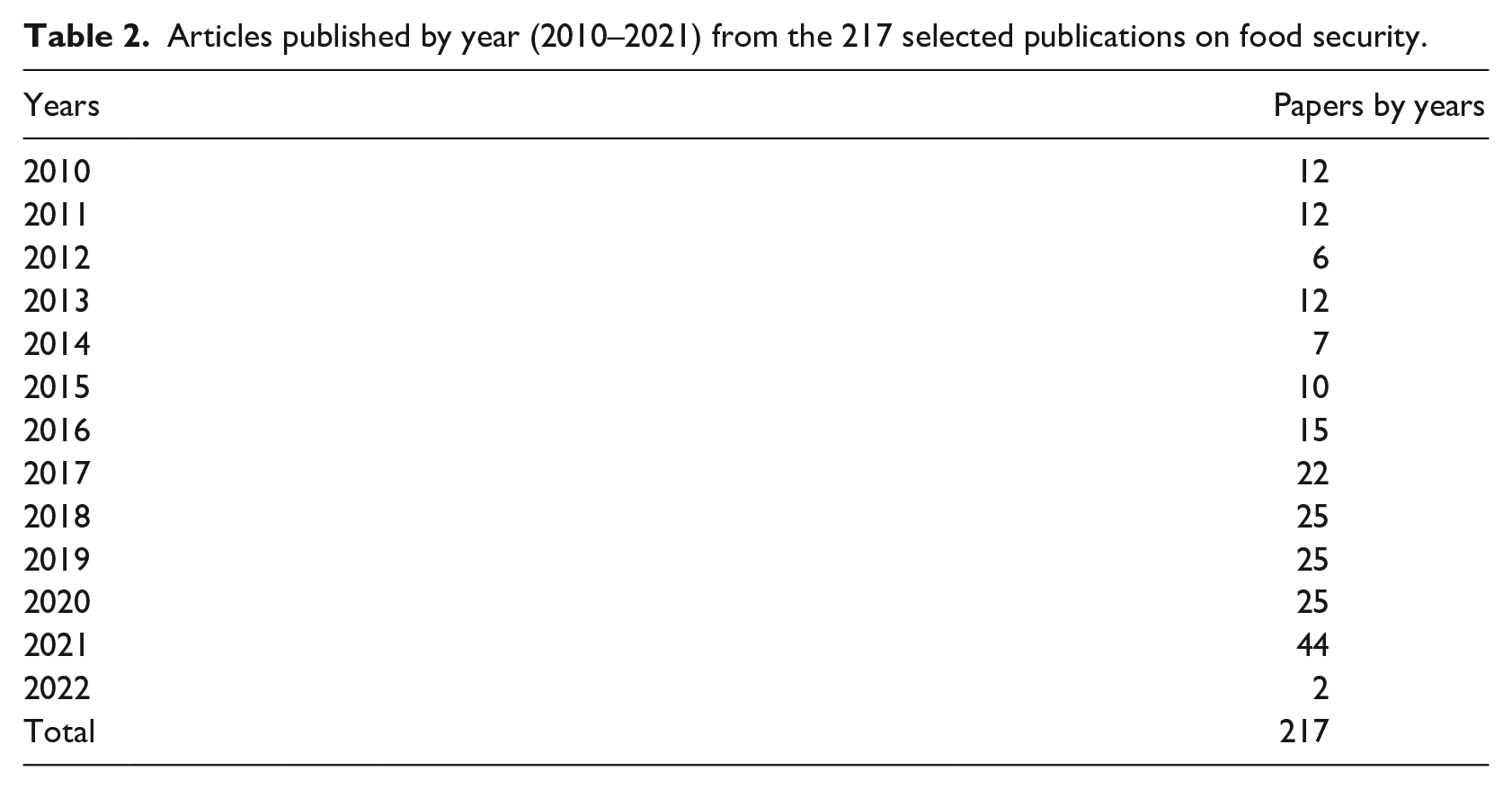
As observed in Table 2, the largest number of papers were published in the most recent years; specifically, a growing trend can be observed in the number of publications, which reflects a commensurate trend in interest in the subject. The year 2021 marks the most prolific year in terms of the number of publications investigating the subject, with a growth of 56% (121 papers) from 2018 to 2021. The year 2022 does not reflect a decrease in publications due to the fact that publications are collected only until the beginning of that year.
Papers by country in the period 2010–2021 (n = 217)
Table 3 shows the number of publications by country. It can be seen that the highest number is collected by the United States and the United Kingdom, with 67 publications (30%) between the two. Nevertheless, most of these papers refer not just to the country in which they were published but also to other countries. Consequently, there is also an important diversification by publishing countries, which once again reflects the worldwide interest in the subject.
Articles published by country from the 217 selected publications (2010–2021) conducted in January 2022 on food security.

Papers by author
With regard to authorship, a few authors have published more than one paper in this field. In Figure 1, the items are labelled and represented by a circle in all the figures: the larger the circle, the larger the weight of that item. In addition, the relationships among items are shown in different colours that represent the clusters in which an item is included. The distance between two papers in the network visualisation indicates the relationship between them such that the closer the papers, the stronger their relatedness.
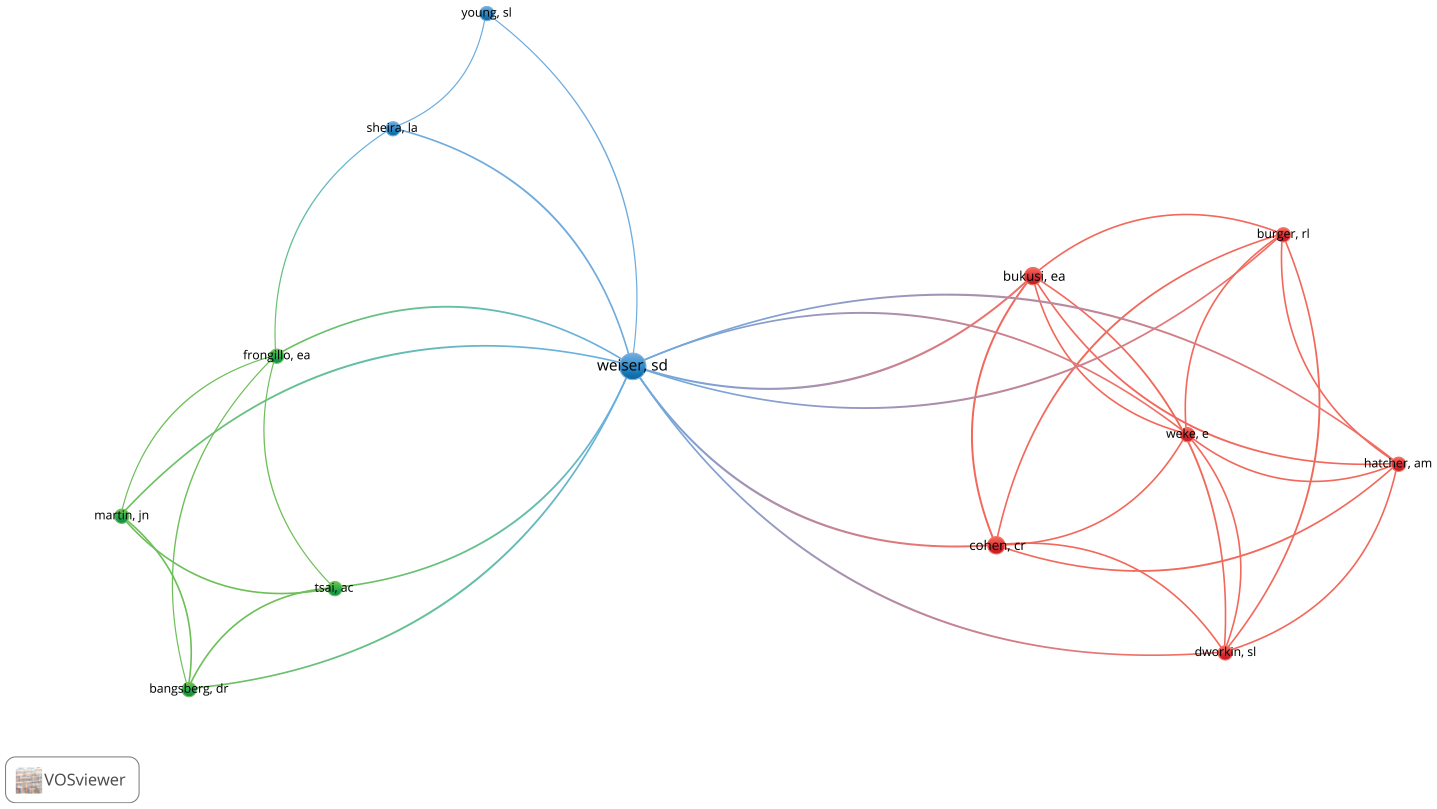
Co-authorships among the 217 selected papers (2010–2021) conducted in January 2022.
Figure 2 reveals the linkages between authors, while Figures 3 and 4 represent the terms most frequently used in titles and abstracts.
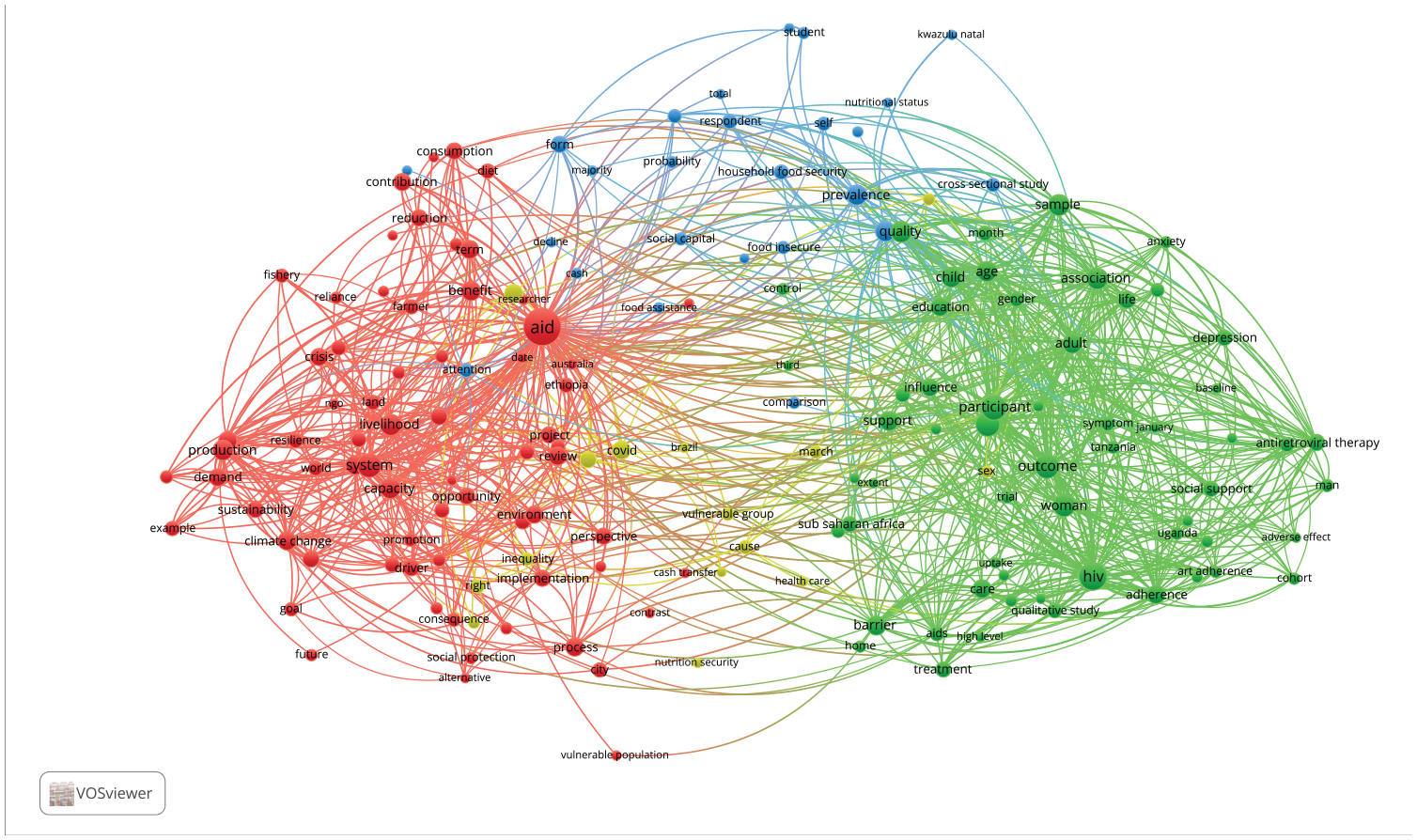
Titles and abstracts (2010–2021) from the 217 selected papers conducted in January 2022.

Titles (2010–2021) from the 217 selected papers conducted in January 2022.

Abstracts (2010–2021) from the 217 selected papers conducted in January 2022.
Figure 2 presents several interesting results: the relevance of agriculture, climate and climate change for food security, the need for interventions in the field, the relationship between food security and sustainability and the need for public policies, among others.
Figure 3 highlights the relevance of social protection and climate change. Accordingly, the COVID-19 pandemic and the crisis appear as relevant factors in this area of research.
Finally, abstracts underline the need for intervention and social protection. Climate, production and the effects of the pandemic are again terms mentioned in Figure 4.
Papers by journal
This section describes the most commonly cited articles published in the field from the selected papers. Five journals publish almost 20% of the total publications but the large number of publications in recent years confirms the interest in the subject (Table 4).
Papers published by journals from the 217 selected papers (2010–2021) conducted on January 2022 on food security.
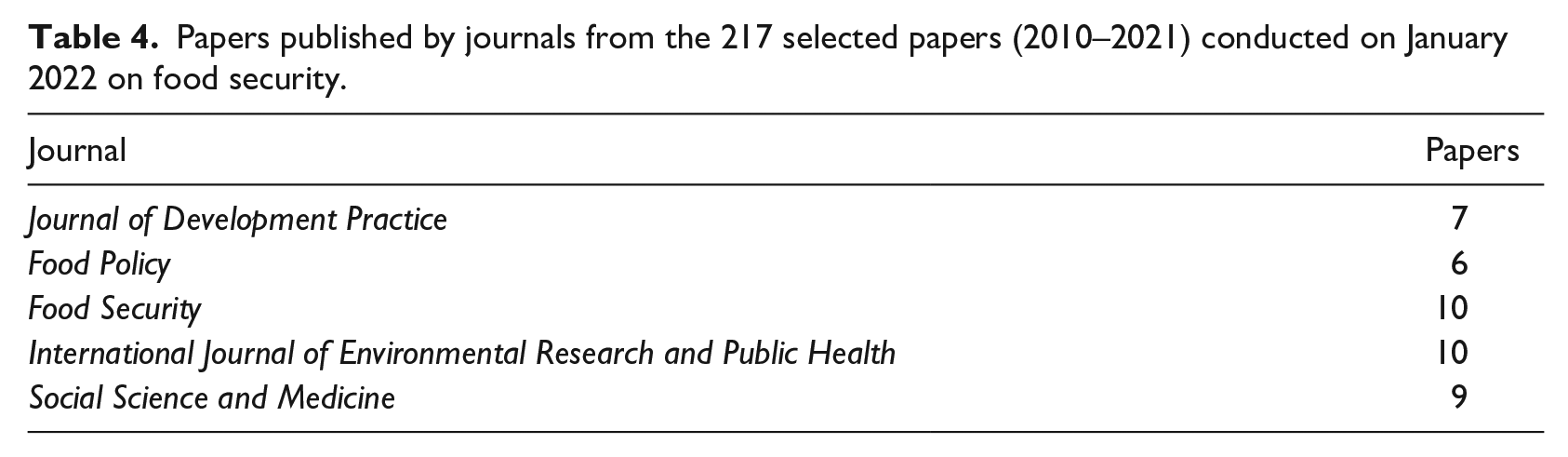
On the other hand, all the citations of the 217 papers amounted to 12,486 citations, of which only 21 papers have almost 3000 citations. There is an article that clearly exceeds the rest in citations, with approximately 250 citations; it is the paper entitled ‘Territorial Exceptionalism and the American Welfare State’ (Hammond, 2021).
The most repeated Web of Science categories are Development; Environmental Sciences; Public, Environmental & Occupational Health; Food Science & Technology; Nutrition & Dietetics; Social Sciences; Biomedical.
Results
The present section presents the main findings from the analysis of the selected papers. Distribution by continents and countries, best practices, vulnerable groups of citizens, food security and social welfare and, finally, the role of social workers are considered.
Distribution by continents and countries and best practices
Problems related to malnutrition and food security are focused on developing and less industrialised countries (Scanlan, 2010). Moreover, Africa concentrates the main needs in this field. From our selected articles, there are constant references to the situation of Africa: Boatemaa et al. (2018), Chakona and Shackleton (2019), Chen et al. (2019), Claasen and Lemke (2019), among others. In short, 23 articles out of 217 refer specifically to Africa in their titles and other publications are focused on individual African countries (e.g. Kenya, Tanzania).
China is also included in 23 publications from the selected articles. Problems in China refer to the lack of water security (Workman and Ureksoy, 2017), and, in general terms, to food security and food insufficiency (Jaspars, 2021; Kalichman et al., 2011).
However, there is also food insecurity in developed countries, and, more concretely, among the most vulnerable populations in these countries. Whittle et al. (2020) show problems in women with human immunodeficiency virus in the United States, while McKay et al. (2020) present the situation in Australia. Moreover, the population with food insecurity in the United States is increasing, particularly among children, according to Belsky et al. (2010).
The best projects are also described in several publications. Guo et al. (2018) present a framework of payment for ecosystem services to protect cropland in China, whereas Kim et al. (2019) refer to a project aim surrounding Zero Hunger in communities from Tanzania and Bangladesh. Food for work programmes are also considered to face food insecurity in Ethiopia (Abebe, 2020). Finally, Bazerghi et al. (2016) conduct a meta-analysis to study the role of food banks to face this problem.
Projects that impact climate change are also considered (Weatherdon et al., 2016) as food security is closely linked to agricultural challenges, climate change, sustainability and food production.
Policy responses to food insecurity are analysed by several authors. Boatemaa et al. (2018) conduct an analysis of policies developed in South Africa to combat malnutrition, whereas Bitler et al. (2020) highlight the role of networks to solve these problems, particularly as a result of the pandemic.
Vulnerable groups of citizens
When referring to citizen vulnerabilities, 111 out of 217 articles refer to health (51.17%). Interventions concerning nutrition education, health habits or healthy diet assistance are proposed to solve obesity, malnutrition and other health problems (e.g. Oketch et al., 2011; Vlassopoulos et al., 2021). In addition, there is a close relationship between the lack of nutrition and issues such as mental health problems and depression (Eicher-Miller et al., 2009).
In this context, there are groups of citizens that present higher vulnerabilities. Multiple publications point out that several characteristics related to low income, gender, race, young mothers, the elderly, immigrants or rural families and children present a high relationship with food insecurity (Floro and Swain, 2013).
As a result, children in developing countries are particularly affected by food insecurity and malnutrition. Several publications refer to the situation of children in Pakistan, Tanzania, Kenya, South Africa and, in general, in less industrialised countries (Collishaw et al., 2016; Exavery et al., 2020; Fenn et al., 2015; Goodman et al., 2016; Scanlan, 2010; Sharpe et al., 2021; Sunguya et al., 2011, 2012). Furthermore, there are specific groups of children that require more attention (e.g. human immunodeficiency virus-positive children who are caregivers or orphans). Indeed, several researchers analyse the effect of these situations on children’s mental health (Collishaw et al., 2016; Sharpe et al., 2021) or the impact of the use of therapeutic food on antiretroviral therapy-treated and human immunodeficiency virus-positive children (Sunguya et al., 2012).
Food security and social welfare: The role of social workers
In total, 13 articles from our selection refer to welfare. Food quality is essential for household welfare. Consequently, public policies are required to ensure food security, and most international public budgets are related to food aid.
Davis and Geiger (2017) studied the evidence on recent patterns of food insecurity across countries and welfare regimes using secondary analysis of the European Quality of Life Survey. They found that food insecurity has risen across many European countries and has varied according to different welfare regimes. In short, there is a close relationship between welfare policies and food security. Indeed, vulnerability is a key factor in food security (Roncarolo et al., 2015); access to resources affects food security. Furthermore, vulnerability is related to health status and education and these variables have a relevant impact on the quality of food consumed.
In short, the meta-analysis highlights a group of factors relevant to this interinfluence: health, education, social protection, social support and so on. The described relationship between food security and welfare justifies the need for the intervention of social workers in this area.
Social work contributes to facing food security by promoting good health habits and prevention activities. Similarly, education is a key issue in this context, and social workers can perform a relevant role by introducing these good habits into families.
However, the connection between the field of social work and food insecurity should improve and Biggerstaff et al. (2002) explain that the social work profession does not give adequate attention to food insecurity when working with families.
Discussion
This article has summarised the evidence on food security through a review of the literature on the topic published from 2010 to 2021. The main results show the interaction between food security and other factors such as food production, sustainability, health or social welfare. Public policies are needed to achieve Goal 2 defined by the United Nations in 2030: Zero Hunger (Sustainable Development Goal 2: ‘End hunger, achieve food security and improved nutrition and promote sustainable agriculture’).
As previously mentioned, there is a group of factors that interact and present an interinfluence in the context of malnutrition and food security: health, education, social protection, social support and so on. The relational bibliometric indicators show that the COVID-19 pandemic and the crisis therein appear to be relevant factors in this area of research.
We have also identified that two groups are the most affected: (a) the most vulnerable and (b) citizens from Africa and China. In addition, children are considered as the most vulnerable group in this field.
Food for work programmes and projects to improve sustainability and the impact of climate change are proposed as best practices. In this sense, the interdisciplinary approach, taking into account all the factors that influence food crises, would allow the design of better social policies in the field of food security (which cannot be addressed without taking into account health, the environment or employment). The analysed articles highlight a paradoxical situation that affects the professional practice of social workers. On the one hand, they are limited by the budgets and available services that have been previously defined in each country-region-cities. In this sense, in professional practice social workers have certain resources, but they are also constrained by limitations. On the other hand, it is increasingly important to develop programmes that not only focus on providing access to food, but also focus on strengthening good healthy habits, linking food with health. And, finally, they can mobilise communities to encourage better use of available resources. Education, community mobilisation, food security and health, with special attention to children as the most vulnerable group, must be part of the priorities of social work after COVID-19.
From the perspective of social work, social workers mainly perceive that they do not have the resources necessary to adequately help citizens address this issue. However, social work must promote health promotion and prevention activities at the local level based on the needs felt by the population and relying on their knowledge in the treatment of certain local disease characteristics. To quote an example, social workers can promote educational activities to maximise the scarce resources that families have, as well as make known which are the cheapest and most high-calorie foods that can increase the nutritional level of the population. It is essential to create and participate in projects that aim to promote health based on good nutrition and the understanding that a good quality of life will be the result of the combination of a diet rich in protein and fibre. By so doing, social workers will stop being simple executors of social policies, and became active drivers of their communities, working as professionals who reinforce healthy habits related to food safety for individuals, groups and communities.
In the field of promoting healthy practices, it is especially important to start from a good diagnosis of the citizens’ needs, taking into account particularly vulnerable groups. Programmes to guarantee healthy eating for children in schools and nurseries must be linked to the promotion of healthy habits in families. The professional intervention of social workers in the field of food safety must have a double priority. First, to ensure access to available services that guarantee healthy eating for the population at risk, and, second, to address food security as a long-term project linked to the health of the population (preventing possible diseases such as diabetes or overweight, in contexts in which poor nutrition generates a clear risk to the health of minority groups). In this sense, it must be remembered that while hunger and lack of food is a serious problem, at the same time, poor nutrition and obesity is a serious problem in many countries. In some urban contexts, social workers have to deal with both problems at the same time. In addition, food security demands a comprehensive approach, which favours both access to food and access to healthy food that allows a balanced development of the person.
This review has some limitations. First, some grey literature, such as reports by non-governmental organisations and the reflections of frontline practitioners, were not included. Second, only studies in English and Spanish were reviewed. Despite these limitations, this study has reviewed the leading journals in the social sciences field which constitute a very significant sample of the literature on food security. Our results should help to define social policies and goals that are better aligned with the current social reality. Indeed, the challenge of food security in our global society calls for an interdisciplinary approach that allows us to effect the necessary changes in the economic, education, health, climate change and social services fields, all of which are affected by this phenomenon.
Footnotes
Declaration of conflicting interests
The authors declared no potential conflicts of interest with respect to the research, authorship and/or publication of this article.
Funding
The authors disclosed receipt of the following financial support for the research, authorship and/or publication of this article: This work was supported by the Ministerio de Ciencia e Innovación (grant number PID2020-115018RB-C31).
